
Tax Debt Resolution
CNC vs Offer in Compromise: Which One Fits Your Situation in 2026?
The short answer: CNC (Currently Not Collectible) pauses IRS collection but leaves the debt in place while the 10-year collection clock keeps running. An Offer in Compromise settles the debt permanently for what the IRS could realistically collect — but it costs $205 plus 20% down, and per IRS data, roughly 1 in 5 offers were accepted in FY2024.
You've done the honest math: after rent, health insurance, and this quarter's estimated taxes, there's nothing left for the balance the IRS says you owe. Now you're weighing the CNC vs offer in compromise decision — two programs that both exist for people who can't pay, with opposite mechanics. One presses pause. One ends the debt. Picking wrong can cost you real money and, less obviously, real years.
The comparison image below shows both paths side by side — where your debt sits after each one, and which clock keeps ticking while it does.
⏱ The real clocks: there's no printed deadline on this decision, but two clocks are running while you decide. Interest and the 0.5% monthly failure-to-pay penalty keep accruing under either status — and the 10-year collection statute keeps running during CNC but pauses while an OIC is under review.
CNC vs offer in compromise: the core difference
Currently Not Collectible status pauses IRS collection without erasing the debt, while an accepted Offer in Compromise legally settles the debt for less than the full balance. Everything else — cost, paperwork, liens, refunds, and what happens to the 10-year clock — flows from that one distinction.
Think of CNC as a ceasefire and an OIC as a peace treaty. The ceasefire is free and relatively fast, but the war isn't over: the balance grows with interest, your refunds get taken, and the IRS checks back when your income recovers. The treaty is expensive to negotiate and most attempts fail — but when it's signed, the debt is gone.
| Question | CNC (Currently Not Collectible) | Offer in Compromise |
|---|---|---|
| What happens to the debt | Remains and grows with interest and penalties | Legally settled once the offer is paid |
| Upfront cost | $0 | $205 fee + 20% of the offer (waived with low-income certification) |
| The 10-year collection clock | Keeps running | Pauses during review, plus 30 days after a rejection |
| Your tax refunds | Offset to the balance every year you owe | Generally kept by the IRS through the years before acceptance; the acceptance-year refund is no longer taken under current policy |
| Federal tax lien | Often filed to protect the government's claim | Released after the offer is paid and its terms are met |
| How long it lasts | Until your income recovers — or the CSED expires | Permanent, if you stay filing- and payment-compliant for 5 years after acceptance |
| Approval standard | Financials show collection would create hardship | Offer must equal or exceed your reasonable collection potential; ~1 in 5 accepted in FY2024, per IRS data |
Why the same financial form decides both
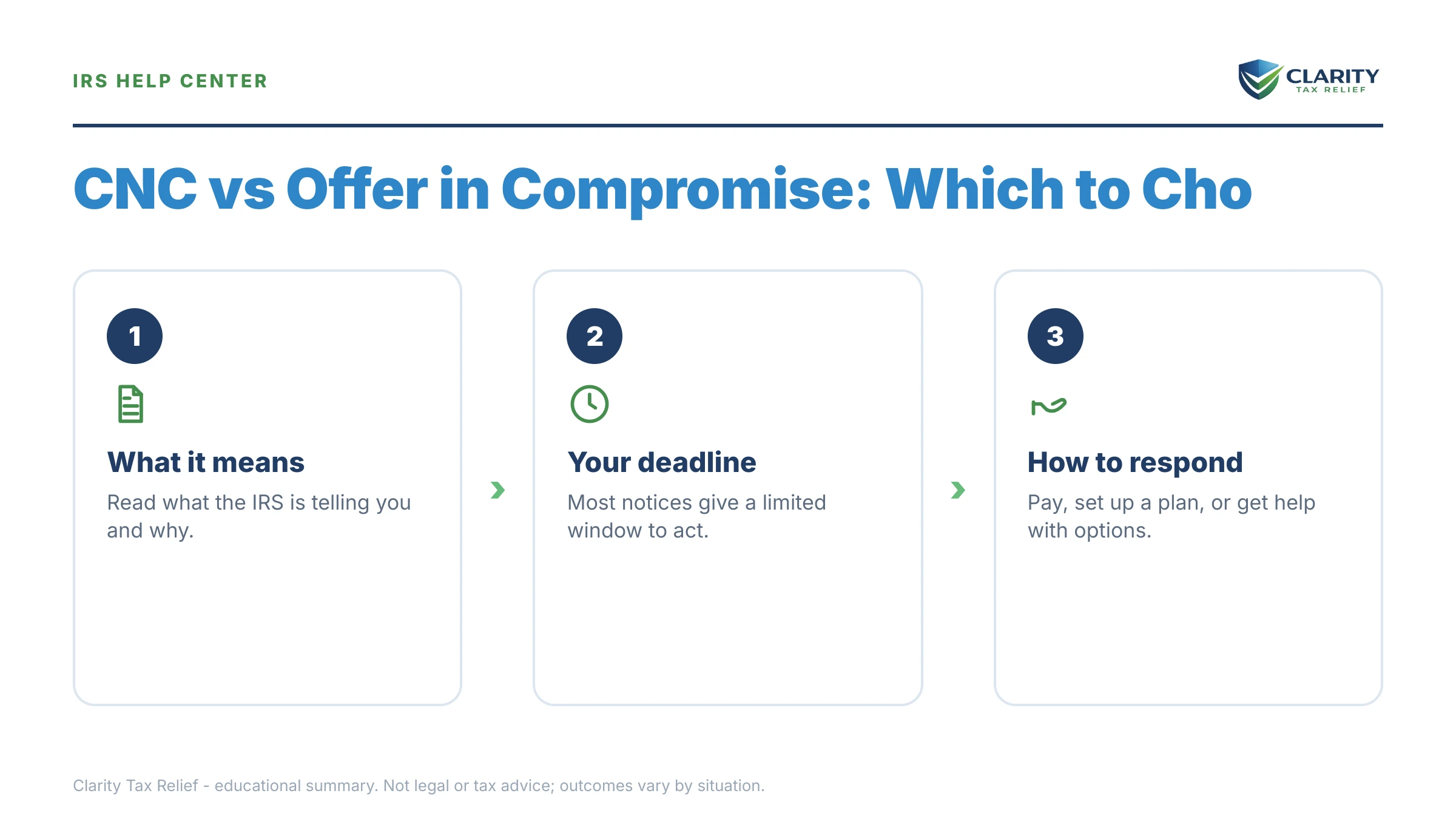
CNC and an OIC are both ability-to-pay programs judged on the same Collection Information Statement math. For CNC, the IRS reviews a Form 433-F; for an offer, a Form 433-A(OIC). Both compare your income against the IRS allowable living expense standards — not your actual budget — to decide what's left over each month.
That shared math is why this comparison exists at all. If your allowable expenses eat your entire income, both doors are open — and the question stops being "which one can I get?" and becomes "which one is the better strategy?" If you have meaningful money left over each month, neither fits, and a payment plan is the honest answer; see payment plan vs. offer in compromise for that fork.
One eligibility note that trips people up: neither program is available while you have unfiled required returns. The IRS won't grant hardship status or process an offer for an account it can't fully see.
The 10-year clock is the tiebreaker most people miss
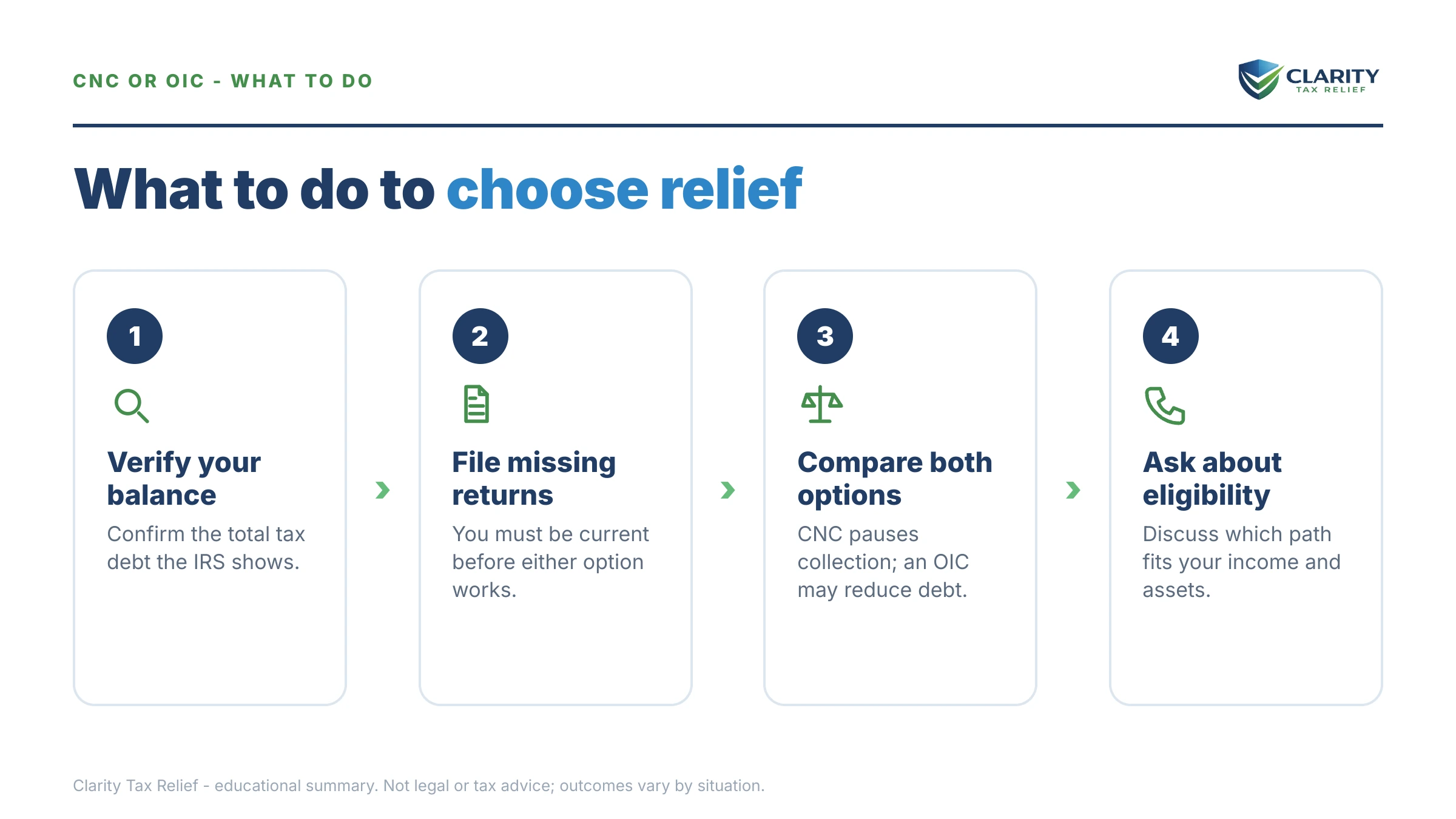
The IRS generally has 10 years from the date a tax was assessed to collect it — the Collection Statute Expiration Date, or CSED — and CNC lets that clock keep running while an OIC stops it. This single mechanical difference decides more CNC-versus-OIC cases than anything else.
Here's why it matters. If most of your balance was assessed eight years ago, CNC can quietly carry you across the finish line: the debt expires unpaid at the CSED while collection sits paused. Filing an offer in that situation is often a mistake — the statute is tolled the entire time your offer is pending, plus 30 days after a rejection. A failed offer hands the IRS back months or years of collection time it was about to lose.
Flip the facts and the logic flips too. If your debt is recent — assessed in the last year or two — CNC means seven-plus years of accruing interest, offset refunds, a likely lien, and periodic financial reviews. If your numbers support a low offer, settling now is usually cheaper than a decade of limbo.
What each path costs and how long it takes
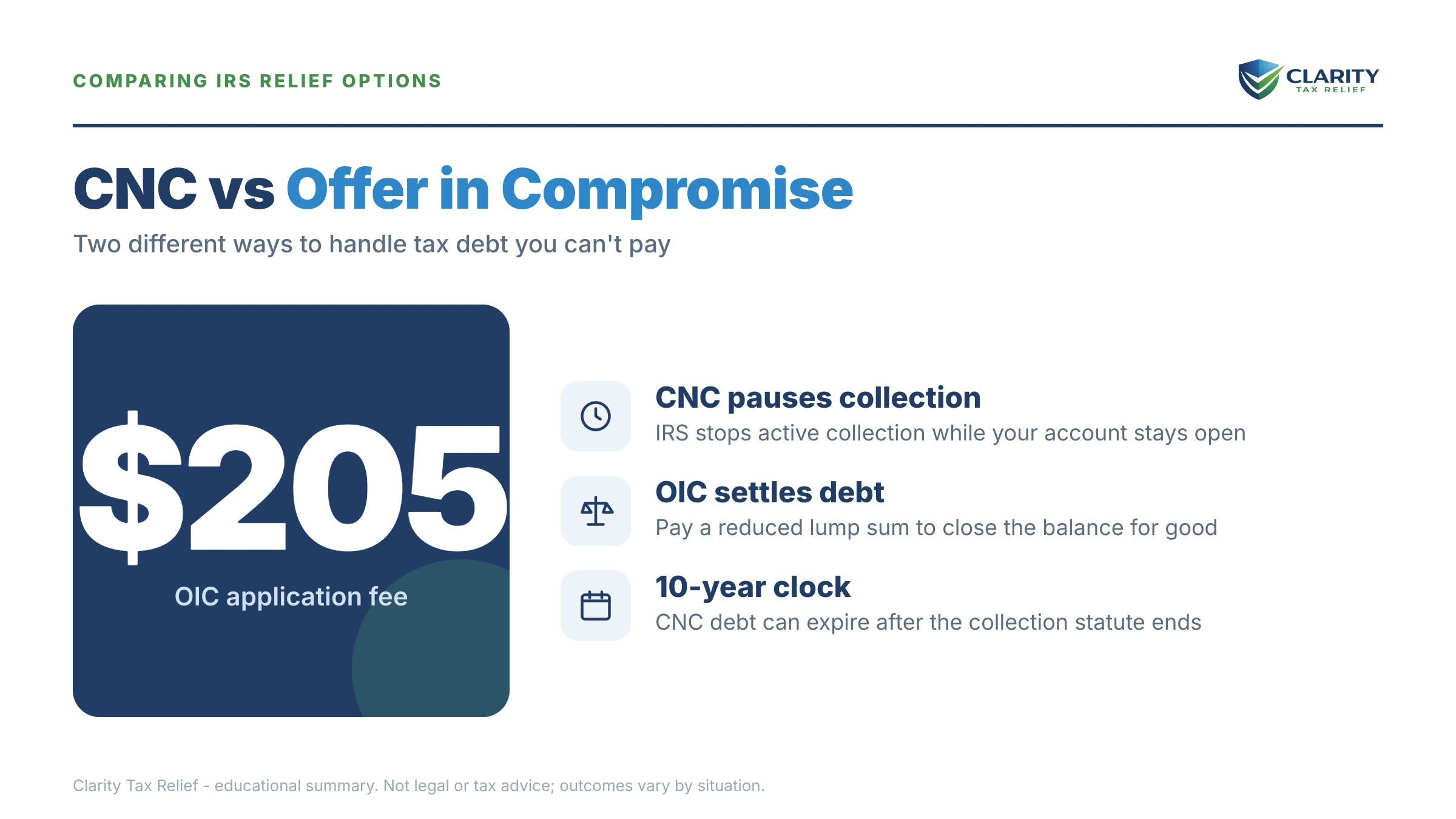
CNC is free to request; a lump-sum offer in compromise costs $205 plus 20% of your offer amount before the IRS even reviews it. Both the fee and the down payment are non-refundable — they're applied to your balance if the offer fails, but you don't get them back. The one big exception: if your AGI is at or below 250% of the federal poverty level, the OIC low-income certification waives the fee, the 20% down payment, and payments during review.
| Path | Upfront cost | Time to a decision | Where the debt ends up |
|---|---|---|---|
| CNC status | $0 | No fixed timeline — often granted after a single financial review, sometimes after weeks of documentation back-and-forth | Paused, still growing; expires only at the CSED |
| OIC — lump sum | $205 fee + 20% of the offer (waived if low-income certified) | Commonly many months; capped at 2 years — an offer is automatically accepted if the IRS doesn't decide in time, with narrow exceptions: a returned or rejected offer stops the clock, and time during court disputes does not count | Settled; remainder due within 5 months of acceptance |
| OIC — periodic payment | $205 fee + first monthly payment, with payments continuing during review (waived if low-income certified) | Same review window as lump sum | Settled after the final offer payment (up to 24 months) |
| 72-month payment plan (for contrast) | Setup fee applies (reduced with direct debit) | Often same-day approval online for balances of $50,000 or less | Paid in full over time, with interest and penalties |
The offer amount itself is set by your reasonable collection potential (RCP): the net equity in your assets plus 12 months of your monthly disposable income for a lump-sum offer, or 24 months for a periodic offer. You can estimate your own number with our Offer in Compromise Calculator before you spend a dollar on filing. For the full mechanics of the program — payment structures, review process, acceptance terms — see how an offer in compromise actually works.
Worked example: a sole proprietor who owes $23,800
Say you're a self-employed sole proprietor who owes $23,800 across two recent tax years, all assessed within the last eighteen months. Your business nets $4,300 a month after business expenses. Under the IRS allowable living expense standards, your household is allowed $4,180 a month. That leaves $120 a month of disposable income in the IRS's eyes. Your only meaningful asset is a work truck with about $2,600 of equity at the IRS's quick-sale valuation.
The OIC math: a lump-sum offer would need to be at least your RCP — $2,600 in asset equity plus ($120 × 12) = $1,440 in future income, so roughly $4,040 on a $23,800 debt. Filing costs $205 plus 20% down ($808) — about $1,013 out of pocket, non-refundable — with the remaining ~$3,232 due within five months of acceptance. If your AGI qualifies you as low-income, the $1,013 in filing costs disappears; you'd still need to fund the $4,040 offer, which can come from savings, a family loan, or gifted funds.
The CNC math: requesting hardship status costs nothing. But the $23,800 keeps growing with quarterly-set interest and the 0.5% monthly late-payment penalty, every refund you'd otherwise receive is offset, and a Notice of Federal Tax Lien is a real possibility at this balance. Because the debt is new, the CSEDs run to roughly 2034–2035 — that's eight-plus years of exposure and periodic income reviews before anything expires.
With this fact pattern, the offer usually wins: about $4,040 ends a $23,800 problem permanently. Change one variable — say the debt dates to 2017 and the CSEDs expire in two years — and CNC becomes the smarter play: pay $0, stay compliant, and let the statute do the work.
What happens if you choose neither and do nothing
An unpaid IRS balance moves through an automated notice sequence that ends in levies, whether or not a human ever reviews your file. With the IRS workforce down roughly 27% since 2025, per TIGTA reports, the people are harder to reach — but the collection machine never stopped. In order:
- CP14 — the first bill for the balance. No enforcement yet, but interest and penalties are already accruing.
- CP501 / CP503 — reminder notices. Still bills, each one arriving with a larger balance.
- CP504 — Notice of Intent to Levy. The IRS can now seize your state tax refund, and a federal tax lien becomes likely.
- LT11 / Letter 1058 — Final Notice of Intent to Levy. This starts a 30-day clock and your Collection Due Process rights (Form 12153). After 30 days, levies can begin.
- Levy — a bank levy freezes funds for 21 days before they're sent to the IRS; a wage levy is continuous. For a sole proprietor, the IRS can also levy accounts receivable and send levy notices directly to your 1099 clients — which can end a business relationship overnight.
Here's the part worth underlining: both CNC and a pending OIC stop this sequence. Doing nothing is the only option on the table that guarantees it continues.
Not sure which side of the math you're on?
Send us your numbers. An experienced tax professional will run the same allowable-expense and CSED analysis the IRS will — and tell you whether CNC, an offer, or something else fits — free and confidential. Interest and the monthly late-payment penalty accrue while you wait, so run the numbers now.
When CNC is the right call — and when the offer wins
CNC tends to win when time is on your side; an OIC tends to win when it isn't. Use these as the honest tiebreakers:
CNC usually fits when:
- Most of your CSEDs expire within the next two to three years — the debt may die on its own.
- Your hardship is likely temporary (a slow season, an injury, a lost contract) and your income will recover — an offer priced on your recovery-year income would be high anyway.
- You genuinely can't fund even a small offer, and you don't qualify for the low-income waiver. See how to qualify for CNC for the hardship test itself.
- You're on fixed income — Social Security or disability — with no assets, where the IRS has little to gain by ever reactivating collection.
An OIC usually fits when:
- You have six or more years left on the collection statute and a low, stable RCP — settling beats a decade of accrual, offsets, and reviews.
- You can fund the offer, even with borrowed or gifted money — the source of offer funds doesn't count against you.
- You need finality: a lien released, a clean path to a mortgage, or simply the debt off your back permanently.
A few situations change the answer entirely. If you're married, your spouse's income counts in the household expense math even when only you owe — which can erase the "no disposable income" picture for both programs. If you dispute the amount itself, neither program is the right first move; a doubt-as-to-liability offer challenges the balance without any financial disclosure. If the debt is business payroll tax, the rules tighten sharply — see business offer in compromise payroll before assuming either path applies. And if you also owe your state, don't assume any of these IRS rules carry over: California, for example, runs its own hardship program and its own FTB offer in compromise with different standards and a 20-year collection statute.
| Event | The window | What it controls |
|---|---|---|
| OIC rejection letter | 30 days from the letter date | Your right to appeal with Form 13711; miss it and the rejection is final |
| LT11 / Letter 1058 | 30 days from the notice date | Your Collection Due Process rights (Form 12153) — you can propose CNC or an OIC in the hearing itself |
| OIC under review | 2 years maximum | Automatic acceptance if the IRS fails to decide in time — with narrow exceptions: a returned or rejected offer stops the clock, and time during court disputes does not count |
| CNC status | No fixed end date | The IRS can reactivate collection when filed returns show your income recovered; new notices restart your response rights |
| CSED | 10 years from each assessment | The debt expires — the clock runs during CNC, pauses during an OIC, appeals, and bankruptcy |
How to choose between CNC and an OIC, step by step
- Pull your IRS account transcripts — Confirm the balance and assessment date for every year you owe — the assessment dates set your CSEDs.
- Run the financial math once — Complete Form 433-F (or Form 433-A(OIC)) using the IRS allowable living expense standards; the same numbers drive both programs.
- Check your remaining collection time — If most of your CSEDs expire within the next few years, CNC may let the debt expire without you ever paying it.
- Calculate your reasonable collection potential — Net asset equity plus 12 or 24 months of disposable income is the minimum offer the IRS will consider — if it rivals the balance itself, the offer loses its point.
- File the path that fits — Request CNC through IRS collections with your completed financials, or mail Form 656 with Form 433-A(OIC) and the $205 fee (waived with low-income certification) for an offer.
- Stay compliant either way — File every return on time and keep current-year taxes paid — falling behind ends CNC protection and disqualifies a pending offer or defaults an accepted one.
When you can handle this yourself
Plenty of people don't need professional help with this decision, and it's worth saying so plainly. If your finances are simple — one household, no business entities, income clearly below the allowable expense standards — you can request CNC yourself by calling IRS collections with a completed Form 433-F in hand, at zero cost. If you have real disposable income and just need time, setting up a payment plan online at IRS.gov/payments takes minutes and skips this whole comparison.
Experienced help changes outcomes in four specific situations. First, self-employed OIC math: how business income gets averaged, how equipment and receivables get valued, and which expenses the IRS allows can swing an offer by thousands — get it wrong and you've donated a non-refundable 20% down payment to a doomed offer. Second, a levy already in motion — sequencing the release and the resolution matters. Third, multiple unfiled years, which block both programs until fixed and change the CSED analysis entirely. Fourth, payroll or trust-fund debt, where personal liability rules override everything on this page. The IRS's own program page at IRS.gov's Offer in Compromise overview and the independent Taxpayer Advocate Service are both worth reading before you commit either way.
If your situation matches any of those four, a free case review before you file anything — two-minute form or (888) 825-7779 — costs you nothing and can save you a rejected offer's worth of time and tolled statute.
Terms on your paperwork, decoded
- Currently Not Collectible (CNC): hardship status that pauses IRS levies and garnishments while the debt remains on the books — shown as transaction code 530 on your account transcript.
- Offer in Compromise (OIC): a formal agreement, filed on Form 656, to settle a tax debt for less than the full balance based on what the IRS could realistically collect.
- Reasonable Collection Potential (RCP): the IRS's minimum acceptable offer — your net asset equity plus 12 or 24 months of monthly disposable income.
- CSED: the Collection Statute Expiration Date — 10 years from assessment, after which the IRS can no longer collect; it runs during CNC and pauses during an OIC.
- Allowable living expenses: the national and local expense standards the IRS uses instead of your actual budget to compute what you can afford to pay.
- Low-income certification: the OIC provision that waives the $205 fee, the 20% down payment, and payments during review when your AGI is at or below 250% of the federal poverty level.
CNC vs OIC questions, answered
Is CNC better than an offer in compromise?
Neither is better universally — it turns on two numbers. If your remaining collection statute is short, say most of your CSEDs expire within two or three years, CNC can let the debt die without paying it. If you have seven-plus years left and a low reasonable collection potential, an accepted OIC ends the debt for a fraction of the balance and stops the interest for good.
Can I apply for an offer in compromise while in CNC status?
Yes. CNC and an OIC use the same financial disclosures, and being in hardship status doesn't block an offer — the same numbers that got you CNC often support a low offer amount. The trade-off is that filing the offer pauses your 10-year collection clock while it's reviewed, so weigh that carefully if your CSEDs are close.
Does the 10-year collection statute keep running during CNC?
Yes — that is CNC's quiet superpower. The IRS generally has 10 years from assessment to collect, and hardship status does not pause that clock. An OIC does the opposite: the statute is tolled while your offer is pending, plus 30 days after a rejection, so a failed offer leaves the IRS more time to collect than it had before.
Does currently not collectible forgive my tax debt?
No. CNC pauses levies and garnishments, but the balance remains, interest and the late-payment penalty keep accruing, and the IRS keeps any tax refunds you're owed. The debt only goes away if it reaches its CSED while you're still in hardship status — which is exactly why the time remaining on your collection statute matters so much.
How much does an offer in compromise cost compared to CNC?
CNC costs nothing to request. A lump-sum OIC requires a $205 application fee plus 20% of your offer amount up front, both non-refundable even if the offer is rejected. If your adjusted gross income is at or below 250% of the federal poverty level, the low-income certification waives the fee, the down payment, and payments during review.
Will the IRS file a tax lien if I'm in CNC?
It often does. Placing an account in CNC stops levies, but the IRS commonly files a Notice of Federal Tax Lien to protect its claim, especially on larger balances. An accepted OIC works differently: once you finish paying the offer amount and meet the offer's terms, the lien is released.
What happens if my offer in compromise is rejected?
You have 30 days from the date on the rejection letter to appeal using Form 13711. Skip the appeal and the rejection is final — you would start over with a brand-new offer. Many rejected-offer taxpayers fall back to CNC or a partial-pay installment agreement, but remember the collection clock was paused the entire time your offer was pending.
Can a self-employed person qualify for CNC or an OIC?
Yes, but the paperwork is heavier. You'll document gross receipts and business expenses, not just a paycheck, and the IRS applies its allowable expense standards to what's left. Irregular 1099 income cuts both ways: a bad stretch can show hardship for CNC, but the IRS may average your income over a longer period when computing an offer, which raises the offer amount.
Do I keep my tax refunds under CNC or after an OIC?
Under CNC, no — the IRS offsets every refund against your balance for as long as you owe. After an accepted OIC, current IRS policy no longer takes the refund for the calendar year your offer is accepted, though refunds tied to earlier years may still be applied. The terms printed in your acceptance letter control, so read them.
More on the details raised above: does CNC stop a tax lien, appealing an OIC rejection (Form 13711), and will the IRS keep my refund after an OIC.
Your next 24 hours
- Find your assessment dates. Log into your IRS online account or pull your account transcripts and note the balance and assessment date for every year you owe — those dates set the CSEDs that drive this entire decision.
- Gather your financial picture. Last filed return, three months of bank statements, a simple profit-and-loss for your business, and your monthly household bills — the raw material for the Form 433 math both programs run on.
- Get the comparison run for you, free. Interest and the 0.5% monthly penalty accrue every month either way — use the 2-minute form or call (888) 825-7779 and an experienced tax professional will tell you whether your numbers point to CNC, an offer, or neither.
This guide is general information, not tax or legal advice for your specific situation. Eligibility for IRS programs depends on individual facts and circumstances; no outcome is guaranteed.