
Business Tax Debt
LLC Owes IRS Back Taxes: Who's Liable and What to Do in 2026
The short answer: when an LLC owes IRS back taxes, who pays depends on the tax type and how the LLC is taxed. Pass-through income tax is assessed against the owners personally; unpaid payroll taxes can follow any "responsible person" through the Trust Fund Recovery Penalty. Payment plans, hardship status, penalty relief, and settlement are all available.
You formed the LLC precisely so business problems would stay business problems. Now there's an IRS balance tied to the company, a home refinance on your calendar, and one question the notice never answers: is this the LLC's debt — or yours? For most LLC tax debt, the answer decides everything, and it's usually not the one owners expect.
Here's the map: first, figure out whose debt this legally is (a five-minute check). Then match it to the right resolution program before the automated notice sequence turns a paperwork problem into a lien or a levy.
⏱ Your clock: there's no single printed deadline on "LLC back taxes" — but the failure-to-pay penalty adds 0.5% per month (0.25% while an approved installment agreement is in effect; 1% if the tax remains unpaid 10 days after a final notice of intent to levy), capped at 25% total, while interest compounds daily, and if you've received Letter 1153 proposing the Trust Fund Recovery Penalty, you have 60 days to protest before the IRS assesses it against you personally.
Why your LLC owes the IRS — and who the IRS actually collects from
An LLC's liability shield does not stop the IRS from collecting most LLC tax debt from the owner personally. That's because "LLC" is a state-law wrapper, not a federal tax category. The IRS taxes your company based on its classification — disregarded entity, partnership, S corporation, or C corporation — and that classification determines whose name the debt is assessed under.
Pass-through income tax is assessed under your Social Security number, not the LLC's EIN. A single member LLC tax debt from Schedule C profit is legally identical to any personal IRS debt: your wages, your bank accounts, and your home are all within reach. When a multi-member partnership owes irs balances, the income tax flows to each member's 1040 through their K-1 — while the LLC itself can rack up steep per-partner late-filing penalties on Form 1065. An LLC with an S election works the same way for pass-through tax on the 1120-S; see s corp back taxes for the salary-and-distribution wrinkles.
Only an LLC taxed as a C corporation truly owes its own income tax. And even that shield has a hole: payroll taxes, covered below.
| How your LLC is taxed | Return the debt comes from | Who the IRS collects from |
|---|---|---|
| Single owner (default) | Disregarded entity — Schedule C on your Form 1040 | You personally — wages, accounts, and home equity are reachable |
| Two or more owners (default) | Partnership — Form 1065 with K-1s | The members personally on their own 1040s; the LLC owes 1065 late-filing penalties |
| S corporation election | Form 1120-S with K-1s | Shareholders personally for pass-through tax; the LLC for late-filing and payroll penalties |
| C corporation election | Form 1120 | The LLC itself — owners are generally shielded from entity income tax |
| Payroll taxes (any classification) | Forms 941 and 940 | The LLC — plus any "responsible person" via the Trust Fund Recovery Penalty |
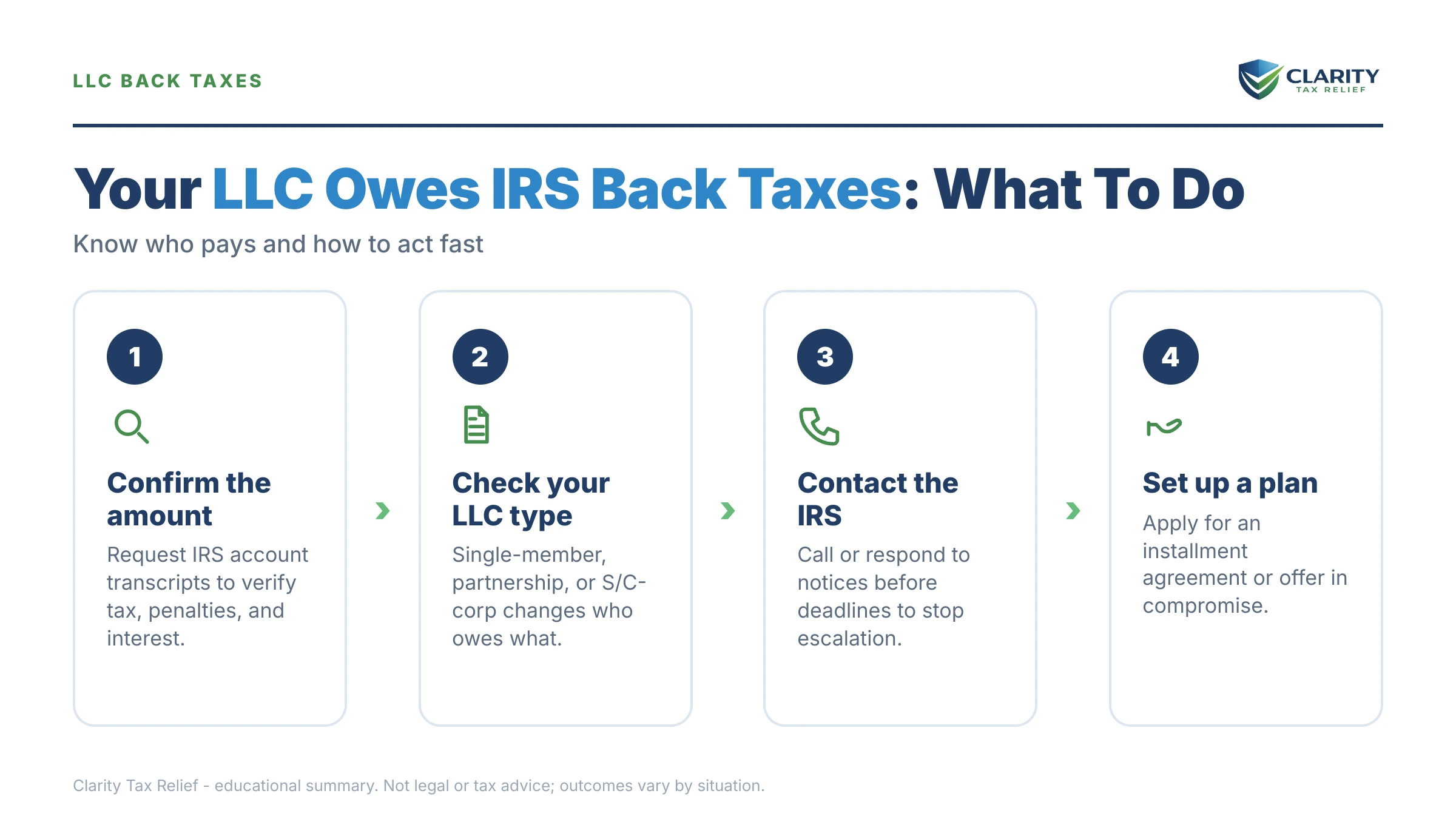
The fastest way to confirm your situation: read the top of the notice. A CP161 or CP504B addressed to the LLC's name and EIN means an entity-level assessment; a CP14 or CP504 with your name and SSN means the IRS already treats this as your personal debt. For a deeper dive into how the shield holds or fails by entity type, see llc back taxes personal liability.
Payroll taxes: the LLC debt that becomes personal fastest
Unpaid payroll withholding is the one LLC tax debt the IRS can assess against owners, officers, and even non-owner bookkeepers — no matter how the LLC is taxed. The income tax and FICA withheld from employee paychecks are "trust fund" taxes: legally the employees' money, held in trust for the Treasury. When it isn't deposited, the IRS treats the shortfall as taken, not merely owed.
The Trust Fund Recovery Penalty equals 100% of the unpaid trust-fund portion and attaches personally to anyone who was responsible for collecting or paying the money and willfully didn't — a bar the IRS reads broadly enough to include check signers. The process starts with an investigation and a Form 4180 interview, then Letter 1153 proposing the penalty, which opens a 60-day protest window. Miss it and the assessment lands on your SSN alongside everything else.
Form 940 (federal unemployment) debt stays with the entity, but it usually travels with 941 debt — and the failure-to-deposit penalties stack quickly. If your LLC has employees and the balance involves withholding, start with 941 back taxes and understand the trust fund recovery penalty before you talk to anyone at the IRS: statements made in that first call can decide who gets assessed.
What happens if your LLC owes IRS back taxes and you do nothing
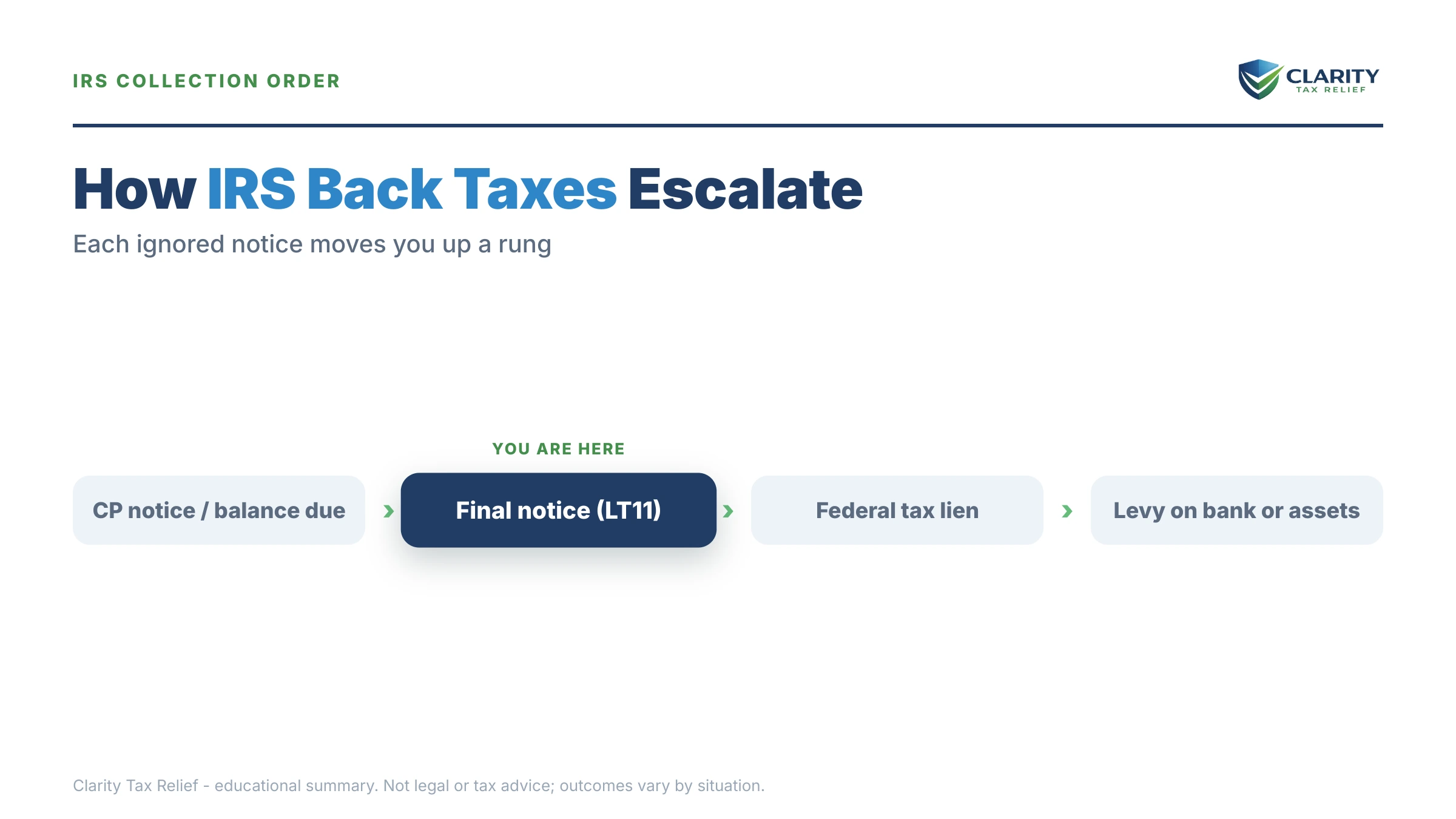
The IRS collection sequence for a business balance runs from a first bill to a levy on the LLC's bank account and receivables — and every step is automated. The IRS workforce shrank roughly 27% in 2025, which makes humans harder to reach, but the notice-and-levy machinery never paused. Silence doesn't slow it; it accelerates it.
- First bill — CP161 to the LLC's EIN, or CP14 if the debt sits on your SSN. No enforcement yet; penalties and interest are already running.
- Reminder notices — CP163 on the business side, CP501/CP503 on the personal side. Still just bills, but each cycle adds another month of accrual.
- Intent to levy — a cp504b notice for the business, or CP504 personally. The IRS can now seize state tax refunds, and a Notice of Federal Tax Lien becomes a realistic next move.
- Final notice — Letter 1058, LT11, or CP297. This starts a 30-day clock and your Collection Due Process rights (requested on Form 12153). It's the last exit before enforcement.
- Enforcement — a levy on the LLC's operating account (the bank holds funds 21 days before sending them), a levy on accounts receivable that tells your customers to pay the IRS instead of you, and — for personally assessed debt — wage levies and personal account levies. In extreme business cases, asset seizure.
An accounts-receivable levy is the one that kills operating businesses, because it cuts off cash flow and announces the problem to your clients at the same time. One more personal-side threshold worth knowing: if a personally assessed balance grows past $66,000 (the 2026 figure), the IRS can certify you to the State Department for passport denial. You can watch your balance grow in real time — estimate the accrual with our IRS penalty and interest calculator, and see how the compounding works in irs interest rate on back taxes 2026.
Your LLC owes and the notices are escalating?
Before a lien hits the title search or a levy hits the operating account, get a free review of exactly whose debt this is — the LLC's, yours, or both — and the fastest way to resolve it. Interest and penalties are accruing either way.
Your options to resolve LLC back taxes in 2026
Every federal resolution program — payment plans, hardship status, settlement, penalty relief — is available for LLC back taxes, but the thresholds differ depending on whether the debt sits on your SSN or the LLC's EIN. The step-by-step mechanics of setting these up on your own are in our guide to how to settle tax debt yourself; here's what applies to an LLC specifically.
| Option | Who typically qualifies | Cost & what to know |
|---|---|---|
| Short-term payment plan | Personally assessed debt you can pay within 180 days | $0 setup; interest and penalties keep accruing until paid |
| Long-term installment agreement | Personal assessments of $50,000 or less — online, up to 72 months; larger balances need Form 433 financials | Setup fee applies; direct debit required from $25,000 to $50,000 |
| In-business payroll plan | Operating LLCs with smaller 941 balances and current deposits | One missed deposit going forward defaults the agreement |
| Currently Not Collectible | Financials (Form 433-B for the business, 433-A or 433-F personally) show paying would prevent basic operations or living expenses | Collection pauses; the debt, interest, and a possible lien remain |
| Offer in Compromise | Reasonable Collection Potential below the balance owed | $205 fee plus 20% down on lump-sum offers (both waived with low-income certification); roughly 1 in 5 offers accepted in FY2024 |
| Penalty abatement | Clean compliance the prior 3 years (First-Time Abate) or reasonable cause | Removes penalties, not tax; automatic AEP relief begins summer 2026 |
Debt on the LLC's EIN plays by business rules, not the individual online thresholds. An operating company negotiates a business irs installment agreement, usually with a Form 433-B financial statement once the balance is meaningful. Settlement is also possible at the entity level — a business offer in compromise exists, but the IRS scrutinizes whether a business that can't pay its taxes should keep operating at all, so the bar is high. And never lead with settlement hopes: penalty abatement is the quiet workhorse that shrinks many LLC balances by thousands with no eligibility drama, especially where late-filing penalties on a 1065 or 1120-S make up a big slice of the debt.
For personally assessed pass-through debt, the realistic menu tracks the amount:
| Balance assessed to you | Realistic options | What changes at this level |
|---|---|---|
| Under $10,000 | Guaranteed installment agreement | Approval is essentially by statute if your filings are current |
| $10,000–$25,000 | Streamlined plan set up online | No financial disclosure required |
| $25,000–$50,000 | Streamlined plan with direct debit, up to 72 months | Direct debit is required; it also keeps the plan from defaulting on a missed payment |
| $50,000–$100,000 | Non-streamlined agreement with Form 433 financials, or CNC/OIC if the numbers support it | The IRS reviews income, assets, and equity before agreeing |
| Over $100,000 | Revenue-officer-managed resolution | Full asset review; liens are likely; experienced representation changes outcomes here |
A worked example: $41,800 and a refinance on the calendar
Say your single-member LLC had two strong years, you missed the quarterlies, and the IRS has now assessed $41,800 across two tax years — under your SSN, because a disregarded LLC's income tax lands on your personal 1040. You own your home and plan to refinance this fall. Here's the honest math:
- Installment agreement: $41,800 is under $50,000, so you can set up a plan online for up to 72 months with direct debit. $41,800 ÷ 72 ≈ $581/month as the floor — but interest and the 0.5% monthly failure-to-pay penalty keep accruing on the unpaid balance, so the total paid will exceed $41,800, and paying more than the floor shortens the accrual window meaningfully.
- Offer in Compromise: almost certainly not your path. The IRS's settlement math counts equity in assets — including the home equity you're planning to borrow against. A homeowner with meaningful equity generally can't show that $41,800 exceeds what the IRS could collect.
- The refinance angle: getting into the direct-debit agreement before the IRS files a Notice of Federal Tax Lien keeps the public record clean for your lender's title search. Wait until after a lien is filed, and the refinance gets harder and slower (more on this below).
- Penalty relief: if these are your first penalties after three clean years, First-Time Abate can strip the failure-to-pay penalties from the older year — a request worth making before you lock in the payment amount.
How to respond when your LLC owes back taxes, step by step
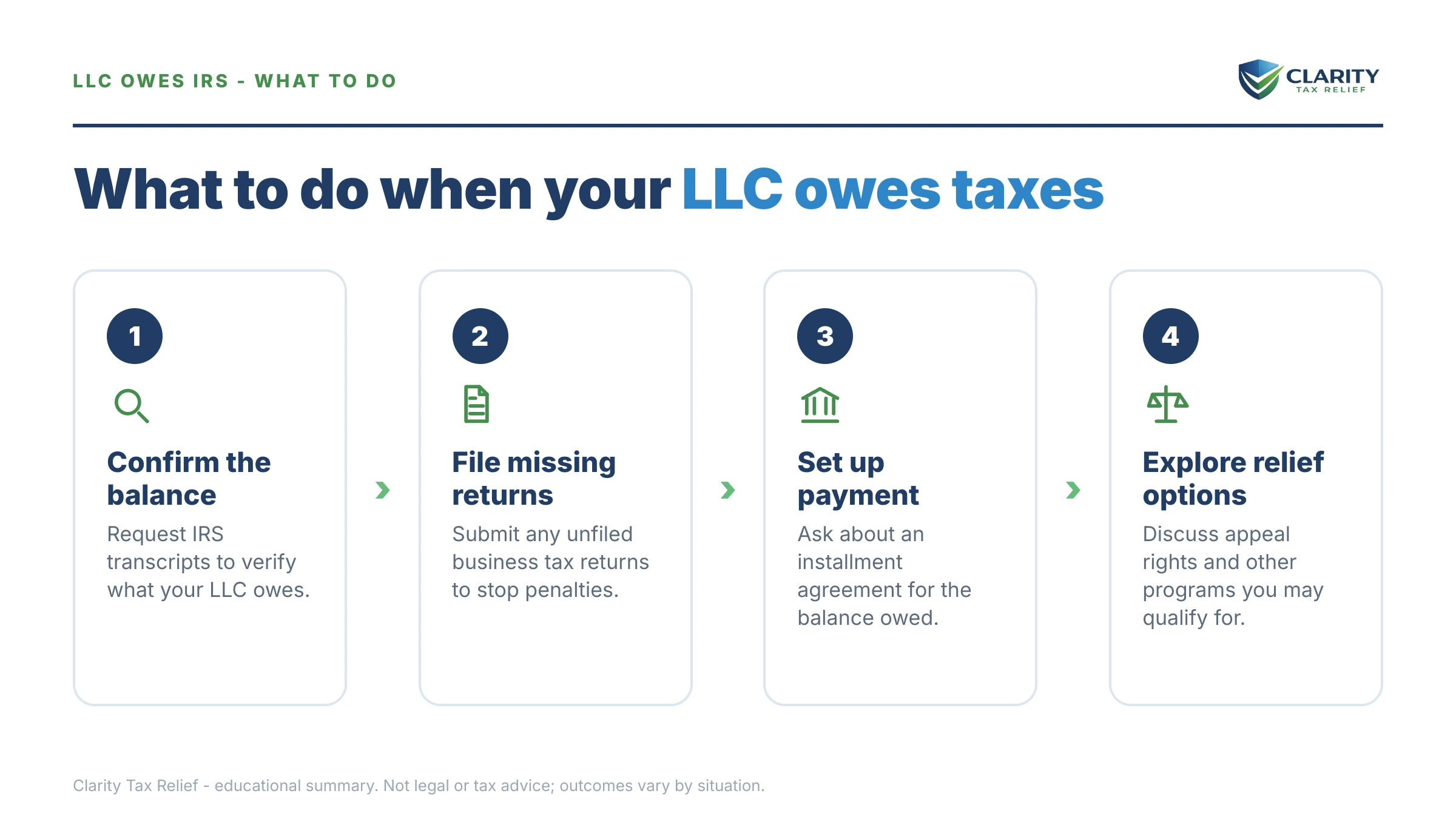
- Identify which tax the LLC owes — pull the notice and match it to the return it came from: Form 941, 1065, 1120-S, 1120, or your own 1040.
- Confirm who the debt is assessed against — the LLC's EIN, your SSN, or both; this decides which assets are exposed and which programs apply.
- File every missing return — the IRS will not approve a payment plan, hardship status, or an offer while any required return is outstanding.
- Get current on this quarter's deposits and estimates — every resolution program requires staying compliant from today forward.
- Set up the resolution that fits your numbers — a payment plan, hardship status, or an offer — before the next notice escalates.
- Bring in an experienced tax professional if enforcement has started — payroll taxes, a revenue officer, a levy, or a filed lien all change the playbook.
Refinancing your home while your LLC owes the IRS
A refinance lender's title search will surface a filed Notice of Federal Tax Lien — and personally assessed LLC debt is exactly the kind that produces one. Since 2018, tax liens no longer appear on consumer credit reports, but they remain public county records, and title companies find them every time.
Before a lien is filed, timing is your biggest asset. Entering an installment agreement — ideally direct debit — and building a payment history gives many lenders what they need to close; underwriters typically ask about tax debt on the application either way, so plan to disclose it with the agreement in hand rather than hope it stays invisible.
After a lien is filed, you have two workable paths. First, pay the IRS at closing from refinance proceeds — a cash-out refi can retire the debt and release the lien in one transaction. Second, request subordination: tax lien subordination on Form 14134 asks the IRS to let the new mortgage take priority over its lien, which the IRS grants when the deal improves its odds of getting paid. Subordination takes weeks, not days — start well before your rate lock. The full lender-side picture is in can i refinance with an irs lien.
When you can handle LLC tax debt yourself — and when to get help
Plenty of LLC back-tax situations don't need professional help, and it would be dishonest to tell you otherwise. Handle it yourself when the debt is personally assessed and under about $50,000, every return is filed, you have no employees, and you agree with the numbers: the online agreement takes an afternoon, and our scripts for what to say when calling the irs about back taxes cover anything the website can't do. Free help also exists — the Taxpayer Advocate Service can intervene when IRS delays or errors are causing you harm.
Experienced help genuinely changes outcomes in five situations: any payroll-tax balance (what you say in a Form 4180 interview can decide whether the Trust Fund Recovery Penalty lands on you); a revenue officer already assigned; a levy in motion against the operating account or receivables; multiple unfiled years across both the entity and your personal returns; and offer-in-compromise math involving business assets, where a miscounted asset sinks the offer and forfeits your payments. In those cases, the cost of representation is usually small next to the cost of a preventable assessment.
Terms on your notices, decoded
- Disregarded entity: the IRS's default treatment of a single-owner LLC — the company's income tax is simply yours, reported on Schedule C.
- Trust fund taxes: the income tax and FICA withheld from employee paychecks, held "in trust" for the government — the portion the IRS pursues hardest.
- Responsible person: anyone with the duty and authority to pay the withheld taxes — owners, officers, and sometimes bookkeepers or check signers.
- Notice of Federal Tax Lien: a public filing that attaches the IRS's claim to everything you own, including your home; it's what a title search finds.
- Subordination: the IRS agreeing to let a new lender's mortgage take priority over its lien so a refinance can close (Form 14134).
- CSED: the Collection Statute Expiration Date — generally 10 years from assessment, though appeals, offers, and bankruptcy pause the clock.
If a refinance deadline, a revenue officer, or a Letter 1153 is already in the picture, a free case review with an experienced tax professional at (888) 825-7779 can map the fastest sequence before the next notice lands.
LLC back-tax questions, answered
Am I personally liable if my LLC owes the IRS back taxes?
Usually, yes. If your LLC is taxed as a sole proprietorship or partnership, the income tax was assessed on your personal return, so the IRS collects from you directly. If the debt is unpaid payroll withholding, the Trust Fund Recovery Penalty can make any "responsible person" personally liable. The main exception is income tax owed by an LLC taxed as a C corporation, which stays at the entity level.
Can the IRS take my personal bank account or house for LLC tax debt?
If the debt is assessed under your Social Security number — as most pass-through LLC income tax is — the IRS can levy your personal accounts and wages and file a lien that attaches to your home after the required notices. Home seizures are rare and require court approval, but the lien alone can block a sale or refinance. Debt assessed only to the LLC's EIN reaches personal assets mainly through the Trust Fund Recovery Penalty.
Can I dissolve my LLC to escape its IRS back taxes?
No. Pass-through income tax already sits on your personal account, so it follows you whether the LLC exists or not. The trust-fund portion of payroll taxes survives dissolution and can be assessed against responsible persons after the business closes. Dissolving without resolving the debt can also create transferee-liability exposure if assets were distributed to owners while taxes went unpaid.
Can an LLC set up an IRS payment plan?
Yes. An operating LLC can request a business installment agreement for debt on its EIN, and smaller payroll balances may qualify for an expedited in-business plan if deposits are current. If the debt is assessed to you personally, you use the individual thresholds instead: balances of $50,000 or less can be set up online for up to 72 months.
Can an LLC settle IRS back taxes with an Offer in Compromise?
It's possible but harder than the ads suggest. Both individuals and operating businesses can file offers, and the IRS accepted roughly 1 in 5 offers in FY2024. Acceptance turns on Reasonable Collection Potential — what the IRS could realistically collect from your income and assets. Home equity and business equipment count, so profitable LLCs and owners with equity often don't qualify.
What is the Trust Fund Recovery Penalty for LLC owners?
It's the IRS's tool to collect withheld payroll taxes — the income tax and FICA taken from employee paychecks — from the people who controlled the money. The penalty equals 100% of the unpaid trust-fund portion and can be assessed against owners, officers, bookkeepers, or anyone with check-signing authority. The IRS proposes it with Letter 1153, and you have 60 days to protest.
Will my LLC's tax debt stop me from refinancing my home?
It can, but usually only once a Notice of Federal Tax Lien is filed — the lien attaches to your home and appears in the lender's title search. Before a lien is filed, many lenders will proceed if you're in an established installment agreement with a payment history. After filing, you'll typically need to pay the debt at closing or request lien subordination on Form 14134 so the new mortgage takes priority.
How long can the IRS collect back taxes from an LLC?
Generally 10 years from the date each balance was assessed — the Collection Statute Expiration Date, or CSED. That clock applies whether the assessment sits on the LLC's EIN or your SSN, and it pauses for events like a pending Offer in Compromise, bankruptcy, or a collection appeal. Waiting out the statute rarely works, because the IRS escalates enforcement long before the deadline.
Your next 24 hours
- Find two facts on the notice: whether it's addressed to the LLC's name and EIN or your name and SSN, and the notice number in the top corner. Those two lines tell you whose debt this legally is and how close enforcement sits.
- Gather your file: the notice, the LLC's last two filed returns and your 1040s, payroll records if you have employees, and a rough list of what you and the LLC each own — everything a resolution decision needs. Any payment you decide to make goes only through IRS.gov/payments.
- Get a free case review — call (888) 825-7779 or use the 2-minute form. Right now, penalties and interest are the only things accruing; a lien on the title or a levy on the operating account would make both the refinance and the business far harder to protect.
This guide is general information, not tax or legal advice for your specific situation. Eligibility for IRS programs depends on individual facts and circumstances; no outcome is guaranteed.