
Business Tax Debt
S Corp Back Taxes in 2026: Who Actually Owes the IRS and How to Fix Each Debt
The short answer: S corp back taxes are almost never one debt. Because an S corporation passes profit through on Schedule K-1, income tax debt lands on your personal 1040 — while payroll taxes, late-filing penalties on Form 1120-S, and some state taxes stay with the company. Each debt is collected differently, and each has its own fix.
Maybe the K-1 said the company made money you never actually pocketed. Maybe payroll deposits slipped during a slow quarter, or the 1120-S sat unfiled while you kept the business running. However it started, the letters now arriving carry two different names — yours and the corporation's — and that split decides everything about how you fix this.
The good news: every one of these debts has an established resolution path, and sorting them into the right buckets is the whole game. Here is the map.
⏱ The clock that's running: there is no single deadline printed on an S corp tax debt — the cost simply compounds. An unfiled 1120-S adds a per-shareholder penalty every month, for up to 12 months. On your personal balance, the failure-to-pay penalty (0.5% per month) plus daily-compounding interest never pause while you decide.
What "S corp back taxes" actually means: four separate debts
An S corporation almost never owes federal income tax itself — the shareholders do, which is why one S corp tax problem usually means two or more separate debts on separate IRS accounts. Before you can fix anything, you have to know which of the four you're holding.
Debt #1 — income tax on K-1 profit. The corporation's profit flowed to your Schedule K-1, you reported it (or the IRS did for you), and the tax went unpaid. This debt lives on your personal 1040 account. The IRS collects it from you, your wages, and your bank accounts — not from the company.
Debt #2 — unpaid payroll taxes. If the corporation ran payroll (including your own W-2 salary) and missed deposits or 941 filings, that's the entity's debt — with a dangerous exception covered below. See 941 back taxes for the full payroll-side playbook.
Debt #3 — late-filing penalties on the 1120-S. Even a return showing zero tax due generates a penalty when filed late, charged per shareholder, per month. It arrives as a CP162 notice, and it's frequently the most removable debt on this list.
Debt #4 — state entity-level taxes. Several states tax S corporations directly even though the IRS doesn't. More on that below.
| Type of debt | Whose debt it is | Primary fix |
|---|---|---|
| Income tax on K-1 profit (your 1040) | Yours, personally — never the corporation's | Personal payment plan, Offer in Compromise, hardship status, penalty relief |
| Unpaid payroll taxes (Form 941) | The corporation — but the trust fund share can become yours via the TFRP | Business installment agreement; TFRP defense if you're targeted personally |
| Late-filed 1120-S penalty (CP162) | The corporation | First-Time Abate or reasonable-cause abatement |
| State entity-level taxes (e.g., CA franchise tax) | The corporation (varies by state) | State payment plans and state relief programs |
Why S corp owners end up owing back taxes
Most S corp back-tax debt starts with phantom income: profit reported on your Schedule K-1 that was taxed to you personally even though the cash never hit your bank account. If the company reinvested its profit in inventory, equipment, or debt payments, you still owed tax on your share of it — with no withholding to cover it.
The second driver is the withholding gap. Your W-2 salary from the corporation has taxes withheld; your distributions and K-1 profit don't. Owners who skip quarterly estimated payments discover the shortfall all at once in April, plus an underpayment penalty stacked on top.
The third driver is the reasonable-salary problem. Owners who take large distributions while paying themselves little or no W-2 wage are a known IRS target: an exam can reclassify distributions as wages and assess back payroll taxes across multiple years at once. If that's your exposure, the S corp reasonable salary back taxes guide covers it in depth.
Finally, there's simple non-filing. An 1120-S that sits unfiled generates a CP161 notice for any business balance and CP162 penalties for the late return — and it blocks your personal return, because you can't accurately file a 1040 without the K-1. One missed corporate return quietly creates debt on two accounts. You can estimate what the penalties and interest have already added with our IRS Penalty & Interest Calculator.
What happens if you ignore S corp back taxes
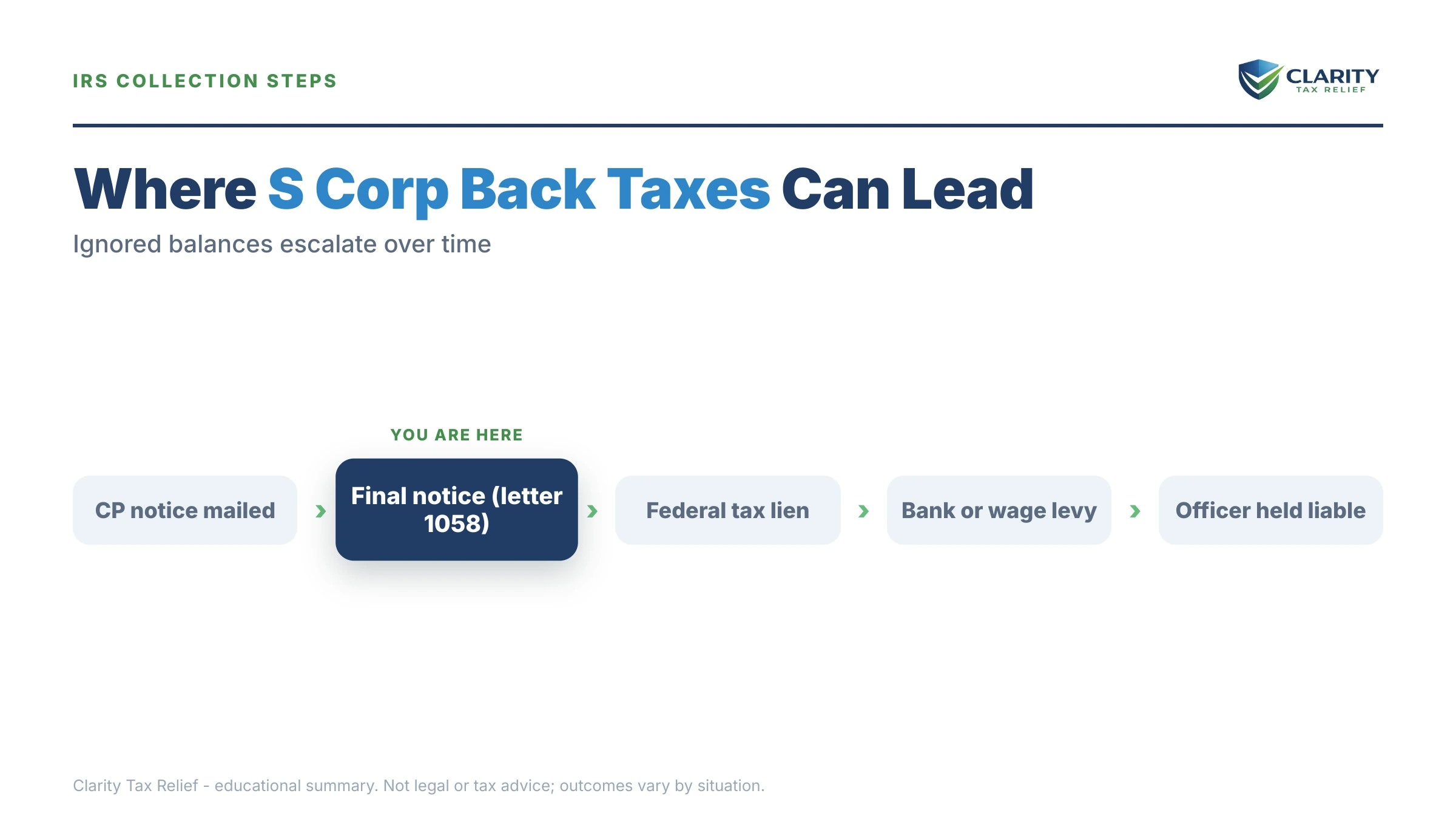
Unpaid S corp taxes trigger two automated collection tracks at once — one against you personally, one against the corporation — and neither waits for the other. The IRS workforce shrank roughly 27% in 2025, but these notices are generated by machines that never got laid off. The sequence runs like this:
- First bills. A CP14 hits your personal account for the K-1 balance; CP161 and CP162 hit the corporation for business balances and late-filing penalties. No enforcement yet — this is the cheapest moment to act.
- Reminders. CP501 and CP503 on the personal side, CP163 on the business side. Still just bills, but each cycle adds another month of penalties and interest.
- Intent to levy. CP504 (personal) and CP504B (business) authorize seizure of state tax refunds, and a federal tax lien against you or the corporation becomes a realistic next step.
- Final notice. LT11 or Letter 1058 starts a 30-day clock and your Collection Due Process rights (requested on Form 12153). Once it lapses, the IRS can levy bank accounts, garnish your W-2 wages, and — on the business side — levy the corporation's accounts receivable, which cuts off cash flow overnight.
- Enforcement. A bank levy holds funds for 21 days before they leave; a wage levy is continuous until released. If your combined personal debt reaches $66,000 (the 2026 threshold), the IRS can also certify it to the State Department against your passport.
- The parallel TFRP track. If payroll taxes are unpaid, a revenue officer can investigate who controlled the money and propose the Trust Fund Recovery Penalty via Letter 1153 — converting company debt into your personal debt, with 60 days to protest.
The order matters because your leverage shrinks at each stage. At stage one, everything on this page is available. By stage five, you're negotiating a levy release instead of choosing a plan.
Two collection tracks are running against you at once
Send us your notices — CP14, CP161, CP162, whatever arrived. An experienced tax professional will separate what's personal from what's corporate and map the cheapest way out of each, before another month of penalties and interest posts. Free, confidential, no pressure.
Your options for resolving S corporation tax debt
A personal K-1 balance of $50,000 or less qualifies for a streamlined installment agreement of up to 72 months, set up online without filing financial statements. That single fact resolves most S corp income-tax debt. But the full menu is wider, and the right pick depends on which debt you're fixing and what your finances show. (For the general mechanics of negotiating with the IRS on your own, see how to settle tax debt yourself — this table covers what's specific to the S corp situation.)
| Option | Which debt it fits | Thresholds, cost & catch |
|---|---|---|
| Short-term payment plan | Personal K-1 balance you can clear fast | Up to 180 days, $0 setup; interest and penalties keep accruing until paid |
| Guaranteed installment agreement | Personal balance of $10,000 or less | The IRS must accept it if you've filed and paid on time the prior five years and can full-pay within three |
| Streamlined installment agreement | Personal balance of $50,000 or less | Up to 72 months, online setup, no financial disclosure; direct debit required above $25,000 |
| Business installment agreement | The corporation's 941 or penalty debt | Separate agreement in the entity's name; current payroll deposits are a precondition |
| Offer in Compromise | Personal debt you genuinely cannot full-pay | $205 fee; 20% down on lump-sum offers (both waived with low-income certification); roughly 1 in 5 offers accepted in FY2024 |
| Currently Not Collectible | Genuine hardship on the personal side | Collection pauses; the debt and interest remain, and the IRS re-reviews your income later |
| First-Time Abate / AEP | Penalties on the 1120-S or your 1040 | Clean compliance the prior 3 years; the new Automatic Exemption from Penalty applies without a request starting summer 2026 |
Two S-corp-specific notes on this menu. First, first-time penalty abatement works on the corporation's account separately from yours — a company with three clean prior years can erase a CP162 penalty even if your personal account has its own history. The Automatic Exemption from Penalty rolling out in summer 2026 will apply similar relief without a request, so never assume a penalty is permanent.
Second, if you're weighing an offer, your ownership stake in the S corp is itself an asset the IRS values. Offer math with business income and business equity is its own discipline — the OIC self employed guide walks through how the IRS counts a going concern you own.
What you owe changes what's realistic: options by balance band
The IRS's collection posture shifts at $10,000, $25,000, $50,000, and $66,000 — and your realistic options shift with it. These bands apply to the personal side of the debt (the K-1 balance on your 1040):
| Personal balance | Realistic options | What changes at this level |
|---|---|---|
| Under $10,000 | Guaranteed installment agreement; short-term plan | Acceptance is required by statute if you qualify; a lien is unlikely if you act promptly |
| $10,000 – $25,000 | Streamlined agreement, set up online | No financial disclosure; any payment method allowed |
| $25,001 – $50,000 | Streamlined agreement, up to 72 months | Direct debit becomes required to stay streamlined |
| $50,001 – $65,999 | Non-streamlined agreement, OIC, or CNC review | Full financials (Form 433 series) — the IRS now examines your income, assets, and your equity in the S corp itself |
| $66,000 and up | Same options, higher stakes | Passport certification threshold for 2026; possible revenue officer assignment |
Worked example: say you owe $31,200 on K-1 income
This is hypothetical, but the math is real. Say you're the sole shareholder, filing single, taking a W-2 salary from your own S corp. The company had a strong year, your K-1 showed profit you mostly left in the business, and after filing you owe $31,200 on your 1040 with nothing set aside.
Here's what each path actually costs:
- Doing nothing: the failure-to-pay penalty alone is 0.5% × $31,200 = $156 every month, before interest, which compounds daily on the growing balance. Waiting a year adds roughly $1,900 in penalty plus interest — with the notice sequence escalating the whole time.
- Short-term plan: $0 setup, up to 180 days. You'd need about $5,200/month for six months. Realistic only if a distribution or receivable is genuinely coming.
- Streamlined 72-month plan: $31,200 ÷ 72 ≈ $434/month minimum. Because you're above $25,000, direct debit is required. Interest continues (though the monthly penalty rate typically drops once an agreement is active), so paying $600–$700/month instead shortens the payoff and cuts the total cost meaningfully.
- Offer in Compromise: only viable if your numbers say the IRS can't collect $31,200. If, after IRS allowable expenses, you could pay $200/month and your assets net $8,000, a lump-sum offer would start around $10,400 ($200 × 12 + $8,000). But with a steady W-2 salary and equity in a profitable S corp, most owners in this position show enough collection potential to full-pay — making the payment plan, not the offer, the honest answer.
One more note: at $31,200 you're below the $66,000 passport threshold, so travel isn't at risk yet — but two more years of unaddressed K-1 debt could change that.
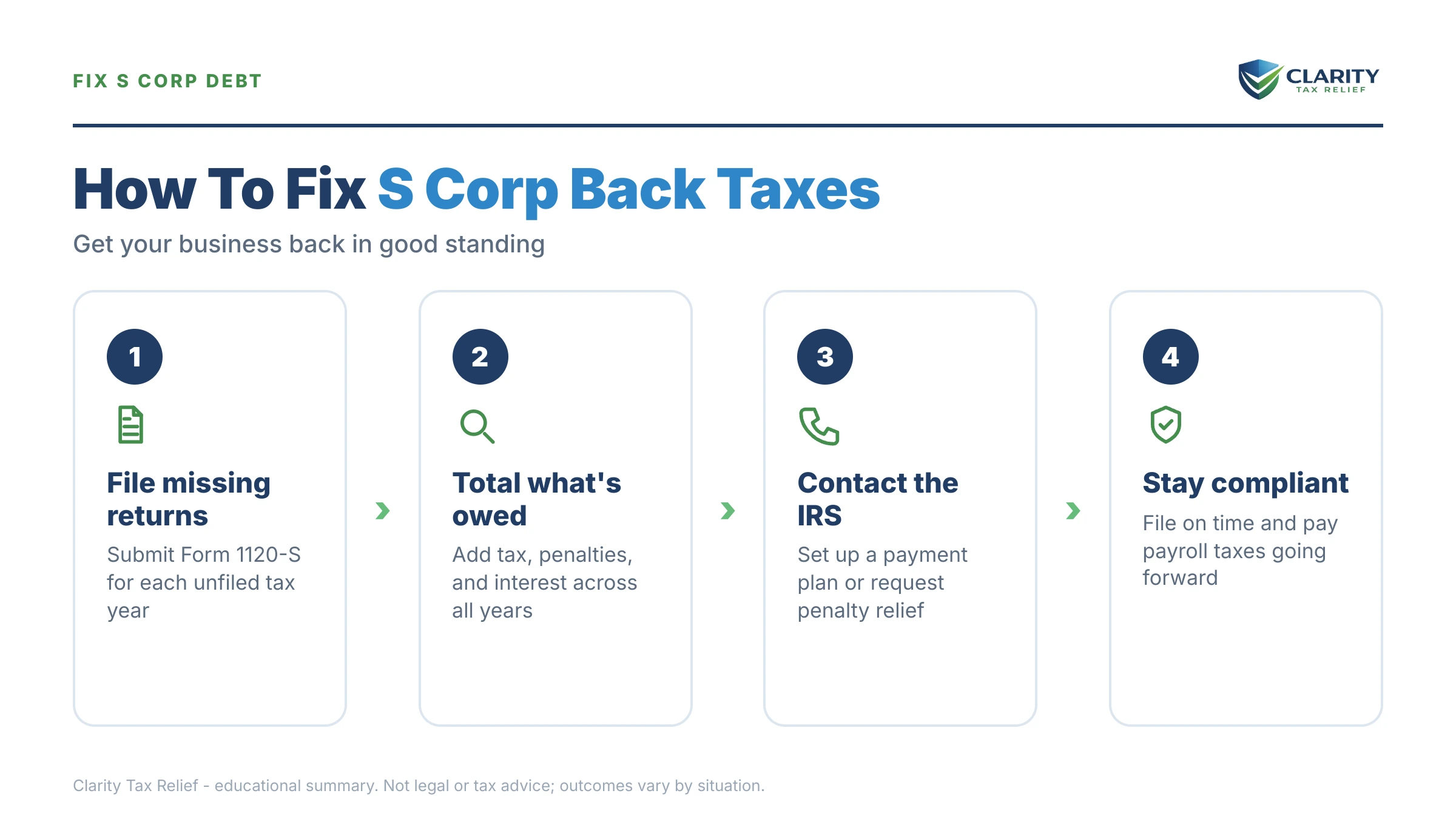
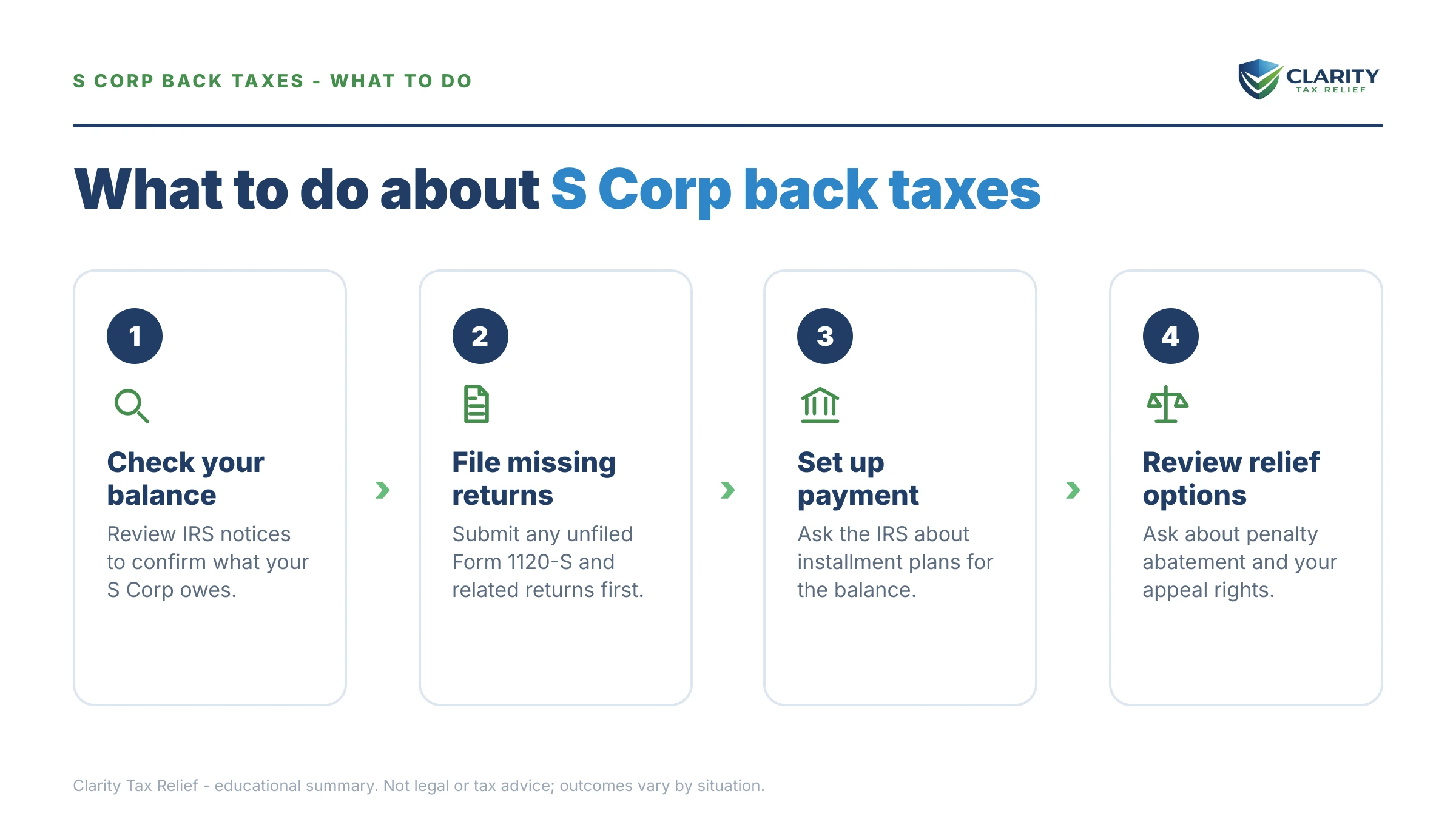
How to respond to S corp back taxes, step by step
- Pull the transcripts for every account. Order IRS account transcripts for your personal 1040 and for the corporation's 1120-S and 941 accounts so you can see exactly what is assessed, where, and for which years.
- File every missing return. Submit any unfiled 1120-S, 941, and 1040 returns before negotiating anything — the failure-to-file penalty runs 5% per month, ten times the failure-to-pay rate (though in months where both penalties apply, the failure-to-file portion drops to 4.5%, for 5% combined), and no resolution gets approved while returns are missing.
- Verify the numbers. Match your K-1s, payroll records, and any CP161 or CP162 notices against the transcripts, and dispute anything that doesn't line up before you pay it.
- Request penalty relief. Ask for First-Time Abate on the 1120-S late-filing penalty and qualifying personal penalties if the prior three years are clean — and check whether the new automatic exemption covers you from summer 2026.
- Set up the right resolution on each account. Choose a payment plan, hardship status, or offer for your personal balance, and a separate business agreement for anything the corporation owes — the two accounts never combine.
- Stop the debt from rebuilding. Set a defensible reasonable salary, start quarterly estimated payments on expected K-1 income, and keep payroll deposits current going forward.
The payroll side: 941 debt and the Trust Fund Recovery Penalty
The trust fund portion of an S corp's unpaid payroll taxes — the income tax withheld from paychecks plus the employee half of FICA — can be assessed against you personally, and it survives even if the corporation dissolves. This is the one place where "the company owes it, not me" fails completely.
The IRS treats withheld payroll money as employees' funds held in trust. When it goes unpaid, a revenue officer identifies every "responsible person" who controlled the money and had the power to pay — owner, officer, sometimes even a check-signer — and proposes the penalty via Letter 1153, with a 60-day window to protest. Because most S corp owners run their own payroll, the owner is almost always the first name on the list.
Two practical consequences. First, resolve payroll debt before income-tax debt when both exist: the trust fund exposure is personal, permanent, and the IRS's top priority. Second, if the corporation is still operating, keep current deposits perfect — the IRS will not grant a business agreement to a company still falling behind, and repeated non-deposit is what pushes cases toward criminal referral. Note that entity choice doesn't save you here: the LLC back taxes personal liability rules work the same way for LLCs taxed as S corps.
State S corp taxes: the entity-level surprise
Several states tax S corporation income at the entity level even though the IRS doesn't — California charges S corps a franchise tax with an $800 annual minimum, due every year the corporation exists, profitable or not. A federal S election does not switch that off, and the FTB has 20 years to collect versus the IRS's 10. If you have California exposure, start with California FTB back taxes.
Other states — New York and New Jersey among them — impose their own entity-level taxes or minimum fees on S corporations, and a handful of jurisdictions don't fully recognize the federal S election at all. State rules, statutes, and payment programs are their own systems; never assume an IRS figure or timeline applies. When in doubt, the state agency's own notice controls, and its collections arm is often faster-moving than the IRS.
And if your S corp sells taxable goods or services, unremitted sales tax is a trust-fund debt at the state level with its own personal-liability rules — states are typically the most aggressive collector you'll face. See sales tax debt help before anything else if that's in your stack.
When you can handle this yourself — and when help changes the outcome
Plenty of S corp back-tax situations don't need professional help. You can confidently handle it yourself when:
- The debt is a single-year personal K-1 balance you agree with, under $50,000 — the streamlined agreement is a genuinely simple online setup at IRS.gov.
- You can full-pay within 180 days — the short-term plan costs nothing to set up.
- The only problem is a CP162 penalty and the corporation's prior three years are clean — a First-Time Abate request is one phone call or letter.
Experienced help changes outcomes in specific situations, not all of them: any unpaid 941 balance (because TFRP exposure is personal and the Form 4180 interview is adversarial), multiple unfiled 1120-S years (filing order and penalty strategy interact), a reasonable-compensation exam already underway, offer math involving business equity, or a levy already in motion against you or the company's receivables. In those cases the cost of getting the sequence wrong — resolving the 1040 while the TFRP quietly gets assessed, for example — dwarfs the cost of representation.
If any of those flags is yours, get a free S corp back-tax review before the next notice cycle posts another month of penalties — it costs nothing to find out where you actually stand.
Terms on your K-1 and IRS notices, decoded
- Pass-through entity: a business whose profit is taxed on the owners' personal returns instead of the company's — the defining trait of an S corporation.
- Schedule K-1: the form reporting your share of the S corp's profit, loss, and distributions; its numbers flow onto your 1040 whether or not you received cash.
- Phantom income: K-1 profit you owe tax on even though it was never distributed to you.
- Trust fund taxes: money withheld from employee paychecks that the business holds in trust for the government — the portion of payroll debt that can become personal.
- Trust Fund Recovery Penalty (TFRP): the IRS's tool for assessing unpaid trust fund taxes against the individuals who controlled the money.
- CSED: the Collection Statute Expiration Date — generally 10 years from assessment, paused by offers, bankruptcy, and certain appeals.
S corp back taxes: your questions, answered
Am I personally liable for my S corp's back taxes?
It depends on which tax. Income tax on S corp profit was never the company's debt — it passed through on Schedule K-1 to your personal 1040, so the IRS collects it from you directly. Payroll taxes belong to the corporation, but the trust fund portion (withheld income tax and the employee half of FICA) can be assessed against you personally through the Trust Fund Recovery Penalty if you controlled the money.
Does an S corp pay its own back taxes?
Usually not for income tax — an S corporation is a pass-through, so federal income tax on its profit is owed by the shareholders, not the entity. The corporation does owe its own payroll taxes, late-filing penalties on Form 1120-S, and, in some states, entity-level taxes such as California's franchise tax. That's why one "S corp tax problem" often means two or three separate IRS accounts.
What is the penalty for filing Form 1120-S late?
The IRS charges a late-filing penalty per shareholder, per month (or part of a month), for up to 12 months — even though the return itself usually shows no tax due. For a two-shareholder S corp that files a year late, that multiplies fast. First-Time Abate often removes it if the company's prior three years are clean, and starting summer 2026 the IRS's new Automatic Exemption from Penalty applies similar relief automatically.
Can I owe taxes on S corp profit I never actually received?
Yes — this is the phantom income trap. You're taxed on your share of the corporation's profit shown on Schedule K-1 whether or not the cash was ever distributed to you. If the company reinvested the profit or used it to pay down debt, you still owe personal income tax on it, which is why so many shareholders end up with a 1040 balance they never saw coming.
Can I get a payment plan for S corp back taxes?
Yes, but you may need more than one. K-1 income tax debt sits on your personal account, where a balance of $50,000 or less qualifies for a streamlined installment agreement of up to 72 months set up online. The corporation's payroll or penalty debt needs its own business agreement under different rules. The two accounts don't combine, so each needs its own arrangement.
Will the IRS settle S corp back taxes for less than I owe?
Sometimes, through an Offer in Compromise — but only when the numbers genuinely show the IRS could never collect the full balance from your income and assets. The application costs $205 (waived with low-income certification), and the IRS accepted roughly 1 in 5 offers in FY2024. Since K-1 debt is personal, the IRS looks at your whole financial picture, including your stake in the S corp itself.
What happens if the IRS reclassifies my distributions as salary?
You get hit with back payroll taxes, failure-to-deposit penalties, and interest on the amounts reclassified — often across multiple years at once. The IRS targets S corp owners who take large distributions while paying themselves little or no W-2 wages. If you're taking distributions without reasonable compensation, fixing your payroll now is far cheaper than defending an exam later.
Does closing the S corp make the back taxes go away?
No. K-1 income tax debt was always yours personally, so dissolving the company changes nothing. The trust fund portion of unpaid payroll taxes follows responsible individuals through the Trust Fund Recovery Penalty even after the entity is gone. Dissolving can even complicate things, because you lose the ability to resolve the business account cleanly.
How long can the IRS collect S corp back taxes?
Generally 10 years from the date each tax was assessed — the Collection Statute Expiration Date, or CSED. The clock pauses during an Offer in Compromise, bankruptcy, or certain appeals, so it often runs longer than 10 calendar years. State clocks differ sharply: California's FTB, for example, has 20 years to collect.
Your next 24 hours
- Sort your notices by name. Pull the most recent IRS letter (CP14, CP161, or CP162) and note the tax year, the amount, and — most important — which taxpayer it names: you or the corporation. That one line tells you which track each debt is on.
- Gather three documents: your last-filed 1120-S with its K-1s, your last personal return, and the corporation's payroll records for any year with a 941 balance. Every resolution starts from these.
- Get a free case review. Call (888) 825-7779 or use the 2-minute form. An experienced tax professional will map which debts are personal, which belong to the company, and the cheapest order to resolve them — while penalties and interest are still compounding every month you wait.
For the IRS's own reference material, see its overview of S corporation filing and tax rules, the official payment plan and installment agreement options, and — if the IRS's own delays are hurting your case — the independent Taxpayer Advocate Service.
This guide is general information, not tax or legal advice for your specific situation. Eligibility for IRS programs depends on individual facts and circumstances; no outcome is guaranteed.