
State Tax Debt
Sales Tax Debt Help: How to Resolve State Sales Tax Back Taxes in 2026
The short answer: sales tax debt help means dealing with your state — not the IRS — and fast, because states treat unremitted sales tax as their money, held in trust by you. Filing every missing return, then using a voluntary disclosure agreement, payment plan, or penalty waiver resolves most cases before permits, bank accounts, or personal liability are on the line.
Maybe you drive for a delivery app during the week and sell at weekend markets or through your own site — and somewhere in three years of hustling, sales tax returns never got filed. Now your state's revenue department has noticed, and the letter in your hand has a number on it you didn't expect. This is fixable, and the order you fix it in matters more than the amount. Here's the map.
If a state notice triggered your search, keep scrolling — the image below shows exactly what a state sales tax assessment looks like and where to find the periods, the amount, and the response date that controls everything.
⏱ Your deadline: the appeal or response date printed on your state assessment notice — miss it and the state's estimated number becomes final and collectible. No notice yet? Your clock is still running two ways: penalties and interest accrue every month, and unregistered sellers lose voluntary-disclosure eligibility the day the state makes first contact.
Why you have sales tax debt — and why states collect it harder than the IRS
Sales tax debt is trust-fund debt: money you collected — or were required to collect — from customers on the state's behalf, which makes states faster and more personal in collections than the IRS is with income tax. To the state, an unremitted sales tax balance isn't a debt you owe. It's the state's own money sitting in your account.
Most sales tax debt starts one of three ways:
- You never registered. Since the Supreme Court's Wayfair decision, selling into a state — even online, even as a side hustle — can create "nexus" and a duty to collect. Thousands of gig workers and small sellers owe tax on sales they never knew were taxable. If that's you, start with our guide to sales tax nexus back taxes.
- You registered but fell behind. Cash got tight, and the sales tax sitting in the operating account went to rent or inventory. This is the most dangerous version, because the state can prove you collected money that wasn't yours.
- The state estimated a number for you. When returns stop arriving, most states issue an estimated assessment — usually built from your best past periods, your 1099-Ks, or industry averages, and usually inflated. It becomes legally final if you don't respond by the printed date.
The good news hiding in that third scenario: an estimated assessment is a placeholder, not a verdict — filing the real returns almost always shrinks it.
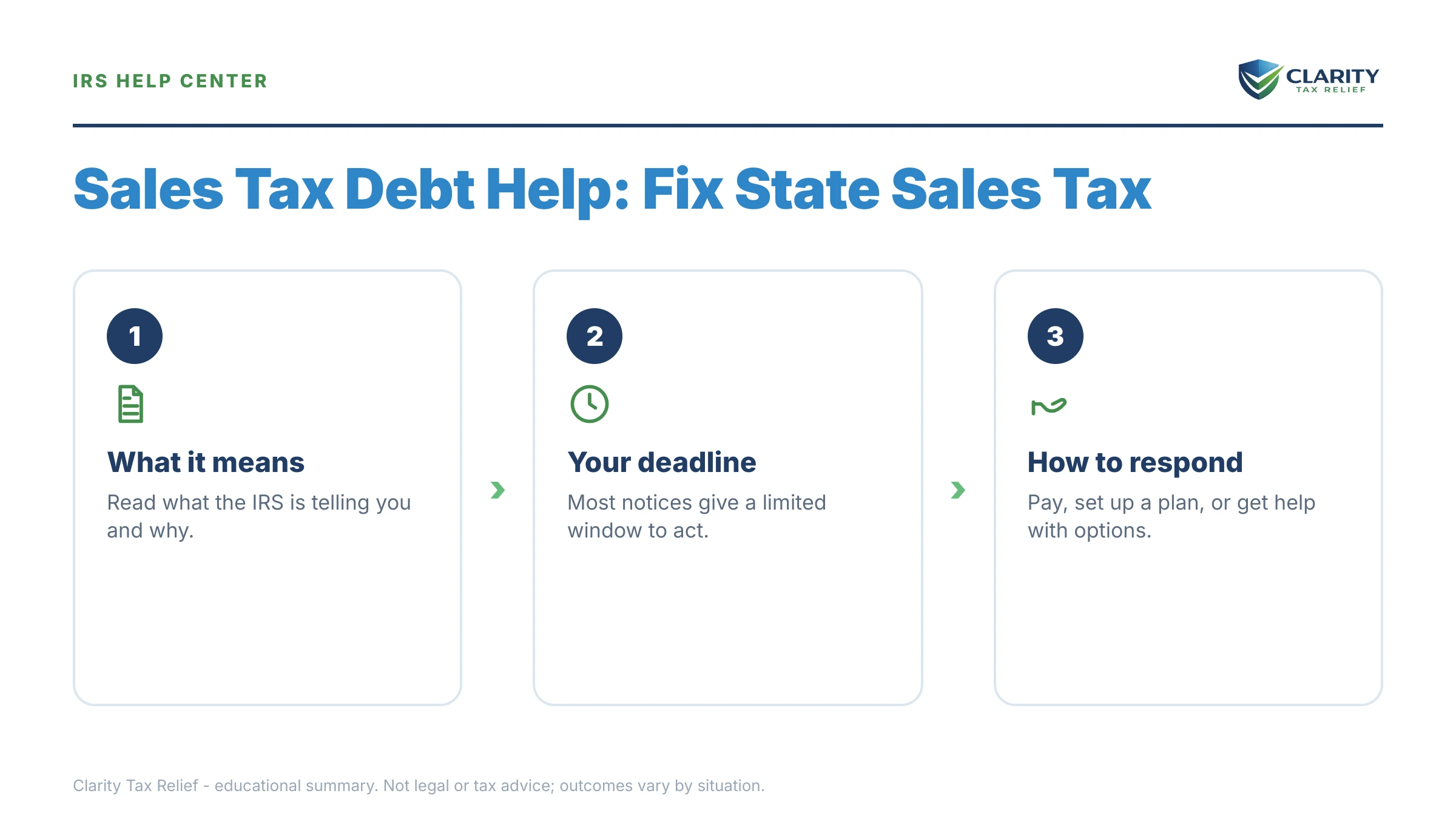
Sales tax back taxes vs. IRS back taxes: the differences that decide your strategy
State sales tax debt carries three risks federal income tax debt doesn't: license revocation, near-automatic personal liability, and a lower bar to criminal referral. If you've dealt with the IRS before, do not assume the playbook transfers. Here's the side-by-side:
| Question | IRS income tax debt | State sales tax debt |
|---|---|---|
| Whose money is it? | Yours — a tax you owe on income | The state's — collected from customers, held in trust by you |
| Does an LLC or corporation protect you? | Often, for entity-level income tax | Rarely — responsible-person statutes reach owners and money-handlers personally |
| Is your license to operate at stake? | No (passport can be, at $66,000+) | Yes — states revoke seller's permits, and operating without one can itself be illegal |
| How fast does enforcement move? | A long, mostly predictable notice ladder | Faster — many states lien and levy with far less warning |
| Does the debt expire? | Generally 10 years from assessment (with tolling) | Varies by state; a filed warrant or judgment can make it effectively permanent |
| Criminal exposure? | Rare, reserved for willful fraud | Real for collected-but-unremitted tax — many states can charge it as theft |
That last row is why sequencing matters. If you owe both, most people should stabilize the sales tax side first — our guide comparing state tax debt vs IRS walks through when that order flips.
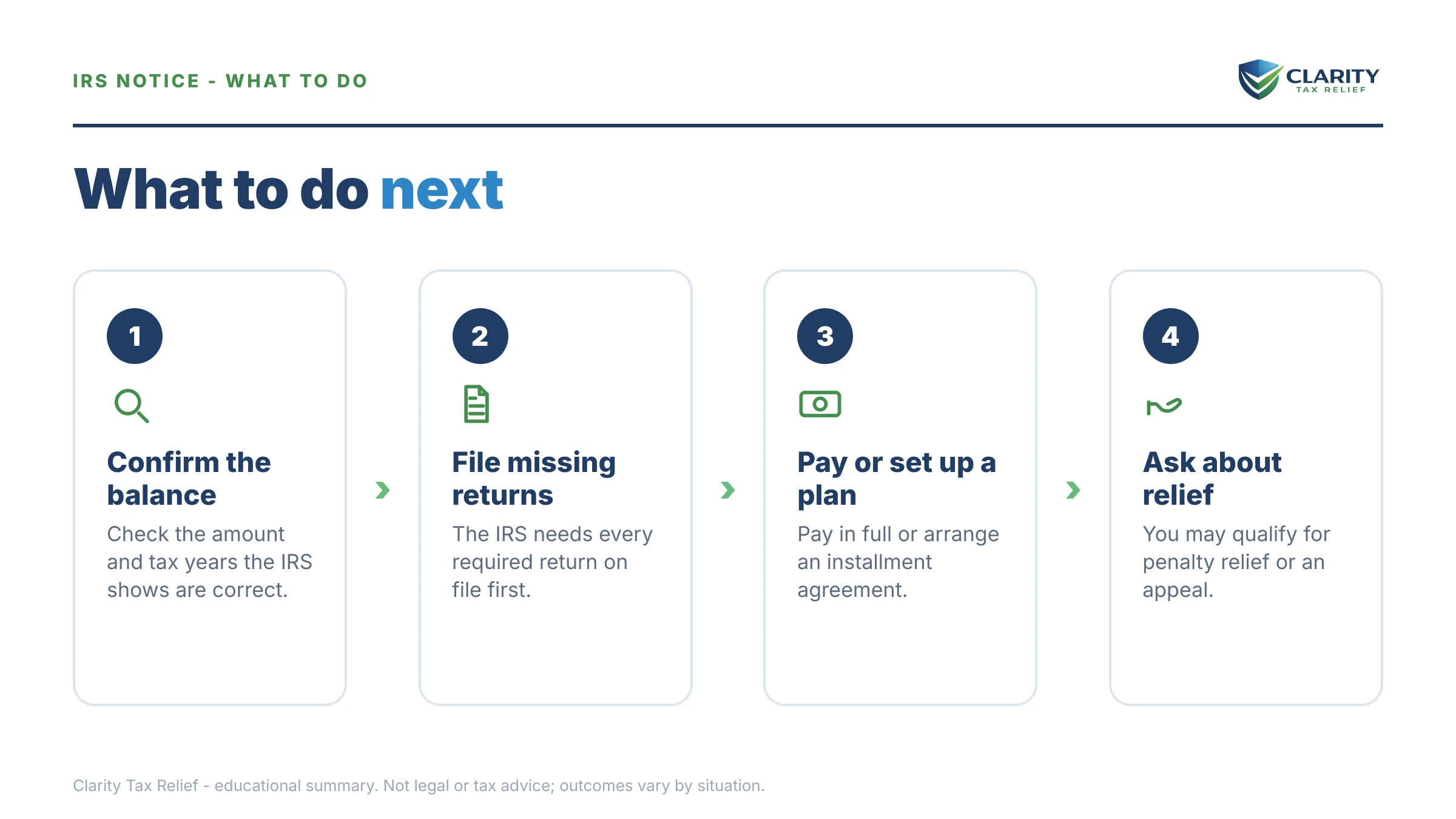
What happens if you ignore sales tax debt
Ignored sales tax debt escalates through a fixed sequence — notice, estimated assessment, lien, permit action, levy, then personal assessment — and the exact timing varies by state, but the order rarely does. Every stage removes an option you had at the stage before:
- Missing-return notice. The state flags unfiled periods and demands returns. Cheapest possible moment to act — voluntary disclosure may already be off the table, but everything else is open.
- Estimated assessment. The state invents a liability for you, typically high, and gives you a printed window to file actual returns or appeal. Silence makes the inflated number legally final.
- Penalties and interest compound. Late-filing and late-payment penalties stack on each unfiled period, and interest accrues on all of it, month after month.
- Lien or tax warrant filed. The debt attaches to your business and often personal property. In New York, a tax warrant functions as a civil judgment and a public record — visible to lenders, landlords, and customers. See how a NYS tax warrant works.
- Seller's permit revocation. The state pulls your license to make taxable sales. For a retailer, restaurant, or market seller, that's a shutdown order — and continuing to sell without a permit is a separate offense in many states.
- Levy and garnishment. Bank accounts, wages, merchant-processor deposits, and receivables. States often move here with less advance notice than the IRS gives.
- Responsible-person assessment. The trust-fund portion of the business's debt is assessed against you — or anyone who controlled the money — personally. The entity no longer matters; your personal assets do. Our guide to LLC back taxes personal liability covers who gets named.
- Criminal referral. Reserved for collected-and-kept tax, usually after prolonged silence. This is where a case stops being a math problem.
One 2026 reality check: state revenue agencies did not shrink the way the IRS did, and their data feeds — 1099-Ks, marketplace reports, license databases — keep improving. Non-filers are found by matching software, not by luck running out.
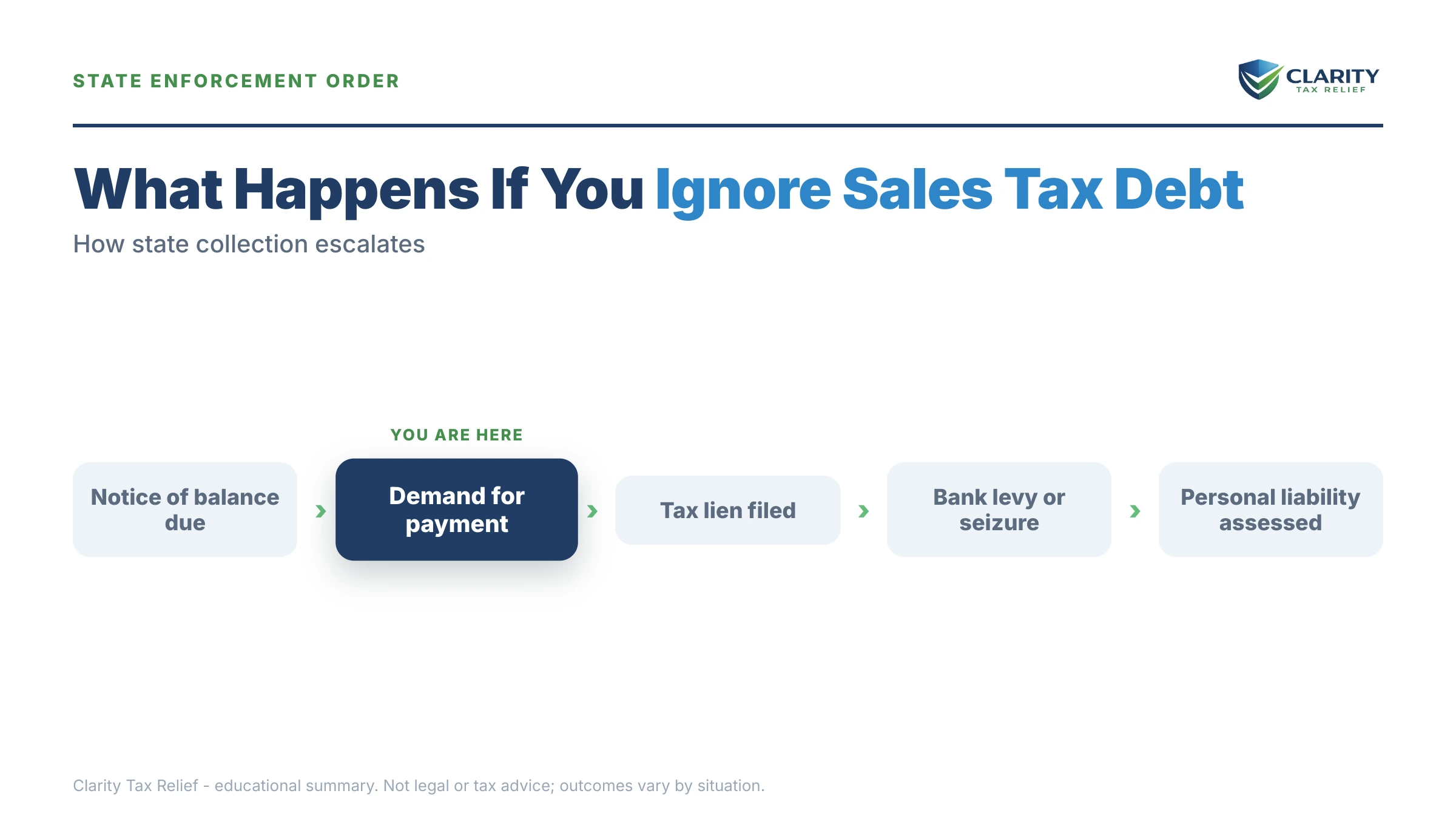
Holding a state sales tax notice right now?
Whether it's an estimated assessment, a permit warning, or a responsible-person letter, send us a photo. An experienced tax professional will decode which stage you're at, what the printed deadline protects, and the cheapest way out — free and confidential.
Your state sales tax debt relief options
Every state offers some version of five resolution paths, and which one fits depends on two questions: has the state contacted you yet, and does your balance include tax you actually collected? The general mechanics of negotiating a tax balance are covered in our guide on how to settle tax debt yourself — here's how each path applies specifically to sales tax:
| Option | Best fit | What it typically requires | Watch out for |
|---|---|---|---|
| Voluntary Disclosure Agreement (VDA) | Unregistered sellers the state hasn't contacted | Coming forward first; filing a limited lookback (often 3–4 years); paying tax + interest | Eligibility ends the moment the state contacts you — even a nexus questionnaire counts |
| File actual returns to replace estimates | Anyone hit with an estimated assessment | Reconstructed sales records; filing by the printed response date | Miss the window and the inflated estimate becomes final |
| State payment plan | Correct balance you can't pay at once | All returns filed; often 12–36 months; staying current on new periods | Shorter and stricter than IRS plans; default can trigger immediate levy |
| Penalty waiver / reasonable cause | First-time lapses, disaster, illness, bad professional advice | A written request with documentation; tax and interest usually still due | Waivers rarely cover collected-but-unremitted tax penalties |
| Settlement (state OIC-style program) | Documented inability to ever pay in full | Full financial disclosure; often a closed or insolvent business | Many states exclude the trust-fund portion; approval is never assured |
| Hardship / deferred collection | No ability to pay anything right now | Financial proof; periodic re-review | Interest keeps accruing; liens usually still filed |
The single most valuable option on that list is the one with an expiration trigger: a VDA is only available while the state doesn't know you exist. If you're unregistered with multiple years unfiled, that window — not any printed deadline — is your real clock.
State programs also differ enormously in the details. If your debt is in a specific state, start with the agency-specific guide: California back sales tax (CDTFA), Texas Comptroller tax debt, or Washington state back taxes.
Worked example: say you owe $6,200 across three unfiled years
Say you're a gig worker who sold handmade goods at markets and through your own website for three years without registering — roughly $82,000 in taxable sales at a 7.5% combined rate, so about $6,200 in sales tax that was never collected or remitted. This is a hypothetical, but the math pattern is what you'd see:
- If the state finds you first: many states stack late-filing and late-payment penalties that can reach roughly 25% of the tax across delinquent periods — call it about $1,550 here — plus interest, say around $700 on the older years. Total in the neighborhood of $8,450, assessed on the state's timeline, with your permit and personal liability in play. And if the state estimates instead of waiting for your returns, the opening number could be higher still.
- If you come forward first through a VDA: penalties are typically waived and the lookback capped, so you'd owe roughly the $6,200 of tax plus interest — call it about $6,900. On a 12-month state plan, that's roughly $575 a month; stretched to 24 months where allowed, roughly $290 a month while interest continues to accrue.
- The go-forward fix: registering and collecting properly costs you nothing — from day one, the 7.5% comes from customers at checkout instead of out of your pocket.
Same debt, same seller — a difference of about $1,550 plus the entire enforcement track, decided by who moves first.
How to respond to sales tax debt, step by step
- Pull your filing history. Request your account history from the state revenue agency — most have online business portals — so you know exactly which periods are unfiled, what has been assessed, and whether any of it is an estimate.
- File every missing return, even if you can't pay. Actual returns replace estimated assessments, which are almost always inflated, and filing stops the worst late-filing exposure. Use bank deposits, POS reports, marketplace summaries, and 1099-Ks to reconstruct sales.
- Verify or contest the assessment. Compare the state's numbers to your real records — exempt sales, resale transactions, and marketplace-collected tax are often counted against you. Appeal by the date printed on the notice if the figures are wrong.
- Choose your resolution path. If you were never registered and the state hasn't contacted you, pursue a voluntary disclosure agreement first. Otherwise, set up the state's payment plan, request penalty relief, or pursue a settlement if you genuinely cannot pay.
- Get compliant going forward before you negotiate. Register, collect, and remit on every current period. No state will finalize a plan or a deal while new sales tax debt is still piling up behind it.
Deadlines and appeal rights: what each state notice protects
Every stage of a state sales tax case comes with a right that expires on the date printed on that stage's notice — and unlike IRS notices, the windows vary by state, so the printed date is the only one that counts. What's at stake at each stage:
| What arrives | The right at stake | Where your deadline is |
|---|---|---|
| Demand to file / missing-return notice | Filing your own numbers before the state estimates them | Response date printed on the notice |
| Estimated or proposed assessment | Replacing the estimate with actual returns, or petitioning the amount | Appeal/petition date printed on the assessment — varies by state |
| Final assessment / bill | Administrative appeal before the debt becomes collectible | Printed appeal window; missing it usually ends the dispute |
| Lien or tax warrant notice | Resolving before a public filing damages credit and vendor relationships | Any cure date on the notice; act before recording |
| Permit revocation / intent to levy | A hearing or emergency resolution before shutdown or seizure | Hearing-request date on the notice — often the shortest window of all |
| Responsible-person proposal | Contesting that YOU are personally liable before it's assessed | Protest date on the proposal letter |
If your notice is from an agency named in this table's neighborhood — the California Department of Tax and Fee Administration, the Texas Comptroller of Public Accounts, or the New York State Department of Taxation and Finance — the agency's own site publishes the exact appeal windows and plan terms. When a figure isn't printed on your notice, confirm it with the agency rather than assuming another state's rule applies.
Special situations that change the answer
Gig and marketplace sellers. If most of your sales ran through Amazon, Etsy, or eBay, marketplace facilitator laws likely made the platform responsible for collecting on those orders in recent years — your exposure is usually the direct sales: your own site, markets, in-person. Pull your platform tax reports before you panic; the debt may be smaller than the 1099-K suggests. (And note the 1099-K $20,000 threshold in 2026 changes what gets reported — not what was ever owed.)
Multistate sellers. Economic nexus means you can owe several states at once, each with its own thresholds and lookbacks. Resolving them one at a time, worst-first, with VDAs where you're still eligible, usually beats waiting for each to find you.
You closed the business. The debt survives, and the trust-fund portion follows the people. If you sold the business, the buyer may be on the hook too under successor-liability rules. Full breakdown in our guide to a closed business owe sales tax situation.
Sales tax plus payroll tax. Restaurants and retailers behind on sales tax are often behind on federal payroll deposits too — a second trust-fund debt with its own personal-liability rules. The IRS side is covered in our guide to 941 back taxes. Both debts reach you personally; neither waits for the other.
You're under audit. A state exam of your sales records is a different fight from a collection case — markup tests, exempt-sale documentation, and sampling methods drive the number. See our guide to defending a sales tax audit before you hand over records.
When you can handle sales tax debt yourself
You can usually handle it yourself when the balance is small, the returns are filed, and no tax was collected and kept. Concretely:
- DIY is reasonable if: you owe a few thousand dollars on filed returns, the state's numbers match your records, and you just need the standard online payment plan — most state portals set one up in under an hour. A single missed quarter with a penalty you can explain is also a fair DIY penalty-waiver request.
- Experienced help changes the outcome when: you have multiple years unfiled or were never registered (the VDA has to be negotiated before your name surfaces), the balance includes tax you collected and spent (criminal exposure means every statement matters), a permit revocation or levy is already in motion, you're facing a responsible-person assessment, or you owe several states at once.
The honest line: states negotiate plans with self-represented owners every day. What they don't do is warn you which of your answers on a financial questionnaire will later anchor a personal assessment. If collected-and-kept tax or criminal exposure is anywhere in your fact pattern, read our guide on whether you need a tax attorney for back taxes before your first call to the state.
If your balance includes tax you actually collected from customers, get your notice and your numbers reviewed by an experienced tax professional before you say anything to the state — the free case review takes two minutes to request, or call (888) 825-7779.
Terms on your state notice, decoded
- Trust fund tax: tax you collect from someone else (customers, employees) and hold for the government — the category of debt states pursue personally and, in bad cases, criminally.
- Estimated assessment: a liability the state calculates for you when returns don't arrive — usually inflated, and it becomes final if you don't file or appeal by the printed date.
- Tax warrant: some states' version of a lien with teeth — in New York it operates as a civil judgment and a public record against everything you own.
- Responsible person: anyone with the duty and authority over the money — owner, officer, sometimes a bookkeeper or check-signer — whom the state can assess personally for the trust-fund portion.
- Nexus: the connection (physical presence or enough sales into the state) that creates your duty to collect that state's sales tax.
- Seller's permit: your license to make taxable sales — revocable for unpaid sales tax, and selling without it can be a separate violation.
Sales tax debt help: your questions answered
Can you go to jail for not paying sales tax?
It is possible — but almost always for collecting sales tax from customers and keeping it, not simply for owing it. Most states treat collected-but-unremitted sales tax as theft of public funds and can prosecute larger amounts as a felony. Cases stay civil when the owner files, communicates, and gets on a plan; prosecutions typically involve years of silence plus collected tax that was spent. If your balance includes tax you actually collected, treat it with real urgency.
Am I personally liable for my LLC's or corporation's sales tax debt?
Usually yes, for the trust-fund portion. Nearly every state has a responsible-person statute that lets it assess collected-but-unremitted sales tax against owners, officers, or anyone who controlled the money — the LLC or corporate shield does not block it. The state generally has to show you had a duty and the authority over funds, which is why bookkeepers and check-signers sometimes get pulled in too.
Does sales tax debt expire after 10 years?
No — the IRS's 10-year collection statute does not apply to state sales tax. Each state sets its own collection window, and several make the debt effectively permanent once a lien, warrant, or judgment is filed. New York, for example, converts state tax debt into a civil judgment through a tax warrant. Waiting a state out is not a strategy; the balance only compounds.
Can sales tax debt be settled or forgiven for less than I owe?
Sometimes, but expect a harder path than with the IRS. Many states run offer-in-compromise-style programs, and most of them exclude or heavily restrict the trust-fund portion — tax you collected from customers. Penalty waivers are granted far more often than reductions of the tax itself. A documented, genuine inability to pay is the only route to a reduced balance, and no outcome is ever assured.
What is a voluntary disclosure agreement (VDA) for sales tax?
A VDA is a deal for sellers the state has not contacted yet: you come forward, register, and file a limited number of back years — commonly three or four — and the state typically waives penalties and agrees not to pursue earlier periods. You lose eligibility the moment the state finds you first, which is why unregistered sellers should move before a nexus questionnaire or assessment letter arrives.
I closed my business — do I still owe the sales tax?
Yes. Closing or dissolving the entity does not erase sales tax debt, and the trust-fund portion follows the responsible people personally after the business is gone. Many states also hold the buyer of a business liable if it was sold without a tax clearance certificate. Filing the final returns and negotiating the balance is still necessary even after the doors close.
I never collected sales tax from my customers — do I still owe it?
Yes. If your sales were taxable and you had nexus, the tax was legally due whether or not you added it at checkout — so now it comes out of your own pocket. Some states let you treat past prices as tax-included, which slightly lowers the taxable base and the bill. An experienced tax professional can run both calculations before you file the back returns.
Do I owe back sales tax on Etsy, Amazon, or eBay sales?
Usually not for recent years. Marketplace facilitator laws — in place in every sales-tax state since roughly 2019 to 2020 — require the platform to collect and remit tax on marketplace orders. But sales through your own website, at markets, or in person are still your responsibility, and periods before your state's facilitator law took effect may still be open.
How do state payment plans for sales tax work?
Most states offer installment plans, but they are generally shorter and stricter than IRS plans — many expect the balance cleared within roughly 12 to 36 months, require all current returns filed and paid on time, and some ask for financial disclosure or a down payment. Defaulting usually reinstates waived penalties and can trigger immediate levy or permit action, so set a payment you can actually sustain.
Your next 24 hours
- Find the controlling facts on your notice: the agency name, the tax periods listed, whether the amount is marked "estimated," and the response or appeal date printed on it. That date decides what's still fixable.
- Gather your sales records for the periods in question — bank deposits, POS or marketplace reports, 1099-Ks, and any prior state letters. Real numbers are what shrink an estimated assessment.
- Get a free case review of your sales tax situation — the 2-minute form or (888) 825-7779. Penalties and interest accrue monthly, and if you're an unregistered seller, voluntary-disclosure eligibility lasts only until the state contacts you first — moving now is what keeps the cheapest options open.
This guide is general information, not tax or legal advice for your specific situation. Eligibility for IRS programs depends on individual facts and circumstances; no outcome is guaranteed. State programs, deadlines, and penalty structures vary — confirm figures with your state's revenue agency or an experienced tax professional.