
State Tax Debt
Texas Comptroller Tax Debt: What You Owe, What They Can Do, and Your Options (2026)
The short answer: Texas Comptroller tax debt is almost always business tax — sales and use tax or franchise tax — because Texas has no personal income tax. Once an assessment becomes final, the Comptroller can freeze bank accounts, file liens, and suspend your sales tax permit without going to court. Payment agreements and penalty waivers exist, but the dispute window is short.
You did the work, the checks cleared, and now an envelope from the Texas Comptroller of Public Accounts says you owe tens of thousands in tax you never knew you were supposed to collect. For a 1099 contractor, that's the gut-punch of Comptroller debt: the state isn't billing you for income tax — it's billing you for sales tax on your own invoices. It's fixable, and the fixes work best in the first weeks, so here's the map.
Two documents dominate this problem — the billing notice and the Notice of Determination — and they carry very different stakes. The image below shows you exactly what a Comptroller notice looks like and where to find the figures and date that control your options.
⏱ Your deadline: you generally have 60 days from the date printed on a Texas Notice of Determination to file a petition for redetermination — the date on your notice controls, so check it now. Miss it and the assessment becomes final, penalties and interest keep accruing monthly, and the Comptroller's collection tools unlock without any court order.
Why you owe the Texas Comptroller (and why it's never income tax)
The Texas Comptroller collects business taxes — sales and use tax, franchise tax, mixed beverage, hotel occupancy, and motor fuels taxes — not personal income tax, which Texas doesn't have. So if the Comptroller says you owe, it's almost always one of these:
- Sales tax you should have collected but didn't. Texas taxes more than retail goods. Commercial repair and remodeling, many repair services, equipment rentals, and some digital and data services are taxable. Contractors get caught here constantly: residential repair and new construction are generally treated differently than commercial remodeling, and misclassifying one job type across four years of invoices produces a five- or six-figure sales tax audit assessment.
- Sales tax you collected but didn't send in. This is the most dangerous category. That money was the state's from the moment your customer paid it — Texas treats it as trust money, and keeping it can create personal liability and even criminal exposure, regardless of your LLC or corporation.
- Franchise tax. Texas's tax on business entities. Most small operations owe little or nothing — no tax is due below a revenue threshold in the millions (roughly $2.47 million in annualized revenue for recent report years) — but failing to file the report at all triggers penalties and, eventually, forfeiture of your entity's right to do business. See our guide to franchise tax debt.
- Use tax on out-of-state purchases, or nexus-based assessments against online sellers who built Texas sales without registering — the sales tax nexus back taxes problem.
Penalties stack fast. A late sales tax payment picks up a 5% penalty, doubling to 10% once you're more than 30 days late, an audit deficiency determination typically adds its own penalty on top, fraud can add 50%, and interest accrues at a floating rate tied to prime until the balance is zero.
What happens if you ignore Texas Comptroller tax debt
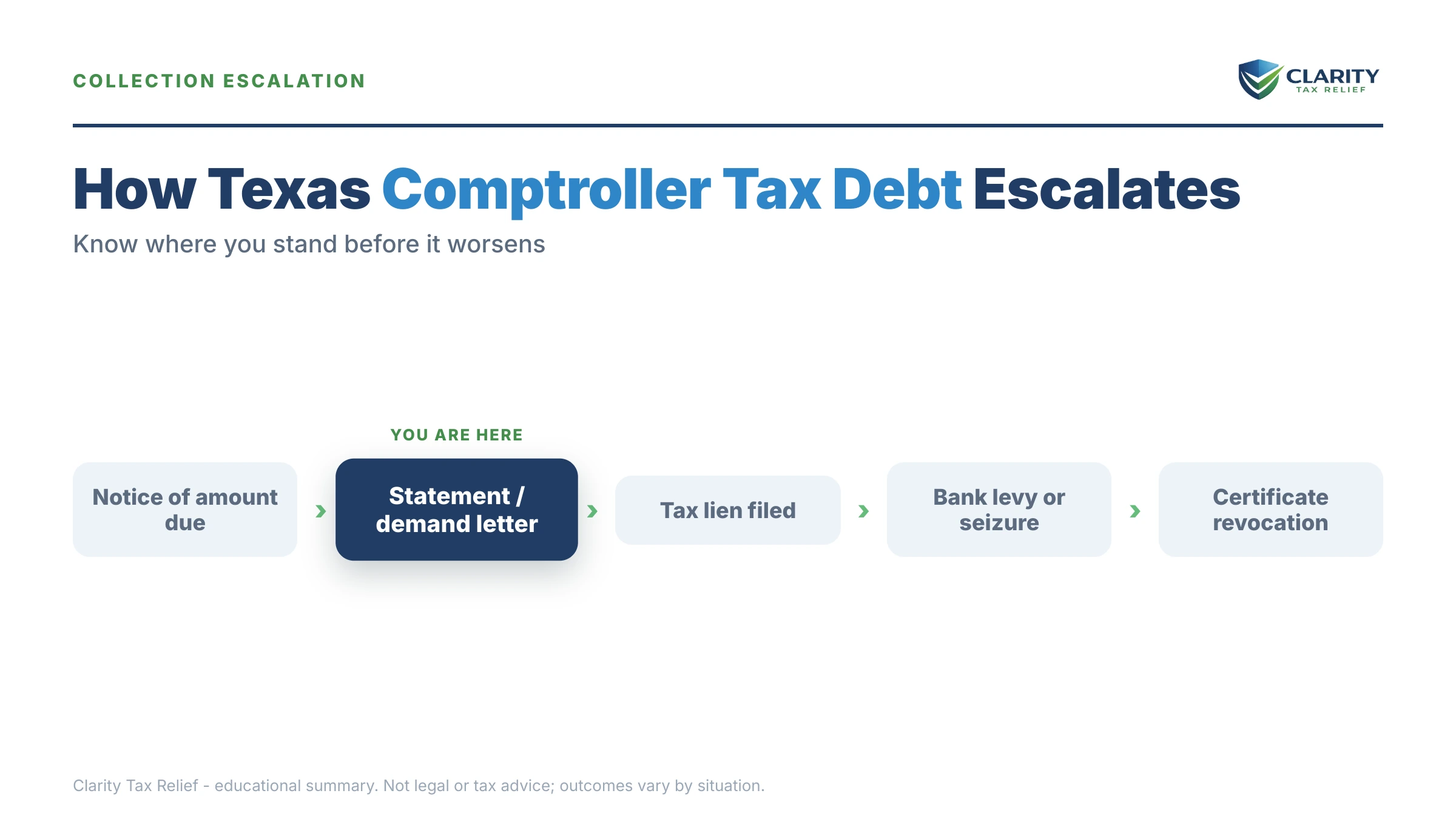
The Comptroller does not need a judge's permission to collect — once a determination is final, enforcement is administrative and largely automated. Ignore the notices and the sequence runs like this:
- Billing notice or audit assessment. The state tells you what it thinks you owe — sometimes an estimated figure built from industry averages when you stopped filing, which is usually higher than reality.
- Notice of Determination. The formal assessment. Your redetermination window runs from the date printed on it. Do nothing and the debt becomes final and legally collectible.
- State tax lien. Filed in county records — a public document that attaches to your property, wrecks financing, and shows up in any business credit pull.
- Bank account freeze and levy. The Comptroller sends a freeze notice directly to your bank; the bank holds your funds and remits them to the state. For a contractor, a frozen operating account mid-project is a business-ending event.
- Sales tax permit suspension and bond demands. Selling taxable goods or services without an active permit is illegal — suspension is functionally a shutdown order. Reinstatement can require posting a security bond.
- Escalated collection. Referral to contracted collection firms or the Texas Attorney General for suit, a warrant "hold" that intercepts any payment a state agency owes you, franchise forfeiture that exposes officers and directors personally, and — for collected-but-kept sales tax — potential criminal referral.
Notice what's missing from that list: a courtroom. Every step before an Attorney General lawsuit happens without one, which is why "I never got sued" is not a sign you're safe.
Holding a Comptroller notice right now?
Send us a photo of it before the redetermination window printed on it closes. An experienced tax professional will tell you whether the assessment is inflated, what a payment agreement would look like, and which penalties can realistically come off — free and confidential.
Your options for resolving Texas Comptroller tax debt
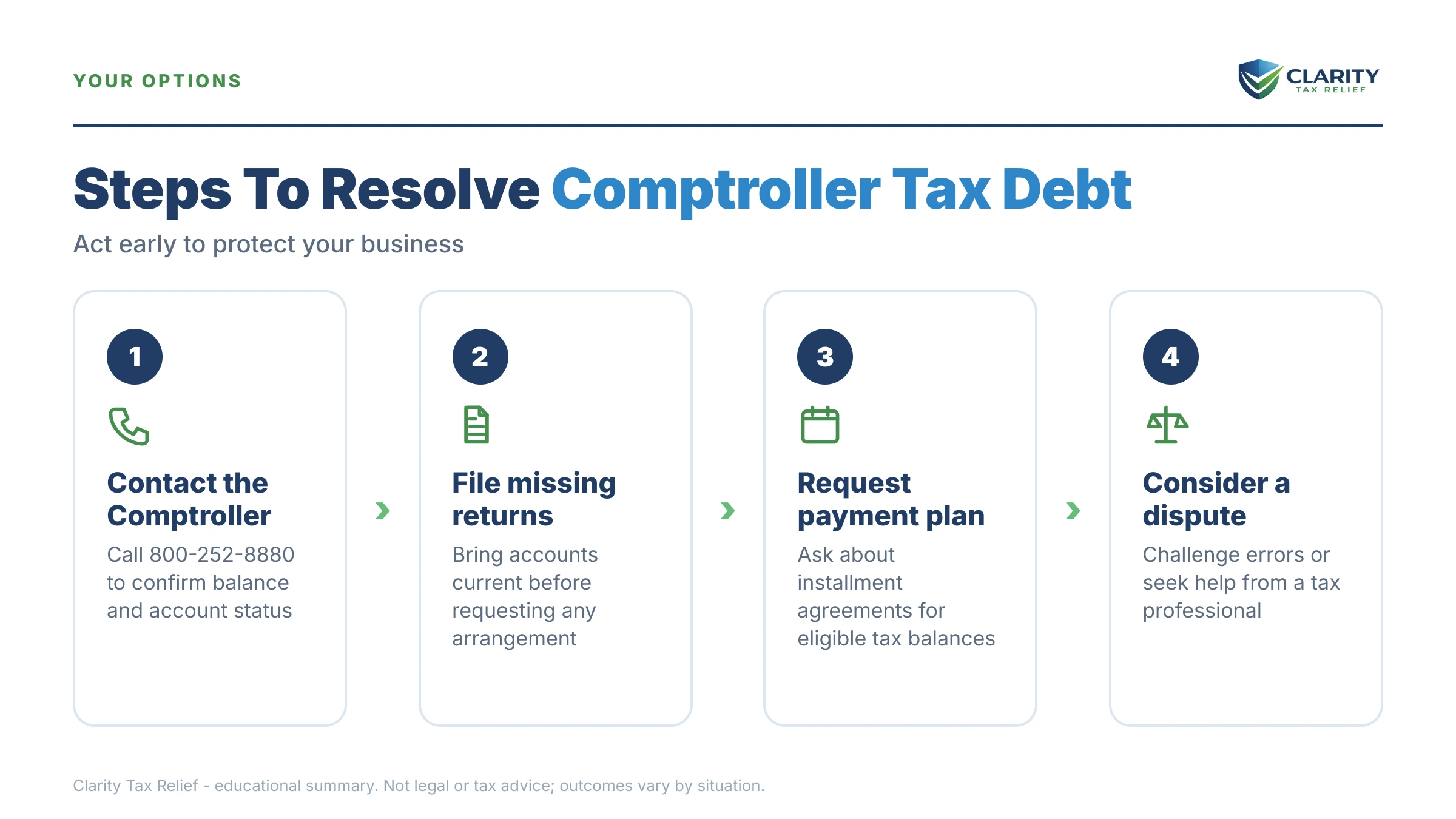
Texas has no broad settlement program like the IRS Offer in Compromise — real relief comes from disputing the number, removing penalties, or restructuring the payment. Which door is open depends on where you are in the sequence:
| Option | Who it fits | What it does |
|---|---|---|
| Pay in full | Small balances you can clear now | Stops interest, prevents liens and freezes; you can still seek a penalty waiver afterward |
| Petition for redetermination | Anyone whose Notice of Determination is wrong or inflated — still inside the window on the notice | Freezes the assessment from becoming final and forces the state to re-examine the numbers, exemptions, and job classifications |
| Payment agreement | Correct balances you can't pay at once; must stay current on all new filings | Spreads payment over months (shorter terms than IRS plans); voluntary contact usually heads off freezes |
| Penalty waiver request | Taxpayers with a clean compliance history or genuine reasonable cause (disaster, serious illness, reliance on bad written guidance) | Removes some or all penalties; tax and interest generally remain |
| Voluntary Disclosure Agreement (VDA) | Businesses that never registered and haven't yet been contacted by the Comptroller | Limits how many back years the state pursues and typically waives penalties in exchange for coming forward |
| Bankruptcy (narrow cases) | Rarely useful — collected sales tax is trust-fund debt and generally survives | May restructure other debts around the tax; get case-specific advice before relying on it |
What each option costs and how long it takes
| Option | Out-of-pocket cost | Timeline reality |
|---|---|---|
| Redetermination | No state filing fee; professional help is the main cost | Must be filed inside the window on your notice; the hearing process can run months — collection generally pauses on the disputed amount while it does |
| Payment agreement | No setup fee; interest continues on the unpaid balance | Set up through Enforcement in days to weeks; terms are short, so monthly payments run higher than an equivalent IRS plan |
| Penalty waiver | Free to request in writing | Weeks to a few months for a decision; a denial can be re-argued with better documentation |
| VDA | You pay the limited-lookback tax plus interest; penalties typically waived | Weeks to negotiate — but only available before the state finds you first |
What a $92,700 assessment actually looks like — and how it shrinks
Most large Comptroller balances are audit math, and audit math can be challenged line by line. Say you're a 1099 contractor doing repair and remodel work around Dallas, and a four-year sales tax audit lands at $92,700. A typical breakdown (hypothetical example):
- Taxable receipts the auditor identified: $1,000,000 across four years, none of it taxed
- Tax at the 8.25% maximum combined state-and-local rate (your local rate may be lower): $82,500
- Late penalties at 10%: $8,250
- Accrued interest: $1,950
- Total on the Notice of Determination: $92,700
Now suppose $300,000 of those receipts were actually residential repair jobs or new construction the auditor lumped in with taxable commercial remodeling. Reclassifying them cuts the tax by $24,750, and the penalty and interest tied to it fall away proportionally — the assessment drops below $65,000 before anyone asks for a penalty waiver. That's what a redetermination is for, and it's why the 60-day-window math matters more than any payment plan: you can't negotiate a wrong number down as effectively as you can correct it. The pattern here — inflated job classification, missing exemption certificates, estimated periods — is the pattern in most contractor audits. Our contractor back taxes guide covers the record-rebuilding side in depth.
Personal liability: when the business's debt becomes yours
An LLC does not shield you from collected-but-unremitted Texas sales tax. That money is trust money — the state's from the moment your customer paid it — and Texas can assess the individuals responsible for collecting and remitting it personally. Three other traps catch owners off guard:
- Franchise forfeiture. Let franchise filings lapse and the entity's corporate privileges are forfeited — after which officers and directors can be personally liable for debts the business creates during the forfeiture period.
- Closing the business doesn't close the debt. Trust-fund sales tax follows the responsible people, not the dissolved entity — see closed business owe sales tax.
- Successor liability. Buy a Texas business without a certificate showing no tax is due, and you can inherit the seller's Comptroller debt up to the purchase price.
Owe the IRS too? Handle the two debts in the right order
Comptroller debt and IRS debt live in completely separate systems, and paying one does nothing for the other. This hits self-employed Texans hardest: the state bills you for sales or franchise tax while the IRS bills you for self-employment tax on the same income — and the IRS side accrues its own failure-to-file and failure-to-pay penalties (you can estimate that side with our IRS Penalty & Interest Calculator). The IRS's 180-day short-term plans and 72-month installment agreements do not apply to Texas, and Texas's short payment agreements do not apply to the IRS. Which collector to satisfy first depends on who is closer to a freeze or levy — our guide to state tax debt vs IRS walks through the sequencing, and the broader Texas picture (including the federal side) lives in our Texas back taxes hub.
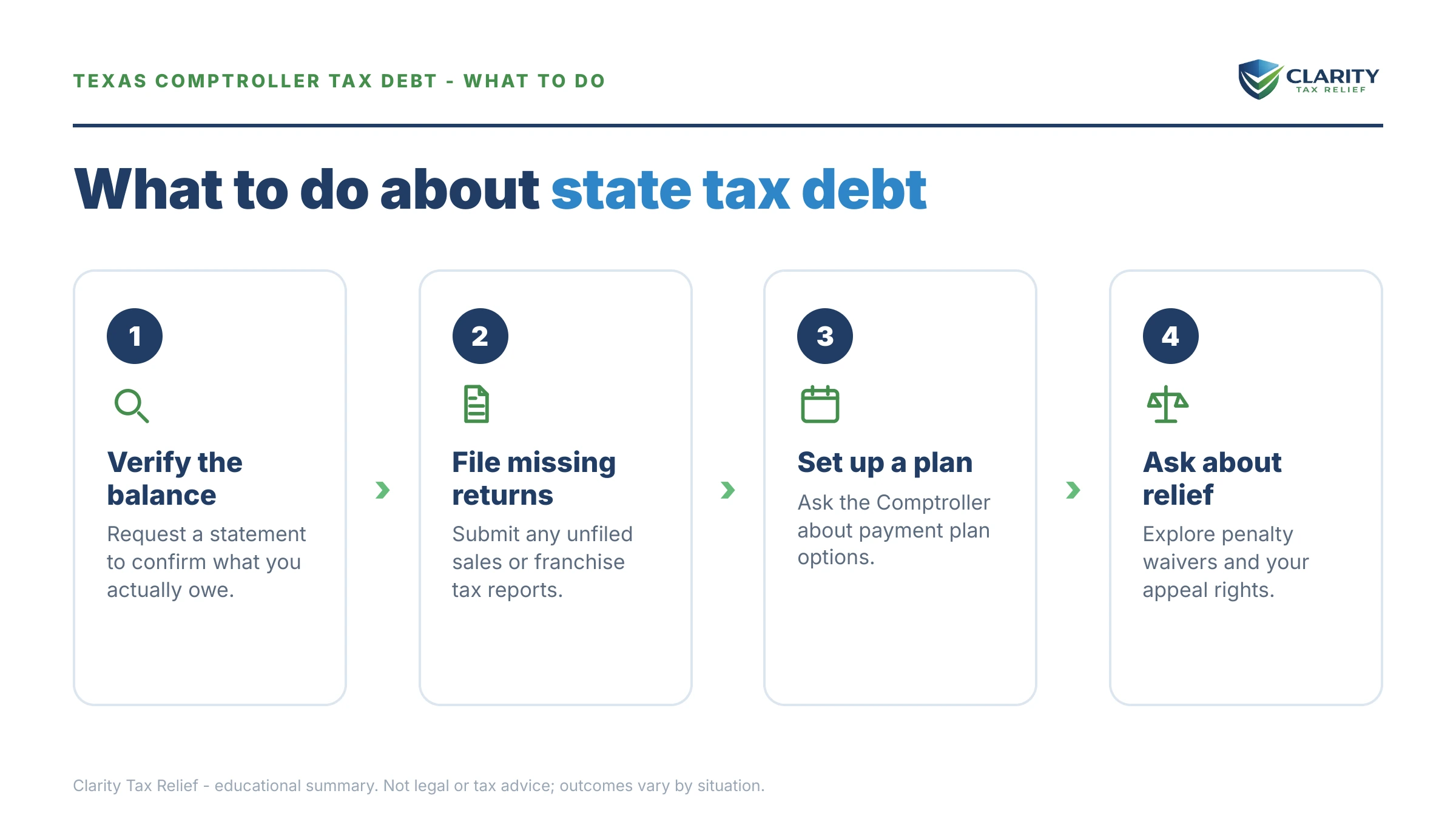
How to respond to a Texas Comptroller notice, step by step
- Identify the notice type and its date. A billing notice, an audit notification, and a Notice of Determination carry different stakes — and the date printed at the top starts your clock.
- Pull your records for the periods listed. Gather sales reports, resale and exemption certificates, contracts, and bank statements for every period on the notice — these are what reduce an assessment.
- Dispute on time if the number is wrong. File a petition for redetermination before the deadline tied to the date on your Notice of Determination — once it becomes final, dispute rights are largely gone.
- Set up a payment agreement if the number is right. Contact the Comptroller's Enforcement division before liens and freezes start; voluntary contact almost always buys better terms than silence.
- Request a penalty waiver in writing. Ask the Comptroller to waive penalties based on your compliance history or reasonable cause — waivers do not happen automatically.
- Get a professional review for large or personal-liability cases. If the assessment is large, the audit method looks inflated, or the state is pursuing you personally, have an experienced tax professional review the file before you sign anything.
When you can handle this yourself
Plenty of Comptroller problems don't need professional help. Handle it yourself when the balance is small and correct — a late filing you agree with, a penalty you can pay now, a straightforward payment agreement on a few thousand dollars. The Comptroller's phone agents will set up a short plan for a compliant taxpayer without drama, and a first-offense penalty waiver request is a one-page letter you can write.
Experienced help changes the outcome in four situations: a large audit assessment built on estimates or misclassified jobs (the redetermination is a technical argument about taxability, and the deadline is unforgiving); a bank freeze already in motion; the state pursuing you personally for an entity's trust-fund sales tax; and unregistered multi-year exposure, where a professionally negotiated VDA usually costs far less than waiting to be found. In each of these, the money at stake dwarfs the fee — and the mistakes are hard to unwind. For the general playbook across states, see sales tax debt help.
Terms on your notice, decoded
- Notice of Determination — the Comptroller's formal assessment; the date on it starts your window to dispute before the debt becomes final.
- Redetermination — the administrative appeal that forces the state to re-examine an assessment before it becomes collectible.
- Trust tax — sales tax you collected from customers; legally the state's money from the moment it was paid, which is why non-remittance creates personal liability.
- State tax lien — a public county-records filing that attaches the debt to your property; different from a freeze, which actually takes funds from your bank.
- Forfeiture of corporate privileges — the penalty for lapsed franchise filings; it strips the entity's right to do business and can expose officers and directors personally.
- Successor liability — the buyer of a business inheriting the seller's unpaid Comptroller taxes when no tax-clearance certificate was obtained.
Texas Comptroller tax debt: your questions, answered
Can the Texas Comptroller freeze my bank account without a court order?
Yes. Once an assessment is final, the Comptroller can send a freeze notice directly to your bank — no lawsuit or judge required. The bank holds the funds and then remits them to the state. The freeze usually arrives after a lien has been filed and warning notices have gone unanswered, which is why the window before a determination becomes final is the cheapest time to act.
Does the Texas Comptroller offer payment plans?
Yes — the Comptroller's Enforcement division sets up payment agreements, but they are generally much shorter than the IRS's 72-month plans, and interest keeps accruing while you pay. Expect to show why you cannot pay in full, and expect the state to want the debt cleared quickly. Staying current on every new sales tax filing during the agreement is mandatory — one missed report can void the deal.
Can I settle Texas Comptroller tax debt for less than I owe?
Texas has no broad settlement program like the IRS Offer in Compromise. Real reductions come from three places: a redetermination that corrects an inflated audit assessment, a penalty waiver for taxpayers with a good compliance history or genuine reasonable cause, and — for businesses that never registered — a Voluntary Disclosure Agreement that limits how many back years the state pursues. Anyone promising to slash a final Texas assessment for pennies on the dollar is selling a fantasy.
Am I personally liable for my LLC's Texas sales tax debt?
Often, yes. Sales tax you collected from customers is trust money — it was never the business's to spend — and Texas can assess the individuals responsible for collecting and remitting it personally, LLC or not. Separately, if the entity's franchise tax filings lapse and its corporate privileges are forfeited, officers and directors can become personally liable for debts the business incurs during the forfeiture period.
How far back can a Texas Comptroller audit go?
Generally four years from when the tax was due. That limit disappears in two situations: you never filed the required reports, or the state can show fraud or willful evasion — then the Comptroller can reach back as far as it wants. This is why unregistered businesses often come out ahead using the Voluntary Disclosure Agreement, which typically caps the lookback in exchange for coming forward voluntarily.
What is a Texas Notice of Determination?
It is the Comptroller's formal assessment — the document that turns an audit result or estimated billing into a legal debt. You generally have 60 days from the date on the notice to file a petition for redetermination; check your own notice, because the printed date controls. If you do nothing, the determination becomes final and the state's collection tools — liens, freezes, permit suspension — unlock without any court involvement.
Is Texas Comptroller debt connected to my IRS debt?
No — they are entirely separate systems. Paying the Comptroller does nothing for an IRS balance, and an IRS installment agreement does not protect you from a Texas bank freeze. Many self-employed Texans owe both at once: sales or franchise tax to the state, and self-employment income tax to the IRS. Each debt needs its own resolution, and the sequencing matters because the more aggressive collector usually needs attention first.
Can the Comptroller suspend my sales tax permit?
Yes, and it is one of the state's most effective pressure tools, because making taxable sales without an active permit is illegal. For a retailer, contractor, or restaurant, suspension is functionally a shutdown order. The Comptroller can also demand a security bond before reinstating a permit for a business with a delinquency history, which raises the cost of getting back to work.
Your next 24 hours
- Find the notice type and date. Look at the top of the document: is it a billing notice or a Notice of Determination, and what date is printed on it? That date tells you whether your dispute window is still open.
- Gather the paper that shrinks the number. Sales reports for the periods listed, resale and exemption certificates, contracts showing job type (residential vs. commercial), and your last franchise report. You can verify your account status directly with the Texas Comptroller of Public Accounts, and check any parallel federal balance at IRS.gov/payments.
- Get the assessment reviewed free — before the redetermination window on your notice closes. Use the 2-minute form at claritytaxrelief.com/#consult or call (888) 825-7779. Ten minutes with an experienced tax professional tells you whether to dispute, negotiate, or simply pay — and in which order.
This guide is general information, not tax or legal advice for your specific situation. Eligibility for IRS programs depends on individual facts and circumstances; no outcome is guaranteed.