
Back Taxes by Profession
Contractor Back Taxes: How to Fix IRS Debt From 1099 Income, Cash Jobs, and Sub Crews (2026)
The short answer: contractor back taxes usually build from 1099 income with no withholding, missed quarterly estimates, and 15.3% self-employment tax. The fix runs in one order: file every missing return first, then resolve the balance through a payment plan, hardship status, or an Offer in Compromise — while penalties of 0.5% per month keep accruing.
The checks came in all season — 1099s from the GC, deposits from homeowners, cash for the small jobs — and nothing was ever held out for taxes. Now a return is behind, or several are, and the IRS letters landing in the truck's glovebox keep quoting a bigger number. This is one of the most fixable debts the IRS collects, but only if you attack it in the right order.
⏱ Your real clock: there is no single deadline on contractor back taxes — the clock is the accrual itself. The failure-to-pay penalty adds 0.5% of the balance every month, interest compounds daily on top, and any unfiled year racks up a failure-to-file penalty at 5% per month — ten times faster. If an IRS notice is in front of you, the date printed on that notice is your controlling deadline.
Why contractors end up owing back taxes
Contractor tax debt almost always comes from one of five engines — and most contractors we talk to are running three of them at once. No one withholds a dime from a 1099 check, so the entire income tax bill plus 15.3% self-employment tax lands at filing. If that self-employment tax shock arrives in a slow quarter, the balance rolls — and the next year stacks on top.
The construction trades add three complications most 1099 workers never face. Cash jobs create income the IRS can reconstruct from bank deposits even when you never got a form. Materials, mileage, and sub labor mean your deductions — not your gross — determine the real bill, and lost receipts inflate what the IRS thinks you owe. And if you run your own crew of 1099 subs, you're carrying a payroll tax risk that can dwarf your income tax balance entirely.
| Debt engine | How it shows up | The first fix |
|---|---|---|
| 1099 income with no withholding + SE tax | Balance due at filing; CP14 bills follow | File on time, then size a payment plan to cash flow |
| Missed quarterly estimates | Estimated-tax penalty stacking every single year | Start current quarterlies; annualize seasonal income |
| Cash jobs and underreported income | CP2000 mismatch or bank-deposit audit exposure | Reconstruct records and correct returns before the IRS does |
| Misclassified 1099 subs | Form 941 payroll assessments + personal TFRP exposure | Classification review — Form SS-8 factors, Section 530 relief |
| Unfiled years | Substitute-for-return assessments with zero deductions | File real returns over the SFRs — the six-year catch-up |
What a $6,200 contractor tax bill actually costs
A hypothetical $6,200 balance grows by roughly $31 in penalty alone every month it sits, before interest. Say you worked W-2 for a framing outfit through June — single filer, normal withholding — then went out on your own as a 1099 sub for the back half of the year. You net $27,000 on your own jobs after materials and mileage. Self-employment tax alone runs $27,000 × 92.35% × 15.3% ≈ $3,815. Add the income tax your W-2 withholding never covered, and the return shows about $6,200 due.
Here's the math on letting it ride versus acting:
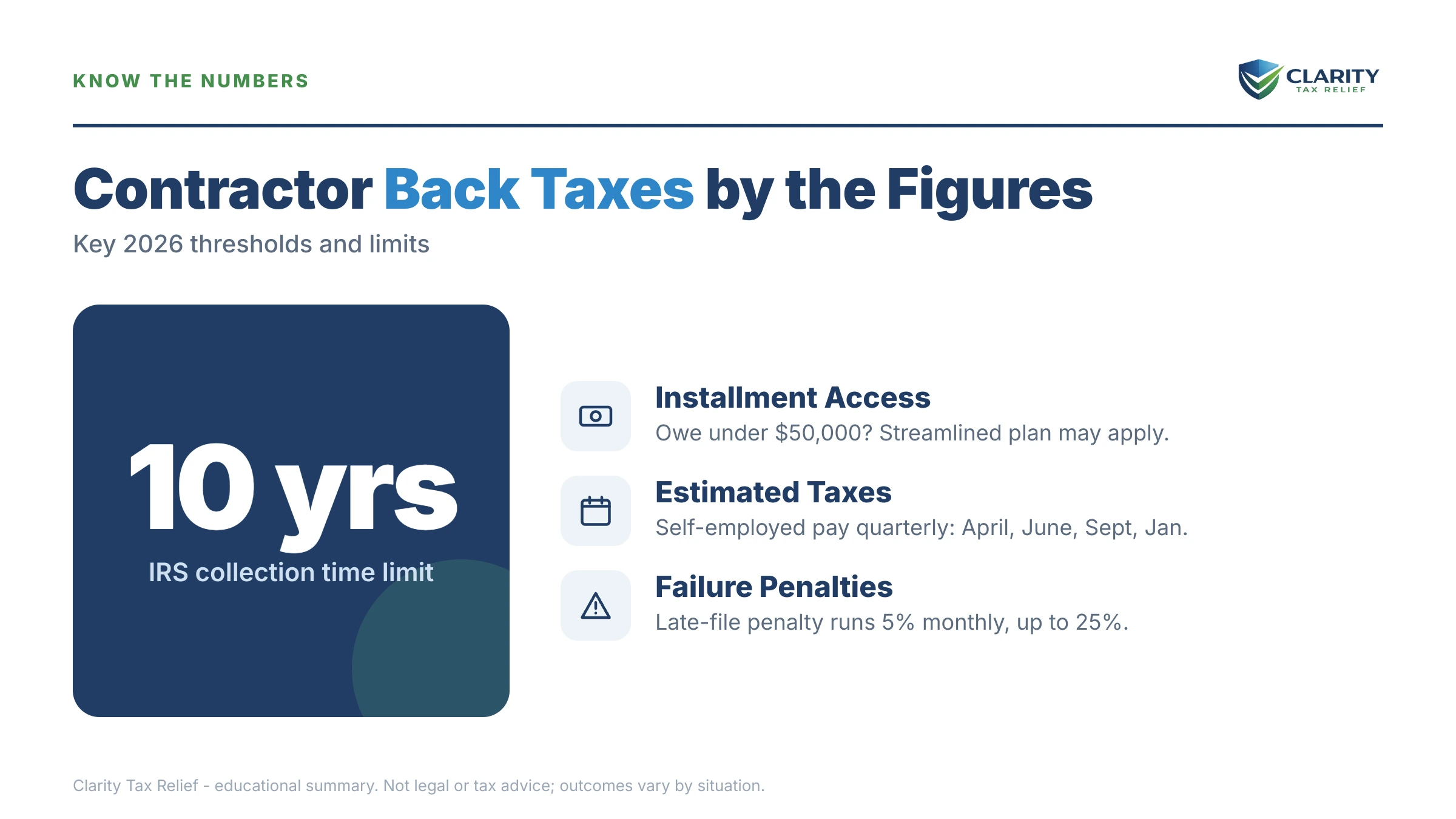
- Do nothing after filing: failure-to-pay penalty of 0.5% × $6,200 = about $31/month, roughly $372 a year, plus daily compounding interest at the federal rate (adjusted quarterly). Estimate your own accruals with our IRS penalty & interest calculator.
- Don't file at all: the failure-to-file penalty runs 5% per month — about $310/month on this balance — and caps at 25%, or $1,550, by month five. Filing even when you can't pay avoids the 10× penalty.
- Short-term payment plan (180 days, $0 setup): six payments of roughly $1,035 clears it, with modest accruals on the declining balance.
- Guaranteed installment agreement: because the balance is $10,000 or less and (say) your prior five years are clean, the IRS must accept a plan that full-pays within three years — about $172/month on a 36-month schedule, plus continuing penalties and interest until paid.
This example is deliberately small. The same order of operations applies at $62,000 — only the option that fits changes, as the tables below show.
The 1099-sub problem: when your income tax debt hides a payroll tax bomb
Misclassified subs can convert a manageable income tax balance into personal payroll tax liability that no LLC protects you from. If your "subs" work your schedule, use your tools, and take direction like employees, the IRS can reclassify them — assessing back Form 941 employment taxes, failure-to-deposit penalties that scale up to 15%, and interest against the business.
Worse, the trust-fund portion of any unpaid payroll tax follows the people, not the entity. Through the Trust Fund Recovery Penalty, the IRS can personally assess whoever was responsible and willful — usually the owner, sometimes whoever signed the checks. Two things cut this risk before an examiner ever raises it: a genuine classification review under the Form SS-8 factors, and Section 530 relief, a safe harbor for contractors who consistently 1099'd their crew and had a reasonable industry basis for doing so. The worker misclassification penalty guide covers both, and if you already run W-2 payroll that's behind, start with construction payroll tax debt instead — the rules and the urgency are different.
One more trap: paying subs in cash with no 1099-NECs. You lose the cleanest proof of your labor deduction, you pick up per-form penalties, and you invite exactly the classification exam described above. Late-filed 1099s beat missing ones.
Unfiled years: why the IRS's number is almost always too high
When a contractor doesn't file, the IRS eventually files for them — and its version allows zero deductions. A CP59 notice asks for the missing return; ignore it and the IRS builds a substitute for return from your 1099s: gross receipts, no materials, no mileage, no sub labor, single filing status, then assesses the inflated result. If the IRS filed a substitute return for one of your years, filing your real return over it is usually the single biggest reduction available to you — bigger than any settlement program.
Getting compliant generally means the last six years of returns — see how many years of back taxes you have to file — and lost paperwork is not a dead end. Your wage and income transcripts show every 1099 ever reported under your SSN, and bank statements, supplier accounts, and job files can rebuild deductions; the full method is in filing back taxes without records. If a filed year is simply wrong — a duplicated 1099, reimbursed materials counted as income — you can amend a return to reduce tax debt before resolving the balance.
What happens if you ignore contractor back taxes
The IRS collection sequence against a contractor is fully automated and ends at your bank account and your payors — the people who write your checks. In 2026, with the IRS workforce down roughly 27%, humans are harder to reach than ever, but the notice-and-levy machine never stopped running. For a filed-but-unpaid year, the stages run in this order:
- CP14 — the first bill. Roughly 21 days to pay before the sequence advances. Cheapest moment to act.
- CP501 / CP503 — reminders. Still just bills, but the balance compounds monthly and a federal tax lien becomes more likely.
- CP504 — intent to levy your state refund. Under IRC §6331(d) the IRS can now take your state tax refund. Not yet the final notice.
- LT11 / Letter 1058 — final notice of intent to levy. A 30-day clock starts, along with Collection Due Process appeal rights you request on Form 12153. This is the last cheap exit.
- Levy. Bank accounts (funds are held 21 days before they're sent), and levies served directly on the GCs and customers who owe you money — the answer to can the IRS garnish 1099 income is yes, payor by payor. A levy notice arriving at your builder's office also tells your best customer you owe the IRS.
Unfiled years run a parallel track — CP59, then the substitute return, then a deficiency notice — that merges into the same levy pipeline. And once your assessed balance crosses $66,000 (the 2026 threshold), the IRS can certify the debt to the State Department, which can deny or revoke your passport. Growing balances also block SBA lending and bonding reviews long before a levy ever lands.
Behind on taxes from contracting work?
Send us your latest IRS notice or just the years involved. An experienced tax professional will map exactly where you sit in the collection sequence and which fix costs the least — free, confidential, before another month of penalties posts.
Your options for resolving contractor tax debt
Every contractor tax debt resolves through one of six programs, and eligibility is set by hard numbers, not negotiation skill. The shared mechanics of each program live in our guide to how to settle tax debt yourself; here's how they map to a contractor's balance and cash flow:
| Option | Eligibility threshold | Key condition |
|---|---|---|
| Short-term payment plan | Any balance you can clear in 180 days | $0 setup; interest and penalties continue |
| Guaranteed installment agreement | $10,000 or less | Full pay within 3 years; recent filing history clean |
| Streamlined installment agreement | Up to $50,000, set up online | Up to 72 months; no detailed financial disclosure |
| Non-streamlined agreement | Over $50,000 | Form 433 financials; asset and income review |
| Currently Not Collectible | Allowable living expenses meet or exceed income | Form 433-F hardship showing; balance still accrues |
| Offer in Compromise (Form 656) | Reasonable collection potential below the balance | All returns filed and current quarterlies paid |
Two overlays can shrink the number before you pick a program. Penalty relief — first-time penalty abatement if your prior three years are clean, reasonable cause if a real hardship caused the lapse — removes penalties but not tax or interest; starting summer 2026, the new Automatic Exemption from Penalty (AEP) applies some of this relief automatically, with no request needed. And for old income tax years, bankruptcy is a real (if narrow) lane: income taxes meeting the age and filing tests can be discharged, a comparison covered in Chapter 7 vs 13 tax debt. Trust-fund payroll assessments never discharge.
On the Offer in Compromise specifically: the IRS accepted roughly 1 in 5 offers in FY2024, and acceptance is pure math — your equity plus what the IRS projects it can collect from future income. Seasonal contractor income actually cuts both ways here: a bad recent year can lower the projection, but trucks, tools, and receivables count as equity. The $205 application fee and 20% lump-sum down payment are both waived if your AGI is at or below 250% of the federal poverty level, and if the IRS doesn't decide within 2 years, the offer is accepted by law — with narrow exceptions: a returned or rejected offer stops the clock, and time during court disputes does not count.
| Option | Upfront cost | While it's in place | Typical timeline |
|---|---|---|---|
| Short-term plan | $0 | Interest + 0.5%/month penalty continue | Up to 180 days |
| Installment agreement | Setup fee (lowest online with direct debit; reduced or reimbursed for low income) | Interest and penalties continue; refunds offset to the debt | Same-day setup online; up to 72 months to pay |
| Currently Not Collectible | $0 | Collection paused; balance still grows; refunds kept | Reviewed as your income changes |
| Offer in Compromise | $205 + 20% of the offer on lump sum (both waived with low-income certification) | Collection generally on hold while pending | Often many months; auto-accepted if no decision in 2 years (narrow exceptions apply) |
| Penalty abatement / AEP | $0 | Removes qualifying penalties; tax and interest remain | Phone requests can resolve in one call; letters take longer |
How to respond to contractor back taxes, step by step
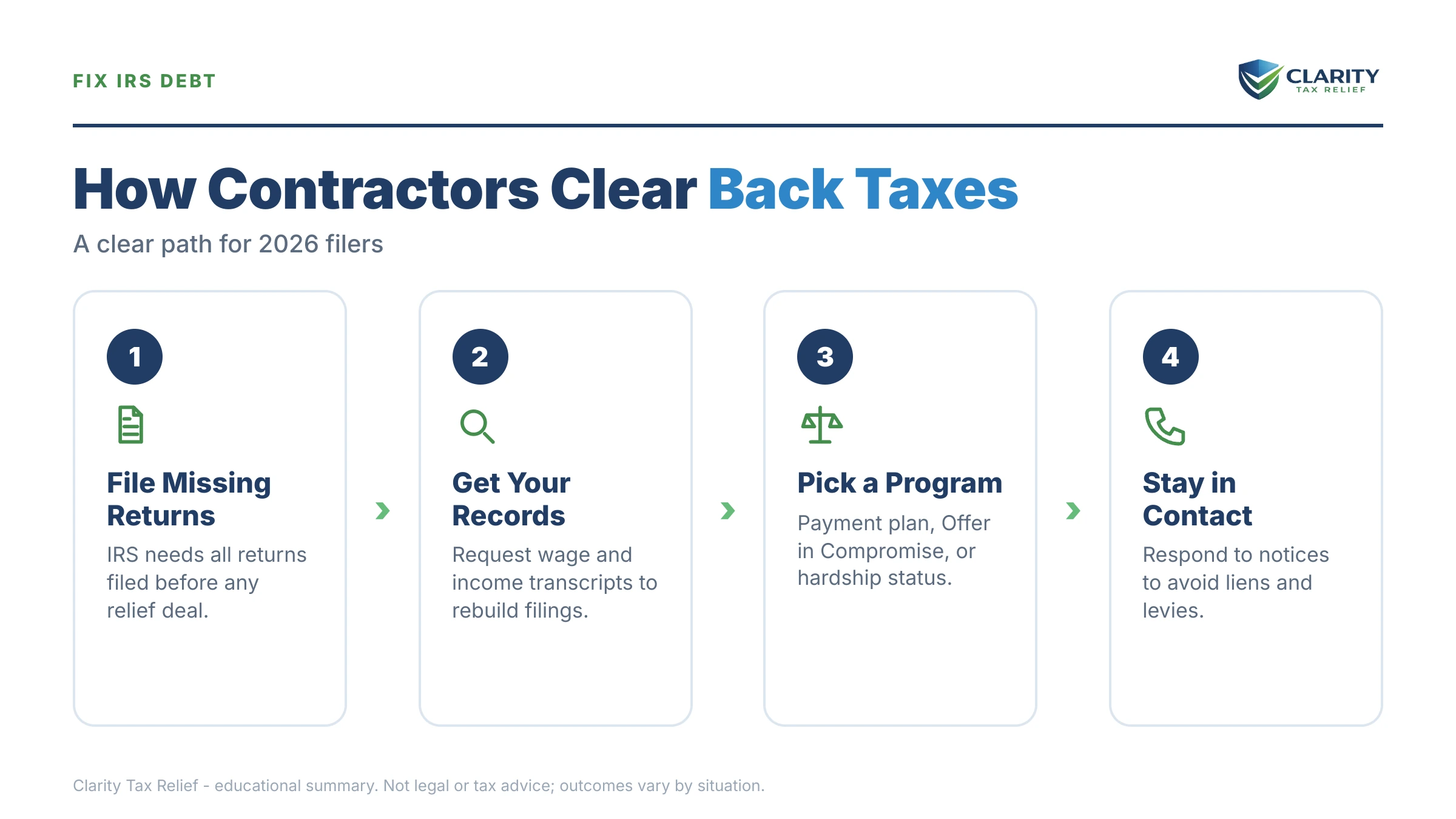
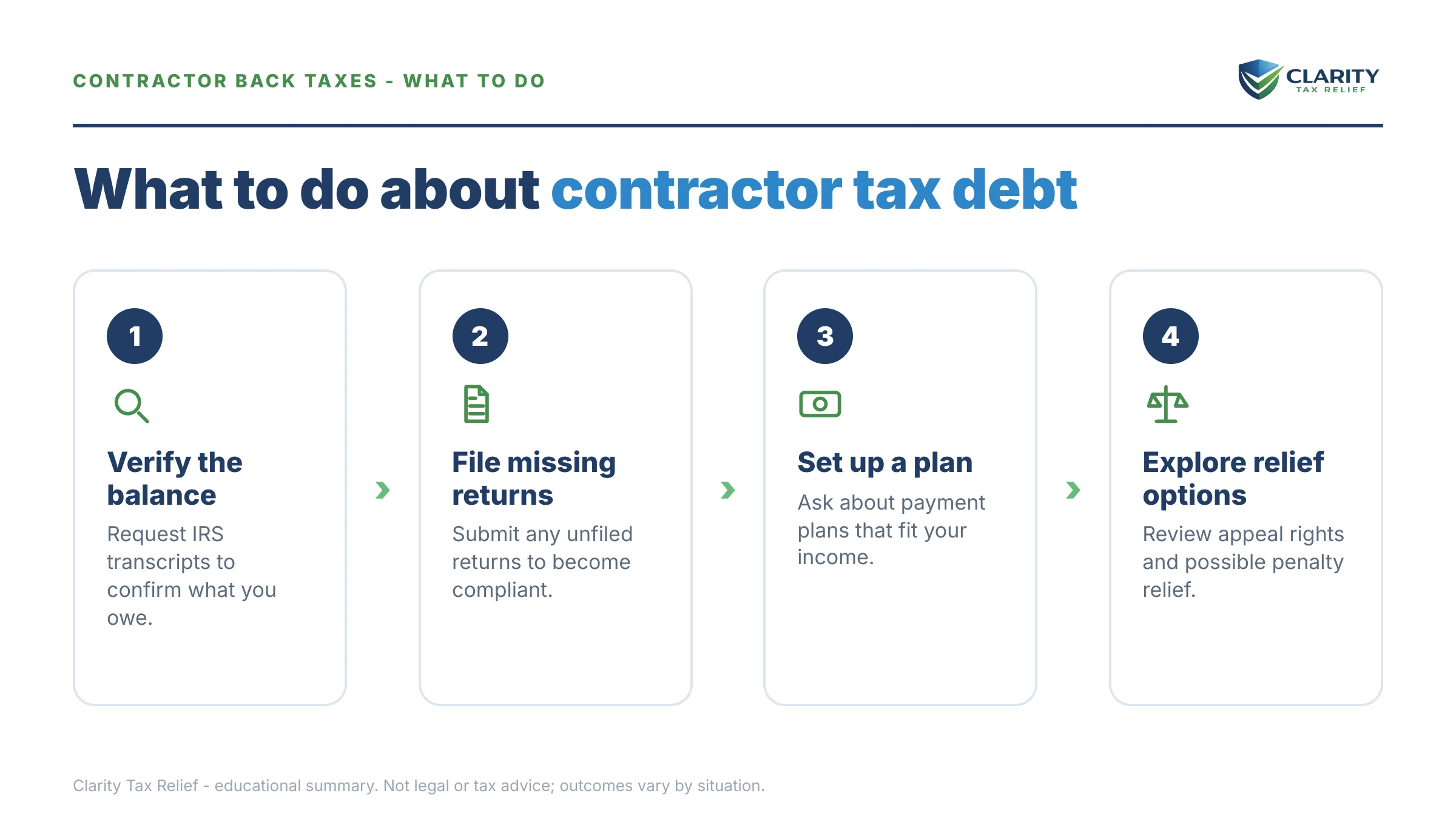
- Pull your IRS transcripts. Get your wage and income transcripts and account transcripts for every year in question, so you know exactly what the IRS has: which 1099s were reported, which years are unfiled, and what has already been assessed.
- File every unfiled return. File all missing returns — generally the last six years — even if you can't pay a dollar, because the failure-to-file penalty runs ten times faster than the failure-to-pay penalty and unfiled years block every resolution program.
- Check the reported 1099 totals against reality. Match each 1099 to your bank deposits and job records, and claim every deduction — materials, mileage, sub labor, insurance — before you accept the IRS's number.
- Set up your resolution before the next notice. Choose the option that fits your balance and cash flow — payment plan, Currently Not Collectible, or an Offer in Compromise — and put it in place online at IRS.gov/payments or by phone.
- Request penalty relief once the returns are in. Ask for first-time penalty abatement or reasonable-cause relief; starting summer 2026, the Automatic Exemption from Penalty applies some relief with no request at all.
- Start current quarterly estimates. Set aside 25-30% of net income as jobs pay and make this year's quarterly payments, because every IRS agreement defaults if new debt piles up behind it.
That last step is the one contractors skip most. Seasonal income makes even quarters feel impossible, but the annualized-income method lets you pay estimates that track your actual busy season — the mechanics are in how quarterly estimated taxes work, and plan details are on the IRS payment plans page.
When you can handle contractor back taxes yourself
A single filed year under $10,000 that you agree with is a do-it-yourself job. A balance like the $6,200 example above qualifies for a guaranteed installment agreement you can set up online in one sitting, and a first-time penalty abatement request is a phone call. If your returns are filed, the 1099 totals are right, and the balance is under $50,000, the streamlined online plan needs no financial disclosure and no professional.
Experienced help changes the outcome in five specific situations: multiple unfiled years built on cash records that need reconstruction; substitute-for-return assessments that real returns could slash; any 1099-sub classification question, because a wrong answer in an IRS interview creates personal payroll liability; a levy already served on your bank or your payors; and Offer in Compromise math involving business equipment and receivables, where a valuation mistake sinks the offer. If your budget is zero, Low Income Taxpayer Clinics and the Taxpayer Advocate Service exist for exactly these cases.
If your file includes misclassified subs, an assigned revenue officer, or a levy already in motion, have an experienced tax professional review it free before your next IRS contact — (888) 825-7779 or the 2-minute form.
Terms on your IRS notices, decoded
- Self-employment tax: the 15.3% Social Security and Medicare tax you pay on net 1099 profit — the piece W-2 withholding used to split with an employer.
- Substitute for Return (SFR): the return the IRS files for a non-filer using only reported income — no deductions, so the balance is inflated until you file the real thing.
- Trust Fund Recovery Penalty (TFRP): the personal assessment of a business's withheld payroll taxes against whoever was responsible for paying them and willfully didn't.
- Section 530 relief: a safe harbor that can block worker reclassification when you consistently treated subs as contractors, issued 1099s, and had a reasonable industry basis.
- CSED: the Collection Statute Expiration Date — 10 years from assessment, paused by offers, bankruptcy, and certain appeals.
- Levy vs. lien: a lien is a legal claim recorded against everything you own; a levy is the actual taking — from a bank account, a payor, or property.
Contractor back taxes: your questions, answered
Can the IRS garnish my 1099 pay as an independent contractor?
Yes — the IRS can serve a levy on the builders or customers who owe you money. Unlike a W-2 wage garnishment, which runs continuously until released, a levy on contractor pay generally captures only what the payor owes you on the day it's served — but the IRS can serve new levies on every payor it finds on your 1099s. A bank levy freezes funds for 21 days before they're sent to the IRS.
What if I paid my subs in cash and never issued 1099s?
Fix it before the IRS finds it. Missing 1099s carry per-form penalties, make your labor deductions harder to defend in an audit, and hand the IRS a reason to look at whether those subs were really employees. File the late 1099s, keep proof of what you paid and to whom, and get ahead of the worker-classification question before an examiner asks it.
Am I personally liable if my contracting LLC owes payroll taxes?
You can be. The Trust Fund Recovery Penalty lets the IRS assess the withheld income tax and employee FICA portion of unpaid payroll taxes against any responsible person who willfully failed to pay it — owners, officers, and sometimes whoever signs the checks. The LLC wrapper does not block it. And income tax on your own profit is always personal on a pass-through entity.
How many years of unfiled returns do I have to file?
In most cases the IRS expects the last six years of returns to get you back into filing compliance under its own policy, though it can demand more where the facts warrant it. Prioritize any year with a refund at stake: refunds expire three years after the original due date, while a balance due lives on until it is assessed and the 10-year collection clock runs out.
Will the IRS take my work truck and tools?
Almost never — but it can. Seizing equipment is a last-resort action, a portion of tools of the trade is exempt from levy by statute, and the IRS weighs whether a seizure would destroy your ability to earn and pay. Bank accounts and receivables get levied long before trucks do, which is why acting while you're still in the notice stage matters so much.
Can I get an Offer in Compromise while my contracting business is still running?
Yes, but the math is harder. The IRS calculates your reasonable collection potential using business income, equipment equity, and receivables on top of your personal finances, and it accepted roughly 1 in 5 offers in FY2024. An operating contractor usually has to show that future income genuinely cannot cover the debt within the collection period. Missing current quarterly estimates is an automatic disqualifier.
Do contractor back taxes ever expire?
Yes — the IRS generally has 10 years from the date a tax is assessed to collect it (the CSED). But the clock doesn't start on an unfiled year until a return or substitute return is assessed, and it pauses during an Offer in Compromise, bankruptcy, and certain appeals. Trying to wait out the statute while ignoring notices usually means enduring levies for most of a decade.
Do I have to keep paying quarterly estimates while on a payment plan?
Yes. Every IRS resolution — installment agreement, Currently Not Collectible, Offer in Compromise — requires you to stay current on this year's taxes, and for a contractor that means quarterly estimated payments. Miss a quarter and the IRS can default your agreement, putting you back in full collection. Setting aside 25-30% of net income as jobs pay is the habit that keeps the deal alive.
What if the 1099s the IRS has are higher than what I actually made?
Dispute them — the IRS treats 1099 totals as accurate until you show otherwise. Duplicated forms, reimbursed materials reported as income, and gross figures that include a GC's pass-through amounts are all common on construction 1099s. Match each form against your bank deposits, then correct the record with an accurate original or amended return backed by statements and job records.
Your next 24 hours
- Find your most recent IRS notice and read two lines: the notice code in the top corner (CP14, CP504, LT11) and the date printed on it. Those two facts tell you exactly how much runway you have.
- Gather your paper trail: every 1099 you can find, last year's return, bank statements for the years in question, and a rough list of jobs and what they paid. Even a partial pile is enough to start.
- Get a free case review. Use the 2-minute form or call (888) 825-7779 and tell us it's contractor back taxes. Penalties and interest post every month you wait — a plan set up this week is money the accrual never gets.
This guide is general information, not tax or legal advice for your specific situation. Eligibility for IRS programs depends on individual facts and circumstances; no outcome is guaranteed.