
State Tax Debt
Franchise Tax Debt: How to Resolve a Delaware, California, or Texas Balance (2026)
The short answer: franchise tax debt is a state-level balance your business entity owes for the privilege of existing — even with zero income. California charges an $800 minimum every year, Delaware LLCs owe a flat $300, and unpaid balances lead to suspension or forfeiture of your entity. It's resolvable by filing, paying, negotiating, or formally dissolving.
You run your business as a self-employed sole proprietor — but years ago you formed an LLC "just in case," and now a state you barely think about says that shell owes thousands in franchise tax debt. The bill grew while the entity sat idle, and the letter mentions suspension or forfeiture. This is one of the most fixable tax problems there is, because the debt follows clear mechanical rules — and once you know which state's rules you're under, the way out is usually obvious.
Franchise tax notices are confusing partly because they look nothing like an IRS bill — the image below shows you exactly what one of these state billing notices looks like and where the tax years, penalties, and your entity's status appear.
⏱ The real clock: most franchise tax bills carry no single response deadline — but the meter never stops. California adds another $800 minimum tax every year your LLC stays on the books, Delaware adds interest at 1.5% per month on unpaid balances, and suspension or forfeiture of your entity can happen at any point once you're delinquent.
Why you owe franchise tax — even if your business made nothing
Franchise tax is a fee for your entity's legal existence, and most states that charge it collect the minimum whether you earned $2 million or $0. It is not an income tax, not a sales tax, and not connected to whether the business ever operated. The taxpayer is the LLC or corporation itself — which is why the bill often shocks owners whose businesses never made a dime.
Here's the detail that matters for your situation: a true sole proprietorship owes no franchise tax. If you're getting these bills as a "sole proprietor," it's because at some point you formed an LLC or corporation — and the moment you did, you created a taxpayer that owes the state annually until it's formally shut down. Forgetting about the entity doesn't end the obligation; only cancellation or dissolution does.
The three states that generate the most franchise tax debt work very differently:
| State (agency) | Who owes it | Typical minimum | When it's due |
|---|---|---|---|
| Delaware (Division of Corporations) | Every registered LLC, LP, and corporation | $300 flat for LLCs/LPs; corporate tax starts around $175 and scales with shares | June 1 (LLCs/LPs); March 1 with the annual report (corporations) |
| California (Franchise Tax Board) | Every LLC, corporation, and LP registered or doing business in CA | $800 per year, plus a gross-receipts fee for LLCs once revenue passes $250,000 | Annually — generally the 15th day of the 4th month of the tax year |
| Texas (Comptroller of Public Accounts) | Taxable entities formed or doing business in TX | $0 below the no-tax-due threshold (roughly $2.47 million in annual revenue); a margin-based tax above it | May 15 annual report |
Two common ways owners end up owing in a state they've never lived in: they formed a Delaware entity because a formation service recommended it, or their inventory and sales created nexus in states like Texas and California. Online sellers get hit with the second version constantly — if warehoused inventory or revenue triggered registrations in multiple states, our guide to Amazon FBA seller taxes covers how multistate nexus stacks these obligations. And if your Delaware corporation owes the IRS on top of the state, see C corporation tax debt — the federal and state balances get resolved on separate tracks.
How an $800-a-year tax becomes $11,300: a worked example
Say you formed a California single-member LLC in early 2020 for liability protection, the venture fizzled, and you never filed Form 568 or canceled the entity. Here's the approximate math the FTB's system runs while you're not looking:
- Base tax: 6 years (2020–2025) × $800 minimum = $4,800 — assessed whether the LLC earned anything or not.
- Penalties: late-filing penalties on each missing Form 568 plus the late-payment penalty (which grows monthly until it maxes out) add roughly $4,700 across the six years.
- Interest and fees: compounding interest plus the FTB's collection cost recovery and lien fees add roughly $1,800 more.
Total: about $11,300 owed by an LLC that never earned a dollar — and the balance grows by another $800 plus penalties every year the entity stays on the Secretary of State's books. This example is hypothetical and the exact penalty math varies by year, but the shape of it is what thousands of Californians find when they finally open the FTB's mail. The broader playbook for that agency lives in our California FTB back taxes hub.
What happens if you ignore franchise tax debt
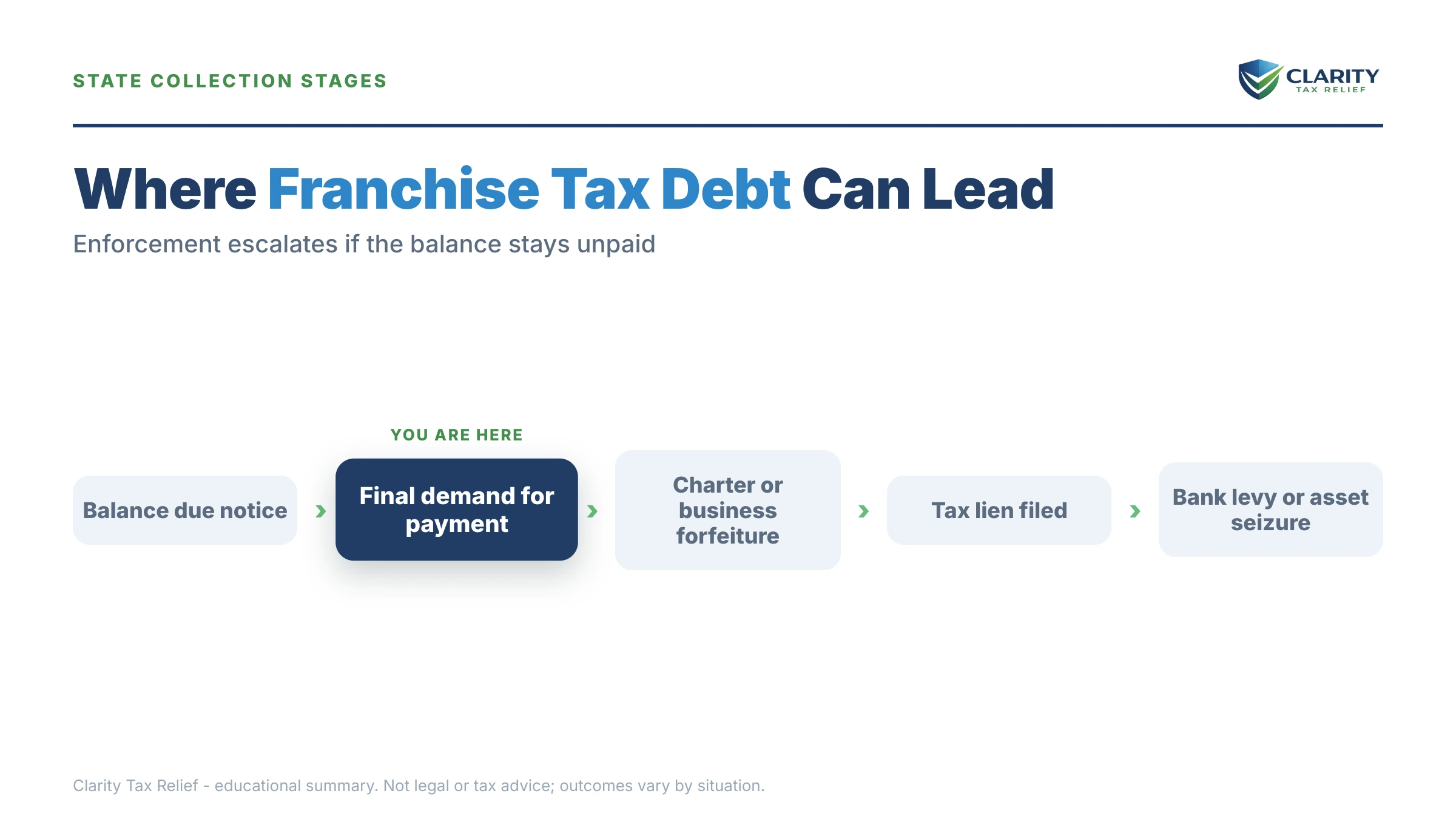
Unpaid franchise tax doesn't just grow — it eventually strips your entity of its legal rights, and in Texas it can reach you personally. The escalation runs in a predictable sequence, though the pace varies by state:
- Delinquency notice. The agency bills the entity for the unpaid tax or the unfiled report. No enforcement yet — this is the cheapest moment to act.
- Penalties and interest stack. Delaware adds a late penalty plus 1.5% monthly interest; California layers late-filing and late-payment penalties plus collection fees; Texas adds a per-report late-filing penalty and percentage penalties on any tax due.
- Loss of good standing. The entity can no longer get certificates of good standing — which quietly blocks loans, business bank accounts, licenses, and deals that require one.
- Suspension, forfeiture, or void. California suspends the entity, Texas forfeits its privileges and eventually its charter, and Delaware ultimately declares the charter void. This is the stage where real damage starts.
- Active collection. California's FTB records liens, intercepts refunds, and levies bank accounts on assessed balances — and it can keep collecting for 20 years from assessment under its 20-year collection statute, double the IRS's window.
Suspension and forfeiture sound bureaucratic, but the consequences are concrete and different in each state:
| State | Mid-stage consequences | End-stage consequence |
|---|---|---|
| California | Penalties, interest, collection fees; FTB liens, refund intercepts, and bank levies | FTB-suspended LLC or corporation: it can't sue or defend itself in court, its contracts become voidable by the other party, and its name can be taken by someone else |
| Delaware | $200 late penalty plus 1.5% monthly interest; loss of good standing | Charter declared void — the entity legally ceases to exist, and reviving it requires paying everything owed plus renewal fees |
| Texas | Late-filing and percentage penalties, interest; loss of the right to sue or defend in Texas courts | Forfeiture of privileges and charter — and under Tax Code §171.255, officers and directors can become personally liable for debts the business creates after forfeiture |
That Texas rule deserves emphasis because it's the trap owners don't see: keep operating a forfeited Texas entity and the liability shield you formed it for is gone for every new debt the business takes on. Texas-specific enforcement is covered in depth in our Texas Comptroller tax debt guide, and Delaware's collection side in Delaware back taxes.
Franchise tax balance growing while your entity slides toward suspension?
Every year the entity stays on the books adds another minimum tax, more penalties, and more interest — and suspension or forfeiture can hit at any point. Get your franchise tax notices reviewed free by an experienced tax professional: we'll tell you what's actually owed, which years can be reduced, and whether to revive or dissolve.
Your options for resolving a franchise tax balance
Every franchise tax debt resolves through one of five paths, and the right one depends on the state, the size of the balance, and whether you still need the entity. The general mechanics of negotiating with a tax agency yourself are covered in our guide to how to settle tax debt yourself — what follows is what's specific to franchise tax:
| Option | Where it's available | Best fit |
|---|---|---|
| Pay in full | All states | Small balances — stops interest immediately and clears the path to good standing or clean dissolution |
| Payment plan | California (FTB payment plan) and Texas; Delaware generally expects payment with the report | Balances you can retire over months, when you want to keep the entity alive |
| Penalty waiver | All three states, on documented reasonable cause | Owners with a genuine excuse — serious illness, disaster, reliance on bad professional advice |
| Settlement for less | California's FTB Offer in Compromise; rare and case-by-case elsewhere | Taxpayers who can document they genuinely cannot pay the full balance — eligibility is means-tested, never automatic |
| Formal dissolution / cancellation | All states, with state-specific conditions | Dead entities — the single most important move, because it stops future years from accruing |
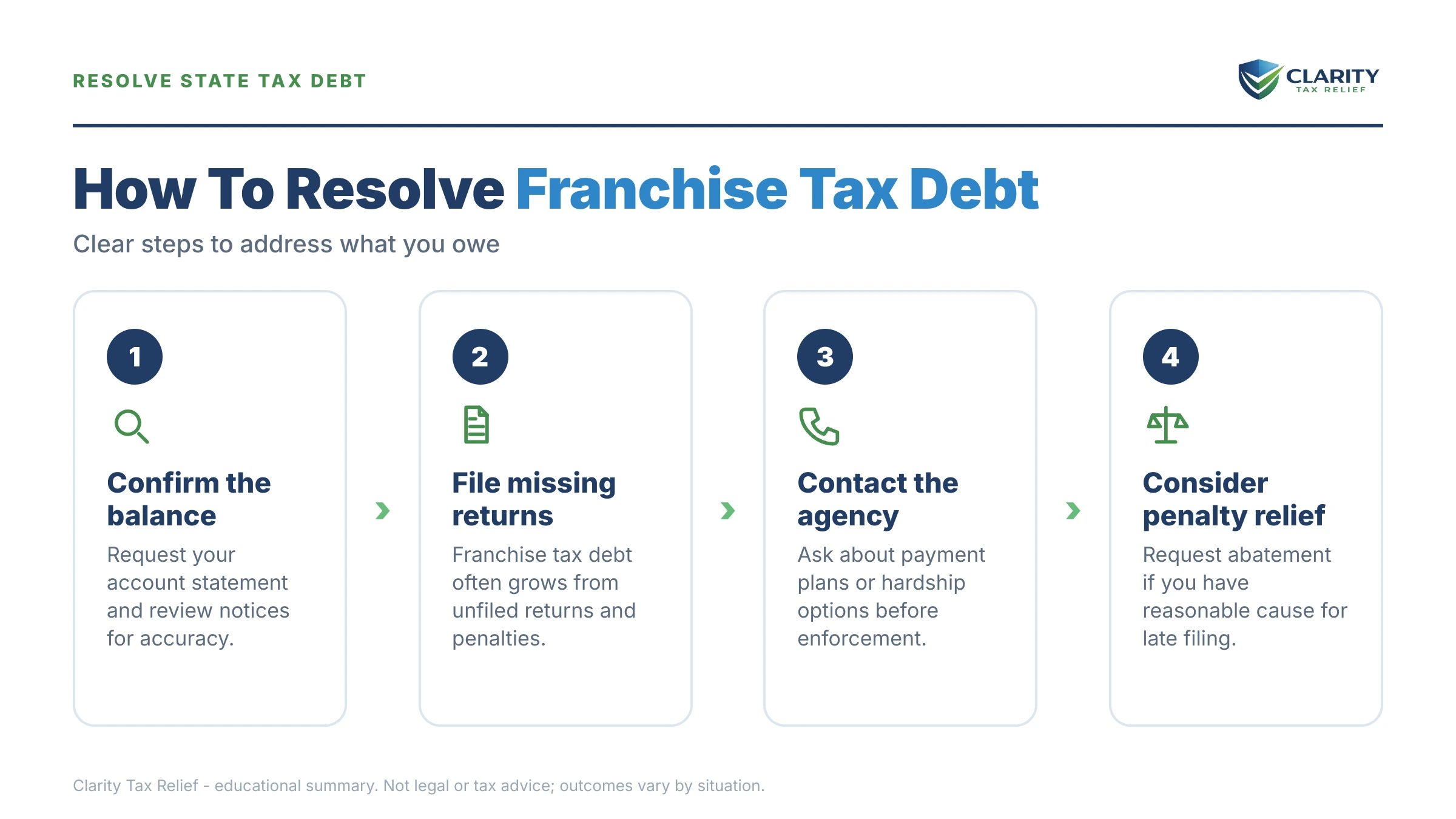
One more balance-reducer people miss: correcting the numbers. States assess estimated amounts when reports go unfiled, and Texas franchise tax computed on overstated revenue or without a cost-of-goods-sold deduction can often be fixed by filing or correcting the report — the same logic as amending a return to lower a tax debt. Never pay an estimated assessment without checking whether the real figures are lower.
Keep the entity or shut it down?
This is the decision that separates franchise tax debt from every other tax problem: the debt exists because the entity exists. If the business is dead, formal dissolution stops the bleeding — in California that means filing the cancellation paperwork with the Secretary of State so no new $800 years accrue (the assessed back years survive and still need resolving). If the business is alive, you'll need revivor or reinstatement, which every state conditions on filing everything and paying — so the negotiation becomes about penalties, timing, and payment terms rather than whether to pay.
How to respond to a franchise tax bill, step by step
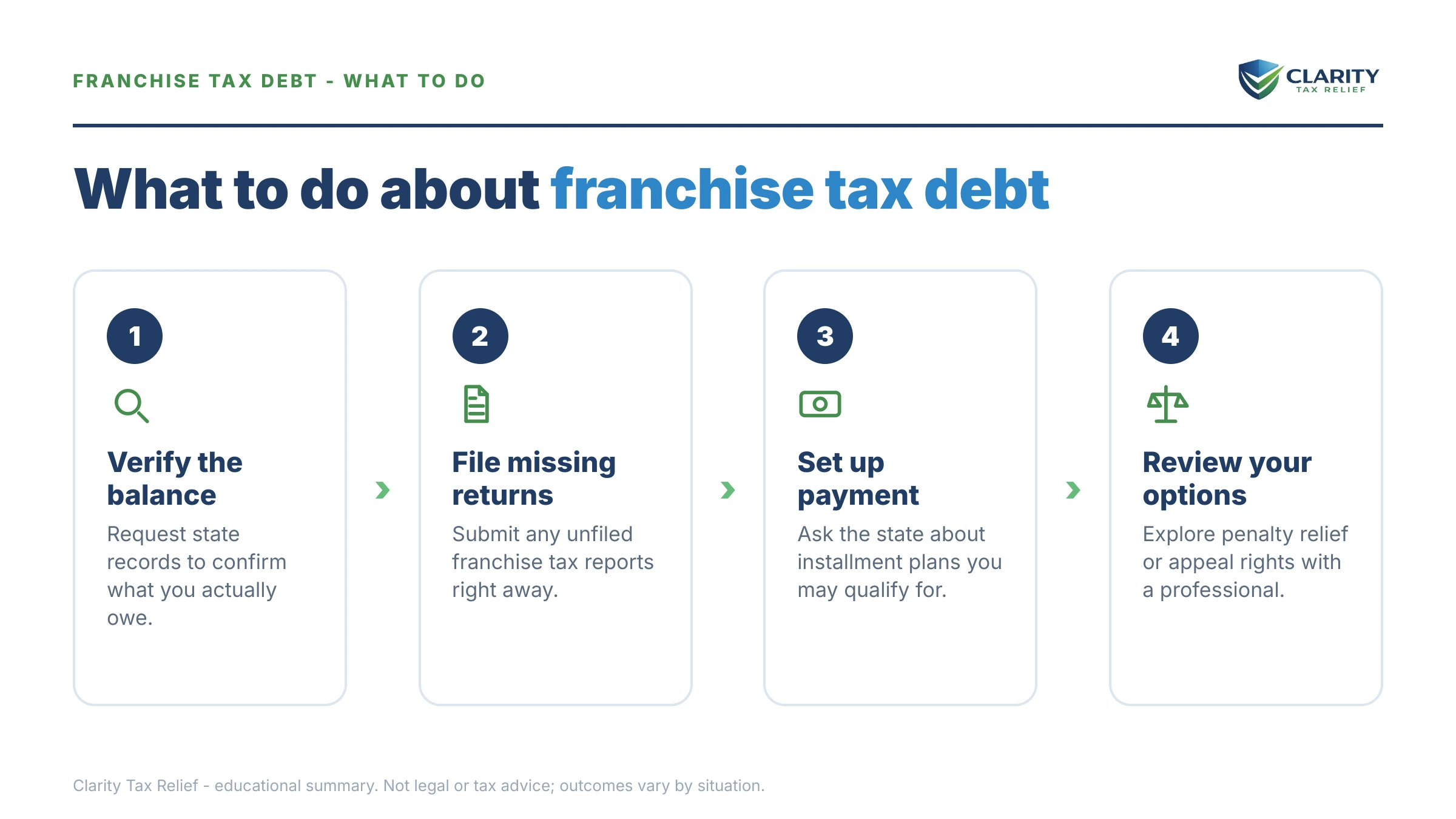
- Identify the state, the entity, and the years. Pull every notice you have and look up your entity on the state's business search — the bill only makes sense once you know which years are assessed and whether the entity is still active, suspended, or forfeited.
- File every missing report or return. Most agencies won't finalize a balance, grant a payment plan, or reinstate an entity until every annual report or franchise return is filed — and in Texas, the forfeiture is often about the missing report, not the money.
- Verify the assessed amounts. States estimate when you don't file, and estimates run high. Filing the real numbers — or correcting a report that overstated revenue — often shrinks the bill before you pay a dollar.
- Decide the entity's future before you negotiate. Choose whether to revive the entity and keep operating or formally dissolve it. The answer changes your strategy, because dissolution stops future minimum taxes while revivor requires catching up in full.
- Set up your resolution before enforcement escalates. Pay in full if the balance is small, request a payment plan and penalty waiver if it isn't, or pursue a state settlement program like the FTB's Offer in Compromise if you genuinely can't pay.
When you can handle franchise tax debt yourself
Plenty of franchise tax problems don't need professional help. If you owe Delaware's flat $300 LLC tax for a year or two, you can pay online and be done in twenty minutes. If your only issue is an unfiled Texas report below the no-tax-due threshold, filing it yourself usually clears the account. And a single delinquent California year with the entity still in good standing is a file-and-pay situation, not a negotiation.
Experienced help changes the outcome in four situations: multiple unfiled years across more than one state, where the filing order affects what you owe; a suspended or forfeited entity you need to revive while contracts or a lawsuit hang in the balance; an FTB lien or bank levy already in motion; and any case where an FTB Offer in Compromise or a multi-year penalty-waiver argument could cut the balance materially — those live or die on how the financial documentation is built. You can check your entity's standing directly with the California Franchise Tax Board, the Texas Comptroller of Public Accounts, or the Delaware Division of Corporations before deciding either way.
Terms on your notice, decoded
- Franchise tax — a privilege tax on an entity's right to exist or do business in a state, owed regardless of profit.
- Good standing — the status showing your entity has met its filing and payment obligations; banks and lenders check it.
- Suspension / forfeiture — the state stripping a delinquent entity of its legal powers, including the right to sue, defend, or enforce contracts.
- Revivor (reinstatement) — the process of restoring a suspended or forfeited entity by filing everything and paying what's owed.
- Certificate of Account Status — the Texas Comptroller's confirmation that a franchise tax account is settled, required before an entity can formally terminate.
- Void charter — Delaware's end-stage status for non-payment: the entity legally ceases to exist until renewed and paid up.
Franchise tax debt questions, answered
Do I owe franchise tax if my LLC made no money?
Yes, in most franchise tax states. Franchise tax is a fee for the entity's legal existence, not a tax on profit — California charges its $800 minimum every year the LLC exists, and Delaware charges LLCs a flat $300 whether you earned millions or nothing. Texas is the exception for small businesses: entities under roughly $2.47 million in annual revenue owe no franchise tax, though filing obligations can still apply.
Am I personally liable for my business's franchise tax debt?
Usually the entity owes the tax, not you personally — but there are real exceptions. In Texas, officers and directors can become personally liable for debts the business creates after its corporate privileges are forfeited for non-payment. And in any state, taking money or assets out of a dissolving entity can expose you to claims up to the value of what you received.
Can I just abandon my LLC instead of paying the franchise tax?
Walking away does not stop the meter. California keeps assessing the $800 minimum tax, plus penalties and interest, every year until the LLC is formally canceled with the Secretary of State, and the FTB can collect what's already assessed for up to 20 years. Delaware keeps billing until the entity is canceled or its charter is voided. Formal dissolution — not abandonment — is how you stop future years.
Can franchise tax debt be settled for less than the full amount?
Sometimes, but the realistic path depends on the state. California's FTB runs an Offer in Compromise program for taxpayers who genuinely cannot pay, and it also waives penalties for reasonable cause. Texas and Delaware handle relief mostly through penalty waivers rather than settling the underlying tax. No state settles simply because you ask — you'll need to document why you can't pay.
How long can a state collect unpaid franchise tax?
Longer than most people expect — California's FTB has 20 years from assessment to collect under R&TC §19255, double the IRS's 10-year window. Other states set their own collection statutes, and some enforcement tools, like refusing to reinstate a forfeited entity until you pay, have no expiration at all. Waiting it out is rarely a workable strategy for franchise tax.
Can I dissolve an LLC or corporation that still owes franchise tax?
It depends on the state. California lets you cancel an LLC without a tax clearance certificate, though the debt already assessed survives cancellation. Delaware generally requires franchise taxes to be paid before it accepts a certificate of cancellation or dissolution. Texas requires a Certificate of Account Status showing your franchise tax account is settled before you can formally terminate the entity.
Is franchise tax the same as state income tax?
No. Income tax is charged on profit; franchise tax is charged for the privilege of existing or doing business in the state, which is why it's owed even in loss years. Some states calculate it on net worth or margin rather than income, and some — like California — charge both a franchise tax and an income-based tax depending on the entity. The two debts are billed and collected separately.
Your next 24 hours
- Find the entity ID, tax years, and total on your notice. Then look the entity up on the state's business search so you know its exact status — active, delinquent, suspended, or forfeited.
- Gather your formation paperwork, any annual reports or franchise returns you filed, and the full stack of state letters. The gap between what was filed and what the state assessed is where most balances shrink.
- Get a free case review. Call (888) 825-7779 or use the 2-minute form — an experienced tax professional will map exactly what your entity owes, which penalties can realistically come off, and whether revivor or dissolution is the cheaper path, before another year's minimum tax and interest get added to the pile.
This guide is general information, not tax or legal advice for your specific situation. Eligibility for IRS programs depends on individual facts and circumstances; no outcome is guaranteed.