
State Back Taxes
Delaware Back Taxes in 2026: Division of Revenue Bills, Franchise Tax, and How to Resolve Them
The short answer: Delaware back taxes come from two separate agencies. The Division of Revenue collects income, withholding, and gross receipts tax and can garnish wages and record judgments. The Division of Corporations collects franchise and LLC annual tax, adding a $200 penalty plus 1.5% monthly interest the day you miss the deadline. Payment plans and penalty relief exist for both.
The envelope on your counter is from the Delaware Division of Revenue — or maybe it's a franchise-tax delinquency notice forwarded by a registered agent you forgot you were still paying. Either way, you and your spouse are now looking at a balance that wasn't in the budget, and the letter doesn't explain which of Delaware's two tax agencies you're actually dealing with. That distinction is the whole map: it decides who you call, what the penalties are, and which resolution programs apply.
Delaware's paperwork looks nothing like an IRS notice, which is why so many people misread it. The image below shows you exactly what Delaware's balance-due paperwork looks like and where to find the tax period, the amount, and the response date that control everything else.
⏱ Your deadline: there is no single statutory deadline for Delaware back taxes — the clock that controls is the response date printed on your Division of Revenue notice. On the franchise side, the dates are fixed: corporate annual reports are due March 1 and LLC annual tax June 1, and interest accrues at 1.5% per month from the day you miss them.
Why you owe Delaware — and which agency is collecting
Delaware splits tax collection between the Division of Revenue and the Division of Corporations, and paying one never fixes a balance with the other. That two-agency structure is the source of most Delaware back-tax confusion — a couple can be fully current on income tax while an LLC balance quietly grows across town in Dover.
On the Division of Revenue side, the common causes are familiar: personal income tax that wasn't fully withheld (Delaware's top rate is 6.6% on taxable income over $60,000), self-employment income with no estimated payments behind it, or business taxes you didn't know existed. Delaware has no sales tax — instead it charges a gross receipts tax on a business's total revenue, with no deduction for costs. New business owners routinely miss it for years, then get assessed for every one of those years at once.
One more trap unique to this state: Delaware has no reciprocal agreements with its neighbors. If you live in Pennsylvania, New Jersey, or Maryland and work in Delaware, Delaware taxes the wages you earn there — and under-withholding on that cross-border paycheck is a classic way a married couple ends up with multiple years of Delaware balances without ever noticing.
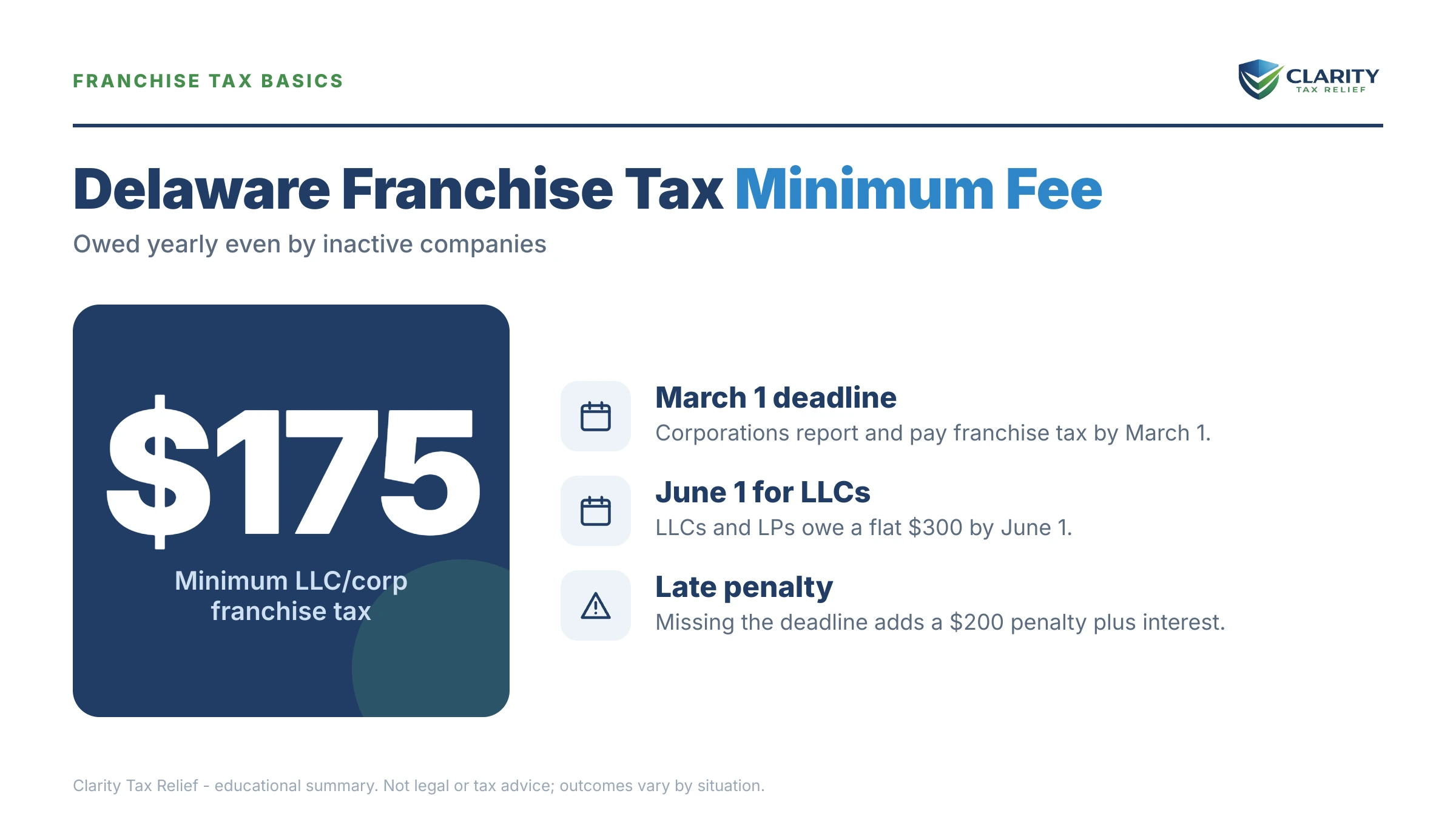
On the Division of Corporations side, the debt is entity-based, not income-based. Every Delaware corporation owes franchise tax with its annual report by March 1; every Delaware LLC and LP owes a flat $300 annual tax by June 1 — profitable or not, active or not. Because more than a million entities are registered in Delaware, this is the back-tax balance that hits people who have never set foot in the state.
| Tax type | Agency that collects | The key fact |
|---|---|---|
| Personal income tax | Division of Revenue | Top rate 6.6%; nonresidents who work in Delaware owe it too — no reciprocity with PA, NJ, or MD |
| Gross receipts tax | Division of Revenue | Delaware's replacement for sales tax — charged on the seller's total revenue, rates vary by business activity |
| Employer withholding | Division of Revenue | Money withheld from employees' pay — the balance Delaware treats most seriously |
| Corporate income tax | Division of Revenue | 8.7% on Delaware-apportioned corporate income — separate from franchise tax |
| Corporate franchise tax | Division of Corporations | Due March 1 with the annual report; $200 late penalty plus 1.5% monthly interest |
| LLC / LP annual tax | Division of Corporations | Flat $300 due June 1 whether or not the entity did any business |
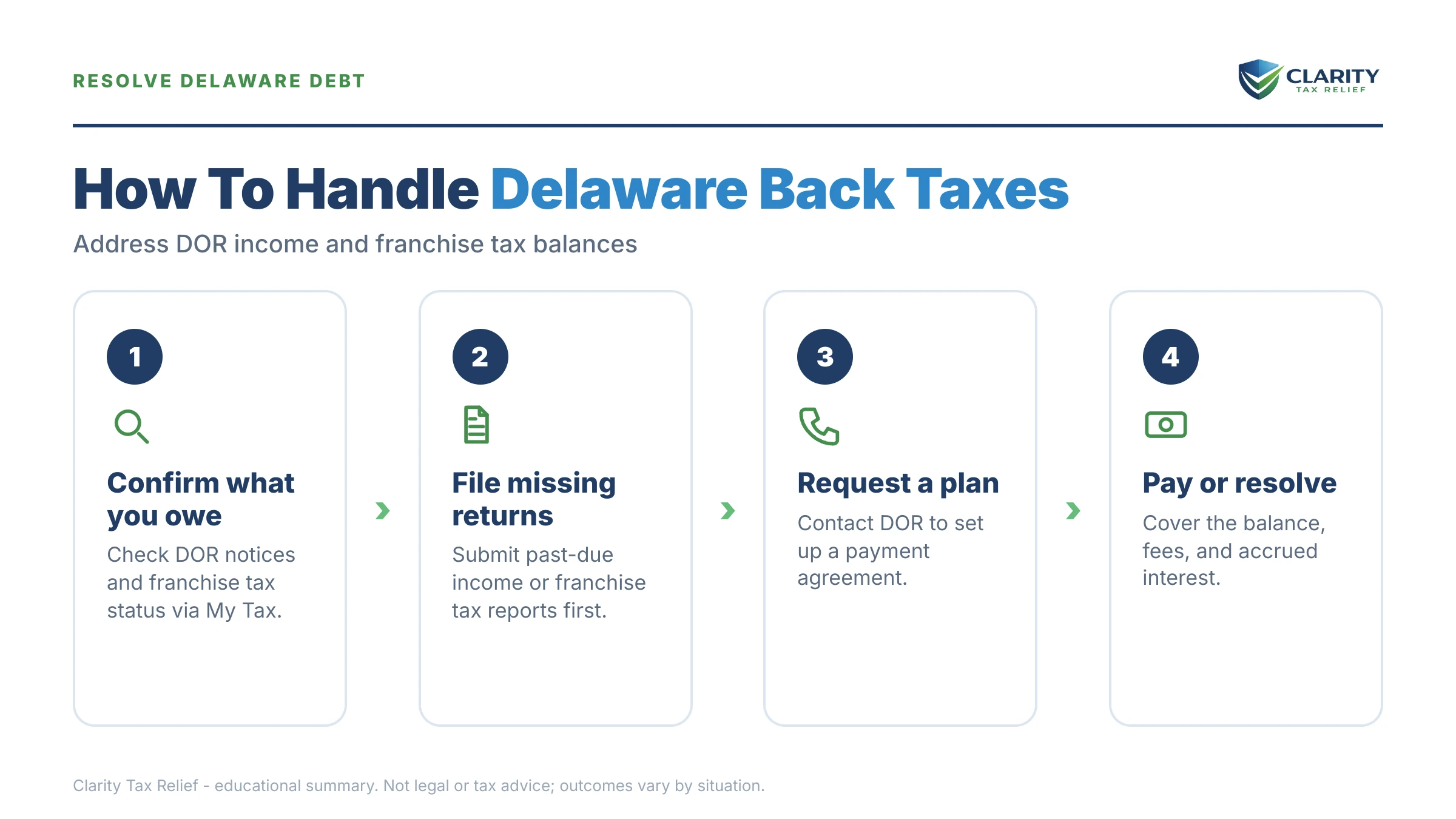
What happens if you ignore Delaware back taxes
Delaware back taxes escalate on two separate tracks at once, and neither track waits for the other. Here's the Division of Revenue sequence for unpaid income, withholding, or gross receipts tax:
- Assessment or balance-due notice — the bill stage. Penalties and interest are already attached, but nothing is being taken yet.
- Demand notices — the balance grows each month while the notice language hardens. This is still the stage where a phone call or portal request resolves things cleanly.
- Judgment and lien — Delaware can record a judgment for the unpaid tax, creating a public-record lien that surfaces in title searches, refinances, and closings.
- Wage attachment and bank levy — your employer or bank is ordered to send money to the state. Unlike the notice stages, this happens without further negotiation.
- Refund intercepts and license consequences — Delaware keeps your state refund, and unpaid balances can block renewal of a Delaware business license. If you also owe the IRS, the federal side can seize your Delaware refund too through the State Income Tax Levy Program.
The franchise track runs on autopilot. The day after March 1 (corporations) or June 1 (LLCs and LPs), the Division of Corporations adds a $200 penalty and starts interest at 1.5% per month — an 18%-a-year clock — and your entity immediately falls out of good standing. Out of good standing, you can't get the certificate lenders, buyers, and title companies demand, which is usually how owners discover the problem: mid-deal, at the worst possible moment. Keep ignoring it and Delaware can declare a corporation's charter void, and it cancels an LLC's certificate of formation after three consecutive unpaid years. Cancellation does not cancel the debt — every dollar still has to be paid before Delaware will revive the entity or accept a formal wind-down.
One 2026 reality check: Delaware's collection notices and the Division of Corporations' penalty clock are automated. Staffing shortages that make agencies hard to reach by phone don't slow the escalation — they only make it harder to fix once enforcement starts.
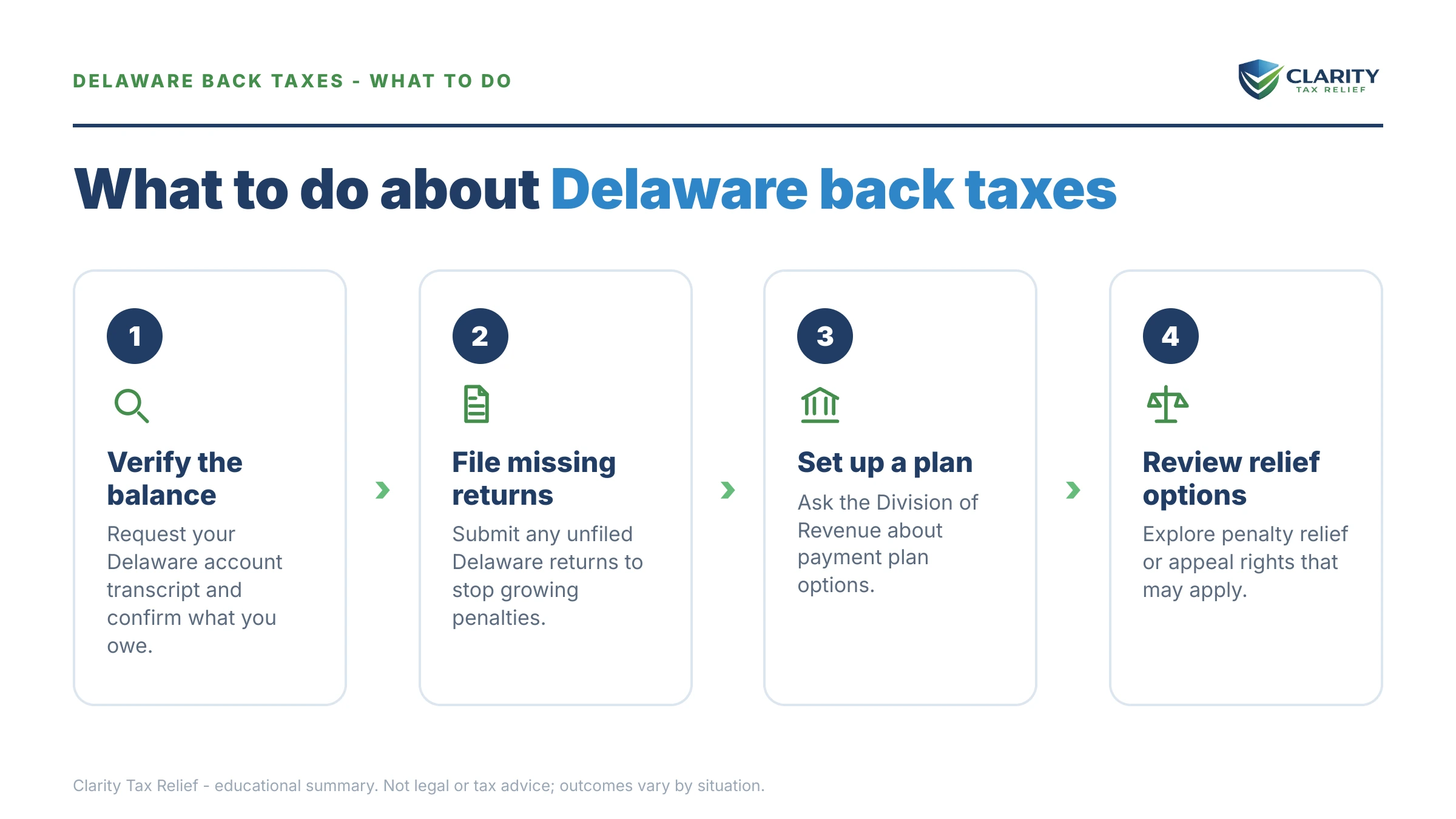
Holding a Delaware tax notice right now?
Whether it's a Division of Revenue balance or a franchise-tax delinquency on your LLC, send it to us. An experienced tax professional will decode which agency you're dealing with and map your options — free, before another month of penalties and 1.5% interest posts.
Your options for resolving Delaware back taxes
Delaware offers payment plans, penalty waivers, and good-standing restoration — but each option lives with a specific agency and has its own requirements. If part of your balance is federal, the IRS side has its own programs (payment plans, hardship status, the Offer in Compromise); our guide to state tax debt vs. IRS — which to resolve first covers how the two systems interact, so this table stays Delaware-specific.
| Option | Best for | What it requires or costs |
|---|---|---|
| Pay in full | Balances you agree with and can cover | Stops further penalties and interest immediately; pay through the Delaware Taxpayer Portal or by check |
| Division of Revenue installment agreement | Income, withholding, or gross receipts balances you can't pay at once | Request through the Taxpayer Portal or by contacting the Division; interest keeps accruing and new filings must stay current |
| Penalty waiver for reasonable cause | Penalties caused by illness, disaster, or events outside your control | Written request with documentation; interest generally remains even when penalties are waived |
| Franchise-tax payoff / good-standing restoration | Corporations, LLCs, and LPs behind on annual taxes | Pay all back years plus $200 penalties and 1.5% monthly interest through the Division of Corporations |
| Certificate of cancellation or dissolution | Entities you no longer need | All back annual taxes must be paid first; stops future years from ever accruing |
| Federal-side programs (IRS plans, OIC, hardship status) | The federal portion of a combined balance | Separate applications to the IRS — a Delaware arrangement never covers federal debt, and vice versa |
Two honest caveats. First, Delaware does not advertise a standing settle-for-less program the way the IRS runs the Offer in Compromise — treat any pitch promising a guaranteed Delaware settlement as a red flag. Second, a Division of Revenue installment agreement is a privilege, not a right: miss a payment or miss a new filing deadline and the state can resume enforcement on the full remaining balance.
| Entity type | Due date | Late penalty | Ongoing cost |
|---|---|---|---|
| Corporation (annual report + franchise tax) | March 1 | $200 | 1.5% monthly interest; charter can be declared void for continued nonpayment |
| LLC ($300 annual tax) | June 1 | $200 | 1.5% monthly interest; certificate of formation canceled after three unpaid years |
| LP ($300 annual tax) | June 1 | $200 | 1.5% monthly interest; loss of good standing until every back year is paid |
A worked example: a married couple owing $76,400
Say you and your spouse owe $76,400 across three balances — a common Delaware pattern where a federal debt, a state income-tax debt, and a forgotten LLC all stack up:
- $61,200 to the IRS — two years of under-withheld tax after one spouse started 1099 consulting work.
- $13,300 to the Delaware Division of Revenue — three years of state income tax on that same consulting income.
- About $1,900 to the Division of Corporations — the consulting LLC's annual tax, unpaid for three years: 3 × $300 in tax ($900), 3 × $200 in penalties ($600), plus roughly $400 of interest at 1.5% per month on the older years.
Here's how the math plays out, piece by piece. The franchise balance is the smallest number with the biggest collateral damage — it's the one blocking good standing — so it gets paid in full first, and if the LLC is done consulting, a certificate of cancellation stops next June's $300 from ever accruing.
The $13,300 Delaware income-tax balance goes on a Division of Revenue installment agreement. Terms are set case by case, but as an illustration: if the Division agreed to 24 months, that's roughly $555/month plus the interest that continues to accrue while you pay.
The $61,200 federal balance sits above the IRS's $50,000 streamlined ceiling, which changes the playbook. The couple can either pay it down by about $11,200 to qualify for the online 72-month plan (about $695/month on the remaining $50,000 before continuing accruals), or keep the full balance and submit financial disclosure for a non-streamlined agreement — our guide to an IRS payment plan over $50,000 compares the two routes, and you can set up an IRS payment plan online once you're under the threshold. For illustration only — actual monthly payments depend on your exact balance with accrued penalties and interest, and the plan must pay off within 72 months or by your collection statute expiration date, whichever comes first. To see what the federal penalties and interest add while you decide, you can estimate them with our Penalty & Interest Calculator.
The combined picture: roughly $1,250/month across both agencies, $1,900 paid up front, and — critically — three separate arrangements, because no single agency will consolidate the other two.
How to respond to Delaware back taxes, step by step
- Identify which agency sent the notice — Division of Revenue letters cover income, withholding, and gross receipts tax; franchise-tax delinquency notices come from the Division of Corporations, usually forwarded by your registered agent.
- Verify the balance yourself — check the Delaware Taxpayer Portal for Division of Revenue balances and the Division of Corporations' franchise tax lookup for entity balances before paying anything.
- File every missing return — Delaware won't finalize a payment arrangement on unfiled years, and unfiled years let the state estimate your tax high — filing usually shrinks the number.
- Pay the franchise arrears first if you own an entity — it's usually the smallest balance with the fastest-growing interest, and paying it restores your company's good standing immediately.
- Set up payment arrangements with each agency — request a Division of Revenue installment agreement for the state income-tax side, and handle any federal balance through an IRS payment plan the same week.
- Request penalty relief in writing — ask the Division of Revenue to waive penalties for reasonable cause with documentation, and check first-time abatement on the federal side.
When you can handle Delaware back taxes yourself
Plenty of Delaware balances don't need professional help, and you should know which is which. You can handle it yourself when: it's a single-year Division of Revenue bill you agree with and can pay or put on a straightforward plan; it's one missed $300 LLC year — just pay it online through the Division of Corporations and move on; or it's a franchise notice on an entity you're ready to cancel and you can afford the back years.
Experienced help changes outcomes when the situation compounds: a wage attachment or bank levy is already in motion; you have multiple unfiled years with both Delaware and the IRS (start with our guide if you haven't filed in 3 years); the debt involves employer withholding or gross receipts tax on an operating business; a voided charter or canceled LLC is holding up a sale or refinance; or the combined balance crosses into the range — like the $76,400 example above — where the order you resolve things in changes the total you pay. Sequencing three agencies is where a professional earns the fee; paying one $300 annual tax is not.
Terms on your Delaware notice, decoded
- Gross receipts tax — Delaware's seller-side substitute for a sales tax, charged on total business revenue with no deduction for costs.
- Franchise tax — the annual fee a Delaware corporation pays for the privilege of being incorporated there, unrelated to profit or activity.
- Good standing — the status proving your entity is current with Delaware; lost the day an annual tax goes unpaid and required for most financings and closings.
- Certificate of cancellation — the filing that formally ends a Delaware LLC, which the state accepts only after all back annual taxes are paid.
- Judgment lien — the public-record claim Delaware can attach to your property after recording a judgment for unpaid tax.
- Notice of assessment — the Division of Revenue's formal statement of what it says you owe, which starts the response window printed on its face.
If your Delaware notice is sitting on top of a larger federal balance, a free review of both together — call (888) 825-7779 — can map which agency to stabilize first before either one escalates.
Delaware back taxes: FAQs
Does Delaware have a payment plan for back taxes?
Yes. The Delaware Division of Revenue sets up installment agreements for taxpayers who can't pay a balance in full — you can request one through the Delaware Taxpayer Portal or by contacting the Division directly. Interest continues to accrue while you pay, and staying current on new filings is a condition of keeping the plan. Franchise tax owed to the Division of Corporations is separate and generally must be brought current to restore good standing.
What happens if I don't pay Delaware franchise tax on my LLC?
Delaware adds a $200 late penalty plus interest at 1.5% per month the day after the June 1 deadline, and your LLC immediately loses good standing. After three consecutive unpaid years, Delaware cancels the LLC's certificate of formation. Cancellation doesn't erase the debt — the back taxes, penalties, and interest still have to be paid if you ever want to revive the company or formally wind it down.
Can Delaware garnish my wages for back taxes?
Yes. The Division of Revenue can attach wages, levy bank accounts, and record a judgment against you for unpaid state taxes — a judgment that becomes a public-record lien on your property. It can also keep your Delaware refund and deny renewal of a Delaware business license. Enforcement follows written notices, so acting while you're still in the notice stage is what keeps garnishment off the table.
Does Delaware have a sales tax I could owe back taxes on?
No — Delaware is one of the few states with no sales tax. What trips up business owners instead is the gross receipts tax: a tax on the seller's total revenue, with no deduction for costs, that many owners don't realize applies to them. If the Division of Revenue says you owe gross receipts tax, it usually means unfiled or underreported business returns, not a math error.
I live in another state but own a Delaware LLC — do I still owe Delaware?
Yes, for the annual tax. Every Delaware LLC owes the $300 annual tax by June 1 regardless of where it operates or whether it made any money. You generally don't owe Delaware income tax unless you have Delaware-source income, but the annual tax and its penalties apply purely because the entity is registered there. Ignoring it because the business is "inactive" is the single most common way these balances build.
Will Delaware settle my back taxes for less than I owe?
Delaware doesn't advertise a standing settlement program the way the IRS promotes the Offer in Compromise. The Division of Revenue can waive penalties when you show reasonable cause — illness, disaster, circumstances beyond your control — and will negotiate payment terms based on your finances. If most of your balance is federal, that's where formal settlement programs like the IRS Offer in Compromise realistically live.
Should I pay Delaware or the IRS first if I owe both?
Usually you stabilize both at once rather than paying one to zero first: get a payment arrangement in place with each agency so neither escalates to enforcement. State agencies often move to garnishment faster than the IRS, while the federal balance is usually larger and accrues more total interest over time. Our guide to state tax debt vs. IRS — which to resolve first walks through the sequencing in detail.
How do I know a Delaware Division of Revenue letter is real?
Verify it independently rather than trusting the letter: log in to the Delaware Taxpayer Portal or call the Division of Revenue using contact information from revenue.delaware.gov, not a number printed on a suspicious notice. Real Delaware tax payments go to the State of Delaware through official channels — never gift cards, wire transfers, or payment apps. Franchise tax notices typically arrive through your registered agent, which scammers also imitate.
Can I just dissolve my Delaware LLC to stop the franchise tax?
Not without paying first. Delaware requires all back annual taxes and penalties to be paid before it will accept a certificate of cancellation, so dissolving stops future years from accruing — it does not erase existing debt. If the LLC was already canceled for nonpayment, reviving it later requires paying everything that accrued in the meantime. The cheapest year to cancel an unused LLC is always this one.
Your next 24 hours
- Find the tax period and response date on your notice — and check the letterhead, because it tells you whether the Division of Revenue or the Division of Corporations is collecting.
- Gather three things: your last three Delaware and federal returns, the notice itself, and a quick snapshot of household income and monthly bills — that's everything a payment arrangement is built from.
- Get a free case review — the 2-minute form or (888) 825-7779 — before another month of penalties and 1.5% franchise interest posts to the balance.
Official resources: verify Division of Revenue balances and payment options at the Delaware Division of Revenue, check and pay franchise or annual tax through the Delaware Division of Corporations, and handle any federal portion at IRS.gov/payments.
This guide is general information, not tax or legal advice for your specific situation. Eligibility for IRS programs depends on individual facts and circumstances; no outcome is guaranteed.