
City Tax Relief Guides
Tax Relief in Wilmington (2026): IRS, State, and City Back-Tax Options
The short answer: tax relief in Wilmington runs through official programs — IRS payment plans, the Offer in Compromise, Currently Not Collectible status, and penalty abatement — plus separate resolutions with your state agency (Delaware's Division of Revenue or North Carolina's DOR) and, in Wilmington, DE, the city's own earned income tax. Each debt is resolved on its own track.
Maybe it's three years of DoorDash and Uber 1099s sitting unfiled in a folder, and every tax season you told yourself next year. Now an IRS letter has followed you to your Wilmington address, and the number on it isn't going to shrink on its own. Here's the part that matters: every real path out is still open to you, and this page maps all of them.
One thing that makes searching for tax relief in Wilmington genuinely different from most cities: depending on which Wilmington you're in, you may answer to up to three separate tax collectors — the IRS, your state revenue agency, and (in Delaware) the City of Wilmington itself. Fixing one does nothing for the other two.
⏱ Your real clock: unfiled years have no single deadline — the cost compounds monthly instead. The failure-to-file penalty runs at 5% of the unpaid tax per month, ten times the 0.5% failure-to-pay rate, until it caps at 25% per year. Filing — even without paying a dollar — shuts off the biggest penalty.
Why Wilmington tax debt comes in layers
A Wilmington, Delaware taxpayer can owe three different governments on the same income: the IRS, the Delaware Division of Revenue, and the City of Wilmington. Delaware has no sales tax, but it absolutely has a state income tax — and the city layers an earned income tax on top for people who live in Wilmington or work within its limits. Employers withhold the city tax for W-2 workers; if you're a gig worker or self-employed, nobody withheld it for you.
If you're in Wilmington, North Carolina, the stack is simpler: the IRS plus the NC Department of Revenue back taxes track. North Carolina cities don't levy their own income tax, but the NCDOR is an assertive collector in its own right.
Either way, the IRS almost certainly already knows about your gig income. Platforms report it on Forms 1099-NEC and 1099-K — and while the 1099-K threshold reverted to $20,000 and 200 transactions for 2026, the 1099-NECs from delivery and rideshare apps have been landing in IRS systems for every year you didn't file.
| Agency | What it collects | Key thing to know |
|---|---|---|
| IRS | Federal income tax, self-employment tax, federal penalties and interest | Automated collection escalates on its own schedule; 10-year federal collection statute (CSED) from assessment |
| Delaware Division of Revenue | Delaware state income tax and state penalties | Separate notices, separate balance, separate resolution — see our Delaware back taxes guide |
| City of Wilmington, DE | City earned income (wage) tax on residents and people working in the city | Withheld for W-2 workers; gig and self-employed workers must file and pay it themselves |
| NC Department of Revenue (Wilmington, NC) | North Carolina state income tax | No city income tax in NC, but the state runs its own liens, garnishments, and offsets |
What happens if you keep waiting
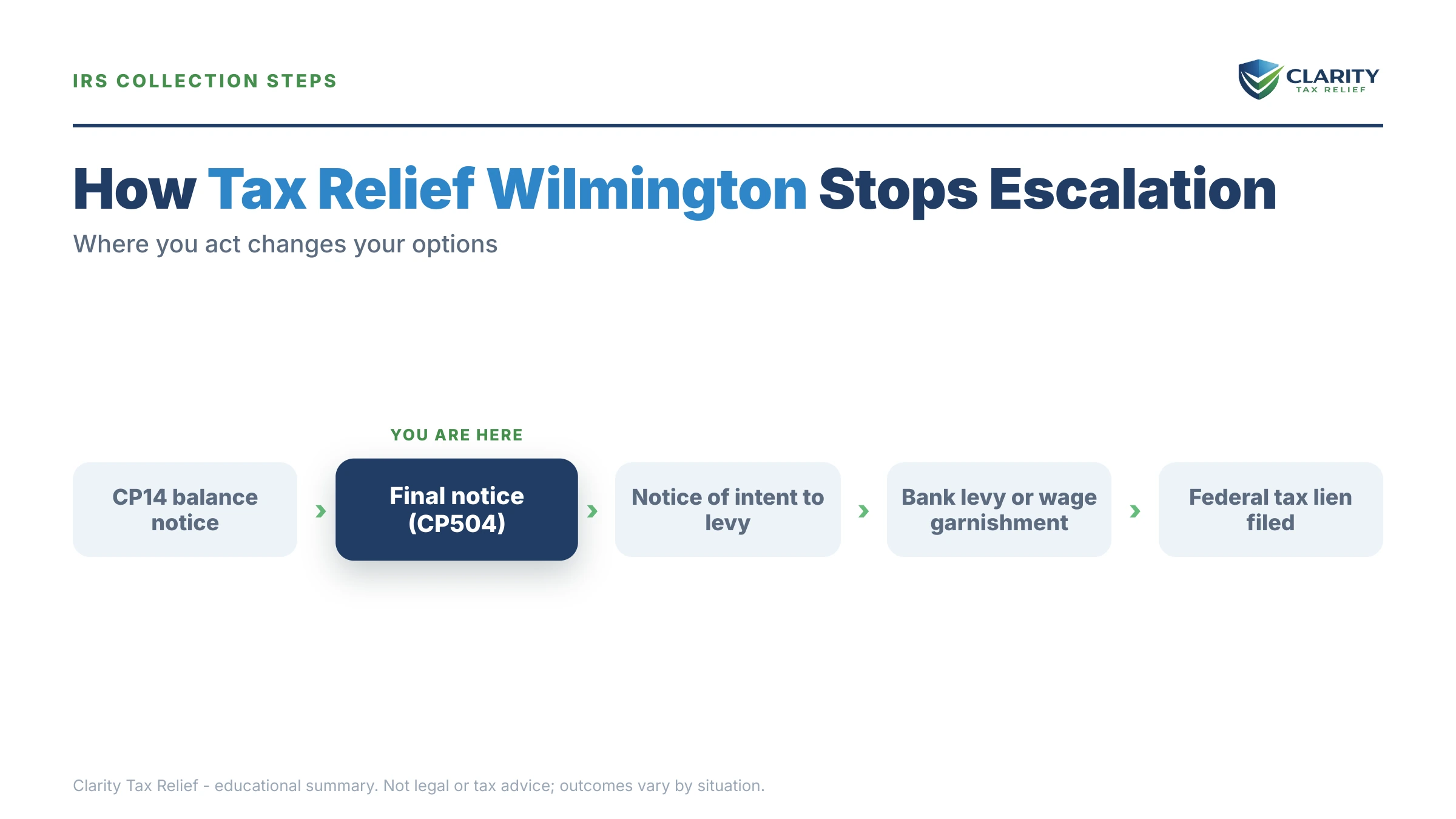
An unfiled year doesn't sit quietly — the IRS's automated systems eventually file a return for you and start collecting on it. For a Wilmington gig worker with three unfiled years, the sequence typically runs like this:
- CP59 notice — the IRS's records show 1099 income for you but no return. This is the polite ask.
- CP516 / CP518 — repeated and then final requests to file. Still no enforcement, but your file is now in the non-filer pipeline.
- Substitute for Return (SFR) — the IRS prepares a return from your 1099s with zero business deductions: no mileage, no phone, no supplies, single filing status. For a delivery driver, this routinely doubles the real tax. A CP3219N gives you 90 days to respond before it's assessed.
- CP14 — the first bill on the assessed balance, typically with about 21 days before the next notice queues up.
- CP504 — intent to levy your state refund. Your Delaware or North Carolina refund becomes seizable.
- LT11 / Letter 1058 — the final notice. After 30 days the IRS can garnish pay, levy bank accounts (with a 21-day hold before funds leave), and send one-time levies to gig platforms that owe you money.
In 2026 the IRS's workforce is down roughly 27% from 2025 — which means it's harder to reach a human to fix things, but the automated notices, SFRs, and levies never stopped. The machine escalates whether or not anyone reads your file. Your state agency, meanwhile, runs its own parallel track on its own timeline.
| Notice or event | Your window | What's at stake |
|---|---|---|
| CP3219N (SFR proposed) | 90 days | Your chance to file a real return before the inflated SFR balance is assessed |
| CP14 (first bill) | Typically 21 days from the notice date | The cheapest moment to pay or set up a plan before escalation |
| CP504 (intent to levy) | The pay-by date printed on the notice | Your Delaware or North Carolina state refund becomes seizable |
| LT11 / Letter 1058 (final notice) | 30 days | Your Collection Due Process hearing rights (Form 12153) — the strongest levy shield you get |
| Bank levy served | 21-day hold | Last window to prove hardship or reach a resolution before funds leave the account |
| Balance reaches $66,000 (2026 threshold) | Ongoing | Passport certification — the State Department can deny or revoke your passport |
Behind on three years in Wilmington?
Get a free, confidential review from an experienced tax professional before the IRS files substitute returns for you — the balance only grows while you wait, because penalties and interest accrue every month.
Tax relief in Wilmington: your real options
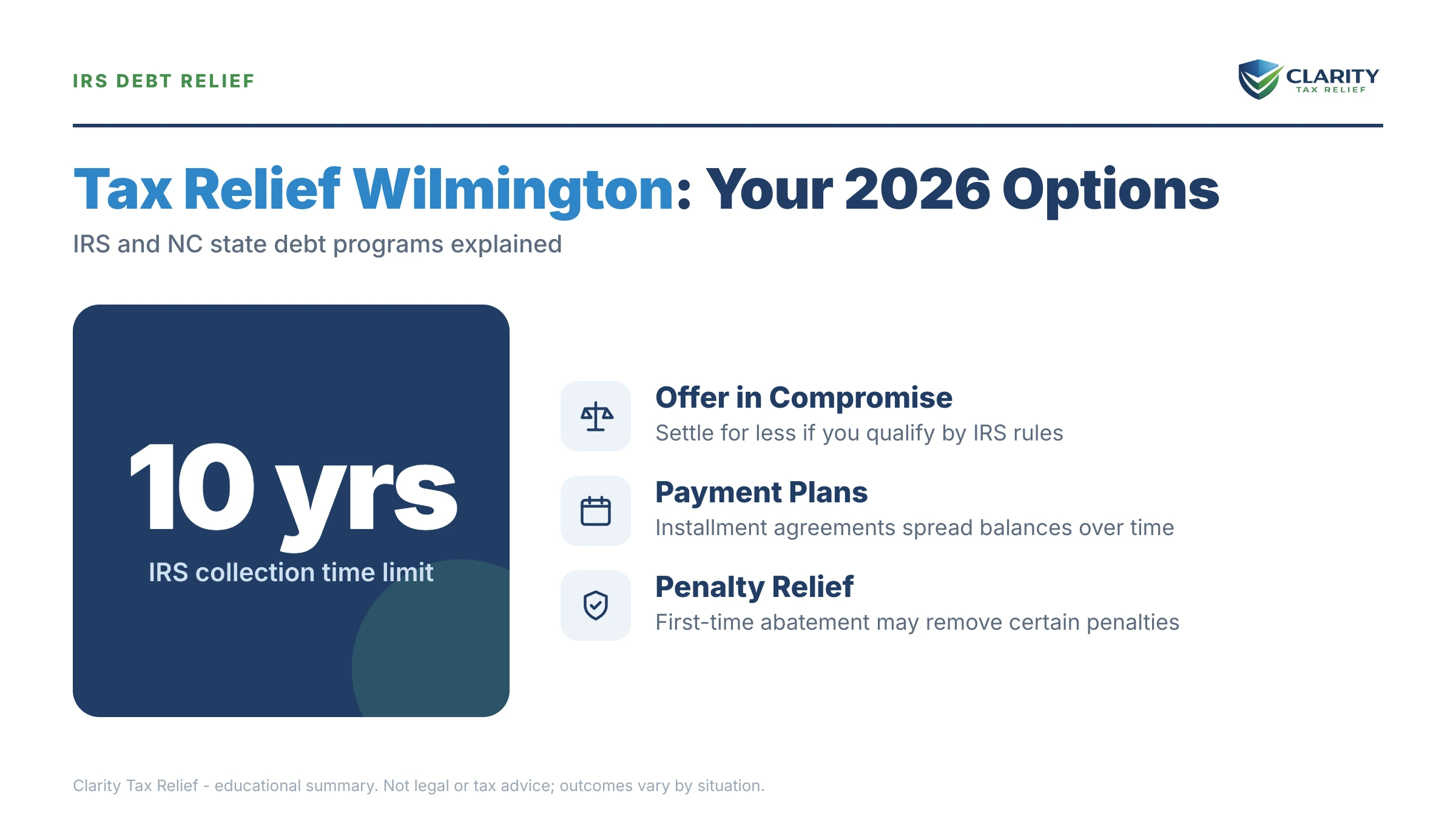
Every legitimate resolution runs through the same IRS programs, and each one is means-tested — no company can get you a result your financials don't support. Here's the full menu, with what each one costs and who it fits. (For the complete do-it-yourself playbook, see how to settle tax debt yourself.)
| Option | Who it fits | Setup cost | The catch |
|---|---|---|---|
| Short-term payment plan | Can pay in full within 180 days | $0 | Interest and the 0.5%/month penalty keep accruing until paid |
| Guaranteed installment agreement | Owe $10,000 or less, returns filed | Setup fee varies by application method | Must pay within 3 years and stay current going forward |
| Streamlined installment agreement | Owe $50,000 or less — up to 72 months, set up online with no financial disclosure | Setup fee varies; lower with direct debit | Requires all returns filed first; interest continues |
| Currently Not Collectible | Paying anything would prevent basic living expenses (proven on Form 433-F) | $0 | Debt remains and grows; the IRS reviews your income periodically |
| Offer in Compromise | Assets plus future income genuinely can't cover the debt before the CSED | $205 fee + 20% down on lump-sum offers (both waived with low-income certification) | Roughly 1 in 5 offers accepted in FY2024 — the IRS runs the math, not the marketing |
| Penalty abatement (FTA / reasonable cause) | Clean compliance in the prior 3 years, or circumstances beyond your control | $0 | Removes penalties, not the underlying tax; AEP makes some relief automatic starting summer 2026 |
A few notes the table can't hold. A streamlined installment agreement is the workhorse for most Wilmington balances under $50,000 — no financial disclosure, set up online in one sitting once your returns are filed. Currently Not Collectible status matters if gig income has cratered: collection pauses while the 10-year collection clock keeps running. And how an offer in compromise works is worth understanding before anyone pitches you one — it's a financial formula, not a negotiation.
Your state balance needs its own plan. Delaware and North Carolina each offer their own payment arrangements with their own rules; don't assume any IRS threshold or timeline applies to them.
What $19,700 across three unfiled years actually looks like
A concrete, hypothetical example — say you drove delivery in Wilmington and never filed 2023, 2024, or 2025, and the real tax works out to $19,700 ($7,900 + $6,600 + $5,200 across the three years).
Because the 0.5% failure-to-pay penalty ran in the same months, the failure-to-file penalty caps at 22.5% — about $3,263 on the $14,500 for 2023-2024 — with failure-to-pay continuing to accrue on top (combined cap 47.5% plus interest). The 2025 year is still climbing at 5% per month — roughly $780 so far by mid-2026. Add daily-compounding interest on all three years, and the posted balance lands somewhere around $25,000 by the time everything is assessed. You can rough out your own figures with our IRS penalty and interest calculator — it estimates, it doesn't promise.
Now the fixes. Because ~$25,000 is under the $50,000 streamlined ceiling, a 72-month plan runs roughly $350 a month ($25,000 ÷ 72 ≈ $347), with interest continuing until it's paid. If 2020–2022 were filed and clean, first-time abatement could erase the 2023 failure-to-file penalty — about $1,778 back with one request. And if the IRS had beaten you to it with substitute returns, the bill would have been meaningfully higher than $19,700, because SFRs ignore every mile you drove. Filing your own returns first is where most of the savings actually live.
If your income barely covers rent, car payments, and gas, the picture changes: an Offer in Compromise or hardship status may fit better than any payment plan — but that depends entirely on the Form 433-F math, not on wanting it.
How to get tax relief in Wilmington, step by step
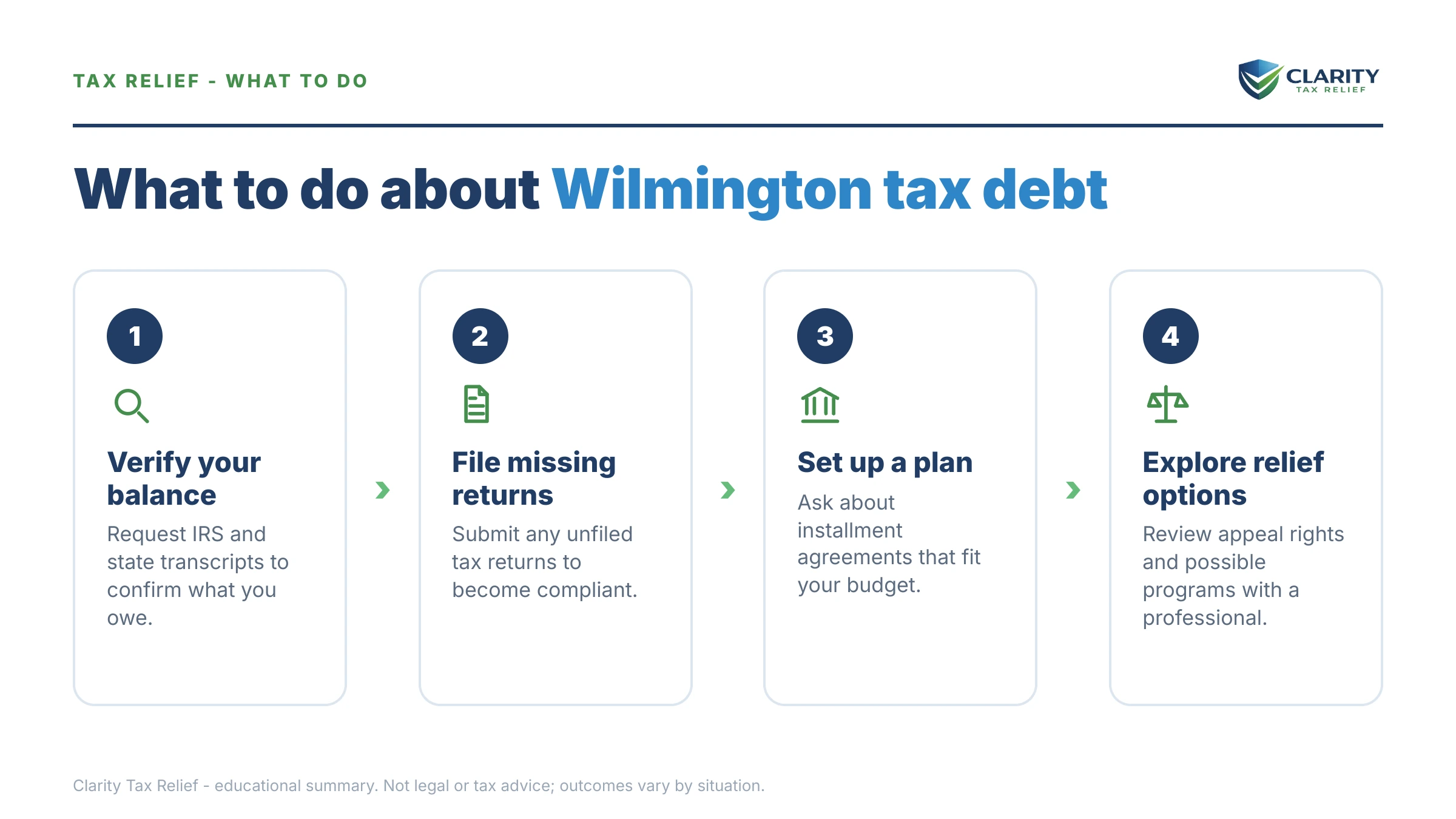
- Pull your IRS records — request wage and income transcripts for each unfiled year so you know exactly what the IRS already has on file.
- File the missing returns — real returns with your mileage and business expenses will almost always show less tax than an IRS substitute return.
- Verify what each agency says you owe — check your IRS online account, then confirm any Delaware, North Carolina, or City of Wilmington balances separately.
- Pick your resolution — a short-term plan, a streamlined installment agreement, Currently Not Collectible status, or an Offer in Compromise, based on what your finances actually support.
- Request penalty relief — ask for first-time penalty abatement or reasonable-cause relief on qualifying years, and watch for the new Automatic Exemption from Penalty rolling out in summer 2026.
Federal payments and plan setup happen at IRS.gov/payments. For state balances, go straight to the source: the Delaware Division of Revenue or the North Carolina Department of Revenue, depending on your Wilmington.
When you can handle this yourself
Plenty of Wilmington taxpayers don't need to hire anyone. If you're missing only one recent year, your records are reasonably intact, and the balance will land under $25,000, you can file, set up a streamlined plan online, and request first-time abatement on your own — our guide on haven't filed taxes in 3 years walks the filing catch-up in detail.
Experienced help changes the outcome in specific situations: substitute returns have already been assessed and need to be replaced, you're juggling IRS, state, and city balances at once, records for the 1099 years are gone and income has to be reconstructed, a levy or garnishment is already in motion, or the Offer in Compromise math is genuinely in play. In those cases the order you fix things in — returns first, then penalties, then the balance — often matters more than any single move.
Choosing tax relief help in Wilmington
Almost every firm advertising tax relief to Wilmington is national, not local — and that's fine, because IRS work is federal and handled remotely. What matters is who does the work and what they promise. Vet any firm against our how to choose a tax relief company checklist before signing anything, and if you're comparing the big advertisers, our Optima Tax Relief alternatives and Larson Tax Relief alternatives breakdowns show what to look for in each. Walk away from anyone who quotes a settlement figure before pulling your transcripts.
Terms you'll keep seeing, decoded
- SFR (Substitute for Return): a return the IRS files for you from 1099s and W-2s, with no deductions — almost always higher than the real number.
- CSED: the Collection Statute Expiration Date — the IRS generally has 10 years from assessment to collect, though appeals, offers, and bankruptcy pause the clock.
- Lien vs. levy: a lien is a legal claim against your property; a levy is the actual taking — of a bank balance, a paycheck, or money a platform owes you.
- RCP (Reasonable Collection Potential): the IRS's formula for the most it could ever collect from you — the number an Offer in Compromise must meet or beat.
- CNC (Currently Not Collectible): a hardship status that pauses IRS collection while the debt (and interest) remains on the books.
Wilmington tax relief questions, answered
Are tax relief companies in Wilmington legitimate?
The IRS programs behind tax relief — payment plans, the Offer in Compromise, Currently Not Collectible status, and penalty abatement — are completely real. What's often not legitimate is the marketing: the IRS accepted roughly 1 in 5 offers in FY2024, so any firm promising a settlement before reviewing your finances is selling something it can't verify. Judge a firm by its credentials and its willingness to tell you no.
Do I need a tax relief company located in Wilmington?
No — IRS collection work is federal and handled by phone, mail, and the IRS's online systems, so a firm's competence matters far more than its zip code. The exception is a hyper-local issue like the City of Wilmington's earned income tax, where familiarity with the local office helps. Even Delaware and North Carolina state cases are routinely resolved remotely.
I haven't filed taxes in three years — will the IRS come after me?
Eventually, yes — but almost always civilly, not criminally, especially if you come forward before the IRS finds you. The failure-to-file penalty runs 5% of the unpaid tax per month up to a 25% cap, and if you wait long enough the IRS files a substitute return with no deductions and starts collecting on that inflated number. Filing voluntarily now is the single cheapest move available to you.
Can I settle my IRS debt for less than I owe in Wilmington?
Only through an Offer in Compromise, and only if the IRS's own math shows your assets and future income can't cover the debt before the collection statute runs out. The application costs $205 with a 20% down payment on lump-sum offers, though low-income certification (AGI at or below 250% of the federal poverty level) waives both. The IRS accepted roughly 1 in 5 offers in FY2024.
Does Wilmington, Delaware have its own income tax?
Yes. The City of Wilmington levies an earned income tax on people who live in the city or work within it, separate from Delaware state income tax and federal tax. Employers withhold it for W-2 workers, but self-employed and gig workers are responsible for reporting and paying it themselves — check the City of Wilmington's Earned Income Tax office for current rates and filing rules.
What can the Delaware Division of Revenue do if I owe state back taxes?
The Division of Revenue runs its own collection track, entirely separate from the IRS — it can intercept your Delaware refund, file liens, and pursue wage attachment under state law, on Delaware's timelines rather than federal ones. Resolving your IRS balance does nothing for your state balance, and vice versa. Each debt needs its own resolution.
How much does tax relief cost?
The IRS's own fees are modest: $0 for a short-term payment plan, a setup fee for installment agreements that varies by how you apply, and $205 for an Offer in Compromise application. Professional fees depend on the work involved — preparing three back returns plus negotiating a resolution costs more than setting up a simple payment plan. Be wary of any firm quoting a price before it has seen your transcripts.
Can the IRS garnish my gig or 1099 income?
Yes, but differently than wages. A levy on a W-2 paycheck is continuous until released, while a levy sent to a gig platform or client generally captures only what that payer owes you on the day it arrives — though the IRS can issue new levies repeatedly. The IRS can also levy your bank account, with a 21-day hold before the funds are sent to the Treasury.
Your next 24 hours
- Find your latest IRS letter and note the notice number in the top right corner and any date printed on it — that tells you exactly where you sit in the escalation sequence above.
- Gather what you have for the unfiled years: 1099s, bank statements, mileage records or app history, and your last filed return. Gaps are fixable — transcripts can fill in the income side.
- Get a free case review — call (888) 825-7779 or use the 2-minute form. Three unfiled years with IRS, state, and possibly city balances is exactly the kind of layered case worth mapping before penalties and interest add another month's growth.
This guide is general information, not tax or legal advice for your specific situation. Eligibility for IRS programs depends on individual facts and circumstances; no outcome is guaranteed.