
State Back Taxes
NC Department of Revenue Back Taxes: How NCDOR Collections Work in 2026
The short answer: NC Department of Revenue back taxes get more expensive at one specific moment — when the debt reaches NCDOR's collection stage, the state adds a 20% collection assistance fee and can garnish 10% of your gross wages without a court order. Payment plans, penalty waivers, and a state offer in compromise (Form OIC-100) can stop the escalation.
The envelope came from Raleigh, not Washington — "N.C. Department of Revenue" in the corner — and the total inside includes penalties and interest you never saw coming. Here's the good news: NCDOR's process runs on fixed stages, each with its own exit, and right now you're standing at one of the cheaper ones.
This guide walks the whole road: why NCDOR says you owe, what happens at each stage if you wait, and every tool North Carolina actually offers to resolve the debt. The image below shows exactly what an NCDOR notice looks like and where to find the three things that control everything else — the tax year, the total, and the response date.
⏱ Your deadline: the response date printed on your NCDOR notice. If you're holding a proposed assessment, you typically have 45 days from the notice date to dispute it before it becomes final and collectible. Once a final debt sits unpaid into the collection stage, NCDOR adds a 20% collection assistance fee — the single most expensive consequence of waiting.
Why the NC Department of Revenue says you owe back taxes
Most NCDOR balances start with a return the state processed — or a return you never filed. NCDOR receives your federal return data from the IRS, so North Carolina usually knows your income even when it never got a D-400 from you.
The common triggers, in rough order of frequency:
- You filed but didn't pay in full. The state bills the shortfall plus late-payment penalties and interest.
- An IRS change flowed downhill. If the IRS adjusted your federal return — a CP2000, an audit — NC law requires you to report that change to NCDOR (generally within six months). If you don't, the state can assess later, with penalties attached.
- You never filed a NC return. NCDOR can create an assessment from federal data alone, using estimates that ignore your deductions — which is why these balances are often inflated.
- Residency confusion. Part-year moves into or out of North Carolina, or remote work across state lines, produce assessments people genuinely didn't know they owed.
- Business trust taxes. Sales tax collected from customers and income tax withheld from employees belong to the state the moment you collect them. NCDOR pursues these harder than anything else — and can pursue owners and responsible people personally.
One more thing worth knowing before you panic at the total: North Carolina taxes income at a flat rate that has been stepping down year over year, so the tax itself is often the smallest slice of an NCDOR bill. Penalties, interest, and — later — the 20% collection fee are what make old balances balloon.
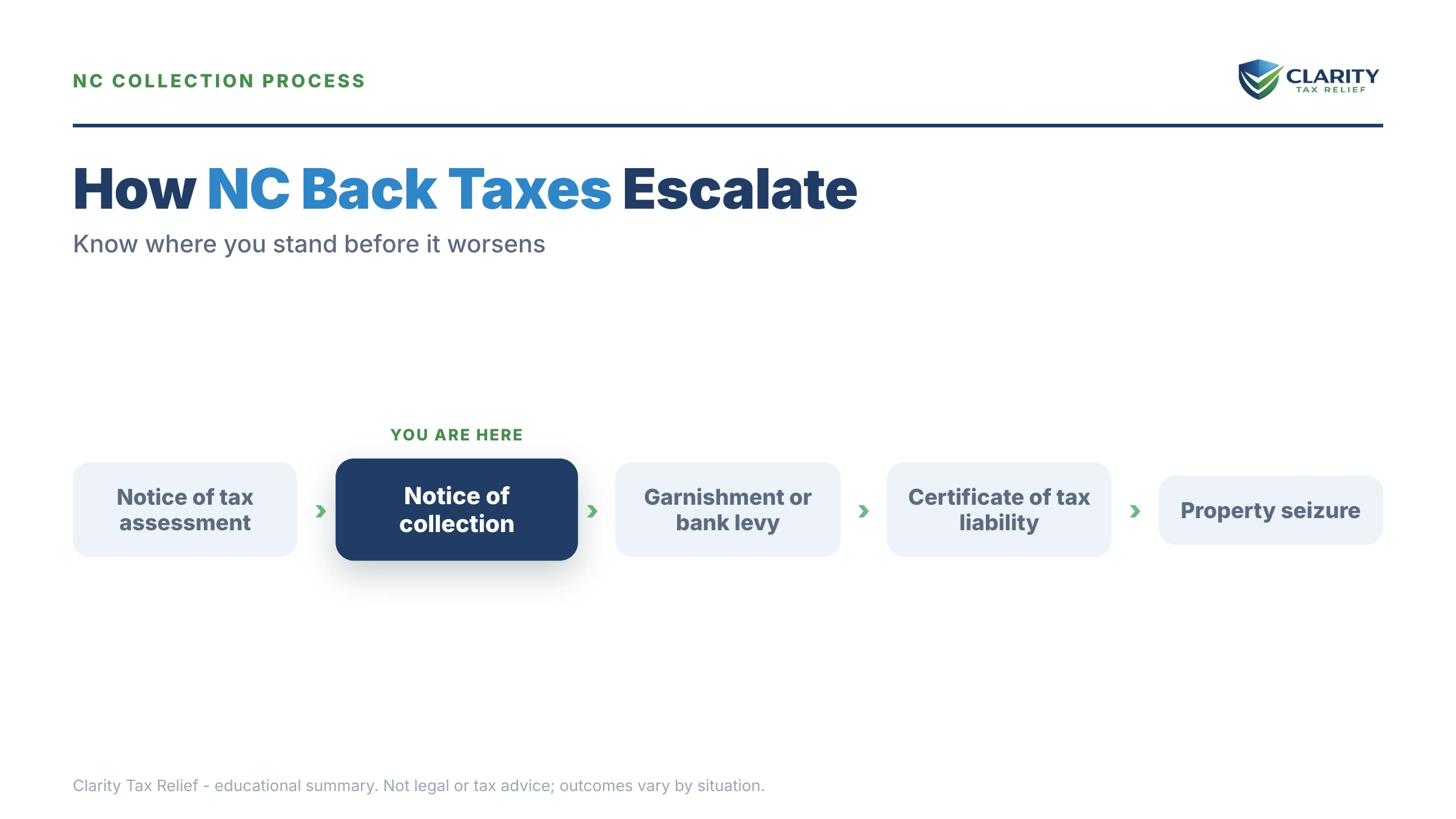
What happens if you ignore NC Department of Revenue back taxes
An unpaid NCDOR debt moves through a fixed sequence, and forced collection in North Carolina requires no courtroom. NCDOR can garnish wages, drain bank accounts, and file a public lien entirely through administrative notices.
- Notice of proposed assessment. The state's opening position. You can still dispute it — typically within 45 days — and this is the only stage where the amount itself is easily challenged.
- Final assessment and Notice of Collection. The debt is now legally fixed. NCDOR demands payment and is authorized to begin forced collection.
- Collection assistance fee. A 20% fee is added to debt that lingers unpaid into NCDOR's collection stage — but only after the debt is at least 60 days past due and NCDOR has given advance notice, so paying in full or entering an installment payment agreement before then avoids the fee entirely. On $13,600, that's $2,720 of pure waiting cost.
- Attachment and Garnishment. NCDOR orders your employer to withhold 10% of your gross wages, and can order banks — and even people who owe you money — to remit funds up to your full balance.
- Certificate of Tax Liability (CTL). The state dockets your debt with the clerk of superior court. It's public record, works like a court judgment against your property in that county, and complicates any sale or refinance.
- Refund intercepts and license pressure. Your NC refunds are seized, your federal refund can be offset, and businesses risk losing sales tax registration and related privileges.
| Stage | What NCDOR does | What it means for you |
|---|---|---|
| Proposed assessment | States what it believes you owe | Your dispute window — typically 45 days to request Departmental review |
| Final assessment / Notice of Collection | Fixes the debt and demands payment | Forced collection is now authorized; disputes get much harder |
| Collection stage | Adds the 20% collection assistance fee | Your balance jumps by one-fifth for waiting |
| Attachment and Garnishment | Orders employers, banks, and third parties to pay | 10% of gross wages per paycheck; bank funds up to the full balance |
| Certificate of Tax Liability | Dockets a judgment-like lien at the county courthouse | Public record; attaches to your property; clouds sales and refinances |
| Ongoing enforcement | Intercepts state and federal refunds; presses business licenses | Every refund disappears until the debt is resolved |
There's no 2026 slowdown to hide behind here, either. While federal collections wobble with IRS staffing cuts, NCDOR's notice-and-garnishment machinery is automated, state-run, and unaffected — the stages above keep firing on schedule.
Holding an NCDOR notice right now?
Get it reviewed free before your balance crosses into North Carolina's 20% collection-fee and garnishment stage. An experienced tax professional will tell you exactly which stage you're at and the cheapest way out — no pressure, no obligation.
Your options for resolving North Carolina back taxes
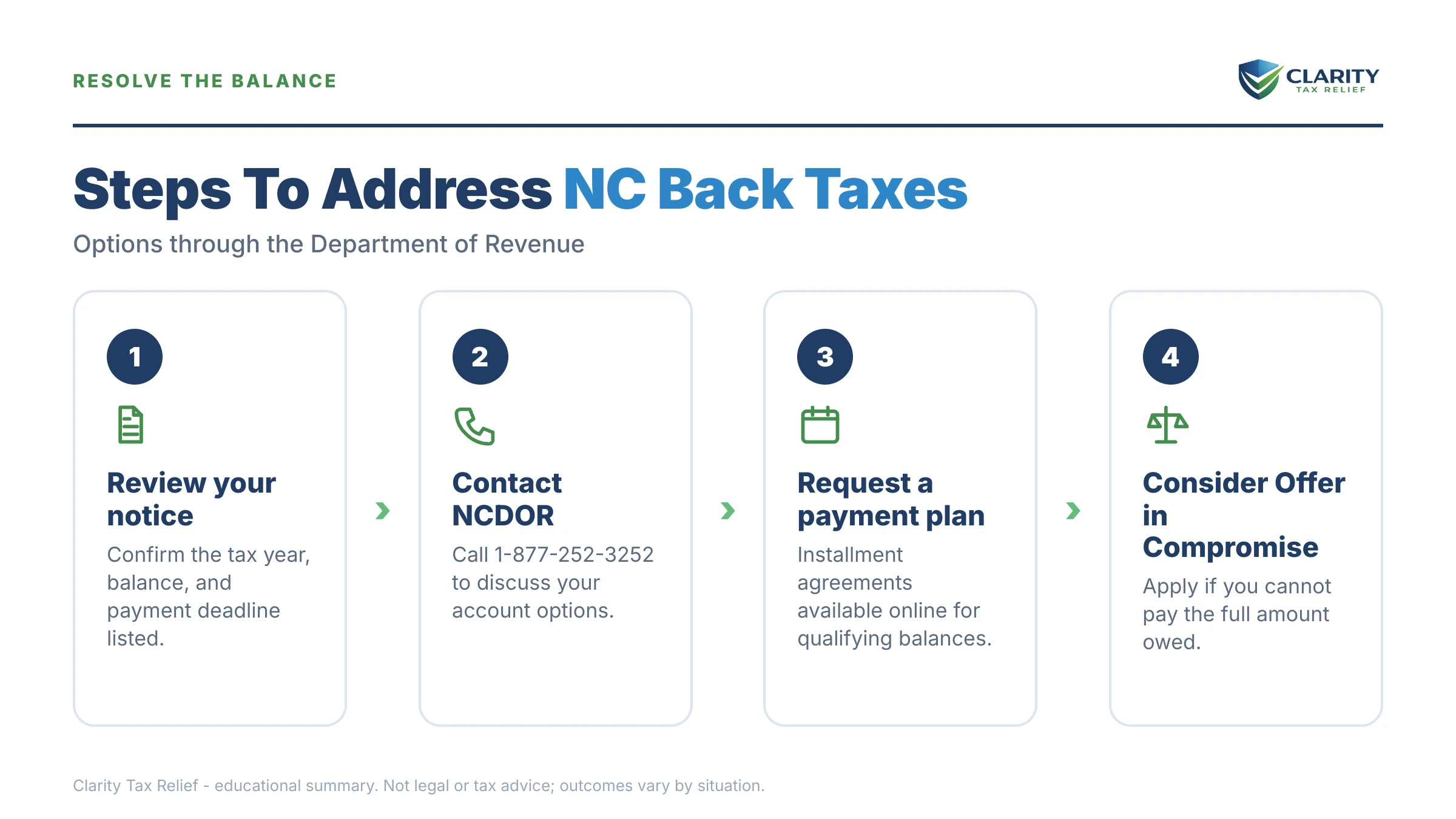
NCDOR offers fewer programs than the IRS, but every path below is real. Every option works better before the 20% fee attaches — the same debt resolved early is simply a smaller debt. (For the general playbook that applies to any tax agency, see our pillar on how to settle tax debt yourself; everything below is NC-specific.)
| Option | What it does | Typically fits | Watch out for |
|---|---|---|---|
| Pay in full | Stops all escalation immediately | Balances you can cover within a billing cycle | Verify the amount first — SFR-style assessments are often inflated |
| Installment payment agreement | Monthly payments; halts forced collection while current | Steady income, balance too big to pay at once | Windows are balance-based and shorter than IRS plans; interest keeps accruing; one default restarts collection |
| Departmental review (Form NC-242) | Formally disputes a proposed assessment or refund denial | Wrong income, wrong year, missed deductions, residency errors | Must be filed by the notice deadline — typically 45 days — or the assessment goes final |
| Penalty waiver (Form NC-5500) | Removes penalties for good compliance history or reasonable cause | First slip-up in years, or illness/disaster behind the lapse | Interest is rarely waived; the underlying tax stays |
| Offer in Compromise (Form OIC-100) | Settles for less than the full balance under G.S. §105-237.1 | Genuine inability to ever pay in full, shown through full financial disclosure | Means-tested and strictly reviewed — if NCDOR's math says you can pay over time, expect a rejection |
A few NC-specific notes the table can't hold. NCDOR's installment agreements can be requested through its online services, but unlike the IRS's published 72-month framework, plan length in North Carolina depends on the balance and tax type — confirm current terms directly with the department before promising yourself a number. And the state's offer program is nothing like the late-night-radio version: it exists, it works for genuinely uncollectible situations, and NCDOR audits your finances line by line before saying yes.
If you're facing true hardship — paying anything would leave you unable to cover basic living expenses — say so explicitly when you contact NCDOR. The state weighs documented hardship in structuring arrangements, but there's no formal equivalent of the IRS's Currently Not Collectible status, so don't expect an automatic pause.
Say you owe NCDOR $13,600: the real math
Here's a clearly hypothetical example. Say you and your spouse file jointly in Greensboro and owe $13,600 across two NC tax years — a withholding shortfall the year one of you went 1099, plus an IRS adjustment that flowed down to your state return.
If you wait until the collection stage: NCDOR adds the 20% collection assistance fee — $13,600 × 20% = $2,720 — pushing the balance to $16,320 before ongoing interest. Then comes Attachment and Garnishment. On roughly $9,000 per month in combined gross wages, 10% is about $900 per month taken off the top of your paychecks, before your mortgage sees a dime. And because a joint liability attaches to both spouses, both employers, both bank accounts, and both refunds are exposed. At $900 per month against $16,320, you're garnished for around 18 months — longer as interest accrues.
If you act before the fee attaches: you're arranging payment on $13,600, not $16,320. If NCDOR approves, say, a 36-month agreement, that's roughly $378 per month before interest — a payment you choose, on a schedule you control, with no garnishment order sitting at your employer's HR desk. The difference between the two paths is $2,720 in fees plus the paycheck disruption, for the identical underlying debt.
One more lever: if this is your first compliance problem in years, a penalty waiver request could trim the penalty portion of that $13,600 before you even set up the plan — shrinking both the balance and the monthly payment.
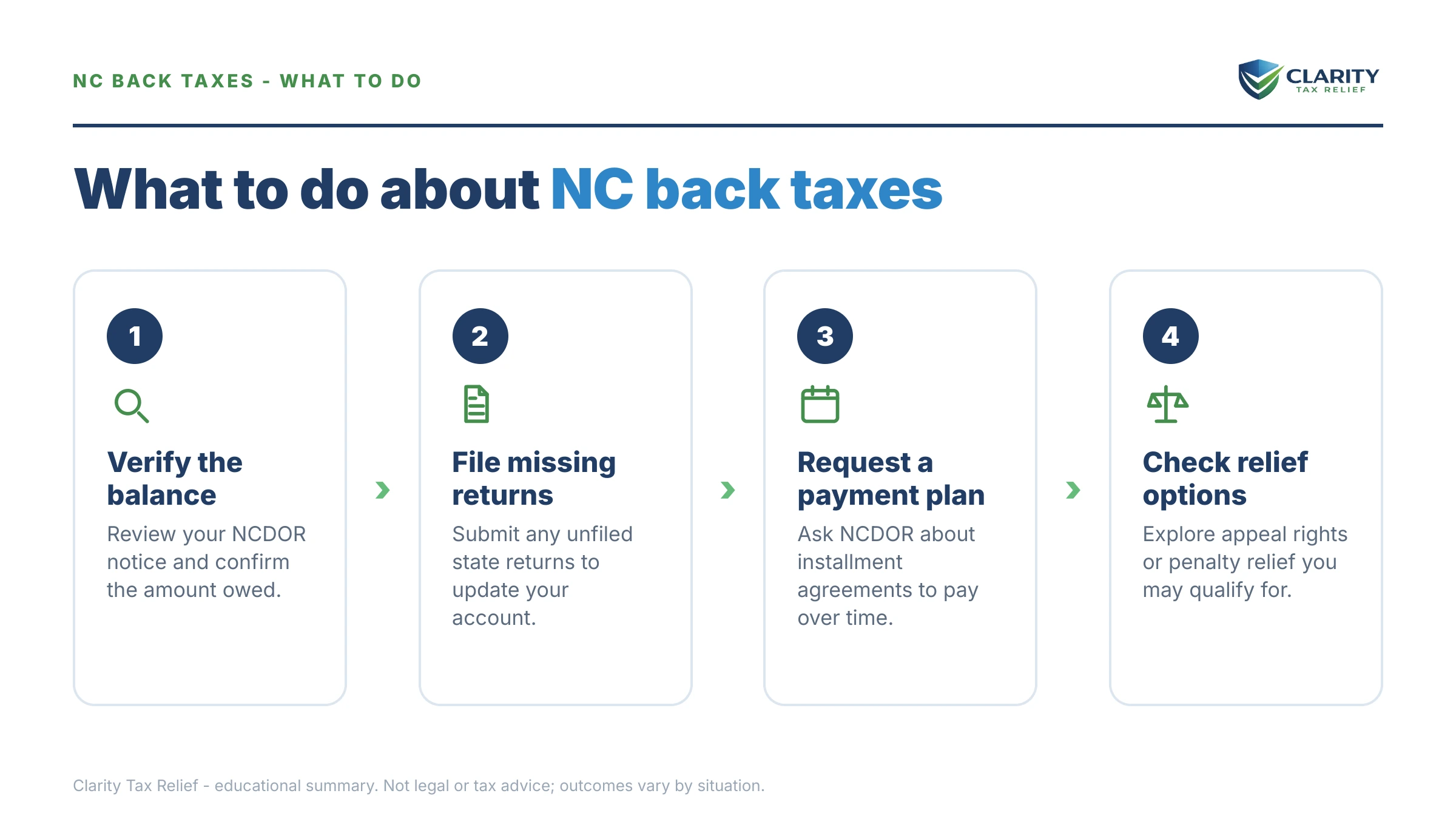
How to respond to an NCDOR collection notice, step by step
- Verify the assessment. Match the notice's tax year and amount against your filed NC returns, and check whether it says "proposed" or "final" — that one word decides your next move.
- Dispute it before it goes final. If the numbers are wrong, request a Departmental review (Form NC-242) by the response date printed on the notice — typically 45 days for a proposed assessment.
- File any missing NC returns. NCDOR generally won't finalize a payment arrangement while required returns are unfiled, and filing replaces the state's inflated estimates with your real numbers.
- Arrange payment before the fee stage. Pay in full through NCDOR's online services or request an installment payment agreement so the 20% collection assistance fee and garnishment never enter the picture.
- Request penalty relief in writing. Ask NCDOR to waive penalties (Form NC-5500) based on a good compliance record or reasonable cause — interest stays, but penalties often don't have to.
- Escalate to a professional when the stakes jump. If a garnishment is already running, a Certificate of Tax Liability is docketed, or business trust taxes are involved, have an experienced tax professional take over before the next stage.
NCDOR vs. the IRS: why North Carolina collects differently
The NC Department of Revenue moves faster than the IRS and charges a waiting cost the IRS never does. The IRS has no equivalent of North Carolina's 20% collection assistance fee — which is exactly why the "deal with the IRS first, the state can wait" instinct backfires in North Carolina.
| Collection feature | NC Department of Revenue | IRS |
|---|---|---|
| Extra collection cost | 20% collection assistance fee added at the collection stage | None — penalties and interest only |
| Wage garnishment | 10% of gross wages per pay period, by administrative notice | Leaves you an exempt amount based on filing status and dependents; the rest can be taken |
| Public lien | Certificate of Tax Liability docketed with the county clerk of court, judgment-style | Notice of Federal Tax Lien filed in public records |
| Settlement program | Offer in Compromise via Form OIC-100 (G.S. §105-237.1) | Offer in Compromise via Form 656; roughly 1 in 5 offers accepted in FY2024 |
| Payment plans | Balance-based, generally shorter windows; requested through NCDOR | Up to 72 months online for balances of $50,000 or less |
| Collection window | A docketed CTL is generally enforceable for 10 years | 10-year CSED from assessment, pausable by appeals, offers, and bankruptcy |
What if you owe both the IRS and North Carolina?
Owing both agencies means both refunds and both sets of remedies are in play at once. The IRS can seize your NC refund through the state income tax levy program, and North Carolina can intercept your federal refund through the Treasury Offset Program — so whichever return generates a refund, someone takes it.
The sequencing question — which agency gets your first dollar — comes down to who's closest to forced collection and who charges more for delay. NCDOR's 20% fee usually makes the state the more expensive one to stall, even when the IRS balance is bigger. Our full framework on state tax debt vs irs walks the decision through; the short version is: get an arrangement in place with both, and prioritize whichever notice is furthest down its own escalation ladder. Federal payments themselves run through IRS.gov/payments; keep the two debts, and the two paper trails, strictly separate.
Situations that change the answer
Married filing jointly. A joint NC liability makes both spouses fully liable for the whole balance — NCDOR can garnish either paycheck or both, and reach jointly held accounts. If the debt traces to one spouse's income or a year before the marriage, raise that when you call; allocation arguments exist but must be made, not assumed.
Self-employed and 1099 earners. No employer means no wage garnishment target — so NCDOR leans on bank garnishments and payments owed to you by clients instead, and those aren't protected by the 10% cap. Quarterly underpayment is also usually the root cause, so fixing estimates going forward is part of any durable resolution.
Business owners. Sales tax and employee withholding are trust taxes, and North Carolina pursues the people behind the business when they go unpaid — an LLC does not automatically shield you. See our guide to personal liability for payroll taxes. If federal payroll deposits slipped at the same time — they usually did — the 941 back taxes problem needs solving in parallel, because the IRS's trust-fund penalties dwarf the state's.
Short-term rental hosts. Asheville, the Outer Banks, and the Triangle are full of hosts who discovered NC sales tax and county occupancy tax apply to their listings. If that's your letter, our guide for when an Airbnb host owes taxes covers the layered state and local exposure.
You've moved out of North Carolina. Distance doesn't dissolve the debt. A docketed CTL still clouds NC property you own, refund offsets still work across state lines, and NCDOR can still pursue collection. Resolve it before it complicates a home sale or a background check you didn't see coming.
Bankruptcy on the table. State income taxes follow age-and-filing rules similar to federal ones, and a repayment plan can structure both debts together — our chapter 13 irs back taxes guide explains how tax debt behaves inside a plan. This is attorney territory; don't file around a tax debt without tax-specific advice.
If your NCDOR notice already says "Attachment and Garnishment" — or you owe Raleigh and the IRS at the same time — call (888) 825-7779 for a free, no-pressure review of both files before either agency takes the next step.
When you can handle NCDOR back taxes yourself
Plenty of NC balances need no professional at all. If you agree with the amount and can pay it within a few months, just handle it directly through the department's official site at NCDOR.gov — pay online or request an installment agreement, keep the confirmation, and you're done. The same goes for a first notice on a single year, or a simple penalty waiver request when your compliance history is clean.
Experienced help changes the outcome in a narrower set of situations: a garnishment already hitting your paycheck or bank account, a CTL docketed ahead of a home sale or refinance, multiple unfiled NC years assessed from estimates, business sales tax or withholding debt with personal exposure, an OIC-100 where the financial disclosure math decides everything, or a combined IRS-plus-NCDOR problem where sequencing mistakes cost real money. In those cases the fee for help is usually smaller than the cost of getting the order of operations wrong.
Terms on your NCDOR notice, decoded
- Proposed assessment — NCDOR's opening position, not yet final; you can still dispute it through Departmental review.
- Notice of Collection — the debt is final and the state is authorized to use forced collection without going to court.
- Collection assistance fee — the 20% charge added to overdue debt that reaches NCDOR's collection stage.
- Attachment and Garnishment — NCDOR's administrative order requiring your employer, bank, or another third party to hand over money that's yours.
- Certificate of Tax Liability (CTL) — a public filing with the clerk of superior court that operates like a court judgment against your property in that county.
- Forced collection — the umbrella term on NCDOR notices for garnishments, CTLs, and seizure remedies.
NC Department of Revenue back taxes: your questions, answered
Can the NC Department of Revenue garnish wages without a court order?
Yes. NCDOR issues Attachment and Garnishment notices administratively — no judge signs anything. For wages, the garnishment is capped at 10% of your gross pay each period and continues until the debt is paid or released. Your employer is legally required to comply, and the 10% cap does not protect bank accounts or payments owed to you by third parties.
How much can NCDOR take from a bank account?
Up to the full amount you owe, if it's in the account. A bank Attachment and Garnishment is not limited by the 10% wage cap — the bank must hold and remit funds up to your total liability. Joint accounts can be reached when the taxpayer has rights to the funds, which is why arranging payment before the garnishment stage matters so much.
What is the NC collection assistance fee?
It's a 20% fee NCDOR adds to overdue tax debt that isn't resolved after the department's collection notices. On a $13,600 balance, that's $2,720 stacked on top of tax, penalties, and interest. NCDOR notifies you before imposing it, so that warning notice is your last cheap exit — pay or arrange payment before the fee attaches.
Does NCDOR offer payment plans?
Yes — installment payment agreements, requested online through NCDOR.gov or by contacting the department. Plan length depends on how much you owe and the tax type, and NCDOR's windows are generally shorter than the IRS's 72-month online plans. You must stay current on new filings and payments; a missed payment or a new unpaid balance can default the agreement and restart forced collection.
Does North Carolina have an offer in compromise?
Yes. NCDOR can settle for less than the full balance under N.C. Gen. Stat. §105-237.1 using Form OIC-100, but only when the state concludes you genuinely can't pay in full — it's a means-tested review of your assets and income, not an advertised discount. Expect full financial disclosure, and expect rejection if NCDOR's math shows you could pay over time.
Will NCDOR take my federal tax refund?
It can. North Carolina participates in the federal Treasury Offset Program, which lets the state intercept your federal income tax refund for finalized state income tax debt. It works in the other direction too — the IRS can take your North Carolina refund through the State Income Tax Levy Program. Owing either agency puts both refunds at risk.
How long can NCDOR collect back taxes?
North Carolina's collection window doesn't mirror the IRS's 10-year CSED. Once NCDOR dockets a Certificate of Tax Liability with your county's clerk of court, it functions like a judgment against you and is generally enforceable for 10 years. Don't plan on outlasting the state — confirm the status of your specific years with NCDOR or an experienced tax professional before assuming anything expired.
Can NCDOR penalties be waived?
Often, yes. NCDOR grants penalty waivers for taxpayers with a good compliance record and for reasonable cause — events outside your control like serious illness or disaster. The request is made in writing, generally using Form NC-5500, Request to Waive Penalties. Interest, by contrast, is rarely waivable, so a waiver shrinks the balance but doesn't stop its growth.
Should I pay the IRS or NCDOR first if I owe both?
Usually the agency closest to forced collection gets the first dollar — and NCDOR often escalates faster, because its process is heavily automated and its 20% collection fee front-loads the cost of waiting. That said, IRS balances are typically larger and grow at their own penalty rates. Compare both timelines and both balances before deciding, and try to get an arrangement in place with each.
Your next 24 hours
- Find the notice type and response date. Look at the top of your NCDOR letter: does it say "proposed assessment," "Notice of Collection," or "Attachment and Garnishment"? That word, plus the printed date, tells you which stage you're at and how much time you actually have.
- Gather three things. Your last two NC returns (Form D-400), the notice itself, and a recent pay stub or profit-and-loss — everything a review of your options requires.
- Get a free case review. Call (888) 825-7779 or use the 2-minute form before your balance crosses into the 20% collection-fee and garnishment stage — every option on this page is cheaper on this side of that line.
This guide is general information, not tax or legal advice for your specific situation. Eligibility for IRS programs depends on individual facts and circumstances; no outcome is guaranteed.