
City Tax Relief Guides
Tax Relief Raleigh: Every Real Option for IRS and NCDOR Debt in 2026
The short answer: tax relief in Raleigh means resolving two separate debts — federal (IRS) and state (NCDOR) — through payment plans, hardship status, penalty relief, or a means-tested Offer in Compromise. You don't need a local storefront: IRS cases are handled centrally, and NCDOR has its own programs. Eligibility depends entirely on your finances.
If you're searching for tax relief Raleigh residents can actually use, you're probably past the first letter — maybe past the fifth. Rent on your apartment is due on the first no matter what the IRS does, and now a notice is threatening the paycheck or bank account that pays it.
Here's what makes your situation different from someone in Miami or Dallas: Raleigh taxpayers answer to two collectors — the IRS and the North Carolina Department of Revenue (NCDOR) — and NCDOR can garnish 10% of your gross wages without ever going to court. This guide maps both systems, what each option costs, and the exact order to fix things in.
⏱ The clock that's actually running: there's no single deadline on a tax-debt problem — but IRS penalties and interest compound every month, an NCDOR garnishment runs until the debt is paid, and if you've received an LT11 Final Notice, you have 30 days to request a Collection Due Process hearing before the IRS can levy. Check the date printed on your newest notice — that date controls.
Why Raleigh taxpayers end up needing tax relief
Most Raleigh tax debt starts with income that had no withholding attached. The Triangle runs on 1099 work: contract developers and consultants around RTP, gig drivers covering Glenwood South on weekends, real estate agents riding Wake County's market, and small firms juggling payroll. No employer withheld, quarterlies got skipped, and April produced a bill instead of a refund.
The second common trigger is a bad year absorbed the expensive way — a layoff followed by a 401(k) withdrawal, which adds tax and usually a 10% early-distribution penalty on top of lost income. The third is simply an old balance that compounded: the failure-to-file penalty runs 5% per month — ten times the 0.5% failure-to-pay penalty — though in months where both penalties apply, the failure-to-file portion drops to 4.5% (5% combined). Either way, unfiled years grow fastest of all.
Whatever started it, the same debt often exists twice. North Carolina piggybacks on your federal return, so a balance with the IRS usually means a smaller parallel balance with NCDOR — and NCDOR frequently moves to garnishment faster than the IRS does.
What happens if you ignore IRS and NCDOR collections
Both collectors escalate automatically — no human decides to come after you, and no staffing shortage stops the sequence. The IRS cut its workforce roughly 27% in 2025, but its notices and levies are generated by computers that never got laid off.
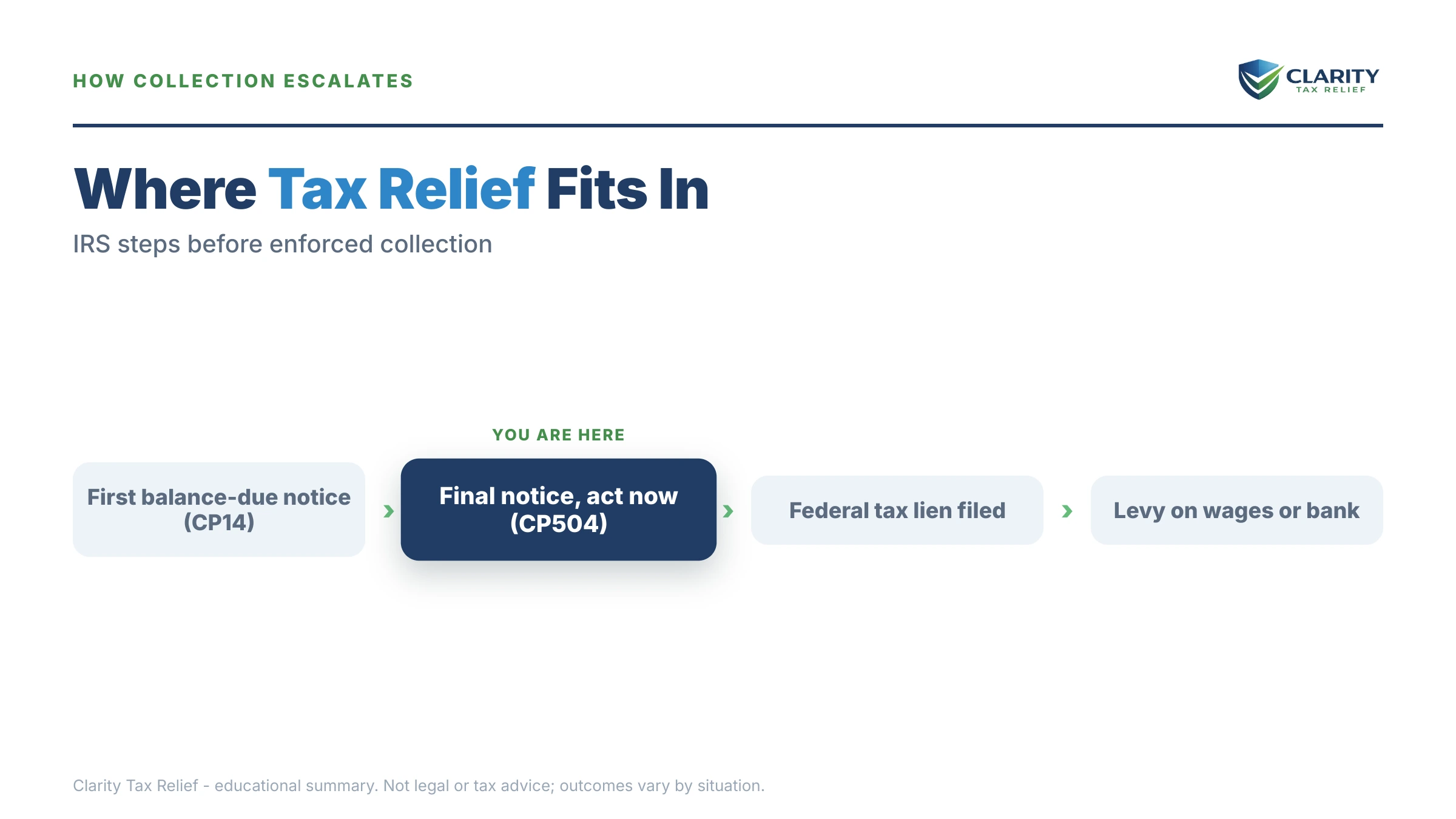
On the federal side, the stages run in this order:
- CP14 and reminder notices (CP501/CP503) — bills. No enforcement yet, but the balance grows monthly.
- CP504 — Notice of Intent to Levy. The IRS can now take your North Carolina state refund, and a federal tax lien becomes a live risk.
- LT11 / Letter 1058 — Final Notice. This starts a 30-day clock and your Collection Due Process hearing rights via Form 12153. After 30 days, levies can begin.
- Levy. A bank levy freezes funds with a 21-day hold before they leave; a wage levy is continuous until released; Social Security can lose up to 15% through the Federal Payment Levy Program. Once your assessed federal debt passes $66,000 (the 2026 threshold), the IRS can also certify you for passport denial.
On the state side, NCDOR is leaner and faster. A Notice of Collection is followed by an Attachment and Garnishment — sent directly to your employer or bank with no court order required — taking 10% of gross wages, or reaching funds on deposit up to your liability. NCDOR can also record a Certificate of Tax Liability with the county clerk of court, which works like a civil judgment against you in Wake County's public records. Our North Carolina back taxes guide covers the state track in detail.
The pattern to understand: nothing about waiting makes either debt smaller. Every stage you let pass removes an option you had at the stage before.
Facing an IRS or NCDOR levy in Raleigh?
If a Final Notice or garnishment is in motion, the order you respond in matters more than anything else. Get your notices reviewed free by an experienced tax professional — we'll tell you exactly where you are in both sequences and what to do first.
Tax relief Raleigh residents actually qualify for: every option compared
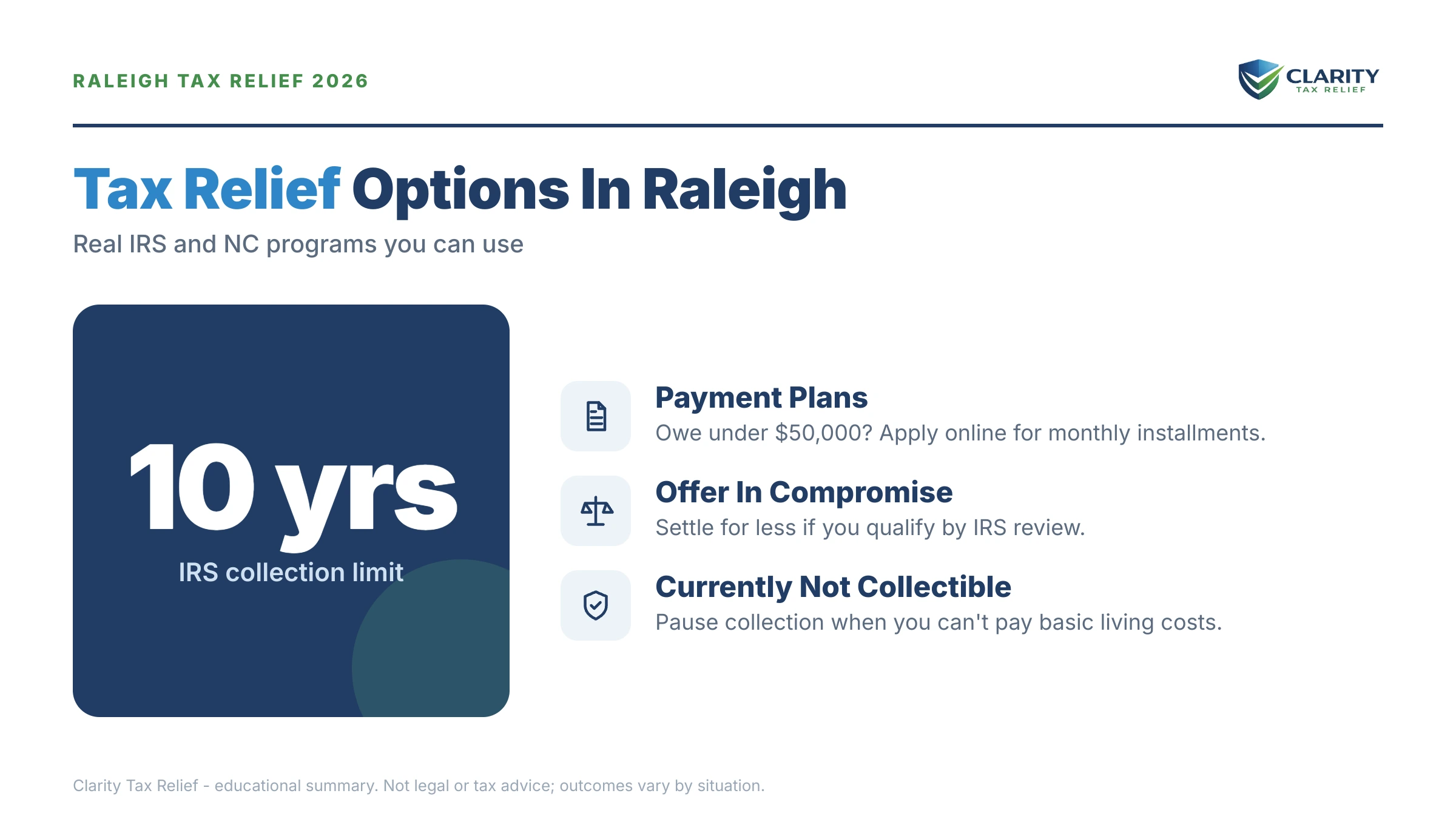
Every legitimate relief program is means-tested — your income, rent, and assets decide what you qualify for, not a salesperson. Our how to settle tax debt yourself guide walks through each program's mechanics; here's the Raleigh-relevant summary, federal and state side by side.
| Option | Who may qualify | Cost & catch |
|---|---|---|
| IRS short-term plan | Can pay in full within 180 days | $0 setup; interest and penalties keep accruing |
| IRS long-term installment agreement | ≤ $50,000 assessed: set up online, up to 72 months | Modest setup fee (reduced/waived low-income); accrual continues |
| Currently Not Collectible (CNC) | IRS allowable expenses meet or exceed your income (Form 433-F) | $0; collection pauses but the debt and interest remain, and a lien is possible |
| Offer in Compromise (IRS) | Assets + future income genuinely can't cover the balance | $205 fee + 20% down on lump-sum offers — both waived with low-income certification (AGI ≤ 250% of poverty) |
| Penalty relief (FTA / AEP / reasonable cause) | Clean prior 3 years, or documented cause (illness, disaster) | $0; from summer 2026 the new Automatic Exemption from Penalty applies without a request |
| NCDOR installment agreement | State balance you can't pay at once | NCDOR sets its own terms; garnishment generally pauses while you're compliant |
| NCDOR Offer In Compromise | Demonstrated inability to pay under NCDOR's own criteria | Separate application and review from the IRS program |
Three warnings that save Raleigh readers money. First, an accepted IRS resolution does nothing to your NCDOR balance — each debt must be resolved on its own track. Second, an Offer in Compromise is real but selective: the IRS accepted roughly 1 in 5 offers in FY2024, and the math runs on what the IRS could collect from you, not on what you'd like to pay. Third, Currently Not Collectible status pauses collection without shrinking the debt — it buys time, not forgiveness.
How much do you owe? Realistic options by balance
Your total assessed balance — not your monthly budget — decides which doors are open. Here's the honest map:
| Balance | Realistic path | What changes at this level |
|---|---|---|
| Under $10,000 | Guaranteed installment agreement; usually DIY online | Approval is essentially procedural if you've filed and stay current |
| $10,000–$25,000 | Streamlined installment agreement, online setup | No financial disclosure required; penalty relief worth checking |
| $25,000–$50,000 | Streamlined up to 72 months; direct debit typically expected at the top of this band | OIC or CNC becomes worth pricing out if income is tight |
| $50,000–$66,000 | Non-streamlined agreement — full financials (Form 433-F) required | The IRS now examines your budget line by line |
| Over $66,000 | Managed collection; negotiated agreement, OIC, or CNC | Passport certification threshold crossed; professional help usually pays for itself |
IRS vs. NCDOR: two different collectors, two different rulebooks
The single biggest mistake Raleigh taxpayers make is assuming the state works like the IRS. It doesn't — and on wages, NCDOR often strikes first.
| Question | IRS | NCDOR |
|---|---|---|
| Wage garnishment | Continuous levy; leaves only an exempt amount based on filing status and dependents | 10% of gross wages via Attachment and Garnishment |
| Court order needed? | No — but must send a Final Notice (LT11) with 30-day appeal rights first | No — the notice goes straight to your employer or bank |
| Bank accounts | Levy with a 21-day hold before funds leave | Attachment can reach funds on deposit up to your liability |
| Public record | Notice of Federal Tax Lien, filed at the county level | Certificate of Tax Liability recorded with the clerk of court, like a judgment |
| How long they can collect | 10 years from assessment (the CSED), pausable by appeals, an OIC, or bankruptcy | Its own rules — confirm the timeline on your specific debt with NCDOR |
| Settlement program | Offer in Compromise ($205 fee, waivable) | NCDOR Offer In Compromise — separate application, separate criteria |
If you owe both, the general playbook is to neutralize whichever agency is actively enforcing first, then resolve the IRS balance (usually the larger one), then the state. If an IRS wage levy is your live threat, our guide on how to stop IRS wage garnishment covers the release paths — and you can estimate what a levy would leave you with using our IRS Wage Garnishment Calculator.
A worked example: $48,300 and a Final Notice in Raleigh
Say you owe the IRS $48,300 across two tax years from contract work, you rent near downtown, and an LT11 Final Notice just arrived. Here's the hypothetical math on your three realistic moves:
- Protect the 30-day window first. Filing Form 12153 within 30 days of the LT11 date generally stops levy action while your Collection Due Process hearing is pending — it's the difference between negotiating calmly and negotiating after your bank account is frozen with a 21-day hold running.
- Streamlined installment agreement. Because $48,300 is under the $50,000 line, you can set up a plan online for up to 72 months without submitting full financials: $48,300 ÷ 72 ≈ $671 per month, plus the interest and failure-to-pay penalty that keep accruing until it's paid. Once the agreement is active and you stay current, levy action generally stops.
- Price out an Offer in Compromise. As a renter, you have no home equity in the calculation. If your countable assets were, say, $2,500 in car equity plus $800 in savings ($3,300), and the IRS expense standards left you $180/month of disposable income (× 12 for a lump-sum offer = $2,160), your reasonable collection potential would be roughly $5,460 — far below $48,300, which makes you worth evaluating as a candidate. That's an illustration, not a promise: the IRS runs this math on documented numbers, and most offers are still rejected.
Notice what the renter status did: no house means no equity inflating the offer math, but it also means no asset to borrow against — which is exactly why the IRS's own programs, not a loan, are usually the renter's path.
How to get tax relief in Raleigh, step by step
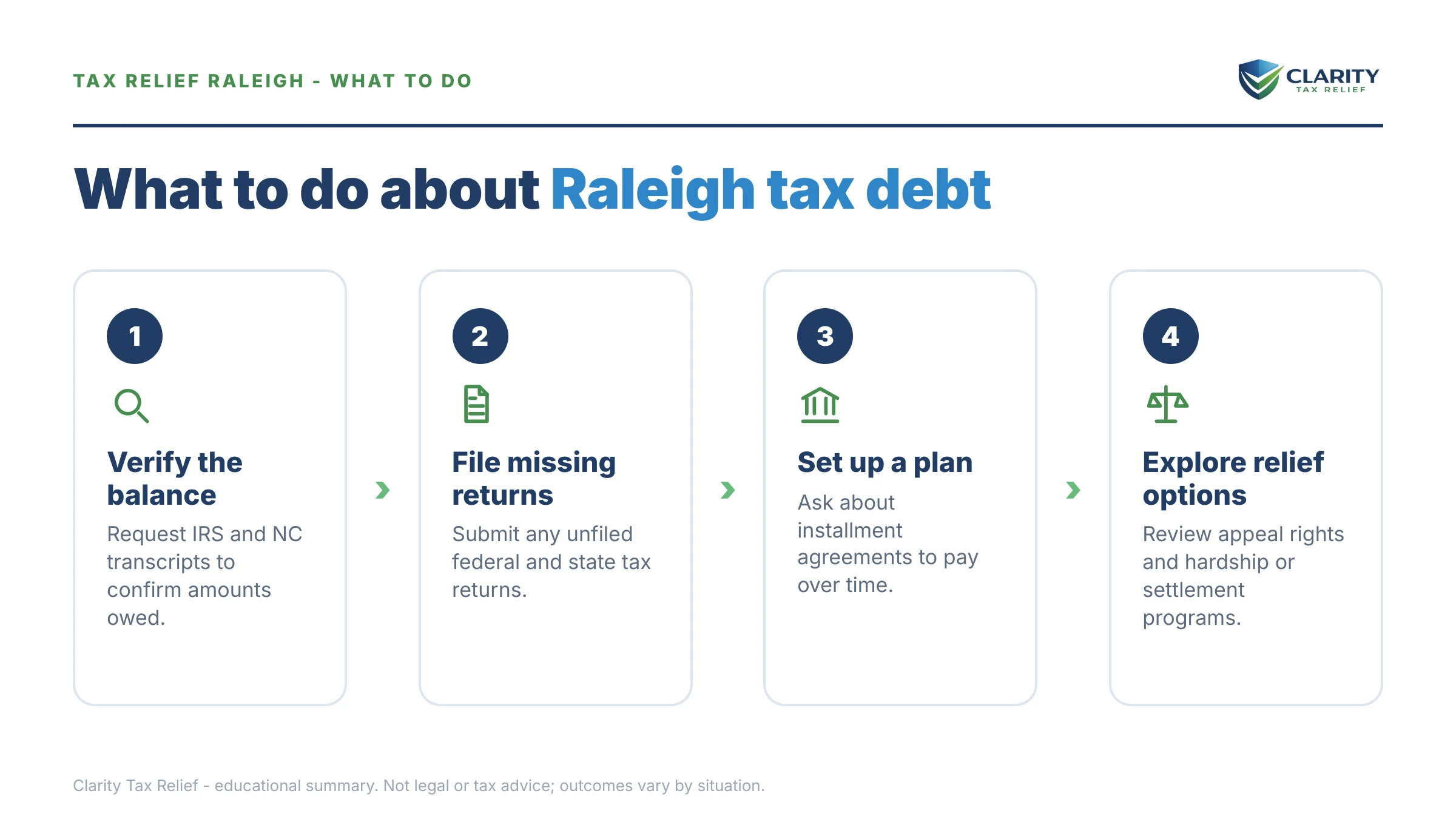
- Pull your IRS records. Set up an IRS online account and download your account transcripts so you know every year with a balance, every penalty, and every assessment date before you negotiate.
- Confirm your NCDOR balance. Gather every NCDOR notice and contact the North Carolina Department of Revenue for a current payoff — state and federal debts are tracked separately and both must be addressed.
- Stop active enforcement first. If you're holding an LT11, request a Collection Due Process hearing with Form 12153 within 30 days; if a garnishment or bank levy is already running, pursue a release before negotiating the balance.
- Match your finances to a program. Compare your income, rent, and assets against the options — payment plan, Currently Not Collectible, Offer in Compromise, or penalty relief — and pick the one your numbers actually support.
- Vet anyone you hire. Confirm the credential (EA, CPA, or attorney), get flat-fee pricing in writing, and walk away from anyone promising a settlement amount before reviewing your finances.
When you can handle this yourself — and when help changes the outcome
Plenty of Raleigh tax problems don't need a professional. If you owe under $10,000 on a bill you agree with, a guaranteed installment agreement set up online in twenty minutes solves it. Same if you can pay within 180 days (short-term plan, $0 fee), or if your only issue is a first-time penalty on an otherwise clean record — relief for that is procedural, and the new AEP rules make much of it automatic starting summer 2026.
Experienced help earns its fee in specific situations: a levy or NCDOR garnishment already in motion, an LT11 window about to close, multiple unfiled years that must be reconstructed before anything can be negotiated, business or payroll debt where personal liability is on the table (see our tax relief for small business guide), or Offer in Compromise math where one wrong number on Form 433 gets a viable offer rejected. In those cases the professional isn't buying you sympathy — they're buying you sequence, and sequence is what determines the outcome.
Free help exists too. The IRS Taxpayer Assistance Center in Raleigh takes in-person appointments (call 844-545-5640), Low Income Taxpayer Clinics serve the Triangle for taxpayers under income limits, and the Taxpayer Advocate Service can intervene when IRS action causes hardship.
Do you need a local Raleigh firm, or a national one?
Location is the least important thing about your representative. IRS collection cases are worked by centralized campuses through phone, mail, and fax; your representative files Form 2848 and works the case from anywhere. NCDOR likewise handles most collection matters remotely. What actually matters is on our how to choose a tax relief company checklist: a real credential, flat-fee pricing disclosed before you sign (see how much tax relief costs), and no promised outcomes.
Raleigh is blanketed by the same national radio and TV advertisers as every other market, and the biggest names aren't automatically the best fit — our Optima Tax Relief alternatives comparison shows what to weigh instead of ad volume. And if your debt spans a move down I-85, the state playbook is identical in our tax relief Charlotte guide.
Terms on your notices, decoded
- Levy vs. lien: a lien is a legal claim against what you own; a levy is the actual taking of wages or bank funds.
- Attachment and Garnishment: NCDOR's levy — a notice sent straight to your employer or bank, no court involved.
- Certificate of Tax Liability (CTL): NCDOR's public filing with the county clerk of court that works like a civil judgment.
- CSED: the Collection Statute Expiration Date — the end of the IRS's 10-year window to collect, which appeals, offers, and bankruptcy can pause.
- CDP hearing: the Collection Due Process appeal you can demand (Form 12153) within 30 days of a Final Notice, before levy.
- Reasonable Collection Potential (RCP): the IRS's math — your asset equity plus future disposable income — that decides whether an Offer in Compromise flies.
Tax relief in Raleigh: your questions answered
Is tax relief in Raleigh legit, or is it a scam?
The programs are real — installment agreements, Offers in Compromise, hardship status, and penalty relief are official IRS and NCDOR options written into law. What's often not legit is the marketing around them: any firm promising to settle for "pennies on the dollar" before reviewing your finances is selling a fantasy. The IRS accepted roughly 1 in 5 Offers in FY2024, and every program is means-tested, so a promise made before a financial review is a red flag.
How much can NCDOR garnish from my paycheck in North Carolina?
NCDOR can garnish 10% of your gross wages for tax debt through an Attachment and Garnishment notice, and it does not need a court order to send one. The garnishment continues until the debt is paid or NCDOR releases it. Bank accounts are treated differently — an NCDOR bank attachment can reach the funds on deposit up to your full liability, so a bank garnishment often hurts far more than a wage one.
Do I need a local tax relief company in Raleigh, or can a national firm handle my case?
You don't need a local office. IRS collection cases are worked by centralized campuses and by phone, mail, and fax — not at a Raleigh branch — so an experienced tax professional anywhere in the country can represent you with Form 2848. What actually matters is the credential (enrolled agent, CPA, or attorney), flat-fee pricing in writing, and experience with NCDOR if you owe the state too. A storefront adds convenience, not authority.
How much does tax relief cost in Raleigh?
Government costs are small: short-term IRS plans have a $0 setup fee, long-term plans carry a modest setup fee that's reduced or waived for low-income taxpayers, and an Offer in Compromise has a $205 application fee that low-income certification waives. Professional representation typically runs from several hundred dollars for a simple payment plan to a few thousand for an Offer or levy release. Be wary of large upfront "investigation" fees charged before anyone quotes the actual work.
Does North Carolina have an Offer in Compromise program?
Yes. NCDOR runs its own Offer In Compromise program, separate from the IRS's, with its own forms and its own acceptance criteria based on your inability to pay the full balance. An accepted IRS offer does not erase your North Carolina debt, and an accepted NCDOR offer does not touch your federal balance — if you owe both, each has to be resolved on its own track.
Will setting up an IRS payment plan stop a levy?
Generally yes, going forward — once an installment agreement is in place and you stay current, the IRS typically releases an active wage levy and stops new levy action. It won't automatically return money already taken. If a bank levy has hit, the bank holds the funds for 21 days before sending them to the IRS, and that window is your chance to get the levy released or reduced.
Where can I get free help with tax debt in Raleigh?
Three real options: Low Income Taxpayer Clinics serve the Triangle and represent taxpayers who generally earn under 250% of the federal poverty level (the current list is at taxpayeradvocate.irs.gov); the Taxpayer Advocate Service can step in when IRS action is causing financial hardship; and the IRS Taxpayer Assistance Center in Raleigh takes in-person appointments at 844-545-5640. None of these will negotiate an NCDOR balance — for state debt, contact NCDOR directly.
More detail on the bank-levy timeline is in our guide to the IRS bank levy and the 21-day rule. For primary sources, see IRS.gov payment options, the North Carolina Department of Revenue, and the Taxpayer Advocate Service.
Your next 24 hours
- Find the newest letter from each agency. Note the notice name in the corner (LT11? CP504? Notice of Collection?) and the date printed on it — that date, not today's, controls your response window.
- Gather three things: your last filed return, every IRS and NCDOR notice you've received, and a recent pay stub or income summary. That's everything needed to size up every option above.
- Get a free case review. Send us what you found through the 2-minute form or call (888) 825-7779. An experienced tax professional will map your federal and NCDOR positions in one conversation — before another month of penalties and interest posts to either balance.
This guide is general information, not tax or legal advice for your specific situation. Eligibility for IRS programs depends on individual facts and circumstances; no outcome is guaranteed.