
Tax Relief Pricing
How Much Does Tax Relief Cost in 2026? Real Fee Ranges by Option and Debt Size
The short answer: how much does tax relief cost? Most reputable companies charge $1,500 to $4,000 for a straightforward individual case in 2026, and $4,000 to $7,500+ for complex work like an Offer in Compromise or payroll debt. The IRS's own program fees run $0 to $205. Percentage-of-debt pricing is a red flag.
You've called three companies about the same tax debt and heard three different prices — one wanted $1,800, one wanted $6,000, and one wouldn't name a number until you "enrolled." That spread isn't your imagination, and it isn't random. Tax relief pricing follows a logic, and once you see it, you can price your own case before the next sales call does it for you.
This guide gives you the market's real 2026 fee ranges three ways — by resolution option, by how much you owe, and by pricing model — plus a fully worked example on a $92,700 balance. The visual breakdown below shows where each dollar of a typical fee actually goes, so keep reading before you sign anything.
⏱ The real clock: there's no printed deadline on hiring help, but your balance grows while you compare quotes. The failure-to-pay penalty adds 0.5% every month, and interest compounds daily on top of it. On a $92,700 balance, that's roughly $464 a month in penalty alone — before interest.

Why tax relief quotes vary so much
Tax relief fees are driven by three numbers: how much you owe, how many tax years are unresolved, and which IRS program your finances actually fit. Everything else — the firm's brand, the salesperson's script, the "special program ending Friday" — is noise around those three inputs.
Your balance matters because it crosses IRS thresholds that change the work. Under $25,000, a payment plan can usually be set up online in an afternoon. Between $25,000 and $50,000, streamlined agreements still work with direct debit. Above $50,000, the IRS requires full financial disclosure — an IRS payment plan over $50,000 means preparing a Form 433 financial statement, documenting income and assets, and negotiating allowable expenses. That's real labor, and it's why quotes jump at that line.
Your compliance state matters just as much. The IRS won't approve any resolution while returns are unfiled, so every missing year adds preparation work — and cost — before negotiation can even start. And the resolution type sets the ceiling: an Offer in Compromise is a full financial case built from scratch, while a simple installment agreement is mostly paperwork and a phone call.
Finally, the pricing model itself changes what you pay for identical work. A flat-fee firm and a percentage-of-debt firm can quote the same case thousands of dollars apart. We compare the models in detail further down.
What waiting costs: the meter running while you compare quotes
An unresolved IRS balance grows by 0.5% in failure-to-pay penalty every month, plus daily-compounding interest — before the IRS lifts a finger to collect. The "cost of tax relief" question has a hidden second half: the cost of the weeks you spend deciding. And while you decide, the collection sequence advances on its own:
- The first bill (CP14) — typically about 21 days to pay before the automated notice sequence begins. Penalties and interest are already accruing.
- Reminder notices (CP501, CP503) — still just bills, but each one arrives with a larger balance than the last.
- CP504 — intent to levy your state refund — the IRS can now take your state tax refund, and a federal tax lien becomes a realistic next move.
- LT11 / Letter 1058 — final notice — a 30-day clock starts. After it runs, the IRS can levy bank accounts (funds are held 21 days before they leave) and garnish income.
- Above $66,000 certified as seriously delinquent — the IRS can certify your debt to the State Department, blocking passport renewal. See how passport revocation for tax debt works at the 2026 threshold.
One 2026-specific note: the IRS workforce was cut roughly 27% in 2025, which makes humans harder to reach — but the notices, liens, and levies above are issued by automated systems that never stopped running. Waiting for the IRS to "get around to you" is not a strategy. To see what delay costs on your own numbers, estimate it with our IRS penalty & interest calculator.
Comparing tax relief quotes right now?
Get a flat, written price for your exact case — free. An experienced tax professional reviews your situation and tells you what it should cost, including when the honest answer is "handle this yourself." Penalties and interest accrue monthly while you decide, so get the real number first.
How much does tax relief cost by resolution option?
In 2026, professional fees for individual tax resolution run from about $250 for a standalone penalty request to $7,500 or more for a full Offer in Compromise. Two separate costs hide inside every quote: what the IRS itself charges for the program, and what the professional charges to get you into it. Here they are side by side:
| Resolution option | What the IRS charges | Typical professional fee | Who typically qualifies |
|---|---|---|---|
| Short-term payment plan (up to 180 days) | $0 setup | $0–$1,500 (rarely worth hiring out) | Anyone who can pay in full within 180 days |
| Streamlined installment agreement | Modest setup fee; waived or reimbursed for low-income | $1,500–$3,000 | ≤ $25,000 (or ≤ $50,000 with direct debit), all returns filed |
| Non-streamlined agreement (over $50,000) | Setup fee + full financial disclosure | $3,000–$5,500 | Balances above $50,000; Form 433 financials required |
| Currently Not Collectible (hardship) | $0 | $1,500–$3,500 | Income at or below IRS allowable living expenses |
| Offer in Compromise | $205 fee + 20% down (lump sum); both waived with low-income certification | $3,500–$7,500 | Assets + future income genuinely below the balance; all returns filed |
| Penalty abatement (FTA / reasonable cause) | $0 | $250–$1,500 | FTA: clean compliance in the prior 3 years |
| Unfiled return preparation | $0 | $250–$750 per return | Required before the IRS approves any agreement |
Short-term plans and simple streamlined agreements are the cheapest resolutions in the system — and the ones you're most likely to be overcharged for, because they're easy work sold at complex-work prices. The exact IRS fee tiers, and when they're waived, are covered in our guide to the IRS payment plan setup fee.
Currently Not Collectible costs the IRS nothing to grant, but proving hardship means documenting that your income doesn't exceed the IRS's allowable expense standards — that documentation work is what the professional fee buys. The debt doesn't go away in CNC; interest keeps accruing and a lien remains possible.
The Offer in Compromise deserves its own caution. The IRS accepted roughly 1 in 5 offers in FY2024, and eligibility is pure math — the IRS compares your offer to what it could collect from your assets and future income. A firm that quotes you OIC-level fees before running that math is selling hope, not analysis. If your AGI is at or below 250% of the federal poverty guidelines, low-income certification waives the $205 fee, the 20% down payment, and payments during review — a fact some firms conveniently omit.
On penalties, don't pay for what's becoming free: First-Time Abate has long removed penalties for taxpayers with a clean prior three years, and starting summer 2026 the IRS is rolling out the Automatic Exemption from Penalty (AEP) — applied automatically, no request needed. A firm charging $1,000 to "request" relief the IRS grants on its own is charging you for a letter nobody needed to send.
For the full plain-English walkthrough of doing any of these yourself, the hub guide is how to settle tax debt yourself — this page sticks to what each path costs.
What tax relief should cost for what you owe
The realistic price of tax relief tracks your balance — not because bigger debts are proportionally more work, but because bigger balances cross IRS thresholds that add work. Here's what a fair total professional fee looks like at each band:
| Amount owed | Realistic resolution path | Fair total professional fee |
|---|---|---|
| Under $10,000 | Guaranteed installment agreement or short-term plan — usually DIY | $0 (IRS setup fee only) |
| $10,000–$25,000 | Streamlined plan online + penalty relief check | $0–$2,500 |
| $25,000–$50,000 | Streamlined plan with direct debit; OIC only if the math supports it | $1,500–$3,500 |
| $50,000–$100,000 | Financial-disclosure agreement, CNC, or OIC; passport risk above $66,000 | $3,500–$6,500 |
| Over $100,000 | Possible revenue officer assignment; full financial strategy across years | $5,000–$10,000+ |
Read this table defensively: if you owe $14,000 and a firm quotes $5,000, you're being priced like a $100,000 case. If you owe $92,700 and a firm quotes $900, nobody credentialed is doing the work. A fair quote sits inside the band for your balance — quotes far outside it, in either direction, are telling you something.
If the debt belongs to a business — payroll, 941s, sales tax — the fee structure is different because personal liability investigations and trust-fund issues enter the picture. See our buyer's guide to tax relief for small business for those ranges.
A worked example: a 1099 contractor who owes $92,700
Say you're a self-employed contractor who owes $92,700 across two tax years — no withholding, missed quarterlies, and the balance snowballed with penalties. This is a hypothetical, but the math is real. Here's how the costs stack up on every path:
The waiting cost. At 0.5% per month, the failure-to-pay penalty alone adds about $464 a month ($92,700 × 0.005 = $463.50), plus daily-compounding interest. Six months of "thinking about it" costs roughly $2,800 in penalty before interest — more than many complete resolutions.
The payment plan path. Because $92,700 is over the $50,000 line, there's no streamlined online agreement — the IRS wants a Form 433 financial statement. Spread over 72 months, the raw balance works out to about $1,288 a month ($92,700 ÷ 72), and the real payment runs higher because interest keeps accruing on the shrinking balance. One trap specific to contractors: the IRS requires you to be current on this year's quarterly estimated payments before it will approve — or keep — any agreement, so part of the professional work is fixing your quarterlies going forward, not just the old debt.
The passport wrinkle. At $92,700 you're above the $66,000 seriously-delinquent threshold for 2026, so certification to the State Department is on the table if the debt sits unresolved. Getting into an approved agreement is what takes that off the table.
The OIC path — if the math works. Suppose your asset equity totals $9,000 and the IRS's future-income formula adds $16,800, putting your reasonable collection potential around $25,800 — well below the $92,700 owed. An offer near that figure is plausible. IRS costs: the $205 application fee plus a 20% down payment of about $5,160 on a lump-sum offer (all waived with low-income certification, which is unlikely at contractor income levels but worth checking). If instead your equity and income show the IRS could collect the full $92,700 over time, no offer amount will be accepted — and an honest firm tells you that before charging OIC fees.
The professional fee. A case like this — over $50,000, two years, financial disclosure, quarterly compliance fixes — should run roughly $4,000 to $6,500 flat at a reputable firm. A percentage-of-debt firm charging 10% would bill $9,270 for the same work. Same forms, same phone calls, $3,000+ difference — that gap is the pricing model, not the service.
Flat fee vs. hourly vs. percentage of debt: pricing models compared
The pricing model a firm uses predicts your experience better than its star rating. Four models dominate the market:
| Pricing model | How it works | Risk to you |
|---|---|---|
| Flat fee (written, fixed scope) | One price for defined work, quoted after transcript review | Lowest — total cost known before you commit |
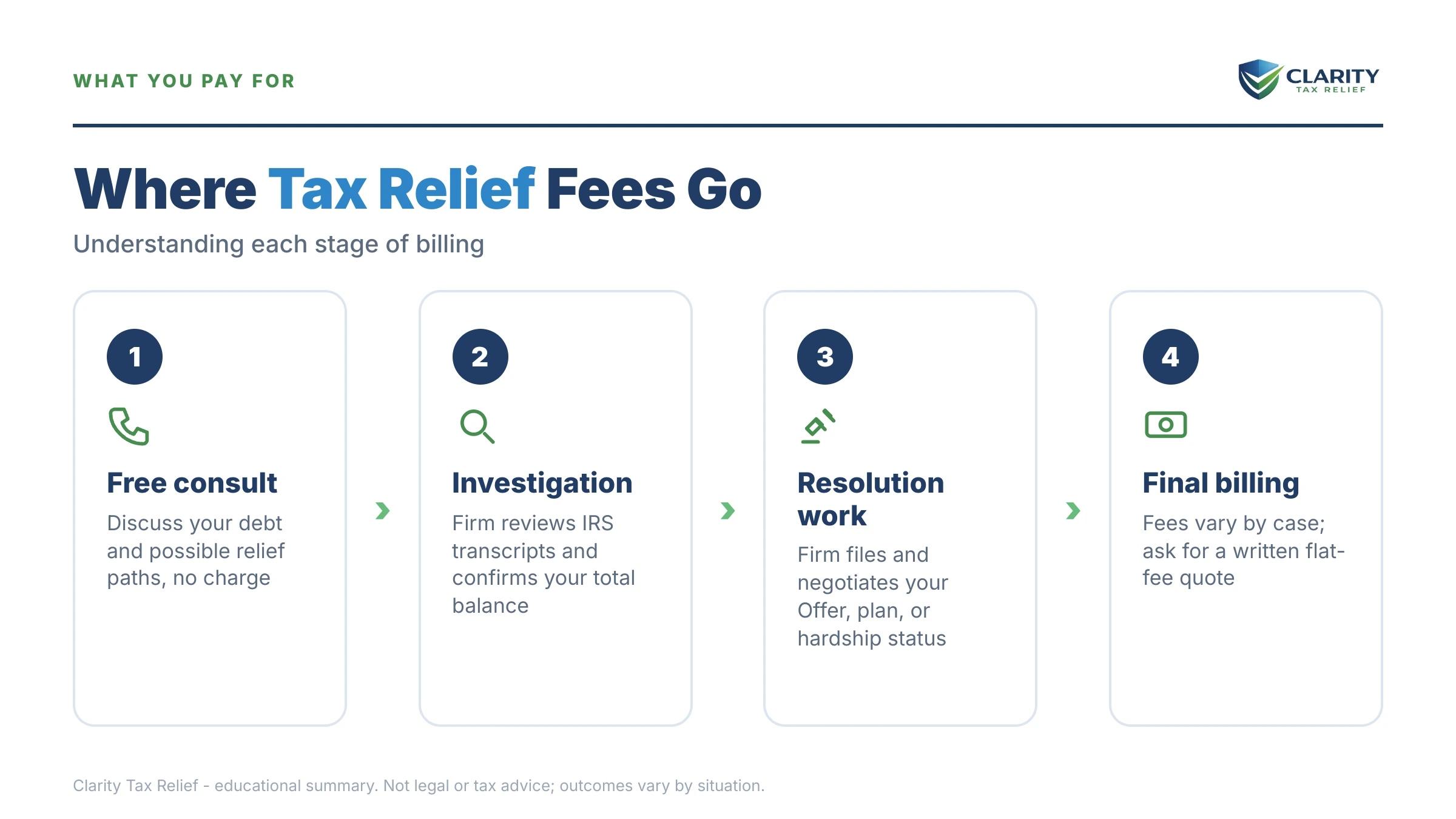
| Phased (investigation, then resolution) | Small discovery fee ($250–$750), then a fixed quote for the fix | Low — fair, if the phase-two quote is in writing |
| Hourly | $200–$550/hour, common at law firms | Open-ended for routine collection work; right for litigation |
| Percentage of debt | Fee scales with your balance, not the work | High — same work costs thousands more on bigger balances |
This is also where the industry's ugliest sales pitch lives. "Settle for pennies on the dollar" is a marketing line, not a program — settlement amounts come from the IRS's collection math, not a firm's negotiating swagger, and the FTC has shut down operators for exactly these promises. Firms built around that pitch tend to pair it with percentage pricing and mass-filed offers; our guide to OIC mills explains how that machine works. The deeper comparison of models is in tax relief flat fee vs. hourly pricing, and the full warning list is in our tax relief company red flags checklist.
How to shop for tax relief, step by step
Five steps turn you from a lead into an informed buyer:
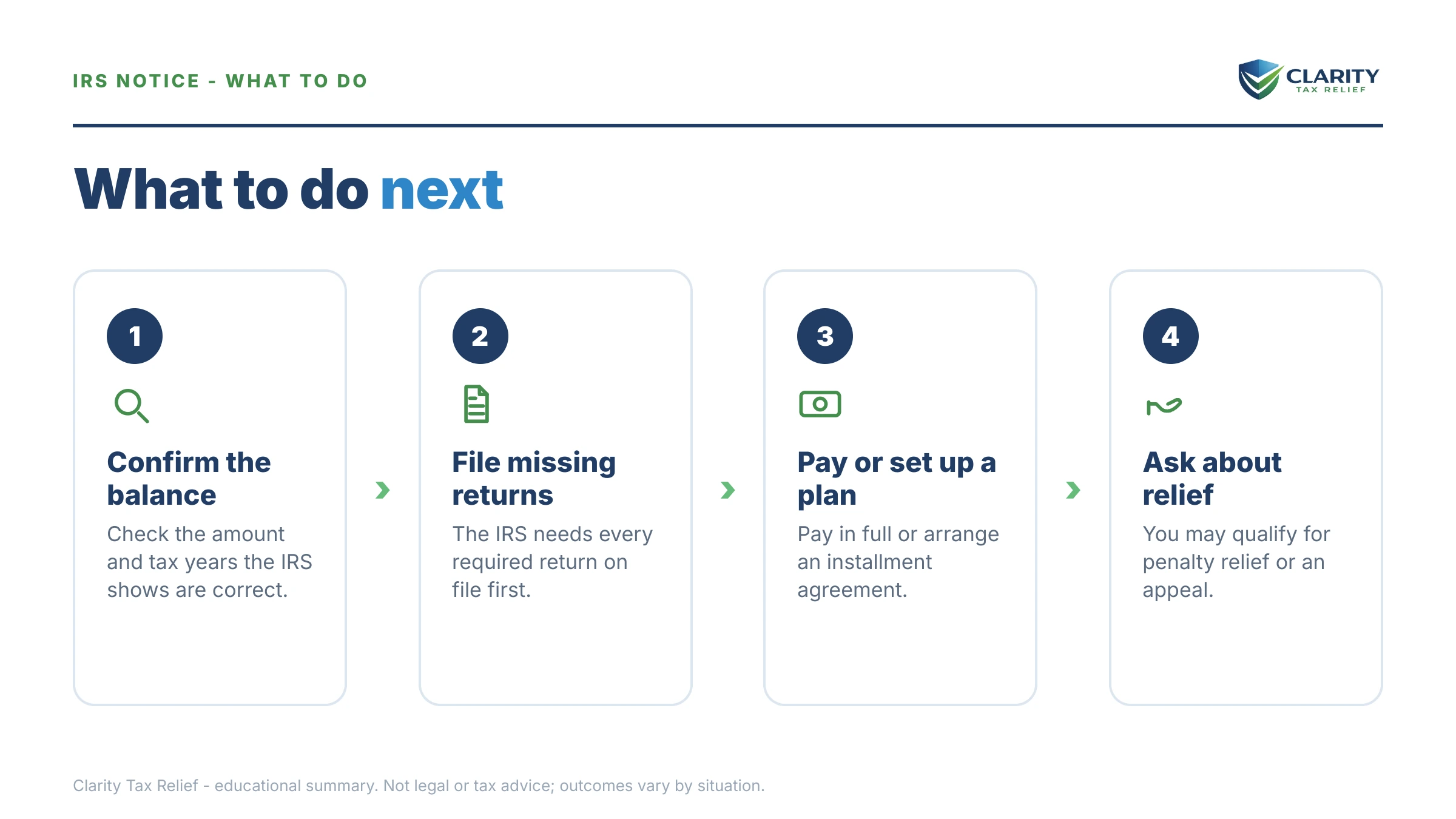
- Pull your exact IRS balance. Log into your IRS online account or check your latest notice so every quote is priced against your real balance, not a guess.
- Rule out the DIY path first. If you owe under $25,000 for one year you agree with, you can usually set up a payment plan yourself online and skip professional fees entirely.
- Get two or three written flat-fee quotes. Ask each firm for the total fee in writing after they review your transcripts — never accept a final price quoted before anyone has seen your IRS file.
- Ask exactly what the fee covers. Confirm whether the quote includes all tax years, unfiled returns, penalty relief requests, and an appeal if the first resolution is rejected.
- Verify who will actually represent you. Ask for the name and credential — enrolled agent, CPA, or attorney — of the person signing your Form 2848 power of attorney. If the firm won't name them, walk away.
For the complete vetting checklist, see how to choose a tax relief company and the exact questions to ask a tax relief company before signing. If you're comparing specific big-brand firms, our Optima Tax Relief alternatives breakdown shows how pricing and structure differ across the major players.
When you can handle this yourself — and pay $0 in professional fees
Plenty of tax debts don't need a paid firm, and an honest cost guide says so. You can almost certainly handle it yourself when all of these are true: you owe under $25,000, it's a single tax year, you agree with the amount, and your returns are filed. The IRS's online payment plan tool takes about 20 minutes, the setup fee is modest (zero for a 180-day plan), and no company can get you a better interest rate — the rate is set by law, not negotiation.
Free professional help also exists for those who qualify: a Low Income Taxpayer Clinic represents income-qualifying taxpayers in IRS disputes at no charge, and every no-cost path — clinics, the Taxpayer Advocate Service, IRS tools — is mapped in our guide to free help with IRS tax debt.
Experienced help changes outcomes in a narrower set of situations: a levy or garnishment already in motion, a balance over $50,000 that triggers financial disclosure, multiple unfiled years, business or payroll debt, and any Offer in Compromise decision — where the difference between a well-built financial statement and a sloppy one is the difference between acceptance and a wasted $205. In those cases the fee buys expertise the DIY path genuinely can't replicate.
If your case sits in that second column — over $50,000, multiple years, or an OIC on the table — get a flat written quote on your exact numbers before you accept anyone else's: start the 2-minute form or call (888) 825-7779.
Sales-call terms, decoded
Six terms you'll hear on quote calls, in plain English:
- Investigation (discovery) fee — a small upfront charge to pull your IRS transcripts and diagnose the case before quoting the real work.
- Resolution fee — the main fee for actually fixing the problem: filings, financial statements, and negotiation with the IRS.
- Form 2848 — the power of attorney that lets a credentialed professional speak to the IRS for you; the person named on it is who actually represents you.
- Reasonable Collection Potential (RCP) — the IRS's math for what it could collect from your assets and future income; it decides whether an Offer in Compromise is even possible.
- Compliance — being current on filed returns and this year's payments; the IRS requires it before approving any resolution, which is why unfiled years add cost.
- Fresh Start — an umbrella label for existing IRS programs, not a special enrollment; any fee to "get you into Fresh Start" is a fee for ordinary work with better branding.
Verify any program cost against the primary sources before paying anyone: the IRS's own pages on the Offer in Compromise and payment plans and installment agreements list current fees and waivers, and the Taxpayer Advocate Service explains the free-help routes.
Tax relief cost questions, answered
How much does it cost to hire a tax relief company?
Most reputable firms charge a flat $1,500 to $4,000 for a straightforward individual case — typically a payment plan plus penalty relief — and $4,000 to $7,500 or more for an Offer in Compromise or a multi-year, high-balance case. Business and payroll cases run higher. Many firms split the fee into a small investigation charge first, then a fixed resolution fee once they've reviewed your IRS transcripts.
Do tax relief companies charge fees upfront?
Most charge something upfront — commonly a $250 to $750 investigation fee to pull your IRS transcripts and quote the real work. That structure is normal. What isn't normal is demanding the entire multi-thousand-dollar fee before anyone has seen your IRS file, or quoting a "final" price on the first phone call. No one can price your case honestly without your transcripts.
Is tax relief worth the cost?
It's worth it when the fee is small next to what representation changes: a levy already in motion, a balance over $50,000 that requires financial disclosure, several unfiled years, or an Offer in Compromise decision. It's usually not worth it for a single year under $25,000 that you agree with — you can set up that payment plan yourself online for just the IRS setup fee.
How much does an Offer in Compromise cost?
On the IRS side, a $205 application fee plus 20% of your offer upfront for a lump-sum offer — both waived if your adjusted gross income is at or below 250% of the federal poverty guidelines. On the professional side, expect $3,500 to $7,500 for full preparation. Because the IRS accepted roughly 1 in 5 offers in FY2024, pay for an honest eligibility analysis before you pay anyone for full prep.
What does the IRS itself charge for a payment plan?
A short-term plan of up to 180 days costs $0 to set up. Long-term installment agreements carry a modest setup fee — lowest when you apply online with direct debit, and waived or reimbursed for low-income taxpayers. Interest and the 0.5% monthly failure-to-pay penalty keep accruing on any plan, so the setup fee is the smallest part of the true cost.
Can I get tax relief help for free?
Yes, in specific situations. If your income qualifies, a Low Income Taxpayer Clinic can represent you in IRS disputes at no charge, and the Taxpayer Advocate Service is free when IRS delays or actions are causing hardship. The IRS's own online tools — payment plan setup, transcripts, balance lookup — cost nothing. Free options usually can't take on complex, high-balance resolution work, which is where paid help fills the gap.
Why do some companies charge a percentage of my tax debt?
Because it inflates the fee without changing the work. Setting up a resolution on a $90,000 balance is not nine times the labor of a $10,000 balance, yet a 10% pricing model charges nine times as much. Percentage-of-debt pricing is one of the most reliable red flags in this industry, and it often travels with "settle for pennies on the dollar" sales scripts — a pitch built on outcomes no one can promise.
How much does a tax attorney cost compared to a tax relief company?
Tax attorneys typically bill hourly — often $200 to $550 per hour — so a full collection case can reach $5,000 to $10,000 or more. You genuinely need an attorney for criminal exposure, Tax Court litigation, or attorney-client privilege. For standard collection work like payment plans, hardship status, and Offers in Compromise, an enrolled agent or CPA performs the same representation, usually for a lower flat fee.
What should a tax relief company never charge me for?
Never pay for a promised outcome — no honest firm charges for a "guaranteed settlement," because eligibility for every IRS program is means-tested. Be equally wary of fees to "enroll" you in the Fresh Start program (it's not an enrollment program), open-ended monthly charges with no defined end date, and any final price quoted before your IRS transcripts have been reviewed.
Your next 24 hours
- Find your real number. Pull your exact balance from your IRS online account or the total on your most recent notice — every fee range in this guide is priced against that figure, and every quote you get should be too.
- Gather three things: your last filed return, any IRS notices you've received, and a rough picture of your monthly income and expenses. That's everything a professional needs to quote you honestly.
- Get a flat, written quote — free. Use the 2-minute form or call (888) 825-7779. Penalties and interest accrue every month a debt sits unresolved, so knowing your real cost today beats guessing next month.
This guide is general information, not tax or legal advice for your specific situation. Eligibility for IRS programs depends on individual facts and circumstances; no outcome is guaranteed. Fee ranges reflect typical market pricing and vary by firm and case.