
Hiring Help
How to Choose a Tax Relief Company in 2026: A Buyer's Checklist
The short answer on how to choose a tax relief company: verify that an enrolled agent, CPA, or tax attorney — not a salesperson — will sign your power of attorney; get the full fee and scope in writing; check complaint records; and walk away from anyone quoting a settlement before reviewing your IRS transcripts.
You searched your tax balance once, and now every ad in your feed promises to make an $83,100 problem vanish. Two of the loudest-advertising firms in this industry have faced federal enforcement — the FTC permanently banned one operator in June 2026 for the exact "settle for a fraction" pitch you're hearing. That's unnerving, but it also gives you an edge: the difference between a real firm and a mill shows up in five checkable facts, and this guide walks you through every one.
⏱ The real clock: there's no deadline for hiring help — but while you compare companies, the failure-to-pay penalty adds 0.5% per month and interest compounds daily on your balance, and the IRS's automated notice sequence keeps moving. Take days to decide, not months.
Why choosing a tax relief company is harder than it should be
Tax relief is a legitimate service sold inside an industry with almost no barrier to entry. Anyone can buy the keyword "tax relief" and open a call center; the person answering the phone is usually a commissioned salesperson with no right to speak to the IRS on your behalf. The real work — pulling transcripts, negotiating agreements, filing offers — can only be done by three credentials, and many heavily-advertised firms keep those people far from the sales floor.
The stakes are asymmetrical. Hire well and you get someone who knows, for example, that your $83,100 balance sits above the $66,000 passport-certification threshold for 2026 and above the $50,000 line where online streamlined payment plans stop — two facts that should shape your strategy on day one. Hire badly and you lose the fee and the months, while penalties compound.
The good news: mills are easy to expose once you know what to ask. Everything below is checkable before you spend a dollar.
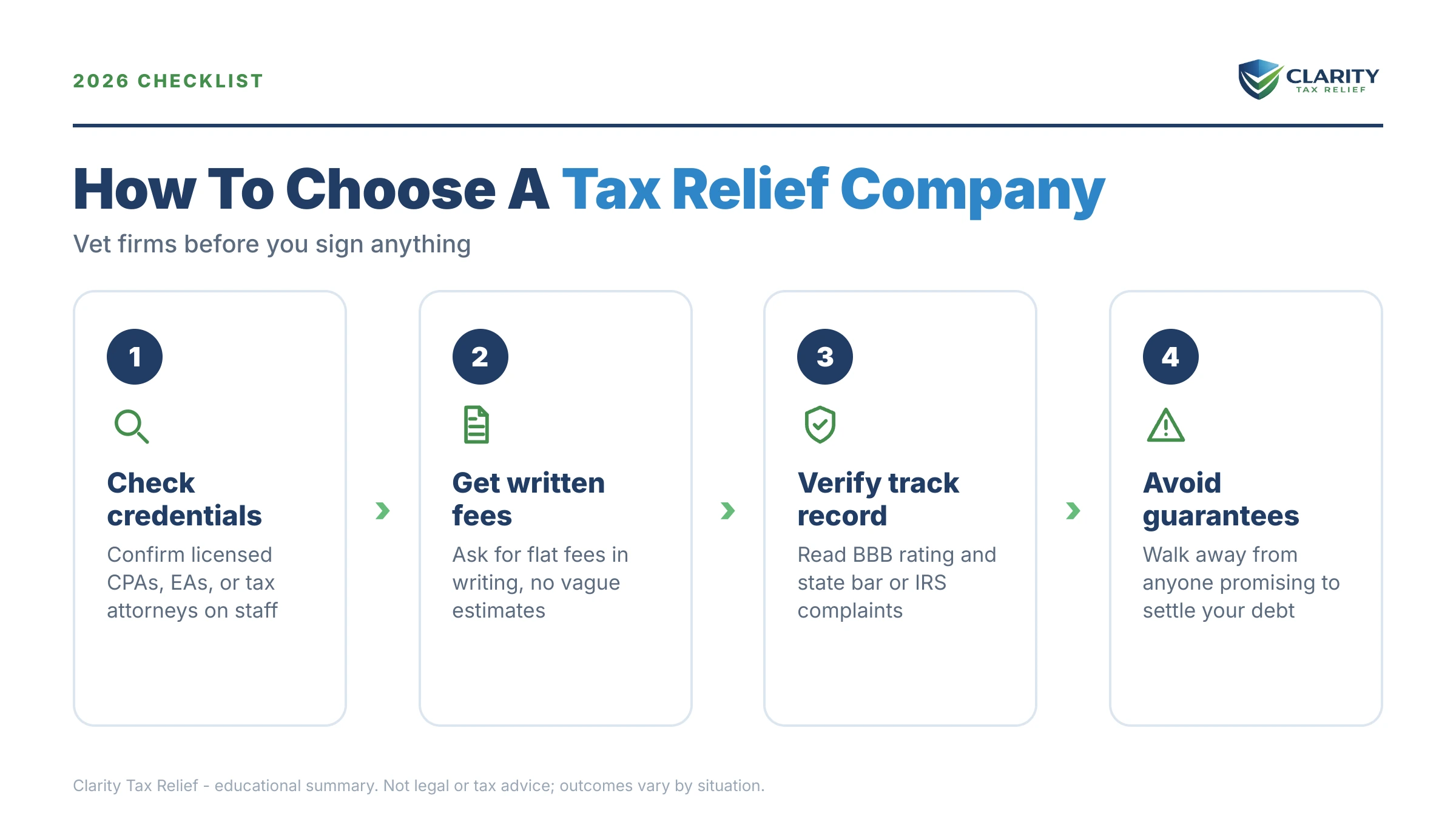
The five things every legitimate tax relief company does
A legitimate tax relief company will always name the credentialed professional handling your case before asking for money. If a firm passes all five of these tests, it belongs on your shortlist; if it fails any one, it doesn't.
- 1. It names who will represent you. Only enrolled agents, CPAs, and tax attorneys can sign Form 2848 power of attorney and negotiate with the IRS. Ask for the name and credential of that person — not the "senior tax consultant" selling you.
- 2. It investigates before it quotes an outcome. Nobody can honestly recommend a resolution without seeing your IRS transcripts — your assessed balances, penalty history, unfiled years, and collection statute dates. Diagnosis first, quote second.
- 3. It puts the entire fee in writing. Total cost, exact scope, refund terms, and what counts as billable extra — signed before payment. Vague "phases" with open-ended pricing are how bills triple.
- 4. It tells you when you don't need it. An honest reviewer will say "you can set this payment plan up yourself in twenty minutes" when that's true. A firm that finds a reason to charge everyone is a sales operation.
- 5. It never promises a result. IRS programs are means-tested against a fixed formula. Firms that "guarantee" settlements are making claims the FTC has shut companies down for.
The credential question matters more than any review score, because it determines who can legally act for you:
| Who | Can represent you before the IRS? | Best fit |
|---|---|---|
| Enrolled agent (EA) | Yes — unlimited rights, all 50 states | Collections, payment plans, Offers in Compromise, penalty relief |
| CPA | Yes — unlimited rights | Complex returns and business accounting plus resolution |
| Tax attorney | Yes — unlimited rights, plus attorney-client privilege | Criminal exposure, fraud allegations, Tax Court litigation |
| "Tax consultant" / salesperson | No — cannot sign Form 2848 or speak to the IRS for you | Nothing that touches your case |
If you're weighing the attorney route specifically, our guide to tax relief attorney vs company maps which problems genuinely need privilege. For what an EA actually is and does, see what is an enrolled agent.
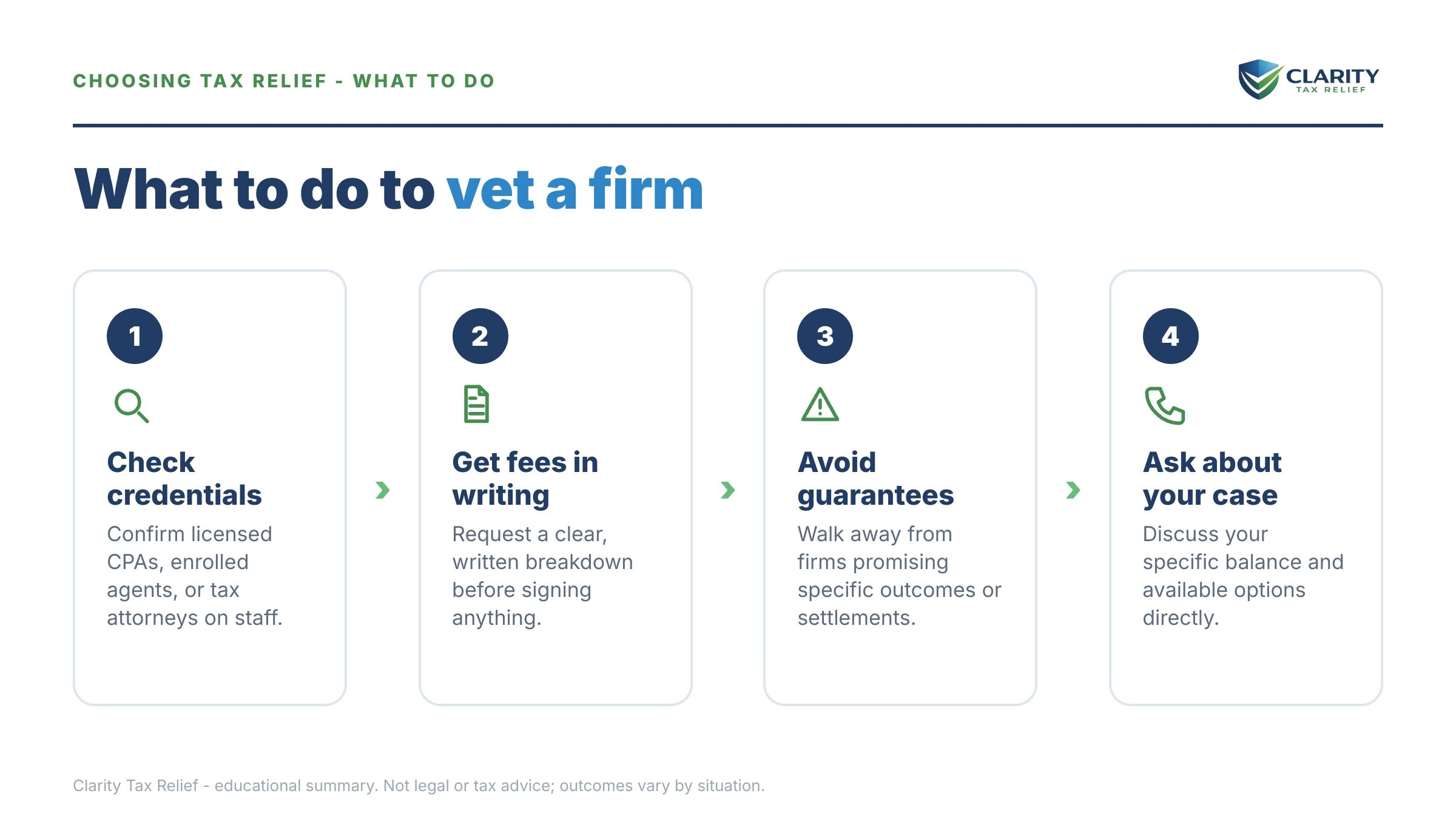
Red flags that should end the call
The fastest disqualifier is a settlement quote delivered before anyone has seen your IRS transcripts. Nobody on Earth can know what you'd settle for from a ten-minute phone call — the number comes from a financial formula the IRS applies, not from a script.
Other conversation-enders:
- "Pennies on the dollar." This phrase is the signature of the mill pitch — it's the exact claim behind FTC enforcement actions. Offers in Compromise are real, but the IRS accepted roughly 1 in 5 offers in FY2024, all on the math, none on marketing.
- "You qualify" on the first call. Every IRS program is means-tested. Honest phrasing is conditional: "you may qualify if your income and assets fall below what you owe."
- Pressure to pay today to "lock in a program" or "beat a government deadline" no one can show you in writing.
- Requests for your IRS online account login. A real firm uses Form 2848 or Form 8821 to access records lawfully in its own name.
- No physical address, no named professionals, no complaint history you can check.
Our full tax relief company red flags checklist goes deeper, and the offer in compromise mill guide dissects how the settlement-promise scam actually operates.
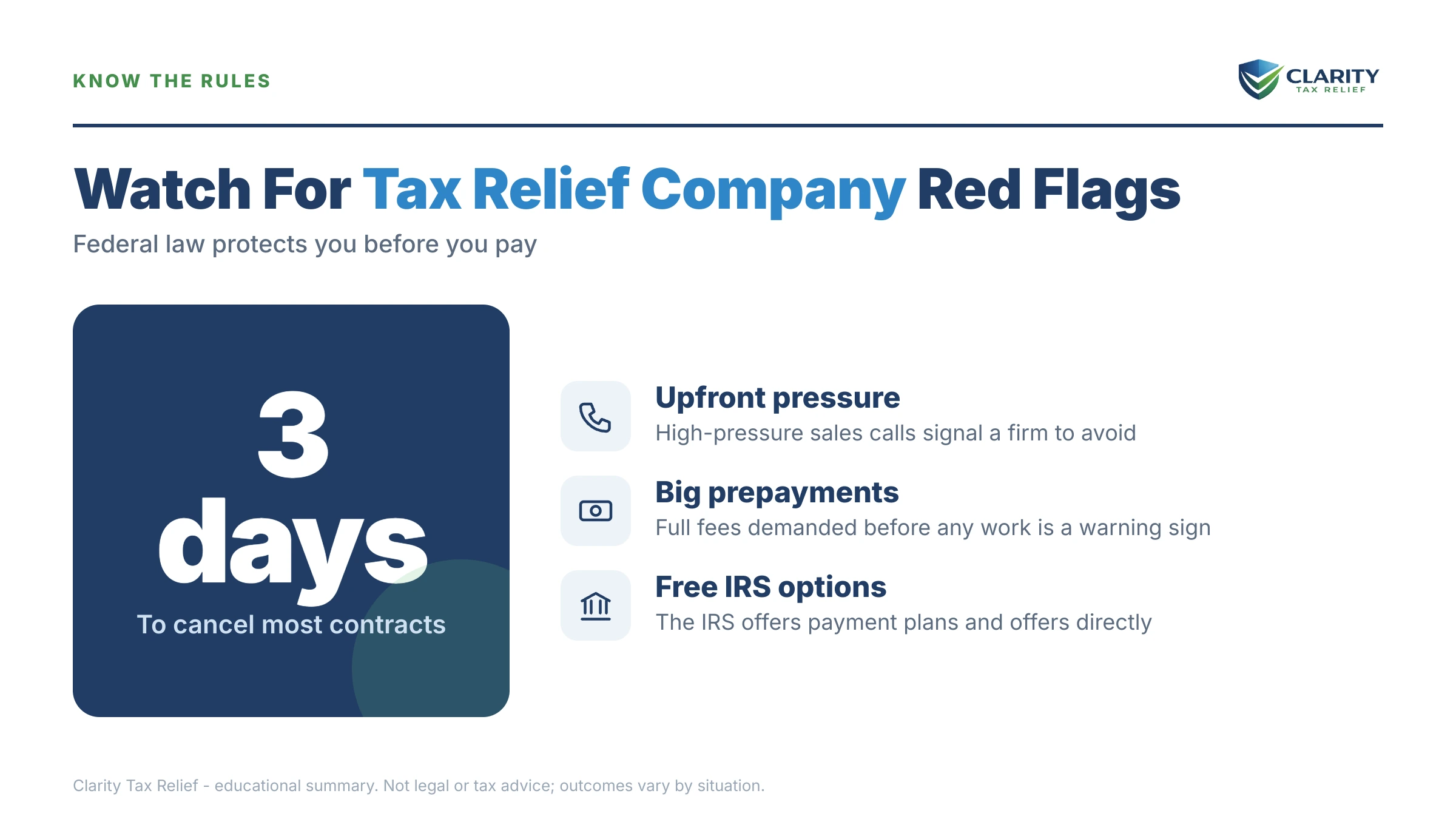
What happens if you hire the wrong tax relief company
Hiring the wrong firm doesn't just waste the fee — it burns months while the IRS's automated collection sequence keeps escalating. Here's the pattern that generates the complaints regulators see, stage by stage:
- The sale. A salesperson quotes a dramatic settlement, collects a large upfront fee, and hands your file to a "processing" department.
- The stall. Weeks pass with no update. Meanwhile the failure-to-pay penalty and daily interest keep growing your balance — hiring anyone changes none of that math by itself.
- The IRS keeps moving. The notice sequence doesn't pause because you paid a private company. Balance-due notices give way to a CP504 intent to levy, then an LT11 final notice with a 30-day window to assert your appeal rights — a deadline a stalled file silently misses.
- The doomed application. Mills file Offers in Compromise for people the formula plainly disqualifies. The IRS returns or rejects the offer; the mill keeps its fee either way — and the time the offer spent pending paused your 10-year collection statute, extending how long the IRS can collect.
- The exit. The firm declares the case "closed," asks for more money, or stops answering. You're back at the start with a bigger balance and fewer rights intact.
In 2026 this failure mode is more dangerous, not less: the IRS workforce shrank roughly 27% in 2025, so unwinding a botched case means longer waits for a human — while the automated levies never stopped. If you've already lived this story, start with tax relief company took my money for the recovery playbook.
Comparing companies for a serious balance?
Before you sign with anyone — including us — get a free transcript-based review of where your case actually stands. An experienced tax professional will tell you your real options and honest odds, with the full fee in writing before any decision. No pressure, and interest doesn't wait while mills stall.
What a legitimate company can actually do for you
Every tax relief company, good or bad, is selling access to the same handful of IRS programs — none of them secret, all of them means-tested. (For the full DIY walkthrough of each program, see our guide on how to settle tax debt yourself.) A firm earns its fee by matching you to the right program, building the financial case, and defending it — not by knowing a door you can't find. Use this table to check whether what a salesperson is pitching is even plausible for your numbers:
| Program | Basic eligibility (2026) | What an honest firm says |
|---|---|---|
| Short-term payment plan | Can pay in full within 180 days; $0 setup fee | "You don't need to hire anyone for this." |
| Streamlined installment agreement | Balance ≤ $50,000; up to 72 months, set up online | "Simple to DIY — we add value only if there are complications." |
| Installment agreement over $50,000 | Form 433-F financial disclosure; payment negotiated | "This is where representation genuinely changes the monthly number." |
| Offer in Compromise | Assets + future income below the balance; $205 fee, 20% down on lump-sum offers (both waived with low-income certification) | "We'll run the formula first — about 1 in 5 offers were accepted in FY2024." |
| Currently Not Collectible | Paying would prevent basic living expenses; verified via financial statement | "Collection pauses, but the debt, penalties, and interest remain." |
| Penalty relief (FTA / AEP) | Clean compliance the prior 3 years; AEP applies automatically starting summer 2026 | "Some of this is now automatic — it should never be a big line-item fee." |
Notice what's on that list and what isn't. There is no program that erases debt because you asked nicely, and none that requires a private company to unlock. What a strong firm changes is the quality of the case: which allowable expenses get counted, whether penalty relief is layered in, and whether the IRS's first "no" gets appealed.
What hiring a tax relief company should cost
The fee structure tells you more about a firm than the fee amount. Complexity drives legitimate pricing — one year with a straightforward balance costs far less to resolve than five unfiled years plus an offer — but the structure is what separates fair firms from fee machines:
| Fee model | How it works | What to watch for |
|---|---|---|
| Flat fee, written scope | One price for a defined body of work | A scope so narrow that every new notice is an "extra" |
| Phased (investigation → resolution) | Small fee to pull and analyze transcripts, then a resolution quote | A resolution quote that ignores what the investigation found |
| Hourly | Pay for time; common at law firms | Open-ended totals on cases that don't need attorney work |
| Percentage of "savings" | Fee tied to the reduction the firm claims it achieved | Inflated "savings" math; several states restrict this model |
Two deeper dives if pricing is your sticking point: how much does tax relief cost breaks down what drives quotes up or down, and tax relief flat fee vs. hourly compares the models head to head. Whatever the model, the rule is the same: no payment before a written total, scope, and refund policy.
A worked example: choosing help for an $83,100 balance
Say you're a 1099 contractor who owes $83,100 across three tax years — no withholding, missed quarterlies, and the balance snowballed. This is a hypothetical, but the math is exactly what separates a mill's pitch from an honest evaluation.
What the balance itself dictates. At $83,100 you're above the $50,000 ceiling for a streamlined online plan, so the IRS will want a Form 433-F financial disclosure before agreeing to monthly payments. Spread over 72 months anyway, that's roughly $83,100 ÷ 72 ≈ $1,154 per month — before the interest and 0.5% monthly failure-to-pay penalty that keep accruing on the unpaid balance. You're also above the $66,000 passport-certification threshold, which an honest firm flags immediately.
The mill's pitch: "We can settle this for around $4,000." Quoted on the first call, before anyone has seen a transcript. That number came from nowhere.
The honest analysis: an Offer in Compromise is scored on your Reasonable Collection Potential — roughly your asset equity plus a multiple of your monthly disposable income. Suppose you net $6,200 a month from contracting and the IRS's allowable living expense standards permit $5,300: that leaves $900/month disposable. For a lump-sum offer, the formula is 12 months of that ($10,800) plus equity — say $9,200 in truck equity and $2,200 in the bank — for an RCP around $22,200. That's a credible offer amount, filed on Form 656 with a $205 fee and a 20% down payment (about $4,440) unless you're low-income certified. You can sketch your own numbers with our Offer in Compromise Calculator before any sales call — it estimates, it doesn't promise.
The other branch matters just as much. If your disposable income were $2,500/month instead, the formula would show the IRS can collect the full debt through payments before the 10-year statute runs — the offer would be rejected, and the honest recommendation becomes a negotiated installment agreement plus penalty abatement. A firm that would file the offer anyway is selling you a $205 application and a paused collection statute, not a settlement. That single fork — will they tell you when the offer doesn't work? — is the whole test.
How to choose a tax relief company, step by step
- Pull your own IRS records first. Log into your IRS online account and write down your exact balance, the tax years involved, and any unfiled returns — so no salesperson can define your situation for you.
- Verify who will actually represent you. Ask for the name and credential — enrolled agent, CPA, or tax attorney — of the person who will sign Form 2848 and speak to the IRS on your behalf. If the answer is vague, walk.
- Check the complaint trail. Search the firm's name plus "complaint," then check Better Business Bureau records, your state attorney general's office, and FTC enforcement actions before you hand over a dollar.
- Demand the full fee in writing. Get the total cost, the exact scope of work, the refund policy, and what counts as extra — signed, before any payment.
- Insist on investigation before promises. Refuse any specific settlement quote made before the firm has pulled and reviewed your IRS transcripts. Honest firms diagnose first and quote second.
- Compare the quote against doing it yourself. If your case is a simple payment-plan setup, you may not need to hire anyone — price the DIY route before you sign.
Bring a script to every sales call: our list of questions to ask tax relief company reps gives you the exact wording, and tax relief consultation what to expect walks through how a legitimate first call should feel.
When you can handle this yourself — and when help changes the outcome
Most people with a single tax year and a balance under $50,000 do not need to hire a tax relief company at all. If you agree with the amount, you can set up a payment plan yourself at the IRS's payment plans page in one sitting — up to 180 days with no setup fee, or up to 72 months online. If money is tight, real no-cost options exist too — our roundup of free help with irs tax debt covers Low Income Taxpayer Clinics and the Taxpayer Advocate.
Experienced help earns its fee when the case has moving parts:
- A levy or garnishment already in motion — release negotiations are time-critical and technical.
- Multiple unfiled years — the order you file and resolve in changes the total you pay.
- Business or payroll tax debt — personal liability rules make DIY mistakes expensive; see the tax relief for small business buyer's guide.
- Balances over $50,000 — the financial-disclosure negotiation directly sets your monthly payment.
- Offer in Compromise math that's genuinely close — how allowable expenses are documented can decide acceptance.
The honest framing: hiring help is a purchase, not a rescue. Buy it the way you'd buy any five-figure-consequence service — informed, in writing, and unhurried by anyone's script.
Sales-pitch terms, decoded
- "Fresh Start Program" — a marketing umbrella for ordinary IRS options (payment plans, offers, lien thresholds) that already exist; there is no special enrollment window.
- "Pennies on the dollar" — the banned pitch behind FTC actions; the real program (OIC) is means-tested and accepted roughly 1 in 5 times in FY2024.
- "Investigation phase" — legitimate when it means pulling your transcripts under Form 8821 or 2848 and delivering findings; a stall when nothing in writing ever arrives.
- Power of attorney (Form 2848) — the document that lets a credentialed professional speak to the IRS for you; salespeople cannot sign one.
- RCP (Reasonable Collection Potential) — the IRS's formula for the most it could collect from you; the floor under any offer amount.
- CSED — the 10-year expiration of the IRS's right to collect, pausable by offers, appeals, and bankruptcy; a firm that stalls doesn't pause your interest, but a doomed offer does pause this clock.
Choosing a tax relief company: your questions answered
How do I know if a tax relief company is legitimate?
A legitimate company names the enrolled agent, CPA, or tax attorney who will file a power of attorney on your case, puts its full fee in writing before you pay, and reviews your IRS transcripts before quoting any outcome. Check the firm's name against Better Business Bureau records and your state attorney general's complaint database. Any firm that quotes a specific settlement amount on the first phone call is guessing — or lying.
How much does a tax relief company cost?
Fees vary with the complexity of the case: a simple payment-plan setup costs far less than a multi-year Offer in Compromise with unfiled returns. What matters more than the number is the structure — a written flat fee tied to a defined scope of work. Be wary of large upfront retainers with no deliverables, and of fees quoted before anyone has reviewed your IRS transcripts.
Can a tax relief company really settle my tax debt for less than I owe?
Sometimes — through an Offer in Compromise — but only if your assets and future income genuinely can't cover the balance before the collection statute expires. The IRS accepted roughly 1 in 5 offers in fiscal year 2024, and acceptance follows a fixed financial formula, not negotiating skill. Any company that promises a settlement before running that math is selling you an application, not a result.
Do I need a tax attorney or is a tax relief company enough?
For most collection problems — payment plans, Offers in Compromise, penalty abatement, levy releases — an enrolled agent or CPA has the same unlimited IRS representation rights as an attorney. You need an attorney when there is potential criminal exposure, fraud allegations, or you're headed to Tax Court, because attorney-client privilege protects those conversations. Match the credential to the problem, not the marketing.
Does hiring a tax relief company stop IRS collections?
Not automatically. Filing a power of attorney routes IRS contact through your representative, but it does not freeze levies, liens, or the notice sequence, and interest and penalties keep accruing the whole time. Collections pause only when a specific action is in place — a pending installment agreement or offer, Currently Not Collectible status, or a timely collection appeal. A firm that says it will stop the IRS the day you sign is overselling.
What credentials should a tax relief company have?
The people working your case should be enrolled agents, CPAs, or tax attorneys — the only three credentials with unlimited rights to represent you before the IRS. The salesperson who answers the phone usually holds none of these, which is fine, as long as a credentialed professional signs your Form 2848 and does the actual negotiating. Ask directly: who will sign my power of attorney, and what is their credential?
What can I do if a tax relief company took my money and did nothing?
Demand a written accounting of work performed and a refund of unearned fees, then file complaints with your state attorney general, the FTC, and the Better Business Bureau. If a credentialed professional was involved, you can also report them to the IRS Office of Professional Responsibility. Move fast on your actual tax problem too — the IRS notice sequence kept running while the firm stalled.
Your next 24 hours
- Get your real numbers. Log into your IRS online account and write down the exact balance, the tax years, and whether any returns are unfiled — the facts no salesperson can spin. If you can't get online, the Taxpayer Advocate Service explains your records rights.
- Gather your paper. Your most recent IRS notices, last filed return, and a rough monthly income and expense picture — every honest evaluation, ours or anyone's, starts from these.
- Take a free, no-pressure case review. Call (888) 825-7779 or use the 2-minute form — an experienced tax professional will run your options against the real eligibility rules (the IRS publishes the offer criteria at irs.gov's Offer in Compromise page) while penalties and interest are still accruing on the balance, not after another month of them.
This guide is general information, not tax or legal advice for your specific situation. Eligibility for IRS programs depends on individual facts and circumstances; no outcome is guaranteed.