
Choosing Tax Help
Tax Relief Attorney vs Company: Which One Should You Hire in 2026?
The short answer: for ordinary IRS collection problems — back taxes, unfiled returns, payment plans — a reputable tax relief company staffed by enrolled agents or CPAs does the same work an attorney would, usually for a lower flat fee. Hire a tax relief attorney for criminal exposure, fraud penalties, Tax Court, or bankruptcy.
You have two tabs open and two quotes in hand: a national firm offering a flat fee, and a local lawyer quoting $400 an hour with a retainer. With three years unfiled and a balance climbing toward $19,700, the tax relief attorney vs company question feels expensive to get wrong. It isn't — once you know the one fact both sides' marketing leaves out, the decision usually takes about ten minutes. This guide gives you that fact, the honest cost math, and the short list of situations where only a lawyer will do.
⏱ The clock that's actually running: there's no letter deadline on choosing help — the deadline is your balance. The failure-to-pay penalty adds 0.5% every month, interest compounds daily, and on unfiled returns the failure-to-file penalty runs at 5% per month until it caps at 25%. Every month spent comparison-shopping costs real money.
Why the tax relief attorney vs company choice is confusing on purpose
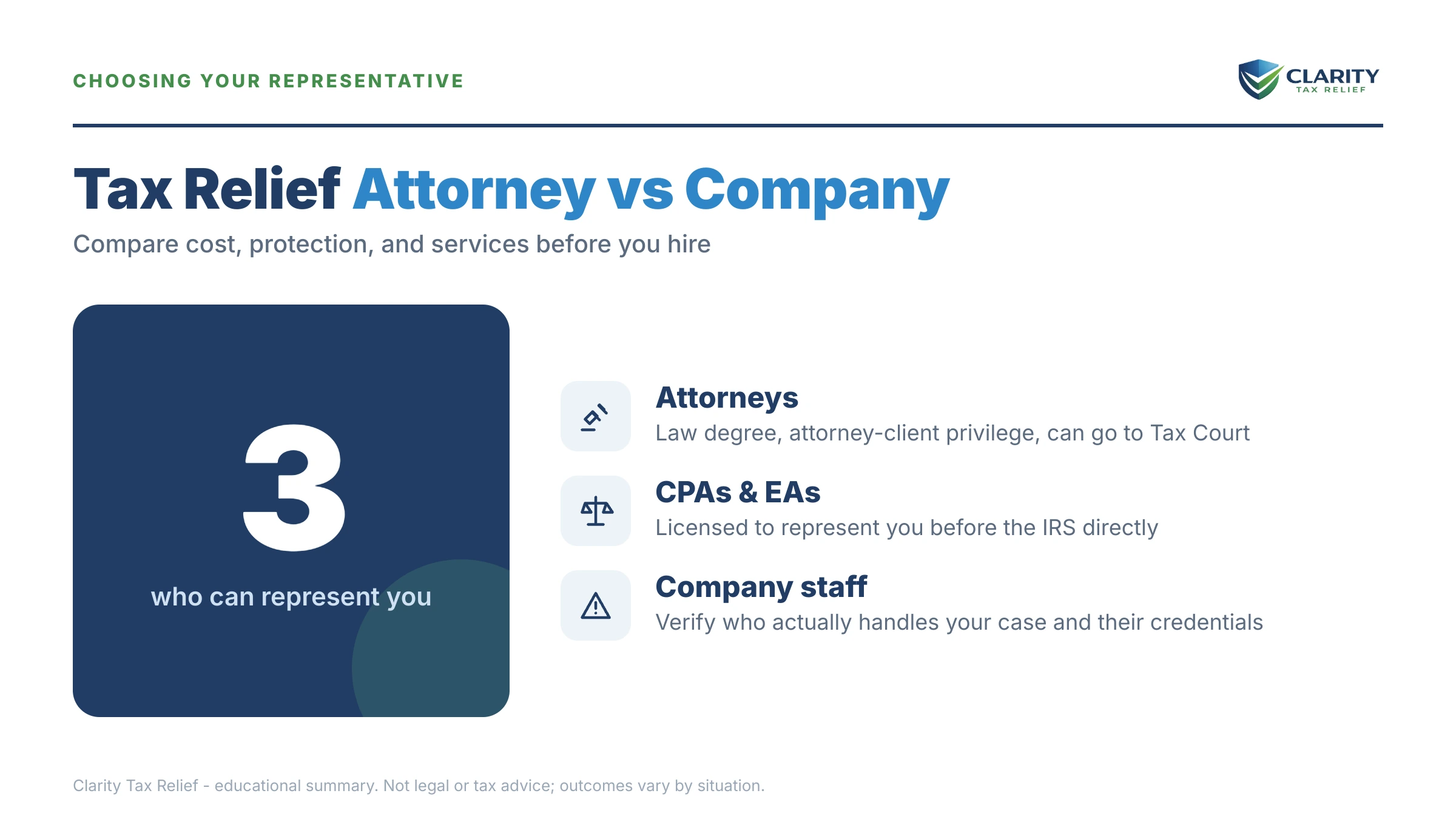
Attorneys, CPAs, and enrolled agents all hold identical, unlimited rights to represent you before the IRS under Treasury Circular 230. For collections work — installment agreements, Offers in Compromise, penalty abatement, hardship status, audits, and collection appeals — the IRS treats all three credentials exactly the same. That single fact collapses most of this debate.
So why does the debate exist? Because "attorney vs company" isn't really a credential question — it's a business-model question dressed up as one. A tax relief company is a firm (usually national, usually flat-fee) staffed mostly by enrolled agents and CPAs, sometimes with attorneys available. A tax relief attorney is typically a solo or boutique law practice billing hourly.
Both sides muddy the water. Some companies put "tax lawyers" in their name while enrolled agents do all the work. Some attorneys imply every relief company is a scam so hourly billing looks safer. If you want the credential comparison itself, that's covered in tax attorney vs CPA vs enrolled agent — this page is about the business models and which one your specific problem needs.
What happens while you delay — or after you hire the wrong one
An unfiled-return case escalates on its own while you compare quotes, because the IRS's collection machine is automated and, per TIGTA reports on the agency's workforce reductions, its 2025 staffing cuts didn't touch it. Here's the sequence for someone with unfiled years and a growing balance:
- Income matching flags the missing returns. The IRS already holds your 1099-NEC and 1099-K data; unfiled-return notices go out automatically. If this is you, start with haven't filed in 3 years.
- The IRS files for you. A substitute for return (SFR) uses single filing status and zero business deductions — a gig worker's SFR balance is routinely roughly double what a real return would show — and the tax gets assessed without your signature.
- The billing stream begins. A first bill (CP14, typically about 21 days to respond) is followed by escalating reminders, each adding interest.
- Enforcement notices arrive. A CP504 lets the IRS take your state refund; the final notice (LT11) opens a 30-day window, after which bank levies and levies on your 1099 pay become legal.
Hiring wrong has its own escalation sequence, and it runs in parallel. A sales rep — not a practitioner — quotes you an Offer in Compromise before anyone pulls your transcripts. The retainer disappears into an "investigation phase." Months pass, the IRS sequence above keeps moving, and you end up where you started minus several thousand dollars. Our tax relief company red flags checklist and the recovery guide for when a tax relief company took my money exist because this pattern is that common.
Two quotes on the table and three years unfiled?
Send us both engagement letters and your latest IRS notice. An experienced tax professional will tell you — free — whether anything in your case actually needs a lawyer, and what the complete fix should cost. Penalties and interest accrue while you decide, so get the answer this week, not next month.
Tax relief attorney vs company: what each one actually does
A tax relief company is built for volume collections work; a tax attorney practice is built for disputes, privilege, and courtrooms. The company model: a phased flat fee (an investigation phase to pull transcripts, then a resolution phase), a team that includes return preparers and enrolled agents, and standardized handling of the IRS programs most people need. The attorney model: hourly billing against a retainer, a direct one-on-one relationship, full attorney-client privilege, and standing to walk into court.
That means the deciding question is simple: can your case stay inside the IRS's administrative process, or could it leave it? Administrative work — returns, payment plans, offers, penalty relief, appeals — is credential-equal. Court and criminal matters are attorney-only. Here's the full map:
| Your situation | Tax relief company (EA/CPA staff) | Tax relief attorney |
|---|---|---|
| Unfiled returns + balance due | Core work — return prep plus negotiation | Can do it, but hourly billing makes routine prep expensive |
| Installment agreement / hardship (CNC) status | Yes — routine | Yes — rarely worth hourly rates |
| Offer in Compromise | Yes — if they pull transcripts and run the math before quoting it | Yes — same forms, same IRS formula |
| Audit or CP2000 response | Yes — EAs and CPAs have full audit representation rights | Yes — comparable |
| Collection appeal (CDP hearing) | Yes | Yes |
| U.S. Tax Court petition | No — attorney territory (rare exam-admitted non-attorneys aside) | Yes — home turf |
| Civil fraud penalty / audit with fraud undertones | Not appropriate — no criminal-proof privilege | Attorney only |
| IRS criminal investigation (special agent contact) | Never | Attorney only |
| Discharging tax debt in bankruptcy | No | Attorney only |
Notice how short the attorney-only column is. Roughly speaking, if you owe money and the question is "how do I resolve it," you're in company/EA territory. If the question is "did I break the law" or "I want a judge to hear this," you're in attorney territory — the full test lives in do I need a tax attorney for back taxes, and if criminal contact has already happened, read IRS criminal investigation before you talk to anyone.
One credential-adjacent nuance matters here: enrolled agents and CPAs have a limited confidentiality privilege under IRC §7525, but it evaporates in criminal cases. If there's any chance your file involves willful concealment, everything you tell a non-attorney is discoverable. That — not IRS skill — is the real reason fraud cases go to lawyers.
What a tax relief attorney vs a tax relief company costs in 2026
For a five-figure collections case, hourly attorney billing typically costs roughly 40–100% more than a flat-fee firm for identical administrative work. The ranges below are market norms, not quotes — your facts, state, and firm all move them. Full pricing detail is in how much does tax relief cost, and the billing-model tradeoffs are in tax relief flat fee vs hourly.
| Route | How you're billed | Typical cost, ~$20,000 collections case | Typical timeline |
|---|---|---|---|
| DIY with IRS online tools | No professional fees; modest IRS setup fee on some long-term plans | $0 in fees | Payment plan: often same-day online. OIC: months |
| Tax relief company | Flat fee, usually phased (investigation, then resolution) | Commonly $1,500–$7,000 total, depending on returns and program | Returns + plan: weeks. OIC: commonly 6–12+ months |
| Solo enrolled agent or CPA | Flat or hourly (often $100–$300/hr) | Often $1,000–$4,000 | Similar to a company, one named practitioner |
| Tax relief attorney | Hourly, commonly $200–$550/hr, against a $2,000–$10,000+ retainer | Often $3,500–$10,000+ for the same administrative work | Same IRS timelines; billing runs the whole way |
Two cost traps to watch regardless of route. At companies: fees quoted by commissioned salespeople before anyone has seen your transcripts, and "phase two" surprises after the investigation fee is spent. At attorneys: open-ended hourly billing on tasks that don't need legal judgment — you can pay $400 an hour for someone to sit on hold with the IRS. The vetting steps below neutralize both.
A worked example: $19,700 owed, three years unfiled
Say you're a gig worker — rideshare and delivery 1099s — who hasn't filed for 2022, 2023, or 2024, and the combined tax across those three returns comes to $15,000. The failure-to-file penalty caps at 25%, adding about $3,750; failure-to-pay penalties and daily-compounding interest tack on roughly another $950. Total: about $19,700, of which nearly $4,700 is penalties and interest — you can estimate your own penalty share with our IRS Penalty & Interest Calculator.
Now run the three routes on those same facts:
DIY: you prepare and file all three Schedule C returns yourself, then set up a streamlined online plan. $19,700 over 72 months is roughly $274/month before accruing interest — call it $290–$320 in practice. Free, but you're reconstructing three years of mileage and expenses alone, and the plan defaults if you miss current-year estimated payments.
Tax relief company: a flat fee in the $3,000–$4,500 range typically covers preparing the three returns and negotiating the resolution. Because filed returns with real deductions usually show less tax than the IRS's numbers, professional prep often pays for part of itself. If your gig income is genuinely low, the firm might pursue hardship status or an Offer in Compromise instead — but only after running the IRS's collection-potential math, and knowing that, per IRS Data Book figures, the IRS accepted roughly 1 in 5 offers in FY2024.
Tax relief attorney: the identical task list — three returns, transcript analysis, a negotiated agreement — at $400/hour typically runs 15–25 hours: $6,000–$10,000. Nothing in this fact pattern requires a law license, so the premium buys comfort, not a different outcome. The math flips only if the facts change: six figures of deliberately concealed income, a prior IRS warning you ignored, or a special agent's card in your mailbox.
How to choose between a tax relief attorney and a company, step by step
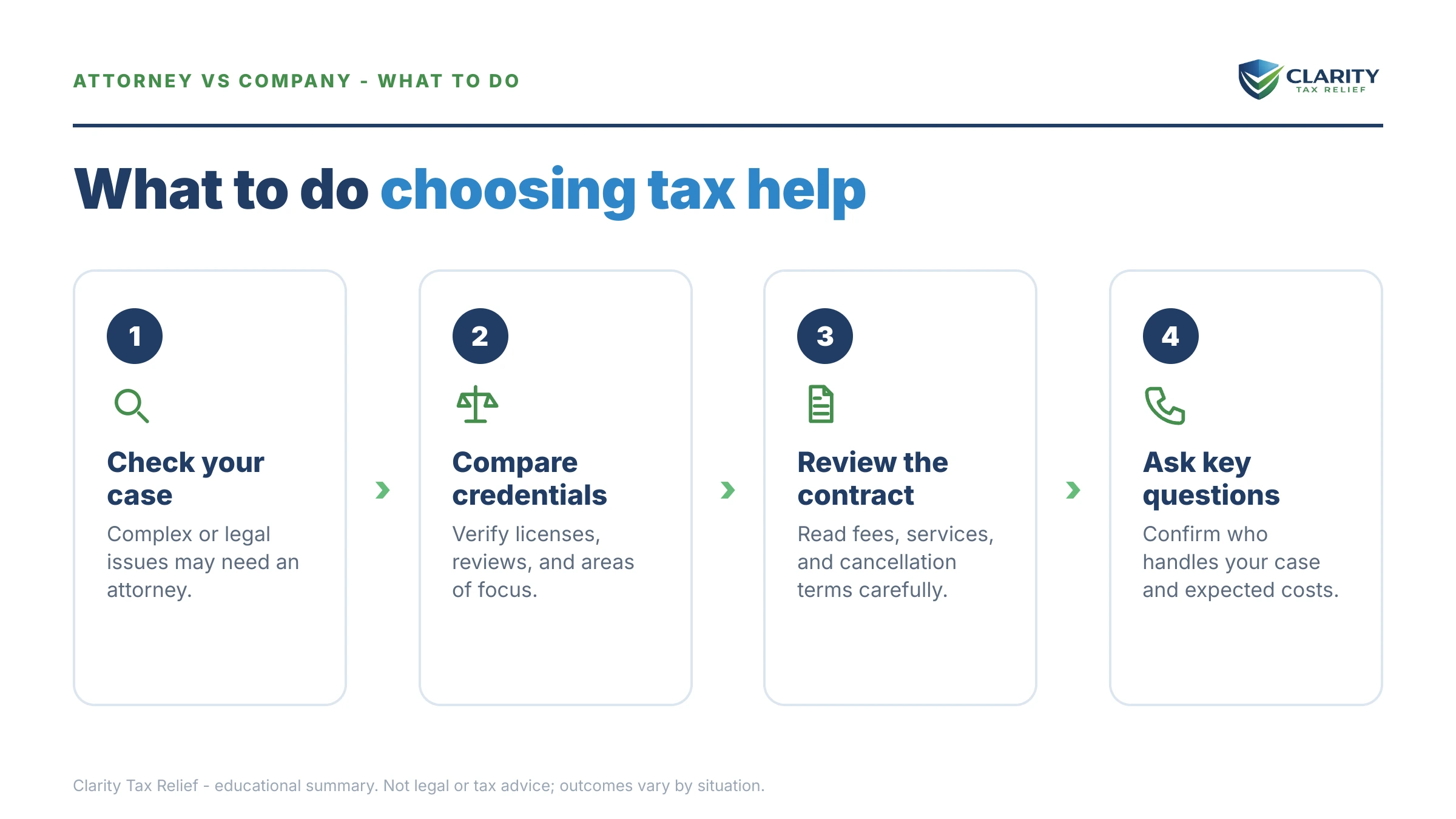
- Screen for criminal or fraud exposure first. If an IRS special agent has contacted you, a civil fraud penalty has been raised, or you knowingly hid income, stop comparing companies and consult a tax attorney before speaking to anyone — including the IRS.
- List the actual tasks in your case. Count your unfiled returns, note which notices you've received, and pull your balance from your IRS online account — the task list, not the brand, determines who you need.
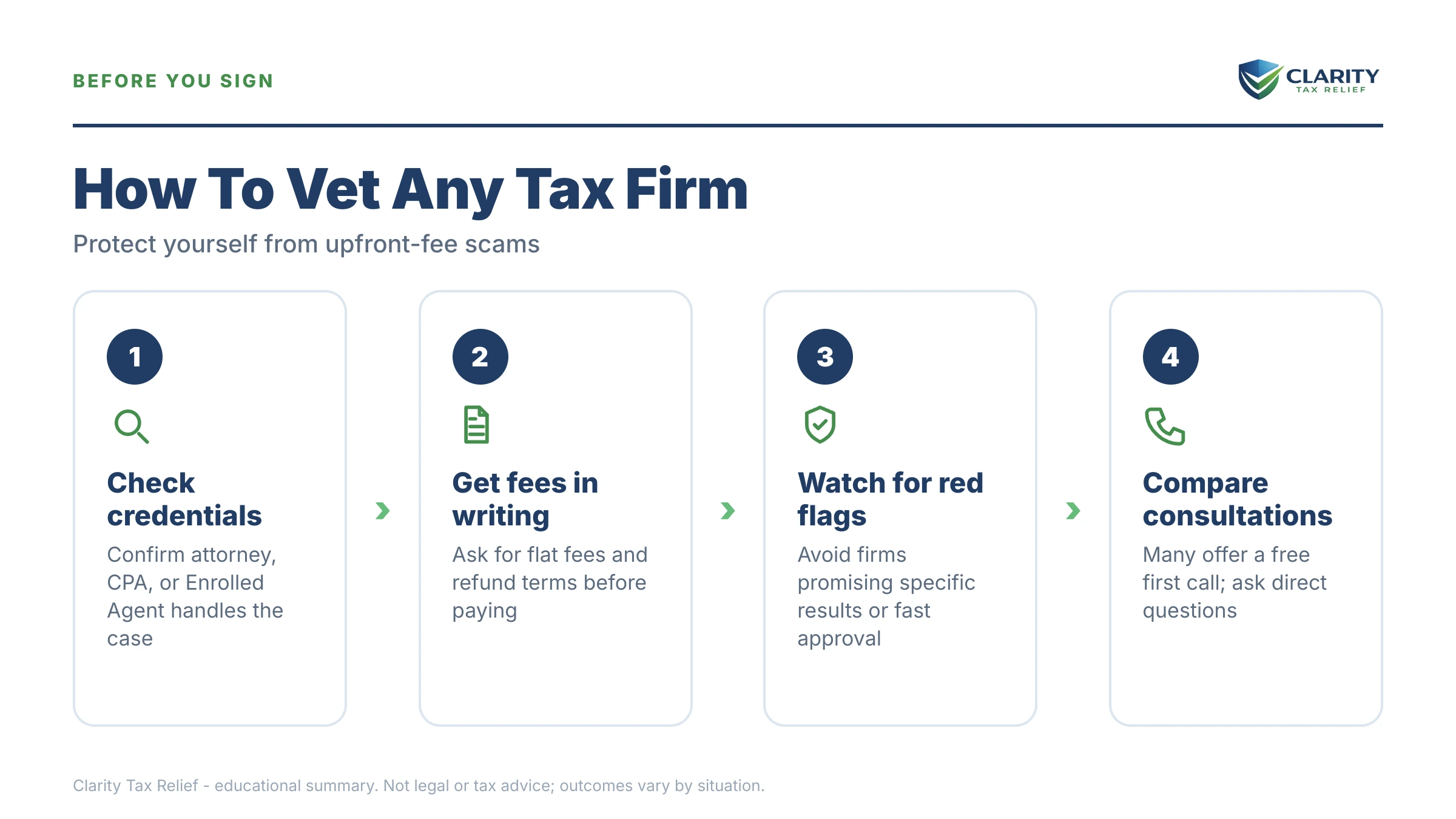
- Get every fee structure in writing. Ask for the total projected cost through resolution: flat fee with phases at a company, hourly rate plus retainer at an attorney — and what happens to unused money if the case ends early.
- Vet the person, not the brand. Get the name and credential of the practitioner who will work your file, then verify it: state bar records for attorneys, the IRS enrolled agent roster for EAs, the state accountancy board for CPAs.
- Confirm who signs your Form 2848. Whoever appears on your power of attorney is your actual representative — if it's not the person you vetted, or the firm won't tell you, walk away.
If you're leaning toward a firm, run it through the full buyer's checklist in how to choose a tax relief company before you sign anything. And one universal disqualifier for either route: anyone who promises to settle your debt for "pennies on the dollar" before reviewing your finances. That phrase is the signature of the settlement mills federal regulators have shut down — the IRS decides settlement eligibility with a formula, and nobody who hasn't seen your numbers can predict it.
When you can handle this yourself — no attorney, no company
Plenty of tax problems need no paid help at all, and an honest comparison page should say so. You can likely go DIY when:
- You qualify for the guaranteed installment agreement (that's the official IRS program name), which makes approval essentially mechanical — it's for individuals only who owe $10,000 or less in income tax (excluding penalties and interest), have all returns filed, have filed and paid on time for the past 5 years with no installment agreement during that period, and can pay in full within 3 years.
- You owe up to $50,000 and just need time: a long-term plan of up to 72 months sets up online in minutes, and balances payable within 180 days qualify for a $0-setup-fee short-term plan.
- You have one unfiled year and your records — file it, then set up the plan.
- Your only issue is a first-time penalty: relief is often available on request, and starting summer 2026 the IRS's new Automatic Exemption from Penalty (AEP) begins removing qualifying penalties with no request at all.
The full self-help playbook — every program, in order — is in our guide to how to settle tax debt yourself. Paid help genuinely changes outcomes when a levy is already in motion, multiple years are unfiled with missing records, the debt involves a business or payroll taxes, a revenue officer is assigned, or you're attempting Offer in Compromise math where one wrong asset entry sinks the offer.
Terms you'll see while comparing, decoded
- Unlimited practice rights: the Circular 230 status letting attorneys, CPAs, and enrolled agents represent any taxpayer on any matter before the IRS — the reason collections work is credential-equal.
- Attorney-client privilege: full confidentiality for what you tell a lawyer, and the only privilege that survives a criminal referral.
- §7525 practitioner privilege: the limited confidentiality covering EAs and CPAs — valid in civil tax matters, void in criminal ones.
- Form 2848: the power of attorney naming who actually represents you to the IRS. The name on this form is your representative — not the brand on the letterhead.
- Retainer: the upfront deposit an attorney bills hours against; ask in writing whether the unused portion is refundable.
- Investigation phase: a relief company's first paid step — pulling transcripts and diagnosing the case before quoting the resolution fee. Legitimate when it produces a written findings report; a red flag when it's just a toll booth.
Tax relief attorney vs company: your questions, answered
Is a tax relief attorney better than a tax relief company?
Neither is automatically better — for IRS collection work, attorneys, CPAs, and enrolled agents hold identical representation rights under Circular 230. A reputable company staffed by enrolled agents typically resolves a back-tax case for a lower flat fee. An attorney becomes the better choice when your case involves potential criminal exposure, civil fraud penalties, Tax Court litigation, or bankruptcy — situations where privilege and courtroom standing actually matter.
What can a tax attorney do that a tax relief company can't?
Three things: assert full attorney-client privilege that holds up in criminal matters, represent you in court (U.S. Tax Court, district court, bankruptcy court), and defend a criminal tax investigation. The limited practitioner privilege that covers CPAs and enrolled agents under IRC §7525 does not apply in criminal cases. For everything else — payment plans, Offers in Compromise, penalty abatement, audits, appeals — a company's enrolled agents can do the identical work.
How much does a tax attorney cost compared to a tax relief company?
Tax attorneys commonly bill $200–$550 per hour against a retainer of $2,000–$10,000 or more, while tax relief companies typically charge flat fees of roughly $1,500–$7,000 depending on complexity. For a straightforward $20,000 collections case, the same work often costs roughly 40–100% more at hourly attorney rates. Always get the total projected cost in writing before signing either engagement.
Can an enrolled agent do everything a tax attorney can with the IRS?
Within the IRS itself, yes — enrolled agents have unlimited practice rights, meaning they can represent you in collections, audits, and appeals on any tax matter, exactly like an attorney. What they cannot do is litigate: filing a Tax Court petition and trying the case, defending criminal charges, or filing bankruptcy all require a lawyer (or, for Tax Court, the rare non-attorney who has passed its admission exam).
Are tax relief companies legitimate?
Some are legitimate firms staffed by credentialed practitioners; others are sales operations that federal regulators have shut down for promising settlements before ever reviewing a case. The dividing line is who does the work and what they promise: a legitimate firm names the enrolled agent, CPA, or attorney handling your file and never promises a result before pulling your IRS transcripts. Check any firm against a red-flags checklist before paying.
Do tax relief companies have attorneys on staff?
Many national firms employ or contract attorneys alongside enrolled agents and CPAs, but an attorney "on staff" is not the same as an attorney on your case. Most files at a relief company are worked by enrolled agents, which is appropriate for collections. If you're paying for attorney-level representation, confirm in the engagement letter that a named attorney signs your Form 2848 — otherwise you have no privileged relationship with any lawyer.
When do I actually need a tax attorney for back taxes?
You need an attorney when the case could leave the IRS's administrative process: a criminal investigation or special agent contact, civil fraud penalty assertions, a Notice of Deficiency you plan to fight in Tax Court, offshore accounts with willfulness questions, or tax debt you intend to discharge in bankruptcy. Ordinary back taxes — even three unfiled years and a five-figure balance — are administrative collections work that enrolled agents and CPAs resolve every day.
Your next 24 hours
- Pull your real numbers. Log into your IRS online account for the assessed balance, and note which notices you've received. For unfiled years, request your wage and income transcripts so any professional — or you — can see exactly what the IRS sees. If it turns out you only need a payment plan, the setup lives at the IRS payment plans page, and free help exists through the Taxpayer Advocate Service if you're in hardship.
- Gather your comparison file. Any quotes or engagement letters you've received, your 1099s for the unfiled years, and your last filed return — ten minutes of gathering turns any consultation from a sales pitch into an actual diagnosis.
- Get a free, no-pressure case review. Call (888) 825-7779 or use the 2-minute form. We'll tell you plainly whether your situation needs an attorney, a firm, or just a Tuesday afternoon on IRS.gov — and since penalties and interest accrue every month either way, the cheapest day to find out is today.
This guide is general information, not tax or legal advice for your specific situation. Eligibility for IRS programs depends on individual facts and circumstances; no outcome is guaranteed.