
Hiring Help & Pricing
Tax Relief Flat Fee vs. Hourly Billing: What a Fair Quote Looks Like in 2026
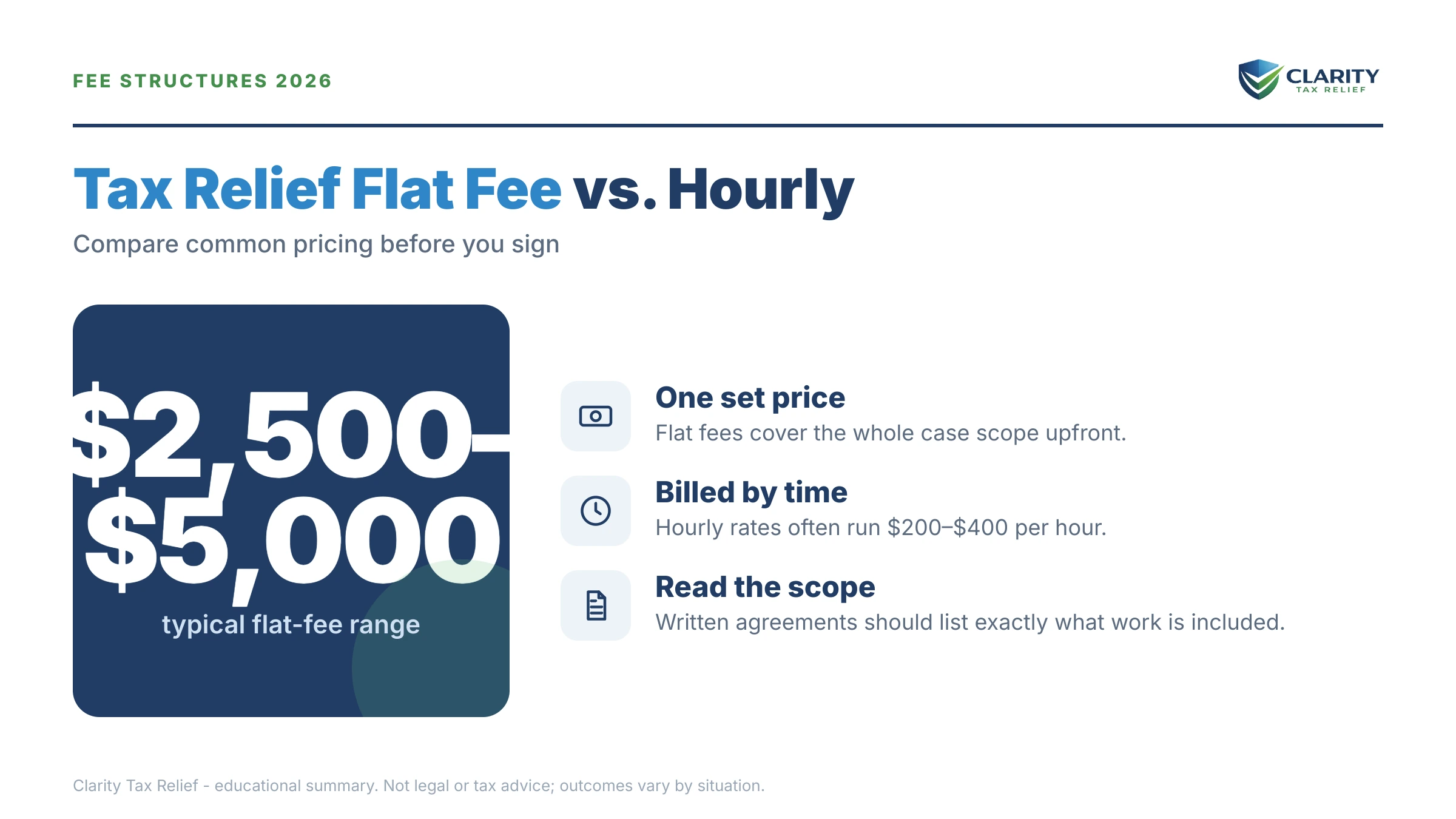
The short answer: a tax relief flat fee is one fixed, written price for a defined scope of work — in 2026, commonly $1,500–$3,500 for payment-plan and hardship cases and $3,500–$7,500 for an Offer in Compromise. Flat fees win on complex cases; hourly is often cheaper for single tasks. Percentage-of-debt pricing is a walk-away red flag.
Two phone calls, two completely different answers: one firm quoted you $3,500 flat to "handle everything," a solo practitioner said she bills $300 an hour, and a third company wanted a cut of what you owe. Meanwhile the levy warning that started all this is still sitting on your kitchen counter. The confusion isn't an accident — but once you know how each pricing model actually works, you can spot a fair quote in one phone call.
⏱ The real clock: there's no deadline for choosing how a firm bills you — but the failure-to-pay penalty adds 0.5% of your balance every month (capped at 25% of the balance, and cut to 0.25% per month while an approved IRS payment plan is in effect), plus compounding interest, while you compare quotes. And if a Final Notice of Intent to Levy (LT11 or Letter 1058) is in your mailbox, the 30-day date printed on that notice outranks every pricing decision on this page.
Why tax relief pricing feels designed to confuse you
Most national tax relief firms charge flat fees, most independent practitioners bill hourly, and almost none of them publish a price list. That means the number you're quoted often depends on the salesperson, not the work — two people with identical cases can be quoted amounts thousands of dollars apart on the same day.
There's a structural reason. Many firms pay their intake reps on commission, so the quote is calibrated to what you sound willing to pay, not to the hours your case requires. The fix is simple and it's the spine of this article: make every quote name its scope, its total, and its refund policy in writing — then compare quotes on those three things, never on the phone pitch.
Our full how much does tax relief cost guide covers the whole market; this page goes deep on the one decision that shapes your bill most — the billing model itself.
Tax relief flat fee vs. hourly vs. percentage of debt: how the three models work
Every tax relief quote you'll hear in 2026 is built on one of three billing models, and only two of them are legitimate.
| Pricing model | How you're charged | Biggest risk to you |
|---|---|---|
| Flat fee | One fixed price for a written scope of work, often split into an investigation fee plus a resolution fee | Scope games — a vague contract lets the firm add "phases" you didn't budget for |
| Hourly | A rate (roughly $150–$550/hr depending on credential) times actual hours worked, usually against a retainer | Open-ended total — a case the IRS drags out for months can outrun the original estimate |
| Percentage of debt | A fee set as a share of your balance or of "projected savings" | The fee scales with your fear, not the work — and often accompanies inflated settlement promises |
Flat fees dominate the national-firm market because they're easy to sell: one number, no surprises — in theory. In practice, many contracts split the work into a small "investigation" fee ($250–$750) followed by a much larger "resolution" fee quoted only after you're invested. That structure isn't automatically dishonest — the investigation genuinely determines what resolution is possible — but you should know both numbers, or at least the resolution range, before paying the first one.
Hourly billing is how most independent attorneys, CPAs, and enrolled agents work, and how some firms — Fortress tax relief alternative comparisons cover the best-known example — market themselves as the anti-flat-fee option. Hourly is genuinely cheaper when the task is small and defined. It gets expensive when the case is messy, because you absorb every IRS delay, every unreturned call, every resubmission. Whether the biller is a lawyer or a company matters less than people assume; our tax relief attorney vs company guide breaks down when the credential itself changes the outcome.
Percentage-of-debt pricing deserves its own sentence: the labor to negotiate a payment plan on $90,000 is nearly identical to the labor on $9,000, so any fee tied to your balance is tied to nothing real. These pitches often travel with "settle for pennies on the dollar" promises — a marketing claim, not a program, and one of the clearest entries on our tax relief company red flags checklist. Per IRS data, the IRS accepted roughly 1 in 5 Offers in Compromise in FY2024; nobody selling by percentage tells you that.
What waiting costs while you compare quotes
IRS collection is automated, so your balance and your risk both grow on a schedule while you fee-shop. For a renter with a levy notice in hand, the sequence runs in this order:
- The final-notice window closes. An LT11 or Letter 1058 gives you 30 days from its printed date to request a Collection Due Process hearing with Form 12153. Let that date pass and you lose your strongest formal right to pause enforcement.
- Bank levy. The IRS can take what's in your account, with a 21-day hold before the bank sends the money — the last realistic window to get it released.
- Wage levy. Unlike a bank levy, a wage levy is continuous — it takes a slice of every paycheck until it's formally released. See how to stop IRS wage garnishment for the release paths.
- Federal payment offsets. Through the Federal Payment Levy Program, the IRS can take up to 15% of Social Security and other federal payments, and keeps intercepting refunds until the debt is resolved.
And even without a levy in motion, the meter runs: penalties and interest compound monthly on whatever you owe. You can estimate how fast your specific balance is growing with our IRS Penalty & Interest Calculator — it's the honest denominator for judging whether any fee quote is worth paying. One 2026 wrinkle worth knowing: per TIGTA reports, the IRS workforce shrank about 27% in 2025, which makes humans harder to reach — but the levy systems are automated and never stopped.
Comparing fee quotes with a levy notice on the table?
Send us the notice and the quotes you've collected. An experienced tax professional will tell you — free — what your case actually requires and give you one flat, written number to compare against, before the window printed on your notice closes.
What a fair tax relief flat fee looks like in 2026, by resolution
A fair flat fee tracks the resolution being pursued, not the size of your debt. The ranges below are what reputable firms and practitioners commonly quote in 2026 — use them as a sanity check, not a guarantee, since complexity (multiple years, business income, disputed amounts) legitimately moves a quote within or above its band.
| Resolution | Who typically qualifies | Commonly quoted flat fee |
|---|---|---|
| Investigation / transcript review | Anyone — this is the diagnostic step | $250–$750 |
| Guaranteed installment agreement | Balance ≤ $10,000, returns filed, full payment within 3 years | $500–$1,500 (often DIY-able for no professional fee) |
| Streamlined installment agreement | Balance ≤ $50,000, up to 72 months, minimal financial disclosure | $1,500–$3,500 |
| Penalty abatement (FTA / reasonable cause) | Clean compliance for the prior 3 years, or documented cause | $500–$2,500 |
| Currently Not Collectible status | Income at or below IRS allowable living expenses | $1,500–$3,500 |
| Levy or garnishment release | Active levy plus a qualifying resolution or hardship | $1,500–$4,000 |
| Offer in Compromise | Assets + future income genuinely below the balance; $205 IRS fee (waived for low-income filers) | $3,500–$7,500 |
| Unfiled back returns | Priced per year; self-employed years cost more | $250–$750+ per return |
Two footnotes that save people real money. First, penalty relief: starting summer 2026, the Automatic Exemption from Penalty (AEP) begins replacing First-Time Abate with relief the IRS applies automatically — never pay a firm a standalone fee for a penalty the IRS is about to remove without being asked. Second, business cases run higher across the board because payroll debt adds personal-liability analysis; the ranges and questions specific to owners are in our tax relief for small business buyer's guide.
Does any fee make sense at your balance?
The smaller your debt, the harder any professional fee has to work to justify itself. Here's the honest map by amount band:
| Balance | Realistic resolutions | Does a fee make sense? |
|---|---|---|
| Under $10,000 | Guaranteed installment agreement, 180-day short-term plan, penalty relief | Rarely — unless a levy is in motion, years are unfiled, or the amount is wrong |
| $10,000–$25,000 | Streamlined installment agreement, penalty abatement, CNC if income is tight | Sometimes — mainly for hardship cases and penalty-heavy balances |
| $25,000–$50,000 | Streamlined agreement (direct debit helps at the top of the band), OIC if you qualify, CNC | Often — choosing the wrong option here costs more than the fee |
| $50,000–$100,000 | Installment agreement with Form 433 financial disclosure, OIC, lien defense | Usually — the financial-disclosure math rewards experience |
| Over $100,000 | Revenue-officer negotiation, OIC, appeals strategy | Almost always — passport certification (at $66,000+ in 2026) and asset exposure are in play |
A worked example: $8,900 and a levy notice
Say you rent, you owe $8,900 from a year you couldn't pay in full, and a final levy notice just arrived. Run the three billing models against the same case:
- DIY: at $8,900 you're under the $10,000 line for a guaranteed installment agreement — $8,900 ÷ 36 months ≈ $248/month, set up online, with interest and penalties still accruing on the shrinking balance. Professional fee: $0. But you'd still need to respond to the levy notice yourself before its 30-day date.
- Flat fee: a national firm quotes $3,000 for "full resolution." That's $3,000 ÷ $8,900 ≈ 34% of your entire debt — defensible only if the quote includes work you actually need, like a levy response plus an unfiled return.
- Hourly: an experienced enrolled agent at $250/hour might need roughly 4–6 hours to respond to the levy notice and lock in the agreement — about $1,000–$1,500 all-in.
This is a hypothetical, not a promise — but the shape holds at any balance: the fee should be priced against the work (a levy response, an agreement, a return), never against the debt. When a quote can't survive that comparison, keep shopping.
How to compare tax relief fee quotes, step by step
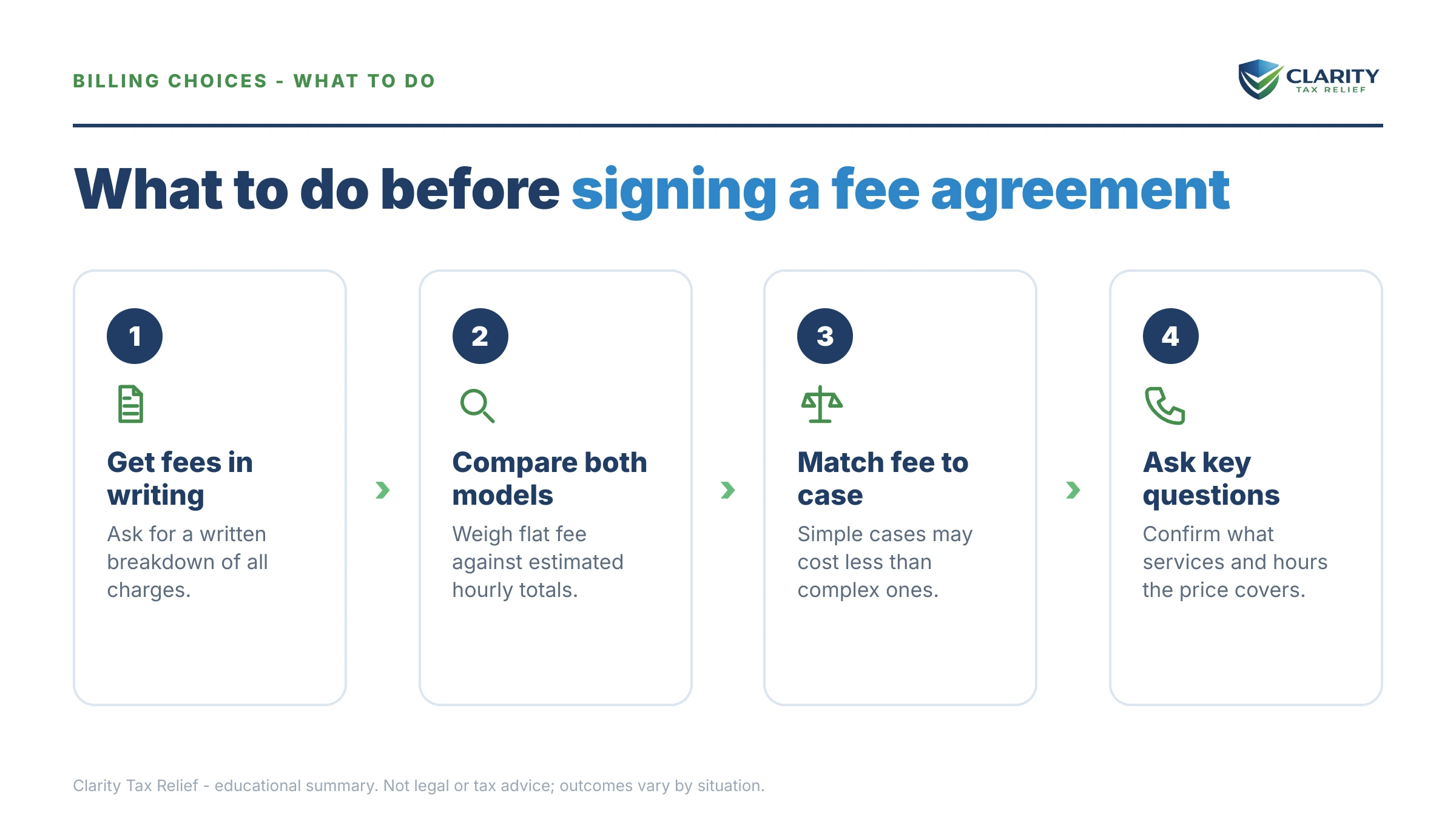
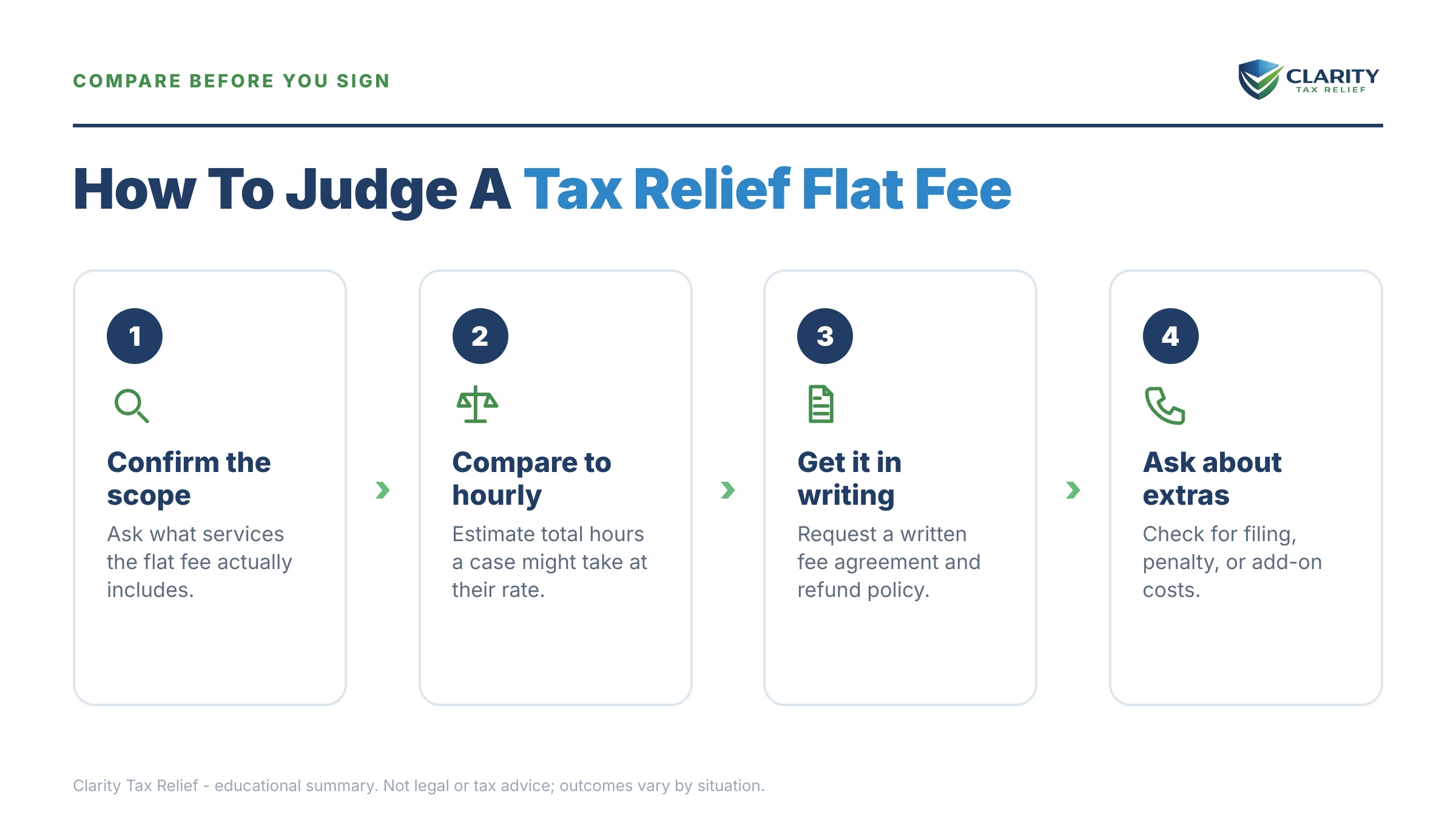
- Get the scope in writing. The engagement letter must name your tax years, the specific resolutions being pursued, and everything that is excluded.
- Demand one all-in number. Ask directly whether any "resolution phase," return-preparation, or appeal fee can be added later — and get the answer in the contract.
- Ask who signs your Form 2848. The person who will actually represent you before the IRS should be named, credentialed, and reachable — not "someone on our team."
- Check the refund policy. Know in writing what you get back if the promised strategy is never filed or the firm misses deadlines.
- Compare against your DIY baseline. Price every quote against what the same resolution would cost you to set up yourself — that gap is what the fee is really buying.
If you want the full interview script — including how to test whether the "investigation" is real analysis or a sales funnel — our list of questions to ask a tax relief company and the broader guide on how to choose a tax relief company pick up where these five steps end.
When you can skip the fee entirely
Honesty first: a large share of the people comparing tax relief fees don't need to pay one. You can almost certainly handle it yourself if your balance is under $10,000 with all returns filed, if you can pay in full within 180 days on a short-term plan, or if you got a first notice you agree with and just need a payment plan through IRS.gov. The complete self-service playbook — every program, form, and phone script — is our guide to how to settle tax debt yourself, and payments themselves always go through IRS.gov/payments, never to a firm.
Experienced help changes outcomes in a narrower set of situations: a levy already in motion (speed and knowing which release path fits matter), multiple unfiled years (the order you file in changes the total), business or payroll debt (personal liability is on the table), a balance you dispute, and Offer in Compromise math, where one wrong number on the financial disclosure sinks the offer. If money is the barrier, you may also qualify for free representation through a low income taxpayer clinic, and the independent Taxpayer Advocate Service can step in when IRS delays are causing hardship.
Pricing terms on the engagement letter, decoded
- Retainer: money you pay up front that the practitioner bills hours against; you're owed back whatever isn't earned.
- Evergreen retainer: a retainer you must keep topped up as it's drawn down — the clause that turns "about $1,500" into an open tab.
- Investigation (discovery) fee: a smaller first fee to pull your transcripts and diagnose the case before quoting resolution work.
- Phase billing: splitting one case into separately priced stages; legitimate only when every phase's price is disclosed before phase one.
- Scope of work: the contract section listing exactly what's included — tax years, resolutions, appeals — and, by omission, what isn't.
- Form 2848: the IRS power of attorney naming who may represent you; the name on it should match the person you vetted.
Tax relief fee questions, answered
What is a typical flat fee for tax relief in 2026?
Most national firms quote flat fees between $1,500 and $3,500 for a payment-plan or hardship case and $3,500 to $7,500 for an Offer in Compromise. Simple standalone work, like a penalty abatement request, is commonly quoted from about $500 to $2,500. Anything far above these ranges deserves a written explanation of what extra work justifies it — the size of your debt alone does not.
Is a flat fee or hourly billing cheaper for tax relief?
Hourly billing is usually cheaper for small, well-defined tasks — a single levy release or a straightforward payment-plan setup may take an experienced practitioner only a handful of hours at $200 to $400 per hour. Flat fees usually win on complex, unpredictable cases like an Offer in Compromise or multiple unfiled years, because the price cannot balloon if the IRS drags the case out for months.
Why do some tax relief companies charge a percentage of the debt?
Because it maximizes their fee, not your outcome. The work to set up a payment plan on a $90,000 debt is nearly identical to the work on a $9,000 debt, so a fee that scales with your balance is scaling with your fear rather than with the labor involved. Treat percentage-of-debt pricing — and any pitch promising settlement for 'pennies on the dollar' — as a signal to walk away.
What should a tax relief flat fee include?
A written scope naming the tax years covered, the specific resolutions the firm will pursue, who will represent you on Form 2848, and what happens if the first strategy is rejected. It should also state whether appeals, defaulted-agreement fixes, and corrected paperwork are included. If the engagement letter doesn't answer those questions, the 'flat' fee is really an opening bid.
Can I get my money back if a tax relief company doesn't deliver?
Sometimes — it depends on the engagement letter and your state's consumer-protection rules, which is why the refund policy must be in writing before you pay anything. Firms that bill in phases owe you unearned fees for work never performed. If work was never done at all, a card chargeback or a complaint to your state attorney general are real levers.
Is paying a tax relief fee worth it if I owe less than $10,000?
Usually not, if your returns are filed and no levy is in motion — a balance under $10,000 generally qualifies for a guaranteed installment agreement you can set up yourself online in under an hour. A $3,000 fee on an $8,900 debt is roughly a third of the balance. Professional help earns its cost at this size mainly when a levy is already moving, several years are unfiled, or the assessed amount is wrong.
How much do tax professionals charge per hour for IRS problems?
Commonly quoted 2026 rates run roughly $150 to $300 per hour for enrolled agents, $200 to $400 for CPAs, and $300 to $550 for tax attorneys. The credential matters less than collections experience — an enrolled agent who negotiates with IRS collections every week will often resolve a levy faster than a generalist attorney billing twice the rate.
Your next 24 hours
- Find the date on any IRS notice you're holding. If it's an LT11 or Letter 1058, the 30-day window printed on it outranks every pricing decision — note that date before you compare a single quote.
- Gather three things: your last filed return, the notice itself, and a rough picture of your monthly income and rent. Every honest fee quote — and every resolution — is built from these.
- Get one flat, written number to compare against. Our free case review — the 2-minute form at claritytaxrelief.com/#consult or a call to (888) 825-7779 — tells you what your case genuinely requires while your balance is still at its smallest.
Fee ranges above are typical market figures, not quotes; your price depends on the specific work your case requires. This guide is general information, not tax or legal advice for your specific situation. Eligibility for IRS programs depends on individual facts and circumstances; no outcome is guaranteed.