
Company Comparisons
Fortress Tax Relief Alternative: How to Compare Your Options in 2026
The short answer: the best Fortress Tax Relief alternative depends on your case size and pricing preference. Fortress is known for attorney-staffed, time-billed representation aimed at larger cases; most people shopping alternatives want a written flat fee, a lower case minimum, or enrolled-agent-led help. Compare total written cost, credentials, and the IRS program each firm would pursue.
You searched "fortress tax relief alternative" because something in your research or consultation didn't quite fit — maybe the quote ran higher than you budgeted, maybe time-based billing made the final cost impossible to pin down, or maybe your case felt smaller than the ones the firm is built for. Meanwhile, your balance is still sitting on the IRS's books, growing. The good news: comparison shopping is exactly the right instinct, and done correctly it takes days, not months.
⏱ The real clock: there's no deadline to hire anyone — but the failure-to-pay penalty adds 0.5% of your balance every month (capped at 25% of the unpaid tax, and cut to 0.25% per month once an approved IRS installment agreement is in place), and interest compounds daily on top of it. On a $68,500 balance, that's roughly $342 in penalty alone each month you spend deciding, before interest.
Why people look for a Fortress Tax Relief alternative
Most searches for a Fortress Tax Relief alternative come down to pricing model, case size, or credential preference — not distrust. Fortress has built its name on cases handled by tax attorneys and, per its own published materials, billing tied to time worked rather than a single flat package price. That model genuinely suits some cases. It also produces three common reasons readers go looking elsewhere:
- Cost certainty. Time-based billing can be fair, but you can't know the final number up front. Many taxpayers — especially self-employed people managing uneven cash flow — want one written, all-in fee before they commit.
- Case-size fit. Attorney-led firms are generally oriented toward larger, more complex balances. If your debt is in the five figures with no criminal exposure and no litigation on the horizon, you may be paying attorney rates for work an enrolled agent or CPA can do with identical IRS representation rights.
- Specialization. A sole proprietor with self-employment tax debt, unfiled quarterlies, and a Schedule C business has different needs than a W-2 employee with one bad year. Some readers simply want a firm that works those cases daily — our guide to tax relief for small business covers what that looks like.
Whatever pushed you to compare, the search is really three separate questions: which IRS program fits your finances, who should represent you, and what you should pay for that representation. The rest of this guide answers all three.
What happens to your tax debt while you compare firms
The IRS collection sequence advances automatically whether or not you've hired anyone. That's the single most important fact for anyone shopping firms: comparing quotes for six weeks doesn't pause anything. The 2025 workforce cuts — roughly 27% of IRS staff — made humans harder to reach, but the notices, liens, and levies come from automated systems that never stopped running. If you already have IRS letters on the counter, the sequence looks like this:
- CP14 — the first bill. Typically about 21 days to pay before the reminder cycle begins.
- CP501 / CP503 — reminder notices. Still just bills, but the balance grows every month.
- CP504 — intent to levy your state tax refund under IRC §6331(d). Not the final notice, despite the alarming language.
- LT11 / Letter 1058 — the final notice of intent to levy. It starts a 30-day clock on your Collection Due Process rights (requested with Form 12153). After that window, wage and bank levies become legally available.
- Levy and lien enforcement — a bank levy freezes funds with a 21-day hold before the money leaves; a wage levy is continuous until released.
One more stage applies specifically at higher balances: at $66,000 or more in 2026, the IRS can certify your debt as "seriously delinquent" (notice CP508C), which lets the State Department deny or revoke your passport. If you owe $68,500, you're already over that line — a detail worth raising in every consultation you take.
| IRS action | Your window | What's at stake if it passes |
|---|---|---|
| CP14 first bill | Typically 21 days from the notice date | Escalation to the reminder cycle; penalties and interest keep compounding |
| CP504 intent to levy | The date printed on your notice | Your state tax refund can be seized; a federal lien becomes likely |
| LT11 / Letter 1058 final notice | 30 days | Your Collection Due Process hearing right (Form 12153) — the strongest pre-levy protection you have |
| CP508C passport certification ($66,000+) | No fixed printed window | Passport denial or revocation until the debt is resolved or in an approved arrangement |
| Bank levy served | 21-day hold before funds transfer | The frozen money goes to the IRS unless the levy is released in time |
Comparing firms while the notices keep coming?
Get a second opinion on your case — free. An experienced tax professional will pull your IRS transcripts, tell you which program your numbers actually support, and quote a written flat fee you can compare against any other firm's proposal. No pressure, no obligation.
The IRS options any Fortress alternative must walk you through
Every legitimate tax relief firm — Fortress and all of its alternatives — works with the same six IRS resolution programs, because no company has special access or a private negotiating channel. What you're actually buying is judgment: which program your finances support, how the paperwork is framed, and how mistakes and delays are prevented. Here's the menu every consultation should cover, with 2026 thresholds:
| Resolution option | 2026 eligibility basics | Cost & what to know |
|---|---|---|
| Short-term payment plan | Can pay in full within 180 days | $0 setup; interest and penalties continue until paid |
| Streamlined installment agreement | Balance ≤ $50,000; up to 72 months, set up online | Modest setup fee (lower with direct debit); no financial disclosure required |
| Non-streamlined installment agreement | Balance above $50,000 | Form 433-series financial disclosure; the IRS reviews income, expenses, and assets to set your payment |
| Offer in Compromise (Form 656) | Reasonable Collection Potential below the balance owed | $205 fee + 20% down on lump-sum offers (both waived with low-income certification); roughly 1 in 5 offers accepted in FY2024 |
| Currently Not Collectible | Allowable living expenses meet or exceed income | $0; collection pauses, but the debt and interest remain and the IRS reviews periodically |
| Penalty abatement (FTA / AEP) | Clean compliance history in the prior 3 years, or reasonable cause | Removes penalties, not tax; starting summer 2026 the new Automatic Exemption from Penalty applies without a request |
The Offer in Compromise deserves one extra sentence, because it's the program firms oversell. The IRS decides acceptance by computing your Reasonable Collection Potential (RCP) — your net asset equity plus a multiple of your monthly disposable income — and it accepts an offer only when that number is less than your balance. If a consultation pitches an OIC before anyone has looked at your assets and income, that's a sales script, not analysis. You can estimate your own numbers first with our Offer in Compromise Calculator and walk into every consultation already knowing whether the pitch is plausible.
A worked example: $68,500, self-employed
Say you're a sole proprietor who owes $68,500 across two tax years — mostly self-employment tax that quarterly estimates never covered. This is a hypothetical, but the math is how any honest firm should frame your choices:
- Full-balance installment agreement: $68,500 is above the $50,000 streamlined line, so a monthly plan requires financial disclosure. Spread over 72 months, the principal alone is $68,500 ÷ 72 ≈ $951/month — and because interest and the 0.5% monthly failure-to-pay penalty keep accruing, the actual payoff runs longer or the payment runs higher.
- The pay-down play: pay $18,501 up front to bring the balance to $49,999, and you regain streamlined eligibility — about $49,999 ÷ 72 ≈ $694/month, set up online with no financial disclosure. That also drops you below the $66,000 passport-certification threshold.
- Offer in Compromise: suppose your work truck has $6,000 in equity, you hold $5,000 in the bank, and your monthly income exceeds IRS allowable expenses by $350. A lump-sum offer's RCP is roughly $11,000 in equity + ($350 × 12) = $4,200 in future income — about $15,200. If that math holds up under IRS scrutiny, an offer near that figure is credible; if your disposable income is really $900/month, the RCP jumps past $21,000 and the case gets harder. Either way, the arithmetic — not the firm's marketing — decides it.
- The compliance catch every sole proprietor hits: the IRS won't approve any of these arrangements unless you're current on this year's estimated payments. Fixing your 2026 quarterlies is step zero, and a firm that doesn't ask about them in the first conversation isn't thinking about your case correctly.
How to evaluate a Fortress Tax Relief alternative, step by step
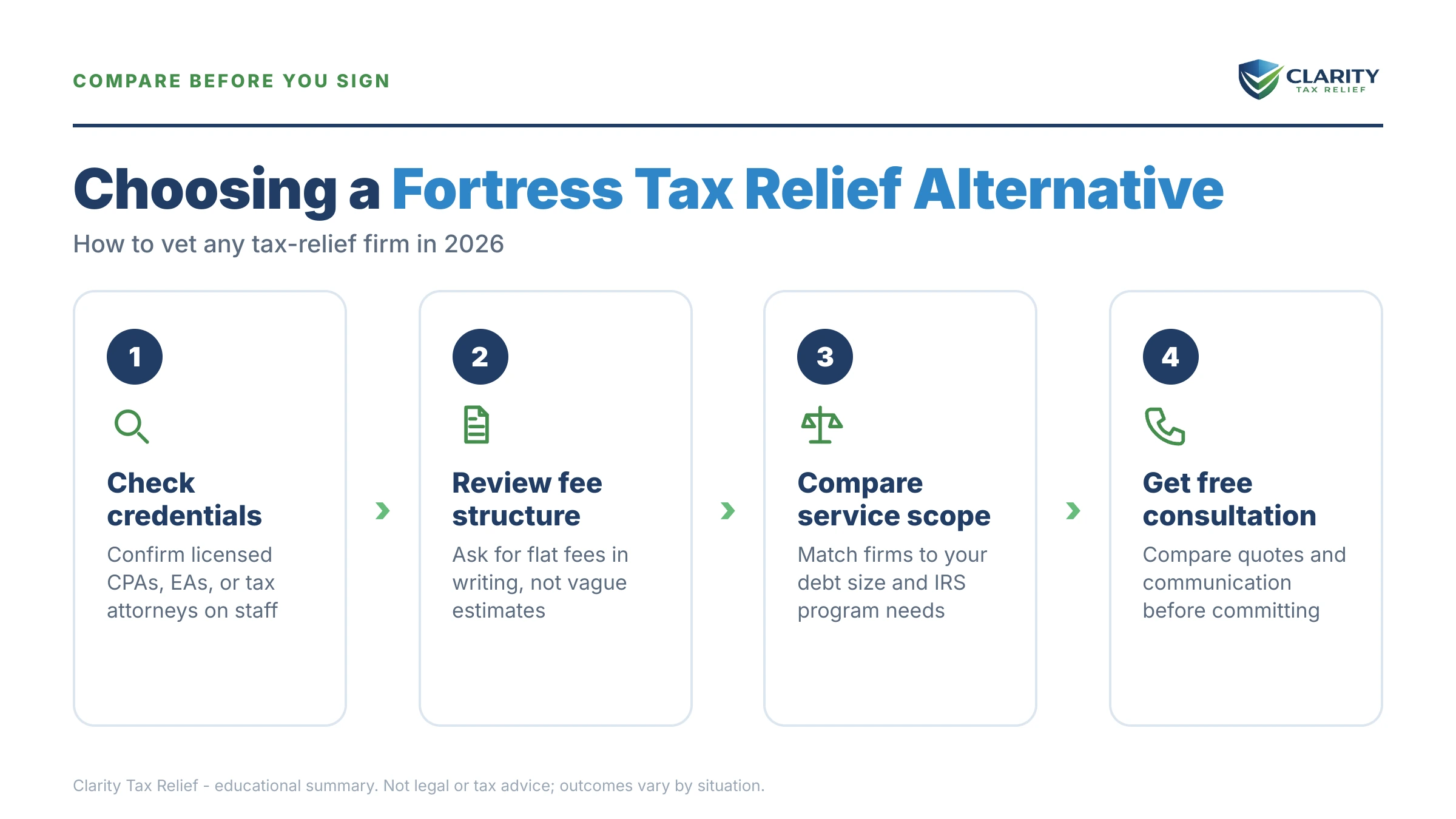
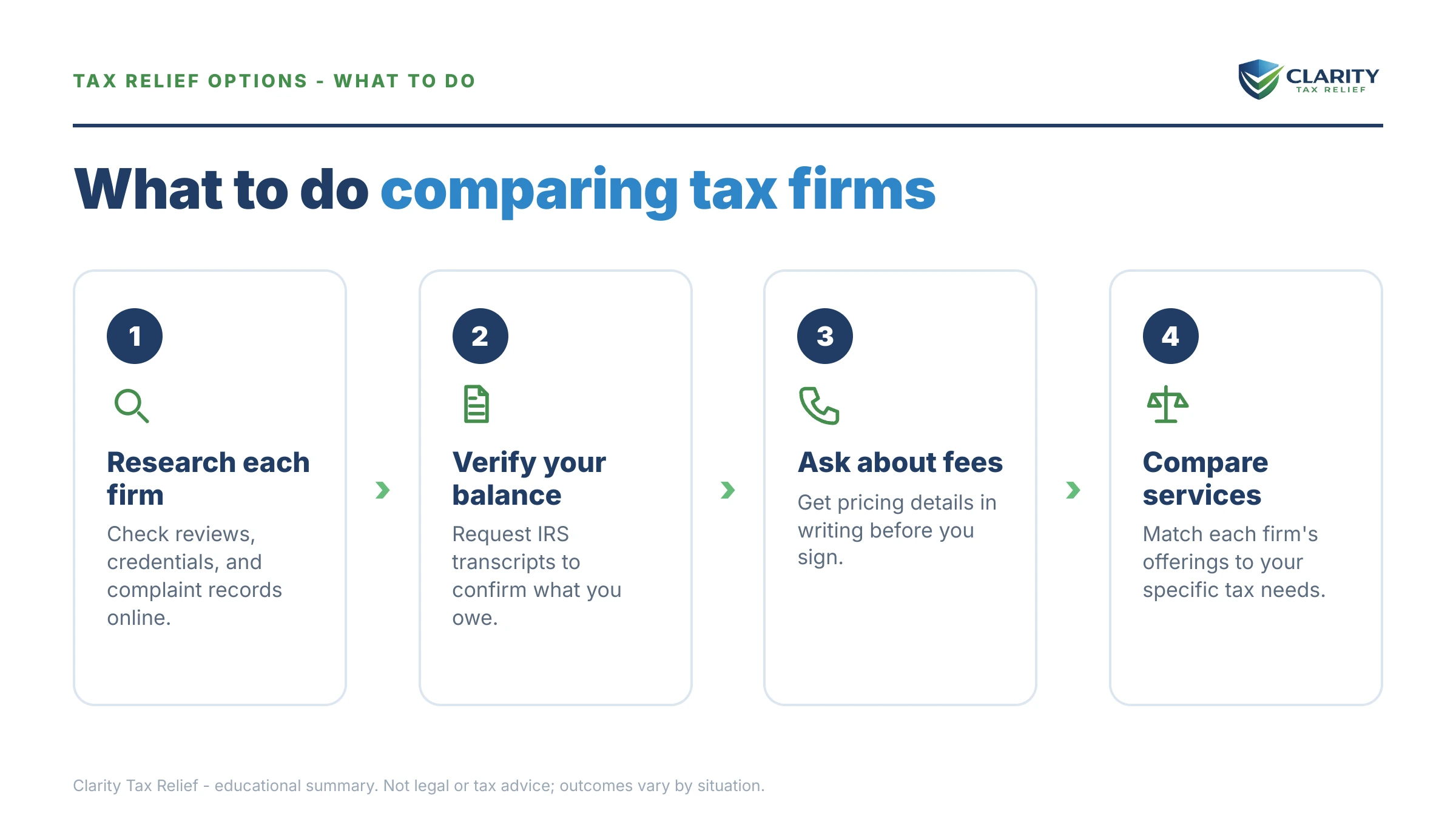
A good comparison takes one focused week, not a month of anxious tab-hopping. Work the steps in order:
- Pull your own IRS records first. Set up your IRS online account and download your account transcripts so you know the exact balance, tax years, and penalties before any firm quotes you.
- Get the total fee structure in writing. Ask every firm — Fortress included — for the total expected cost in writing: the hourly rate and estimated hours, or the all-in flat fee, plus what triggers extra charges.
- Ask who will actually work your case. Confirm the name and credential — attorney, CPA, or enrolled agent — of the person who will hold your Form 2848 power of attorney and speak to the IRS for you.
- Make the firm name the likely program before you pay. A credible consultation should tell you whether you're realistically looking at an installment agreement, an Offer in Compromise, Currently Not Collectible status, or penalty relief — and why.
- Compare at least two quotes against the DIY cost. Weigh each quote against what the same resolution would cost in IRS setup fees alone if you handled it yourself, and pay only for expertise that changes the outcome.
For the full buyer's checklist behind these steps, see how to choose a tax relief company and the specific questions to ask a tax relief company before signing anything. And if you want to know what a legitimate first call sounds like, here's what to expect at a free tax relief consultation.
Hourly vs. flat fee: the pricing question behind most alternative searches
Neither billing model is a scam — but they fit different cases, and mismatched billing is the #1 reason people keep shopping. Time-based billing rewards efficiency and can be genuinely fair on unpredictable matters: a contested trust fund penalty, a complicated appeal, anything litigation-adjacent. Its weakness is that you cannot know the final cost until the case is over, which is a hard sell when you're already staring at a five-figure IRS balance.
Flat fees flip that trade. You get cost certainty on well-defined work — an installment agreement, a penalty abatement request, an OIC package — but a flat fee only protects you if it's genuinely all-in. Ask what happens if the IRS rejects the first proposal, whether appeals are included, and whether unfiled returns are quoted separately. Our breakdowns of tax relief flat fee vs. hourly pricing and how much tax relief costs put real ranges on each model.
The one pricing model to walk away from entirely: fees calculated as a percentage of your "projected savings." That structure incentivizes the firm to inflate what it claims it can save you — it's the engine behind the settle-for-pennies pitch, and it's first on our tax relief red flags checklist.
When you don't need Fortress — or any alternative
If you owe under $50,000 from returns you agree with, you can usually resolve it yourself in an afternoon. The streamlined installment agreement is a self-service online product — here's how to set up an IRS payment plan online — and a short-term 180-day plan costs nothing to establish. First penalty in years? First-Time Abatement (and, from summer 2026, the Automatic Exemption from Penalty) can wipe it without a professional's help. Our complete guide to how to settle tax debt yourself covers every DIY path honestly.
Experienced help earns its fee in specific situations: a balance over $50,000 where financial disclosure gets negotiated rather than just submitted; multiple unfiled years that must be filed in the right order before anything can be resolved; a levy or garnishment already in motion; business or payroll tax debt with personal-liability exposure; and OIC cases, where presentation of the RCP math materially changes outcomes. If your case has one of those features, comparing firms is worth the effort — because representation quality will actually move the result.
Terms you'll hear in consultations, decoded
- Form 2848 (power of attorney): the document that authorizes a specific credentialed person — not a company — to represent you before the IRS. Ask whose name goes on yours.
- Investigation phase: the first paid stage at most firms, where they pull your transcripts and diagnose the case before quoting resolution work.
- Reasonable Collection Potential (RCP): the IRS's formula — asset equity plus future disposable income — that decides whether an Offer in Compromise gets accepted.
- Enrolled agent (EA): a federally authorized tax practitioner with full IRS representation rights, same as an attorney or CPA for collections matters.
- Retainer: money paid up front against future hourly work; the meaningful question is what the retainer is estimated to cover and what happens when it runs out.
- CSED: the Collection Statute Expiration Date — the IRS generally has 10 years from assessment to collect, though appeals, offers, and bankruptcy pause the clock. Any resolution strategy should account for how much time is left on yours.
Fortress Tax Relief alternative FAQs
Is Fortress Tax Relief a legitimate company?
Yes — Fortress is an established tax resolution firm, and searching for an alternative doesn't mean it's a scam. Most alternative-shopping comes down to fit: its attorney-staffed, time-based billing model suits large, complex cases, but readers with mid-size balances often want a written flat fee or enrolled-agent-led representation at a lower total cost. Compare fit, not just reputation.
What should I look for in a Fortress Tax Relief alternative?
Four things: a total cost in writing before you pay, the name and credential of the person who will hold your Form 2848 power of attorney, a specific IRS program recommendation with the reasoning behind it, and experience with cases like yours. A firm that can't name which resolution it would pursue after seeing your transcripts hasn't earned your retainer.
Is hourly or flat-fee billing better for tax relief?
Flat fees are usually better for predictable cases like installment agreements and penalty abatement, because the work is well-defined and hourly billing adds uncertainty. Hourly billing can be fairer on genuinely unpredictable matters — complex appeals or litigation-adjacent disputes — where a flat fee would be padded to cover risk. The red flag isn't either model; it's a firm that won't put its total expected cost in writing.
Do I need a tax attorney, or can an enrolled agent handle my case?
For collections work — payment plans, Offers in Compromise, hardship status, penalty abatement, and levy releases — an enrolled agent or CPA has the same IRS representation rights as an attorney, usually at a lower cost. An attorney adds real value when you face potential criminal exposure, need attorney-client privilege, or are headed to Tax Court. Most back-tax cases never touch those situations.
Can a tax relief company settle my IRS debt for less than I owe?
Only if your finances qualify — the IRS accepted roughly 1 in 5 Offers in Compromise in FY2024, and acceptance turns entirely on the Reasonable Collection Potential math, not on which firm files the paperwork. Any company promising to settle for 'pennies on the dollar' before analyzing your assets and income is selling a fantasy. A credible firm runs the math first and tells you honestly if a payment plan is the better path.
Can I set up an IRS payment plan myself if I owe more than $50,000?
Not through the streamlined online system — above $50,000, the IRS requires financial disclosure on a Form 433-series statement before approving a monthly plan. You can still do it yourself by phone or mail, but the IRS reviews your income, expenses, and assets, and how that disclosure is presented affects the payment you're assigned. One workaround: paying the balance below $50,000 restores online streamlined eligibility for up to 72 months.
How much does hiring a tax relief firm cost in 2026?
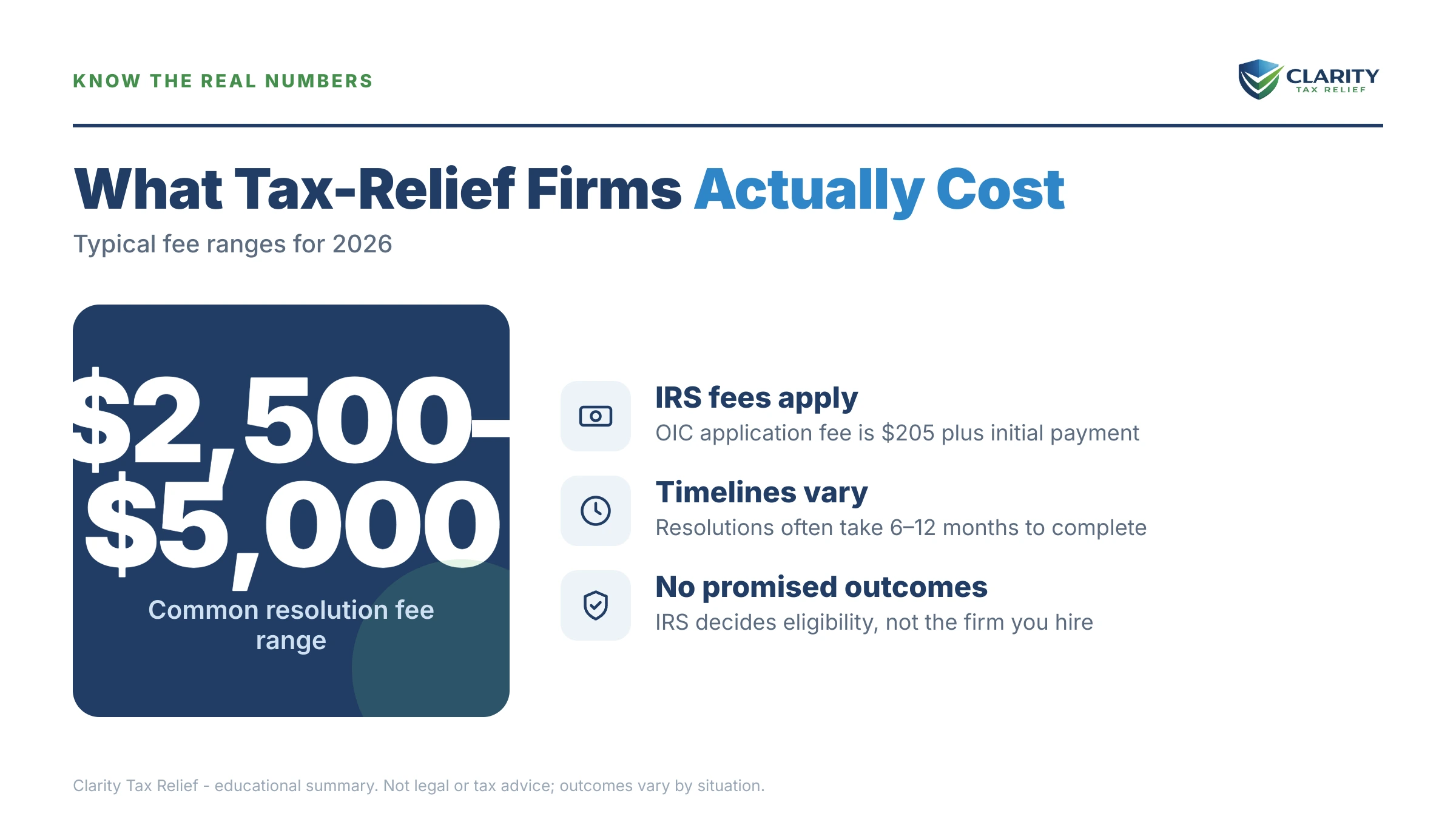
Most reputable firms charge a few hundred dollars for an investigation phase, then roughly $1,500 to $7,500+ for resolution depending on the program — penalty abatement sits at the low end, an Offer in Compromise or a negotiated plan on a $50,000+ balance at the high end. Hourly-billed firms can land below or above those ranges depending on how the case unfolds. Get every quote in writing and compare it against the IRS's own setup fees for the same outcome.
Your next 24 hours
- Find your most recent IRS notice and note the notice code, the date, and the total balance — those three facts determine how much time your comparison shopping actually has.
- Gather your last filed return, your IRS notices, and a rough monthly income-and-expense picture. Every credible firm will need these on the first call, and having them ready turns a sales pitch into a real analysis.
- Book your free case review — the 2-minute form at claritytaxrelief.com/#consult or (888) 825-7779. You'll leave with a written flat-fee quote and a named program recommendation to weigh against Fortress or anyone else, while interest and penalties are still accruing on the balance either way.
Want to verify anything here against primary sources? The IRS publishes its own plain-language pages on payment plans and installment agreements and the Offer in Compromise program, and the independent Taxpayer Advocate Service offers free help when IRS processes break down.
This guide is general information, not tax or legal advice for your specific situation. Eligibility for IRS programs depends on individual facts and circumstances; no outcome is guaranteed.