
Comparing Tax Relief Firms
Precision Tax Relief Alternative: How to Compare Your Options in 2026
The short answer: the best Precision Tax Relief alternative depends on what sent you shopping — fee, fit, or case type — because every legitimate firm uses the exact same IRS programs. Compare firms on flat written fees, the credential of the person working your file, and whether the outcome they suggest matches your financial math.
You've read the reviews, maybe sat through a consultation, and something didn't fit — the fee, the wait, or the sense that your case wasn't the kind they wanted. Now you're searching "precision tax relief alternative" while your IRS balance quietly grows. Good news: the comparison is simpler than the industry makes it look, because the tools are the same everywhere.
⏱ The clock that's actually running: there's no deadline to hire help — but the IRS failure-to-pay penalty adds 0.5% of your balance every month while you compare firms, and interest compounds on top. The cheapest resolution is the one you start soonest, whoever you hire (or don't).
Why people search for a Precision Tax Relief alternative
Precision Tax Relief is one of the better-reviewed names in this industry, so most people comparing alternatives are shopping on fit — not fleeing a scam. That distinction matters, because it changes what you should compare.
The common reasons readers tell us they're looking elsewhere: the quoted fee didn't fit a fixed budget, the firm's minimum balance or case-type requirements didn't match their situation, they wanted a second opinion before signing, or they wanted someone who works fixed-income and retiree cases every week. All are legitimate reasons. None of them change the underlying reality:
Every legitimate firm — Precision, Clarity, or anyone else — files the same IRS forms into the same IRS programs. Form 9465 or an online agreement for payment plans. Form 656 with Form 433-A (OIC) for an Offer in Compromise. Form 843 or a phone request for penalty abatement. A Form 2848 power of attorney to represent you. No firm has a back door, a special relationship, or a secret program. What differs between firms is judgment, honesty about your odds, price, and how much attention your file actually gets.
That means your comparison shouldn't be "which firm has the magic" — it should be "which firm quotes a fair flat fee, staffs my case with a credentialed professional, and recommends the resolution my numbers actually support." If you're comparing several national names at once, our optima tax relief alternative, anthem tax services alternative, and fortress tax relief alternative guides apply the same yardstick to each.
What happens to your tax debt while you compare firms
The IRS collection machine keeps escalating on its own schedule regardless of which firm you're interviewing. In 2026, with the IRS workforce down roughly 27% from the 2025 cuts, it's harder than ever to reach a human — but the automated notice-and-levy system never stopped running. Here's the sequence a balance travels while you deliberate:
- CP14 — the first bill. You typically have about 21 days from the notice date before the sequence advances — but only 10 business days if the balance is $100,000 or more. No enforcement yet, but the 0.5%/month penalty and daily interest are already accruing.
- CP501 / CP503 — reminders. Still just bills. Each one arrives with a bigger balance than the last.
- CP504 — Notice of Intent to Levy. The IRS can now seize your state tax refund, and a federal tax lien becomes a real possibility.
- LT11 / Letter 1058 — Final Notice. A 30-day clock starts on your Collection Due Process rights (requested with Form 12153). After it runs, the IRS can levy bank accounts and income.
- Active levy. A bank levy freezes funds with a 21-day hold before the money leaves. And for anyone on benefits, the Federal Payment Levy Program can take up to 15% of your Social Security — automatically, month after month, until the debt is resolved. Our guide to whether the IRS can garnish Social Security covers exactly how that levy works and how it's released.
The takeaway isn't panic — it's that "shopping for a firm" and "doing nothing" look identical to the IRS computer. Whichever direction you choose, choose it before the next notice, not after.
Comparing firms while your balance grows?
Get a free second opinion on your exact IRS account before you sign with anyone. An experienced tax professional will tell you what your numbers realistically support — including whether you need a firm at all. Penalties and interest accrue monthly until a resolution posts, so get the answer now.
The options every Precision Tax alternative will use — and who qualifies
There are only six real tools for resolving IRS debt, and a good firm's job is picking the right one — not inventing a seventh. Here's the honest eligibility picture; the full do-it-yourself playbook for each lives in our guide to how to settle tax debt yourself.
| Option | Who typically qualifies | Cost to apply | The catch |
|---|---|---|---|
| Short-term payment plan | Can pay in full within 180 days | $0 setup | Interest and the 0.5%/month penalty keep accruing |
| Long-term installment agreement | Balance ≤ $50,000 with all returns filed — up to 72 months, set up online | Setup fee varies; lowest with direct debit | Interest accrues for the life of the plan |
| Guaranteed installment agreement | Owe $10,000 or less in tax with a clean recent filing history | Standard setup fee | The IRS must accept it, but interest still runs |
| Currently Not Collectible (CNC) | Income fully consumed by IRS allowable living expenses | $0 | Debt remains and grows; refunds offset; IRS reviews your income periodically |
| Offer in Compromise (OIC) | Assets + future income genuinely can't cover the balance | $205 fee + 20% down on lump-sum offers (both waived with low-income certification) | The IRS accepted roughly 1 in 5 offers in FY2024; reviews take months |
| Penalty abatement (FTA / AEP) | Clean compliance in the prior 3 years; from summer 2026, the Automatic Exemption from Penalty (AEP) applies without a request | $0 | Removes penalties only — the tax and interest on it remain |
The one worth a special word is the OIC, because it's the product most heavily oversold in this industry. The IRS accepts an offer only when your Reasonable Collection Potential — your net asset equity plus a multiple of your monthly disposable income — comes in below your balance. It's arithmetic, not negotiation. Before any sales call, you can estimate your own offer with our Offer in Compromise Calculator and see whether the math is even in your neighborhood.
A worked example: retired, on Social Security, owing $31,200
Say you're retired, your income is a $1,980 monthly Social Security check, and the IRS says you owe $31,200 across two tax years. This is a hypothetical, but the math is exactly what any honest firm — Precision or an alternative — would run:
- Installment agreement: at $31,200 you're under the $50,000 online threshold, so a streamlined plan of up to 72 months is available without full financial disclosure. $31,200 ÷ 72 ≈ $434 a month — before accruing interest, which means paying slightly more or slightly longer. On a fixed $1,980 check, $434 a month may simply not be livable. That matters, and it points to the next two options.
- Currently Not Collectible: if your allowable living expenses — housing, utilities, food, out-of-pocket medical — run, say, $2,150 a month against $1,980 of income, your disposable income is zero. That's a genuine CNC profile: collection pauses, no levy touches your check, and the 10-year collection statute (CSED) keeps running in the background. Our guides to irs hardship social security cases and being retired and owing back taxes walk through this profile in depth.
- Offer in Compromise: with $0 monthly disposable income, a lump-sum offer is driven almost entirely by asset equity. If your net realizable equity — an older car, a modest bank balance — totals about $4,000, an offer near $4,000 could be mathematically defensible against a $31,200 balance. And on Social Security income alone, you may qualify for low-income certification (AGI at or below 250% of the poverty guideline), which waives the $205 fee, the 20% down payment, and payments during review. Still no sure thing — roughly 1 in 5 offers were accepted in FY2024 — but this is the profile where offers genuinely work.
Notice what just happened: three legitimate answers, and the right one depends entirely on expenses, assets, and how many years remain on the CSED. That judgment call — not access to a secret program — is the only thing a fee should ever buy.
Alternatives to Precision Tax Relief by how much you owe
The size of your balance changes which firms make sense — and whether any firm makes sense at all. Business and payroll debt follows entirely different rules; that comparison lives in our guide to tax relief for small business.
| Balance | Realistic resolution paths | DIY or professional help? |
|---|---|---|
| Under $10,000 | Guaranteed installment agreement; pay in full; penalty abatement | Almost always DIY — many firms won't take these cases, and shouldn't |
| $10,000–$25,000 | Streamlined installment agreement online; penalty abatement | Usually DIY if all returns are filed |
| $25,000–$50,000 | Streamlined IA (≤ $50k with direct debit); CNC on fixed income; OIC when RCP is low | DIY is possible; help pays off when hardship or OIC math is involved — this is where a $31,200 balance sits |
| $50,000–$100,000 | Installment agreement with financial disclosure (Form 433 series); OIC; CNC | Professional help is usually worth the fee |
| Over $100,000 | Likely revenue-officer assignment; lien and levy defense alongside resolution | Experienced representation strongly advised |
One threshold to watch as balances climb: at $66,000 of seriously delinquent debt in 2026, the IRS can certify you to the State Department for passport denial or revocation. At $31,200 you're well below it — one more reason resolving now is cheaper than resolving later.
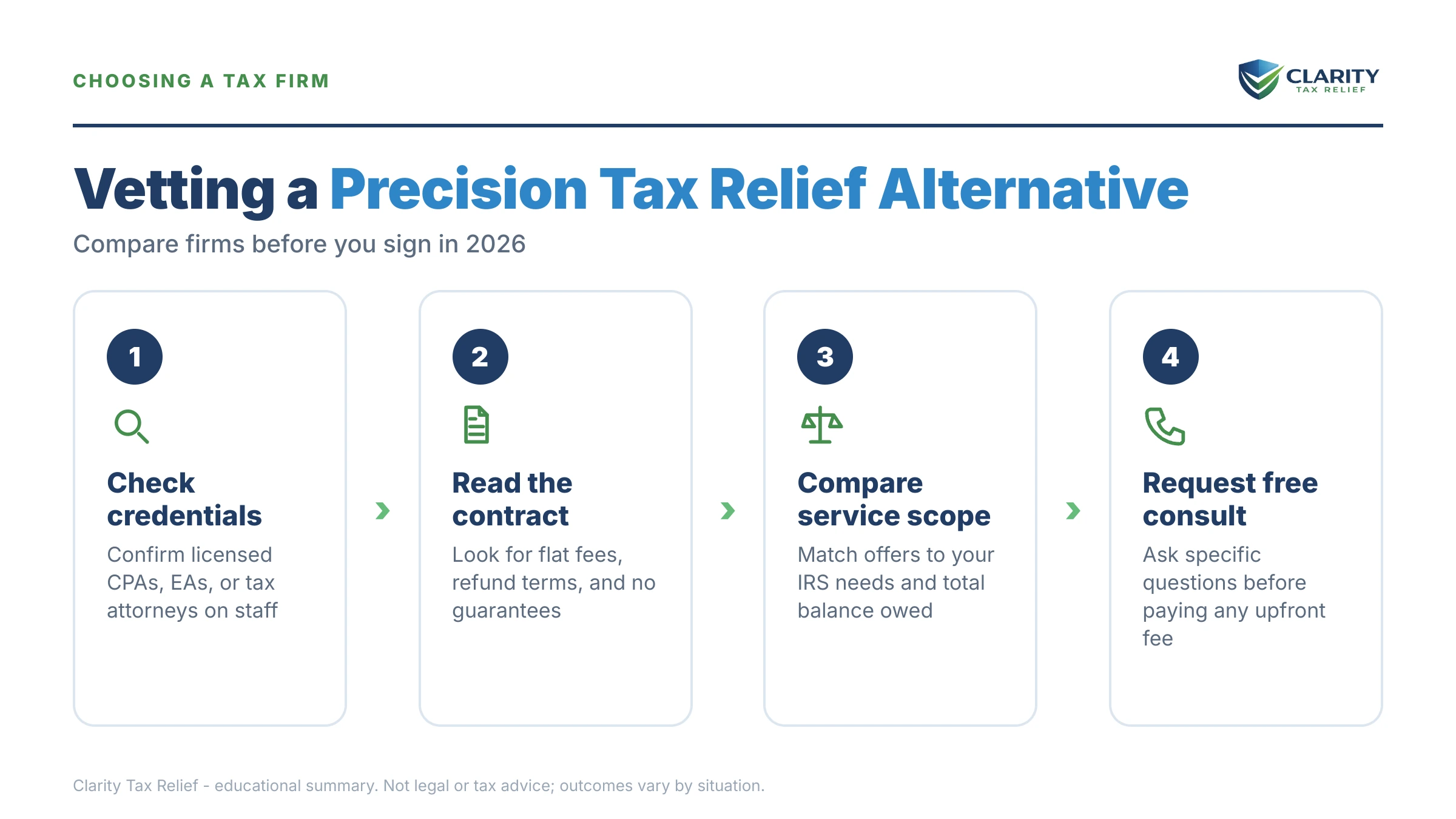
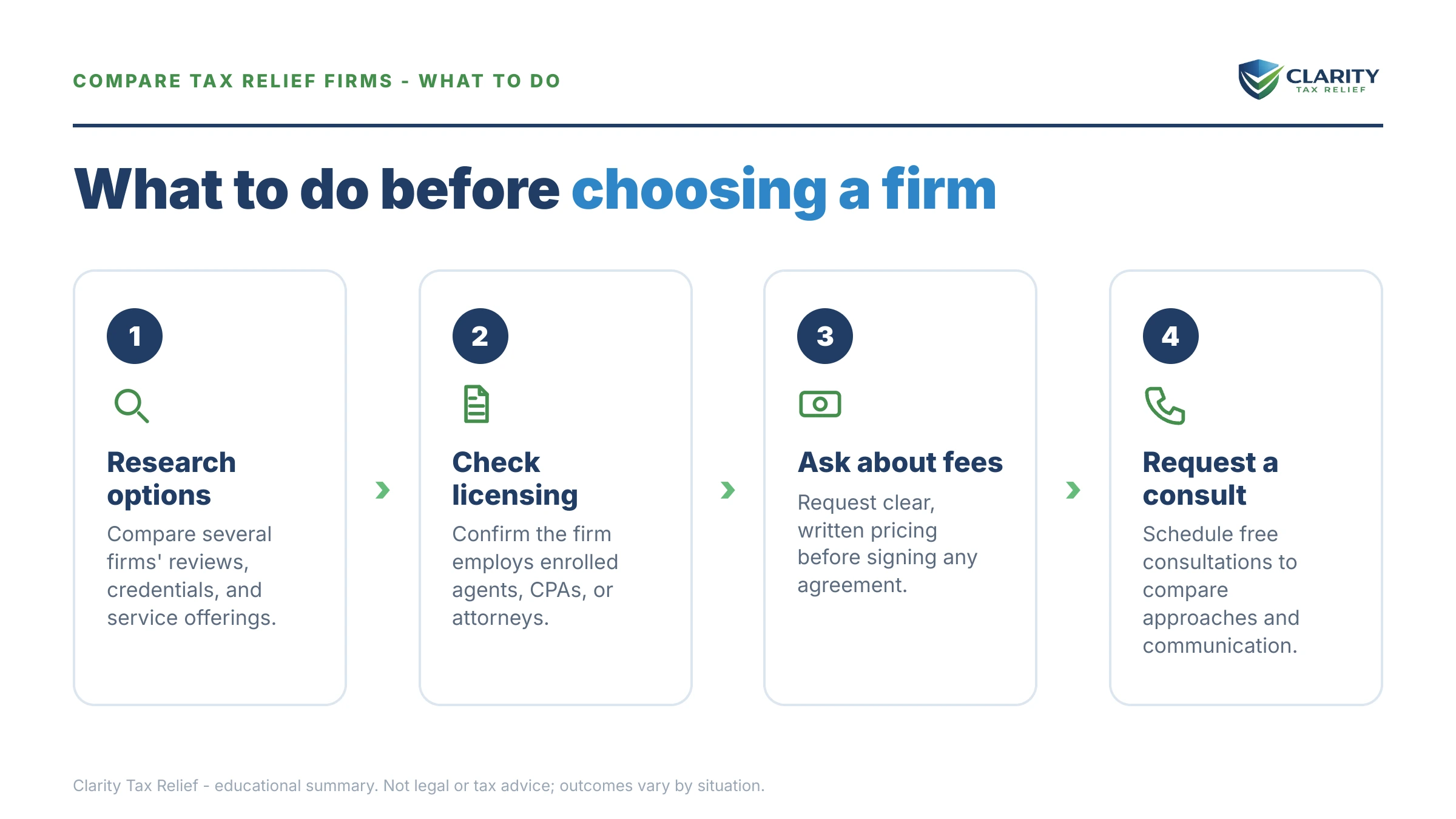
How to vet a Precision Tax Relief alternative, step by step
- Get your real IRS numbers first. Log into your IRS online account or pull your transcripts so you know your exact balance, tax years, and where you sit in the notice sequence before any sales call. Firms quote against fear when you don't know your own numbers.
- Ask who will actually work your case. Get the name and credential — enrolled agent, CPA, or tax attorney — of the person handling your file, in writing. If the answer is a "settlement officer" or "case advocate" with no credential, keep looking.
- Demand a flat, written fee for a defined scope. The quote should name the resolution being pursued, the total price, and what happens if the scope changes. Walk away from open-ended retainers and investigation fees that don't credit toward the actual work.
- Compare at least two quotes against the DIY cost. A payment plan you can set up yourself in an hour shouldn't cost four figures. If the fee doesn't buy judgment, negotiation, or protection you can't provide yourself, the honest answer is to do it yourself.
- Verify before you pay. Check the firm's complaint history, confirm the professional's credential is active, and read the refund policy. One hour of verification protects the thousands you're about to spend.
Our full how to choose a tax relief company checklist and the questions to ask tax relief company guide turn these five steps into a printable script for every consultation call.
When you don't need Precision — or any alternative
If you owe under $50,000, have every return filed, and just need a payment plan, you can resolve this yourself and keep the fee. The IRS's own payment plans and installment agreements page lets you set up a plan online in under an hour, and a first notice you agree with can often be handled with a single payment or a 180-day short-term plan at $0 setup. If cost is the whole reason you're shopping, our breakdown of how much does tax relief cost shows what each resolution should run — so you can tell a fair quote from a padded one.
Experienced help changes outcomes in a narrower set of situations: a levy is already in motion or an LT11's 30-day window is running; you have multiple unfiled years that must be filed in the right order; the debt involves a business or payroll taxes; you're on fixed income and the case turns on CNC-versus-OIC math like the example above; or the IRS says you owe an amount you dispute. In those cases the fee buys sequencing, negotiation, and deadline defense you can't easily replicate — and if money is tight, the Taxpayer Advocate Service and Low Income Taxpayer Clinics are legitimate free routes worth knowing about before you sign anything.
Sales terms tax relief firms use, decoded
- Investigation phase: the firm pulls your IRS transcripts under a Form 2848 or 8821 — useful work, but ask whether the fee credits toward the resolution.
- Fresh Start Program: a 2011–2012 IRS initiative that loosened plan and offer thresholds; today it's mostly a marketing label for the standard programs in the table above.
- Flat fee vs. retainer: a flat fee names a total price for a defined outcome; a retainer bills against hours and can grow without limit.
- Reasonable Collection Potential (RCP): the IRS's formula — asset equity plus a multiple of monthly disposable income — that decides whether an Offer in Compromise can be accepted.
- Power of attorney (Form 2848): the form that lets a professional speak to the IRS for you; it does not, by itself, stop collection.
- CSED: the Collection Statute Expiration Date — generally 10 years from assessment, though appeals, offers, and bankruptcy pause the clock.
Precision Tax Relief alternative questions, answered
Is Precision Tax Relief a legitimate company?
Yes — Precision Tax Relief is an established firm with a strong review reputation, and searching for an alternative doesn't mean you dodged a scam. Most people comparing alternatives are shopping on fit: fee structure, minimum balance requirements, whether the firm handles their case type, or simply wanting a second quote. The real risk in this industry comes from high-pressure firms that promise results before reviewing your finances — hold every firm, including Precision, to that standard.
How much does a tax relief company cost in 2026?
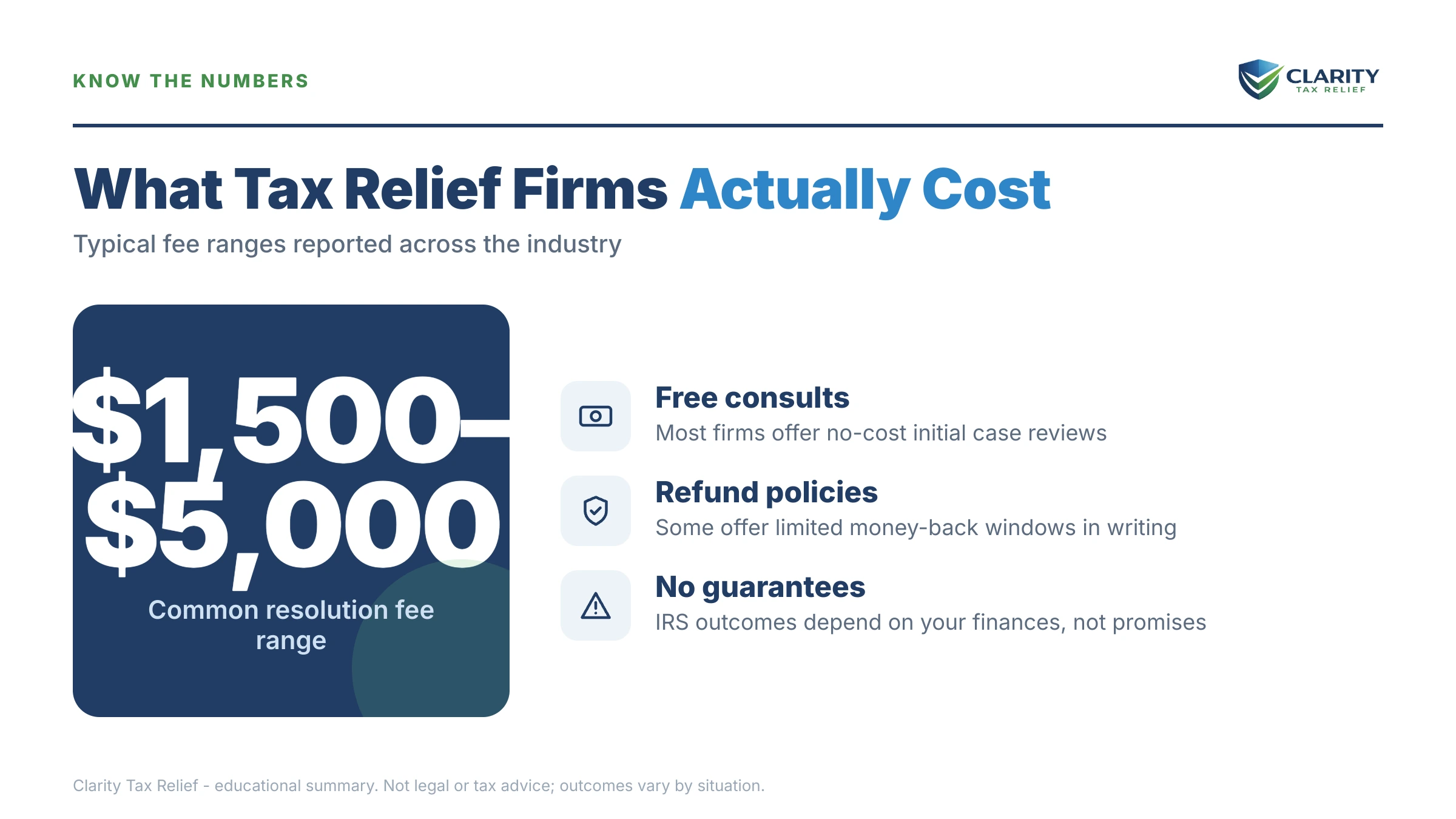
Legitimate firms typically charge flat fees that scale with case complexity — a simple installment agreement costs far less than an Offer in Compromise with unfiled years attached. Expect several hundred dollars for basic resolutions and several thousand for complex offer or levy-defense work. Get the total fee in writing, for a defined scope, before paying anything, and be wary of open-ended retainers or 'investigation fees' that don't credit toward the actual resolution.
Can a tax relief company settle my tax debt for less than I owe?
Only if the IRS's own math says your assets and future income can't cover the balance — that program is the Offer in Compromise, and the IRS accepted roughly 1 in 5 offers in FY2024. No firm can negotiate a discount the numbers don't support, and any company promising a settlement before reviewing your finances is showing you a red flag. A good firm runs the math first and tells you honestly if you're not a candidate.
Can the IRS take my Social Security check for back taxes?
Yes — through the Federal Payment Levy Program, the IRS can take up to 15% of each Social Security benefit payment for back taxes. That levy continues until the debt is resolved or you're placed in a protected status. If losing 15% would leave you unable to cover basic living expenses, you can request a hardship release, and an installment agreement or Currently Not Collectible status stops the levy going forward.
Does hiring a tax relief company stop IRS collections immediately?
No — signing a power of attorney (Form 2848) lets a professional represent you, but it doesn't pause levies or the notice sequence by itself. Collections stop when a specific action is in place: an accepted installment agreement, Currently Not Collectible status, a pending Offer in Compromise, or a timely Collection Due Process appeal. Be wary of any firm implying that hiring them alone freezes the IRS; interest and penalties keep accruing until a resolution posts.
Can I resolve my tax debt without hiring any company?
Often, yes. If you owe under $50,000 with all returns filed, you can set up a payment plan of up to 72 months yourself through your IRS online account, usually in under an hour. Professional help earns its fee when a levy is already in motion, you have multiple unfiled years, the debt involves a business, or you're pursuing an Offer in Compromise where the financial math decides everything.
What should I ask before hiring any tax relief firm?
Four questions separate legitimate firms from mills: Who exactly will work my case, and what credential do they hold? What is the total flat fee, in writing, for a defined scope? What outcome does my financial picture realistically support? And what is your refund policy if the promised work isn't done? Any firm that dodges these — or quotes a result before seeing your finances — should be crossed off your list.
Your next 24 hours
- Find your true balance. Log into your IRS online account — or pull your most recent IRS notice — and write down the total owed, the tax years, and the most recent notice number. Every comparison starts with your real numbers, not a salesperson's estimate.
- Gather three things: your last filed return, your monthly income figures (Social Security award letter or benefit statement, if that's your income), and every IRS letter you've received. That's the whole file any firm needs to quote honestly.
- Get a free second opinion before you sign anywhere. Use the 2-minute form or call (888) 825-7779 — an experienced tax professional will tell you which option your numbers support and what it should fairly cost. Penalties and interest accrue every month until a resolution posts, so get the answer today, not after the next notice.
This guide is general information, not tax or legal advice for your specific situation. Eligibility for IRS programs depends on individual facts and circumstances; no outcome is guaranteed. Clarity Tax Relief is not affiliated with Precision Tax Relief; references to other firms are for general comparison only.