
Choosing Tax Help
Larson Tax Relief Alternative: How to Compare Your Options in 2026
The short answer: the best Larson Tax Relief alternative depends on your debt type. Larson is best known for business and payroll tax cases, so if you owe individual income tax, compare alternatives on flat-fee pricing, credentialed representation, and whether they'll name the same IRS programs you could access yourself.
You owe the IRS $54,600, you're planning to refinance the house this year, and every tax relief website you open — Larson's included — wants your phone number before it will name a price. Shopping around is the rational move. The good news: the IRS menu of programs is fixed, so the only real decision is who, if anyone, you pay to work it.
⏱ The clock that matters: there is no letter deadline attached to comparison shopping — but your balance isn't waiting. The failure-to-pay penalty adds 0.5% per month, interest compounds daily, and if the IRS files a Notice of Federal Tax Lien while you deliberate, a planned refinance gets significantly harder to close.
Why people search for a Larson Tax Relief alternative
Larson Tax Relief is a family-owned Colorado firm, in business since 2005, that is best known for business, payroll, and emergency tax cases — and that specialty is the single most common reason individual taxpayers go looking for an alternative. If your debt is a personal 1040 balance, you want a firm whose daily caseload looks like your case, not a firm whose reputation was built defending 941 payroll accounts. (If you actually do have a business debt, our tax relief for small business buyer's guide covers that side properly.)
Beyond case fit, the reasons readers land on this page cluster into four buckets:
- Fee-quote variation. Two firms quoting the same case can differ by thousands of dollars, because pricing reflects each firm's overhead and sales model — not a market rate. Comparing quotes is not disloyalty; it's how flat-fee services are supposed to be bought. Our breakdown of how much tax relief costs gives you realistic ranges to compare against.
- Case-size minimums. Many national firms decline smaller balances or price them so high the math stops working. Always ask a firm's minimum before you invest a sales call.
- Who actually represents you. The person on the sales call is almost never the person who will sign your power of attorney. Alternatives compete on making the credentialed representative — enrolled agent, CPA, or attorney — visible before you pay.
- Wanting a second opinion on DIY. Some cases genuinely don't need any firm. An honest alternative will tell you that in the first conversation; we cover exactly when below.
To be clear: none of these are knocks on Larson, which is an established, legitimate firm. They're the standard questions any careful buyer asks before signing a multi-thousand-dollar engagement — the same ones we'd tell you to ask about us. We've written the same style of comparison for other firms readers ask about, including an Optima Tax Relief alternative guide, a Fortress tax relief alternative guide, and a Precision tax relief alternative guide.
Every firm works from the same IRS menu
No tax relief company — Larson, Clarity, or anyone else — has access to IRS programs you can't access yourself. The entire industry works from one fixed menu: payment plans, Offers in Compromise, Currently Not Collectible status, penalty abatement, and lien remedies. A firm's value is accuracy, speed, and how well it presents your financials — never a secret door. If you want the full self-service version of that menu, our guide to how to settle tax debt yourself walks through every program without a sales pitch.
That reframes the whole search. You're not choosing which company has the best "program." You're choosing whether to hire a navigator, and if so, which navigator charges a fair, written price and puts a real credential on your Form 2848.
What happens to your $54,600 while you compare firms
An unpaid IRS balance moves through an automated notice sequence whether or not you've hired anyone — and the sequence doesn't pause for your research. The stages, in order:
- CP14 — the first bill, with roughly 21 days to pay before escalation begins (10 business days if the balance is $100,000 or more). Cheapest moment to act.
- CP501 / CP503 — reminder notices. No enforcement yet, but the 0.5%-per-month failure-to-pay penalty and daily interest keep compounding through every stage.
- CP504 — Notice of Intent to Levy under IRC §6331(d). The IRS can seize your state tax refund, and a Notice of Federal Tax Lien becomes a live risk. For a homeowner heading into a refinance, a filed lien is the stage that threatens the loan, because it sits in the public record ahead of your new mortgage.
- LT11 / Letter 1058 — the final notice of intent to levy. It starts a 30-day clock and your Collection Due Process rights (requested on Form 12153). After that window, wage garnishment and bank levies are on the table.
Two 2026 realities sharpen this. First, the IRS workforce was cut roughly 27% in 2025 — humans are harder to reach, but the notice-and-levy machinery is automated and never stopped. Second, at $54,600 you're below the $66,000 passport-certification threshold for 2026, but penalties and interest can carry a balance across that line while a case sits unaddressed.
Comparing firms with $54,600 on the line?
Get a free second opinion before you sign anywhere — including with us. An experienced tax professional will map your realistic options and quote a flat fee in writing, before another month of penalties and interest posts to your balance.
The options any alternative should quote you at $54,600
Whichever firm you interview, the resolution it proposes must come from this table — and each option has a hard eligibility line. If a salesperson names a program without asking about your income, assets, and home equity first, they're guessing.
| Option | Who qualifies | Cost and the catch |
|---|---|---|
| Short-term payment plan | You can full-pay within 180 days | $0 setup fee; penalties and interest continue until paid |
| Streamlined installment agreement | Balance ≤ $50,000 — you'd need to pay $54,600 down below the line | Up to 72 months, set up online, no financial statement; interest still accrues |
| Non-streamlined installment agreement | Balance over $50,000 | Requires a Form 433-F financial disclosure; the IRS reviews income, expenses, and equity |
| Offer in Compromise (Form 656) | Assets + future income genuinely can't cover the debt | $205 fee plus 20% down on lump-sum offers (waived with low-income certification); roughly 1 in 5 offers accepted in FY2024 |
| Currently Not Collectible | Paying anything would create documented hardship | Collection pauses; the debt remains, interest accrues, and a lien filing is likely |
| Penalty abatement (FTA / AEP / reasonable cause) | Clean compliance the prior 3 years, or circumstances beyond your control | Removes penalties, not tax; starting summer 2026, Automatic Exemption from Penalty applies without a request in qualifying cases |
A worked example: $54,600 and a refinance on the calendar
Say you owe $54,600 and want to refinance within the year. Because $54,600 sits just above the $50,000 streamlined line, the cheapest structural move is often paying $4,600 down to reach exactly $50,000. That unlocks a streamlined agreement of up to 72 months — $50,000 ÷ 72 ≈ $695 a month at minimum, realistically closer to $750 once accruing interest is folded in. No Form 433-F, no equity review, and set up online in an afternoon. The full mechanics of the over-$50k tier are in our guide to an IRS payment plan over $50,000.
Why that matters for the loan: many lenders will close a refinance with an IRS balance if you're in a formal agreement with on-time payment history — the details are in can I refinance with an IRS lien. If a lien has already been filed, the IRS can agree to tax lien subordination via Form 14134 so the new mortgage takes priority, since a refinance that frees up cash usually improves the government's position.
And the Offer in Compromise question — the one every sales call dangles? An OIC turns on your Reasonable Collection Potential: roughly your asset equity plus a multiple of your monthly disposable income. For a homeowner with meaningful equity, RCP frequently exceeds $54,600, which makes an offer a poor fit no matter which firm files it. You can pressure-test that math yourself in two minutes with our Offer in Compromise Calculator before anyone charges you to pursue one — it estimates, it doesn't promise.
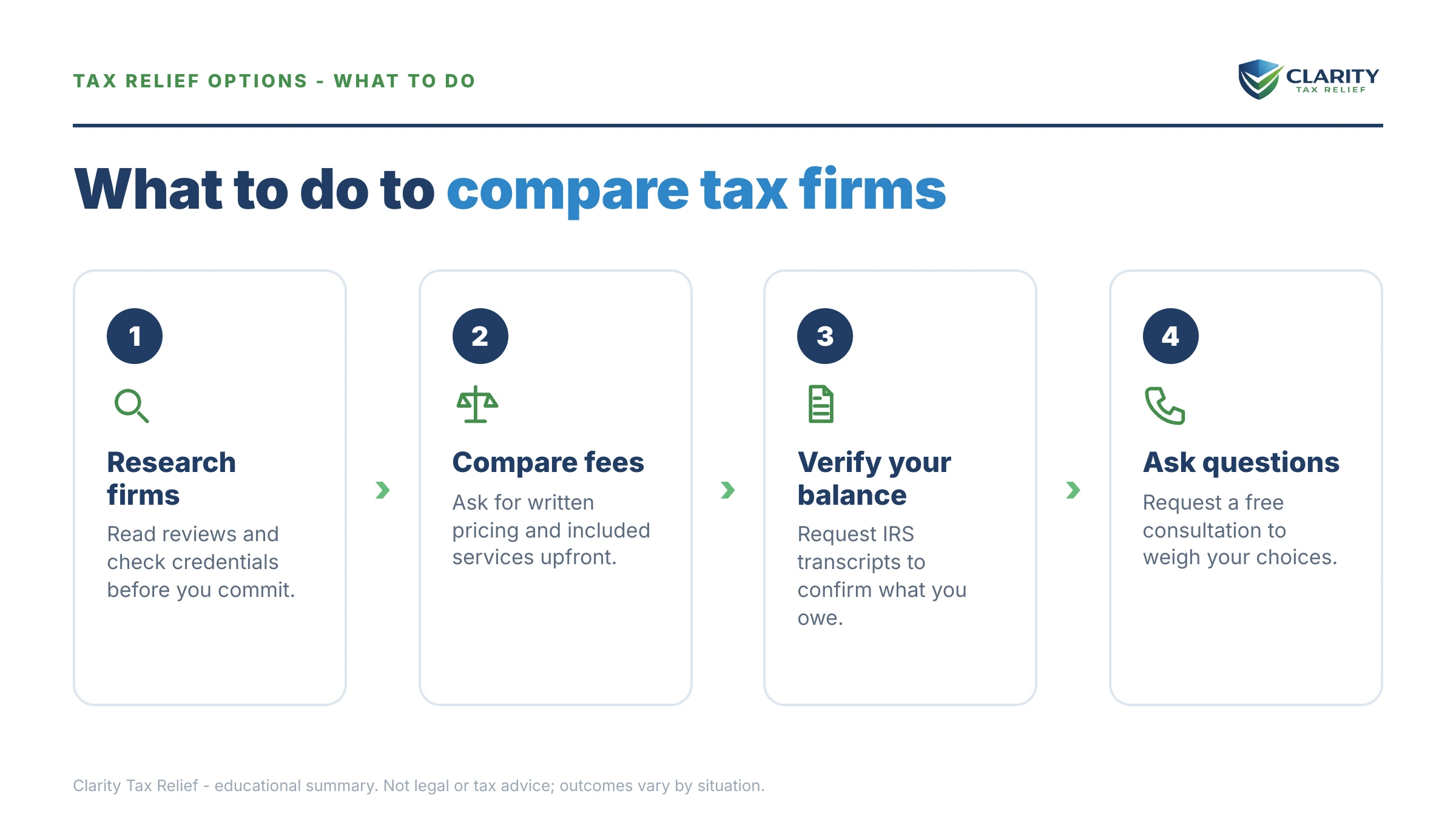
How to choose a Larson Tax Relief alternative, step by step
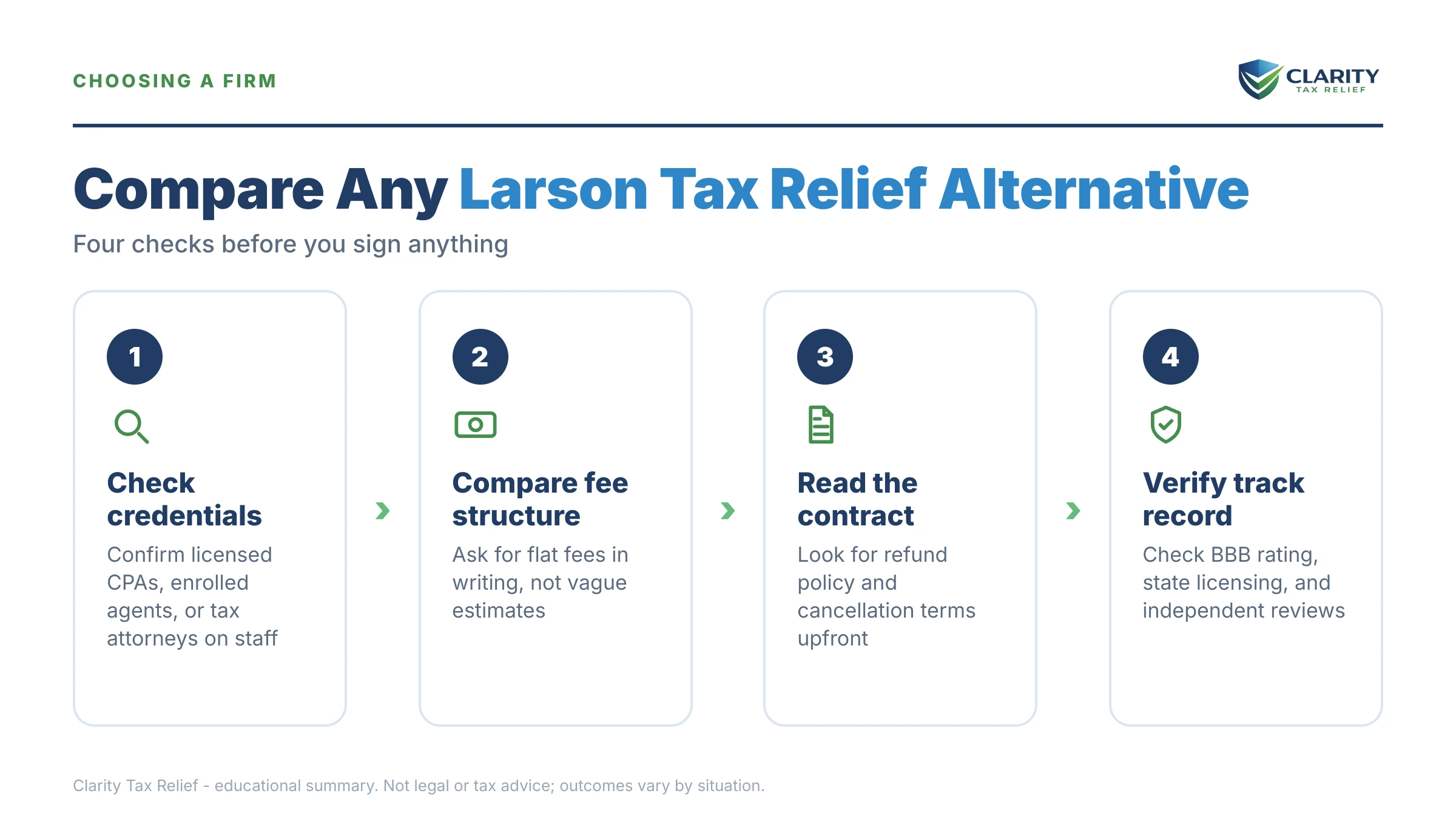
- Confirm your exact balance. Log into your IRS online account and pull the current payoff for every year you owe — quotes based on a guessed balance are worthless.
- Match the firm to your debt type. If you owe personal income tax, ask directly how much of the firm's caseload is individual 1040 work versus business and payroll cases.
- Get the fee in writing. Demand a flat, all-in fee that names the specific resolution work included — and the refund terms if the case stalls.
- Verify who represents you. Ask for the name and credential (enrolled agent, CPA, or attorney) of the person who will sign your Form 2848 — not the salesperson's title.
- Compare against doing it yourself. Price at least two firms, then weigh both against the DIY route: if your case is a simple payment plan, the honest answer may be that you don't need anyone.
Run every firm — including us — through the same grid. The full version lives in how to choose a tax relief company; here's the condensed one:
| What to compare | What good looks like | Walk away if |
|---|---|---|
| Fee structure | Flat fee in writing, scope itemized, before any payment | Open-ended "phases" that keep unlocking new charges |
| Representation | A named EA, CPA, or attorney assigned to your file | You can't find out who signs the Form 2848 |
| Promises made | "Here's what your finances may qualify you for, pending review" | Settlement percentages or outcomes promised before any financial review |
| Case fit | The firm regularly handles your debt type and balance size | Your $54,600 1040 case would be an outlier in their book |
| Refund terms | Written refund policy tied to defined deliverables | "All fees earned on receipt" with no accounting of work |
One more filter: any pitch built on "pennies on the dollar" settlements is the oldest scam framing in this industry — real offers are means-tested and most applicants don't qualify. Our tax relief red flags checklist lists the rest of the warning signs, and what happens at a free tax relief consultation shows you what a legitimate first call should sound like.
When you don't need Larson — or any firm
Some tax debts simply don't justify a professional fee, and an honest alternative says so up front. You can confidently handle it yourself when:
- You agree with the balance, all your returns are filed, and you can full-pay within 180 days — the short-term plan costs nothing to set up.
- Your balance is under $50,000 and your only need is a streamlined monthly agreement — the IRS online tool handles it without a financial statement.
- Your only issue is a first-time penalty on an otherwise clean record — abatement is a phone call or letter, and starting summer 2026 the new Automatic Exemption from Penalty applies to qualifying cases with no request at all.
Experienced help changes outcomes in the opposite situations: a levy already in motion, multiple unfiled years that must be sequenced before any agreement will stick, business or payroll debt with personal-liability exposure, a balance over $50,000 where the IRS reviews your equity, or OIC math close enough that presentation decides it. At $54,600 with a refinance pending, you're in the gray zone — the pay-down-to-$50k move is DIY-able, but coordinating lien subordination with a lender's timeline is where professionals earn their fee.
Sales-call terms, decoded
Every firm's pitch uses the same vocabulary. Know what it actually means before you compare:
- Investigation (or "discovery") phase: the paid first stage where a firm pulls your IRS transcripts and confirms what you owe — legitimate work, but you can pull the same transcripts free from your IRS online account.
- Form 2848: the power of attorney that lets a credentialed professional speak to the IRS for you. Whoever signs it is your real representative.
- Fresh Start: a 2011-era set of IRS threshold changes, not a current enrollment program — treat it as marketing shorthand, not a product.
- Reasonable Collection Potential (RCP): the IRS's formula — asset equity plus future income — that decides whether an Offer in Compromise can be accepted. No firm negotiates around it.
- Flat fee vs. phased fees: a flat fee caps your cost in writing; phased pricing can grow with each newly "discovered" issue. Always ask which model you're being quoted.
Larson Tax Relief alternative FAQs
Is Larson Tax Relief a legitimate company?
Yes. Larson Tax Relief is an established, family-owned firm that has been resolving tax cases since 2005, with a particular reputation in business and payroll tax work. Searching for an alternative is about fit, not legitimacy: if your debt is a personal 1040 balance, or a quote felt high, comparing two or three firms before signing is simply smart buying.
How much should a tax relief company charge for a $54,600 case?
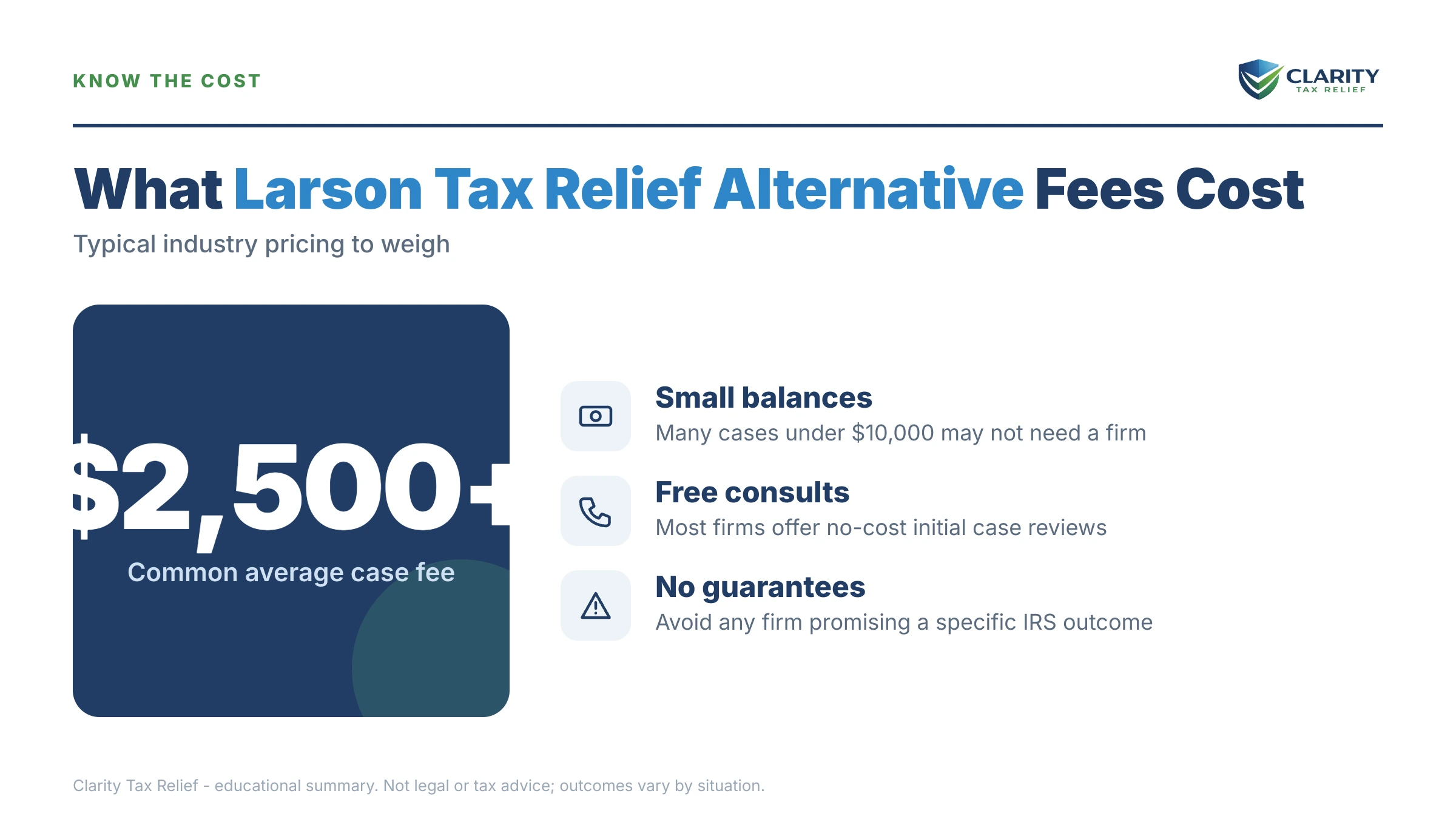
It depends on the resolution, not the balance alone. A straightforward installment agreement is typically priced in the hundreds to low thousands of dollars; an Offer in Compromise or a case with unfiled returns typically runs several thousand. Get a flat fee in writing that names the exact services included and what happens if the IRS rejects the first proposal.
Can any company settle my tax debt for less than I owe?
Only if the IRS's own math supports it. An Offer in Compromise is accepted when your assets and future income — your Reasonable Collection Potential — total less than the balance, and the IRS accepted roughly 1 in 5 offers in FY2024. No firm can change that formula, so treat any company that promises a settlement before reviewing your finances as a red flag, not an alternative.
Does it matter that a tax relief firm is in another state?
Usually not. IRS collection is centralized, and an enrolled agent, CPA, or attorney with a Form 2848 power of attorney can represent you before the IRS from anywhere in the country. Location matters more for state tax debt, where a firm's day-to-day experience with your specific state agency — and, rarely, in-person proceedings — can make a practical difference.
Will hiring a tax relief company stop IRS collections immediately?
No — no firm can stop collections instantly, and any company claiming it can is overselling. Filing a power of attorney routes IRS contact through your representative, and a properly submitted payment plan or offer generally puts a hold on new levy action while it's pending. Interest and penalties keep accruing the entire time, whoever you hire.
Can I switch tax relief companies in the middle of my case?
Yes. You can revoke a firm's Form 2848 power of attorney at any time and authorize a new representative. Before switching, ask the current firm for your case file and a written accounting of work performed against fees paid — and check your contract's refund terms. A new firm should review what's already been filed rather than starting from zero.
Will owing the IRS $54,600 stop my mortgage refinance?
Not automatically. Many lenders will close with an unpaid IRS balance if you're in a payment plan with documented on-time payments. The bigger obstacle is a filed Notice of Federal Tax Lien, which sits ahead of the new loan; the IRS can subordinate its lien with Form 14134 when the refinance improves its position, but that adds weeks to your timeline.
Primary sources worth bookmarking while you compare: the IRS's own payment plans and installment agreements page, its Offer in Compromise overview, and the independent Taxpayer Advocate Service if your case is stuck inside the IRS itself.
Your next 24 hours
- Pull your real numbers. Log into your IRS online account and note the exact payoff for each year — and check whether a lien has been filed. Every quote you collect should be built on those figures.
- Gather your comparison kit. Your last filed return, any IRS notices you've received, and a one-page snapshot of monthly income, expenses, and home equity. With those in hand, any firm can quote you accurately on the first call.
- Get a free case review. Call (888) 825-7779 or use the 2-minute form and let an experienced tax professional map your $54,600 against the options above — while penalties and interest are still compounding monthly, comparing for free beats deciding blind.
This guide is general information, not tax or legal advice for your specific situation. Eligibility for IRS programs depends on individual facts and circumstances; no outcome is guaranteed. Clarity Tax Relief is not affiliated with Larson Tax Relief; references to other firms are for general comparison-shopping education only.