
State Tax Debt
Texas Back Taxes in 2026: Who You Owe, Who Collects It, and How to Fix It
The short answer: Texas has no state income tax, so "Texas back taxes" almost always means one of two debts: federal taxes owed to the IRS, or business taxes — sales and franchise — owed to the Texas Comptroller. Each has its own collector, escalation path, and resolution programs, and both charge interest until you act.
Maybe it started with an IRS balance-due bill for last year's return, or a Texas Comptroller letter about sales tax you thought was remitted. Either way, you're running a business, making payroll every other Friday, and now a tax balance is growing in the background. That's a solvable problem — Texas back taxes follow predictable rules, and every collector on this page has a defined path to resolution. This guide maps all of them.
⏱ The real clock: there's no single deadline on Texas back taxes — the clock is the accrual. The IRS failure-to-pay penalty adds 0.5% of the balance every month, interest compounds on top of it, and Comptroller balances accrue their own state penalties and interest. Each notice in the stack also sets its own printed response date — the date on your letter controls.
Why you have Texas back taxes — and who actually collects them
Texas is one of the states with no personal income tax, so a Texas back-tax debt is owed to the IRS, the Texas Comptroller of Public Accounts, or your county — never a state income tax agency. That's the single most important thing to establish before you do anything else, because the three collectors play by completely different rules.
For most individuals, "back taxes" in Texas means federal debt only: income tax, self-employment tax, or an underpayment the IRS caught after filing. For business owners, it usually means one or more of these:
- Federal income or self-employment tax — you filed and couldn't pay in full, or quarterly estimates fell short.
- Payroll taxes (Forms 941/940) — withheld employee taxes that didn't get deposited. This is federal debt even in Texas, and it's the most dangerous category on this list. Our guide to 941 back taxes covers it in depth.
- Texas sales and use tax — collected from customers but not remitted to the Comptroller.
- Texas franchise tax — the state's margin tax on entities doing business in Texas, including many LLCs.
- County property tax — billed by your county tax assessor-collector, not the state.
Here's the full map of who collects what — and what each collector can do to you:
| Tax type | Who collects it | Primary enforcement tools |
|---|---|---|
| Federal income & self-employment tax | IRS | Federal tax lien, bank levy, wage levy, passport certification at $66,000+ |
| Payroll taxes (941/940) | IRS | Business levies, plus personal Trust Fund Recovery Penalty against responsible people |
| Sales & use tax | Texas Comptroller | State tax lien, bank account freeze, sales tax permit suspension, personal liability |
| Franchise tax | Texas Comptroller | Forfeiture of the entity's right to do business; loss of liability protection |
| Property tax | County tax assessor-collector | Automatic tax lien on the property, escalating penalties, foreclosure suit |
If you owe on more than one row of that table, the order you resolve them in matters — our hub on state tax debt vs IRS walks through the which-first decision. The short version for Texans: trust taxes (payroll and sales tax) come first, because both carry personal liability and both keep generating new penalties every period you stay behind.
One more Texas quirk worth naming: if you moved here from a state with an income tax — California and New York are the common ones — that state can still chase you for the years you lived there. Moving to Texas stops future state income tax; it doesn't erase old assessments, and California in particular collects for up to 20 years.
What happens if you ignore Texas back taxes
IRS collection escalates through an automated notice sequence that ends in bank levies and wage garnishment — and Texas's famous debtor protections do not stop any of it. Texas law shields wages from most creditor garnishment and shields your homestead from most creditors, but the IRS levies under federal law, which overrides both.
On the federal side, the sequence runs in this order:
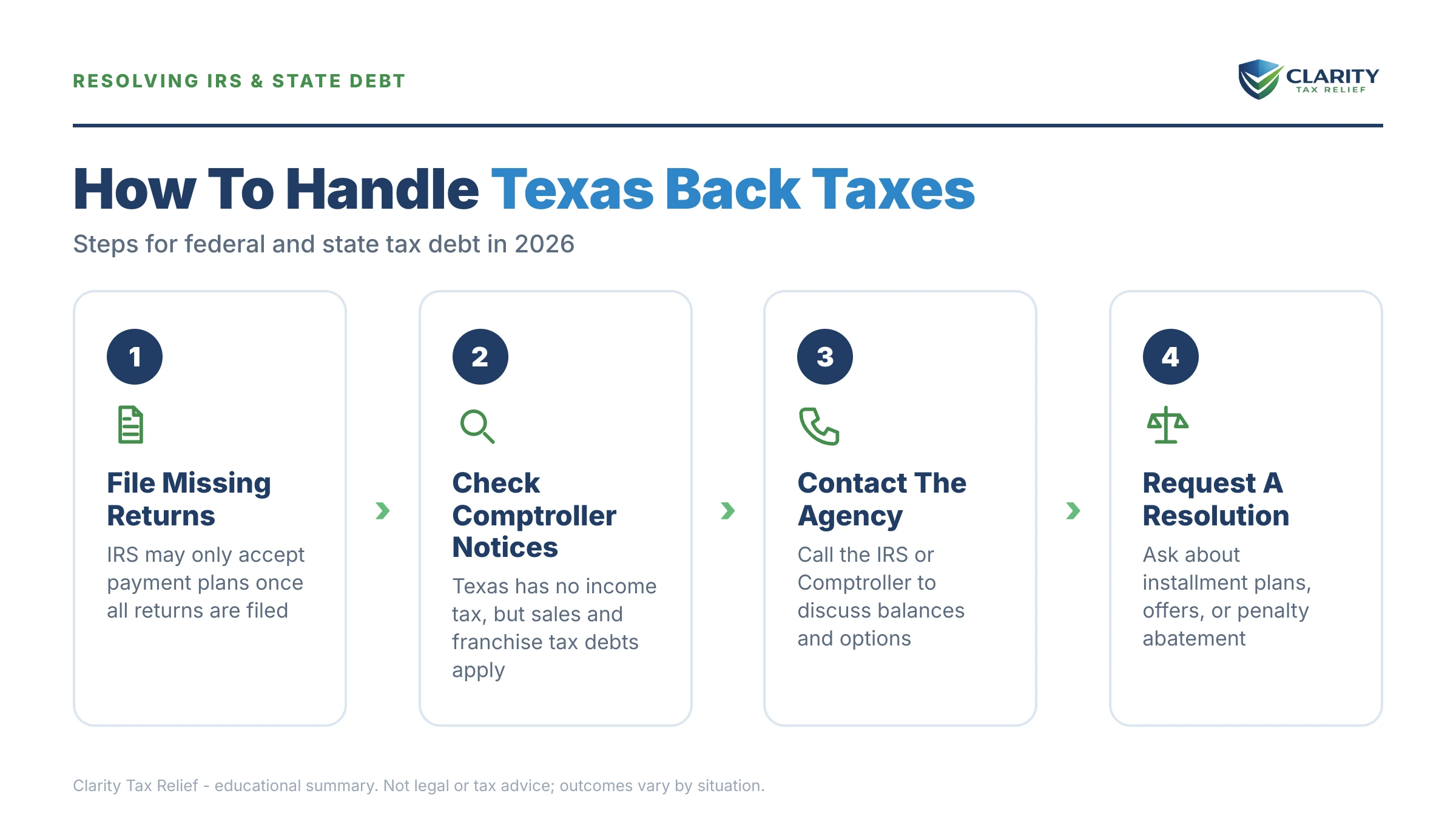
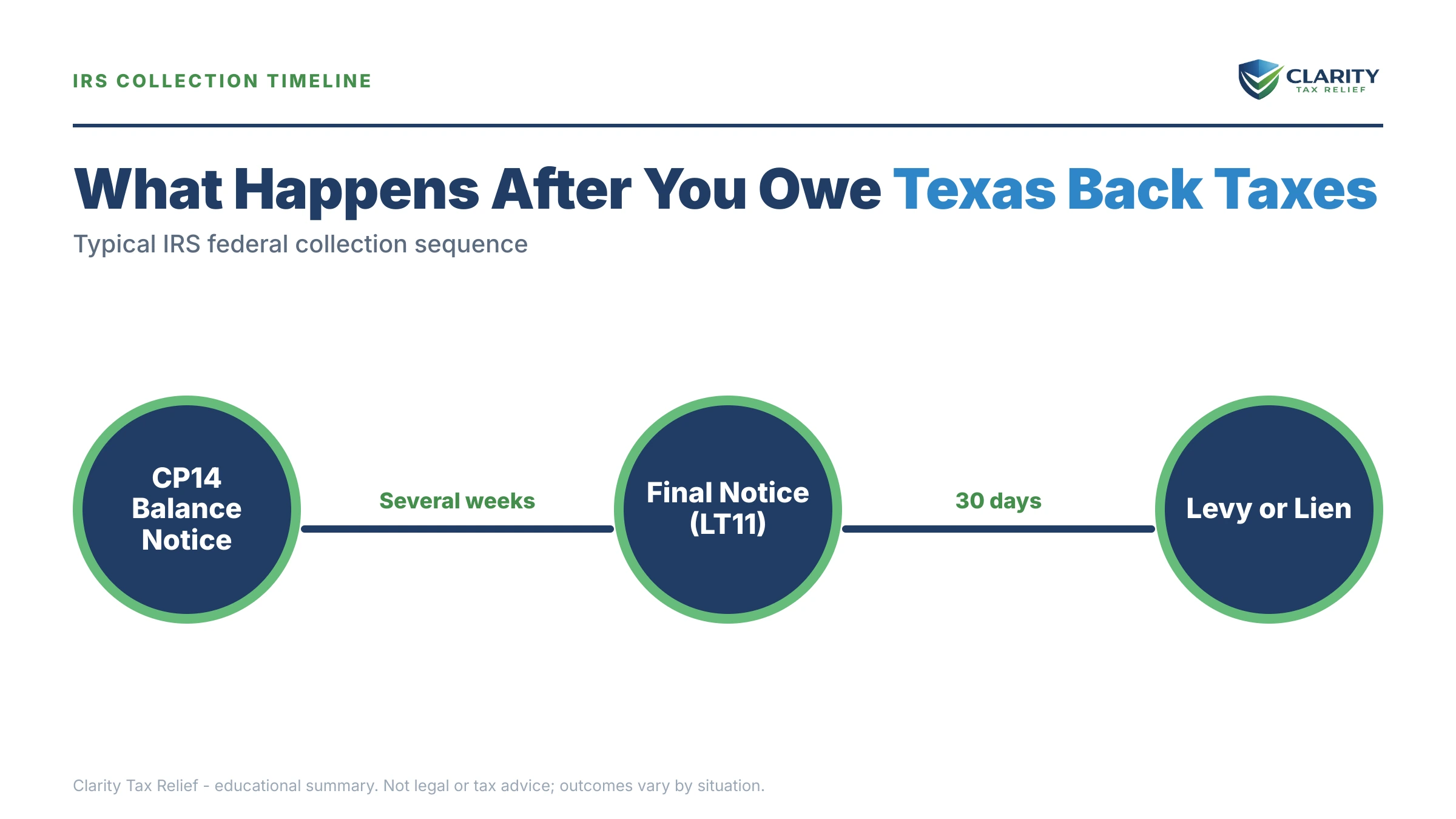
- CP14 — the first bill. You typically have about 21 days from the notice date before the system queues the next letter. No enforcement yet; this is the cheapest moment to act.
- CP501 / CP503 — reminders. Still just bills, but penalties and interest are compounding monthly.
- CP504 — Notice of Intent to Levy. Here's a Texas oddity: the CP504 notice's headline power is seizing your state income tax refund — which, for a Texan, doesn't exist. That makes the letter feel toothless. It isn't. It's the last automated warning before the final notice, and a federal tax lien becomes a live possibility at this stage.
- LT11 / Letter 1058 — Final Notice of Intent to Levy. This starts a 30-day clock and your Collection Due Process rights (requested on Form 12153). After 30 days, the IRS can levy bank accounts and garnish wages.
- Active levy. A bank levy freezes funds for 21 days before the money leaves; a wage levy is continuous until released. At $66,000+ in total debt (the 2026 threshold), the IRS can also certify your debt to the State Department, blocking passport issuance and renewal.
The Comptroller's escalation runs on its own track, and it moves without the IRS's long paper trail. In stage order: a determination or billing notice, then a state tax lien filed in county records, then bank account freezes and — for sales tax — suspension of the permit you legally need to keep making taxable sales. For collected-but-unremitted sales tax, the Comptroller can also assess the responsible individuals personally, which means a closed business can still owe sales tax through its former owners.
Don't read 2026's IRS staffing cuts as breathing room. The workforce shrank roughly 27% in 2025, which makes the IRS harder to reach — but notices, liens, and levies are generated by automated systems that never stopped running. The humans got scarcer; the machine didn't.
Behind on taxes in Texas right now?
Whether it's an IRS balance, unremitted sales tax, or both, penalties and interest are compounding every month you wait. An experienced tax professional will review your notices free, tell you which agency to deal with first, and map your options — no pressure, no obligation.
Your resolution options for Texas back taxes in 2026
Every IRS balance has at least four resolution paths — full pay, a payment plan, hardship status, or an Offer in Compromise — and eligibility is set by dollar thresholds and financial math, not negotiation skill. Here's where the lines fall in 2026:
| Option | Who qualifies | Key numbers |
|---|---|---|
| Short-term payment plan | Anyone who can pay in full within 180 days | Up to 180 days, $0 setup fee |
| Guaranteed installment agreement | Balance of $10,000 or less, clean recent filing history, pay within 3 years | Approval is required by law when the conditions are met |
| Streamlined installment agreement | Balance up to $25,000 — or up to $50,000 with direct debit | Up to 72 months, set up online, no detailed financial disclosure |
| Offer in Compromise | Means-tested: what the IRS could ever collect is less than you owe | $205 fee; roughly 1 in 5 offers accepted in FY2024 |
| Currently Not Collectible | Paying anything would prevent basic living expenses | Financial disclosure on Form 433-F; collection pauses, debt remains |
| Penalty relief | Clean compliance the prior 3 years (FTA), or reasonable cause | Removes penalties, not tax or interest; AEP makes it automatic starting summer 2026 |
A few notes that change real outcomes:
- A guaranteed installment agreement is the official IRS program name for the under-$10,000 tier — if you meet its conditions, the IRS must approve it. Most Texas business owners with a single bad year land here or in the streamlined installment agreement tier.
- An Offer in Compromise settles the debt for less than the balance, but only when the IRS's own math — your equity plus future income — comes out below what you owe. Low-income certification (AGI at or below 250% of the federal poverty level) waives the $205 fee, the 20% down payment, and payments during review. And if the IRS doesn't decide within 2 years, the offer is accepted automatically by law — with narrow exceptions: a returned or rejected offer stops the clock, and time during court disputes does not count.
- Currently Not Collectible status pauses levies and garnishment during genuine hardship, but interest keeps accruing and refunds get offset. It's a shelter, not a settlement.
- Penalty relief is the most under-used option. First-time penalty abatement removes failure-to-file and failure-to-pay penalties if your prior three years were clean — and starting summer 2026, the new Automatic Exemption from Penalty (AEP) applies similar relief automatically, with no request needed. You can estimate what penalties and interest have added to your balance before you decide which relief to pursue.
Before filing anything, start with our guide to how an offer in compromise actually works.
| Option | Upfront cost | Typical timeline |
|---|---|---|
| Pay in full online | $0 | Immediate; accrual stops once paid |
| Short-term plan (180 days) | $0 setup | Same-day setup online; interest accrues until paid |
| Long-term installment agreement | Setup fee applies — lowest with direct debit, reduced or waived for low income | Same-day setup online for most balances under $50,000 |
| Offer in Compromise | $205 fee + 20% of a lump-sum offer (both waived with low-income certification) | Often many months of review; auto-accepted if the IRS doesn't decide within 2 years, with narrow exceptions — a returned or rejected offer stops the clock, and time during court disputes does not count |
| Currently Not Collectible | $0 | Weeks, after financial review; the IRS re-checks your income periodically |
| Comptroller payment agreement | Typically no application fee | Case-by-case with the agency; usually shorter than IRS plans; state interest continues |
On the state side, the Comptroller has nothing as generous as the IRS's 72-month streamlined plan. Payment agreements exist but tend to be shorter, condition-heavy, and contingent on staying perfectly current going forward. Our Texas Comptroller tax debt guide covers the state playbook — audits, redetermination rights, liens, and permit actions — in full.
Say you owe $8,900: the real math for a Texas business owner
A hypothetical to make the options concrete. Say you run a small service company in Fort Worth with two employees on payroll, and your 2025 return landed with $8,900 in federal tax you couldn't pay — self-employment income came in hot and your estimates fell short.
- Do nothing: the failure-to-pay penalty adds 0.5% per month — about $44.50 a month at the start — plus daily-compounding interest on top. In a year, you've added several hundred dollars in penalties alone and you're deep into the notice sequence.
- Short-term plan: $8,900 ÷ 6 months ≈ $1,483/month. Steep, but $0 setup fee and the least total interest of any plan.
- Guaranteed installment agreement: because the balance is under $10,000, you qualify by law if your recent compliance is clean. Spread over 36 months, that's roughly $247/month before accruing interest and penalties — a number a business making payroll can usually absorb.
- Penalty relief on top: if 2022–2024 were clean years, first-time abatement can strip the failure-to-pay penalties off the balance, and the AEP rolling out in summer 2026 may apply relief automatically.
An Offer in Compromise is almost certainly the wrong tool at this size: with a functioning business and equipment on the books, the IRS's collectibility math will usually show it can collect $8,900 in full, and the offer fails on arithmetic. The payment plan is the honest answer here.
Now flip the scenario: if that same $8,900 were collected sales tax you hadn't remitted to the Comptroller, the calculus changes completely. That's trust money, personal liability attaches, and your sales tax permit — your legal ability to operate — is on the line. You'd remit it as fast as cash flow allows and negotiate directly with the agency on the remainder, even if it means slower payment on other debts.
How to respond to Texas back taxes, step by step
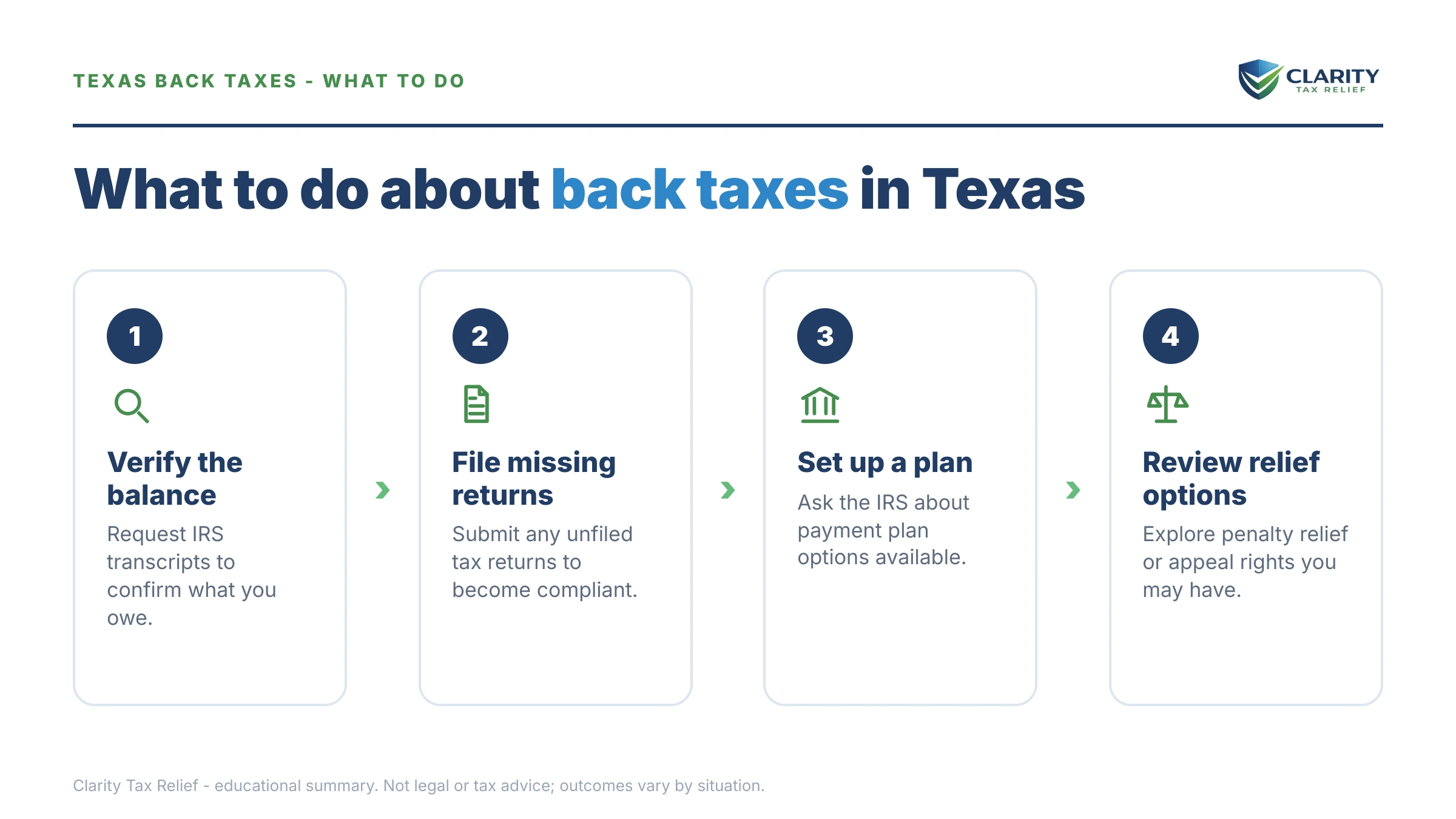
- Sort every notice by collector. Pull every tax letter you've received and separate them into three piles: IRS, Texas Comptroller, and county tax office. The agency name is printed at the top of each notice, and each pile follows different rules.
- Verify each balance at the source. Check your federal balance in your IRS online account, and confirm any Comptroller balance through your Comptroller account or by contacting the agency directly. Notices cross in the mail with payments, and some are simply wrong.
- Stop the bleeding first. File any missing returns and reports, and get current on this quarter's payroll deposits and sales tax remittances before touching the old balance. No agency will finalize a resolution while new debt is still piling up.
- Set up the resolution that fits your numbers. Match your balance to the eligibility table above — short-term plan, installment agreement, hardship status, or an offer — and set it up before the next notice escalates. Most IRS plans under $50,000 can be established online the same day.
- Get a professional review if the debt crosses agencies. If you owe the IRS and the Comptroller, have payroll or sales tax in the mix, or a levy is already in motion, have an experienced tax professional map the sequence — the order you resolve things in changes what you pay.
Payroll and sales tax: where Texas business owners get hurt
Payroll taxes and sales taxes are trust taxes — money withheld or collected from someone else — and both the IRS and the Texas Comptroller can assess them against you personally, straight through an LLC or corporation.
On the federal side, the mechanism is the Trust Fund Recovery Penalty: the IRS identifies every "responsible person" — owners, officers, sometimes bookkeepers or anyone with check-signing authority — and assesses the withheld portion of unpaid 941 taxes against each of them individually. Bankruptcy of the business doesn't touch it, and the assessment follows you even if the company dissolves.
On the state side, unremitted sales tax works the same way in spirit: you collected that money from customers as the state's agent, and the Comptroller treats keeping it as the most serious category of state tax debt. Enforcement runs from liens and bank freezes up through permit suspension — which for a retail or service business is functionally a shutdown order — and personal liability assessments against the people who ran the business.
Franchise tax carries a quieter but expensive trap. An entity that stops filing or paying can have its right to transact business in Texas forfeited. A forfeited entity generally can't sue in Texas courts to enforce its own contracts, and officers and directors can become personally liable for certain debts the business creates after forfeiture. Many owners discover this only when a deal, a lawsuit, or a loan application surfaces the forfeited status.
If your Texas debt includes 941 deposits or sales tax, a free case review with an experienced tax professional can map both agencies at once and sequence the fix — call (888) 825-7779 or use the 2-minute form.
Texas community property: your spouse's exposure
Texas is a community property state, which means the IRS can generally reach community income and community assets to collect one spouse's tax debt — even for a debt from before you handled money jointly, and even when the innocent spouse never signed the return in question.
This surprises couples constantly: filing separately in Texas does not build the wall it builds in a common-law state, because community property rules can pull a share of each spouse's earnings into the other's collection case. If your spouse's separate tax debt is bleeding into household accounts, relief exists — the rules for community property tax relief under §66 are specific to states like Texas, and they turn on facts like who knew what and whose income created the debt.
When you can handle Texas back taxes yourself
You do not need professional help for every Texas back-tax problem. Handle it yourself when:
- You owe the IRS under $10,000, agree with the number, and can manage a monthly payment — the guaranteed agreement tier exists precisely for this, and setup takes minutes online.
- You can pay in full within 180 days — the short-term plan costs nothing to set up.
- You got a first notice, checked your IRS online account, and it's simply correct — pay it or set the plan and move on.
- You're a single quarter behind with the Comptroller and can remit now — call the agency, pay, and ask about penalty waiver for a first slip.
Experienced help genuinely changes outcomes when: a levy or bank freeze is already in motion, you have multiple unfiled years (federal or state), the debt involves payroll or sales tax with personal-liability exposure, the Comptroller has assessed you after an audit and appeal deadlines are running, or you're weighing an Offer in Compromise, where the collectibility math decides everything before you spend a dollar on the application. The IRS's own payment plans page covers DIY setup for the simple cases; the complex ones are won or lost on sequencing and financial presentation.
Terms on your Texas tax notices, decoded
- Trust tax: money you held for someone else — employee withholding or customer sales tax — which is why both governments can pursue you personally for it.
- Lien vs. levy: a lien is a legal claim recorded against your property; a levy is the actual taking — from a bank account, paycheck, or receivables.
- CSED: the Collection Statute Expiration Date — the IRS generally has 10 years from assessment to collect, though offers, bankruptcy, and appeals pause the clock.
- CDP rights: Collection Due Process — your right, triggered by a final notice like the LT11, to a hearing (via Form 12153) before levy action proceeds.
- Responsible person: anyone with the duty and authority to pay trust taxes who didn't — the target of both the federal Trust Fund Recovery Penalty and Texas sales tax personal liability.
- Forfeiture: the Comptroller-initiated loss of an entity's right to do business in Texas for franchise tax non-compliance, which can strip the owners' liability protection for later debts.
For the state-side rules — audits, redetermination hearings, and how the Comptroller's collection division actually operates — the agency's official site is comptroller.texas.gov. If an IRS levy is causing genuine hardship and you can't get traction through normal channels, the independent Taxpayer Advocate Service can intervene at no cost.
Texas back taxes: questions people ask
Does Texas have a state income tax I could owe back taxes on?
No. Texas has no personal income tax, so there is no Texas state income tax return and no state income tax debt. Texas back taxes are owed either to the IRS (income, self-employment, or payroll taxes) or to the Texas Comptroller (sales, franchise, and other business taxes). One exception: if you moved to Texas from a state like California or New York, your old state can still pursue you for taxes from the years you lived there.
Can the IRS garnish wages in Texas?
Yes. Texas law blocks wage garnishment for most ordinary creditors, but that protection does not apply to the IRS, which levies under federal law. An IRS wage levy is continuous — it stays on every paycheck until the debt is resolved or the levy is released — and only a portion of your pay, based on your filing status and dependents, is exempt.
Can the IRS take my house in Texas despite the homestead exemption?
The federal tax lien attaches to your Texas homestead — the state homestead exemption does not block a federal lien. That said, actual seizure and sale of a primary residence is rare and requires federal court approval. The far more common problem is that the lien complicates selling or refinancing the home until the debt is addressed.
How long can the IRS collect back taxes in Texas?
Generally 10 years from the date the tax was assessed — the Collection Statute Expiration Date, or CSED — and that rule is the same in every state. The clock can be paused (tolled) by events like a pending Offer in Compromise, bankruptcy, or a collection appeal, so the real expiration date is often later than ten calendar years after you filed.
What happens if my business doesn't pay Texas sales tax?
The Texas Comptroller treats unremitted sales tax as trust money you collected from customers, and it collects aggressively: state tax liens, frozen bank accounts, suspension of your sales tax permit, and personal liability assessments against the individuals responsible. Closing the business does not erase it — the liability can follow the responsible people personally.
Does the Texas Comptroller offer payment plans?
Yes, the Comptroller enters payment agreements, but they are typically shorter and stricter than IRS installment agreements and are approved case by case. Expect to stay current on all new filings and payments as a condition, and expect interest to keep accruing during the agreement. Terms depend on the tax type and your compliance history, so confirm specifics directly with the Comptroller's office.
Will unpaid franchise tax affect my Texas LLC?
Yes — an entity that fails to file or pay franchise tax can have its right to transact business in Texas forfeited. During forfeiture the entity generally can't sue in Texas courts, and officers and directors can become personally liable for certain business debts created after the forfeiture. Reinstatement usually requires filing the missing reports and paying what's owed.
Can I settle Texas back taxes for less than I owe?
For IRS debt, an Offer in Compromise is real but strictly means-tested — the IRS accepted roughly 1 in 5 offers in FY2024, and approval depends on your assets and income, not negotiation. Comptroller settlement of collected sales tax is far more limited, because that money was never yours to begin with. Be wary of any pitch promising "pennies on the dollar" — that's marketing language, not how either agency runs the math.
Am I personally liable for my company's back taxes in Texas?
It depends on the tax. For payroll taxes, the IRS can assess the trust fund portion against any responsible person through the Trust Fund Recovery Penalty — an LLC or corporation does not shield you. Collected-but-unremitted sales tax works similarly under Texas law. Ordinary entity-level debts like a C corporation's income tax generally stay with the entity, unless franchise forfeiture strips the liability protection.
Your next 24 hours
- Sort your letters by sender. Find the agency name and the notice date at the top of each one — that tells you whose clock is running and how far along each collector is.
- Gather your numbers. Last filed federal return, payroll and sales records for the current quarter, and every notice in the stack — that's everything a resolution decision needs.
- Get the free case review. Penalties and interest are compounding on every balance in that stack whether or not you open the envelopes. An experienced tax professional will tell you which debt to attack first and what each option really costs — start the 2-minute form or call (888) 825-7779.
This guide is general information, not tax or legal advice for your specific situation. Eligibility for IRS programs depends on individual facts and circumstances; no outcome is guaranteed.