
State Back Taxes
Washington State Back Taxes: How DOR Collects and Your Options in 2026
The short answer: Washington has no personal income tax, so Washington state back taxes almost always mean Department of Revenue debt — B&O tax, retail sales tax, or the capital gains excise tax. DOR collects with superior-court tax warrants, bank orders, and license revocation, but payment agreements, penalty waivers, and voluntary disclosure all exist.
Your bank called before the state did — a hold hit your account, and now you're piecing together which agency froze it and why. As a renter, there's no house for a lien to sit on quietly; in Washington, collection pressure lands directly on your bank account and your paycheck. That's frightening, but it's also fixable — and the fix depends on knowing exactly which of Washington's collectors you're facing and what each one can legally do next.
⏱ The clock that matters: Washington doesn't print one response deadline — instead, DOR's late-payment penalty climbs in steps to 29% of the tax due, interest accrues on top, and once a tax warrant is filed with the superior court, your debt has the force of a judgment. Every stage you wait costs more and removes options.
Why you owe Washington state back taxes when there's no income tax
Washington state back taxes are almost never income tax — they're Department of Revenue debt from B&O tax, retail sales tax, or the 7% capital gains excise tax. That surprises a lot of people who moved here partly because Washington doesn't tax wages. But the state still collects billions, and it collects them from different doors than most states.
If you're an individual W-2 employee with a tax debt, your creditor is almost certainly the IRS, not Olympia. But if you've ever run a business, freelanced, sold products, rented out short-term space, or realized a large stock gain, Washington has its own claim — and its own collection machinery, separate from the IRS's.
The most common ways Washingtonians end up owing the state:
- Unpaid or unfiled B&O tax. Washington's business and occupation tax is a tax on gross receipts — you owe it even in years you lost money. Our full guide to Washington B&O tax debt covers the classifications and traps in detail.
- Collected-but-unremitted retail sales tax. This is the most dangerous category, because it's trust-fund money — you collected it from customers on the state's behalf. See our guide to sales tax debt help for why states treat this debt more harshly than any other.
- The capital gains excise tax. Since 2022, Washington taxes large long-term capital gains at 7% above an annually adjusted deduction. A big stock sale can create a five-figure state bill with no withholding behind it.
- An audit assessment. DOR audits registered businesses and, increasingly, finds unregistered ones — including out-of-state online sellers with Washington customers.
Because Washington splits its taxes across several agencies, your first job is routing: figuring out which office actually holds your debt. This table is the map.
| Tax | Who collects it | What enforcement looks like |
|---|---|---|
| B&O (business & occupation) tax | WA Department of Revenue | Assessment → tax warrant → bank and wage orders |
| Retail sales & use tax | WA Department of Revenue | Same as B&O, plus possible personal liability for collected sales tax |
| Capital gains excise tax (7%) | WA Department of Revenue | Same warrant-based collection as other DOR taxes |
| Estate tax | WA Department of Revenue | Claims against estate assets before distribution |
| Property tax | County treasurer (not DOR) | Foreclosure becomes possible after roughly three years delinquent |
| Unemployment insurance premiums | Employment Security Department (ESD) | Its own liens and collection orders |
| Workers' comp premiums | Dept. of Labor & Industries (L&I) | Its own liens and collection orders |
| Federal income / self-employment tax | IRS | CP14 → CP504 → LT11 → levy |
What happens if you ignore Washington DOR back taxes
An unpaid DOR balance escalates from a bill to a superior-court judgment without DOR ever having to sue you. That's the single most important thing to understand about Washington collections: the tax warrant does the work a lawsuit would do in other contexts, and it happens on DOR's schedule, not a judge's.
Here's the sequence, stage by stage:
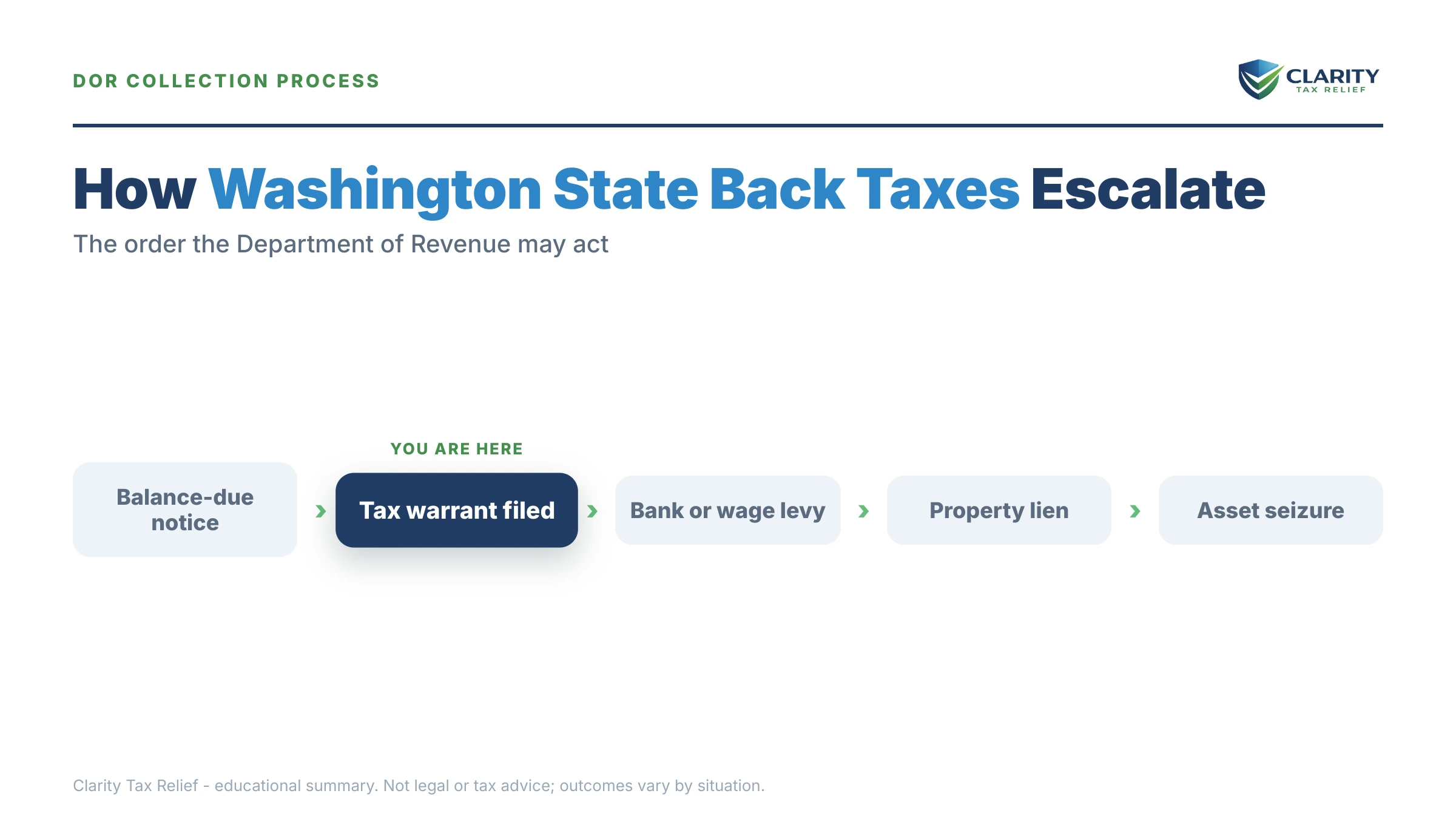
- Balance due / assessment. DOR bills you. The delinquency penalty starts tiering — 9% of the tax, then 19%, then 29% as months pass — with interest accruing on top.
- Collection contact. Letters and calls from DOR's compliance division. This is the cheapest moment to negotiate; nothing is public yet.
- Tax warrant filed. DOR files the warrant with the superior court. Your debt now has the force of a judgment, creates a lien on your property in that county, and becomes a public record that landlords, lenders, and licensing boards can find.
- Notice and Order to Withhold and Deliver. With the warrant in place, DOR can serve this order on your bank, your employer, or businesses that owe you money — reaching your account balance, wages, and receivables directly.
- Revocation and seizure. For businesses, DOR can revoke your certificate of registration — making it illegal to keep operating — and pursue seizure of business assets.
Notice what's missing from that list: long, polite waiting periods. The IRS mails a documented ladder of notices — a CP14 with roughly 21 days, reminders, a CP504, then an LT11 with a 30-day appeal window. DOR's ladder is shorter and quieter. If you're a renter, the warrant's property lien may feel abstract — but the withhold-and-deliver order that follows it is anything but. It's the frozen bank account you may already be looking at.
One more 2026 reality: none of this requires a human being to decide you're worth pursuing. State and federal collection systems run on automation, and the IRS side kept levying right through a 27% workforce cut. Silence is read as refusal by both.
Facing a Washington DOR warrant or a frozen account?
Send us your DOR letters and any IRS notices. An experienced tax professional will map exactly which agency holds what, whether a levy can be released, and the order to resolve it in — free, confidential, no pressure. Penalties and interest are accruing on both sides while you wait.
Your options for resolving Washington state back taxes
Every Washington back-tax debt has a resolution path — but DOR's programs and the IRS's programs are different animals, and most people here need one of each. DOR moves faster and offers shorter terms; the IRS moves slower and offers more flexibility. Which programs you can use depends on who you owe, how much, and your finances.
| Option | Agency | Eligibility & cost |
|---|---|---|
| Payment agreement | WA DOR | Negotiated case by case; typically much shorter than IRS terms; interest continues |
| Penalty waiver | WA DOR | Circumstances beyond your control; request in writing with documentation |
| Voluntary Disclosure Program | WA DOR | Never-registered businesses only; limits the lookback and waives major penalties; must apply before DOR contacts you |
| Short-term payment plan | IRS | Full pay within 180 days; $0 setup fee |
| Streamlined installment agreement | IRS | Balance ≤ $50,000; up to 72 months; online setup |
| Non-streamlined installment agreement | IRS | Balance over $50,000; Form 433-F financial disclosure required |
| Offer in Compromise (Form 656) | IRS | Must show the offer equals the most the IRS could ever collect; $205 fee (waived with low-income certification); roughly 1 in 5 accepted in FY2024 |
| Currently Not Collectible | IRS | Documented hardship; collection pauses but the debt and interest remain |
| Penalty abatement | IRS | First-time abate with a clean prior 3-year history; the new Automatic Exemption from Penalty (AEP) begins automating this in summer 2026 |
Three Washington-specific notes on that table:
DOR has no equivalent of the IRS's 72-month plan. Expect a shorter runway and a request for financial information. If your DOR balance genuinely can't be paid on their timeline, that's a negotiation for an experienced tax professional, not a web form.
Washington's voluntary disclosure program is the best deal DOR offers — and the narrowest. It only works if you were never registered and DOR hasn't found you yet. Out-of-state and online sellers who quietly crossed Washington's economic-nexus thresholds should read our guide to sales tax nexus back taxes before doing anything else.
There is no DOR "offer in compromise" program to apply to the way the IRS has one. Anyone promising to settle a Washington DOR debt through a standard settlement application is describing the federal program, not the state one. On the federal side, how an offer in compromise actually works is strict math, not mercy — and if your business closed owing collected sales tax, read our guide on when a closed business owes sales tax personally before assuming the debt died with the LLC.
Worked example: a Washington renter owing $83,100
Say you owe $83,100 total: you ran a small mobile detailing business in Tacoma, rent your apartment, and the debt splits into $68,300 to the IRS (three years of unpaid income and self-employment tax) and $14,800 to Washington DOR ($9,900 in collected-but-unremitted retail sales tax, $3,400 in B&O tax, and $1,500 in penalties and interest). This is hypothetical — but the math is real.
The federal side first, because of one threshold: $68,300 is above the $66,000 passport certification threshold for 2026. That means the IRS can certify the debt to the State Department, putting passport renewal at risk — see our guide to a passport revoked for tax debt. It's also above the $50,000 streamlined ceiling, so you have two paths:
- Pay down $18,301 to get under $50,000, then set up a streamlined plan online: $50,000 ÷ 72 months ≈ $695/month minimum, with interest and the 0.5%/month late-payment penalty still accruing.
- Or keep the full $68,300 and file Form 433-F financials for a non-streamlined agreement: roughly $68,300 ÷ 72 ≈ $949/month if the IRS accepts a six-year term. Our guide to an IRS payment plan over $50,000 walks through what the IRS looks at.
The state side is smaller but hotter. That $9,900 in collected sales tax is trust-fund money — the category DOR can assess against you personally even after an entity closes. Suppose DOR agrees to a 12-month agreement on the full $14,800: about $1,233/month, ending after a year.
Combined, the first year runs roughly $1,930–$2,180 a month, dropping to just the IRS payment in year two. And if the withhold-and-deliver order already froze your account, the sequence flips: the release negotiation comes before any of this math. As a renter with no home equity in play, your bank balance and paycheck are the entire battlefield — you can estimate what an IRS wage levy could reach with our IRS Wage Garnishment Calculator, and our guide to the IRS bank levy and the 21-day rule explains the federal timeline. Don't assume Washington's bank order follows it — that 21-day hold is an IRS rule, not a state one.
How to respond to Washington state back taxes, step by step
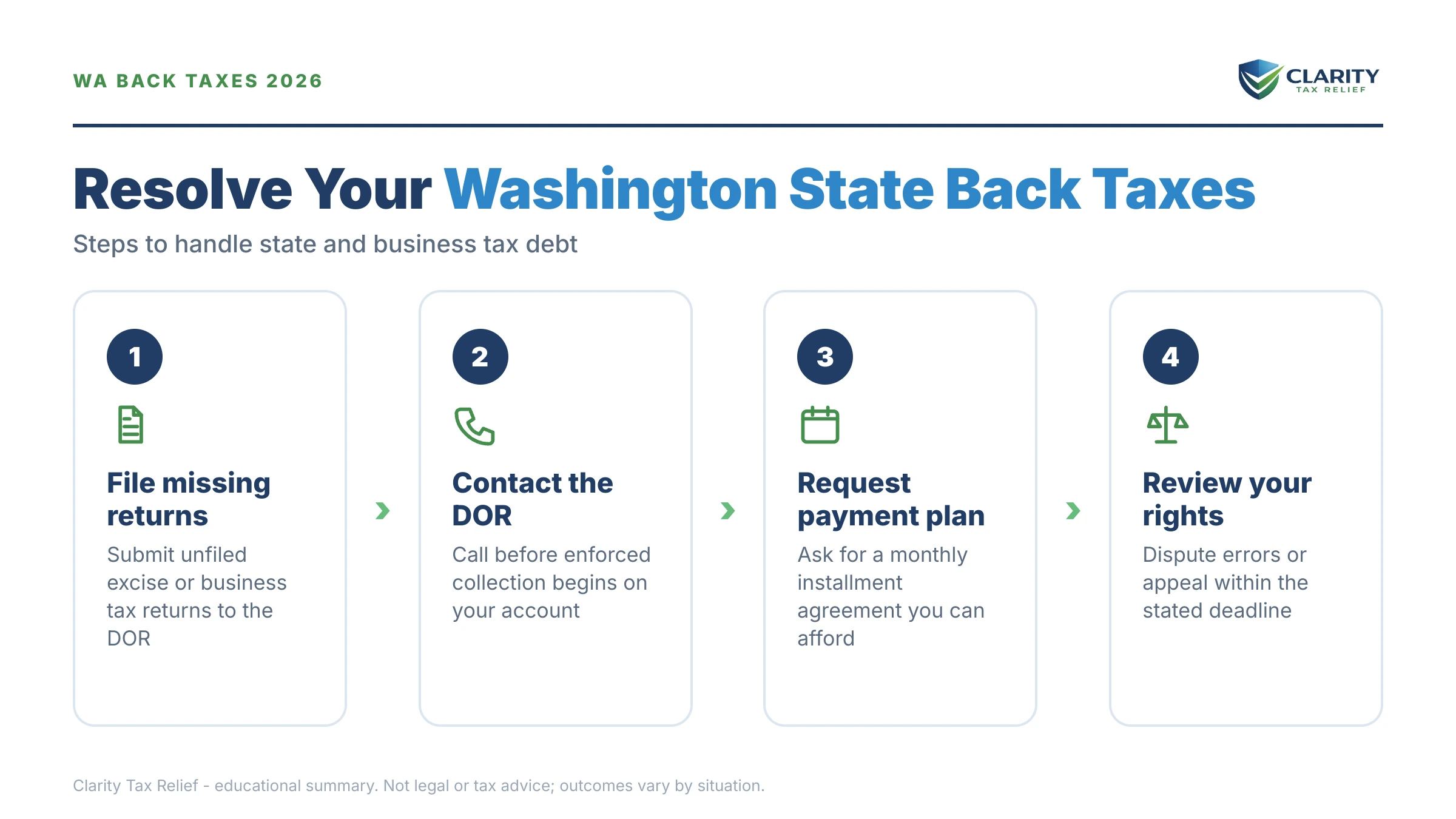
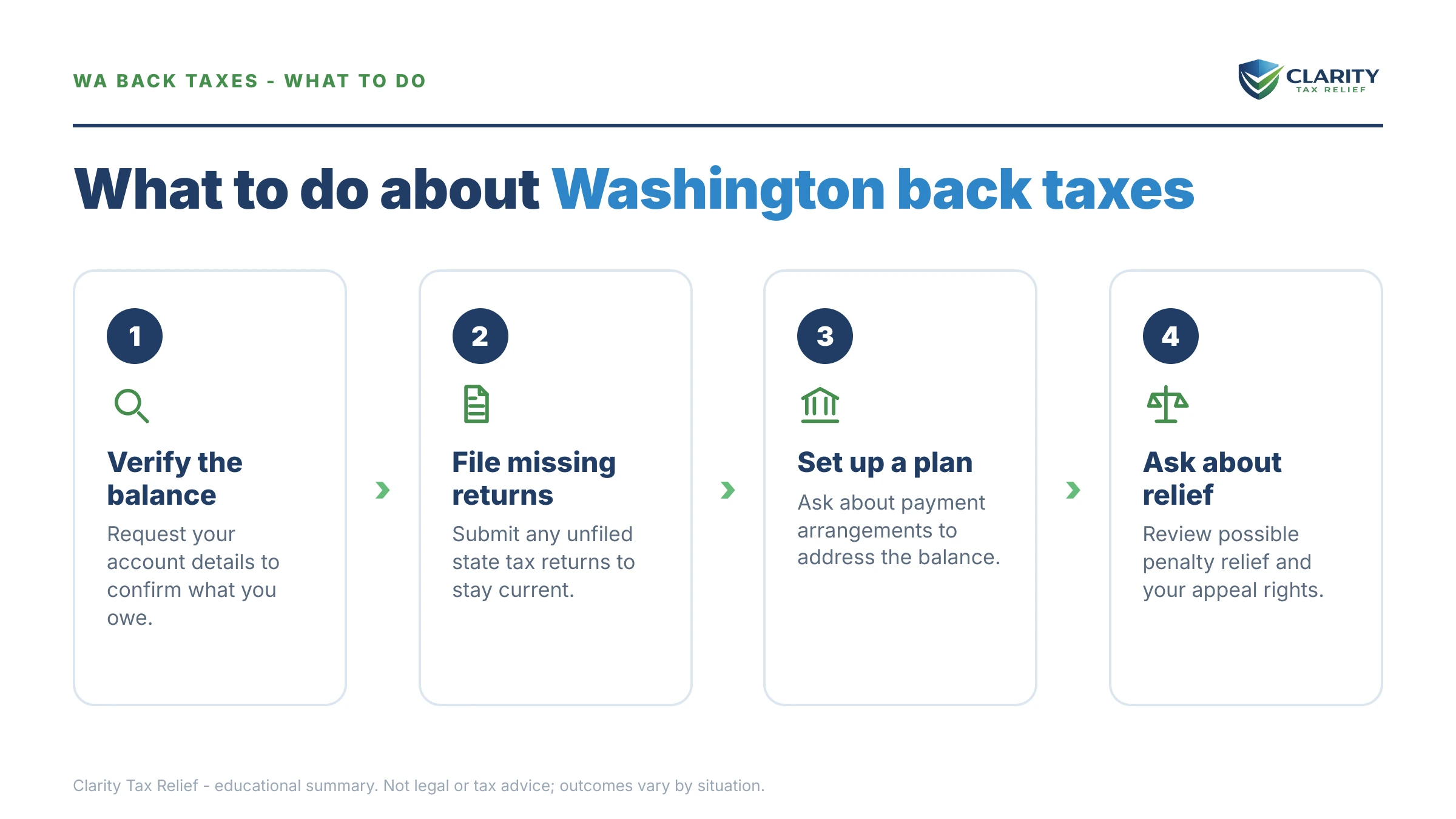
- Identify exactly who you owe. Pull every letter — DOR, county treasurer, ESD, IRS. Log into your IRS online account and DOR's My DOR portal and list each balance by agency, tax type, and year. In Washington, "back taxes" is usually two or three separate debts wearing one scary label.
- Stop any active levy first. If a Notice and Order to Withhold and Deliver hit your bank or an IRS levy is in motion, contact that agency immediately — a payment arrangement is usually the fastest route to a release, and every day of silence makes it harder.
- Protect the trust-fund sales tax slice. Collected-but-unpaid retail sales tax can become your personal debt even if the business is an LLC or corporation. Direct any lump sum you can raise at that portion before anything else.
- Set up agreements in the right order. Negotiate the DOR agreement first — its fuse is shorter and its warrant powers are broader — then set up the IRS plan online or by phone so both clocks stop escalating.
- Request penalty relief in writing. Ask DOR to waive penalties caused by circumstances beyond your control, and pursue IRS first-time abatement — or the new Automatic Exemption from Penalty rolling out in summer 2026 — on the federal side.
Washington DOR vs. the IRS: which do you pay first?
When you owe both, the active levy always comes first — after that, DOR usually outranks the IRS in urgency. Three reasons: DOR reaches the warrant-and-levy stage faster than the IRS's multi-notice ladder; DOR's payment terms are shorter, so delay compresses your monthly payment; and the sales tax portion carries personal-liability risk no IRS income-tax debt has. The IRS, by contrast, will hand most people 72 months and a formal appeal right (Collection Due Process, via Form 12153) before its final levy — flexibility DOR simply doesn't advertise.
The full decision framework — including when the IRS should come first — is in our hub guide to state tax debt vs IRS: which to resolve first. Here's the side-by-side that matters for Washington:
| Stage | Washington DOR | IRS |
|---|---|---|
| First bill | Assessment / balance-due notice; penalty tiers begin (9% → 19% → 29%) | CP14 — about 21 days before escalation |
| Reminders | Compliance-division letters and calls; interest accrues | CP501 / CP503; then CP504 (state refund can be levied) |
| Lien stage | Tax warrant filed in superior court — judgment force, public record | Notice of Federal Tax Lien may be filed |
| Levy stage | Notice and Order to Withhold and Deliver on banks, wages, receivables | LT11 / Letter 1058 — 30 days + CDP appeal rights, then bank/wage levy |
| Business pressure | Certificate of registration revoked — operating becomes illegal | Revenue officer assignment; possible asset seizure |
When you can handle Washington back taxes yourself
Plenty of Washington tax debts don't need professional help. You can almost certainly handle it yourself when:
- Your DOR balance is small, correct, and pre-warrant — call DOR, ask for an agreement or pay it, and request a penalty waiver in writing if something genuinely beyond your control caused the delay.
- Your only debt is federal and under $50,000 with all returns filed — the online streamlined agreement takes twenty minutes, and our walkthrough of first-time penalty abatement shows how to knock the penalties off yourself.
- You agree with the numbers and can full-pay within 180 days on the IRS side.
Experienced help genuinely changes outcomes in a different set of situations: a withhold-and-deliver order or IRS levy already in motion; a warrant filed while you're trying to rent, borrow, or get licensed; collected sales tax at risk of becoming personal liability; multiple unfiled years across two agencies; a never-registered business deciding between voluntary disclosure and waiting to be found; or a combined balance — like our $83,100 example — where the order of resolution changes what you pay monthly. In those cases, the negotiation posture and sequencing matter more than any single form.
If a warrant is already filed or an order has already hit your bank, a free case review with an experienced tax professional can map the fastest release path for your exact letters — call (888) 825-7779 or use the 2-minute form.
Terms on your Washington notices, decoded
- Tax warrant — DOR's court filing that turns your tax debt into the equivalent of a judgment, creating a public-record lien without a lawsuit.
- Notice and Order to Withhold and Deliver — Washington's levy instrument: an order requiring your bank, employer, or customers to hand your money to the state.
- B&O tax — Washington's business and occupation tax, charged on gross receipts, so it's owed even in unprofitable years.
- Trust-fund (collected) sales tax — sales tax you collected from customers on the state's behalf; unpaid, it can be assessed against you personally when a limited-liability business fails.
- Certificate of registration — your legal permission to do business in Washington; DOR can revoke it over unpaid taxes.
- Successorship liability — the rule that a buyer of a Washington business can inherit the seller's unpaid DOR taxes; always get tax-status clearance before buying.
Washington state back taxes: your questions, answered
Does Washington state collect back taxes if it has no income tax?
Yes. Washington has no personal income tax, but the Department of Revenue collects business and occupation (B&O) tax, retail sales and use tax, and the 7% capital gains excise tax — and it pursues unpaid balances aggressively. People who owe "back taxes" in Washington usually owe the IRS on the federal side, a DOR tax, or both at once.
What is a Washington state tax warrant?
A tax warrant is DOR's core collection weapon: a document filed with the superior court that gives your tax debt the force of a judgment. Once filed, it creates a lien on your property in that county and lets DOR levy bank accounts and garnish wages without suing you first. Warrants are public record, so lenders, landlords, and business partners can find them.
Can the Washington Department of Revenue take money from my bank account?
Yes. After a tax warrant is filed, DOR can serve a Notice and Order to Withhold and Deliver on your bank, which requires the bank to hold and turn over your funds. Don't assume the IRS's 21-day holding period applies — that's a federal rule, and Washington's process runs on state law. The safest move is to get an agreement in place before the order is served.
Does Washington DOR offer payment plans for back taxes?
Yes, DOR negotiates payment agreements case by case, but they typically run far shorter than the IRS's 72-month plans — think months, not years. Expect DOR to ask for financial information and larger monthly payments than the IRS would accept, with interest continuing to accrue. Your leverage is strongest before a warrant is filed, so ask early.
Can Washington state shut down my business for unpaid taxes?
Yes. DOR can revoke your certificate of registration — your legal permission to do business in Washington — over unpaid tax debt, and operating after revocation is illegal. Revocation usually comes after warrants and collection attempts have failed, so a business that engages DOR early and gets on a payment agreement can almost always avoid it.
Am I personally liable for my LLC's unpaid Washington sales tax?
You can be. Retail sales tax you collect from customers is trust-fund money, and when a corporation or LLC closes or becomes insolvent still owing it, DOR can assess the collected-but-unpaid sales tax personally against the individuals who controlled the funds. B&O tax generally stays with the entity — which is exactly why the sales tax slice of any DOR debt should be paid first.
Do I owe Washington capital gains tax, and what if I can't pay it?
Washington charges a 7% excise tax on large long-term capital gains above an annually adjusted deduction (over a quarter-million dollars), with exemptions that include real estate and retirement accounts. If you owe it and can't pay, the debt sits with DOR — same warrant and levy powers, same case-by-case payment agreements — so treat it like any other DOR balance and act before a warrant is filed.
Should I pay the IRS or Washington DOR first?
Whichever agency is actively levying comes first — stop the bleeding, then structure the rest. All else equal, DOR usually deserves priority: it escalates to a warrant faster, its payment plans are shorter, and the trust-fund sales tax portion can become personal liability. The IRS offers longer, more flexible plans, so it can often wait one step behind — but never ignore either agency.
How far back can Washington DOR go on unfiled or unpaid taxes?
For registered businesses, DOR's standard assessment lookback is generally four years plus the current year. Businesses that never registered face a much longer lookback — which is why the voluntary disclosure program, which limits the lookback and waives major penalties, is usually the right entry path for anyone who should have registered and didn't.
Is the Washington voluntary disclosure program worth it?
Usually, yes — if you qualify. It's designed for businesses that have never registered with DOR, including out-of-state sellers with Washington nexus, and it generally limits how many back years DOR will assess and waives the largest penalties. The catch: you must come forward before DOR contacts you. Once they find you first, the program is off the table.
Your next 24 hours
- Sort your letters by agency. Find the letterhead on each notice — Department of Revenue, county treasurer, ESD, or IRS — and note the balance and tax type on each. If a bank hold is active, the freezing agency's name is on the order your bank received.
- Gather three things: your last filed returns (state excise and federal), every collection letter, and a rough monthly income-and-rent picture. That's everything needed to price your options on both sides.
- Get a free case review. Call (888) 825-7779 or use the 2-minute form. Washington's penalty tiers and IRS interest are both accruing right now, and once a warrant is filed your options narrow — the review costs nothing and tells you exactly where you stand.
Primary sources: the Washington State Department of Revenue for state taxes, registration, and voluntary disclosure; the IRS's official payment plans and installment agreements page for federal options; and the Taxpayer Advocate Service if an IRS levy is causing immediate hardship.
This guide is general information, not tax or legal advice for your specific situation. Eligibility for IRS programs depends on individual facts and circumstances; no outcome is guaranteed.