
State Tax Debt
Washington B&O Tax Debt: How to Resolve It Before DOR Escalates (2026)
The short answer: Washington B&O tax debt is owed to the Washington State Department of Revenue on your gross receipts — even if the business made no profit. Unpaid balances draw a late-payment penalty that climbs as high as 29%, plus interest, and DOR can file a tax warrant that acts like a judgment lien. Payment plans and penalty waivers can stop the slide.
The divorce took over your life for a year, the quarterly excise returns slid down the to-do list, and now a Department of Revenue notice says your one-person business owes thousands in B&O tax on revenue you already spent living through it. Here's what matters: this is a fixable problem with a known sequence, and you're catching it at a stage where your options are still wide open. This guide covers Washington B&O tax debt specifically — if you also owe sales tax, use tax, or other state balances, our broader guide to Washington state back taxes covers the full picture.
If you're not sure exactly which piece of DOR paperwork you're holding, the image below shows what the Department of Revenue's balance-due documents look like and where to find the tax periods and total — orient yourself there before you do anything else.
⏱ Your real clock: Washington's late-payment penalty climbs in steps — 9% once the return is late, 19% after the last day of the month following the due date, and a maximum 29% after the last day of the second month. Interest accrues on top. Every month-end you wait can move you up a tier, and once DOR files a tax warrant, court fees stack onto the balance too.
Why you owe Washington B&O tax debt in the first place
Washington's business and occupation (B&O) tax is charged on gross receipts — every dollar your business brings in — with no deductions for labor, rent, materials, or any other cost of doing business. That single fact explains most B&O debt: a business can lose money all year and still owe the state real tax, because the tax never asked whether you profited.
Washington has no state income tax, so the B&O tax is how the state taxes business activity. The rate depends on your classification: roughly half a percent for retailing and wholesaling, and around 1.5% or more for the service-and-other-activities classification most consultants, contractors, and freelancers fall under. DOR assigns you a monthly, quarterly, or annual filing frequency based on your revenue.
B&O balances usually build one of four ways:
- You filed but couldn't pay. The return posted, the payment didn't, and the stepped penalty started climbing.
- You stopped filing. Once registered, you must file even for zero-activity periods. Miss enough of them and DOR issues an estimated assessment — its own guess at your tax, usually high, with penalties attached.
- An audit or reclassification found more tax. DOR decided some income belonged in a higher-rate classification, or found receipts you didn't report.
- You never registered at all. Common for out-of-state sellers who crossed Washington's economic-nexus line without realizing it — the same trap covered in our guide to sales tax nexus back taxes.
Which of these describes you matters, because each has a different best fix — an estimated assessment gets attacked differently than a filed-but-unpaid balance.
What happens if you ignore Washington B&O tax debt
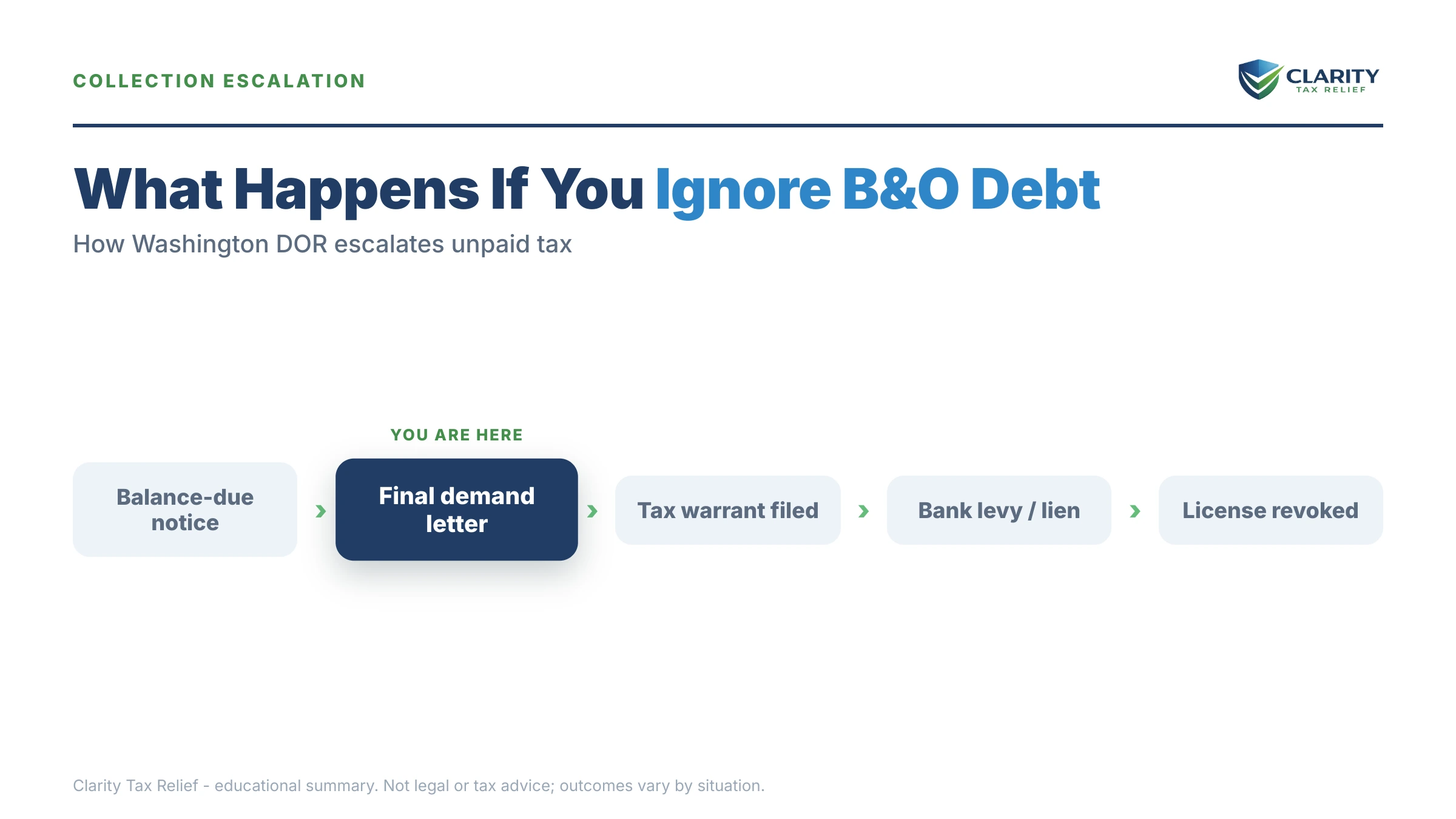
Unpaid B&O tax moves from a notice to a court-filed tax warrant to orders that reach your bank account, paycheck, and even your customers. The sequence is administrative — DOR does not need to sue you first:
- Balance-due notice. DOR bills the unpaid tax for each period, with the penalty tier and interest already added. This is the cheapest moment you will ever have to fix this.
- The penalty maxes out at 29%. Once you pass the last day of the second month after the due date, the delinquency penalty tops out — but interest keeps compounding, and estimated assessments for unfiled periods keep landing.
- Tax warrant filed in superior court. The warrant works like a judgment: it creates a lien against your real and personal property in that county, becomes a public record, and adds filing costs to your balance.
- Notice and Order to Withhold and Deliver. After the warrant, DOR can order third parties who hold your money — your bank, your employer if you also have a W-2 job, even clients who owe you invoices — to send those funds to the state. For a service business, an order landing on a key client can do more damage than the debt itself.
- Revocation of your certificate of registration. DOR can pull your tax registration for persistent nonpayment, which means the business can no longer legally operate in Washington.
Here's the exact penalty math at each tier, so you can see what waiting costs:
| When the tax is still unpaid | Penalty rate | On $4,800 of tax |
|---|---|---|
| After the return's due date | 9% | $432 |
| After the last day of the month following the due date | 19% | $912 |
| After the last day of the second month following the due date | 29% (maximum) | $1,392 |
Interest accrues separately at DOR's annually set rate, and warrant fees are added once a warrant is filed. One more wrinkle to check now: if your DOR balance mixes B&O tax with retail sales tax you collected from customers, that sales-tax portion is trust-fund money the state can pursue against you personally even through an LLC or corporation — see our guide to sales tax debt help for how that piece works.
Holding a DOR balance-due notice right now?
Get your Washington B&O debt reviewed free before the next penalty tier hits or a tax warrant gets filed. An experienced tax professional will map your periods, your penalty exposure, and your best-fit fix — no pressure, no obligation.
Your options for resolving B&O tax debt with the Washington DOR
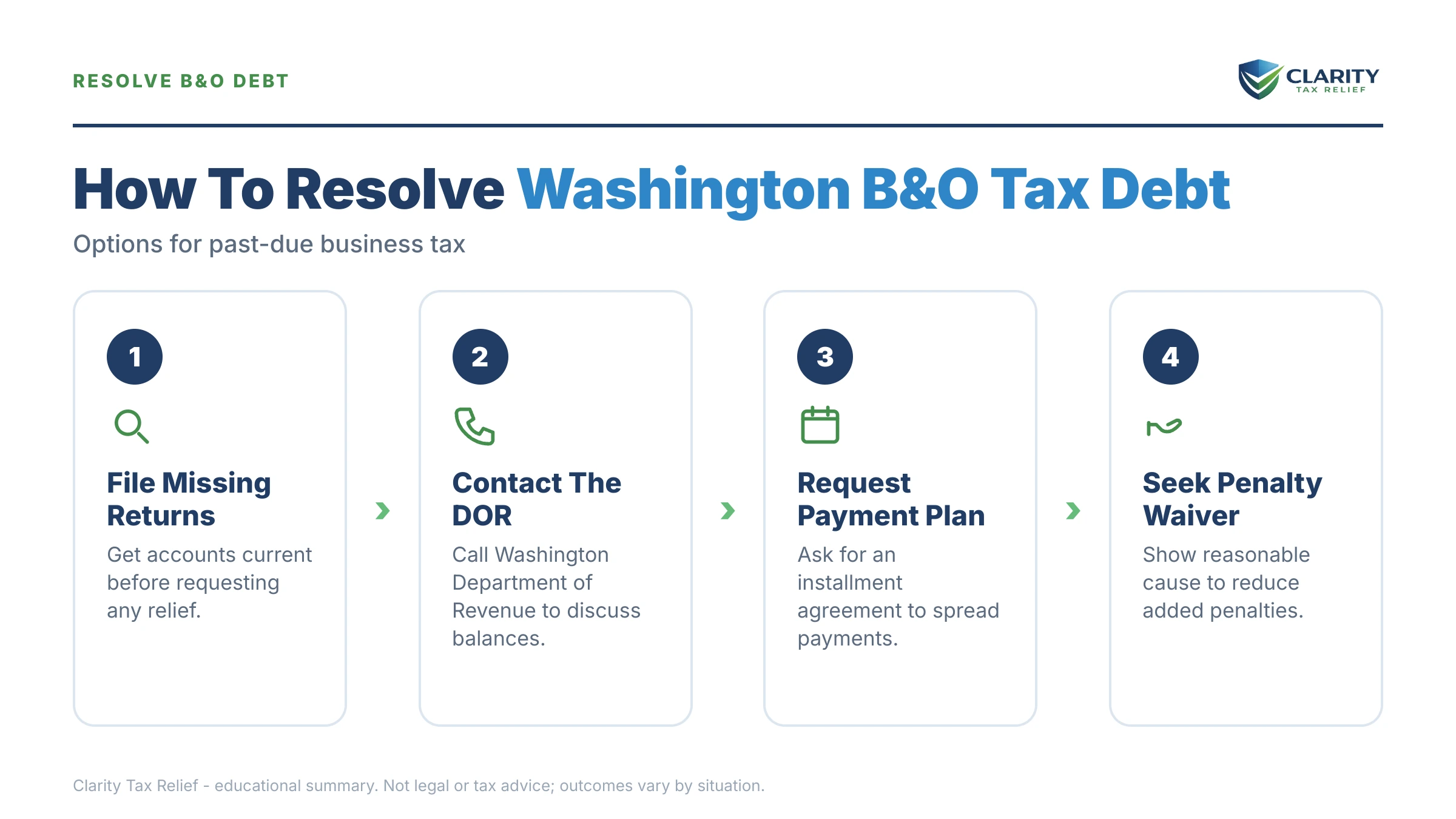
Washington has no program identical to the IRS Offer in Compromise, but it has several real paths that reduce or restructure a B&O balance — each attacking a specific piece of it. The right combination depends on how the debt arose:
| Option | Who it fits | Key requirement |
|---|---|---|
| Pay in full | Small balances you agree with | Ability to pay now — stops penalties, interest, and warrant risk immediately |
| DOR payment agreement | Correct balances you can't pay at once | A sustainable monthly amount; staying current on all new excise returns |
| Penalty waiver | First-time slips or genuine crises | Generally 24 months of on-time filing before the late period, or circumstances beyond your control |
| File actual returns to replace estimates | Anyone facing estimated assessments | Real gross-receipts records — actual figures with correct classifications usually beat DOR's estimates |
| Voluntary Disclosure Program | Unregistered businesses DOR hasn't contacted yet | You come forward first; lookback is generally limited to four years plus the current year, with most penalties waived |
| Appeal / administrative review | Assessments you believe are wrong (misclassification, receipts that aren't yours) | Filed by the deadline printed on your assessment notice |
Two of these deserve emphasis. First, the penalty waiver: DOR's one-time waiver for taxpayers with 24 months of clean filing history doesn't ask why you were late — a divorce year that wrecked your attention span doesn't need to qualify as a disaster if your prior record was spotless. Second, replacing estimated assessments: DOR's estimates for unfiled periods don't apply your deductions from gross receipts (like interstate sales) or the small business B&O tax credit that shields many low-revenue service businesses. Filing real returns often cuts the assessed tax before you negotiate anything.
Here's what each path costs and how long it takes:
| Option | Out-of-pocket cost to pursue | Typical timeline | Does the balance keep growing? |
|---|---|---|---|
| Pay in full | The balance itself; nothing extra | Immediate | No — everything stops |
| Payment agreement | No fee to request | Months, not years — shorter than IRS plans | Interest continues until paid off |
| Penalty waiver request | Free to request in writing | Usually weeks for a decision | Removes the penalty layer only; tax and interest remain |
| File actual returns over estimates | Your time or a preparer's fee | Days to file; weeks for DOR to adjust | Recalculates the tax itself — often the biggest single cut |
| Voluntary disclosure | No application fee; you pay the limited-lookback tax and interest | Weeks to register and file | Caps how many years DOR can bill |
What a $6,200 B&O debt actually costs — a worked example
Say you owe $6,200 in Washington B&O tax debt. You're recently divorced, running a solo consulting practice, and four quarterly excise returns slipped during the worst of it. On roughly $310,000 of gross receipts at the service classification's roughly 1.5% rate, the underlying tax is about $4,650. All four quarters are past the second-month mark, so the 29% maximum penalty adds about $1,348, and interest brings the total to roughly $6,200.
Now run the fixes. If your filing history for the 24 months before the slide was clean, a one-time penalty waiver on the first late quarter — and a circumstances-based request on the rest — could remove a meaningful slice of that $1,348. Had you acted inside the 9% window, the penalty would have been about $418 instead — roughly $930 cheaper — which is exactly why the month-end tiers are the clock that matters.
For the remainder, a DOR payment agreement spread over, say, 12 months runs roughly $517 a month before any penalty relief, less if a waiver lands first. Interest continues during the plan, but warrants, withhold-and-deliver orders, and registration revocation all stay off the table while you keep the agreement current. This is a hypothetical, not a promise — your classification, filing history, and DOR's decisions will move every number — but the structure of the math is the same for almost every service-business B&O debt.
B&O debt vs. IRS debt: which to pay first?
Many Washington business owners who owe B&O tax also owe the IRS self-employment tax from the same lean years — Washington has no income tax, so the state and federal debts arrive by separate mail. As a general rule, DOR moves to a tax warrant faster than the IRS moves to a levy, while the IRS offers longer runway: federal balances under $50,000 can stretch across up to 72 months on an IRS payment plan, versus DOR's shorter agreements. That often means stabilizing the state debt first while putting the IRS on a long plan — but the right order depends on which agency is closer to enforcement in your file. Our guide to state tax debt vs IRS walks through the full decision framework.
How to respond to Washington B&O tax debt, step by step
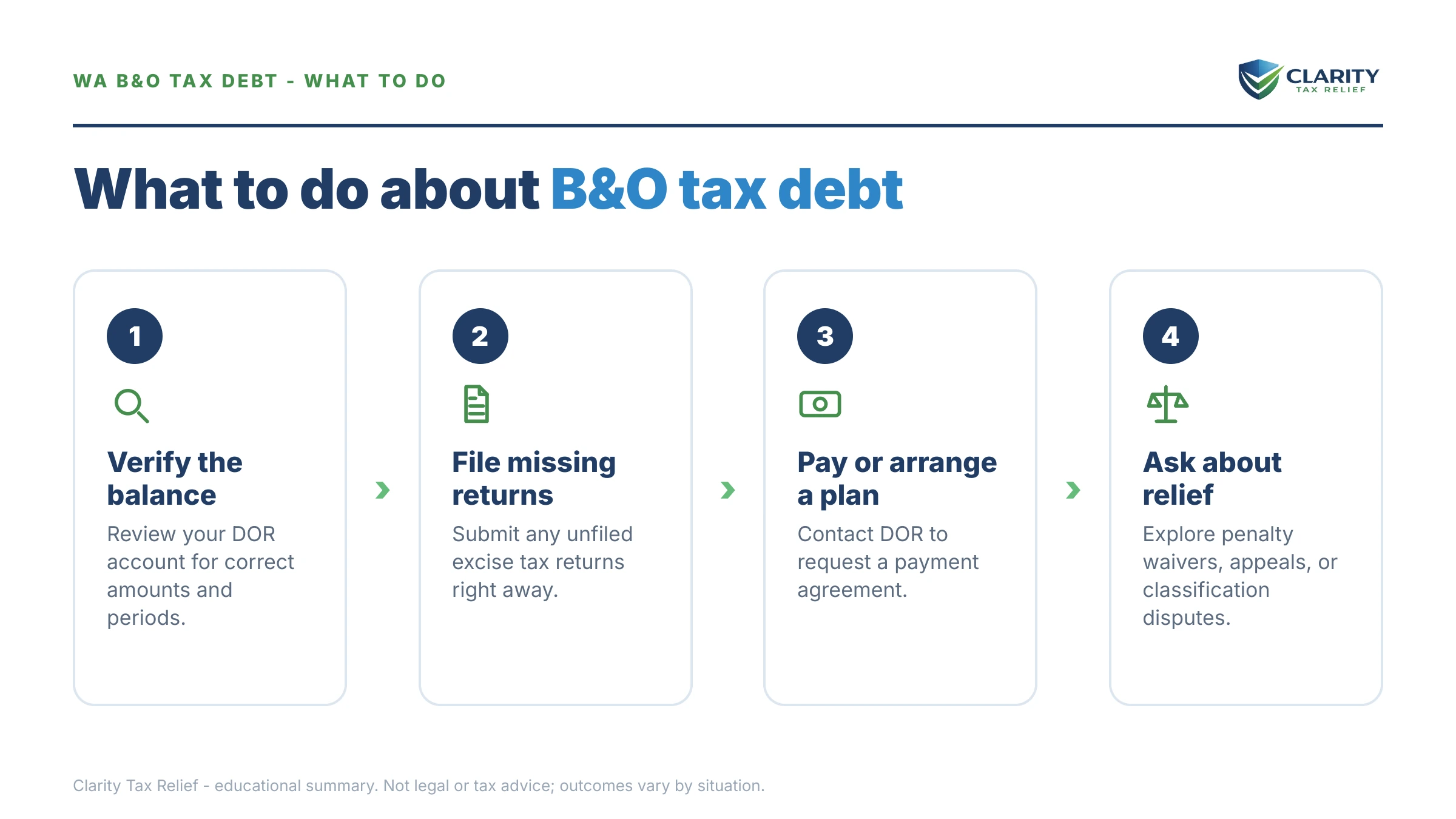
- Confirm the balance in My DOR. Log in to your My DOR account, match every notice against the tax periods and amounts shown, and note whether any period is an estimated assessment rather than a filed return.
- File any missing excise returns. Actual gross-receipts figures replace DOR's estimates, apply your correct B&O classification and any small business B&O credit, and often shrink the assessed balance.
- Request a penalty waiver if you qualify. Ask DOR in writing for the one-time waiver based on 24 months of clean filing history, or a waiver for circumstances beyond your control — removing the penalty layer before you negotiate payment.
- Set up a payment agreement before a warrant is filed. Contact DOR collections with a monthly amount you can actually sustain, and stay current on every new excise return so the agreement doesn't default.
- Escalate to an experienced tax professional if enforcement has started. If a tax warrant, a Notice and Order to Withhold and Deliver, or a registration revocation is in play — or you owe the IRS at the same time — get a professional case review before responding.
Every DOR contact point — My DOR login, collections phone lines, and waiver request instructions — is at the Washington State Department of Revenue.
When you can handle B&O debt yourself — and when help changes the outcome
You can usually resolve this on your own if the balance is one or two periods you agree with, your returns are filed, and you can pay in full or on a short DOR agreement. Requesting the 24-month penalty waiver is a straightforward written request — you don't need to hire anyone to ask for it, and DOR's own staff will walk you through a basic payment agreement.
Experienced help changes outcomes in a different set of situations: a tax warrant has been filed or a withhold-and-deliver order is reaching your bank or clients; multiple years are unfiled and DOR's estimated assessments have inflated the debt; the balance mixes B&O with collected sales tax that carries personal liability; the business has closed but the debt hasn't — a scenario our closed business owe sales tax guide covers in depth; or DOR reclassified your income into a higher-rate category and an appeal deadline is running. In those cases, the sequencing — returns first, penalty relief second, payment terms last — and the classification arguments are where money is actually won or lost.
Terms on your DOR paperwork, decoded
- Gross receipts: everything your business took in before any expenses — the number B&O tax is calculated on.
- B&O classification: the category DOR puts your activity in (retailing, wholesaling, manufacturing, service & other activities) — it sets your rate, and misclassification is a common assessment dispute.
- Estimated assessment: DOR's own calculation of tax for a period you didn't file — usually high, and replaceable by filing the actual return.
- Tax warrant: DOR's collection instrument, filed with a superior court clerk; it functions like a judgment lien against your property and is public record.
- Notice and Order to Withhold and Deliver: DOR's demand to a third party — bank, employer, or customer — to turn over money it holds for you.
- Certificate of registration: your business's license to operate for Washington tax purposes; DOR can revoke it for persistent nonpayment.
Washington B&O tax debt questions, answered
What happens if I don't pay my Washington B&O tax?
The balance grows through Washington's stepped penalty — 9%, 19%, then 29% — plus interest, and the Department of Revenue can file a tax warrant in superior court. Once a warrant is filed, DOR has a lien against your property, can order banks, employers, and even your customers to hand over funds, and can ultimately revoke your business registration. The debt does not go away on its own.
Do I owe B&O tax even if my business lost money?
Yes. Washington's B&O tax is calculated on gross receipts, not profit, so a business that lost money can still owe the full tax on everything it billed. There are no deductions for wages, rent, or supplies. Limited relief exists — some small service businesses qualify for the small business B&O credit — but a loss year by itself does not erase the liability.
Can I get a payment plan for Washington B&O tax debt?
Yes. DOR grants payment agreements, though they are typically shorter than the IRS's 72-month plans — think months, not years. Interest keeps accruing while you pay, and you must stay current on new excise returns or the agreement can default. Ask for the plan before a tax warrant is filed; your negotiating position is far better at the notice stage.
Will Washington DOR settle B&O tax debt for less, like an IRS offer in compromise?
Washington does not advertise an offer-in-compromise-style program for B&O debt. Realistic reduction paths are different: filing actual returns to replace an inflated estimated assessment, requesting a penalty waiver, using the voluntary disclosure program if you were never registered, or appealing an assessment you believe is wrong. Each attacks a specific piece of the balance rather than negotiating the total.
Can DOR waive B&O penalties?
Often, yes. DOR generally grants a one-time penalty waiver if you filed and paid on time for the 24 months before the late period, and it can waive penalties when the delinquency was caused by circumstances beyond your control, such as a serious illness or disaster. Interest is much harder to remove. The waiver only clears the penalty layer — the underlying tax remains due.
Am I personally liable for my LLC's B&O tax debt?
If you're a sole proprietor or single-member LLC, the B&O debt is yours personally — there is no separation. For corporations and multi-member LLCs, B&O is generally the entity's liability, but collected-and-unremitted retail sales tax is trust-fund money that Washington can assess against responsible individuals personally. Many DOR balances mix both, so find out which portion is which before assuming you're protected.
I closed my business — do I still owe the B&O balance?
Yes. Closing your account with DOR stops new filing obligations, but the existing debt survives the closure, and DOR can still file a warrant and collect. If part of the balance is collected sales tax, personal liability for responsible individuals is a real risk after closure. File any final returns, then resolve the balance — it will not dissolve with the business.
Is a Washington tax warrant public record?
Yes. A tax warrant is filed with a superior court clerk, which makes it a public record that lien searches, lenders, and some business partners will find. It operates like a judgment lien against your real and personal property in that county and adds filing costs to your balance. Paying or resolving the debt is the only way to clear it; DOR releases the warrant once satisfied.
Your next 24 hours
- Find the tax periods and total on your DOR notice — or log in to My DOR and pull the balance by period, noting which periods are estimated assessments.
- Gather your gross-receipts records for those periods (bank deposits, invoices, bookkeeping exports) plus every excise return you did file — this is what a waiver request and any corrected returns are built from.
- Get a free case review of your Washington B&O situation at the 2-minute form or by calling (888) 825-7779 — the penalty tiers and interest keep climbing until the balance is on a plan, and a warrant is far harder to unwind than it is to prevent.
This guide is general information, not tax or legal advice for your specific situation. Eligibility for IRS programs depends on individual facts and circumstances; no outcome is guaranteed.