
City Tax Relief Guides
Tax Relief Seattle: Every Real Option for IRS and Washington Tax Debt (2026)
The short answer: tax relief in Seattle means resolving IRS debt through a payment plan (up to 72 months online for balances under $50,000), an Offer in Compromise, hardship status, or penalty abatement. Washington has no personal income tax — so for most W-2 Seattleites, the IRS is the only collector you're facing.
Anyone searching "tax relief Seattle" is usually in one of two spots: a balance you can't pay showed up when you filed — RSU vesting and stock sales under-withheld at the flat 22% rate are the classic Seattle version — or IRS letters have started arriving and each one sounds worse than the last. Either way, the fix follows the same map, and every option on it has a specific eligibility line and a specific cost.
This guide walks through all of them: the federal programs, the Washington Department of Revenue side for business owners, what each path costs in 2026, and when you genuinely don't need to pay anyone for help.
⏱ The real clock: there's no single "tax relief" deadline — the clock is the 0.5% monthly failure-to-pay penalty plus daily-compounding interest, and, if you're holding an IRS notice, the response date printed on it. On a $16,400 balance, waiting costs roughly $82 a month in penalty alone before interest.
Why Seattle taxpayers end up owing the IRS
Most Seattle tax debt is federal, because Washington collects no personal income tax — there is no state return, no state refund, and no state income-tax collector behind your W-2 wages. That simplifies your problem to one agency, but it also means every dollar of the debt sits with the collector that has the strongest enforcement tools in the country.
The most common Seattle-specific trigger is equity compensation. RSUs at the region's large tech employers are withheld at the flat 22% supplemental rate, while a single filer with a six-figure salary plus vesting stock often sits in a higher marginal bracket. The gap becomes a five-figure balance due at filing — tax you genuinely owe, on income you may have already spent or watched drop in value.
Other frequent paths: a stock or crypto sale without estimated payments, a side 1099 on top of a W-2, or a year of contract work with no withholding at all. And if you run a business, you can owe the Washington DOR and the City of Seattle on top of the IRS — more on that below.
What happens if you ignore IRS tax debt in Seattle
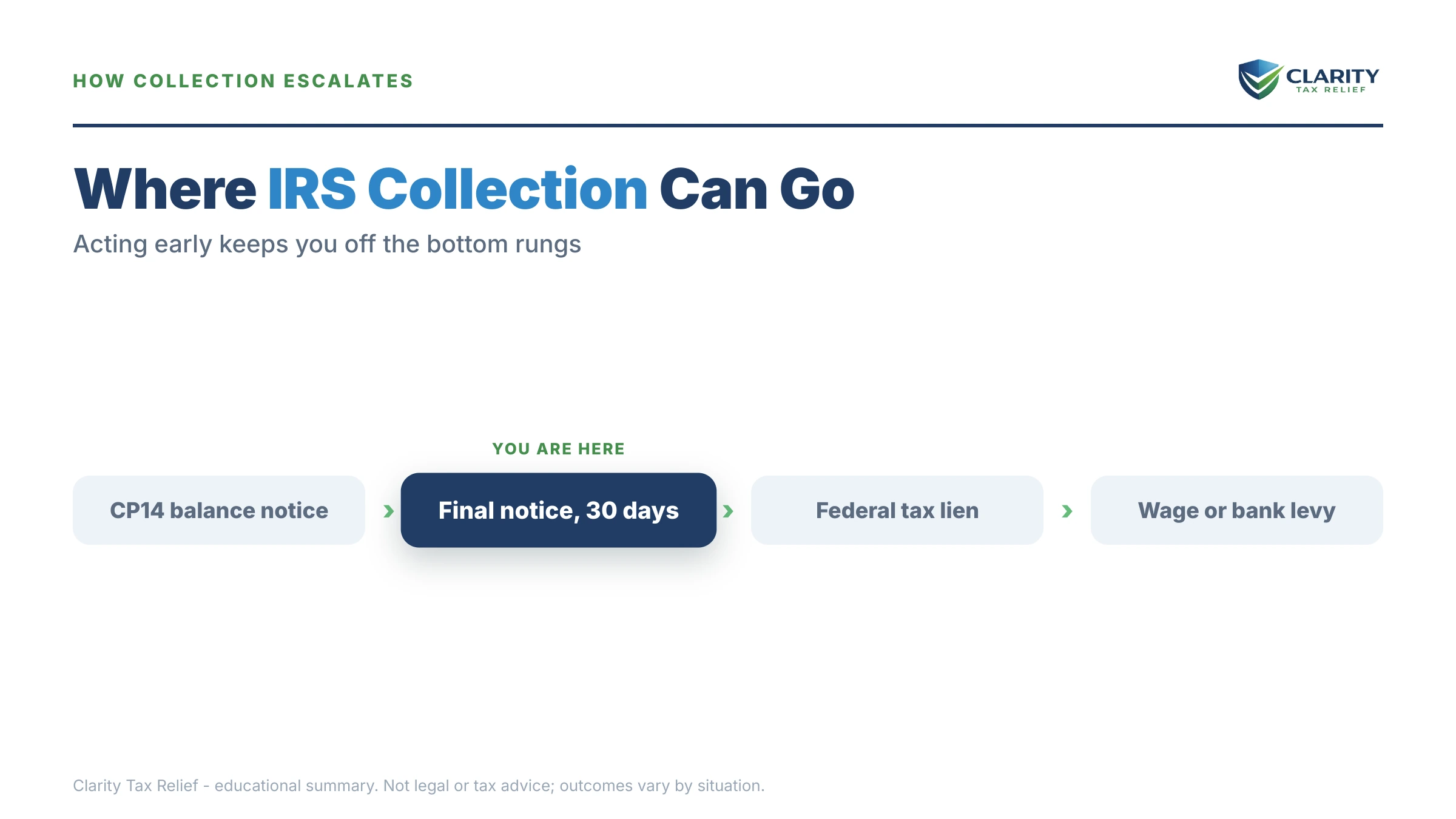
The IRS collection sequence is automated, and in 2026 — with the IRS workforce cut roughly 27% — the notices, liens, and levies keep issuing even when nobody answers the phone. Waiting for a human to notice you is not a strategy; the machine escalates on schedule:
- CP14 — the first bill. You have about 21 days from the notice date before the sequence moves on. No enforcement yet — this is the cheapest moment to act.
- CP501 and CP503 — reminder bills, weeks apart. Still no new enforcement power, but the balance grows every month.
- CP504 — Notice of Intent to Levy under IRC §6331(d). Its headline power is seizing your state income-tax refund — which, in Washington, doesn't exist. Don't relax: the CP504 notice also signals that a federal tax lien and the final notice are next.
- LT11 / Letter 1058 — the Final Notice of Intent to Levy. This starts a 30-day clock to request a Collection Due Process hearing (Form 12153). After it runs, the IRS can levy bank accounts and wages.
- Levy — a bank levy freezes funds for a 21-day hold before the money leaves; a wage levy is continuous until released. If the total debt crosses $66,000 (the 2026 threshold), the IRS can also certify you for passport denial.
| Notice | What it means | Your window |
|---|---|---|
| CP14 | First bill for the balance | ~21 days from the notice date |
| CP501 / CP503 | Reminder bills; balance growing monthly | Weeks apart; no new enforcement power yet |
| CP504 | Intent to levy your state refund — moot in no-income-tax Washington, but lien risk is now real | The date printed on the notice |
| LT11 / Letter 1058 | Final notice before bank and wage levies | 30 days to request a CDP hearing (Form 12153) |
| Levy | Bank levy: 21-day hold before funds leave. Wage levy: continuous until released | Act inside the 21-day hold; a wage levy requires a negotiated release |
IRS letters piling up at your Seattle address?
Send us a photo of the most recent one. An experienced tax professional will tell you exactly where you sit in the collection sequence and which option fits your numbers — free, confidential, before penalties add another month.
Tax relief options in Seattle: what you may qualify for
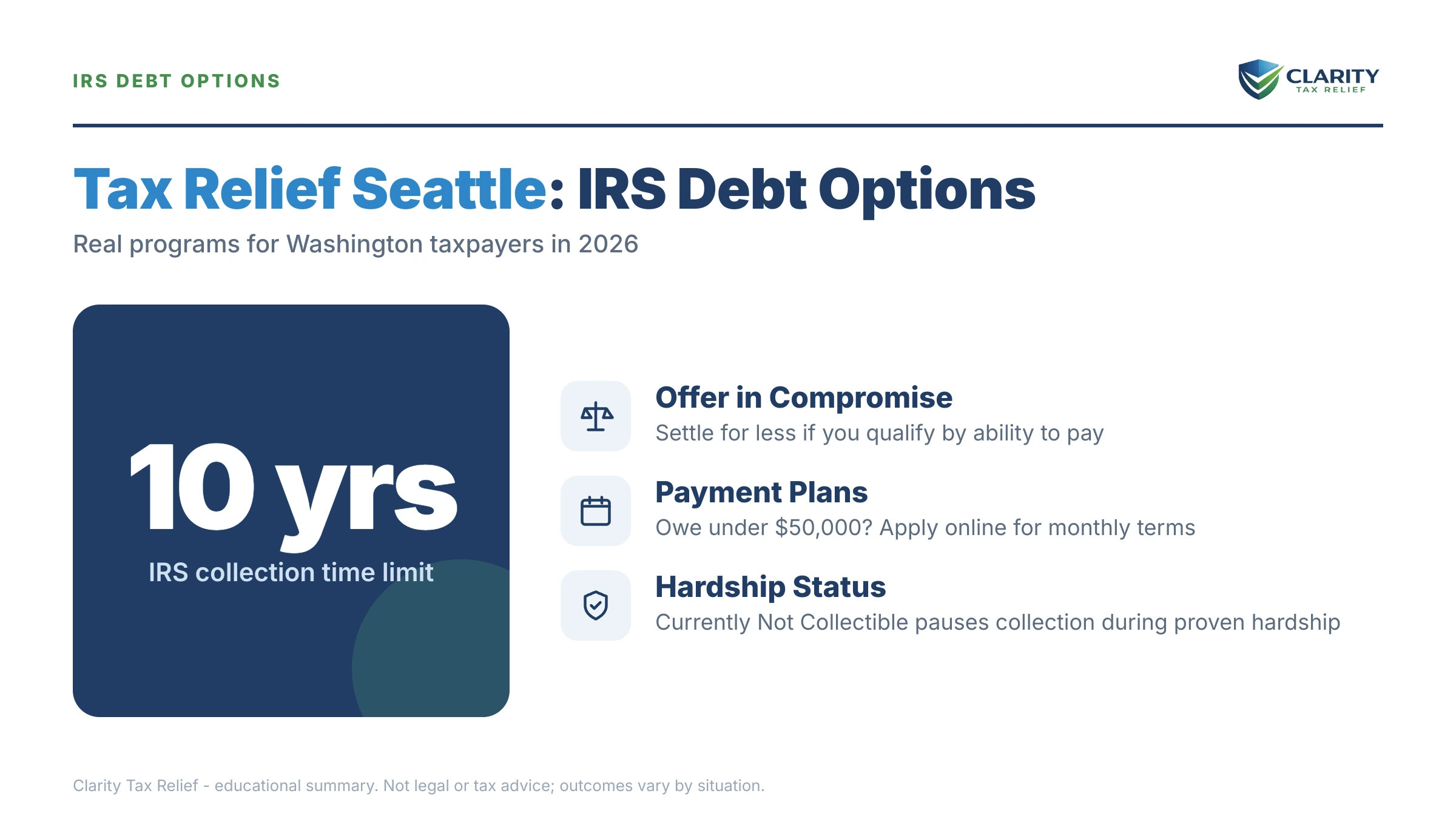
For a balance under $50,000, most Seattle taxpayers can set up an IRS payment plan online — up to 72 months — without ever speaking to an agent. Every other program is means-tested against your income, assets, and IRS allowable living expenses. (If you want the full DIY playbook for each program, it lives in our guide to how to settle tax debt yourself; here's how each one applies in Seattle.)
| Option | Typical eligibility | Cost & notes |
|---|---|---|
| Short-term payment plan | Can pay in full within 180 days | $0 setup; penalties and interest continue |
| Guaranteed installment agreement | Owe $10,000 or less with a clean filing history | Approval is required by law when the criteria are met |
| Streamlined installment agreement | Owe $50,000 or less; up to 72 months, set up online | Setup fee varies; direct debit is cheapest and safest |
| Currently Not Collectible | Paying anything would prevent basic living expenses (shown on Form 433-F) | Free; debt remains and grows, but levies stop |
| Offer in Compromise | Assets + future income genuinely can't cover the debt | $205 fee + 20% down on lump-sum offers; both waived with low-income certification; ~1 in 5 accepted in FY2024 |
| Penalty abatement / AEP | Clean prior 3 years, or reasonable cause (illness, disaster) | Free to request; AEP becomes automatic starting summer 2026 |
A few Seattle-specific notes on that table. First, the IRS hardship math uses local housing and utilities standards, and the King County allowance is well above the national average — Seattle rent that feels crushing actually works in your favor on a Form 433-F, making Currently Not Collectible and offer math more achievable than in cheaper metros. Second, the opposite is true for homeowners: King County home equity counts toward what the IRS believes it can collect, and it often prices homeowners out of an Offer in Compromise entirely. Third, on penalties: if 2025 or 2026 was your first slip after three clean years, first-time penalty abatement can wipe the failure-to-pay penalty — and starting summer 2026, the new Automatic Exemption from Penalty (AEP) applies similar relief automatically, no request needed.
A worked example: owing the IRS $16,400 in Seattle
Say you owe $16,400 — a single W-2 employee whose RSU vesting was under-withheld last year. Clearly hypothetical, but the math is exact:
- Doing nothing: the failure-to-pay penalty alone is 0.5% × $16,400 = $82 per month, plus daily-compounding interest on top. A year of waiting adds roughly $1,000 in penalty before a dollar of interest.
- Short-term plan: $16,400 ÷ 6 ≈ $2,733/month for 180 days. $0 setup fee, and the notice sequence stops while you pay.
- Streamlined installment agreement: $16,400 ÷ 72 ≈ $228/month minimum. Interest and the (reduced) late-payment penalty keep accruing, so anything above the minimum shortens the total cost — you can estimate your own accrual with our Penalty & Interest Calculator.
- Offer in Compromise: only viable if the IRS's collection math comes out below $16,400. A lump-sum offer counts roughly 12 months of your disposable income plus your asset equity. With, say, $400/month left after allowable expenses ($4,800) plus $12,000 in savings and vested stock, the IRS sees $16,800 of collection potential — more than you owe, so it would expect full payment instead. This is why steady tech W-2 earners rarely qualify, and why anyone promising otherwise before seeing your numbers is selling, not advising.
The pattern for most Seattle W-2 filers at this balance: a streamlined agreement set up online, penalty abatement layered on top if the prior three years were clean, and aggressive early payoff once the next vest or bonus lands.
Washington DOR and City of Seattle taxes: when the state is your problem
The Washington Department of Revenue collects business taxes — B&O and sales tax — under its own rules, its own timelines, and none of the IRS thresholds above. Nothing federal in this article transfers to a DOR balance; the state runs its own warrant, lien, and levy process, and its programs are separate. Our guide to Washington state back taxes covers the DOR side in full.
Three things Seattle business owners should know. Collected sales tax is trust-fund money — it was never yours, and unpaid amounts can follow responsible individuals personally even after a business closes. B&O tax is owed on gross receipts, so a business can lose money and still owe it; see Washington B&O tax debt for how that balance gets resolved. And Seattle imposes its own city B&O tax on top of the state's — a struggling business can owe the IRS, the DOR, and the city at once, and the order you resolve them in matters. If that's your situation, start with our buyer's guide to tax relief for small business.
When you're unsure what a DOR notice means or what payment terms the state will accept, go to the source — the Washington Department of Revenue — rather than assuming IRS rules apply.
How to get tax relief in Seattle, step by step
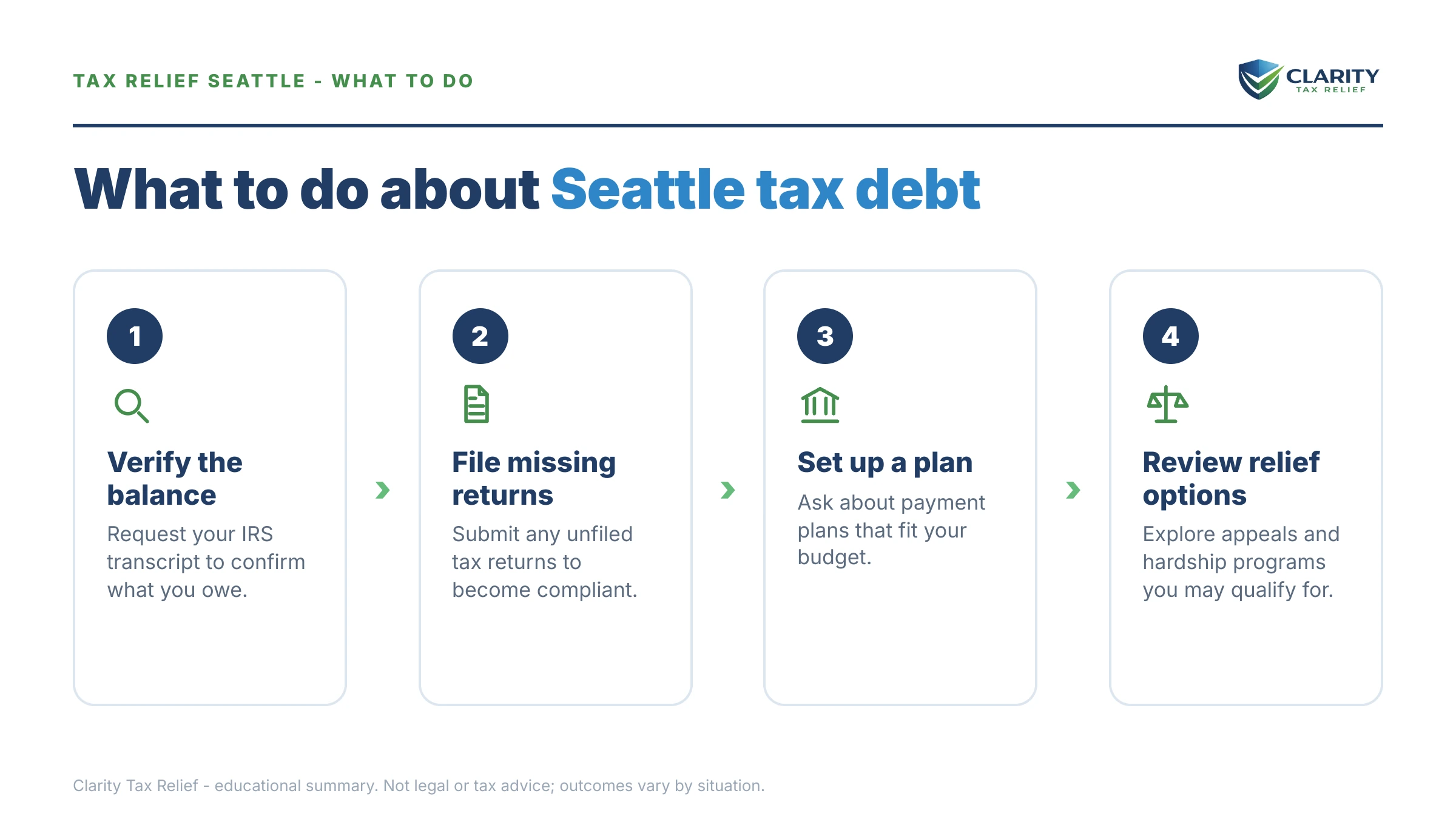
- Pull your IRS records — log into your IRS online account to see every balance, year by year, plus penalties and interest — before you trust any letter or any salesperson.
- File any missing returns — the IRS won't approve a payment plan or an offer while required returns are unfiled. Filing also stops the 5%-per-month failure-to-file penalty, which is 10 times the late-payment penalty — though in months where both penalties apply, the failure-to-file portion drops to 4.5% (5% combined).
- Match your balance to a program — under $50,000 with steady W-2 income usually means an online installment agreement; genuine hardship points to Currently Not Collectible; low assets and low disposable income may point to an Offer in Compromise.
- Set it up before the next notice arrives — payment plans for balances under $50,000 can be set up online at IRS.gov, usually in under an hour. An active agreement stops the escalation sequence.
- Get a professional review for levies, multiple years, or offer math — if a levy is in motion, several years are unfiled, or you're weighing an Offer in Compromise, have an experienced tax professional run the numbers before you commit.
The official starting points are IRS.gov/payments and the IRS payment plans page — every legitimate plan runs through them, and no third party gets you terms the IRS doesn't offer directly.
When Seattle taxpayers can handle this themselves — and when help changes the outcome
You do not need to hire anyone if you agree with the balance, owe under about $25,000, and can afford the streamlined monthly payment. The online agreement takes less than an hour, the setup fee is modest, and no firm can negotiate a "better" streamlined plan — the terms are formulaic.
Experienced help earns its fee in specific situations: a wage or bank levy already in motion (a professional knows the release paths and the financial-statement math the IRS will accept), multiple unfiled years (the order you file and resolve them changes the total), business debt involving the DOR or payroll taxes, and any Offer in Compromise — where a wrong asset valuation or expense claim wastes months and the application fee. In 2026's understaffed IRS, a practitioner line and a properly filed power of attorney also simply get answers faster than you can on hold.
If money is tight, free help exists: the University of Washington's Federal Tax Clinic is Seattle's Low Income Taxpayer Clinic and represents qualifying lower-income taxpayers at no charge, and the Taxpayer Advocate Service can intervene when a collection action causes hardship or a case is stuck.
Choosing a tax relief company in Seattle
Seattle is a heavily-marketed metro for national tax relief advertising, and the same screening rules apply here as anywhere: your case will be worked by phone and upload regardless of the firm's zip code, so judge credentials and pricing, not the address. Insist on an enrolled agent, CPA, or tax attorney actually assigned to your file, a flat fee in writing, and a refusal to quote "savings" before anyone has reviewed your transcripts — anything else is a red flag. Our checklist on how to choose a tax relief company covers the full vetting process, our breakdown of how much does tax relief cost shows what fair pricing looks like, and if you're comparing the big advertisers, start with our review of Optima Tax Relief alternatives.
One phrase should end any sales call instantly: "pennies on the dollar." That pitch describes an Offer in Compromise as if it were routine — it isn't. The IRS accepted roughly 1 in 5 offers in FY2024, acceptance is pure math on your assets and income, and a firm that promises settlement before seeing your financials is guessing with your money.
Terms you'll see on IRS letters, decoded
- Lien vs. levy: a lien is a legal claim against your property that protects the IRS's position; a levy is the actual taking — from a bank account, paycheck, or asset.
- CSED: the Collection Statute Expiration Date — the IRS generally has 10 years from assessment to collect, though appeals, offers, and bankruptcy pause the clock.
- CDP rights: your Collection Due Process rights — a formal hearing you can request within 30 days of a final levy notice using Form 12153, which pauses levy action while it's pending.
- Reasonable Collection Potential: the IRS's math for what it could ever collect from you — asset equity plus a multiple of monthly disposable income — and the number an Offer in Compromise must beat.
- Tax warrant: the Washington DOR's version of a lien — a state-court filing that establishes its claim; a different animal from any IRS notice.
Tax relief in Seattle: your questions, answered
Does Washington having no state income tax mean I only deal with the IRS?
For W-2 wages, yes — Washington has no personal income tax, so there is no state income-tax return and no state agency collecting on your salary. But if you own a business, the Washington Department of Revenue collects B&O and sales tax and enforces aggressively, and Seattle layers its own city B&O tax on top. Business owners often owe two or three agencies at once.
How much does tax relief cost in Seattle?
If you set up an IRS payment plan yourself online, the only cost is the IRS setup fee — $0 for a short-term plan up to 180 days. Professional representation typically runs from several hundred dollars for a straightforward agreement to a few thousand for an Offer in Compromise or levy release. Get any quote as a flat fee in writing before you sign.
How much of my paycheck can the IRS garnish in Seattle?
Most of it. An IRS wage levy is continuous until released, and only a small exempt amount — based on your filing status and dependents — is protected each pay period. No Washington law limits a federal levy. A bank levy works differently: the bank holds the funds for 21 days before sending them to the IRS, which gives you a short window to negotiate a release.
Can I get an Offer in Compromise if I own a home in Seattle?
You can apply, but Seattle home equity often sinks the math. The IRS counts your equity — typically at about 80% of market value, minus what you owe — toward your Reasonable Collection Potential, and with King County home values that figure frequently exceeds the tax debt. The IRS accepted roughly 1 in 5 offers in FY2024, so run the numbers honestly before paying anyone to file one.
Is there free tax relief help in Seattle?
Yes. The University of Washington's Federal Tax Clinic is a Low Income Taxpayer Clinic that represents qualifying lower-income taxpayers in IRS disputes at no charge. The Taxpayer Advocate Service can also intervene when a case is stuck or a collection action is causing hardship. And a short-term IRS payment plan costs nothing to set up yourself at IRS.gov.
Should I hire a local Seattle tax firm or a national tax relief company?
Credentials and pricing matter more than location. IRS collection cases are resolved by phone, fax, and document upload — not by visiting an office — so a strong national firm and a strong local one do identical work. What matters: an enrolled agent, CPA, or tax attorney actually assigned to your case, flat-fee pricing in writing, and no promised savings before anyone has seen your financials.
Does IRS tax debt expire after 10 years?
Generally, yes — the IRS has 10 years from the date a tax is assessed to collect it, a deadline called the CSED. But the clock pauses during an Offer in Compromise, bankruptcy, and certain appeals, so the real date is often later than year ten. Waiting it out rarely works as a plan, because levies and lien filings continue the entire time.
Your next 24 hours
- Find your real number. Pull the notice date and balance from the most recent IRS letter — or log into your IRS online account if nothing has arrived yet — so you're working from the actual figure, not a guess.
- Gather three things: your last filed return, every IRS letter you've received, and a recent pay stub. That's everything needed to match you to a program.
- Get a free Seattle case review. Use the 2-minute form or call (888) 825-7779 — penalties and interest accrue every month you wait, and an experienced tax professional can tell you in one call whether you even need to hire anyone.
This guide is general information, not tax or legal advice for your specific situation. Eligibility for IRS programs depends on individual facts and circumstances; no outcome is guaranteed.