
Business & Payroll Tax Debt
S Corp Reasonable Salary Back Taxes: What Reclassification Costs and How to Fix It (2026)
The short answer: S corp reasonable salary back taxes arise when the IRS decides your officer salary was too low and reclassifies your distributions as wages. The corporation then owes 15.3% employment tax on the reclassified amount, plus deposit penalties and interest — but appeal rights, payment plans, and penalty relief can shrink or restructure the bill.
You built the company, ran real payroll for your employees, and paid yourself the way your bookkeeper or an online forum suggested — a small salary, the rest in distributions. Now an IRS exam letter says your officer compensation was "unreasonably low," and the proposed adjustment reads like a second mortgage. The sinking feeling is normal. The situation is also more fixable than the letter makes it sound, because a reclassification bill has three separate pressure points — the tax, the penalties, and the timeline — and each one can be worked.
If you're wondering how the IRS even noticed you, the image below shows exactly where the salary-versus-distribution mismatch sits in your own filings — and why an examiner can spot it in minutes.
⏱ The clock that matters: if you're holding an exam report or 30-day letter, the response date printed on it — typically 30 days — controls your right to appeal before the tax is assessed. If the tax is already assessed, there is no single deadline, but interest compounds daily and the 0.5%-per-month failure-to-pay penalty keeps stacking until you act.
Why the IRS says your S corp owes back taxes on your salary
The IRS can reclassify S corporation distributions as wages whenever an owner performed substantial services but took an unreasonably low salary. The incentive it's policing is simple: W-2 wages carry 15.3% in combined Social Security and Medicare (FICA) taxes, while S corp pass-through profit and distributions carry none. Every dollar you shift from salary to distributions saves 15.3 cents in employment tax — which is exactly why examiners test the split.
The tell is right on your Form 1120-S. Line 7, "Compensation of officers," sits on page one; your distributions appear on Schedule K. When line 7 shows $0 — or a token figure like $12,000 — next to six figures of profit and distributions flowing to an owner who obviously runs the business full time, the return practically flags itself. No whistleblower needed.
This isn't a gray area the IRS occasionally loses. Its authority to recharacterize owner distributions as wages goes back decades, and federal courts — including the well-known Watson case involving a CPA who paid himself $24,000 while taking far larger distributions — have consistently sided with the government when the salary didn't match the work. The fight worth having is usually over how much should be reclassified, not whether reclassification is allowed.
Note what this problem is not: it's not an unpaid 1120-S balance, unfiled K-1 income, or a missed quarterly deposit. Those are covered in our broader guide to s corp back taxes. This page is specifically about the reasonable-compensation adjustment — the one that converts money you already took out of the company into a payroll tax bill.
How much a reclassification actually costs: the math
A reasonable-compensation adjustment is priced in four layers: employment tax, deposit penalties, late-payment additions, and daily-compounding interest. Because the reclassified amounts were never run through 941 back taxes-style payroll filings, the corporation typically also owes corrected W-2s and amended employment tax returns for each affected year.
Here's a clearly hypothetical example built the way examiners actually build them. Say the IRS reclassifies $65,000 of your distributions as wages for each of two years — $130,000 total:
- Combined FICA at 15.3% × $130,000 = $19,890 (employer share plus employee share, both assessed to the corporation)
- Failure-to-deposit penalty at the 10% tier ≈ $1,989
- Interest, compounding daily from each quarter's original due date ≈ $5,620 (estimate)
- Total assessment ≈ $27,500
| Component | How it's figured | Amount |
|---|---|---|
| Combined FICA | 15.3% × $130,000 reclassified wages (employer + employee shares) | $19,890 |
| Failure-to-deposit penalty | Tiered penalty (2/5/10/15%) on undeposited employment tax — 10% tier shown | $1,989 |
| Interest (estimated) | Compounds daily from each quarter's original deposit due date | ≈ $5,620 |
| Total assessed | Against the corporation, across two tax years | ≈ $27,500 |
Two wrinkles soften the blow slightly. First, there is usually little or no new income tax — you already paid income tax on that money through your K-1; the reclassification bill is almost entirely FICA plus additions. Second, the employer share of FICA is a deductible business expense, which reduces the corporation's pass-through income for those years and can generate a modest income-tax offset when returns are corrected. Neither wrinkle erases the bill, but both matter when you're deciding how hard to fight and how to fund the resolution. To rough out your own penalty-and-interest exposure before the next notice lands, you can estimate it with our IRS penalty & interest calculator.
One trap to avoid: the failure-to-deposit penalty applies to the FICA/withholding side of payroll, not federal unemployment tax — if your exam letter mixes 941 and 940 periods, the two are calculated and resolved differently, as explained in our guide to 941 vs 940 back taxes.
What happens if you ignore a reclassification bill
An unanswered reasonable-compensation adjustment moves from a proposal you can appeal to a levy-backed corporate debt — and then, potentially, to a personal assessment against you. The sequence is automated; in 2026, with IRS staffing down roughly 27%, humans are harder to reach but the notice machine never paused. Here's the order it runs in:
- Exam and proposed adjustment. An examiner questions officer compensation and issues a report recomputing your payroll — often via a Letter 950, the 30-day letter. This is your one pre-assessment window to protest to IRS Appeals.
- Assessment. If you don't respond or the appeal fails, the tax, deposit penalties, and interest post to the corporation's account and become legally collectible.
- Balance-due billing. The bill arrives as a business notice such as a CP161 notice. Interest and the failure-to-pay addition accrue monthly from here.
- Intent to levy. A CP504B notice warns that the IRS intends to levy — it can take the corporation's state refund and is positioning to reach business assets.
- Final notice. A final notice of intent to levy (LT11 or Letter 1058) starts a 30-day clock and your Collection Due Process rights via Form 12153. After it expires, the IRS can levy the business bank account and accounts receivable.
- The personal track. If the corporate debt sits unpaid, the IRS can pursue the trust fund portion against you individually — a Letter 1153 proposing the Trust Fund Recovery Penalty, with a 60-day protest window.
| Stage | What it does | Your window |
|---|---|---|
| Letter 950 / exam report | Proposes the wage reclassification before assessment | 30 days to protest to Appeals |
| CP161 (or similar bill) | Bills the assessed tax, penalties, and interest | Pay-by date printed on the notice |
| CP504B | Intent to levy — state refund seizure authorized | Date printed on the notice |
| LT11 / Letter 1058 | Final notice — levy on bank accounts and receivables follows | 30 days; CDP hearing via Form 12153 |
| Letter 1153 (TFRP) | Proposes assessing the trust fund portion against you personally | 60 days to protest |
The stage you're at determines which rights you still hold. Every window that closes removes a cheaper way out — Appeals is free, a CDP hearing pauses levy action, and a TFRP protest is the last stop before the debt becomes personally yours.
Facing an S corp salary reclassification right now?
Whether you're inside a 30-day appeal window or already getting CP504B-level collection notices, the order you respond in changes what you pay. Send us the letter — an experienced tax professional will map your exact stage, your remaining rights, and your cheapest path out. Free and confidential.
Your options for resolving S corp reasonable salary back taxes
Every reclassification case resolves through one of six paths, and eligibility for each is means-tested or timeline-tested — none is automatic. The general playbook for negotiating with the IRS is covered in our guide to how to settle tax debt yourself; here is how each option applies to a corporate payroll assessment specifically:
| Option | Typically fits when | Key terms & limits |
|---|---|---|
| Appeal / protest | You're inside the 30-day (or 60-day TFRP) window and the salary was defensible | Free; can cut the reclassified amount, not just delay it; interest keeps accruing during review |
| Pay in full | The corporation can cover the balance | Stops the failure-to-pay penalty and the notice sequence immediately |
| Business installment agreement | Operating business with steady cash flow | Payroll-type balances face tighter rules; current deposits must stay perfect; interest continues |
| Penalty abatement | Clean prior compliance or reasonable cause (e.g., relied on a professional's salary advice) | Removes penalties, not tax; AEP begins automating some relief in summer 2026 |
| Business offer in compromise | The corporation genuinely cannot pay from assets, income, and receivables | $205 fee; 20% down on lump-sum offers; strict review — roughly 1 in 5 offers of all types accepted in FY2024 |
| Currently Not Collectible | Business closed or in genuine hardship | Pauses collection; debt and interest remain; TFRP against individuals can still proceed |
Dispute first, pay second. Reasonable compensation is one of the few back-tax issues where the underlying number is genuinely negotiable — Appeals routinely lands between the examiner's figure and yours when you bring real comparability data. If the window has closed, audit reconsideration can sometimes reopen the number, though it's discretionary.
If the amount is right and payment is the issue, a monthly arrangement is the workhorse. The mechanics and thresholds for a business IRS installment agreement differ from personal plans, and because reclassified FICA includes trust-fund-type amounts, the IRS applies the stricter in-business rules described in our business payroll tax payment plan guide — including the non-negotiable condition that current-quarter deposits stay on time throughout the plan. General IRS terms are published on the IRS payment plans page.
Penalty relief punches above its weight in these cases. Owners who set their salary on a CPA's or payroll provider's written advice have one of the stronger reasonable-cause arguments the IRS recognizes; the process for payroll-specific relief is covered in 941 penalty abatement. And a business OIC — settling the corporate debt for less — is real but rare; see business offer in compromise for what the IRS actually requires before it will accept less than full payment. No option on this list guarantees a particular outcome; each turns on the corporation's documented finances.
When the corporation's debt becomes yours personally
An S corporation's reclassified payroll debt can follow the owner personally through the Trust Fund Recovery Penalty. The trust fund portion — withheld income tax and the employee share of FICA — can be assessed against any "responsible person" who willfully failed to pay it over, and an owner who signs the checks is the textbook responsible person. Dissolving the corporation doesn't cut this thread; it often accelerates it.
The personal track has its own paper trail: a revenue officer may schedule a Form 4180 interview to establish who controlled the money, followed by a Letter 1153 proposing the penalty — with a 60-day window to protest. Do not walk into a 4180 interview cold; the answers you give there decide whether the debt attaches to you, your spouse-officer, or your bookkeeper. State agencies can run a parallel play: California's EDD, for example, conducts its own worker-and-wage assessments with its own personal-liability rules, entirely separate from the IRS's numbers.
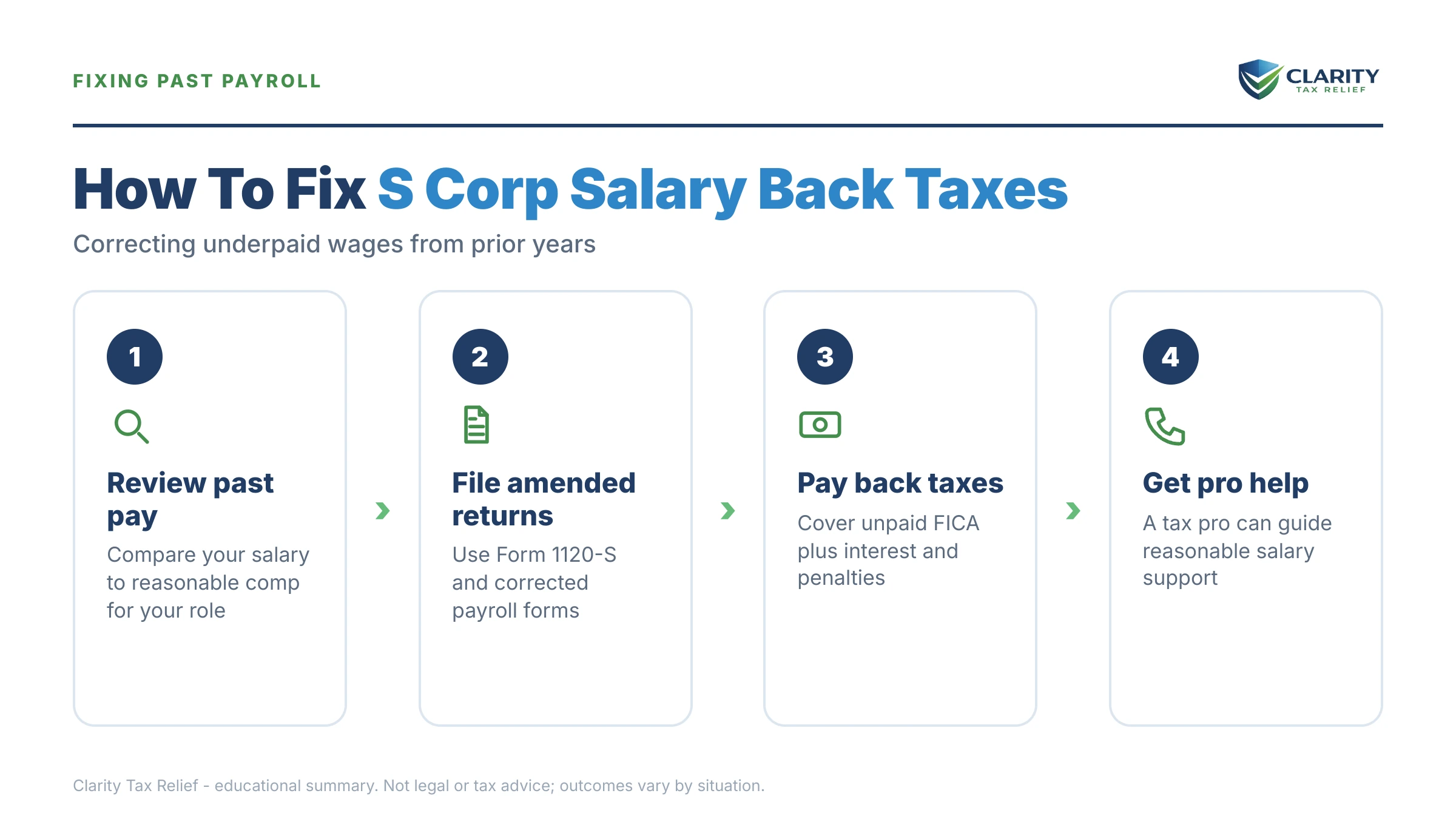
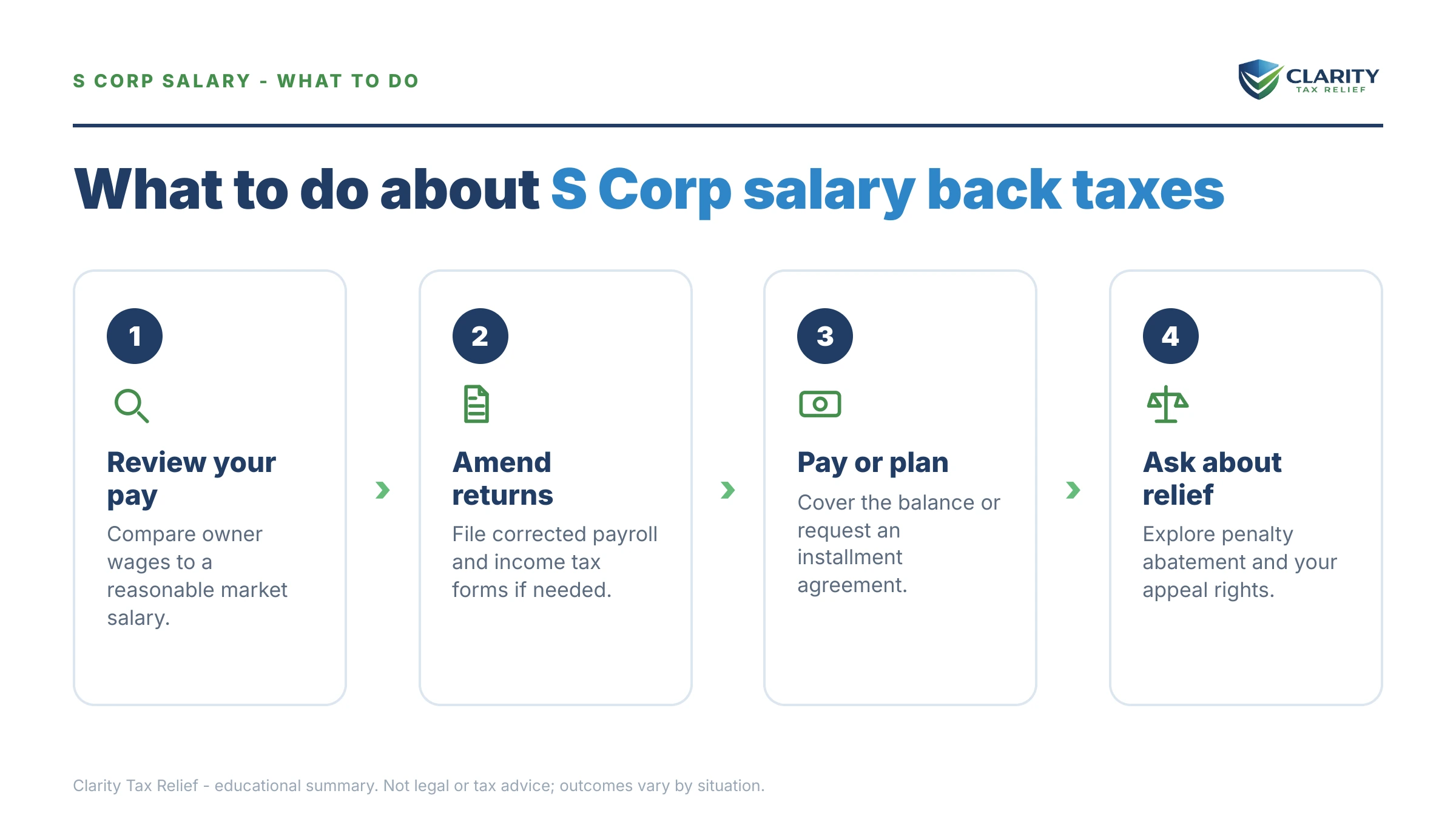
How to respond, step by step
- Identify the letter and its date. Read the top of the notice: an exam report or 30-day letter still carries appeal rights, while a CP-series bill means the tax is already assessed and you're in collections.
- Verify the numbers. Pull the corporation's account transcripts and match the reclassified wage amounts, tax periods, and penalties against your 1120-S filings and payroll records.
- Gather your compensation evidence. Collect your duties, hours worked, comparable salary data for your role, and what you paid non-owner employees for every year in the adjustment.
- Pick your resolution path. Appeal within the printed window if the salary was defensible; otherwise set up payment on the corporate balance and request penalty relief in writing.
- Fix the current year. Start running a documented, defensible W-2 salary now with on-time deposits so new quarters don't feed the same problem.
- Get experienced help for TFRP or levy threats. If a revenue officer, Form 4180 interview, or levy notice is in play, have an experienced tax professional step in before you respond.
Setting a defensible salary going forward
Reasonable compensation is what a comparable business would pay a non-owner to do your actual job — not a ratio, not a rule of thumb. The "60/40 split" you'll see repeated online appears nowhere in the tax code, IRS guidance, or case law; a formula split can be simultaneously too low for a full-time owner-operator earning strong profits and needlessly high for a mostly passive owner. Examiners and courts weigh factors like these:
- What you actually do: hours worked, whether you're the rainmaker, and how many hats you wear (operations, sales, admin).
- Market pay for the role: what similar businesses in your area pay managers or professionals doing comparable work.
- Your own payroll: paying yourself less than your best employee while working more hours is hard to defend.
- Training and experience: licenses, credentials, and years in the trade push the market number up.
- The salary-to-distribution pattern: a token salary next to large, regular distributions is the classic red flag.
The single most valuable move for the future is a written reasonable-compensation analysis — documented comparability data supporting your number, prepared before you file, not after the exam letter arrives. The IRS's own framing of the issue is published at S corporation compensation and medical insurance issues, and it reads exactly like the factor list above. A defensible current-year salary also does quiet work on the old years: it demonstrates good faith for penalty relief and makes the IRS far more comfortable approving a payment plan.
Want a second set of eyes on your salary number and your penalty case before the next notice lands? An experienced tax professional can pressure-test both in a free case review — or call (888) 825-7779.
When you can handle this yourself — and when help changes the outcome
Plenty of reclassification cases are safely DIY. You can likely handle it alone if: the adjustment covers one year and a modest amount you can pay within about 180 days; you agree the salary was too low and just need a payment arrangement on the corporate balance; or your only ask is penalty abatement with a clean three-year history. The IRS also offers free help — the Taxpayer Advocate Service can intervene when the system itself is causing harm, though it won't argue your compensation number for you.
Experienced help tends to change outcomes in five situations: a multi-year reclassification where comparability evidence can cut the assessed wages themselves; an open 30-day window where an Appeals protest needs to be built properly the first time; any Form 4180 interview or Letter 1153, because TFRP exposure is personal and largely irreversible once assessed; a levy already threatened against the business account or receivables; and unfiled 941s layered under the reclassification, where filing order affects both penalties and the statute. The dividing line is whether the number itself is still in play — if it is, representation usually pays for itself in the adjustment, not just the payment terms.
Terms on your notices, decoded
- Reasonable compensation: the wage a comparable business would pay a non-owner to perform the services you actually performed.
- Officer compensation (Form 1120-S, line 7): the salary line examiners compare against your distributions — the origin point of most of these exams.
- Reclassification: the IRS recharacterizing money you took as distributions into W-2 wages, triggering employment tax on it.
- FICA: combined Social Security and Medicare taxes — 15.3% total on wages, split between employer and employee shares.
- Trust fund taxes: the withheld income tax and employee FICA the law treats as held in trust for the government — the portion that can become personally yours.
- TFRP (Trust Fund Recovery Penalty): the mechanism that assesses those trust fund amounts against responsible individuals when the corporation doesn't pay.
- Failure-to-deposit penalty: the tiered 2/5/10/15% penalty on employment taxes that weren't deposited on schedule.
S corp reasonable salary questions, answered
Can the IRS reclassify my S corp distributions as wages?
Yes. When an S corporation owner performs substantial services but takes little or no salary, the IRS has long-standing authority to recharacterize distributions as wages, and courts have consistently upheld it. The reclassified amount becomes subject to the full 15.3% in Social Security and Medicare taxes, plus deposit penalties and interest, assessed against the corporation.
What is a reasonable salary for an S corp owner?
There is no IRS dollar figure or percentage. Reasonable compensation is what a comparable business would pay someone else to do your job — based on your duties, hours, experience, and local market pay for that role. A part-time passive owner can justify a low salary; a full-time owner-operator generally cannot. Documented comparability data is what holds up in an exam.
Is the 60/40 salary-to-distribution rule real?
No. The "60% salary / 40% distributions" rule is a myth — it appears nowhere in the tax code, IRS guidance, or case law. Examiners test your salary against market pay for your actual duties, not against a ratio. A formula split can be simultaneously too low for a high-earning owner-operator and needlessly high for a passive investor.
How far back can the IRS go on reasonable compensation?
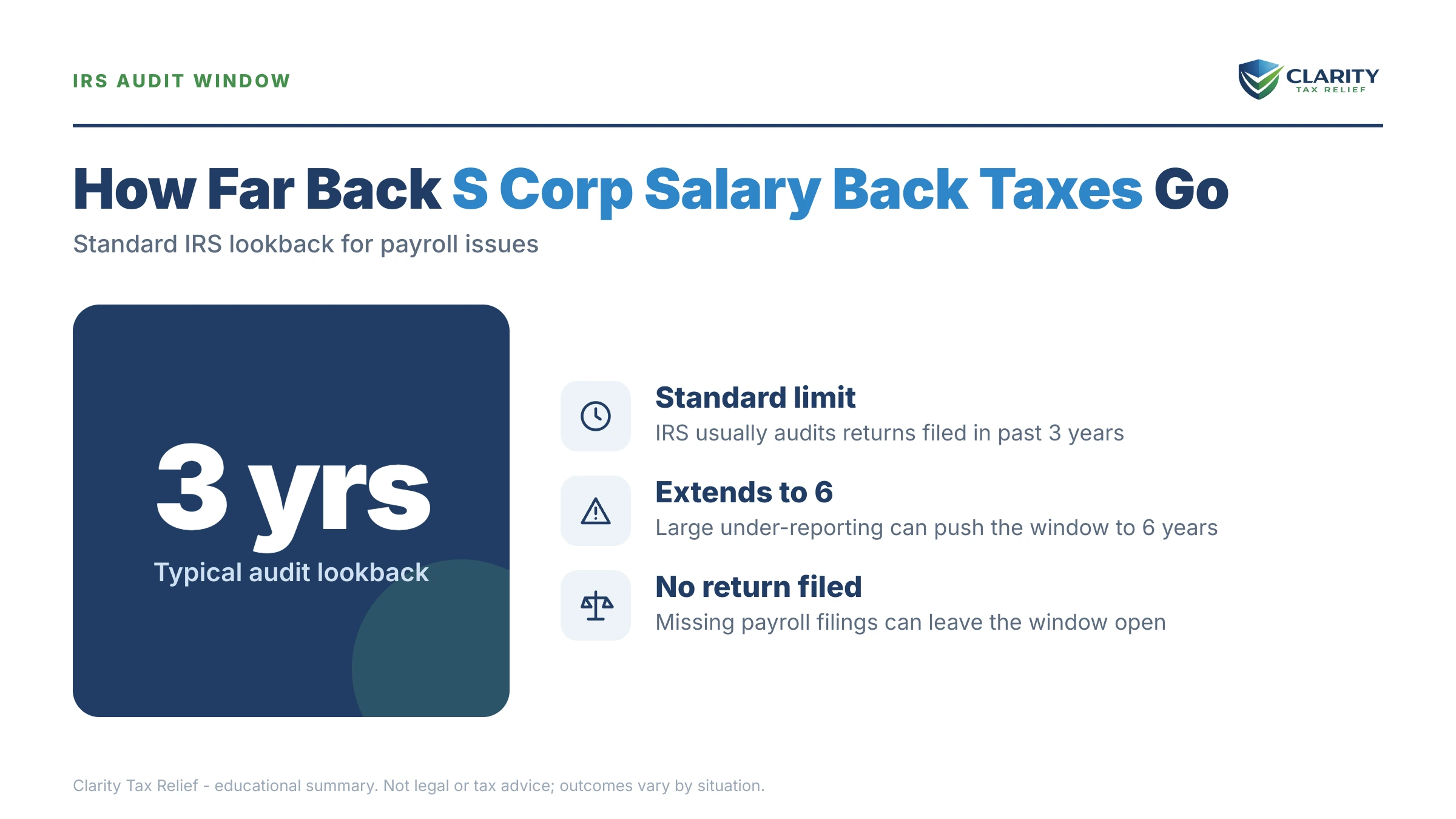
Generally three years from the date each employment tax return was filed, which is why most reclassification exams cover two or three years at once. The window extends if returns were never filed or in cases involving fraud. Once the tax is assessed, the IRS then has ten years to collect it.
Am I personally liable for my S corp's reclassified payroll taxes?
The assessment lands on the corporation first, but the trust fund portion — withheld income tax and the employee share of FICA — can be assessed against you personally through the Trust Fund Recovery Penalty if it goes unpaid. Owners who sign checks and control finances are the primary targets. Closing the corporation does not erase that personal exposure.
Do I owe income tax again on wages the IRS reclassifies?
Usually not in any significant amount — you already paid income tax on that money through your K-1. The real cost is the 15.3% employment tax, plus penalties and interest. In fact, the employer share of FICA is deductible, which slightly reduces the corporation's pass-through income, so the income-tax side can produce a small offset.
Can I settle S corp reasonable salary back taxes for less than the full amount?
Only through a business offer in compromise, and the bar is high: the IRS must conclude the corporation genuinely cannot pay from assets, income, and receivables. The application carries a $205 fee and, for lump-sum offers, a 20% down payment, and roughly one in five offers of all types were accepted in FY2024. Penalty abatement is often the more realistic reduction.
Will paying myself a salary now fix past years?
No — prior-year assessments stand on prior-year facts. But starting a defensible W-2 salary with on-time deposits immediately does three things: it stops the problem from compounding into new periods, it strengthens reasonable-cause penalty arguments by showing good faith, and it makes the IRS far more willing to approve a payment plan for the old balance.
Does an S corp owner need a salary if the business lost money?
If the corporation genuinely had no profit and you took no distributions, a zero salary is generally defensible — the reasonable-compensation issue arises when money flows to an owner who performed services. If you took distributions in a loss year while working full time, that money is still exposed to reclassification. Document the down year carefully.
Can the penalties on reclassified payroll taxes be removed?
Often, yes. Reasonable cause — including documented reliance on a CPA or payroll professional's advice about your salary — is the strongest argument for abating failure-to-deposit and late-payment penalties. First-time abatement can apply if the prior three years were clean, and starting in summer 2026 the IRS's Automatic Exemption from Penalty applies some relief without any request.
Your next 24 hours
- Find the letter type and response date. The top of the notice tells you whether you're pre-assessment (Letter 950 — appeal rights alive) or in collections (CP161, CP504B) — and the printed date tells you how much runway is left.
- Gather the file. Pull your 1120-S returns and K-1s for the adjusted years, payroll records for every employee including you, distribution records, and any written salary advice from your CPA or payroll provider.
- Get the free case review. Interest compounds daily and each notice stage removes an option — send us the letter through the 2-minute form or call (888) 825-7779 and an experienced tax professional will map your cheapest path while your best windows are still open.
This guide is general information, not tax or legal advice for your specific situation. Eligibility for IRS programs depends on individual facts and circumstances; no outcome is guaranteed.