
IRS Letters
IRS Letter 950: The 30-Day Letter, Your Appeal Rights, and What to Do (2026)
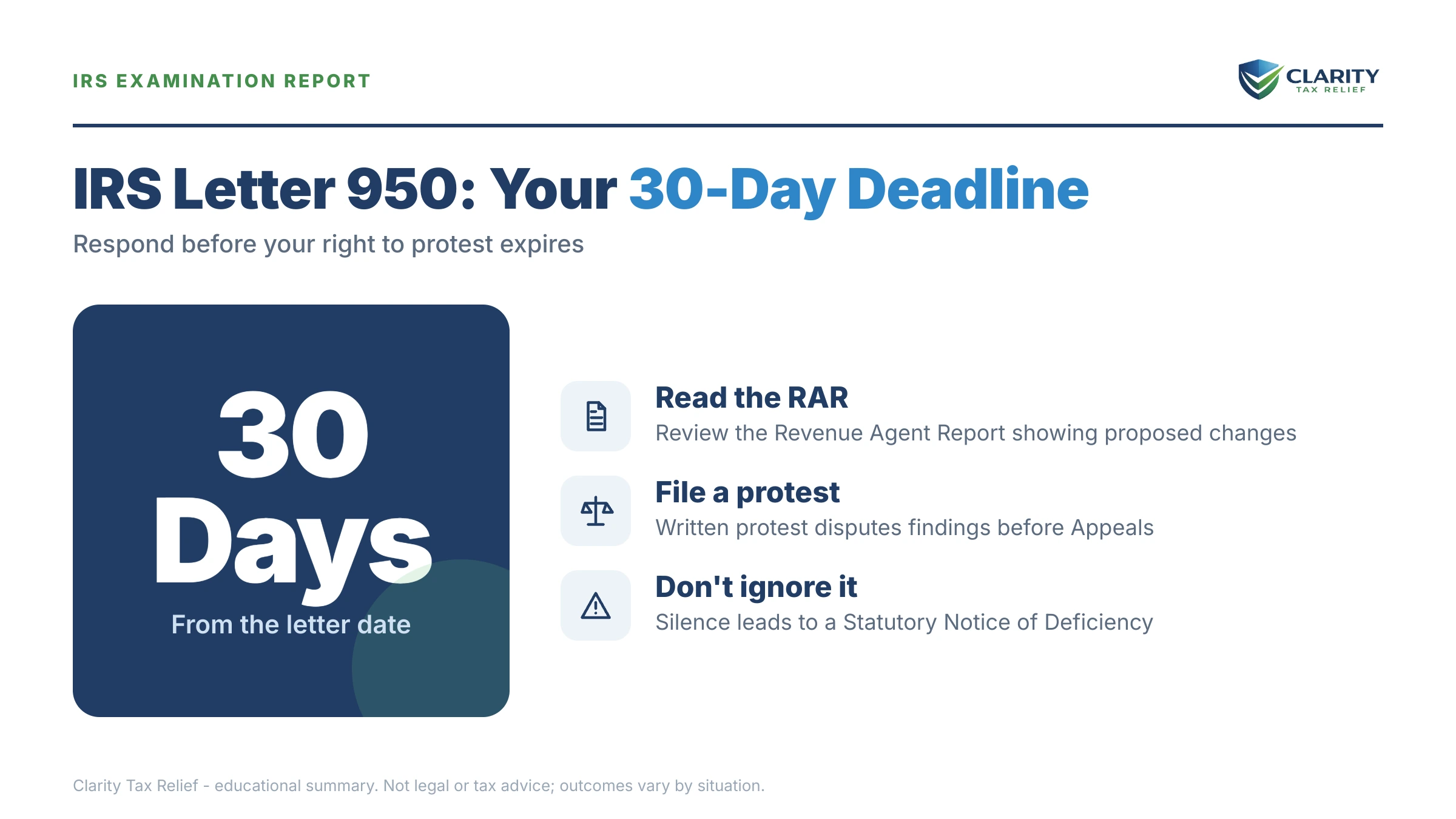
The short answer: Letter 950 is the IRS "30-day letter" sent after an audit. It transmits the examination report (Form 4549) proposing additional tax, and gives you 30 days from the letter date to agree — or file a protest asking the IRS Independent Office of Appeals to review the findings before anything is assessed.
The audit is over, the examiner's report landed in your mailbox, and page one of the attachment says the IRS wants $41,800 you don't have — and if you rent, you already know a levy wouldn't come for a house, it would come for your paycheck and your bank account. Take a breath: nothing on this letter can be seized. Letter 950 is the one stage where the number itself is still up for argument, and the next 30 days decide in which room you get to make that argument.
The image below shows exactly what a Letter 950 packet looks like and where to find the two things that matter most: the letter date that starts your 30-day clock, and the total on the attached exam report.
⏱ Your deadline: you have 30 days from the date printed on Letter 950 to agree with the exam report or file your protest. The clock runs from the letter date — not the day it arrived. Miss it, and the case moves to a statutory Notice of Deficiency, where your options get more formal and more expensive.
Why you got Letter 950 — and what's inside the envelope
Letter 950 means an IRS examination of your return has closed and the examiner did not accept it as filed. The letter itself is just a cover page. The substance is in the attachments: Form 4549 (Income Tax Examination Changes — the exam report, often called the Revenue Agent's Report or RAR) showing each proposed adjustment and the tax, penalty, and interest that flow from it, and Form 886-A (Explanation of Items) explaining the examiner's reasoning for each change.
Letter 950 typically follows a field or office examination. If your audit ran by mail, you may see the closely related Letter 525 audit report instead — same 30-day appeal rights, different exam channel. Businesses that never filed can get a parallel 30-day proposal via Letter 1085. (For a map of how any IRS letter fits into the bigger picture, see why did I get a letter from the IRS.)
Two things Letter 950 is not. It is not a bill — no tax has been assessed, so there is no balance the IRS can collect yet. And it is not final — the proposed numbers become real only if you agree in writing or let every response window expire.
One more thing to watch for in the packet: if the assessment deadline for the audited year is getting close, the examiner may also ask you to sign Form 872, a consent extending the IRS's time to assess. That decision has real strategic consequences — don't sign it reflexively.
Reading the report: where a $41,800 proposed deficiency comes from
Every dollar on a Form 4549 traces to a specific adjustment, and the penalty and interest lines are computed from the tax line — which means shrinking the tax shrinks everything else.
Say your Letter 950 proposes $41,800, broken down like this (hypothetical, but typical of how these reports read):
- $33,000 additional tax — the examiner disallowed unsubstantiated deductions and added a 1099 that never made it onto the return.
- $6,600 accuracy-related penalty — the 20% accuracy-related penalty applied to the tax: 20% × $33,000 = $6,600.
- Roughly $2,200 interest — computed through the report date, and still growing every day after it.
Here's why that breakdown matters for your protest. Because the penalty rides on the tax, every adjustment you knock out in Appeals removes the tax and 20 cents of penalty per dollar and the interest on both. Get $15,000 of the tax conceded — say, by producing the bank records the examiner never saw — and the proposal drops by $15,000 tax + $3,000 penalty + the interest tied to them: roughly $19,000 of movement from one documented issue. The penalty itself is also independently contestable on reasonable-cause and good-faith grounds, even when the tax stands. You can estimate how penalties and interest grow on your own numbers with our Penalty & Interest Calculator.
And if the full $41,800 eventually assessed? At that size you'd still be under the $50,000 line for an online streamlined installment agreement — about $580/month over 72 months ($41,800 ÷ 72), with interest and the late-payment penalty continuing to accrue on top. That's the fallback. The point of the 30-day window is to fight the number before it ever becomes a debt.
What happens if you ignore Letter 950
If you don't respond to Letter 950 within 30 days, the IRS issues a statutory Notice of Deficiency — and from there, the path runs straight toward assessment and collection. The sequence is automated and it does not skip steps, but it does not stop on its own either:
- Days 1–30: the Letter 950 window. You can agree, protest to Appeals, send new documentation to the examiner, or request an extension. Every option is still on the table.
- The 30 days pass: the case is forwarded for a statutory Notice of Deficiency — usually a CP3219A or Letter 531. That notice starts a 90-day Tax Court clock (150 days if it's addressed to you outside the U.S.).
- The 90 days pass: the tax is assessed. Now it's a real debt — the failure-to-pay penalty starts running, interest continues, and a bill for the full balance arrives.
- The bills go unanswered: collection notices escalate, a federal tax lien becomes possible, and eventually a final notice of intent to levy — Letter 1058 or LT11 — arrives with its own 30-day warning.
- Only after all of that: the IRS can levy. For a renter, that means the assets you actually have — your paycheck and your bank account — not real estate. But that moment is many notices and many months away from where you stand today.
Each window in that sequence protects a specific right, and each right disappears when its window closes:
| Notice / stage | Response window | The right you keep by acting |
|---|---|---|
| Letter 950 (30-day letter) | 30 days from the letter date | Pre-assessment review by the Independent Office of Appeals — no court, no petition fee, no paying first |
| Notice of Deficiency (CP3219A / Letter 531) | 90 days (150 if addressed outside the U.S.) | Petition the U.S. Tax Court before the tax is assessed or paid |
| First bill after assessment | Pay-by date printed on the notice | Set up payment arrangements before collection notices escalate |
| LT11 / Letter 1058 (final notice) | 30 days from the notice date | Collection Due Process hearing (Form 12153) before any levy |
Missing the 30 days is not fatal — the Notice of Deficiency still gives you Tax Court rights, and docketed cases are frequently routed back to Appeals anyway. But you'd be arguing the same facts later, under court deadlines, with more interest attached. The 30-day window is the cheapest, least formal chance you will ever get to change these numbers.
Holding a Letter 950 right now?
Your 30-day protest window is already running. Send us the letter and the Form 4549 that came with it — an experienced tax professional will tell you which adjustments are worth fighting and which protest format your numbers require. Free, confidential, before the deadline closes.
Your options for responding to Letter 950
You have five realistic ways to answer a Letter 950, and one number — $25,000 in disputed adjustments per tax period — decides which appeal format the IRS requires:
| Option | When it fits | What it requires — and what follows |
|---|---|---|
| Agree — sign Form 4549 | Every adjustment and penalty checks out against your records | Your signature. The tax is assessed, a bill follows, and you waive Appeals and Tax Court on those items |
| Small case request (Form 12203) | Disputed total is $25,000 or less for each tax period | A short form listing each disputed item and why you disagree; case goes to Appeals |
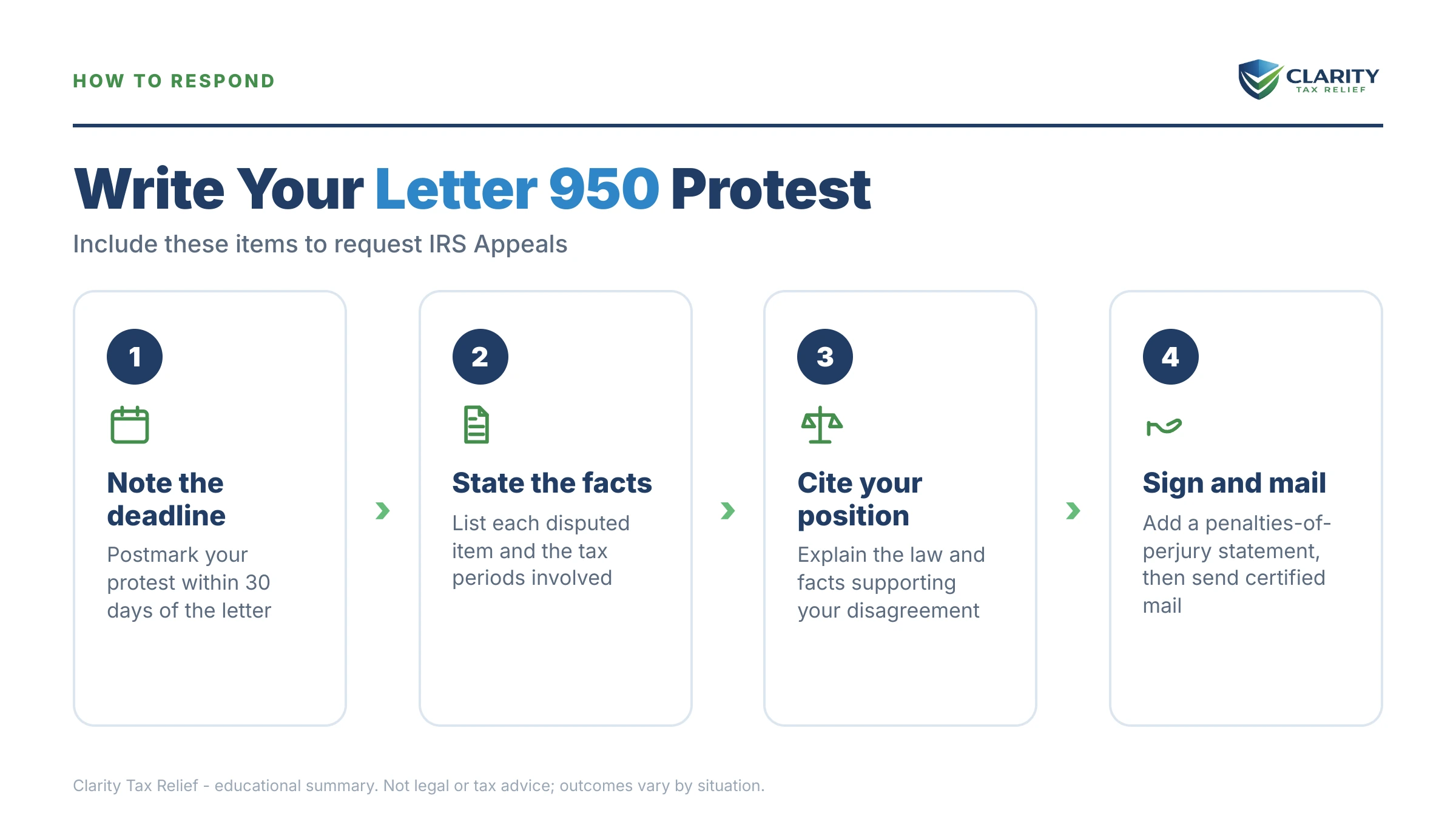
| Formal written protest | Disputed total exceeds $25,000 (a $41,800 report lands here) | A signed statement of the disputed adjustments, facts, and law, declared under penalties of perjury; case goes to Appeals |
| Send new documentation to the examiner | You have records the auditor never saw | A cover letter plus the records, delivered before the 30 days run — the examiner can revise the report without any appeal |
| Do nothing | Almost never | Nothing — a Notice of Deficiency follows and the 90-day Tax Court clock starts |
If your disputed amount clears the $25,000 line, the formal written protest must identify each adjustment you contest, state the facts supporting your position, cite the law or authority you rely on, and carry a declaration under penalties of perjury that the facts are true. A protest that just says "I disagree" gets bounced; a protest that documents one adjustment well can move real money. Form 12203 handles the small-case route with far less formality.
Why Appeals is worth the paperwork: the Independent Office of Appeals is separate from the exam team that audited you, and it evaluates cases on the hazards of litigation — the odds the IRS would lose on each item in court. That means Appeals can settle issues the examiner had no authority to move on, including splitting an adjustment where the evidence cuts both ways. Be clear-eyed about the cost, though: interest keeps accruing the entire time your case sits in Appeals, so a protest is an investment that has to earn more than the interest it costs.
One distinction worth knowing: Letter 950 covers income tax exam findings. If the IRS is proposing to hold you personally liable for a business's payroll taxes, the parallel proposal letter is Letter 1153 — a different letter with a different (60-day) protest clock. Don't apply this article's deadline to that letter, or vice versa.
How to respond to Letter 950, step by step
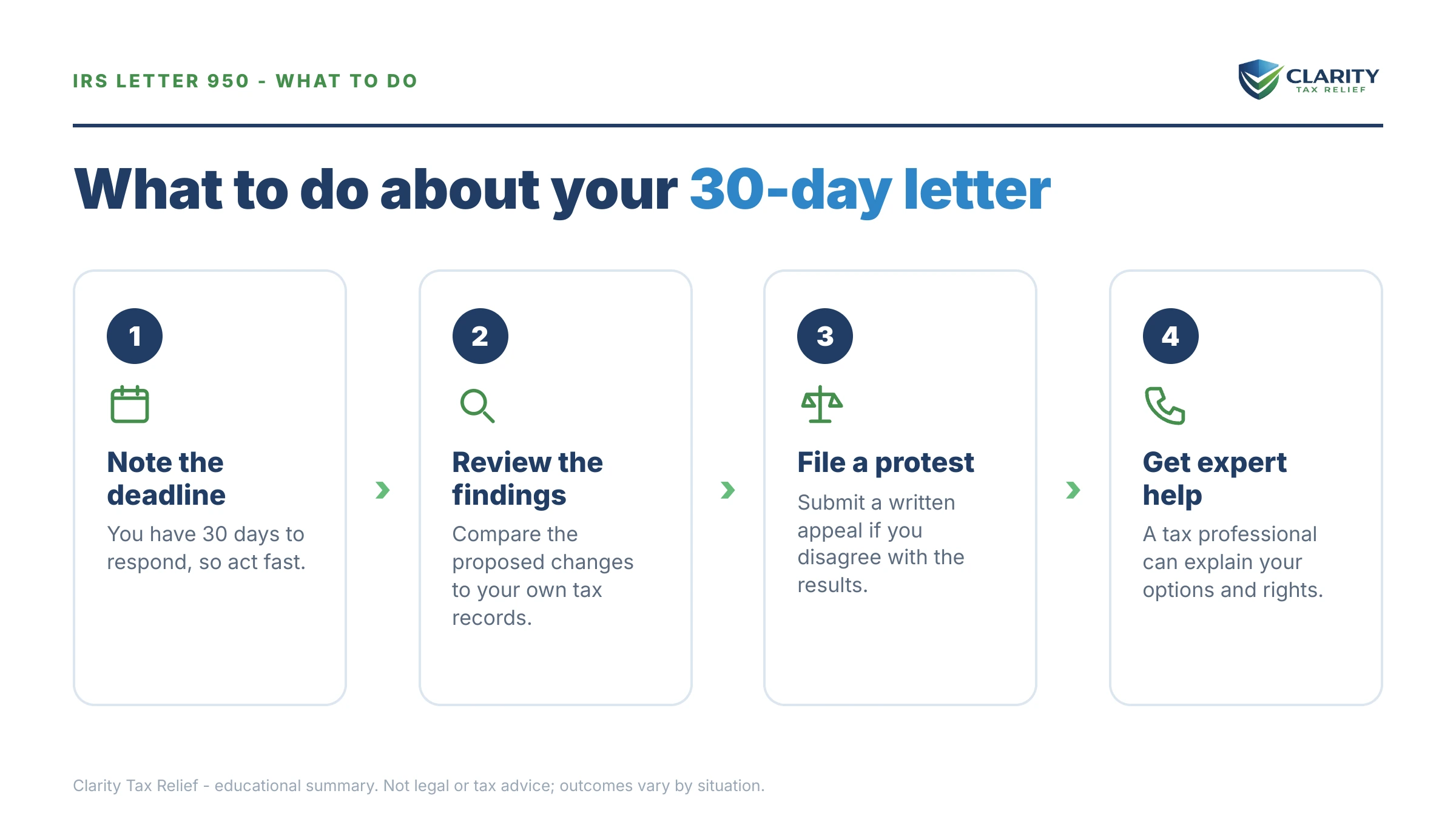
- Find the letter date. Your 30 days run from the date printed at the top of Letter 950 — not the day you opened the envelope. Count forward and write the deadline down.
- Read Form 4549 line by line. Mark every adjustment as agree, disagree with records in hand, or disagree but need records — your disputed total decides which appeal format you must use.
- Choose your response format. Sign Form 4549 if the report is right; file Form 12203 if your disputed total is $25,000 or less per tax period; write a formal protest if it's more.
- Mail it to the address on the letter. Send everything certified mail with return receipt requested, and keep a complete copy of the packet you send.
- Request an extension in writing if you need one. Examiners often grant more time, but only if your request lands before the original 30 days expire.
When you can handle this yourself
Plenty of Letter 950 responses don't need professional help, and it's worth being honest about which ones. You can reasonably go it alone when the report is simply correct — you check every adjustment against your records, the math holds, and your move is to sign and arrange payment (pay in full at IRS.gov/payments or set up a plan). The small-case route is also genuinely DIY-friendly: Form 12203 was designed for taxpayers representing themselves on disputes of $25,000 or less with clean documentation and a single year at issue.
Experienced help changes outcomes in the harder configurations: a disputed total over $25,000, where the formal protest has to argue facts and law and a drafting mistake can get it rejected; multiple audited years stacking on one report; an accuracy-related penalty worth contesting separately on reasonable cause; Schedule C or business-records reconstruction; a Form 872 statute-extension request you're not sure you should sign; or any case you might realistically take to Tax Court, where the protest you file now shapes the record later. On a $41,800 proposal, the gap between a well-built protest and a thin one is routinely measured in five figures.
And if a deadline has already slipped past you and you can't get traction with the IRS on a genuine hardship, the Taxpayer Advocate Service exists for exactly that. Even after assessment, audit reconsideration can reopen exam findings when you have new documentation — harder than protesting on time, but not hopeless.
Terms on your Letter 950, decoded
- Form 4549 (RAR): the examination report attached to Letter 950 — the line-by-line list of proposed adjustments and the tax, penalties, and interest computed from them.
- Form 886-A: the "Explanation of Items" — the examiner's written reasoning for each adjustment, and your roadmap for what to rebut.
- Formal written protest: the signed, penalties-of-perjury statement of disputed items, facts, and law required when your disputed total exceeds $25,000 for a tax period.
- Independent Office of Appeals: the IRS division, separate from the exam team, that reviews protested cases and can settle them — the agency's own overview is at IRS.gov/appeals.
- Hazards of litigation: Appeals' settlement yardstick — the probability the IRS would lose each disputed item if the case went to court.
- Notice of Deficiency: the statutory "90-day letter" that follows an unanswered Letter 950, giving you 90 days to petition the U.S. Tax Court before the tax is assessed.
Letter 950 questions, answered
What is IRS Letter 950?
Letter 950 is the IRS's "30-day letter" — it arrives after an examination closes and transmits the exam report (Form 4549) proposing changes to your return. It is not a bill; the tax has not been assessed yet. It gives you 30 days to agree with the report or file a protest asking the IRS Independent Office of Appeals to review the findings.
What happens if I don't respond to Letter 950 within 30 days?
The IRS moves to a statutory Notice of Deficiency — usually a CP3219A or Letter 531 — which gives you 90 days to petition the U.S. Tax Court. If you let that window pass too, the tax is assessed and billing begins. You don't lose everything by missing the 30 days, but you lose the cheapest forum: an Appeals conference before anything is assessed.
Can I get an extension on the Letter 950 deadline?
Often, yes. Examiners frequently grant a written extension request if it arrives before the 30 days expire — call the number on the letter, then confirm in writing. Never assume an extension is automatic: if the deadline passes without a granted extension or a filed protest, the case moves toward a Notice of Deficiency, and interest keeps accruing either way.
Do I need a formal written protest, or can I use Form 12203?
It depends on the disputed amount. If the total you disagree with is $25,000 or less for any single tax period, you can use the simpler small case request (Form 12203). Above $25,000, the IRS requires a formal written protest — a signed statement listing each disputed adjustment, the facts, and the law you rely on, made under penalties of perjury.
Should I just sign Form 4549 and agree?
Sign only if you have verified every adjustment and every penalty on the report. Signing Form 4549 waives your right to Appeals and to Tax Court on those items; the tax is assessed and billing starts. If the numbers are right and you simply can't pay, signing and then setting up a payment plan is a reasonable path — but check the accuracy-related penalty first, because it is frequently the most contestable line on the report.
Does interest keep adding up while my appeal is pending?
Yes. Interest runs from the original due date of the return until the balance is paid, and it does not pause during an Appeals review or a Tax Court case. That is the real cost of a weak protest filed just to buy time. A strong protest can still be worth months of interest many times over if it removes adjustments or penalties.
Can the IRS levy my bank account or wages because of Letter 950?
No — not at this stage. A levy requires an assessed tax, a demand for payment, and a final notice of intent to levy (Letter 1058 or LT11) with its own 30-day warning. Letter 950 comes before any of that; the tax isn't even assessed yet. If you respond on time, you can fight the numbers before collection ever starts.
Your next 24 hours
- Find the letter date at the top of Letter 950 and count 30 days forward. Write that date somewhere you'll see it — it is your protest deadline, and it doesn't move on its own.
- Gather the full packet: Letter 950, Form 4549, Form 886-A, your filed return for the audited year, and whatever records support each adjusted item — bank statements, receipts, the 1099s.
- Get the report reviewed free before your 30-day window closes. Use the 2-minute form or call (888) 825-7779 — an experienced tax professional will tell you what's worth protesting and how, while protesting is still the cheap option.
This guide is general information, not tax or legal advice for your specific situation. Eligibility for IRS programs depends on individual facts and circumstances; no outcome is guaranteed.