
IRS Forms
Form 872: Should You Sign the IRS Statute of Limitations Extension? (2026)
The short answer: Form 872 is a voluntary consent that gives the IRS more time — beyond the normal 3-year deadline — to assess tax for a year under audit. You can sign it as written, sign a restricted version that limits the issues and the date, or refuse. Refusing usually triggers an immediate Notice of Deficiency for the full proposed amount.
Your auditor just slid Form 872 across the table — or dropped it in the mail — and asked you to give up the one deadline that was quietly working in your favor. If the IRS is already levying you for a different year, handing the government more time feels insane. Sometimes it is. Sometimes it's the smartest move on the board. This guide shows you how to tell the difference before you sign.
Form 872 is a single page, and two entries on it decide everything: the tax period being extended and the expiration date typed into the consent. The image below shows you exactly what the form looks like and where to look for both before you agree to anything.
⏱ Your controlling date: the assessment statute expiration date (ASED) for the audited year — generally 3 years from the date you filed that return. The auditor's cover letter will also print a respond-by date for the consent itself. If you refuse to sign, expect a Notice of Deficiency before the ASED — and that letter starts a fixed 90-day Tax Court clock.
Why the IRS is asking you to sign Form 872
Form 872 — "Consent to Extend the Time to Assess Tax" — exists because the IRS is running out of time to finish your audit and legally bill you. Under IRC §6501, the IRS generally has three years from the date a return is filed to assess additional tax. When an exam is still open and that window gets short — commonly under about a year — the examiner is required to protect the statute, and asking you to extend it is the gentlest tool available.
Here's the part the cover letter underplays: you have a legal right to refuse Form 872, or to limit both its length and its scope. Congress wrote that right into the law in 1998, and the IRS's own Publication 1035 is supposed to accompany every extension request to explain it. The consent is a negotiation, not a demand.
The request also isn't an accusation. In 2026, with the IRS workforce down roughly 27% from 2025 cuts, document-heavy exams routinely crawl past the statute simply because no one is staffed to finish them. A cash business audit reconstructing deposits, or an ERC audit working through payroll quarters, can easily burn two years on its own.
What Form 872 extends — and what it doesn't
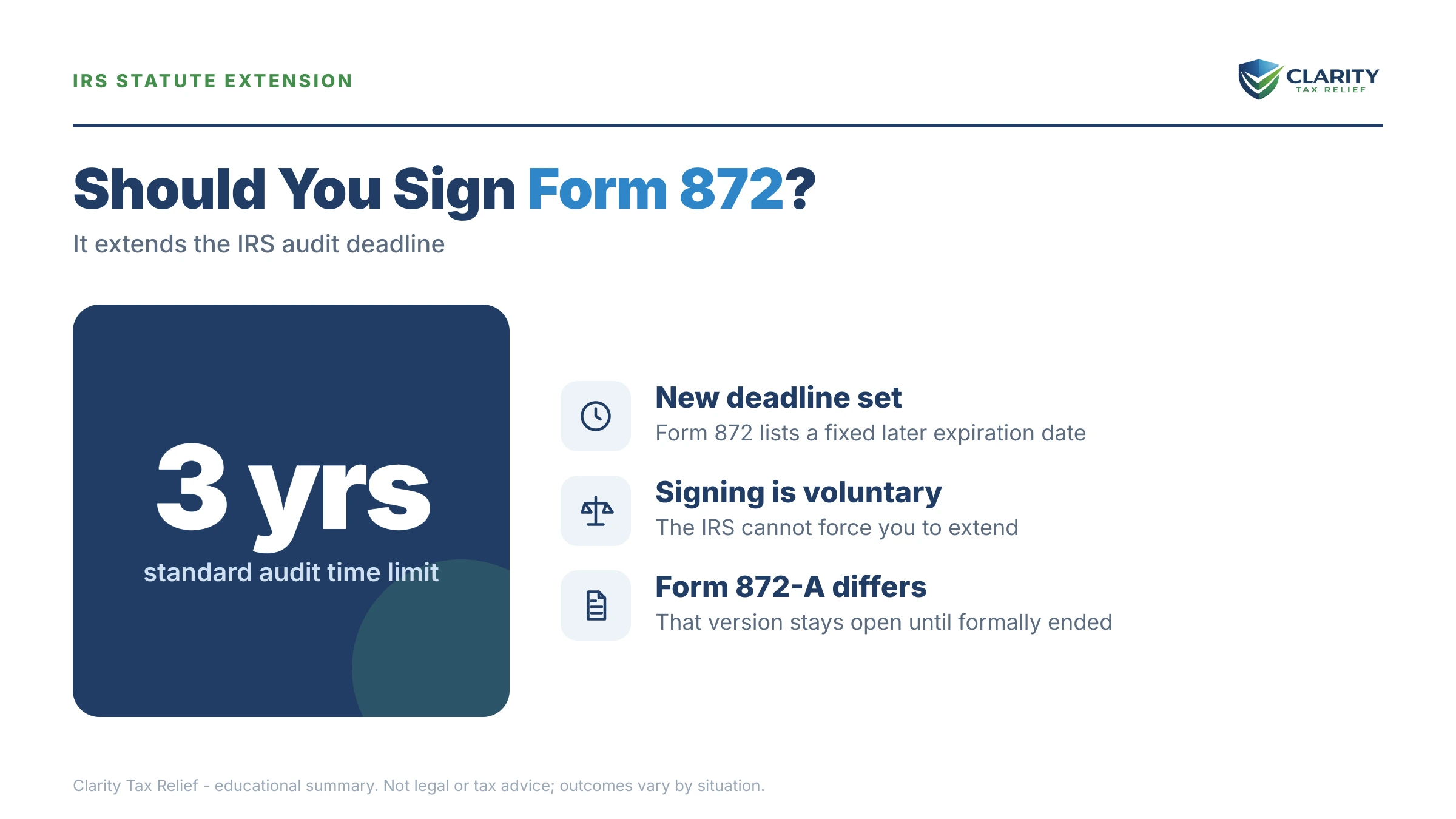
Form 872 extends exactly one thing: the IRS's deadline to assess tax for the listed year — nothing about your audit's outcome, your payment obligations, or the IRS's collection powers.
Three consequences follow, and each one matters to your decision:
- It does not extend the collection statute. The 10-year collection clock (CSED) is a separate law that doesn't start until tax is actually assessed. Signing 872 delays the assessment — which means the eventual 10-year collection statute starts later and ends later, too.
- It extends your refund window in parallel. Under §6511(c), the same consent stretches your deadline to claim a refund for that year, generally to six months past the extended assessment date. If the audit ends up showing you overpaid, the consent protects you.
- It does nothing about interest. Interest on any tax ultimately due runs from the return's original due date whether you sign or not. More months open means more interest if you lose — which is why a Section 6603 deposit (covered below) belongs in this conversation.
Signing is also not an admission that you owe anything. The consent extends a deadline; it concedes zero issues.
How long the IRS normally has to assess tax
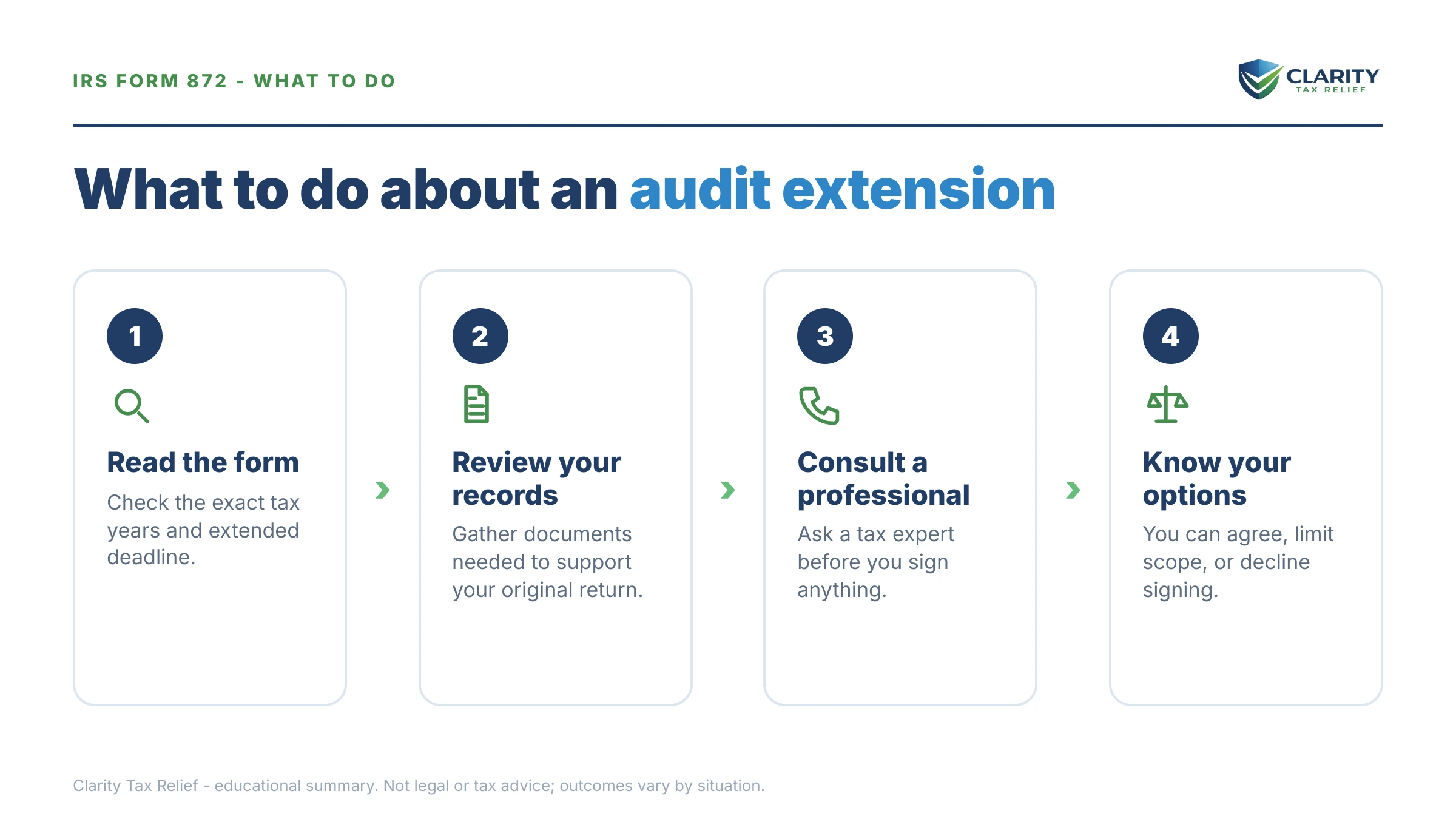
The three-year rule is the default, but your real window depends on what's on — and off — the return. For the full picture of lookback rules, see how far back the IRS can audit; here's the short version that determines whether Form 872 even matters:
| Your situation | Assessment window | What it means for Form 872 |
|---|---|---|
| Filed a substantially accurate return | 3 years from filing (or the due date, if you filed early) | The standard case — extension requests usually arrive in year 2 or 3 of an open exam |
| Omitted more than 25% of gross income | 6 years | The IRS has more runway, so a consent request may signal the exam is deep and serious |
| Employee Retention Credit claims | 5 years for covered quarters — see the ERC statute of limitations | ERC exams have their own clock; a related Form 907 can extend the time to sue on a disallowed claim |
| Fraudulent return, or no return filed | No time limit | There's no statute to extend — if an auditor still wants a consent here, get representation before responding |
One practical warning: verify the date yourself. The clock runs from when you actually filed, so a return filed late in October has an ASED months later than the auditor's shorthand may suggest. You can get your IRS transcript online and confirm the filing date in minutes.
What happens if you refuse to sign Form 872
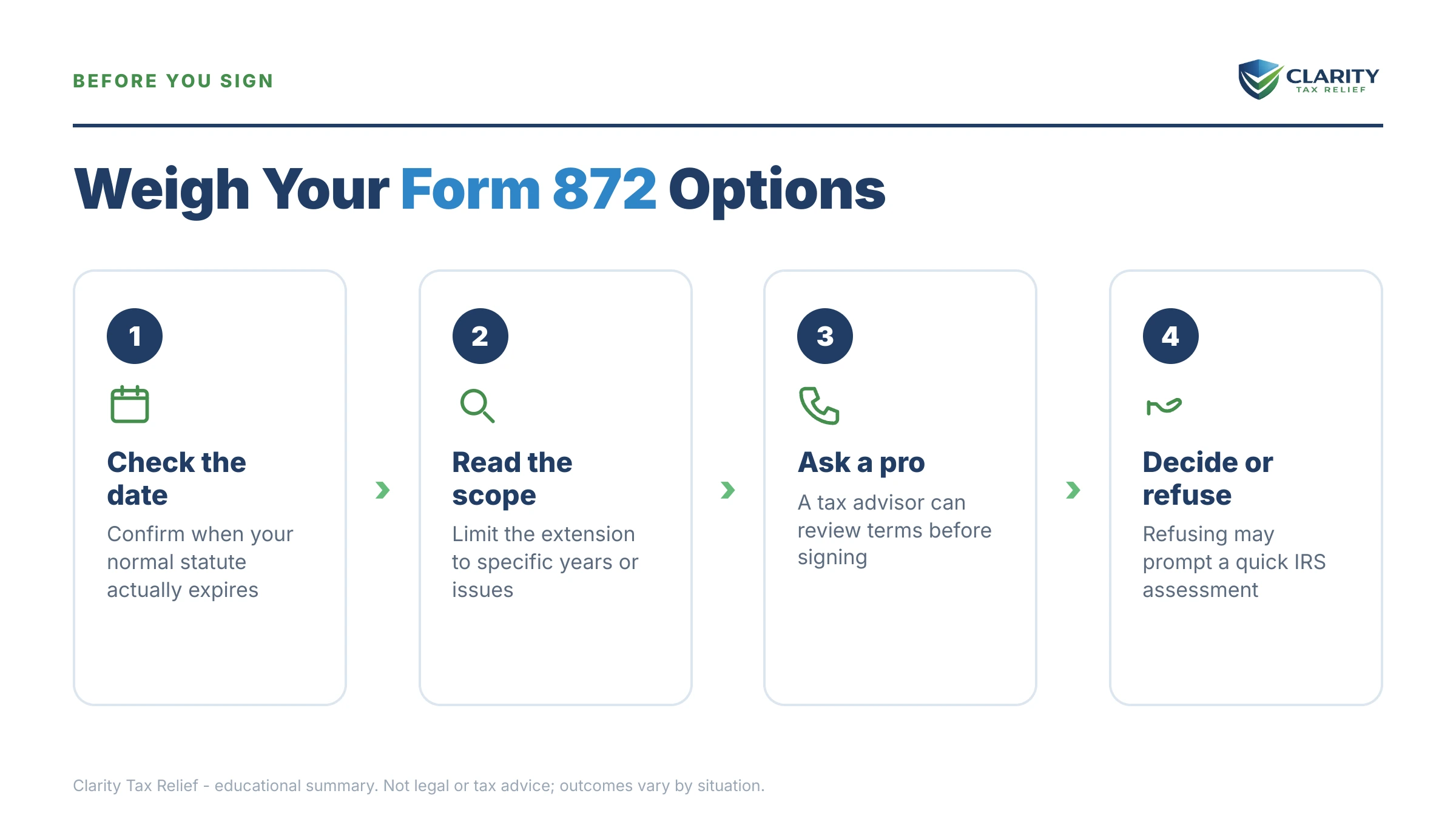
Refusing to sign Form 872 doesn't end the audit — it forces the IRS to act on your file as it stands, before the statute runs out. The sequence is predictable:
- The exam closes on the existing record. Every item you haven't substantiated gets disallowed. The auditor doesn't have time to weigh partial evidence — the file gets written up as-is.
- Appeals usually drops out of reach. The IRS Independent Office of Appeals generally won't accept a case without roughly a year left on the statute. With a short clock, the Letter 950 30-day letter stage — your normal path to an IRS audit appeal — is often skipped entirely.
- A statutory Notice of Deficiency issues. To protect the deadline, the IRS mails a CP3219A Notice of Deficiency (or Letter 531) for the full proposed amount, penalties included.
- The 90-day clock runs. You have 90 days to file a Tax Court petition on the 90-day letter. Miss it, and the tax is assessed automatically — no judge, no appeal of the merits.
- Assessment starts collection. Once assessed, the balance enters the ordinary collection machine: bills, then lien and levy notices, on top of anything the IRS is already collecting from you.
Notice what refusing really trades away: the chance to shrink the number before it becomes official. Tax Court is a real remedy, but you'd be litigating the auditor's worst-case figure instead of negotiating it down first.
Holding a Form 872 you're not sure about?
Don't sign — or refuse — blind. Send us the consent and the auditor's letter, and an experienced tax professional will map your statute date, your leverage, and your best response before the ASED on your request passes. Free and confidential.
Your three options when the consent arrives
Every Form 872 request has exactly three answers, and the right one depends on who needs the time more — you or the IRS.
| Response | What happens next | When it fits |
|---|---|---|
| Sign as written | The exam continues on the auditor's timeline; the year stays fully open to the new date for every issue | You need time to reconstruct records, you want the Appeals path preserved, and the draft is already a reasonable fixed date |
| Sign a restricted consent | Only the named issues stay open; everything else on the return locks in when the original statute expires | Most disputes — one or two open items don't justify keeping the whole return exposed, and a 6–12 month date is almost always enough |
| Refuse | Exam closes on the current file; Notice of Deficiency for the full proposed amount; 90 days to petition Tax Court | The proposed change is small, the positions are fully developed with nothing left to document, or you affirmatively want a judge — not more exam time |
The restricted consent is the underused middle path. You can narrow the extension to the specific unresolved issues — say, the disallowed Schedule C deductions — and set the expiration date yourself. The auditor's draft date is an opening offer, not a mandate. A counterproposal of eight months restricted to two issues gets accepted far more often than nervous taxpayers expect, because the alternative for the examiner is writing up an unagreed case.
Form 872 vs. 872-A vs. 872-T: know which paper you're holding
Not every consent in the 872 family behaves the same, and the open-ended version deserves special caution.
| Form | What it does | Watch out for |
|---|---|---|
| Form 872 | Extends the assessment deadline to a specific, fixed date | Cannot be revoked once countersigned — calendar the date before you sign |
| Form 872-A | Open-ended "special consent" — keeps the year open indefinitely | Interest runs the whole time if tax is due; only ends via Form 872-T or a Notice of Deficiency |
| Form 872-T | Terminates an existing 872-A | The window generally closes 90 days after the IRS receives it — the shutoff isn't instant |
| Form SS-10 | The employment-tax version of the consent, used in payroll exams | Payroll consents can touch personal trust-fund exposure — review before extending anything on 941 issues |
The practical rule: prefer the fixed date, always. An 872-A signed casually in year one of an exam can leave a tax year dangling open for years while interest compounds in the background.
How to respond to a Form 872 request, step by step
- Verify the statute date. Pull your account transcript and confirm the assessment deadline yourself — generally three years from the date you actually filed, not the return's due date if you filed late.
- Get the request in writing. Ask the auditor to state which issues remain open, why more time is needed, and what happens on each item if you decline.
- Negotiate the scope and the date. Propose a restricted consent covering only the unresolved issues, with a fixed expiration date of 6 to 12 months — and decline the open-ended Form 872-A.
- Decide with the stakes in view. Sign when the extra time genuinely helps you document your position; consider refusing when the proposed change is small or fully decided and you are prepared for Tax Court.
- Stop the interest if you'll owe. Send a Section 6603 deposit for the amount you realistically expect to owe so interest stops accruing on it while the audit continues.
- Calendar the new deadline. Keep the countersigned copy, note the exact expiration date, and diary a check-in 90 days before it so you are never asked to extend blind again.
A worked example: $61,200 on the line
Say the auditor's draft report proposes $61,200 in additional tax from disallowed self-employment deductions, plus the 20% accuracy-related penalty of $12,240 — $73,440 before interest. You rent, so there's no home equity in play, but a levy is already running on a different tax year. The statute expires in five months, and the auditor asks you to sign Form 872.
Path one — refuse. The exam closes as written. A Notice of Deficiency arrives for the full $73,440, and you have 90 days to petition Tax Court or the whole amount is assessed on top of the balance already being levied.
Path two — sign an eight-month restricted consent. You spend that time pulling bank statements, invoices, and mileage records, and you substantiate two-thirds of the disallowed deductions. The math changes completely:
- Additional tax drops from $61,200 to roughly $20,400 ($61,200 × ⅓ still unsupported)
- The 20% penalty drops from $12,240 to about $4,080 — and may be contested entirely on the substantiated portion
- Total exposure: about $24,480 instead of $73,440 — roughly $48,960 less
What did the extension cost? Interest on whatever you ultimately owe, for the extra months — at recent federal underpayment rates (adjusted quarterly; see IRS interest rates for 2026), a year of interest on $24,480 runs very roughly $1,700. Sending a Section 6603 deposit for the $20,400 you expect to concede stops even that. You can estimate your own penalty and interest exposure with our Penalty & Interest Calculator. This is a hypothetical, not a promise — but the shape of the trade is real: a small, controllable interest cost against a five-figure documentation opportunity.
If the IRS is already levying you on another year
An active levy on one year does not change the audit clock on another — the two run on separate tracks, and signing Form 872 neither pauses nor worsens the collection already underway.
But the interaction matters more than most articles admit. In the example above, letting a $73,440 assessment land unchallenged on top of an existing levied balance could push your total certified tax debt past $66,000 — the 2026 passport certification threshold — triggering passport certification for tax debt on top of the levy. It also starts a brand-new 10-year collection clock on the audit year the day it's assessed.
The sequencing lesson: shrink the audit number first, then fold every year into one resolution — a payment plan, hardship status, or an offer covering all balances at once. A renter with no seizable assets and a levy already in motion has real leverage in that second conversation, but only after the assessed total is as small as the records allow.
When you can handle Form 872 yourself — and when help changes the outcome
You can reasonably handle a Form 872 decision alone when the stakes are contained: the proposed adjustment is a few thousand dollars, the open issue is a document you simply need time to retrieve, and the consent is a fixed-date form for a single year. Read it, confirm the date and the tax period, counterpropose a shorter window if the draft runs long, and calendar the expiration. Publication 1035 plus the steps above are genuinely enough.
Experienced help changes outcomes in four situations:
- Six-figure proposed adjustments, where drafting a restricted consent and building the substantiation package is the difference shown in the worked example above.
- Any hint of criminal exposure — unreported cash, amended stories, questions about intent. In an eggshell audit, the sign-or-refuse decision has consequences far beyond the tax, and nothing should be signed without counsel weighing in first.
- Business and payroll exams, where an SS-10 employment-tax consent can keep personal trust-fund liability questions open alongside the business issues.
- Multiple years or an active levy, where the order you resolve things — audit first, then collection — changes the total you pay and whether the $66,000 passport threshold ever comes into play.
If the consent on your desk covers a six-figure adjustment or a year with anything you'd rather not explain, have it read before you sign: start a free Form 872 review or call (888) 825-7779.
Terms on your consent form, decoded
- ASED — Assessment Statute Expiration Date: the last day the IRS can legally put additional tax for that year on the books.
- Restricted consent — a Form 872 modified so the extension covers only named issues instead of the entire return.
- Statutory Notice of Deficiency — the letter that formally proposes the tax and gives you 90 days to petition Tax Court before assessment.
- Form 872-T — the notice that shuts off an open-ended 872-A consent, generally effective 90 days after the IRS receives it.
- Section 6603 deposit — money you send the IRS to stop interest on a disputed amount without conceding that you owe it.
- CSED — Collection Statute Expiration Date: the separate 10-year deadline to collect a tax, which starts only once the tax is assessed.
The IRS's own explanation of your extension rights is Publication 1035, Extending the Tax Assessment Period. If an examiner pressures you to sign without explaining your right to refuse or restrict the consent, the Taxpayer Advocate Service exists for exactly that kind of procedural problem. And if you already know you'll owe something, payment and deposit options live at IRS.gov/payments.
Form 872 questions, answered
Do I have to sign Form 872?
No — signing Form 872 is voluntary, and the law requires the IRS to tell you that you can refuse or ask to limit the extension. Publication 1035 spells out that right. Refusing has consequences, though: the IRS will usually protect the deadline by issuing a Notice of Deficiency for the full proposed amount, which starts a 90-day Tax Court clock.
What happens if I refuse to sign Form 872?
The auditor typically closes the exam on the information in the file — disallowing anything you haven't substantiated — and the IRS issues a statutory Notice of Deficiency before the statute expires. You then have 90 days to petition the U.S. Tax Court. Refusing also usually costs you an Appeals conference, because Appeals generally won't take a case without roughly a year left on the statute.
Can I limit what Form 872 covers?
Yes. You can sign a restricted consent that extends the statute only for the specific issues still open, and you can insist on a fixed expiration date rather than an open-ended extension. The IRS's own guidance acknowledges both options. In practice, 6 to 12 months limited to the disputed items is a common negotiated outcome.
What is the difference between Form 872 and Form 872-A?
Form 872 extends the assessment deadline to a specific date you can see and calendar. Form 872-A is open-ended: it keeps the year open indefinitely until you file Form 872-T to terminate it or the IRS issues a Notice of Deficiency. Most taxpayers should avoid the open-ended version — an audit year left open for years accrues interest the entire time if tax is ultimately due.
Does Form 872 extend the IRS's time to collect?
No. Form 872 extends only the assessment window — the time the IRS has to put a tax on the books. The separate 10-year collection statute (CSED) doesn't start until an assessment is actually made, so a later assessment means a later-starting, later-ending collection clock. The two deadlines are different laws with different rules.
Does signing Form 872 extend my refund deadline too?
Yes. Under IRC Section 6511(c), an assessment extension automatically extends your window to claim a refund or credit for that year, generally to six months after the extended assessment period ends. That cuts both ways: if the audit ultimately shows you overpaid, the same consent that helped the IRS preserves your claim.
Can I revoke Form 872 after I sign it?
A fixed-date Form 872 cannot be revoked once both sides sign — the extended date stands. An open-ended Form 872-A can be ended by filing Form 872-T, after which the assessment window generally closes 90 days after the IRS receives it. That difference is a key reason to prefer the fixed-date form.
Is being asked to sign Form 872 a bad sign?
Not by itself — it usually just means the exam won't finish before the three-year deadline, which is routine in document-heavy audits. It becomes a red flag when the exam has criminal undertones: repeated questions about intent, cash, or where the money went. In an eggshell audit like that, never sign anything without representation first.
How long an extension should I agree to on Form 872?
As short as realistically lets the work finish — commonly 6 to 12 months. You are allowed to propose the date; the auditor's first draft is an opening offer, not a mandate. Never accept an open-ended Form 872-A as a default, and match the length to what's actually left: one unresolved issue rarely needs more than a few months.
Your next 24 hours
- Find the two entries that control everything: the tax period listed on the consent and the expiration date typed into it — then compare that date against your own filing date for the year (three years is the default clock).
- Gather your file: the Form 872 and cover letter, the audit report or information document requests, your filed return for that year, and whatever records exist for the disputed items.
- Get the consent reviewed before you respond: the statute date on your request is the real deadline, and your answer is hard to undo. Use the 2-minute form or call (888) 825-7779 for a free, no-pressure review of whether to sign, restrict, or refuse.
This guide is general information, not tax or legal advice for your specific situation. Eligibility for IRS programs depends on individual facts and circumstances; no outcome is guaranteed.