
IRS Audits
ERC Audit: How to Defend Your Employee Retention Credit Claim in 2026
The short answer: an ERC audit is an IRS examination of your Employee Retention Credit claim, usually opened with Letter 6612 demanding proof of eligibility and payroll records. Respond by the date printed on the letter — typically 30 days. A disallowed credit must be repaid with interest, plus a possible 20% penalty.
You claimed the credit because a firm you'd never heard of called your business and said every employer qualified. Now the IRS is auditing that ERC claim, the response deadline is already printed on the letter, and the promoter who kept a cut of your refund isn't returning calls. You're the one on the hook — but you're also the one with real options, and most of them are still open today.
The letter itself tells you a lot before you read a single paragraph: which quarters are under exam, which form opened the case, and where your clock starts. The image below shows exactly what an ERC exam letter looks like and where to find the response deadline and the quarters under review.
⏱ Your deadline: the response date printed on your exam letter — typically 30 days from the letter date. Miss it and the IRS can disallow the entire credit based on the file it already has. If you've already received a Letter 105-C disallowance, a different clock is running: you generally have 2 years from the disallowance date to sue for the credit.
Why the IRS is auditing your ERC claim
The IRS risk-scored its entire inventory of Employee Retention Credit claims and has said publicly that a large share showed signs of being improper. That's the backdrop to your letter: after pausing the processing of new claims in September 2023, the IRS shifted from paying claims to examining them — and ERC exams are now one of the biggest enforcement programs it runs.
Individual claims get pulled for exam when they carry specific risk markers, not at random. The ones that show up over and over:
- Credit size out of proportion to payroll history. A claim that dwarfs the wages ever reported on your Forms 941 is a math problem the computer catches instantly.
- Every available quarter claimed. Genuine eligibility usually comes and goes with lockdowns and revenue swings. Claiming all six quarters at the maximum reads as promoter boilerplate.
- A government-order narrative with no order attached. Vague "COVID impacted our operations" language — especially the supply-chain-disruption theory, which the IRS has said rarely qualifies on its own.
- A known promoter's fingerprints. The IRS tracks preparers, and claims built by firms under investigation get examined in batches. If that's your situation, start with our guide to ERC mill claim problems — the "a promoter filed it" fact pattern has its own playbook.
- PPP overlap and related-party wages. Wages used for PPP loan forgiveness can't also generate ERC, and wages paid to majority owners and certain relatives generally don't qualify. Promoters routinely ignored both rules.
One thing an ERC exam is not: an accusation of fraud. Most examined claims belong to honest business owners — and honest gig workers and sole proprietors — who trusted a pitch. The exam is the IRS asking you to prove what the promoter told you was already proven.
What happens if you ignore an ERC audit
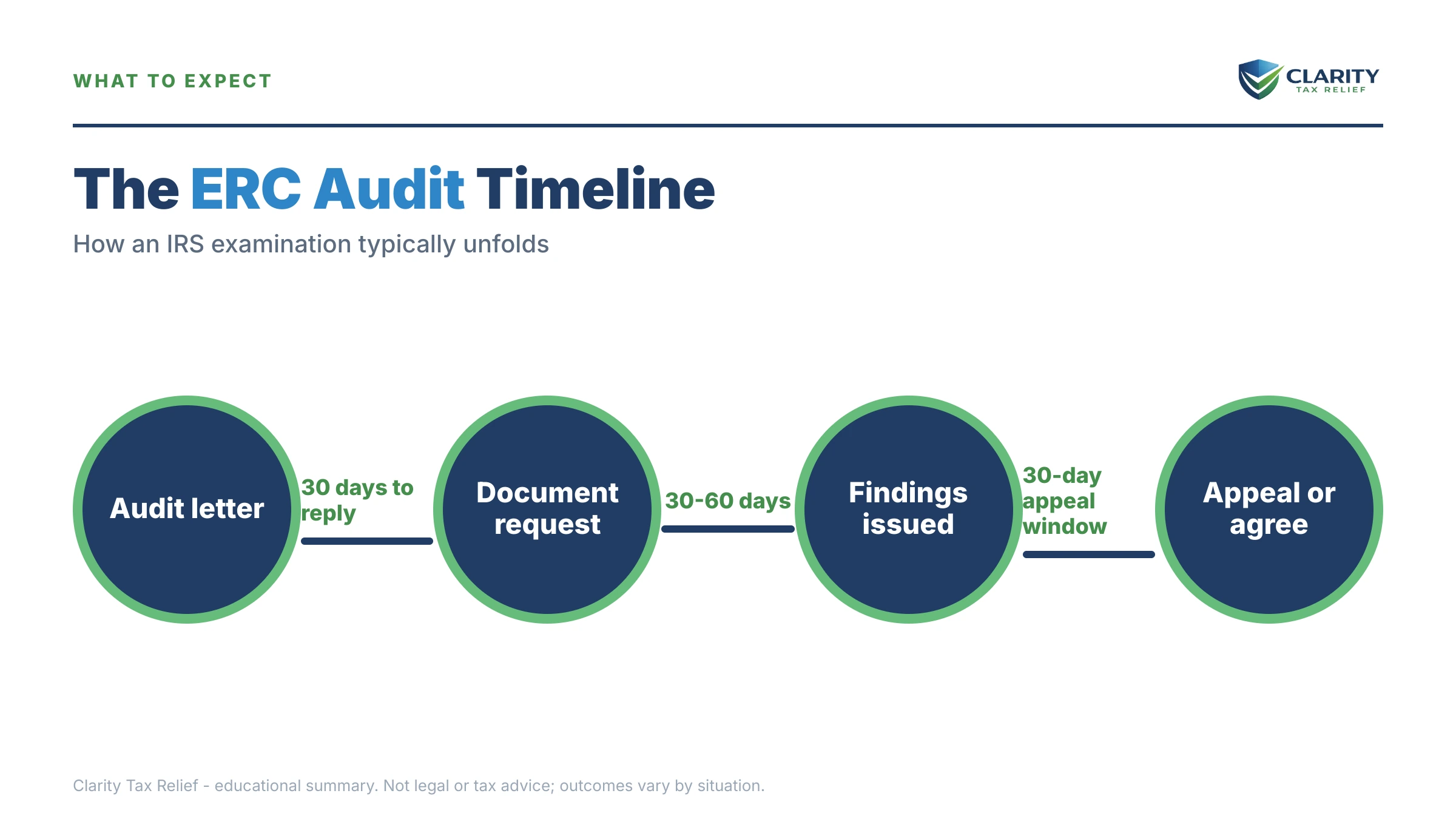
Ignoring an ERC audit converts a documentation request into a full disallowance, a repayable debt, and eventually standard IRS collection against your business. The sequence is mechanical, and each stage costs you a right the previous one still offered:
- Exam letter (usually Letter 6612) goes unanswered. The examiner decides the claim on the file the IRS already has — which, for a promoter-built claim, is usually nothing. You are here, and this is the cheapest stage to act.
- Proposed disallowance. The IRS issues an exam report proposing to deny the credit, with a window to protest to the Independent Office of Appeals. Silence waives that independent review.
- Formal disallowance — Letter 105-C (full) or Letter 106-C (partial). If your refund was never paid, the claim dies here unless you sue within the 2-year window. If it was paid, the IRS moves to take the money back.
- Assessment and recapture. The disallowed credit is assessed on your employment tax account like unpaid 941 tax, with interest running from the day the refund was issued, plus penalties — 20% for an erroneous claim, up to 75% where fraud is proven.
- Collection. Balance-due notices, then a federal tax lien and levies on business bank accounts and receivables — the same machinery that collects any payroll debt. Our guide to what happens when a claim is denied, ERC claim disallowed, covers this back half in depth.
Every stage adds interest, and the later stages replace negotiation with enforcement. IRS staffing is down sharply in 2026, but these letters are generated and escalated by automated systems — nobody at the IRS forgets to send the next one.
| Letter or stage | Your window | The right at stake |
|---|---|---|
| Exam letter (usually Letter 6612) | The response date printed on the letter — typically 30 days | Your chance to substantiate the claim before the IRS decides on the file it has |
| Exam report / 30-day letter | Typically 30 days to file a written protest | Independent review by IRS Appeals without paying first |
| Letter 105-C or 106-C disallowance | 2 years from the disallowance date to sue for the credit — Form 907 can extend it by agreement | Your day in court on eligibility |
| Assessment and balance-due notices | The dates printed on each notice | Payment options before liens and levies; a hearing right at the final levy notice |
Holding an ERC exam letter right now?
Send us a copy before the response date printed on it passes. An experienced tax professional will assess which quarters can actually be defended, which should be conceded, and what your realistic exposure is — free, confidential, no pressure.
Your options at every stage of an ERC exam
An ERC audit has more exits than "win everything" or "repay everything" — and the best one depends on how strong each claimed quarter actually is and whether the refund was ever paid. Match your stage to the table:
| Option | When it fits | What it does |
|---|---|---|
| Substantiate and defend | You have a real gross-receipts decline or a documented government order for the quarters claimed | Keeps the credit; the exam closes with no change |
| Concede weak quarters | Some quarters qualify, others were promoter padding | Preserves the good quarters and shows good faith, which helps against the 20% penalty |
| Withdraw the claim | The refund was never paid, or the check was never cashed | The claim is treated as never filed — no repayment fight, no erroneous-claim penalty on it |
| Protest to Appeals | You disagree with a proposed or issued disallowance | Independent review before litigation — see our ERC disallowance appeal guide for the protest letter itself |
| Refund suit | After a 105-C or 106-C, within the 2-year window | A court, not the examiner, decides eligibility; Form 907 can buy time by agreement |
| Repay on a payment plan | The credit is disallowed and the refund is spent | Converts the recapture into a monthly installment agreement — the full menu is in can't repay ERC |
| Penalty defense | You relied in good faith on a paid preparer or professional advice | Can remove or reduce the 20% penalty even when the credit itself is lost |
Two doors worth knowing about even though they've narrowed: the IRS ran an ERC voluntary disclosure program that let employers repay a discounted amount and skip penalties, but those windows have closed — that guide tracks whether anything reopens. The withdrawal program, by contrast, has remained available for unpaid claims; verify its current status before assuming either way.
How to respond to an ERC audit, step by step
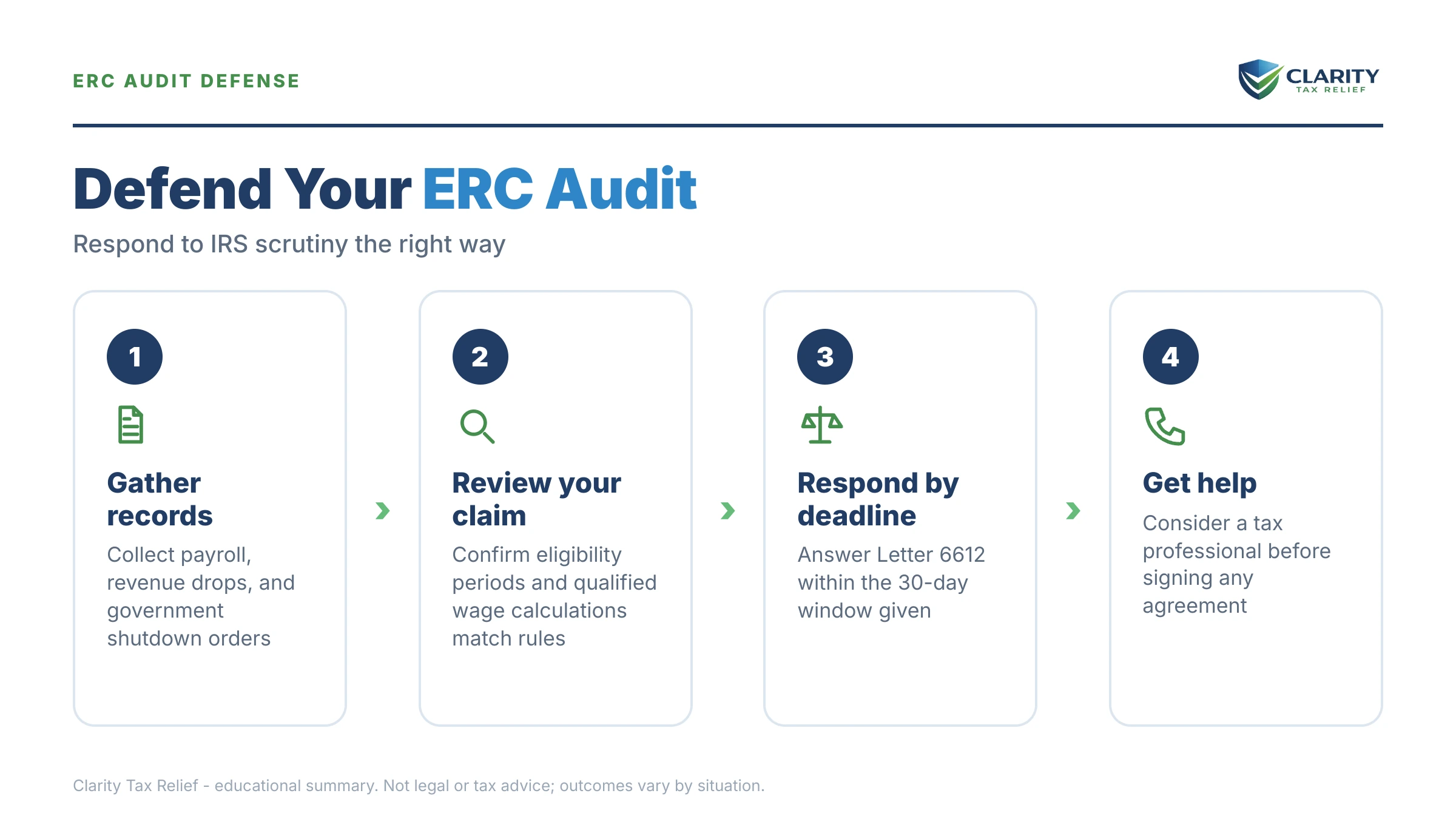
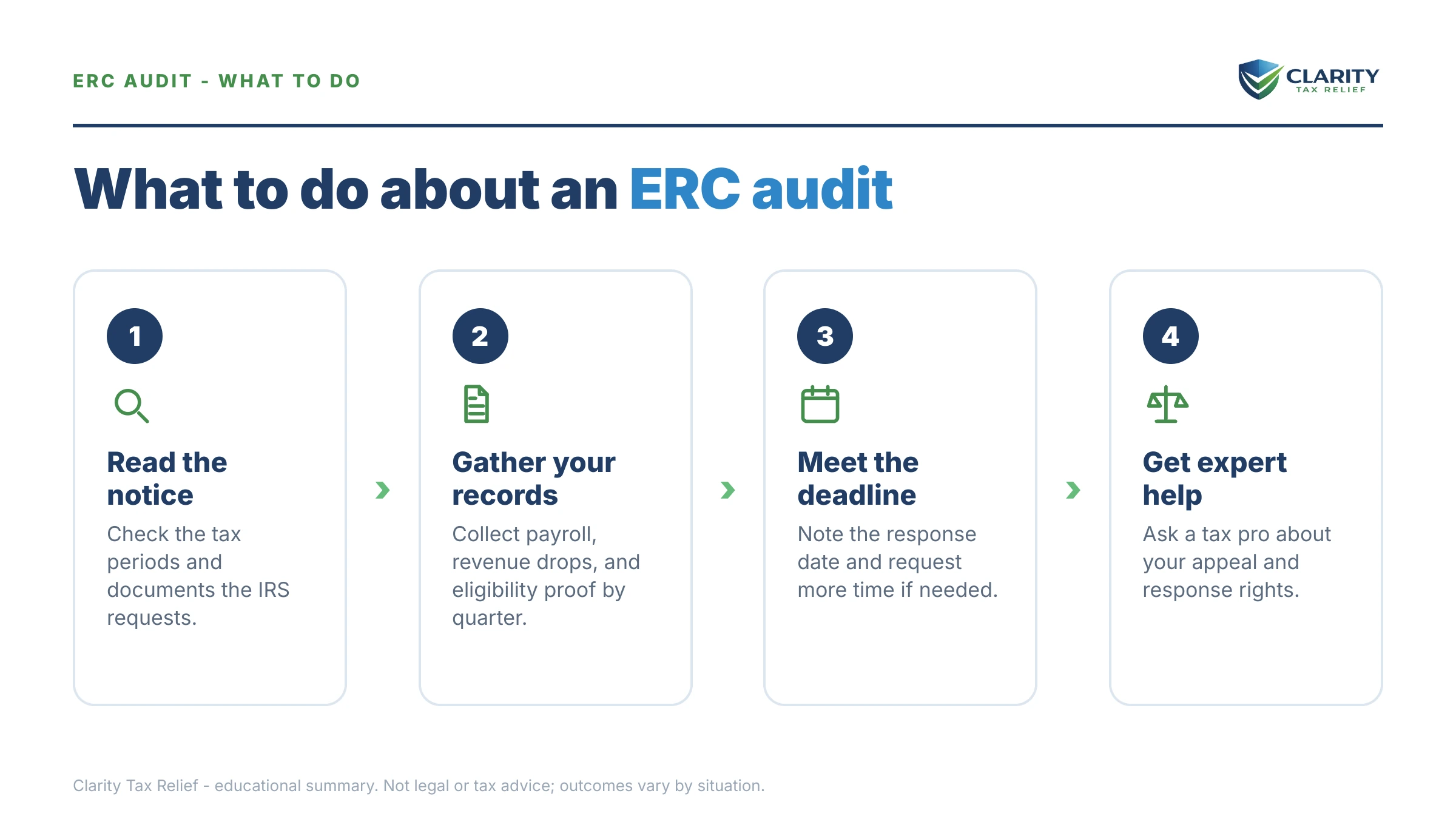
- Calendar the deadline. Find the response date printed on your exam letter, note the letter number and the quarters under review, and put the date somewhere you can't miss it.
- Demand your file from the preparer. Get copies of every 941-X, the eligibility worksheet or memo, the fee agreement, and all correspondence from whoever filed the claim.
- Gather substantiation. Pull payroll registers by employee and quarter, quarterly gross receipts with bank-statement backup, the specific government orders you relied on, and your PPP forgiveness application.
- Pressure-test your own eligibility. Run each claimed quarter through the gross-receipts and government-order tests honestly before responding — conceding a weak quarter early beats defending it badly.
- Respond in writing by the deadline. Send an organized, indexed package answering each item in the request, or ask for more time in writing before the date passes — silence is what turns exams into full disallowances.
- Bring in representation for large or shaky claims. For six-figure claims, government-order-only eligibility, or anything a promoter built, file Form 2848 and let an experienced tax professional deal with the examiner directly.
The three ERC eligibility tests — and the proof that survives
Every legitimate ERC claim rests on one of exactly three eligibility paths, and the audit is won or lost on documents, not narratives. The examiner isn't asking whether COVID was hard on your business; the examiner is asking which statutory test each quarter meets and where the paper is.
| Eligibility path | The threshold | Proof that survives an exam |
|---|---|---|
| Gross receipts decline | 2020: quarterly receipts under 50% of the same 2019 quarter (ends once receipts recover past 80%). 2021: under 80% of the same 2019 quarter | Quarterly profit-and-loss statements that tie to bank deposits and filed returns |
| Full or partial suspension | A specific federal, state, or local COVID order that suspended more than a nominal part of operations during the exact days claimed | The order itself, its effective dates, and records showing how it actually limited your operations |
| Recovery startup business | Began operations after February 15, 2020, with average annual gross receipts of $1 million or less; Q3–Q4 2021 only, capped at $50,000 per quarter | Formation documents, receipts history, and payroll records for the two quarters |
Just as important is the list of wages that never counted, because this is where promoter claims collapse even when the business was genuinely eligible: wages used for PPP loan forgiveness, and wages paid to owners holding more than 50% and to many of their relatives, generally don't qualify. Aggregation rules also treat commonly controlled businesses as one employer, so a "small" company inside a larger group may fail the size tests the promoter never ran.
One more edge to watch: some promoters manufactured eligibility by recasting 1099 contractors as W-2 employees on paper. That invites a second front — worker-classification exams run by states too, and a California employer can face an EDD audit over the very same payroll the IRS is examining. Fixing the federal story in a way that creates a state problem is a promoter mistake you don't have to repeat.
What an ERC disallowance actually costs: the math
A disallowed ERC costs the full credit back, plus interest from the day the refund was issued, plus a possible 20% penalty — and the promoter's fee is never coming back. Here's the arithmetic on a small claim.
Say you're a rideshare driver with no W-2 employees and three years of unfiled 1040s, and in 2023 a promoter charged you 25% to file a Form 941-X claiming a $4,800 "self-employment ERC" refund. The IRS paid it; the promoter kept $1,200; you netted $3,600. Now the claim is under exam — and it fails on its face, because the ERC only ever applied to wages paid to employees. Self-employment earnings never qualified. The tab: $4,800 repaid + $960 (the 20% erroneous-claim penalty) + interest running since the refund date — call it roughly $6,000 and climbing, against $3,600 you actually received. You can estimate how fast that grows with our IRS Penalty & Interest Calculator.
And there's a second problem the exam surfaces: those three unfiled years are now visible on an account the IRS is actively working. Don't panic-file rushed returns into an open exam — the order and accuracy of what you file matters. When there are facts underneath a civil exam that could look willful, the case takes on eggshell audit dynamics, and how you respond should be decided before you respond, not after.
Scale the same math up and you see why employers are calling lawyers: a restaurant that claimed $21,000 for each of four employees across 2021 — an $84,000 claim — faces $84,000 repayment + $16,800 in penalty + interest if all quarters fall. But that same restaurant may genuinely hold two quarters on a real receipts decline, which is exactly why quarter-by-quarter defense beats all-or-nothing.
How far back can the IRS audit an ERC claim?
The IRS has longer to audit ERC claims than almost anything else it examines. The general rule — three years, stretching to six for large understatements — is covered in our guide to how far back the IRS can audit. ERC is different: Congress wrote a five-year assessment window into the statute for the third and fourth quarters of 2021, and 2025 legislation extended the IRS's reach on those late-2021 quarters further still. On top of that, most claims were filed years late on Form 941-X, which pushes the practical exposure deep into the late 2020s.
The quarter-by-quarter detail — which clock applies to which claim, and what the 2025 law changed — lives in our ERC statute of limitations guide. The related decision you may face mid-exam is whether to sign Form 872 extending the statute: refuse and the IRS often disallows immediately to protect its deadline; sign and you buy time to build the file. Neither answer is automatic.
When you can handle an ERC audit yourself
You can reasonably respond to an ERC exam on your own when the claim is small and rests on the gross-receipts test with clean books. If your 2020 Q2 receipts genuinely fell below half of 2019 Q2, your P&Ls tie to your bank statements, your claim excluded PPP-forgiven and owner wages, and you filed the 941-X yourself or with your regular accountant — an organized response package answering each request item, sent by the deadline, will usually carry the day. The receipts test is arithmetic, and arithmetic defends itself.
Experienced help changes outcomes in specific situations:
- Government-order-only eligibility. This is the most-litigated, most-disallowed theory. Building the order file and the "more than nominal" impact analysis is legal-adjacent work.
- Promoter-built claims. You may not even know what theory your claim rests on. A professional can reconstruct it, salvage defensible quarters, and position your reliance on the promoter as a penalty defense.
- Six-figure claims and aggregated groups. The dollars justify representation, and aggregation math is where self-prepared responses go wrong.
- Anything with willfulness underneath. Fabricated payroll, employees who never existed, unfiled returns on the same account — get advice before you say anything to the examiner.
- The 105-C stage. Once the claim is formally disallowed, you're managing a 2-year litigation clock and an Appeals strategy at the same time. Sequencing mistakes here are permanent.
If your claim was promoter-built or you're already past a proposed disallowance, a free case review before your next written response is the cheapest second opinion you'll get — call (888) 825-7779 or use the 2-minute form.
Terms on your ERC letters, decoded
- Disallowance — the IRS's formal denial of some (Letter 106-C) or all (Letter 105-C) of your claimed credit.
- Recapture — the IRS taking back an ERC refund it already paid, assessed and collected like unpaid employment tax.
- Erroneous-claim penalty — a 20% penalty under IRC §6676 on refund claims made without a reasonable basis.
- IDR (Information Document Request) — the examiner's itemized list of records you must produce by a stated date.
- Aggregation rules — rules treating commonly owned or controlled businesses as a single employer for the ERC's size and eligibility tests.
- Form 907 — a written agreement extending your 2-year deadline to sue after a disallowance, so you can keep negotiating without losing court rights.
ERC audit questions, answered
What triggers an ERC audit?
The IRS risk-scores every Employee Retention Credit claim, and it has said a large share of claims filed during the promoter boom showed signs of being improper. The strongest triggers are claims that are large relative to your payroll history, claims covering every available quarter, boilerplate government-order narratives, supply-chain-only eligibility theories, and claims prepared by promoters already under IRS investigation. A claim filed on Form 941-X long after the quarter ended also draws extra scrutiny.
How long does the IRS have to audit an ERC claim?
Generally three years for 2020 and early-2021 quarters, but Congress gave the IRS five years to assess on claims for the third and fourth quarters of 2021, and 2025 legislation extended the window for those quarters further. Because most ERC claims were filed late on Form 941-X, the practical exposure often runs well into the late 2020s. Check the quarters listed on your own exam letter to see which windows apply to you.
What documents does the IRS ask for in an ERC audit?
Expect requests for payroll records showing wages by employee and quarter, quarterly gross receipts with backup, copies of the government orders you relied on, your PPP loan forgiveness application, ownership and family-relationship information, and the eligibility analysis behind the claim. If a promoter prepared the claim, the IRS will also want to know who prepared it and what they gave you. Organized, contemporaneous records matter more than explanations written after the fact.
Do I have to repay the ERC if my claim is denied?
Yes — if the refund was already paid, a disallowed credit becomes a balance due on your employment tax account, with interest running from the date you received the money. The IRS can also add a 20% erroneous-claim penalty, and up to 75% where fraud is proven. If you can't repay in one lump, installment agreements are available just like any other employment tax debt.
Can you go to jail over an ERC claim?
Most ERC audits are civil, and an honest employer who relied on bad advice is facing repayment and penalties, not prosecution. Criminal exposure centers on willfulness — knowingly claiming a credit you understood you didn't qualify for, fabricating payroll, or promoting false claims for others. If your file contains anything you knew was false when you signed, talk with an experienced tax professional before you respond to the exam, not after.
A promoter filed my ERC claim — am I still responsible?
Yes. The claim was filed under your business's EIN with your signature, so the IRS looks to you for repayment even if the promoter kept a 20–25% fee and has since vanished. Good-faith reliance on a paid preparer can help you fight the 20% penalty, but it does not erase the underlying repayment. Demand your complete file from the promoter now — you will need it either to defend the claim or to unwind it.
Can I still withdraw my ERC claim in 2026?
The IRS has offered a withdrawal process for claims it hasn't yet paid — or where the refund check was never cashed — and a withdrawn claim is treated as if it was never filed, which avoids the erroneous-claim penalty. Withdrawal is not available once you've received and kept the money. Check the current status of the program at IRS.gov before assuming the door is open or closed.
Should I sign Form 872 to extend the ERC audit statute?
It's a judgment call, not an automatic yes. Refusing to sign often forces the IRS to disallow the claim immediately to protect the statute, which pushes you straight into Appeals or a refund suit; signing buys time to substantiate but keeps the exam alive longer. A restricted extension limited to the ERC issue is often the middle path. This is one decision worth professional advice before you return the form.
Does an ERC audit affect my income tax returns?
It can. Claiming the ERC required reducing your wage deduction by the credit amount, so many employers amended income tax returns and paid more income tax. If the credit is later disallowed, you're generally entitled to restore those deductions by amending again — but refund deadlines on the income side can expire while the employment tax fight drags on, so track both clocks.
Your next 24 hours
- Find three things on your letter: the letter number (6612, 105-C, or 106-C), the quarters under review, and the response deadline printed on it. Those three facts determine everything else.
- Gather your claim file: every 941 and 941-X, payroll reports by quarter, quarterly gross receipts, any government orders you relied on, your PPP forgiveness application, and everything the preparer ever sent you.
- Get a free case review before you respond in writing: call (888) 825-7779 or use the 2-minute form. The examiner will decide your claim on whatever lands by the printed deadline — make sure it's the strongest version of your facts, not the first draft.
Primary sources worth bookmarking: the IRS's own Employee Retention Credit hub (eligibility rules, warning signs, and withdrawal status), IRS.gov/payments for paying any recaptured balance, and the Taxpayer Advocate Service if your exam or claim has stalled inside the IRS with no one responding.
This guide is general information, not tax or legal advice for your specific situation. Eligibility for IRS programs depends on individual facts and circumstances; no outcome is guaranteed.