
ERC & Business Tax
ERC Claim Disallowed: What It Means and What to Do Next (2026)
The short answer: an ERC claim disallowed means the IRS rejected your Employee Retention Credit refund claim — usually by Letter 105-C (full) or Letter 106-C (partial). You can request an IRS Appeals review or file suit within 2 years of the letter's date. If the refund was already paid, expect a repayment bill.
You filed the 941-X back when everyone — maybe a firm that called your business three times a week — said you qualified, then waited years through the IRS backlog. The answer finally came, and it's a letter saying your Employee Retention Credit claim is disallowed. That decision is not final. You have a formal appeal path, a two-year court window, and, if you were already paid, structured ways to handle repayment.
Two dates control what happens next, and only one of them is obvious. The image below shows exactly what an ERC disallowance letter looks like and where to look for the date that starts your clock.
⏱ Your deadline: you have 2 years from the date on your ERC disallowance letter to file a refund suit. Miss it without a signed Form 907 extension and the claim is permanently gone — even if you were eligible all along. The window your letter gives for requesting an Appeals review is far shorter, so read it today.
Why your ERC claim was disallowed
The IRS has disallowed tens of thousands of Employee Retention Credit claims since 2024 after risk-scoring the enormous backlog of Form 941-X filings. Most rejections cite one of a handful of reasons, and your letter should name which one applies to you:
- No qualifying gross-receipts decline. Your revenue for the claimed quarter didn't drop enough compared to the same 2019 quarter.
- No qualifying government order. The IRS rejected claims built on general economic hardship or supply-chain disruption without a specific order that fully or partially suspended your operations.
- Entity or wage problems. The business didn't exist, had no W-2 employees during the claimed period, or the claimed wages don't match the 941s on file.
- PPP double-dipping. The same wages were used for both Paycheck Protection Program forgiveness and the ERC.
- Promoter boilerplate. The claim covered every available quarter with identical language — a pattern the IRS flags as promoter-driven. If that's your situation, our guide to ERC mill claim problems covers the disavow-and-repair sequence.
One thing to hold onto: a disallowance is a decision on one refund claim — not an audit of your business, and the IRS has acknowledged that some disallowance letters went out with errors. A wrong disallowance is fightable, and businesses with documented eligibility win reversals.
Which letter are you holding? 105-C, 106-C, or a bill
The letter number on your ERC disallowance determines whether you're fighting for money you never got or defending money you already received. Check the upper corner of the letter against this table — the image on this page shows you exactly where that identifier and the controlling date sit on the document.
| The letter | What it means | Your move |
|---|---|---|
| Letter 105-C | Your entire ERC claim was rejected before payment. You owe nothing — but you get nothing. | Read the stated reason, then appeal or accept. The 2-year suit clock starts at the letter's date. |
| Letter 106-C | Part of the claim was allowed; the rest was disallowed. | Cashing the check for the allowed portion does not, by itself, forfeit your right to contest the rest. Appeal the disallowed piece. |
| Balance-due notice on your 941 account | The IRS paid your ERC, then reversed it — recapture. This is now a payroll tax debt, plus interest. | Treat it as a collection matter: contest the recapture if the claim was valid, or arrange payment if it wasn't. |
| Exam letter about your ERC | The IRS is examining eligibility before deciding — not a disallowance yet. | Respond with documentation by the stated date. See our ERC audit defense guide. |
The two clocks a disallowance letter starts
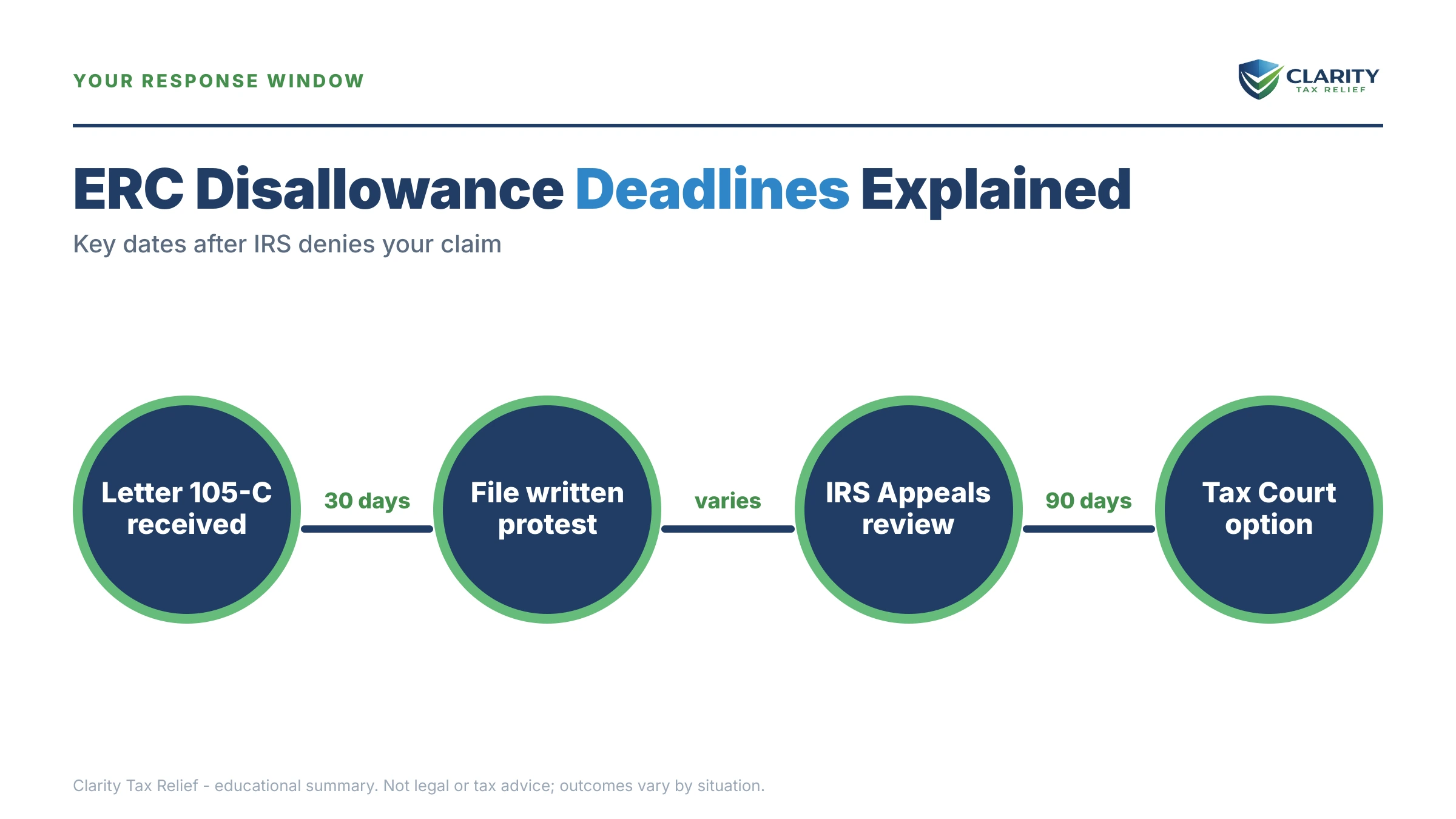
An ERC disallowance letter starts a 2-year period to sue the government for your refund, and a much shorter administrative window to request an Appeals review. They run on different rules, and confusing them is the most expensive mistake owners make at this stage.
Clock one — Appeals. Your letter explains how to request review by the IRS Independent Office of Appeals, and the practical window it gives you is short. Appeals is free to request, handled in writing or by conference, and reverses disallowances when the eligibility record is solid. Our ERC disallowance appeal guide walks through the protest letter itself.
Clock two — court. Under IRC §6532, a refund suit must be filed within two years of the disallowance date, in federal district court or the Court of Federal Claims. Here's the trap: requesting an Appeals review does not pause the two-year suit clock. If Appeals is still deliberating as your two-year mark approaches, the fix is Form 907 — a written agreement, signed by both you and the IRS, extending the time to sue. It must be in place before the window closes; nothing revives it afterward.
Separately, the IRS's own clock to come after paid claims is longer than normal — up to five years for some 2021 quarters. The details are in our guide to the ERC statute of limitations.
What happens if you ignore an ERC disallowance
Ignoring an ERC disallowance costs you the entire claim if you were never paid — and starts business collection if you were. If your claim was rejected before payment, nothing dramatic happens next: no bills, no reminders. The two-year clock simply runs out in silence, and a claim that might have been won becomes unwinnable. If the IRS already sent you the refund, the sequence has teeth:
- The Appeals window closes. The review path printed on your letter expires, leaving court as the only way to contest the decision.
- Recapture is assessed. The credit is reversed on your business's 941 account — with interest that generally runs from the date the refund was issued, not from today.
- Balance-due notices arrive. The business enters the standard collection sequence: a first bill, then escalating demand notices.
- Final notice of intent to levy. This letter starts a 30-day window with Collection Due Process rights — after it passes, the IRS can levy business bank accounts and accounts receivable.
- The two-year mark passes. The disallowance becomes permanent. All that's left is repayment logistics and the income-tax deduction fix below.
One 2026 reality worth naming: the IRS workforce shrank roughly 27% in 2025, so reaching a human about your ERC file is harder than ever — but the disallowance letters, recapture assessments, and levy notices are generated by automated systems that never slowed down.
Holding a 105-C, 106-C, or an ERC repayment bill?
Send us a photo of it before the response window printed on it passes. An experienced tax professional will tell you whether your claim is worth fighting, what the two-year clock means for you, and what repayment actually looks like — free, confidential, no pressure.
ERC claim disallowed: your options in 2026
Every disallowed ERC claim resolves down one of five paths, and the right one depends on two questions: was the claim actually valid, and did you already receive the money? The general playbook for resolving any IRS balance is covered in our guide to how to settle tax debt yourself — here's what's specific to a disallowed ERC:
| Option | Who it fits | Deadline / key rule |
|---|---|---|
| Appeals protest | Owners with documented eligibility — a real gross-receipts decline or a qualifying government order | Respond within the window on your letter. Free to request, but it does not pause the 2-year suit clock |
| Refund suit (district court or Court of Federal Claims) | Strong claims worth litigation costs — usually larger, multi-quarter claims | Must be filed within 2 years of the letter date (IRC §6532) |
| Form 907 extension | Anyone whose Appeals review is still pending near the 2-year mark | Both you and the IRS must sign before the window closes |
| Accept, then amend your income tax return | Boilerplate or promoter-driven claims that aren't worth defending | Restores the wage deduction you gave up — but the refund statute (generally 3 years) may limit recovery |
| Payment plan on recaptured ERC | Businesses that received the refund and can't repay it at once | Interest keeps accruing until paid; business plan thresholds differ from individual plans |
| Voluntary disclosure | Owners who know the claim was bad and were paid | Prior rounds of the ERC voluntary disclosure program (with 80%-repayment terms) have closed — verify current status before counting on it |
If repayment is the path and the number doesn't fit your cash flow, two guides go deeper: can't repay ERC for the full menu, and business IRS installment agreement for the plan thresholds that apply to an operating business. You can also estimate what's accruing on an unpaid recapture balance with our penalty & interest calculator.
The income-tax side effect most owners miss
Claiming the ERC required cutting your wage deduction by the credit amount on the income tax return for the year those wages were paid. If the credit is now disallowed and you accept that — or fight and lose — you paid income tax on a deduction you were entitled to all along.
The fix is amending that income tax return to restore the deduction. The catch is timing: the refund statute of limitations is generally 3 years from when the original return was filed, and for 2020 and 2021 returns that window may be closing or already closed. Whether a protective claim can preserve your refund while the disallowance fight plays out is exactly the kind of question worth ten minutes with a professional. The full mechanics — including how this interacts with recapture — are in our ERC recapture guide.
Say your disallowed claim is $19,700: the math on each path
Here's a clearly hypothetical example. Say you run a small business with payroll and claimed $19,700 of ERC for one 2021 quarter on a 941-X.
If you were never paid, the question is whether the claim is worth defending. If your books show a genuine gross-receipts decline for that quarter, an Appeals protest is fighting for the full $19,700 at the cost of preparation time and any professional fees — usually a fraction of the claim. If the filing was promoter boilerplate with no real eligibility, folding may be smarter: if you reduced your 2021 wage deduction by $19,700 when you claimed the credit, restoring that deduction at a 22% marginal rate recovers about $4,334 ($19,700 × 0.22) — real money back from a dead claim, if the refund statute is still open.
If you were already paid, the $19,700 comes back as a recapture balance with interest running from the refund date. Spread over 24 months, that's roughly $821 a month before interest; over 48 months, about $410. Which term you can actually get depends on business plan thresholds and your financials — but the point stands: a five-figure recapture is a payment plan problem, not a padlock-on-the-door problem, if you engage before the levy notices start.
How to respond to an ERC disallowance, step by step
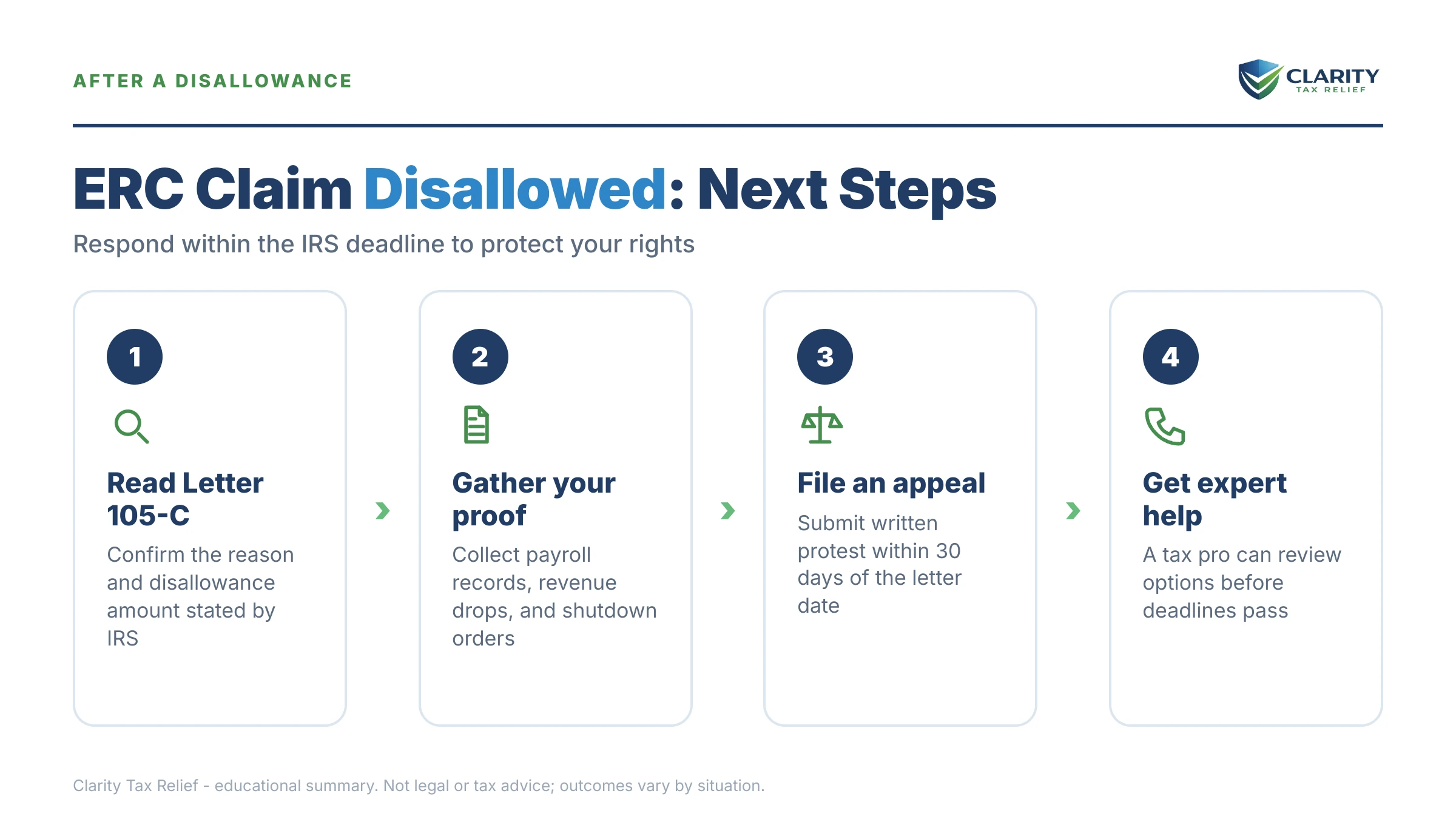
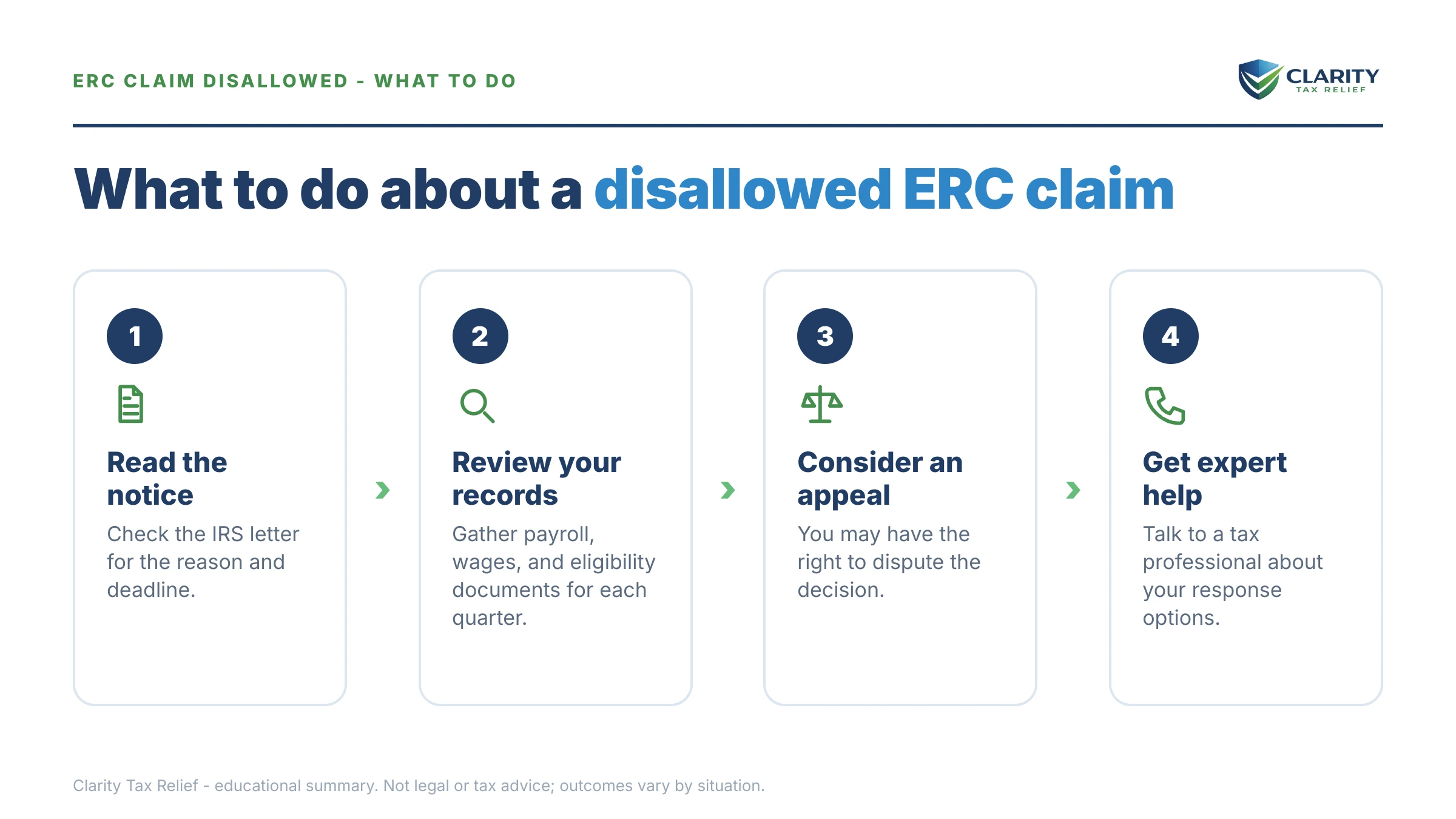
- Identify your letter. Confirm whether you're holding Letter 105-C (full disallowance) or Letter 106-C (partial), and circle the date at the top — it starts your two-year clock.
- Pull your claim file. Gather the Form 941-X for each quarter, your gross-receipts numbers, any government orders you relied on, and everything the preparer or promoter gave you.
- Score your eligibility honestly. Before spending money on an appeal, test your claim against the gross-receipts and government-order rules — fight a solid claim, fold a boilerplate one.
- Request an Appeals review in writing. If the claim holds up, follow the protest instructions printed on your letter and respond within the window it gives you.
- Protect the two-year suit window. Calendar the date two years from your letter, and ask about Form 907 if Appeals hasn't decided as it approaches.
- Fix the income-tax side. If you reduced wage deductions for a credit you'll never receive, amend that return to restore them before the refund statute closes.
When you can handle this yourself — and when help changes the outcome
Plenty of ERC disallowances don't need professional help. If you look at the letter's stated reason and agree — the numbers really didn't decline, the order really didn't suspend you — and you were never paid, you can accept the disallowance, calendar the income-tax amendment, and move on. If you were paid a small amount and can repay within your cash flow, setting up a plan directly with the IRS is straightforward.
Experienced help earns its cost in four situations: you have documented eligibility and real money at stake — Appeals protests are won on how the record is assembled; a promoter filed the claim and you need an independent read before trusting anyone's story, including theirs; the recapture balance threatens payroll or operations, where sequencing the response wrong invites a levy on your operating account; or the two-year mark is inside the next six months, where Form 907 and litigation decisions have hard, unforgiving deadlines.
Terms on your disallowance letter, decoded
- Disallowance: the IRS's formal rejection of a claim for refund — a decision you can contest, not merely a form letter.
- Claim for refund: the legal name for what your Form 941-X was — a request for money back that the IRS must allow, disallow, or sit on.
- Recapture: the IRS reversing an ERC it already paid, converting your refund into a payroll tax balance due with interest.
- Two-year suit period: the window under IRC §6532 to take a disallowed claim to federal court, starting on the letter's date.
- Form 907: a signed agreement between you and the IRS extending that two-year window — the only thing that does.
- Protest: the written statement, following your letter's instructions, that asks the IRS Independent Office of Appeals to review the disallowance.
ERC disallowance questions, answered
Can I appeal an ERC disallowance?
Yes. Letter 105-C and Letter 106-C both carry the right to request a review by the IRS Independent Office of Appeals, using the protest instructions printed on the letter. Appeals is a real path — officers can and do reverse disallowances when eligibility is documented. One trap: requesting Appeals does not pause the two-year deadline to file suit, so calendar that date separately and ask about Form 907 if the review drags on.
Do I have to pay back the ERC if my claim is disallowed?
Only if you already received the money. If the IRS disallowed the claim before paying it, you owe nothing new — you simply don't get the refund. If the refund was already issued, the IRS will assess recapture of the credit with interest, and the balance is collected like any other payroll tax debt, with payment plans available.
What is Letter 105-C?
Letter 105-C is the IRS's formal notice that it has fully disallowed a claim for refund — for ERC, usually the Form 941-X you filed. It states the reason, explains your right to an Appeals review, and starts the two-year period to file a refund suit. Letter 106-C is the partial version: part of the claim allowed, the rest rejected.
How long do I have to fight an ERC disallowance?
Two years from the date on the disallowance letter to file suit in federal district court or the Court of Federal Claims. That period can be extended only by signing Form 907 with the IRS — not by requesting Appeals, sending letters, or waiting for a response. The Appeals request itself should go in much sooner, within the window your letter describes.
What if a promoter filed my ERC claim?
You're still responsible for the claim, because it was filed under your business's EIN and your signature authority. But your position matters: gather everything the promoter gave you, get an independent read on whether you actually qualified, and don't let the same firm handle the appeal. If the claim was never legitimate, contesting it can waste money better spent fixing the fallout.
Can I get my wage deduction back if the ERC is denied?
Usually, yes. Claiming the ERC required reducing your wage deduction by the credit amount for the year the wages were paid. If the credit is disallowed and you don't fight it — or you lose — you can amend that income tax return to restore the deduction. Watch the refund statute of limitations, though: for 2020 and 2021 returns, that window may already be closing or closed.
Will an ERC disallowance trigger a full audit of my business?
Not automatically. A disallowance letter is a decision on one refund claim, not an examination of your books. That said, ERC claims the IRS scores as high-risk can be routed to exam, and an ERC audit can look at the payroll returns and eligibility records behind every quarter you claimed. Answer any exam letter on time, and keep your ERC file organized either way.
Your next 24 hours
- Find the date at the top of your letter and write down two dates: the response window the letter describes, and the day exactly two years out — that's your court deadline.
- Assemble your ERC file: the 941-X for each claimed quarter, quarterly gross-receipts figures for 2019–2021, any government orders you relied on, and every document the preparer or promoter gave you.
- Get the letter reviewed free before the appeal window on it passes — the 2-minute form or (888) 825-7779. Ten minutes now tells you whether you're fighting for $19,700 or planning how to repay it.
Primary sources: the IRS's own explainer at Understanding your Letter 105-C, the IRS's Employee Retention Credit page for current eligibility rules and program updates, and IRS.gov/payments if repayment is your path.
This guide is general information, not tax or legal advice for your specific situation. Eligibility for IRS programs depends on individual facts and circumstances; no outcome is guaranteed.