
IRS Letters
IRS Letter 105-C: Your ERC Claim Was Disallowed — and a 2-Year Clock Just Started (2026)
The short answer: Letter 105-C is the IRS's formal disallowance of a claim — for most people receiving it in 2026, a full denial of an Employee Retention Credit refund. The date printed on the letter starts a two-year deadline to sue for the refund, and appealing inside the IRS does not pause that clock.
You were told the refund was coming — maybe by a promoter who swore your business qualified — and instead of a check, Letter 105-C arrived saying the claim is denied in full and the money will never be paid. That denial is not necessarily the last word. But unlike most IRS mail, this letter starts a hard legal clock, and what you do before it runs decides whether you ever see a dollar of that credit.
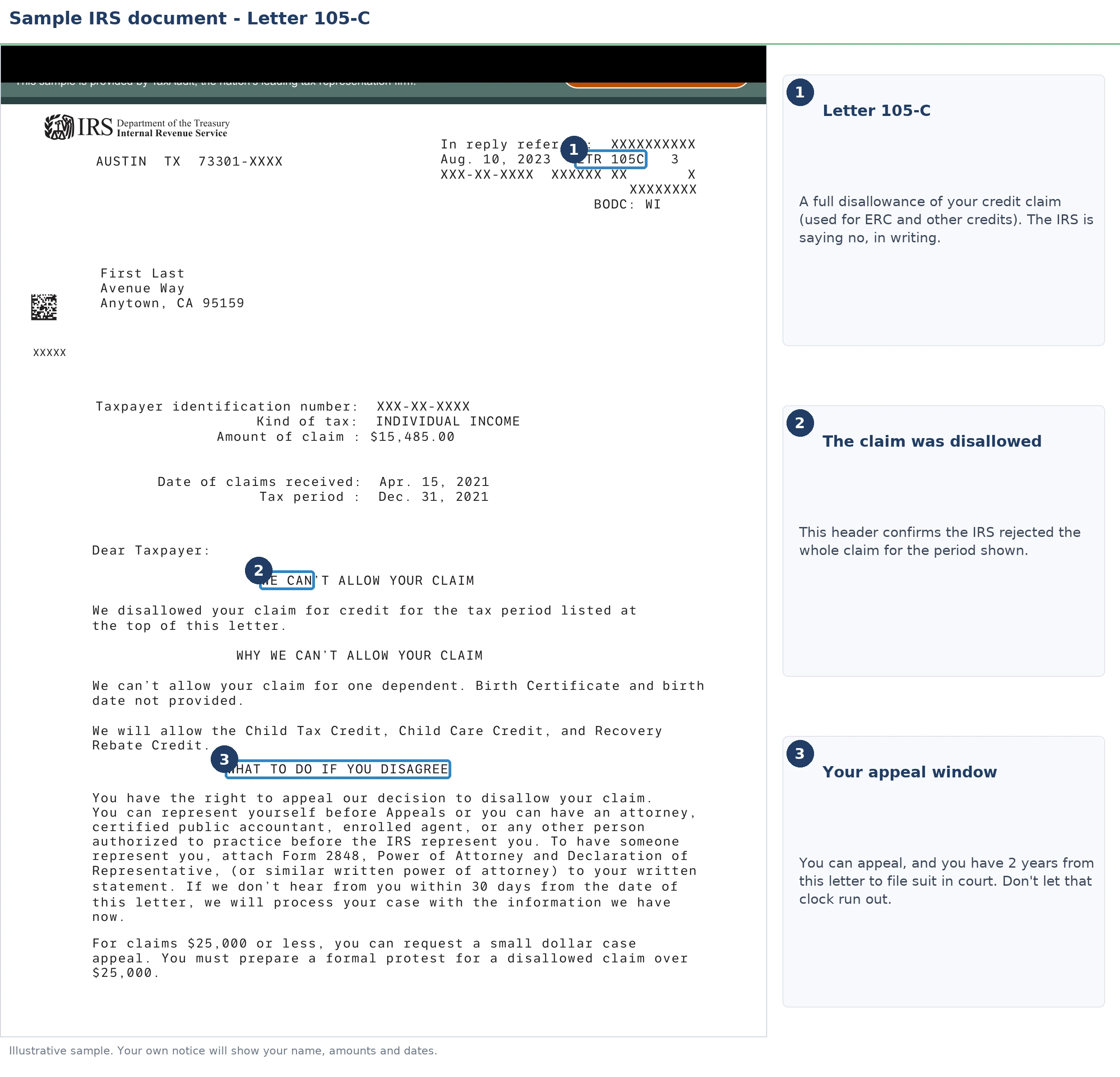
The image below shows exactly what Letter 105-C looks like and where to find the two things that matter most: the letter date at the top and the appeal instructions inside.
⏱ Your deadline: you have 2 years from the date on Letter 105-C to file a refund suit in federal court — after that, the claim is permanently barred, no matter how strong it was. An IRS appeal does not stop this clock; only a filed suit or a signed Form 907 extension does.
Why you got Letter 105-C
Letter 105-C is the IRS's formal notice that it has disallowed your refund claim in full — and since late 2023, the IRS has mailed it in large batches to Employee Retention Credit claimants it screened as ineligible. It is a legal-status letter, not a bill: it doesn't say you owe anything, it says the refund you asked for on Form 941-X (or another amended return) will not be paid.
The most common reasons an ERC claim draws a 105-C:
- No W-2 employees. The ERC is computed on qualified wages paid to employees and reported on Form 941. Self-employment or 1099 income does not qualify — a fact many promoters skipped over when they signed up sole proprietors and independent contractors.
- No qualifying eligibility test. The business can't show a full or partial suspension by a government order, or a sufficient decline in gross receipts, for the quarter claimed.
- The entity didn't exist or paid no wages during the period claimed — a hallmark of promoter-manufactured claims.
- Duplicate or out-of-period claims, such as quarters outside the program's 2020–2021 window.
If you're not sure this letter even relates to an ERC claim — 105-C is also used to deny other refund claims — the tax period and form number printed on it will tell you. For general orientation on IRS mail, see why did I get a letter from the IRS; this page covers only the 105-C itself. And if your letter allows part of the credit and denies the rest, you're holding the partial version — see our Letter 106-C guide, which follows the same clocks.
The two clocks Letter 105-C starts
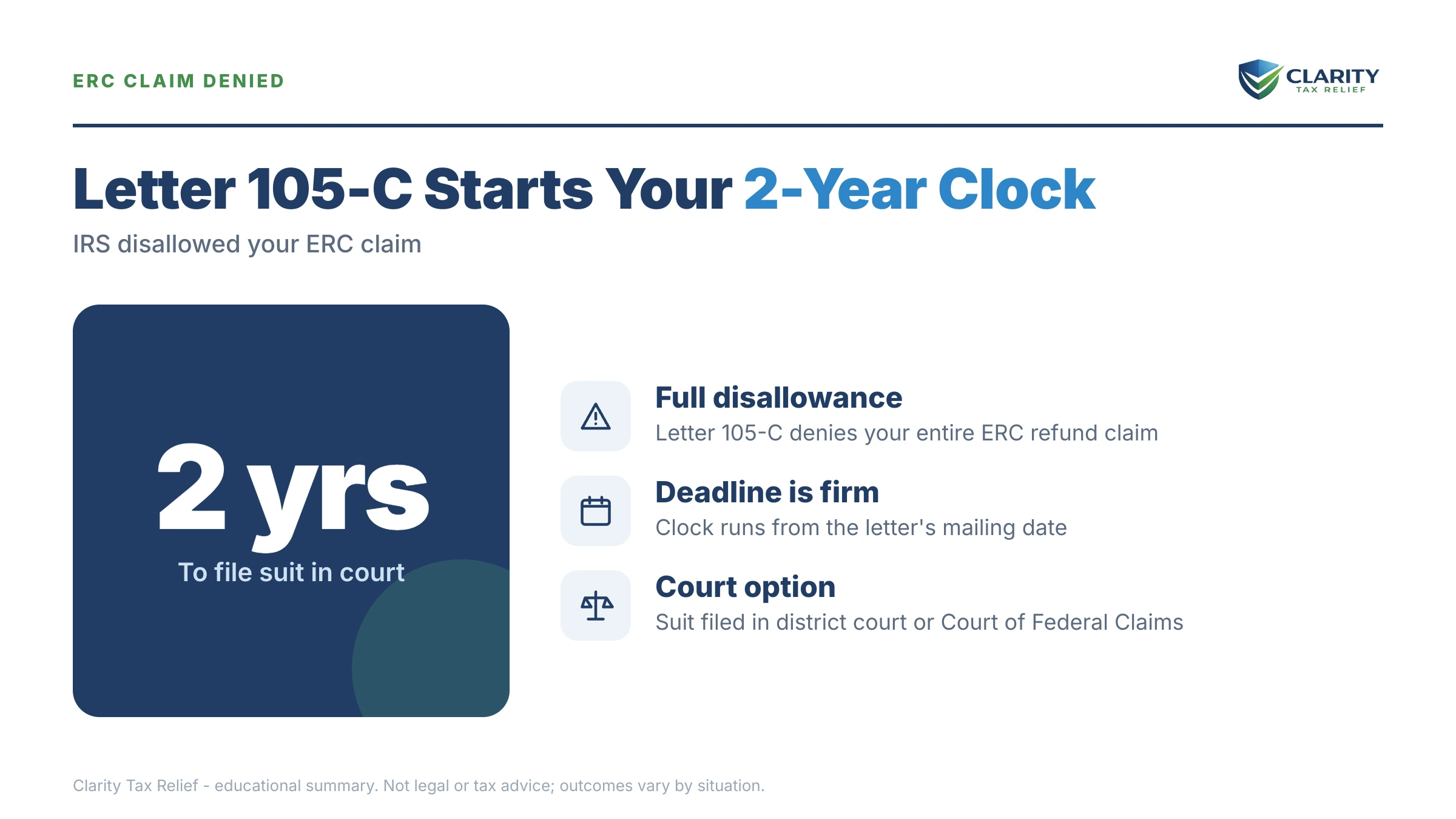
Letter 105-C starts a two-year window under IRC §6532(a) to file a refund suit — and it also prints a much shorter response date for requesting an IRS appeal. These are separate clocks protecting separate rights, and confusing them is the single most expensive mistake 105-C recipients make. The two-year suit deadline keeps running even while your appeal is pending.
| Clock | When it runs out | What it lets you do | If it passes |
|---|---|---|---|
| Response date on the letter | Printed on your 105-C | Request a free review by the IRS Independent Office of Appeals | Appeals becomes much harder to reach; the denial stands administratively |
| Two-year suit window | 2 years from the letter date (IRC §6532(a)) | File a refund suit in U.S. district court or the Court of Federal Claims | The claim is permanently barred — even if you qualified |
| Form 907 decision point | Before the two-year window closes | Extend the suit deadline by written agreement with the IRS | You must sue before the two-year mark or lose the claim |
Note what's not on this list: refiling. For most businesses, the deadlines to file an ERC refund claim in the first place have already passed, so once a 105-C lands, appeal and suit are the only roads back to the money. The ERC statute of limitations works differently on the IRS's side of the ledger — the government kept a longer window to assess against paid claims than you have to fight a denied one.
What happens if you ignore Letter 105-C
Ignoring a 105-C doesn't trigger collection — it triggers expiration. Because this letter denies money rather than demanding it, the consequence of doing nothing is that your rights quietly lapse, one by one, in this order:
- The letter date passes. The two-year suit clock is already running. Nothing visible happens — which is exactly why people set the letter aside.
- The response date on the letter passes. Your cleanest, cheapest path — a written protest to the IRS Independent Office of Appeals — slips away. The denial hardens into the IRS's official position.
- Evidence decays. As quarters recede, payroll providers purge records, the promoter who filed your claim stops answering, and the government orders you relied on get harder to document.
- The two-year mark arrives. Unless you've filed suit or signed a Form 907 extension, the claim is extinguished permanently — a court cannot hear it, and no one at the IRS can revive it, regardless of merit.
One important fork: if the IRS already paid your ERC and later reverses it, that's a different track — a recapture assessment that creates a balance due, sometimes announced by a CP320B notice, followed by ordinary collection letters that can eventually escalate to a Letter 1058 final notice of intent to levy. A 105-C by itself puts no collection machinery in motion. The stakes here are the refund you lose, not money the IRS takes.
Holding a Letter 105-C right now?
Send us a photo of it before the response date printed on your letter passes. An experienced tax professional will tell you — free and honestly — whether your ERC claim is worth fighting, and how to protect the two-year deadline while you decide.
Your options after a full ERC disallowance
A full disallowance leaves you four moves, and the right one depends almost entirely on whether you can document real W-2 wages and a real eligibility test. The broader playbook lives in our ERC claim disallowed pillar; here's how the options compare for a 105-C specifically:
| Option | Who it fits | Cost | Key limit |
|---|---|---|---|
| Accept the disallowance | Claims with no W-2 wages or no qualifying eligibility test | $0 to the IRS (any promoter fee is usually gone) | You give up the credit permanently |
| Administrative appeal (written protest) | Employers with Forms 941, payroll records, and a documented government order or gross-receipts decline | Free to file; professional help typically runs four figures | Does not pause the two-year suit clock |
| Form 907 extension | Appeals cases still open as the two-year mark approaches | No fee | The IRS must agree and sign — it isn't automatic |
| Refund suit | Large, well-documented claims worth litigation costs | Court filing fees plus counsel — often five figures | Must be filed within two years of the letter date |
Accepting is the right call more often than the tax-relief industry admits. If your claim was built on 1099 income, or on an "everyone qualifies" eligibility memo from a promoter, appealing spends money and time to lose. The disallowance itself costs you nothing further.
Appealing is the workhorse option for legitimate employers. A written protest goes to the IRS Independent Office of Appeals — an office separate from the unit that denied you — laying out your quarters, wages, and eligibility test with documentation attached. Our guide to the ERC disallowance appeal walks through the protest letter itself.
Form 907 exists for one scenario: Appeals hasn't finished, the two-year mark is coming, and you don't want to pay for a lawsuit just to keep your claim alive. It's a mutual agreement to extend the time to bring suit — see our Form 907 ERC guide before you rely on it, because the IRS has to countersign.
Suing means filing in U.S. district court or the Court of Federal Claims. For a five-figure claim, litigation economics rarely work; for six- and seven-figure claims with clean documentation, it's a serious lever — and sometimes the filing itself moves the government to settle.
The math on a hypothetical $16,400 disallowed claim
Say a promoter filed a $16,400 ERC claim on your behalf, and you work as a 1099 contractor. Here's the arithmetic that decides your move. For 2021 quarters, the credit is 70% of up to $10,000 in qualified wages per employee, per quarter — so a $16,400 claim implies about $23,429 of W-2 wages ($16,400 ÷ 0.70). If you never ran payroll and never filed a Form 941, those wages don't exist, the claim can't be substantiated, and no appeal or lawsuit changes that. If the promoter charged a 25% upfront fee — $4,100 — that fee is likely your real loss, and walking away from the 105-C costs you nothing more.
Now flip the facts: you operated a small shop with two part-time W-2 employees and paid each roughly $5,857 in Q1 and again in Q2 of 2021 — about $23,428 in total qualified wages, all on filed 941s — and a documented county closure order restricted your operations. 70% of those wages is your $16,400, the paper trail exists, and a written protest to Appeals costs you a few hours or a modest professional fee against a five-figure recovery. Same dollar amount, opposite answer. The claim's paperwork, not its size, decides whether to fight.
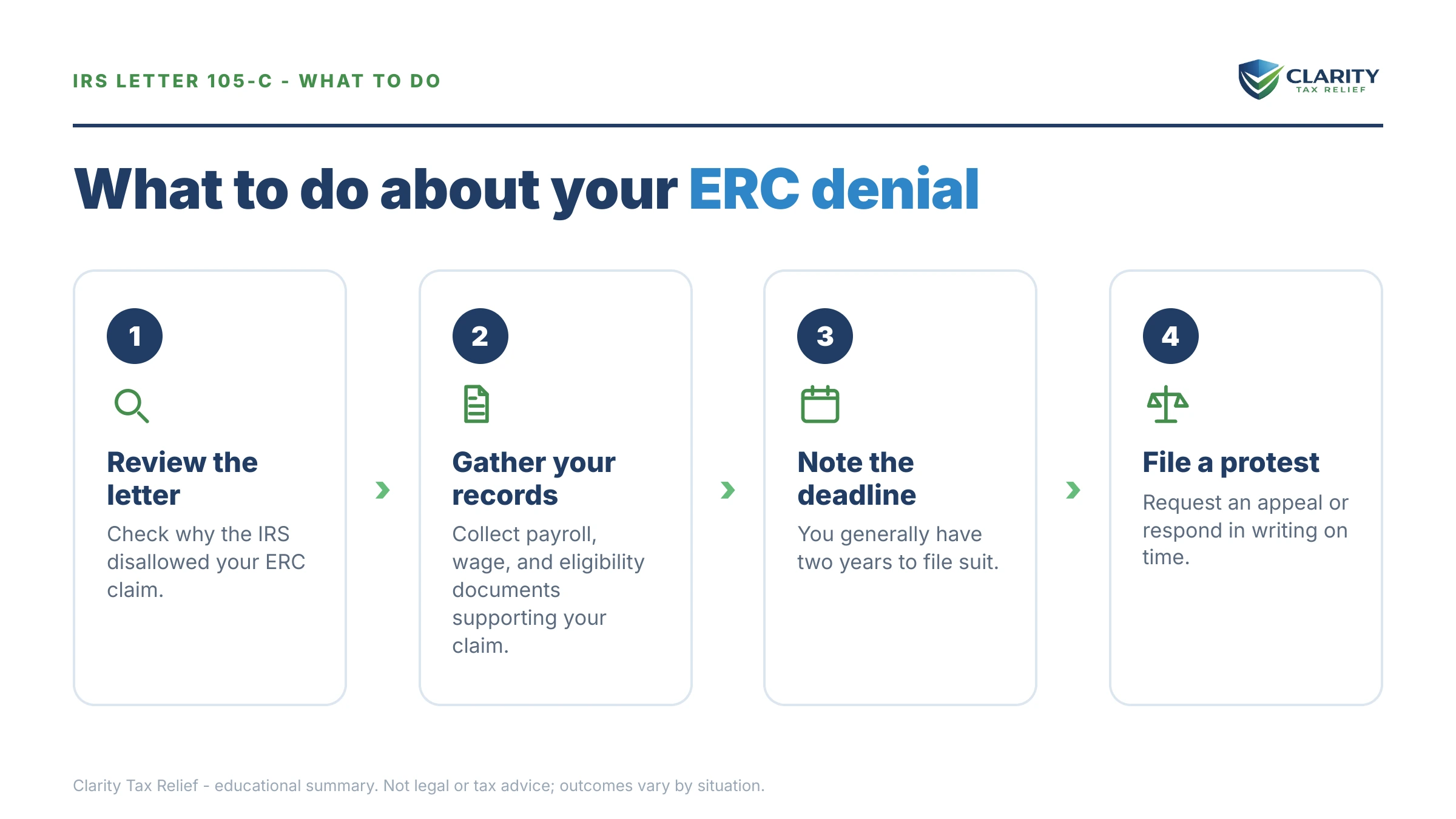
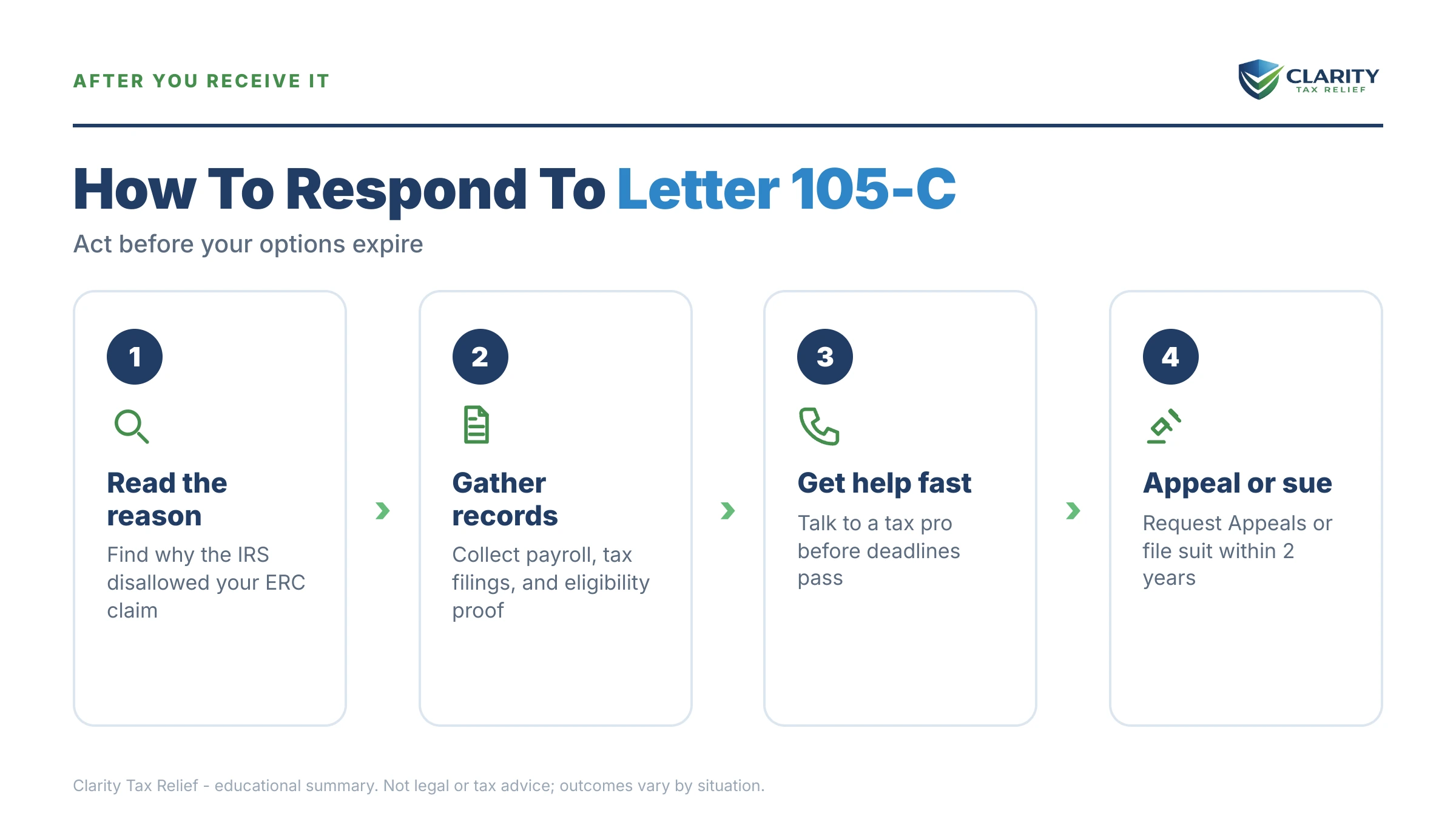
How to respond to Letter 105-C, step by step
- Find the letter date. It's printed at the top of Letter 105-C — every deadline you have, including the two-year suit window, runs from this date.
- Confirm the scope. Check that the letter disallows your claim in full; a partial allowance means you're actually holding a Letter 106-C, which follows the same clocks.
- Pull your eligibility evidence. Gather your Forms 941, W-2s and payroll records, the government order you relied on, or your quarter-by-quarter gross-receipts math.
- Choose your track by the response date on the letter. Accept the denial, file a written protest with the IRS Independent Office of Appeals, or start preparing a refund suit.
- Calendar the two-year suit deadline. Set it the day the letter arrives — and if Appeals is still working your case as it approaches, ask about Form 907 or be ready to file suit.
- Get a professional review if the claim was promoter-filed or already paid. Those two facts change both your exposure and your best move — have an experienced tax professional look before you commit to a path.
If a promoter filed your ERC claim
A promoter-filed claim is still legally your claim — the 941-X carries your signature (or your authorization), and the 105-C lands on you, not the mill. That matters two ways. First, don't count on the promoter to handle the response: many charged their fee upfront and have no incentive to defend a denied claim, and some have shut down entirely. Second, the promoter's eligibility "analysis" is usually worthless as appeal evidence — Appeals wants your payroll records and your government order, not a template memo.
If you suspect the claim never should have been filed, your priorities shift to damage control: confirm nothing was ever paid out (check the letter's tax periods against your bank records), keep every document the promoter gave you, and read our guide to ERC mill claim problems for disavowing the claim and pursuing the fee. And if some quarters were paid before this one was denied, get ahead of the recapture side — our can't repay ERC guide covers the payment options on clawed-back credits.
When you can handle this yourself — and when help changes the outcome
You can handle a Letter 105-C alone when the answer is already obvious. If you had no W-2 employees, you know the claim was invalid — accepting the disallowance requires nothing but a calendar note that the matter is closed. Likewise, if you're a documented employer with a modest claim, organized 941s, and a clear eligibility story, a DIY written protest to Appeals is genuinely realistic: it's a letter with exhibits, not a court filing.
Experienced help changes outcomes in four situations. When the claim is large enough that the two-year suit deadline is a real asset — sequencing Appeals, Form 907, and litigation posture is strategy, not paperwork. When the eligibility theory is a partial suspension by government order, the most technical and most-litigated ERC argument. When quarters were already paid and recapture, penalties — including a possible 20% erroneous-claim penalty under §6676 — or an exam are in play alongside the denial. And when a promoter's paperwork is the only record you have, because rebuilding the evidence file is most of the battle.
The IRS's own explainer is at Understanding your Letter 105-C, and the eligibility rules live on the IRS Employee Retention Credit page. If your two-year deadline is closing in and you can't get the IRS to act on a pending appeal, the Taxpayer Advocate Service is an independent avenue worth knowing about.
Terms on your letter, decoded
- Claim disallowance: the IRS's formal decision to deny a refund claim — it stops the refund but does not, by itself, bill you anything.
- Two-year period (IRC §6532(a)): the statutory window, starting from the disallowance letter's date, in which a refund suit must be filed or the claim dies.
- Form 907: "Agreement to Extend the Time to Bring Suit" — a document you and the IRS both sign to push the two-year deadline out.
- Independent Office of Appeals: the IRS unit, separate from the one that denied your claim, that reviews written protests of disallowances.
- Qualified wages: W-2 wages paid to employees and reported on Form 941 — the only wages the ERC is computed on; 1099 payments never count.
- Gross-receipts decline test: one of the two ERC eligibility gates, comparing a quarter's revenue against the same quarter of 2019.
Letter 105-C questions, answered
Can I appeal Letter 105-C?
Yes. You can file a written protest with the IRS Independent Office of Appeals by the response date printed on your letter, and the appeal itself costs nothing. You'll need real eligibility evidence — Forms 941, payroll records, the government order you relied on, or gross-receipts math. Just remember that appealing does not pause the two-year deadline to file a refund suit.
Does appealing a Letter 105-C extend the two-year deadline to sue?
No. The two-year window under IRC §6532(a) keeps running while Appeals considers your protest, and taxpayers have lost otherwise-winnable claims by letting it lapse mid-appeal. Only two things preserve your rights past that date: filing suit in federal court or signing Form 907, an extension agreement the IRS must also sign.
What is the difference between Letter 105-C and Letter 106-C?
Letter 105-C disallows your claim in full — you get nothing. Letter 106-C is a partial disallowance: the IRS allowed some of the credit and denied the rest. Both letters carry the same appeal rights and start the same two-year suit clock on the disallowed portion, so the response playbook is nearly identical.
Do I have to pay the IRS anything after receiving Letter 105-C?
Usually no. Letter 105-C typically denies a claim before the refund is paid, so there is nothing to repay — you simply don't receive the money. If the IRS already sent you ERC funds and later reverses the credit, that happens through a separate recapture assessment that creates a balance due, followed by regular collection notices.
Can I just refile my ERC claim instead of appealing?
For most quarters, no. The deadline to file a refund claim was April 15, 2024 for 2020 quarters and April 15, 2025 for 2021 quarters, so a new Form 941-X is off the table for most businesses. Once those windows close, your only paths are an appeal of the disallowance or a refund suit filed within the two-year period.
Is Letter 105-C an audit?
No. A disallowance is a claim decision, not an examination — the IRS reviewed your claim, often against screening criteria, and denied it without a full audit. You don't owe additional tax because of the letter itself. A separate ERC audit is possible, especially for claims that were already paid, but it arrives through different exam letters.
What if I actually qualified for the ERC and the IRS is wrong?
Then fight it — the IRS has acknowledged that some batch disallowances swept in eligible employers. Assemble your Forms 941, W-2 payroll records, and proof of a qualifying government order or gross-receipts decline, and file a written protest by your letter's response date. Documented employers have a genuine shot at Appeals; just protect the two-year suit deadline while you wait.
Your next 24 hours
- Find the letter date at the top of your 105-C, then write down two deadlines: the response date printed on the letter and the date exactly two years from the letter date.
- Gather your file: Forms 941 and W-2 payroll records, the 941-X that was filed (request a copy from the preparer or promoter if you never got one), and any government-order or gross-receipts documentation for the quarters claimed.
- Get a free case review — the 2-minute form at claritytaxrelief.com/#consult or (888) 825-7779 — before the response date on your letter passes, so an experienced tax professional can tell you whether the claim is worth fighting and how to protect the two-year deadline while you decide.
This guide is general information, not tax or legal advice for your specific situation. Eligibility for IRS programs depends on individual facts and circumstances; no outcome is guaranteed.