
ERC & Business Notices
ERC Disallowance Appeal: How to Fight Letter 105-C or 106-C (2026)
The short answer: an ERC disallowance appeal is a written protest asking the IRS Independent Office of Appeals to reverse a Letter 105-C or 106-C denying your Employee Retention Credit. File it by the response date printed on your letter — and know that a hard two-year deadline to sue runs whether or not you appeal.
The letter is short for what it does: it says the ERC refund your business may have waited years for isn't coming — all of it on a Letter 105-C, part of it on a Letter 106-C. That decision was almost certainly made by a risk filter, not by anyone reading your payroll records. A filter's decision can be argued with, and the appeal exists for exactly that.
Two items on that letter control everything — the date at the top and the paragraph stating why the claim was denied. The image below shows exactly what a disallowance letter looks like and where to find each one.
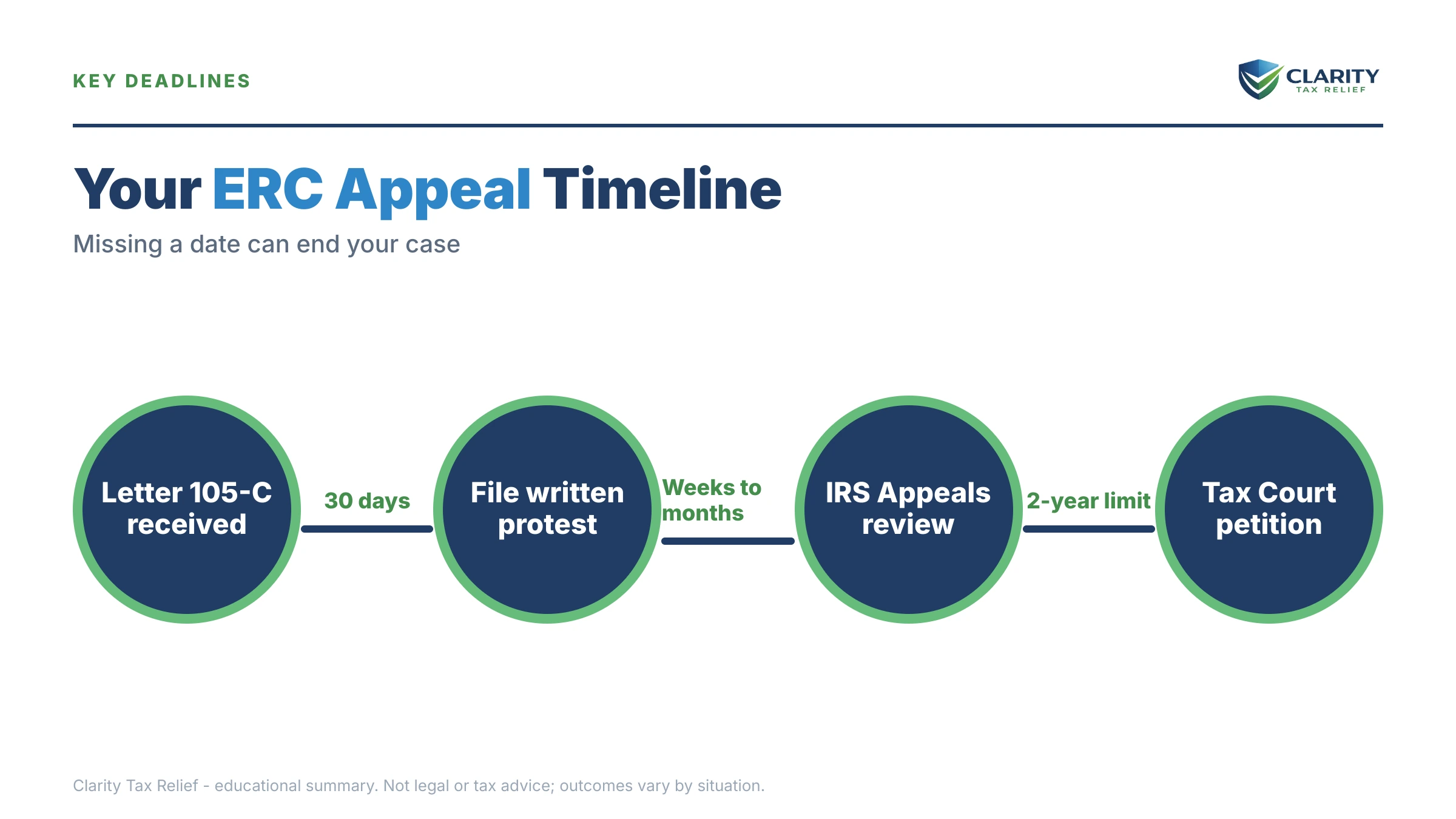
⏱ Your deadlines: the response date printed on your letter is your window to request Appeals review. Behind it sits a harder wall: you have 2 years from the date on your Letter 105-C or 106-C to file a refund suit in court. Appealing does not pause that two-year clock — only a signed Form 907 extension does.
Why the IRS disallowed your ERC claim
Since late 2023, every pending ERC claim has been screened through IRS risk filters, and tens of thousands of disallowance letters have gone out based on those scores. The IRS froze processing of new claims on September 14, 2023, then began mailing disallowances in bulk — and it acknowledged that some early batches contained errors. A letter with your EIN on it is not proof your claim was bad.
The stated reasons cluster into a few buckets:
- Gross receipts don't show a qualifying decline. The IRS compared your quarterly receipts to 2019 and found no 50% drop (2020 quarters) or 20% drop (2021 quarters). Sometimes the IRS is comparing the wrong quarters or missing the 2021 alternative-quarter election — this is the most winnable category.
- The government orders didn't suspend your operations. Generic citations to statewide orders, or "supply chain disruption" theories the IRS has publicly rejected, get denied unless you can tie a specific, dated order to a real suspension of your business.
- The entity didn't exist or paid no W-2 wages during the period. These are largely promoter-generated claims; if a mill filed yours, see ERC mill claim problems before responding.
- The claim was filed too late. The 2025 tax law retroactively barred ERC claims for the third and fourth quarters of 2021 that were filed after January 31, 2024. If your letter cites that bar, the disallowance is statutory — no protest can revive it, and your energy belongs elsewhere.
Which bucket you're in determines whether an appeal is a strong play or a wasted stamp. The reason paragraph on your letter tells you.
What happens if you ignore the disallowance letter
An ignored ERC disallowance becomes permanent two years after the letter date — the refund is forfeited even if your business fully qualified. There's no levy or lien threat behind an unpaid claim; the escalation here is your rights expiring in sequence:
- The response date on your letter passes. Your straightforward path into the Independent Office of Appeals closes with it, and the file sits closed on the IRS side.
- The two-year suit clock keeps running from the letter date — silently, whether you appealed, called, or did nothing.
- The two-year mark passes. The claim dies permanently. No court can hear it, no appeal can reopen it, and a refiled Form 941-X would be rejected as untimely.
- If you received ERC funds that are later clawed back, that balance moves onto the normal collection track — bills, then lien and levy notices — which is a different problem covered below.
The trap is the second stage. Owners assume filing an appeal "stops the clock." It doesn't — Appeals can take longer than two years, and taxpayers have lost live claims while waiting politely for an answer.
Holding a 105-C or 106-C right now?
Send us the letter before your response date passes. An experienced tax professional will map your appeal window, calendar the two-year suit deadline, and tell you honestly whether your eligibility evidence holds up — free, no pressure.
How the ERC disallowance appeal actually works: your options
Every ERC disallowance letter carries appeal rights: a small case request at $25,000 or less per tax period, a formal written protest above that, and a refund suit in federal court as the backstop. Here's the full menu and what each one requires:
| Option | When it fits | Key requirement or deadline |
|---|---|---|
| Small case request (Form 12203 or brief statement) | Disallowed amount is $25,000 or less per tax period | File by the response date printed on your letter |
| Formal written protest to Appeals | Disallowed amount over $25,000 per period | Facts, law, and a penalties-of-perjury declaration; file by your letter's response date |
| Refund suit (U.S. District Court or Court of Federal Claims) | Appeals denies you, stalls, or the claim justifies litigation | Must be filed within 2 years of the disallowance date |
| Form 907 extension | Appeals is still reviewing as the 2-year mark nears | Written agreement the IRS must also sign — request it early, in writing |
| Accept the disallowance | The claim was ineligible or statutorily barred | No filing needed; address repayment if you already received funds |
Appeals is separate from the exam and collection functions — its job is to weigh the hazards of litigation. That means your protest isn't pleading for mercy; it's showing Appeals that if this goes to court, the government could lose. Evidence, not outrage, is the currency.
What goes in the protest — by disallowed amount
The dollar amount on your letter dictates the paperwork. A formal protest must include your business name, address, and EIN; the letter and periods you're contesting; a statement requesting Appeals review; the facts supporting eligibility; the law you rely on; and a signed penalties-of-perjury declaration. A small case request skips the formalities but still lives or dies on the same evidence.
| Disallowed amount | Appeal path | Practical notes |
|---|---|---|
| $25,000 or less per period | Small case request (Form 12203 or brief statement) | DIY is realistic if your gross-receipts math is clean and documented |
| $25,001–$100,000 | Formal written protest | Penalties-of-perjury declaration required; professional review pays for itself when eligibility rests on government orders |
| Over $100,000 or multiple quarters | Formal protest, with litigation counsel evaluating a refund suit in parallel | Suit economics often work at this size; track the 2-year clock on each letter separately |
| Any amount already paid to you | Different track: exam/recapture defense, not a claim appeal | See the recapture and repayment guidance below |
The evidence packet matters more than the prose. For a receipts-based claim: quarter-by-quarter gross receipts for 2019 through 2021, pulled from books that match your filed returns. For an orders-based claim: the specific order, its effective dates, and a concrete account of what part of your operations it suspended — hours, capacity, services you could not legally provide.
A worked example: fighting a $92,700 ERC disallowance
Say your S corporation claimed $92,700 in ERC across Q1 and Q2 2021 on two Form 941-X filings, never received the refunds, and one Letter 105-C disallowed both quarters for "gross receipts do not reflect a qualifying decline." This is hypothetical — but the math is exactly what a protest runs.
Because $92,700 is well over $25,000, you need a formal written protest. Now pull the real numbers. Q1 2021 gross receipts were $210,000 against $290,000 in Q1 2019. The decline is $80,000, and $80,000 ÷ $290,000 = 27.6% — more than the 20% drop the 2021 test requires. Q1 qualifies on arithmetic alone.
Q2 2021 came in at $265,000 against $280,000 in Q2 2019 — only a 5.4% decline, which fails on its face. But the 2021 rules include an alternative-quarter election: you may test the immediately preceding quarter instead. Q2 2021 can qualify by pointing to Q1 2021's 27.6% decline versus Q1 2019. If your original 941-X used that election and the IRS's filter compared the wrong quarters, your protest lays out both calculations, attaches the receipts documentation, and asks Appeals to allow the full $92,700.
No one can promise Appeals will agree. But a protest like that one — dated numbers, shown arithmetic, correct legal test — is precisely the kind of case the disallowance filters were never built to evaluate.
If you already received the ERC money
A disallowance after the check was cashed is a repayment problem, not a refund-claim problem — and it runs on the collection track, not the Appeals-protest track described above. The IRS assesses the amount back, usually with penalties and interest, and standard balance-due notices follow. How that clawback works, including the income-tax amendment side (you gave up wage deductions when you claimed the credit and may restore them), is covered in our guide to ERC recapture.
If the recaptured balance is more than you can write a check for, you have the normal resolution menu — payment plans, hardship status, and in narrow cases an offer — walked through in can't repay ERC and, for the general framework, how to settle tax debt yourself. Interest compounds while you decide; you can estimate what it adds with our Penalty & Interest Calculator. Note the long runway on the IRS side: assessments on Q3 and Q4 2021 ERC carry an extended window, explained in ERC statute of limitations.
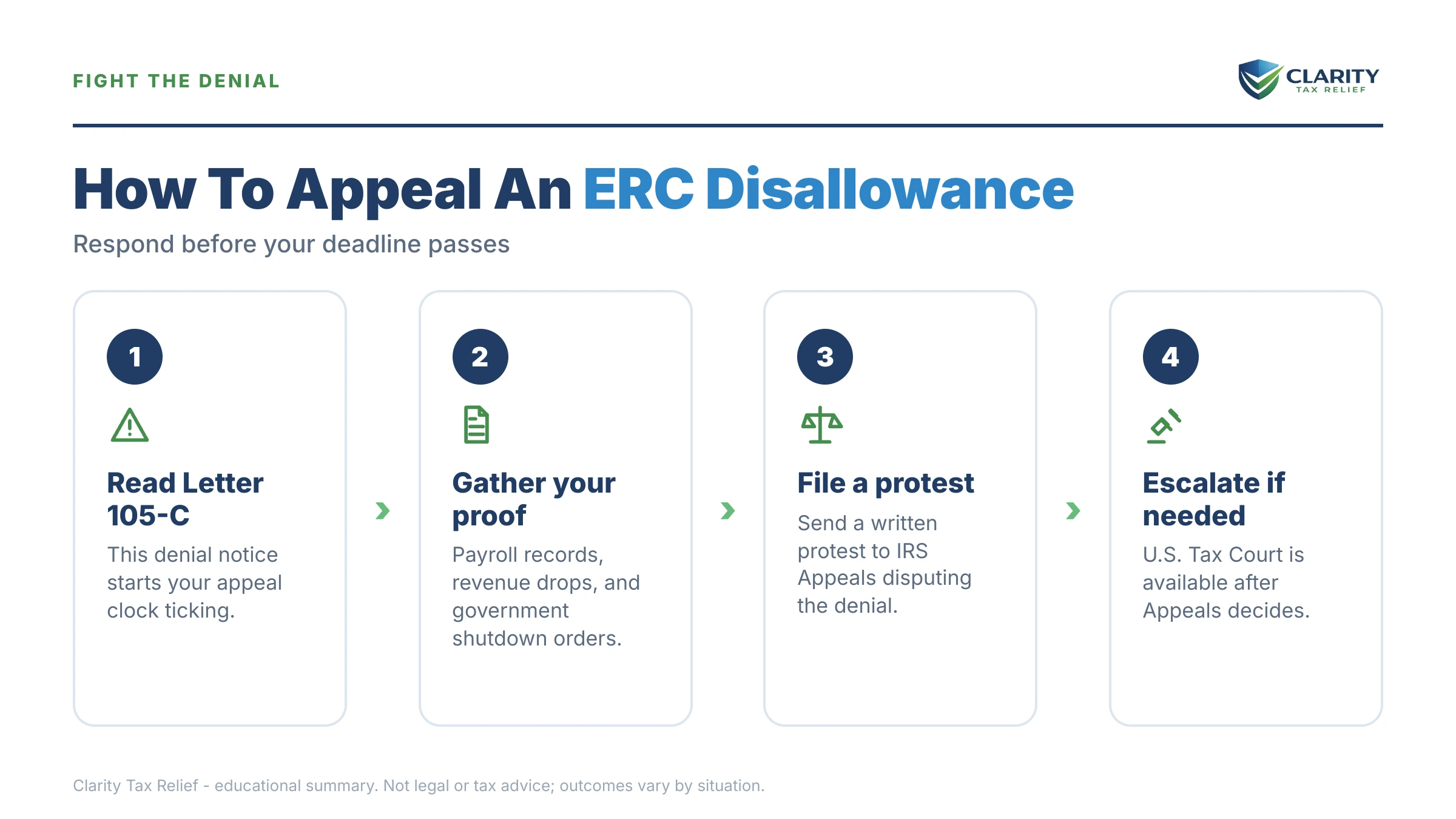
How to appeal an ERC disallowance, step by step
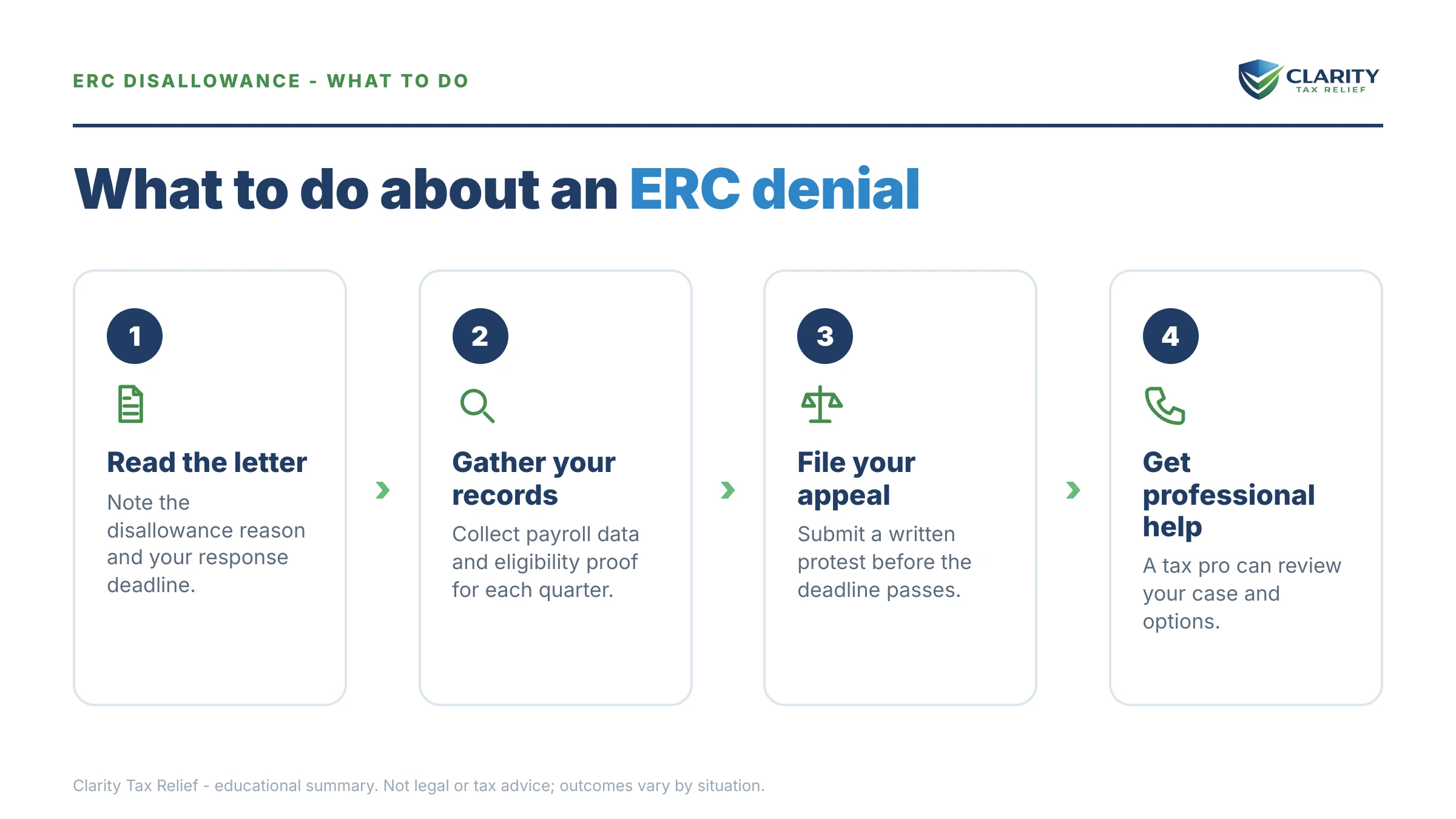
- Read the letter first. Identify whether it is a full (105-C) or partial (106-C) disallowance, the quarters covered, the stated reason, and the response date printed on it.
- Pull your eligibility proof. Gather quarterly gross receipts for 2019 through 2021, payroll records for the claimed wages, the government orders you relied on, your Form 941-X filings, and any PPP forgiveness records.
- Write the protest. Use a small case request (Form 12203 or a brief written statement) if the disallowed amount is $25,000 or less per period; above that, prepare a formal written protest signed under penalties of perjury.
- Mail it certified before the response date. Send the protest to the address on your letter, keep the certified-mail receipt, and retain a complete copy of everything you send.
- Calendar the two-year suit deadline. Mark two years from the letter date on your calendar; if Appeals has not decided as it approaches, request a Form 907 extension in writing or talk to counsel about filing suit.
- Get experienced help for large or technical claims. A government-orders-only argument or a six-figure disallowance is worth a professional review before you commit your position in writing.
When you can handle this yourself — and when help changes the outcome
A disallowed amount of $25,000 or less per period, backed by clean gross-receipts arithmetic, is a legitimate do-it-yourself appeal. If the IRS simply compared the wrong quarters or missed your alternative-quarter election, a small case request with the numbers attached is something a careful owner can file alone. And if your letter cites the statutory bar on late-filed Q3/Q4 2021 claims, no professional can change that answer — don't pay anyone who says otherwise.
Experienced help earns its fee in four situations: a formal protest over $25,000, where the penalties-of-perjury declaration means your written position must be right the first time; an eligibility case built on government orders, which is legal argument rather than arithmetic; a promoter-filed claim you can't fully explain, where your protest may need to correct the original filing's overreach; and any file approaching the two-year suit deadline, where the Form 907/litigation decision has to be made correctly and on time. What full disallowance defense looks like when the IRS opens an exam instead is covered in ERC audit — and the broader decision tree for every disallowance scenario lives in ERC claim disallowed.
Terms on your letter, decoded
- Letter 105-C — the IRS's formal notice that your entire refund claim is disallowed; it starts the two-year period to sue.
- Letter 106-C — a partial disallowance: part of the claim is allowed, the rest denied, with the same appeal rights on the denied portion.
- Formal written protest — the document (facts, law, penalties-of-perjury signature) required to get Appeals review when more than $25,000 per period is at stake.
- Two-year suit period (IRC §6532) — the statutory window, starting on the disallowance date, to file a refund suit; it does not pause for an appeal.
- Form 907 — a written agreement between you and the IRS extending that two-year window; both sides must sign it before the deadline.
- Independent Office of Appeals — the IRS division, separate from exam and collections, that weighs whether the government would likely lose your case in court.
Primary sources, if you want them: the IRS's own Employee Retention Credit page covers eligibility rules and enforcement updates, its Independent Office of Appeals page explains protest procedures, and the Taxpayer Advocate Service can intervene when an ERC file has stalled with no response at all.
ERC disallowance appeal questions, answered
How long do I have to appeal an ERC disallowance?
Two clocks matter. Your Letter 105-C or 106-C prints a response date for requesting Appeals review — use that date, not a generic rule. Separately, federal law gives you two years from the disallowance date to file a refund suit in court, and that clock runs whether or not you appeal. Miss both and the claim is permanently lost, even if your business fully qualified.
Does filing an appeal pause the two-year deadline to sue?
No. The two-year period under IRC §6532 keeps running while the IRS Independent Office of Appeals reviews your protest. The only way to extend it is Form 907, a written agreement that the IRS must also sign. If Appeals review drags toward the two-year mark, request the extension in writing early — or be prepared to file suit to preserve the claim.
What is the difference between Letter 105-C and Letter 106-C?
Letter 105-C disallows your entire ERC claim; Letter 106-C disallows part of it and allows the rest. The appeal mechanics are the same for both — a small case request or formal protest filed by the letter's response date. With a 106-C, accepting the allowed portion does not forfeit your right to contest the part that was denied.
Can I just refile my ERC claim instead of appealing?
Generally no. ERC claims are filed on Form 941-X, and the refund-claim deadlines have passed — April 15, 2024 for 2020 quarters and April 15, 2025 for 2021 quarters. A new claim filed now would be rejected as untimely, which makes an appeal or a timely refund suit your only remaining paths to the money.
What should an ERC protest letter include?
A formal protest needs your business name, address, and EIN, the letter and tax periods you are contesting, a statement that you want Appeals review, the facts supporting eligibility, the law you rely on, and a penalties-of-perjury declaration with a signature. The evidence is what carries it: quarter-by-quarter gross receipts, payroll records for the claimed wages, and the specific dated government orders that affected your operations.
What are my chances of winning an ERC appeal?
There is no published win rate, and no honest professional will promise one. Outcomes track documentation: protests built on clean gross-receipts arithmetic or specific, dated government orders that applied to your operations do far better than generic supply-chain-disruption arguments, which the IRS has publicly rejected. If a promoter prepared your claim with boilerplate eligibility language, expect Appeals to press for real evidence behind it.
Do I need a tax attorney to appeal an ERC disallowance?
Not always. A small case request at $25,000 or less per period with clean gross-receipts math is realistic to handle yourself. Above $25,000, a formal protest signed under penalties of perjury raises the stakes, and if the two-year window forces a refund suit, that is federal court litigation where counsel matters. An experienced tax professional can evaluate your eligibility argument before you commit it to writing.
Your next 24 hours
- Find two things on your letter: the date at the top and the reason paragraph. Write down the response date, and calendar two years from the letter date — that's your suit deadline.
- Gather the evidence: quarterly gross receipts for 2019–2021, payroll records for the claimed quarters, your original Form 941-X filings, and any government orders your claim relied on.
- Get a free letter review — call (888) 825-7779 or use the 2-minute form — before the response date on your 105-C or 106-C passes. The Appeals window is where these claims get resolved on the best terms; after two years, no one can resolve them at all.
This guide is general information, not tax or legal advice for your specific situation. Eligibility for IRS programs depends on individual facts and circumstances; no outcome is guaranteed.