
ERC Problems
ERC Mill Claim Problems: What to Do When a Promoter Filed Your Claim (2026)
The short answer: if an ERC mill filed your Employee Retention Credit claim, you — not the promoter — owe the IRS every dollar if the claim fails. Your fix depends on where the claim sits: withdraw it if it hasn't been paid, correct or repay it if it has, and contest it if the IRS disallowed it.
A promoter cold-called, swore your business qualified, kept 20% of the check, and put your name — not theirs — on every form. Now the mail has your EIN on it and the "ERC specialists" have stopped answering the phone. ERC mill claim problems all share that one design flaw: the promoter's risk ended at the fee, and yours started at the signature. The good news is that every version of this mess has a defined fix, and the earlier you act, the cheaper it gets.
Everything the IRS knows about your claim came from the paperwork the mill filed under your name — the image below shows exactly what that Form 941-X claim looks like and where to find the quarter and credit amount the promoter reported for you.
⏱ Your clock: if a Letter 105-C disallowance is in your mail stack, you have 2 years from the date on that letter to contest the disallowance in court. Every other clock runs continuously: interest accrues on the full refund from the day the IRS paid it — whether or not you've heard from the IRS yet.
Why the promoter's claim is legally your problem
An ERC claim filed under your EIN is your claim, no matter who prepared it. The mill filed Form 941-X — an amended payroll tax return — for your business, and you (or someone with your authority) signed it under penalties of perjury. When the IRS unwinds the claim, it assesses the money against you, adds interest from the day the refund was paid, and can add penalties on top. The promoter's contract almost certainly disclaims responsibility for the outcome it sold you.
Signs your claim came from a mill rather than a real eligibility analysis:
- The fee was a percentage of the refund — typically 15–25% — instead of a flat preparation fee.
- You were told "every business qualifies" or that a generic supply-chain disruption made you eligible, with no written analysis of government orders or your quarterly revenue.
- You never received the workpapers — no eligibility memo, no wage calculations, sometimes not even copies of the 941-X forms.
- The claim counted money that can never qualify: your own owner's draw, Schedule C profit, or wages paid to your relatives.
- The company has rebranded, gone silent, or now offers to "defend" the claim for another fee.
One fact matters most if you're a sole proprietor: the ERC only ever applied to W-2 wages paid to employees. Your own self-employment earnings never qualified — not in any quarter, under any theory. If you had a few W-2 employees, part of a claim might be real; if you had none, the wages on that 941-X were invented, and unwinding the claim fast is how you keep a paperwork problem from becoming something worse.
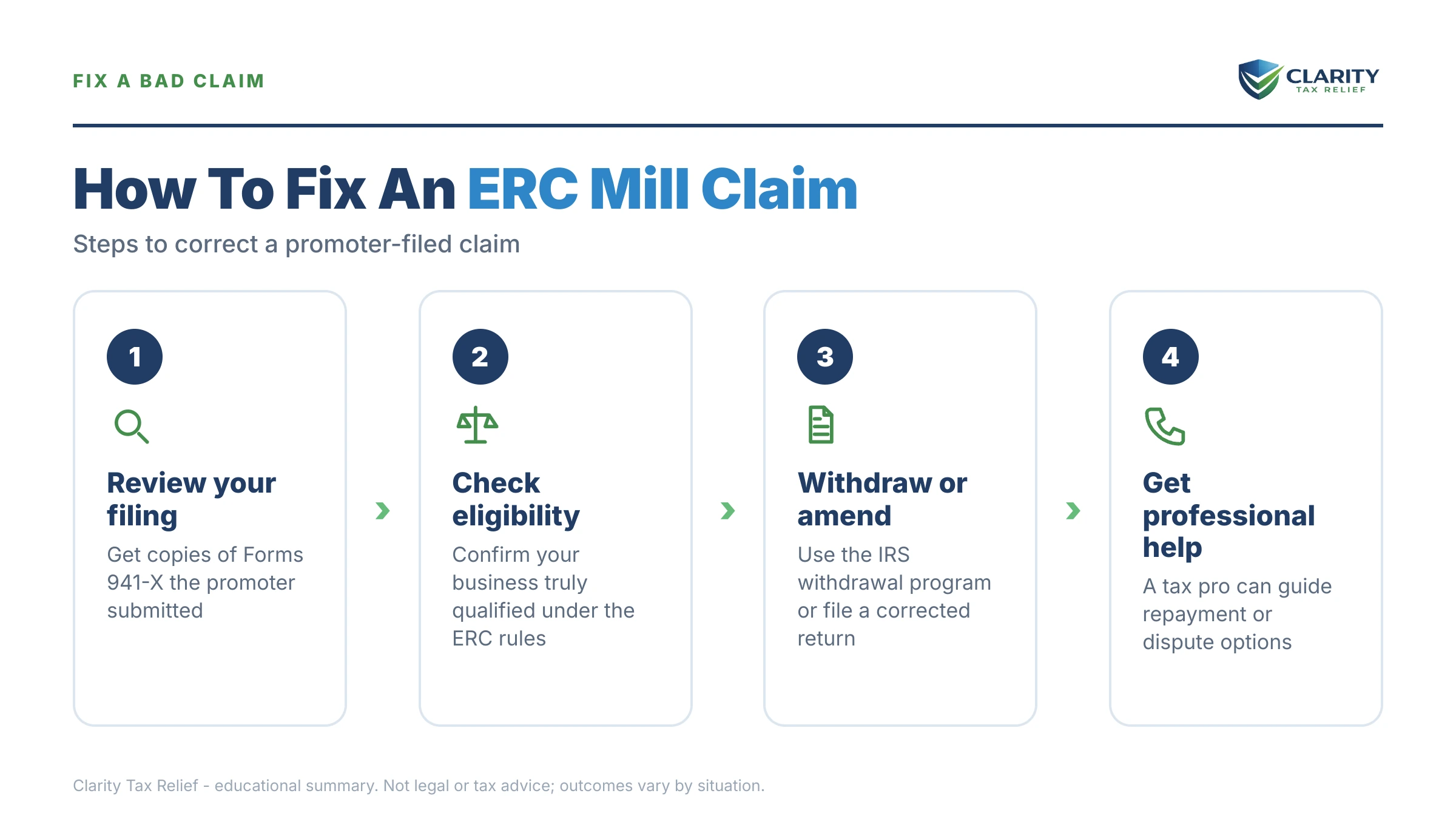
The four ERC mill claim problems — and which one you have
Every mill-filed claim lands in one of four buckets, and the bucket decides the fix.
1. The claim is pending and unpaid. This is the best bucket. The IRS's withdrawal process lets you pull the claim entirely, and a withdrawn claim is treated as if it was never filed — no repayment, no penalties, no interest. The IRS's moratorium on processing new claims (in place since September 2023) left a huge backlog, so many mill claims from 2023–2024 are still sitting here.
2. The refund was paid. Now the full credit — including the slice the mill kept — is money the IRS can demand back with interest. Your paths are a corrected 941-X, repayment (in full or through a plan), or a disclosure program if a window is open. The ERC voluntary disclosure program article covers what those terms looked like and how to watch for a reopening.
3. The claim is under audit or already disallowed. An ERC audit means the IRS wants the eligibility proof the mill never gave you. A disallowance letter means it already decided. If the claim was partly or fully legitimate, you can fight; the ERC claim disallowed guide walks the whole decision tree.
4. The income-tax side effect. ERC and your wage deduction are linked: claiming the credit required reducing the wage expense on your Schedule C for the year the wages were paid. If the credit gets repaid or disallowed, that reduction reverses — the ERC recapture guide covers the amendment mechanics. Many mill victims are owed income tax back on this side even while they owe payroll tax on the other.
Also worth knowing: 2025 legislation barred credits for third- and fourth-quarter 2021 claims filed after January 31, 2024. If your mill filed late for those quarters, the claim may fail on timing alone — regardless of eligibility.
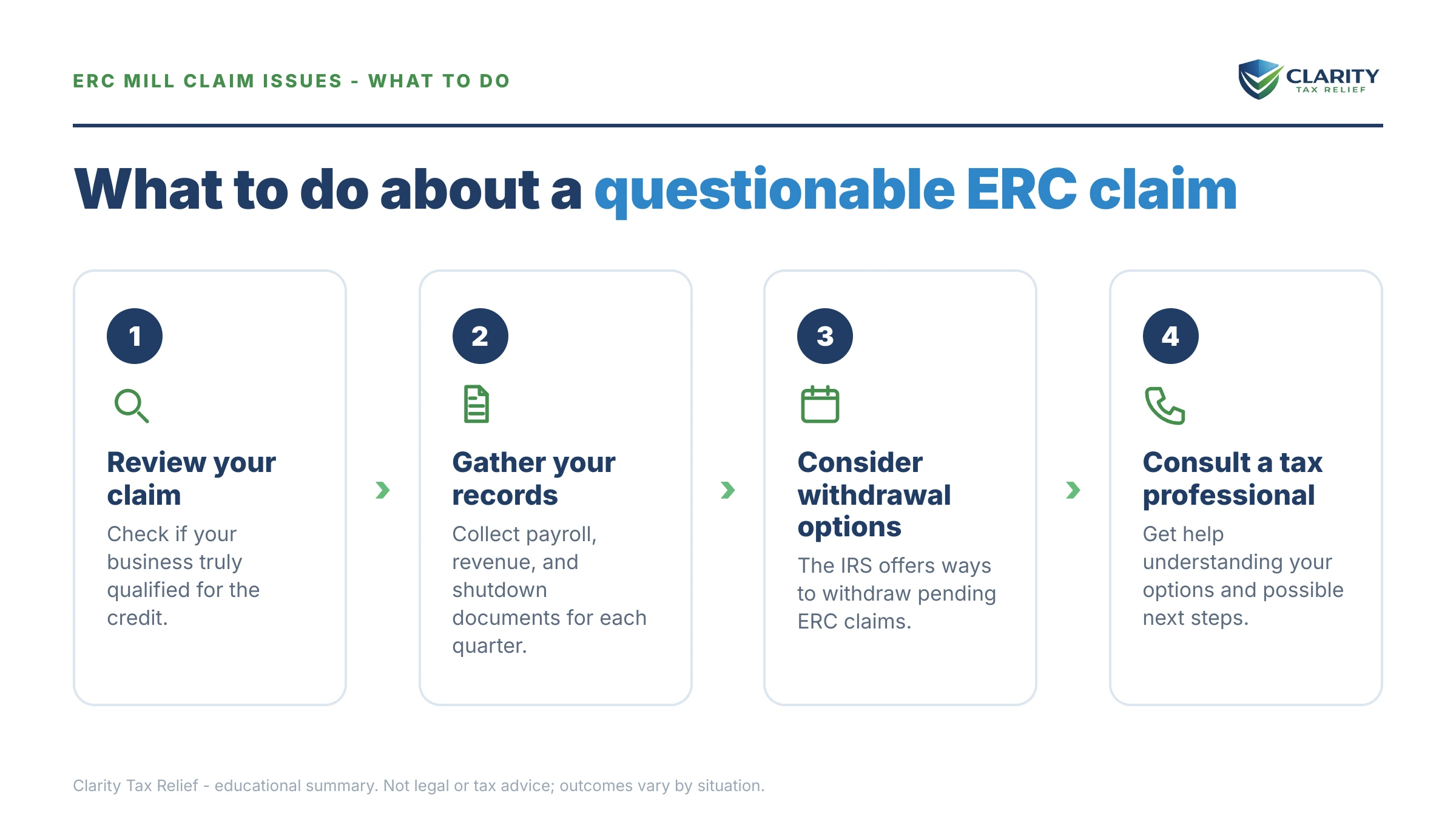
What happens if you do nothing
A mill-filed ERC claim does not fade out — it sits inside a long assessment window while interest compounds. The IRS workforce shrank roughly 27% in 2025, but ERC disallowances and the collection notices that follow are generated by automated systems that never stopped. Ignored, the sequence runs like this:
- Silence, while the clock runs. For the biggest ERC quarters — Q3 and Q4 of 2021 — Congress gave the IRS five years to assess, a window running well into 2027. Details in the ERC statute of limitations guide. Interest accrues on any paid refund the entire time.
- Examination or disallowance. The IRS either opens an audit of the 941-X or issues Letter 105-C (full disallowance) or Letter 106-C (partial). Miss the response windows and the decision hardens.
- Assessment and balance-due notices. The disallowed credit posts to your business account as a debt — credit plus interest, plus penalties where the IRS asserts them — and the bill notices start arriving.
- Enforced collection. The sequence ends where every unpaid federal tax debt ends: a possible federal tax lien, an intent-to-levy notice, then a final notice giving you 30 days before the IRS can levy your business bank account and, for a sole proprietor, reach the same account that pays your mortgage.
| Stage / letter | What it means | Your window |
|---|---|---|
| ERC examination letter | The IRS is auditing the 941-X and wants eligibility and wage proof | Respond by the date printed on the letter |
| Letter 105-C / 106-C | Claim disallowed in full (105-C) or in part (106-C) | Protest per the letter; 2 years from its date to sue |
| Balance-due notice | The credit is assessed back with interest as a collectible debt | Pay or set up a plan by the printed date |
| Intent-to-levy notice (CP504-type) | The IRS can seize your state tax refund; lien filing becomes likely | Act before the final notice issues |
| LT11 / Letter 1058 final notice | Levy on bank accounts and income can follow | 30 days to request a Collection Due Process hearing |
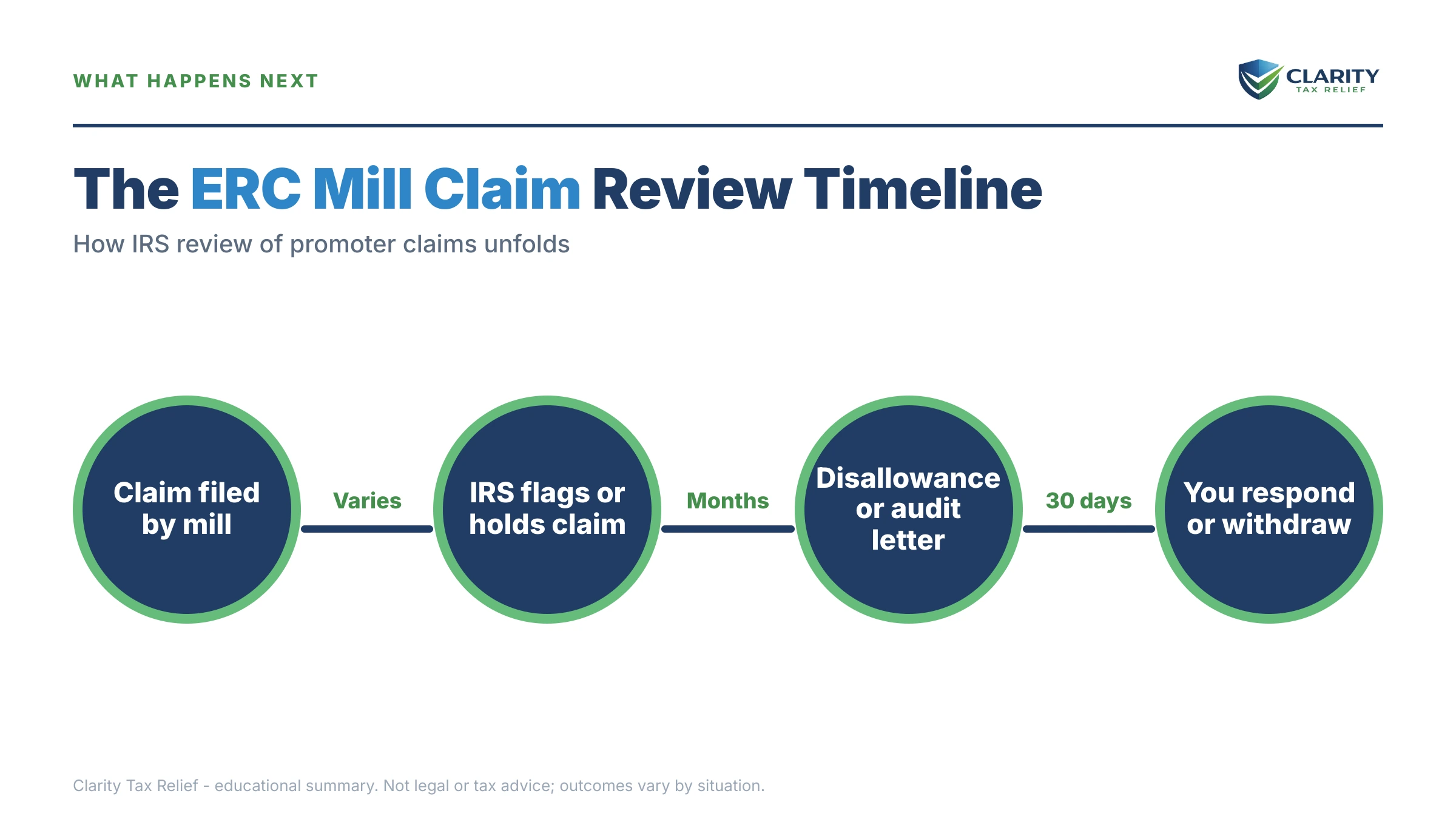
A promoter filed your ERC claim and now it's unraveling?
Interest on that refund has been running since the day the check was issued — and the mill isn't paying it. Send us the letters and the 941-X copies. An experienced tax professional will map exactly where each quarter's claim sits and the cheapest way out — free, confidential, no pressure.
Your options, matched to where the claim sits
There is a defined exit for every claim status — and the cost difference between them is enormous.
| Where your claim sits | Best move | What it costs you |
|---|---|---|
| Filed, refund not yet paid | Withdraw the claim through the IRS withdrawal process | $0 to the IRS — the claim is treated as never filed |
| Refund check received but not cashed | Withdraw and return the voided check with the request | The refund goes back; no penalties or interest on the withdrawn claim |
| Refund paid and spent | Corrected 941-X plus full payment, a payment plan, or a disclosure window if open | Credit + interest; penalties possible, good-faith reliance helps |
| Under audit | Respond with real eligibility workpapers — or concede bad quarters and arrange payment | Depends on findings; withdrawal may still be possible if unpaid |
| Disallowed (Letter 105-C / 106-C) | Written protest to Appeals, or suit within 2 years, if the claim was legitimate | Repay with interest if you concede or the window lapses |
If repayment is where you land, the mechanics mirror any federal tax debt: full payment stops interest, a short-term arrangement buys up to 180 days, and installment agreements spread the balance monthly while interest continues — the how to settle tax debt yourself guide covers those programs in depth, and can't repay ERC covers the ERC-specific wrinkles, like which entity owes and how business versus personal accounts are treated. If the disallowance itself is wrong, the ERC disallowance appeal guide shows how to build the protest.
And the mill's fee? You owe the IRS the full credit — including the 20% you never saw. Recovering the fee is a separate, parallel fight against the promoter: written refund demand, state attorney general and FTC complaints, and civil court if needed. The tax relief company took my money guide walks that playbook step by step.
The math on a $36,900 mill claim (hypothetical)
Say a mill filed 941-X claims totaling $36,900 across your 2021 quarters for the two part-time W-2 employees of your sole proprietorship. The mill kept 20% — $7,380 — so you actually pocketed $29,520.
If the IRS disallows the claim, you owe back the full $36,900, plus interest compounding from the refund date, plus — where the IRS asserts negligence — an accuracy-related penalty of 20%, another $7,380. That's over $44,000 before interest, roughly $15,000 more than you ever held. You can estimate what's accruing on your own numbers with our IRS Penalty & Interest Calculator.
Compare the exits. Withdrawing the same claim before payment: $0. The first voluntary disclosure window, when it was open, required repaying 80% — $29,520, almost exactly what you kept, effectively making the IRS absorb the mill's fee. That spread — $0 versus $29,520 versus $44,000-plus — is why the single most expensive move with a mill claim is waiting.
One offset works in your favor: if your 1040 was amended to cut the Schedule C wage deduction by $36,900 when the credit was claimed, repayment or disallowance means you overpaid income tax that year — and a re-amendment can claw a real chunk of it back.
How to respond to an ERC mill claim, step by step
- Gather the promoter's paperwork. Demand every document the mill filed or relied on — the Forms 941-X, any eligibility memo, and your signed agreement — and pull your business tax transcripts to see what the IRS actually received.
- Pin down the claim's status. Confirm whether each quarter's claim is pending, paid, under audit, or disallowed — the right fix is different for each status.
- Withdraw any claim that hasn't been paid. Use the IRS's ERC claim withdrawal process for unpaid claims (or an uncashed refund check) — a withdrawn claim is treated as if it was never filed.
- Correct or repay claims already paid. File a corrected Form 941-X for overstated quarters and arrange full payment, a payment plan, or a disclosure program if a window is open.
- Contest a disallowance if the claim was legitimate. Respond to Letter 105-C or 106-C with a written protest inside the window printed on the letter — silence turns a disputable disallowance into a final debt.
- Amend your income tax return to match. If you reduced your Schedule C wage deduction when the credit was claimed, re-amend to restore it once the credit is repaid or disallowed.
When you can handle this yourself — and when help changes the outcome
Withdrawing a pending, clearly invalid claim is genuinely a do-it-yourself task. The IRS publishes the exact procedure at its ERC claim withdrawal page, and its main Employee Retention Credit page has the eligibility rules mills ignored. You can also handle it alone if the refund was small and you can repay it in full or within a 180-day short-term arrangement.
Experienced help changes outcomes in four situations. First, when the claim mixed real and fake — say, legitimate wages for your two employees plus your own draw — because someone has to separate the defensible quarters from the ones to concede. Second, when you're already under audit or holding a 105-C, because appeal arguments and the 2-year suit clock (and a Form 907 extension, where it fits) have to be sequenced correctly. Third, when the repayment number is $36,900-scale and needs a plan your cash flow can survive. Fourth — and most seriously — if you signed knowing there was no payroll, get advice before contacting the IRS. If a promoter took your money for a claim it knew was bogus, you can also report the operation to the IRS on Form 14242 and flag your case to the Taxpayer Advocate Service if collection is causing hardship.
Terms on your ERC letters, decoded
- ERC mill: a promoter that mass-filed Employee Retention Credit claims for a contingency fee, with little or no real eligibility analysis.
- Form 941-X: the amended quarterly payroll tax return the mill used to claim the credit under your EIN — the document the IRS holds you to.
- Claim withdrawal: the IRS process that lets you pull an unpaid ERC claim so it's treated as never filed, with no penalties or interest.
- Letter 105-C / 106-C: full and partial claim disallowance letters; 105-C starts a 2-year window to contest in court.
- Recapture: the IRS reversing a paid ERC — assessing the credit back against your account as a debt, with interest.
- Contingency fee: the percentage-of-refund fee the mill kept — the classic mill fingerprint, and money you still owe back to the IRS if the claim fails.
ERC mill questions, answered
Am I liable for an ERC claim a promoter filed for me?
Yes. The claim was filed on Form 941-X under your EIN with your signature or authorization, so the IRS collects the credit, interest, and any penalties from you — not the mill. You may have a separate civil claim against the promoter for its fee, and you can report the promoter to the IRS on Form 14242, but neither pauses IRS collection against you.
Can I withdraw an ERC claim that hasn't been paid yet?
Yes. The IRS's withdrawal process covers claims that haven't been paid — or paid claims where you still hold the uncashed refund check — and a withdrawn claim is treated as if it was never filed, with no penalties or interest on the withdrawn amount. Withdrawal is available even if the claim is already under audit. It does not erase exposure for a knowingly fraudulent filing, but for a mill-sold claim it is usually the cleanest exit.
I'm self-employed with no employees — was my ERC claim ever valid?
No. The Employee Retention Credit applies only to W-2 wages a business paid to employees during eligible 2020–2021 quarters. Your own Schedule C profit, owner's draws, and 1099 payments to contractors never qualify, and wages paid to most of your relatives are excluded too. If a mill filed a claim for a business with no payroll, the wages on that 941-X were invented — which makes withdrawing or repaying quickly even more important.
If I repay the IRS, do I get the mill's contingency fee back?
Not from the IRS — you owe back the full credit, including the 15–25% slice the promoter kept. Fee recovery is a separate fight against the mill: a written refund demand, a state attorney general or FTC complaint, and small-claims or civil court if the contract promised eligibility work that was never done. Start that fight in parallel, but never wait on it to fix the IRS side.
Can I go to jail over a bad ERC claim?
For most owners who relied on a promoter in good faith, no — the exposure is civil: repayment, interest, and possible penalties. Criminal enforcement has focused on promoters and on taxpayers who knowingly fabricated payroll or eligibility. If you signed a claim knowing your business had no employees or no qualifying wages, talk to an experienced tax professional before you contact the IRS, so the fix is sequenced correctly.
How long does the IRS have to audit an ERC claim?
Longer than most audits. Congress gave the IRS five years to assess on ERC claims for the third and fourth quarters of 2021 — a window that runs well into 2027 — and those late-2021 quarters carried the biggest per-employee credits, so they are where most mill claims live. Do not assume a quiet mailbox means the claim survived.
What is Letter 105-C and what is my deadline?
Letter 105-C is a full disallowance of your ERC claim, and it starts a 2-year clock from the letter's date to contest the disallowance in court. Before court, you can file a written protest asking IRS Appeals to review the decision, and Form 907 can extend the suit deadline by agreement. If you do nothing, the disallowance becomes final and any refund already paid is collected back with interest.
Is the ERC voluntary disclosure program still open in 2026?
The enrollment windows the IRS announced closed in 2024 — the first round let employers repay 80% of the credit and keep the rest, with no interest or penalties on the repaid amount. The IRS has reopened disclosure terms before, so check current availability with the IRS or an experienced tax professional before assuming full repayment is your only path. The withdrawal process for unpaid claims remains available as of this writing.
Your next 24 hours
- Find the claim details. Locate the 941-X copies (or the deposit in your bank records) and note the quarter, the credit amount for each, and the date on any IRS letter you've received — that date controls your windows.
- Gather your proof. Pull the promoter's contract and emails, your payroll records (or the fact that you had none), the bank statement showing the refund, and your amended 1040 if the wage deduction was changed.
- Get the claim reviewed free. Interest on that refund compounds every day it stays unresolved — call (888) 825-7779 or use the 2-minute form and an experienced tax professional will tell you whether withdrawal, correction, repayment, or appeal is your cheapest exit.
This guide is general information, not tax or legal advice for your specific situation. Eligibility for IRS programs depends on individual facts and circumstances; no outcome is guaranteed.