
ERC & Business Tax Debt
Can't Repay ERC? Your Options for Paying Back the Employee Retention Credit (2026)
The short answer: if you can't repay ERC money the IRS has recaptured or disallowed, the balance becomes a normal assessed employment-tax debt — which means payment plans, hardship status, penalty relief, and (rarely) settlement are all available. Nothing gets levied at the first notice, but interest and a 0.5% monthly penalty accrue until you act.
The ERC refund landed two or three years ago, it went straight into keeping the business alive, and now a letter says the credit was never yours to keep — and the money is long gone. You are not being accused of fraud, and you are not the only employer in this exact spot. The IRS treats recaptured ERC like any other tax it has assessed, and that opens every repayment tool in its playbook.
The image below shows what an ERC recapture bill looks like and where to find the three things that control your options: the quarter, the assessed amount, and the pay-by date.
⏱ Your deadline: the pay-by date printed on your ERC recapture or disallowance notice. There is no single statutory repayment deadline for everyone — but interest compounds daily and a 0.5% monthly failure-to-pay penalty accrues on the assessed balance, and the IRS's automated notice sequence escalates whether or not a human ever reviews your file.
Why the IRS wants the ERC money back
The IRS recaptures ERC when it decides a claimed quarter didn't qualify — because of the government-shutdown test, the gross-receipts decline test, or wages that were double-counted with other relief. The recapture is assessed on your employment-tax account for that specific quarter, the same account your Form 941 or 941-X touched, which is why the bill looks like a payroll-tax debt rather than an income-tax one.
Most repayment situations start from one of four places: your ERC claim was disallowed after review; an exam recaptured a refund already paid out; you entered the ERC voluntary disclosure program and now owe the agreed payback; or a promoter filed the claim and you've since learned it never qualified — the ERC mill claim problems path. In 2026 the mail includes a new arrival too: the CP320B notice, an ERC-specific notice that started going out in April 2026.
Two facts make ERC recapture different from ordinary back taxes. First, the IRS has an extended ERC statute of limitations — generally 5 years to assess recapture on the third and fourth quarters of 2021 — so bills are still arriving for claims filed years ago. Second, the amount on the bill is the full credit plus penalties and interest, even if a promoter kept a 20% cut and you never saw the whole refund.
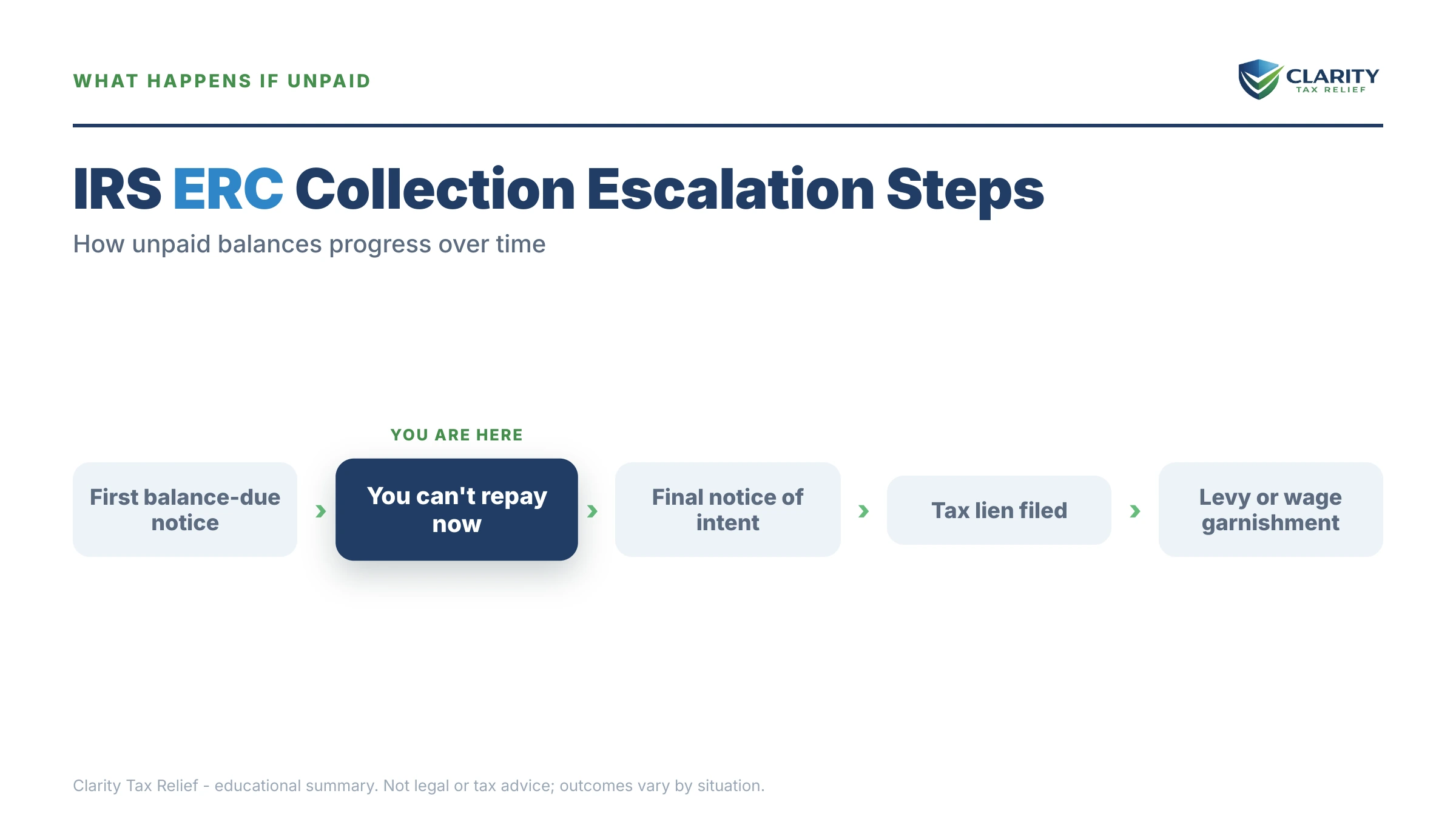
What happens if you don't repay the ERC
Unpaid ERC recapture moves through the same automated collection sequence as any assessed tax debt, and each stage carries more enforcement power than the last. The sequence runs in this order:
- Disallowance or recapture assessment — Letter 105-C (full disallowance), Letter 106-C (partial), or an exam report posts a balance to your 941 account for the quarter. Your dispute rights are strongest right here.
- Balance-due notices — the IRS bills the assessed amount plus penalties and interest. Still just bills; no enforcement yet, but the balance grows monthly.
- CP504 / CP504B — Notice of Intent to Levy under IRC §6331(d). The IRS can now seize your state tax refund, and a federal tax lien becomes a live risk against business assets.
- LT11 / Letter 1058 — Final Notice of Intent to Levy. A 30-day clock starts, along with your Collection Due Process rights (requested on Form 12153). This is the last formal brake before enforcement.
- Levy — bank accounts (funds are held 21 days before they leave), accounts receivable, and — if you're a sole proprietor — your personal income and accounts, because a sole proprietor is personally liable for the business's tax debts.
Unlike a missed payroll tax deposit, recaptured ERC is a credit clawback rather than withheld employee money, so it's generally treated differently from trust-fund payroll debt — but the collection machinery that pursues it is identical, and in 2026 that machinery is fully automated even while IRS staffing is down roughly 27%.
| Notice or stage | Your window | The right at stake |
|---|---|---|
| Letter 105-C / 106-C (disallowance) | Appeal window printed on the letter; generally 2 years to sue for a disallowed claim (Form 907 can extend it) | Your chance to keep the credit instead of repaying it |
| First balance-due notice | Pay-by date printed on the notice | Cheapest moment to set terms — no enforcement exists yet |
| CP504 / CP504B | Date printed on the notice | After this stage the IRS can take your state tax refund; lien risk rises |
| LT11 / Letter 1058 | 30 days | Collection Due Process hearing via Form 12153 — the last formal brake before levy |
| Levy | Bank levy: 21-day hold before funds leave | Release is still possible through hardship or an agreement, but options narrow fast |
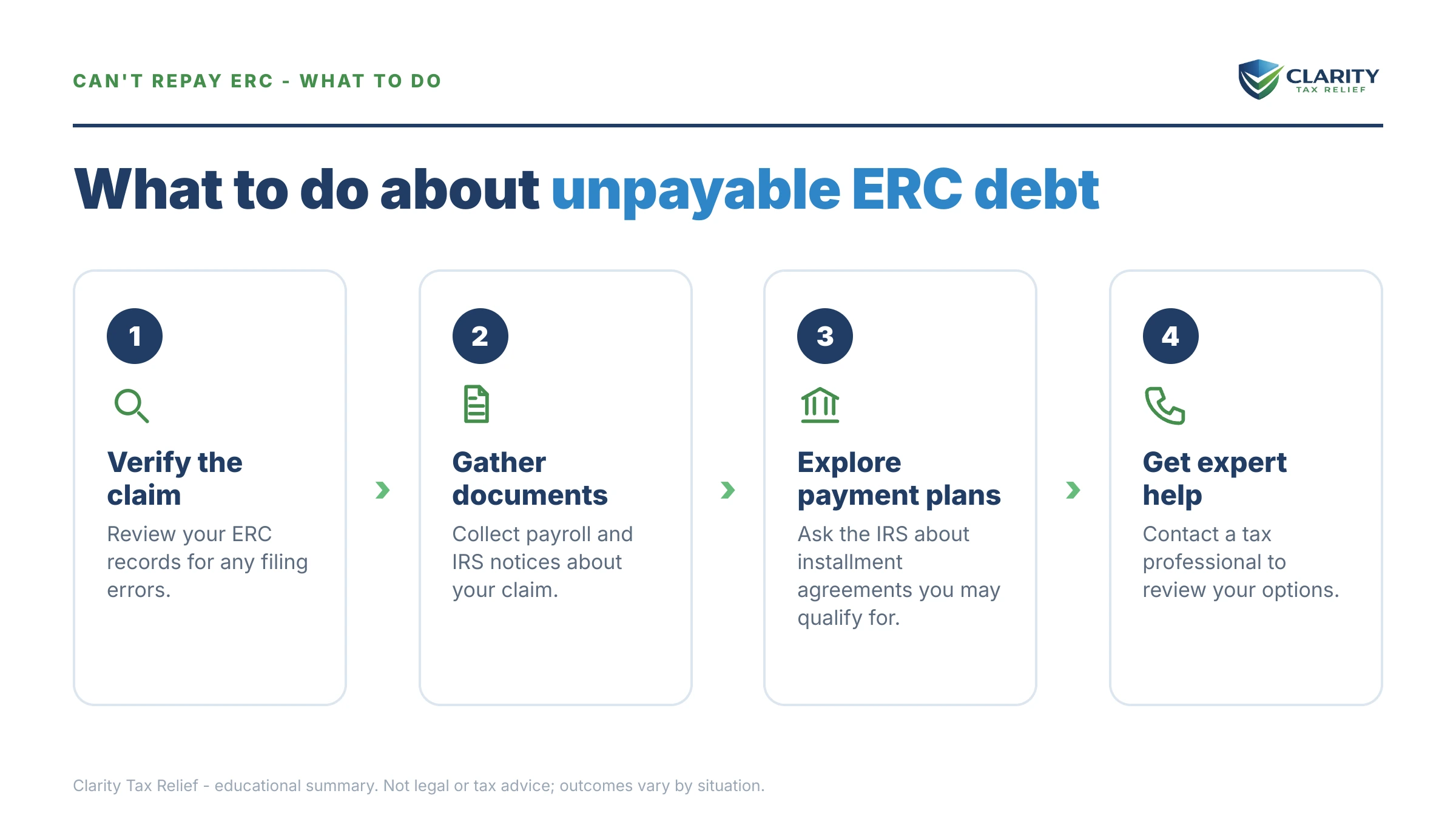
Holding an ERC recapture bill you can't pay?
Get it reviewed free before the pay-by date on your notice passes and the automated sequence escalates. An experienced tax professional will confirm what was assessed, whether it's worth disputing, and which repayment option actually fits your numbers.
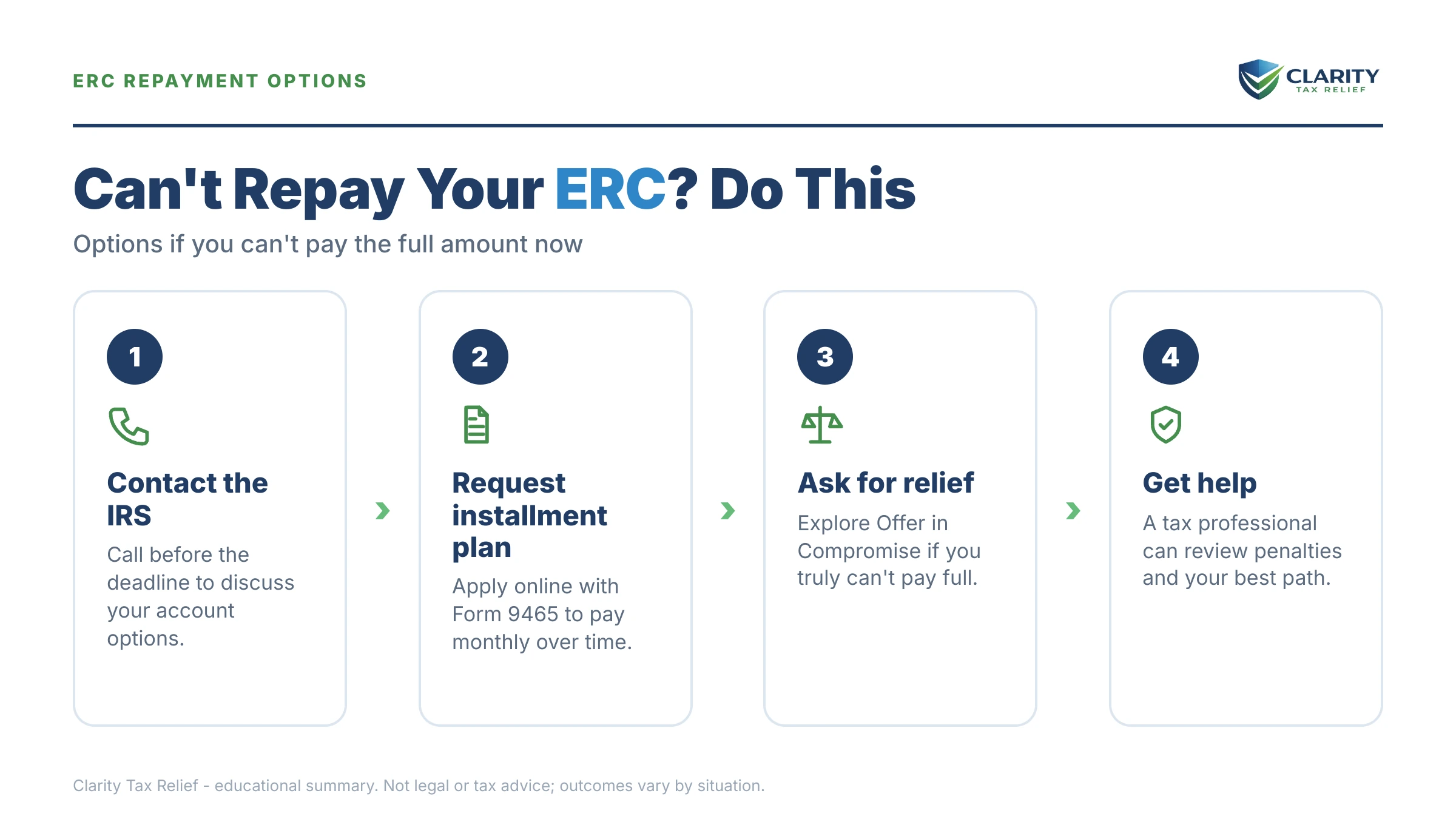
Your options when you can't repay the ERC
Recaptured ERC qualifies for the same resolution programs as any assessed tax debt — payment plans, hardship status, penalty relief, and in rare cases settlement. The table below maps each option to its threshold; the general mechanics of resolving a balance yourself live in our guide to how to settle tax debt yourself, so here we focus on how each option behaves with ERC specifically.
| Option | Best for | Key threshold or requirement | Cost |
|---|---|---|---|
| Pay in full | You agree with the recapture and have the cash | None | Stops the failure-to-pay penalty and the notice stream immediately |
| Short-term plan | You can pay within 180 days | Required filings current | $0 setup; interest and penalties continue |
| Installment agreement | Monthly payments over time | Businesses can typically set one up online at $25,000 or less paid within about 24 months; larger balances need Form 433-B financials | Setup fee varies; interest and penalties continue |
| Currently Not Collectible | Genuine hardship or a closed business | Financial disclosure showing no ability to pay | $0; collection pauses but the debt and interest remain |
| Offer in Compromise | Income and assets genuinely can't cover the debt | Full financial review; roughly 1 in 5 offers accepted in FY2024 | $205 fee plus 20% down on lump-sum offers (waived for qualifying low-income individuals) |
| Penalty abatement | Penalties are inflating the balance | Clean prior compliance or reasonable cause (promoter reliance can help) | Free to request |
| Dispute the recapture | The claim was actually valid | Appeal and 2-year suit windows on the disallowance letter | Free to appeal; representation costs vary |
Three ERC-specific notes on that table. A business IRS installment agreement is the workhorse here — most recaptured-ERC cases resolve on one, and the online route is fastest for balances of $25,000 or less. A business offer in compromise is real but rare: the IRS scrutinizes an operating business's offer hard, and a going concern with receivables usually has more collection potential than the owner thinks. And if a voluntary disclosure window is open when you read this, its discounted-repayment terms can beat every option above — the earlier rounds let employers repay a reduced share of the credit — so check the current status of the program before committing to anything else.
Don't skip the penalty layer. First-Time Abatement can remove the failure-to-pay penalty if your prior three years were clean, reasonable-cause relief fits many promoter-misled employers, and starting in summer 2026 the Automatic Exemption from Penalty (AEP) begins removing qualifying penalties automatically — no request needed. On a recapture balance that has been accruing since 2022 or 2023, the penalty layer can be a meaningful slice of the bill.
One more moving part most articles miss: when you claimed the ERC, you had to reduce your wage deduction on the matching income-tax return. If the credit is now disallowed or repaid, that reduction may reverse — amending can generate an income-tax refund or reduction that partially offsets what you're repaying. The mechanics live in our guide to ERC recapture and its income-tax side effects.
A worked example: repaying $4,800 of recaptured ERC
Say you owe $4,800. You spent 2021 driving gig routes and running a small courier operation with one part-time helper; a promoter cold-called, filed a $4,800 ERC claim, kept a 20% fee — so you actually received about $3,840 — and the IRS has now disallowed the quarter. To complicate things, you also have three years of unfiled personal returns.
Here's the math. The failure-to-pay penalty runs $4,800 × 0.5% = $24 per month, capping at 25% ($1,200), while interest compounds daily on top. On a 24-month online business installment agreement, that's $4,800 ÷ 24 = roughly $200 per month plus the accruing interest and penalty — very manageable, except the IRS generally won't finalize any agreement while required returns are missing. So the sequence is: file the three 1040s first (our guide for anyone who hasn't filed in 3 years walks through it), then request the plan, then ask for penalty abatement citing the promoter. You can estimate what the penalty and interest layer adds to your own balance with our Penalty & Interest Calculator. This scenario is hypothetical, but the sequence — compliance first, plan second, penalty relief third — is the sequence for almost everyone.
How to respond when you can't repay the ERC, step by step
- Verify what was assessed. Pull the business account transcript for the quarter on your notice and confirm the assessed credit, penalties, and interest match what the IRS is billing.
- Decide whether you agree. If the ERC claim was actually valid, use the appeal or suit window on your disallowance letter instead of paying — once those windows close, your leverage drops sharply.
- Get filing-compliant. File any missing business or personal returns; the IRS will not finalize a payment plan or offer while required returns are unfiled.
- Request your repayment option before the pay-by date. Choose full payment, a 180-day short-term plan, an installment agreement, or hardship status, and submit the request before the date printed on your notice.
- Ask for penalty relief and fix the income-tax side. Request abatement of penalties where you qualify, and amend the income-tax return that lost wage deductions once the credit is repaid or disallowed.
Most plan requests can be made online without ever speaking to a person — useful, because if you can't reach the IRS on the phone in 2026, you're in the majority.
When you can handle ERC repayment yourself — and when help changes the outcome
You can likely handle this alone if the recapture is $25,000 or less, you agree the quarter didn't qualify, and your filings are current: set up the online business payment plan, request first-time abatement, and you're done. That's a phone-free afternoon, not a professional engagement.
Experienced help changes outcomes in specific situations: you believe the claim was valid and the appeal or suit clock is running; a promoter filed the claim and penalty exposure — including the 20% erroneous-claim penalty — is on the table; the recapture is large or spans multiple quarters; the business has closed and the personal-liability question is unresolved; or a levy notice has already arrived. In those cases the order of moves matters as much as the moves themselves, and a mistake in the dispute window can't be undone later.
Terms on your ERC notice, decoded
- Recapture — the IRS reversing a credit it already paid you, turning the refund into an assessed tax debt on your employment-tax account.
- Disallowance (Letter 105-C / 106-C) — the IRS rejecting your claim in full (105-C) or in part (106-C) before or after payment, with appeal rights printed on the letter.
- Form 941-X — the amended quarterly payroll return most ERC claims were filed on; the recapture posts to the same quarter's account.
- Erroneous-claim penalty — a 20% penalty that can apply when a refund claim had no reasonable basis; reliance on professional advice can be a defense.
- CDP rights — your right to a Collection Due Process hearing (Form 12153) within 30 days of a final levy notice, which pauses levy action while the hearing is pending.
- CSED — the 10-year collection statute that starts once the recapture is assessed; certain events, like a pending offer, pause it.
Can't-repay-ERC questions, answered
What happens if I can't pay back the ERC?
The debt becomes an assessed employment-tax balance and moves through the IRS's automated collection sequence: balance-due notices, then intent-to-levy notices, then levy power over bank accounts and receivables. Nothing is seized at the first notice. If you request a payment plan, hardship status, or an appeal before the sequence escalates, enforcement pauses while your request is worked. Interest and the 0.5% monthly failure-to-pay penalty accrue until the balance is resolved.
Can I get a payment plan for ERC repayment?
Yes. Recaptured ERC is treated like other assessed employment tax, so businesses can typically set up an installment agreement — online for balances of $25,000 or less paid within about 24 months, and with financial disclosure on Form 433-B for larger amounts. You must be current on required filings first. Interest and penalties keep accruing during the plan, so paying faster always costs less.
Is the ERC voluntary disclosure program still open?
The ERC Voluntary Disclosure Program has run in limited windows, and each window closed once its deadline passed — the earlier rounds let employers repay a reduced share of the credit. Whether any window is open changes, so verify current status before assuming a discount is available. If no window is open, the standard options — payment plan, hardship status, penalty relief — still apply to the full recaptured amount.
Do I have to repay the ERC if a promoter filed the claim for me?
Generally yes — the employer is legally responsible for the claim even when a promoter prepared and filed it. The promoter's contingency fee is not deducted from what you owe the IRS, so you can owe more than you ever received. That said, a promoter-filed claim can support penalty relief for reasonable cause, and you may have a separate civil claim against the promoter itself.
Will I owe penalties on recaptured ERC?
Usually, yes. The failure-to-pay penalty of 0.5% per month applies to the assessed balance, interest compounds daily, and a 20% erroneous-claim penalty can apply where the claim had no reasonable basis. Penalty relief is realistic: first-time abatement, reasonable cause (especially where a promoter misled you), and starting in summer 2026 the Automatic Exemption from Penalty may remove qualifying penalties without any request.
Can I settle recaptured ERC for less with an Offer in Compromise?
Only if a full financial review shows the IRS could never collect the whole balance from your income and assets — the IRS accepted roughly 1 in 5 offers in FY2024, and business offers face stricter scrutiny than individual ones. An OIC on employment-tax debt requires filing compliance and detailed disclosure. For most employers with an operating business, a payment plan resolves recaptured ERC faster and more predictably.
What if my business closed and I can't repay the ERC?
A closed business changes the analysis but does not automatically erase the debt. Whether you owe it personally depends on your entity: sole proprietors are personally liable, while corporate and LLC employment-tax debt generally stays with the entity — and recaptured ERC is a credit clawback, not withheld employee money, so it is generally treated differently from trust-fund payroll debt. Hardship status or an offer based on the defunct entity's inability to pay may fit; get the liability question answered before paying personally.
How long does the IRS have to recapture ERC?
The IRS generally has a 5-year assessment window for ERC claimed on the third and fourth quarters of 2021 — longer than the usual 3-year rule — so 2021 claims remain exposed well into 2027. Once the recapture is assessed, the separate 10-year collection statute starts running on the balance. Waiting out the clock is not a strategy: the assessment on your notice has already happened.
Your next 24 hours
- Find three things on your notice: the quarter being recaptured, the total assessed amount, and the pay-by date. Those three facts determine which options are still open.
- Gather your file: the notice itself, the Form 941 or 941-X for that quarter, anything the promoter gave you (contract, eligibility memo, fee invoice), and a snapshot of your business and personal finances.
- Get a free case review before the pay-by date passes: use the 2-minute form or call (888) 825-7779. Interest and the monthly penalty are accruing either way — the review tells you whether to dispute, discount, or structure the repayment before the automated sequence moves to the next notice.
For primary sources, see the IRS's own Employee Retention Credit page, its overview of payment plans and installment agreements, and — if your case stalls inside the IRS — the Taxpayer Advocate Service.
This guide is general information, not tax or legal advice for your specific situation. Eligibility for IRS programs depends on individual facts and circumstances; no outcome is guaranteed.