
ERC Problems
ERC Recapture: Paying the Credit Back — and the Income Tax Fix Most Businesses Miss (2026)
The short answer: ERC recapture is the IRS taking back an Employee Retention Credit it already paid, reassessing it as employment tax you owe now — with interest and penalties. The overlooked flip side: if you reduced your wage deduction when you claimed the credit, you can usually restore it and recover income tax you overpaid.
The ERC refund hit your business account a year or two ago — maybe minus a promoter's cut — and the money has long since gone to payroll, rent, and inventory. Now a letter says the IRS has reversed the credit and wants it back. That's a real bill, but it's fixable in stages — and one stage of the fix actually puts money back in your pocket.
Most owners never hear about that second stage, because the recapture letter only talks about the payroll side. The image below shows you exactly what a recapture notice looks like and where to find the recaptured amount, the quarters involved, and your response date.
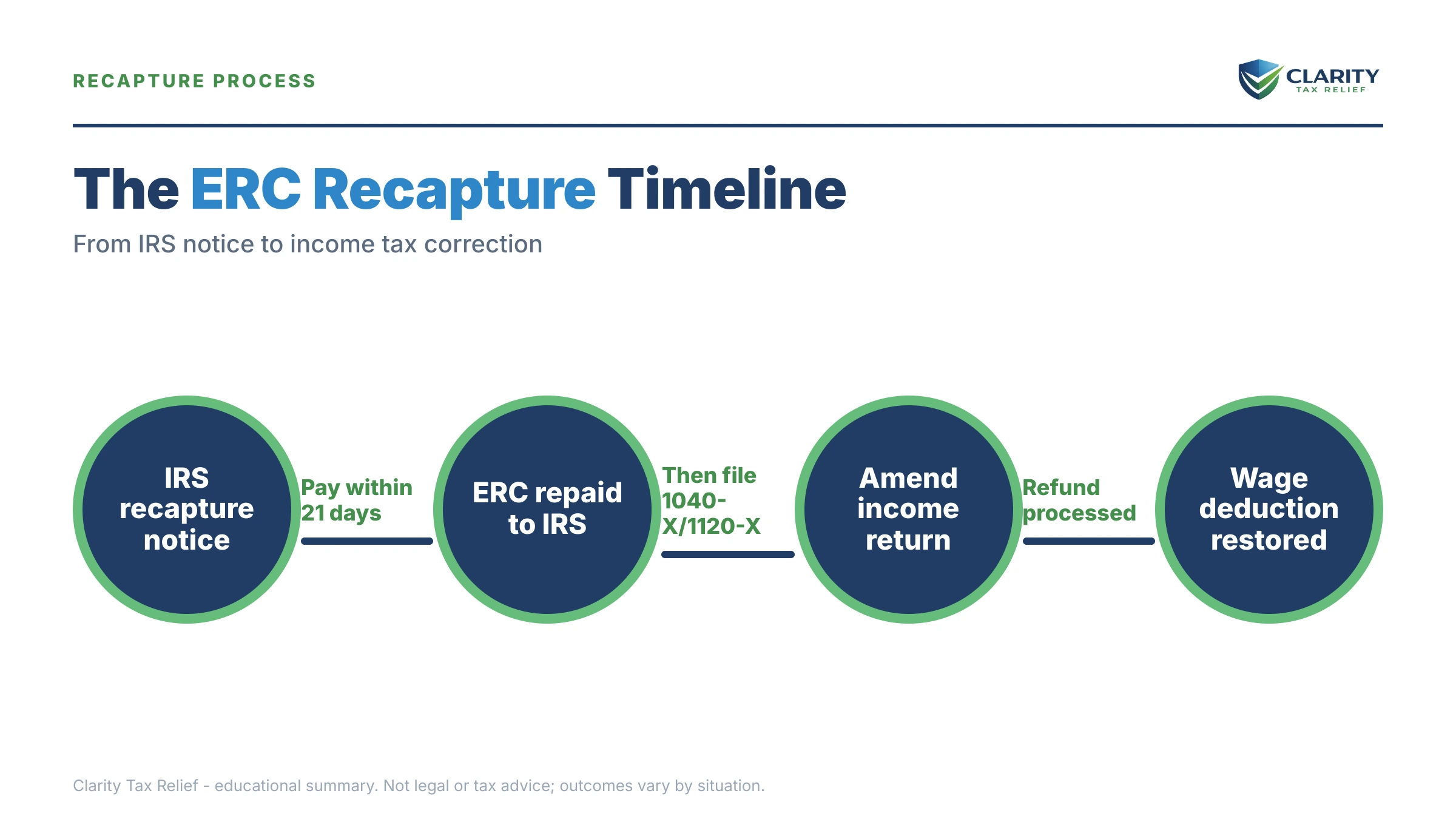
⏱ Your clock: the response date printed on your recapture letter controls any dispute rights — and interest plus a 0.5%-per-month late-payment penalty accrue on the recaptured balance every month it goes unpaid. There is no single statutory day count for every recapture notice; the date on your letter is the one that matters.
Why the IRS is recapturing your ERC
The IRS recaptures an Employee Retention Credit when it decides a refund it already paid went out on a claim that didn't qualify. Recapture letters — many arrive as Letter 6577-C, others as an adjustment notice on your business account — reverse the credit for specific quarters and assess that amount as employment tax due now.
The most common reasons a paid claim gets reversed:
- The government-order test fails. A "partial suspension" theory built on general COVID guidance, supply-chain talking points, or orders that never actually restricted your operations.
- The gross-receipts test fails. Your revenue decline didn't meet the quarter-by-quarter thresholds, or the wrong comparison quarters were used.
- Double-dipped wages. The same wages were counted for both PPP loan forgiveness and the ERC.
- Promoter-inflated math. Owner and family wages counted when they shouldn't be, or headcounts and wage totals that don't match your actual payroll.
Two things make this a 2026 problem, not a 2021 one. First, the IRS assesses the employer — not the promoter — so the bill lands on you even if a mill filed the 941-X. Second, Congress extended the assessment window to five years for third- and fourth-quarter 2021 claims, so reversal letters are still going out; the ERC statute of limitations guide covers the window for each quarter.
How ERC recapture works: your payroll account vs. your income tax return
ERC recapture hits two different tax returns at once: the credit is reassessed as employment tax on your Form 941 account, and the wage deduction you gave up when you claimed it can be restored on your income tax return.
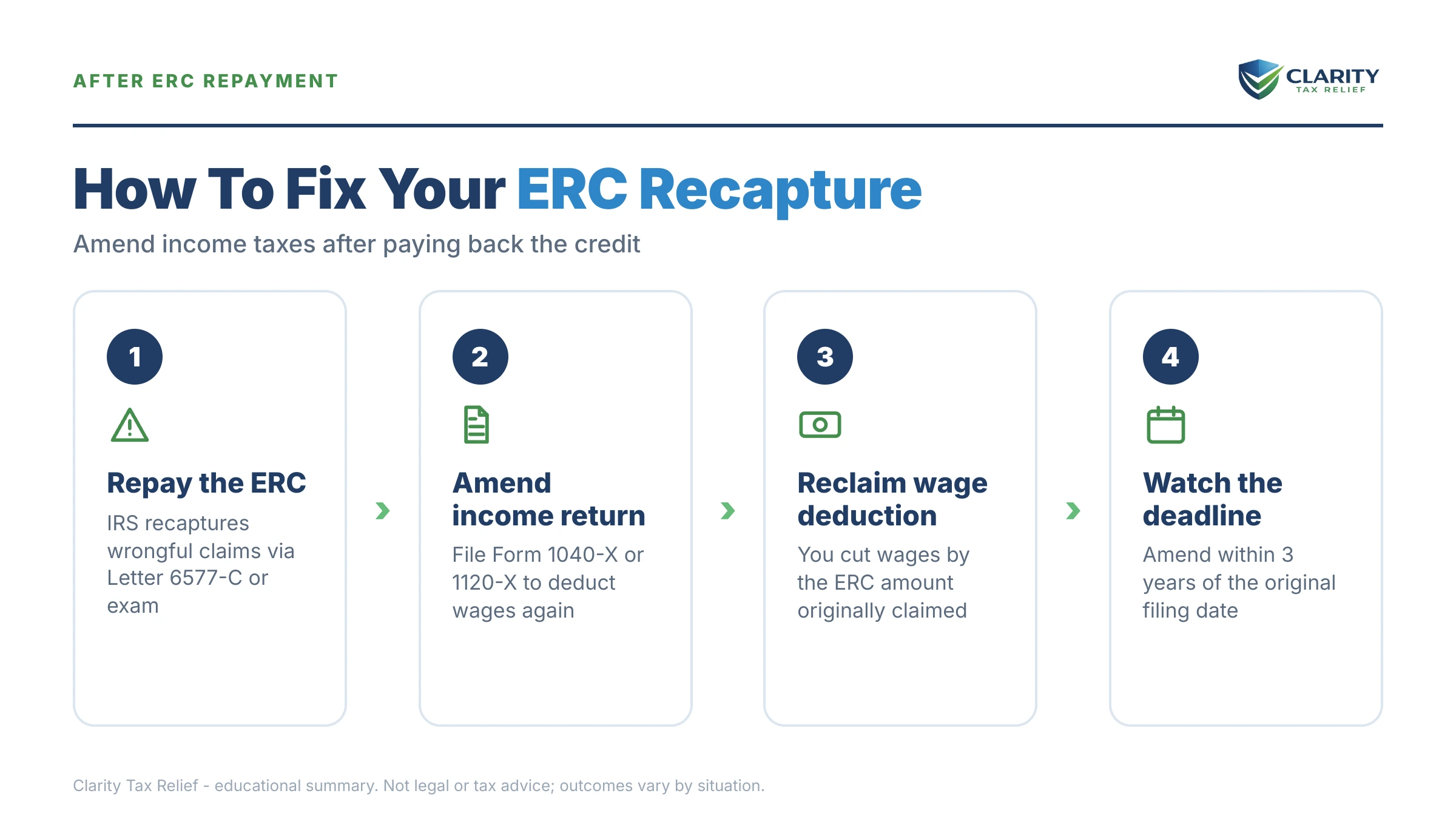
Here's the part the recapture letter never explains. When you claimed the ERC, Section 280C required you to reduce your deductible wages by the credit amount for the year those wages were paid. Most claimants amended their 2020 or 2021 income tax returns to do that — and paid more income tax as a result. When the credit is recaptured or repaid, that reduction reverses. Money can flow back to you on the income-tax side even while you're repaying the payroll side.
Depending on your facts and current IRS guidance, the fix is either amending the original-year return or accounting for the restored wages in the year the recapture becomes final — an experienced tax professional can confirm which path applies to you. The mechanics of amending a return to lower a tax debt are the same ones at work here, just aimed at a refund instead of a reduction.
One warning for the reverse situation: if you took the ERC but never reduced your wage deduction, the income-tax side cuts against you. The IRS can adjust that year's income tax return, and a proposed income-tax deficiency ultimately arrives as a 90-day letter with its own Tax Court clock.
| What changes | Payroll (Form 941) account | Income tax return |
|---|---|---|
| The assessment | Credit reversed and reassessed as employment tax for each recaptured quarter | No new tax assessed automatically — but the wage deduction you reduced is now wrong in your favor |
| Money direction | You owe the credit back, plus interest and penalties | Restoring the wage deduction usually creates an income tax refund or offset |
| The paperwork | Recapture letter or business adjustment notice; balance-due notices follow | Amended 1120, 1120-S, 1065, or Form 1040-X — or a wage adjustment in the year recapture becomes final |
| The deadline | The response date on your letter; collection escalates if unpaid | Refund claims have their own statute of limitations — waiting can forfeit the recovery |
What happens if you ignore an ERC recapture letter
An unpaid ERC recapture balance moves through the same automated business collection pipeline as any other employment tax debt — and the end of that pipeline is a levy on your operating account. The sequence runs in stages:
- Recapture assessment posts. The letter or adjustment notice makes the reversed credit an official balance on your business account. Interest starts here, and the late-payment penalty adds 0.5% per month.
- Balance-due and reminder notices. Automated business bills arrive while the total grows monthly. No enforcement yet — this is the cheap window to act.
- Intent to levy. A CP504B notice tells you the IRS intends to levy; at this stage it can seize your state tax refund, and a federal tax lien becomes a live risk.
- Final notice of intent to levy. This starts a 30-day clock and your Collection Due Process rights. After it runs, the IRS can levy business bank accounts and even accounts receivable — for a business with payroll, that's the point where a tax problem becomes a cash-flow crisis.
Don't count on IRS understaffing to slow this down. The workforce shrank roughly 27% in 2025, but recapture assessments and the notices that follow are generated by automated systems that never stopped running.
Holding an ERC recapture letter right now?
Send us a photo of it before the response date on your letter passes. An experienced tax professional will confirm what the IRS reversed, whether your eligibility facts support a dispute, and how much income tax the wage-deduction fix could put back in your pocket — free, confidential, no pressure.
Your options for a recaptured ERC balance
A recaptured ERC balance can be disputed, paid over time, reduced through penalty relief, or paused for genuine hardship — the right path depends on your eligibility facts and your cash flow. The general playbook for negotiating any assessed balance lives in our guide on how to settle tax debt yourself; here's what's specific to recaptured ERC.
Two doors that are closed or narrow in 2026: the ERC voluntary disclosure program, which let employers repay at a discount, closed its second window in late 2024 and hasn't reopened — and it never covered claims the IRS had already reversed. And note that entity type matters for payment plans: corporations and partnerships face lower online limits than sole proprietors, covered in our business IRS installment agreement guide. If none of the standard options fit your cash position, our guide for owners who can't repay the ERC walks through the harder scenarios, including closed businesses.
| Option | Who it fits | Cost and catch |
|---|---|---|
| Pay in full | Businesses with the cash or credit to clear it | Stops penalty and interest accrual immediately; cheapest total cost |
| Dispute / appeal | Employers whose government-order or gross-receipts facts genuinely support the claim | No fee to protest, but the response date on your letter controls; the balance keeps accruing until resolved |
| Short-term plan (up to 180 days) | Sole proprietors who can clear the balance within 180 days | $0 setup; interest and the 0.5%/month penalty continue |
| Installment agreement | Sole proprietors: up to $50,000 online over up to 72 months; corporations and partnerships at lower online limits | Setup fee may apply; accruals continue; you must stay current on payroll deposits or the agreement defaults |
| Penalty abatement | Employers with reasonable cause — e.g., documented reliance on a promoter's eligibility analysis | Removes penalties only, not the recaptured credit or interest on the tax |
| Hardship / currently not collectible | Closed or genuinely failing businesses that can't pay anything | Pauses collection, not the debt; interest keeps accruing and the IRS revisits your finances |
| Recaptured amount | Realistic path | Watch out for |
|---|---|---|
| Under $25,000 | Online payment plan for most entity types; pay in full if cash allows | Small balances still ride the escalation pipeline to intent-to-levy notices |
| $25,000–$50,000 | Sole proprietors: streamlined online plan up to 72 months; corporations and partnerships likely need to talk to the IRS and may submit financials | Direct debit may be required; falling behind on current deposits kills the deal |
| $50,000–$100,000 | Negotiated agreement with financial disclosure; pursue penalty relief and the income-tax recovery in parallel | This is the band where the restored wage deduction meaningfully offsets the repayment — don't leave it unclaimed |
| Over $100,000 | Often a revenue-officer-level case: full financials, possible federal tax lien | Get representation before the first revenue officer contact, not after |
A worked example: recapture of a $54,600 ERC claim
Say you run an S corporation with six employees, and a promoter filed 941-Xs claiming $54,600 across two 2021 quarters. This is hypothetical, but the math is what matters:
- The promoter kept a 20% fee — $10,920 — so you actually banked $43,680.
- Your CPA properly amended the 2021 returns, reducing wage deductions by $54,600. At a 24% combined effective rate on the pass-through income, that cost you roughly $13,104 in extra income tax at the time.
- Now the IRS recaptures the full $54,600. Interest runs from assessment, and the late-payment penalty adds 0.5% per month — about $273 a month at the start.
- The flip side: restoring the $54,600 wage deduction recovers roughly that same $13,104 of income tax.
- Net cash swing: $54,600 out, $13,104 back — about $41,496 before penalties and interest. The $10,920 promoter fee is gone unless your contract forces a refund.
- If your business is approved for a 60-month agreement, that's roughly $910 per month before accruals.
You can estimate how fast the penalty and interest side grows on your own balance with our IRS penalty and interest calculator.
Can you still fight an ERC recapture?
Yes — recapture is the IRS's position, not a court's, and employers with genuine eligibility facts can and do push back. If a qualifying government order actually restricted your operations, or your gross-receipts decline meets the thresholds with the right comparison quarters, gather that substantiation and follow the dispute instructions on your letter. Our guides to ERC audit defense and the ERC disallowance appeal process cover how to build the file.
Know which letter you're actually holding, because rights differ. A Letter 105-C (full disallowance) or Letter 106-C (partial) refuses a claim before payment and starts a two-year window to sue for the refund. A recapture letter reverses a refund already paid — the fight happens through the appeal route on the letter, and the assessed balance keeps accruing while you argue.
How to respond to ERC recapture, step by step
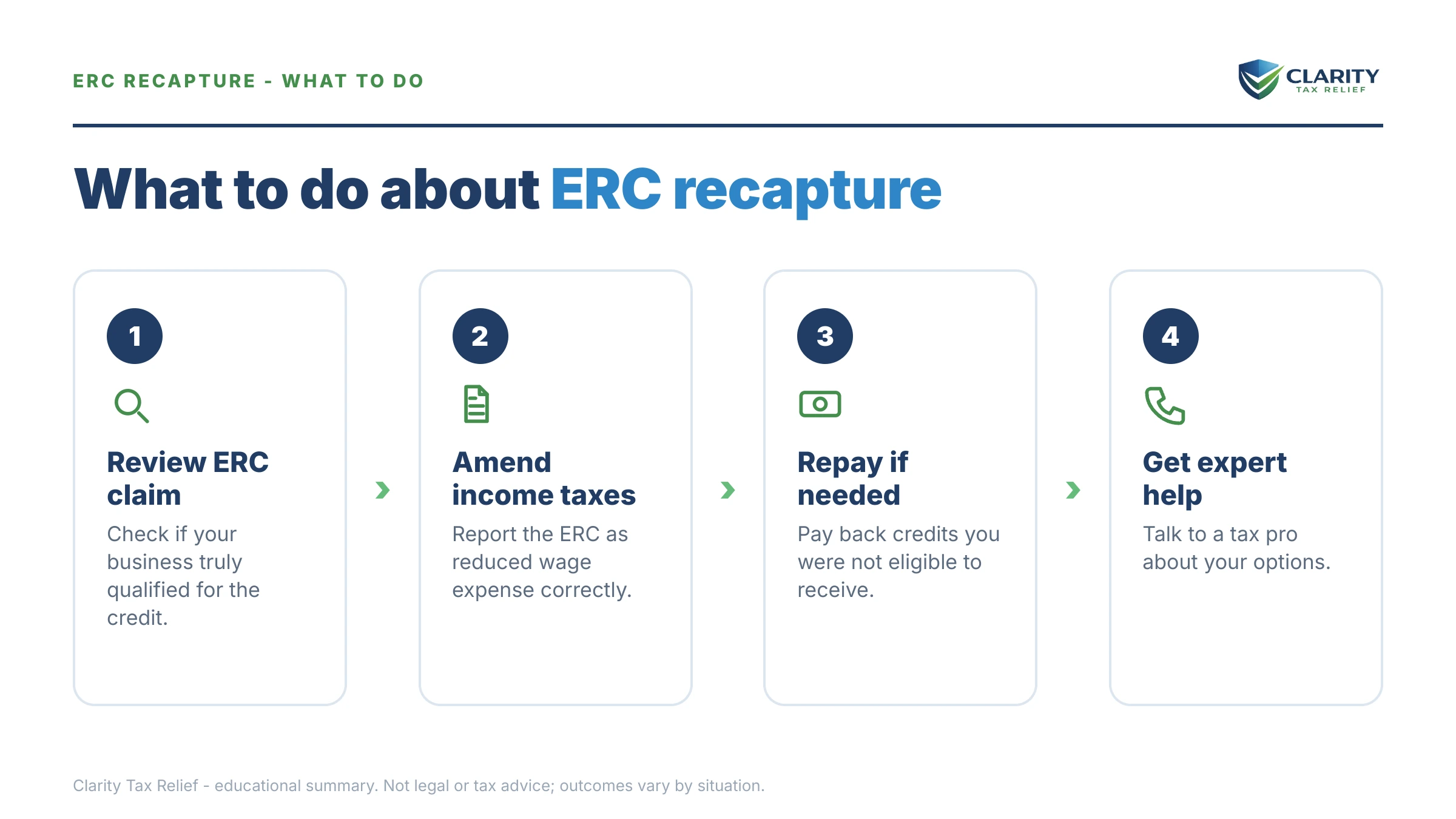
- Verify the numbers — Pull your business account transcript and match the recaptured amount against the 941-X claims filed for each quarter.
- Decide whether to dispute — If your eligibility facts are real, follow the appeal instructions and the response date printed on your letter before paying anything.
- Arrange payment on the payroll side — Pay in full or request an installment agreement before the balance reaches intent-to-levy notices.
- Reverse the income-tax side — Work with your preparer to restore the wage deduction you gave up, so you recover the income tax you overpaid.
- Preserve the promoter records — Save the contract, the fee agreement, and any eligibility analysis the ERC company gave you — they matter for penalty relief and any claim against the firm.
When you can handle this yourself
Plenty of recapture cases don't need professional help. If the recaptured amount is small, you agree the claim was wrong, and you can pay in full or qualify for a straightforward plan — sole proprietors can set one up directly on the IRS payment plans page — handle it yourself and keep your fee money. A single quarter with clean books is a DIY project.
Experienced help changes outcomes in specific situations: you believe the claim was legitimate and want to dispute before the response date; a promoter filed the claim and the eligibility file is a mess; the balance runs $50,000 or more; the income-tax fix spans both entity and personal returns across multiple years; or intent-to-levy notices are already arriving. In those cases the sequencing — dispute first, penalties second, payment terms third, income-tax recovery in parallel — is where money is won or lost.
Terms on your ERC recapture letter, decoded
- Recapture — the IRS reversing a credit it already paid and reassessing it as tax you owe now.
- Disallowance — the IRS refusing to pay a pending claim (Letter 105-C or Letter 106-C) before any refund goes out.
- Erroneous refund — money the IRS paid that it says you weren't entitled to; it can be assessed and collected like tax.
- Section 280C add-back — the rule that made you shrink your wage deduction by the ERC amount when you claimed the credit.
- Form 941-X — the amended quarterly payroll return used to file ERC claims, and the document your recapture should trace back to.
- Assessment statute — the window the IRS has to assess: five years for third- and fourth-quarter 2021 ERC, three years for most other quarters.
The IRS's own eligibility rules, warning signs, and current guidance live on its Employee Retention Credit page.
ERC recapture questions, answered
What does ERC recapture mean?
ERC recapture means the IRS is reversing an Employee Retention Credit it already paid you and reassessing that amount as employment tax you owe now. It usually arrives as a recapture letter or an adjustment notice on your business account for the affected quarters. Recapture is different from disallowance, which blocks a claim before the refund is ever paid out.
Do I have to pay penalties and interest on recaptured ERC?
Usually, yes. Interest runs on the recaptured amount, and the failure-to-pay penalty adds 0.5% per month once the assessed balance goes unpaid. The IRS can also assert a 20% erroneous-refund penalty on some excessive claims, with steeper penalties where it believes a claim was knowingly false. Reasonable-cause relief — including documented reliance on a promoter — can remove some penalties.
Can I recover the income tax I paid when I reduced my wage deduction?
Often, yes — this is the side of recapture that works in your favor. If you shrank your deductible wages when you claimed the ERC and the credit is later recaptured or repaid, that reduction reverses, which usually means you overpaid income tax for that year. Depending on your facts, the fix is an amended return or a wage adjustment in the year the recapture becomes final — and refund claims have their own filing deadlines, so don't sit on it.
What is the difference between ERC recapture and ERC disallowance?
Disallowance means the IRS refused to pay your claim — usually by Letter 105-C in full or Letter 106-C in part — before any refund went out. Recapture means the refund was already paid and the IRS is clawing it back as an assessed employment tax balance. Disallowance letters carry a two-year window to sue for the refund; recapture drops you into the normal balance-due collection process.
How long does the IRS have to recapture the ERC?
Longer than the standard three years for the biggest claims. Congress extended the assessment window to five years for ERC claimed on third- and fourth-quarter 2021 payroll returns, so recapture letters for those quarters can keep arriving well past 2026. Our guide to the ERC statute of limitations walks through the window for each quarter.
Can I set up a payment plan on a recaptured ERC balance?
Yes — recaptured ERC is collected like any other assessed employment tax, and payment plans are available. Sole proprietors can generally use the individual thresholds: up to 180 days with no setup fee, or up to 72 months online on balances of $50,000 or less. Corporations and partnerships face lower online limits and may need to submit financials. Interest and the monthly late-payment penalty keep accruing on any plan, so shorter is cheaper.
Is the ERC Voluntary Disclosure Program still open in 2026?
No. The second ERC Voluntary Disclosure window, which let employers repay the credit at a discount, closed in late 2024, and the IRS has not announced another round as of this writing. If a recapture letter has already arrived, the program would not have covered those quarters anyway — it only applied to claims the IRS had not yet reversed.
What if an ERC company filed the claim and kept a fee?
You still owe the recapture — the IRS assesses the employer, not the promoter, even when a mill filed the 941-X and kept 20% or more of the refund. The promoter file still matters, though: documented reliance on their eligibility analysis supports penalty relief, and your contract may give you a refund right or a legal claim against the firm. Save every document they gave you.
Your next 24 hours
- Find three things on your letter: the recaptured amount, the quarters being reversed, and the response date — that date controls your dispute rights.
- Gather your file: the 941-Xs that were filed, the amended income tax returns where you reduced wages, and every contract or eligibility document the ERC company gave you.
- Get the free case review: use the 2-minute form or call (888) 825-7779. Interest and the 0.5% monthly penalty are accruing on the recaptured balance right now — and the income-tax recovery has its own deadline you don't want to run out.
This guide is general information, not tax or legal advice for your specific situation. Eligibility for IRS programs depends on individual facts and circumstances; no outcome is guaranteed.