
ERC & Payroll Tax
ERC Statute of Limitations: How Long the IRS Can Audit Your Claim (2026)
The short answer: the ERC statute of limitations is 3 years for 2020 and Q1–Q2 2021 claims, 5 years for Q3 and Q4 2021 under ARPA, and up to 6 years for those same quarters under the 2025 OBBBA. Most Q3 2021 claims stay open through at least April 15, 2027.
You and your spouse run the business together, the ERC refund landed in the company account over a year ago, and every new headline about IRS clawbacks makes you wonder whether that money is actually yours to keep. Here's the honest map: the ERC statute of limitations is not one clock — it's three, and which one governs you depends on the quarter you claimed and when your 941-X was filed.
Some of your quarters may already be closed. Others stay open into 2027 — and for late-filed claims, into 2029. The image below shows how the three windows stack quarter by quarter, so you can see at a glance which of your claims is still exposed.
⏱ The key date: for most Q3 2021 ERC claims, the IRS can assess recapture through at least April 15, 2027. And under the OBBBA's 6-year rule, a 941-X filed after April 15, 2022 keeps that quarter open for six years from the claim date — potentially into 2029. Your exposure is set by when each return and claim was actually filed, not by the calendar year alone.
The ERC statute of limitations by quarter: three different clocks
The IRS has 3 years to assess on most employment tax returns, but Congress gave ERC quarters Q3 and Q4 2021 a 5-year window under the American Rescue Plan Act — later stretched to 6 years. The starting gun matters as much as the length: under IRC §6501(b)(2), employment tax returns for a calendar year are treated as filed on April 15 of the following year, no matter which quarter they cover. That single rule sets almost every date in the table below.
| Quarter claimed | Return treated as filed | Assessment window | Window closes* |
|---|---|---|---|
| Q2–Q4 2020 | April 15, 2021 | 3 years | April 15, 2024 — generally closed |
| Q1–Q2 2021 | April 15, 2022 | 3 years | April 15, 2025 — generally closed |
| Q3 2021 | April 15, 2022 | 5 years (ARPA §3134(l)); 6 years under OBBBA, from the latest of filing, deemed filing, or the claim date | April 15, 2027 at the earliest — later if the 941-X was filed after April 15, 2022 |
| Q4 2021 (recovery startup businesses only) | April 15, 2022 | Same 5-year / 6-year rules as Q3 2021 | April 15, 2027 at the earliest |
*Assumes a timely-filed return and no fraud. Fraud — or a return that was never filed — leaves the assessment window open indefinitely.
Notice what the table implies for a typical claim history. Most businesses didn't claim the ERC on their original 941s — they claimed it later on Form 941-X, often in 2022 or 2023 after a promoter called. For the 3-year quarters, that later filing generally did not move the clock. For Q3 and Q4 2021, under current law it does — and that changes everything about how long you stay exposed.
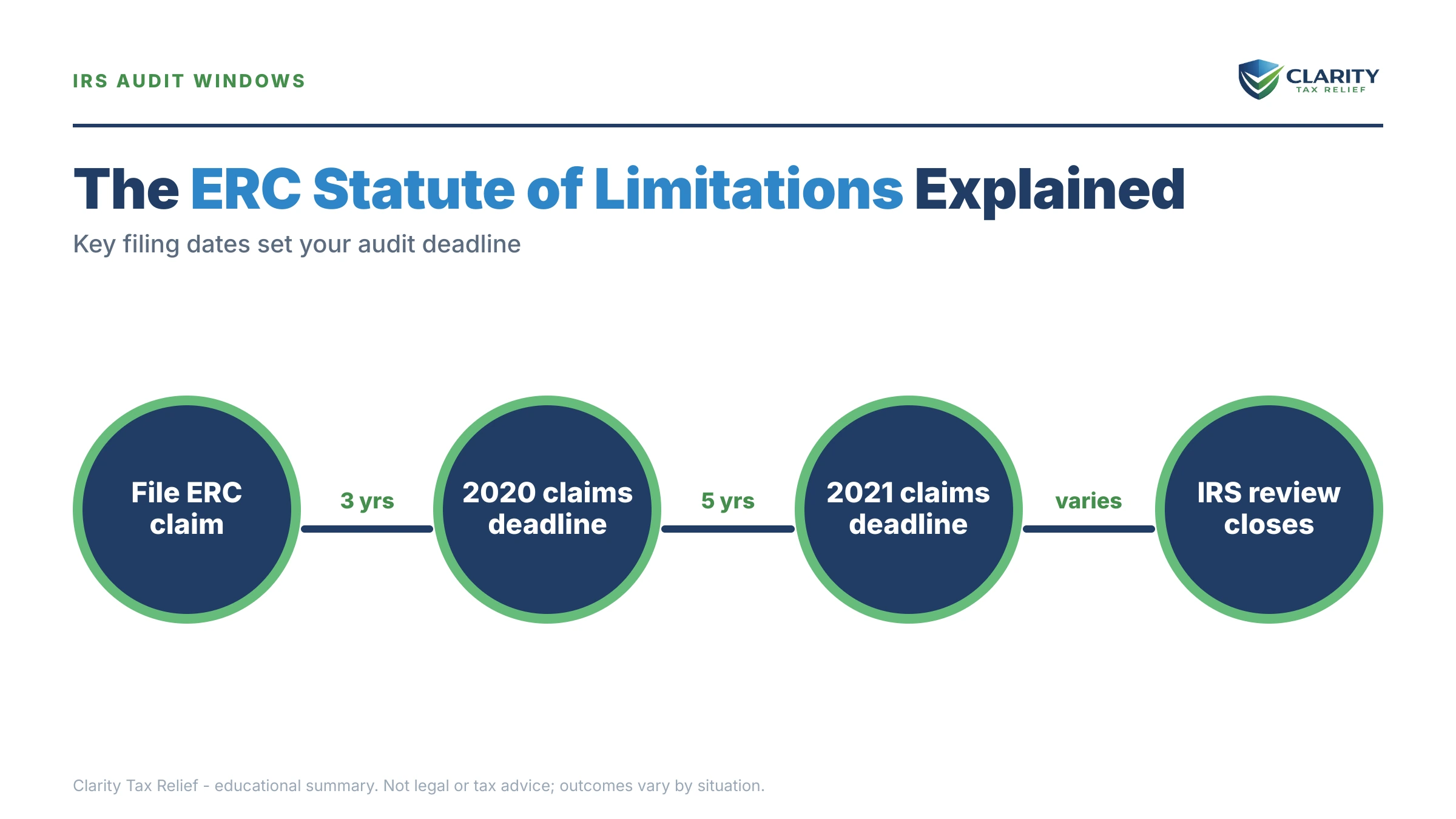
Why Q3 and Q4 2021 ERC claims stay open five — now six — years
Congress extended the ERC assessment window twice, both times aimed at the last two eligible quarters of 2021. The first extension came in the American Rescue Plan Act itself: IRC §3134(l) gives the IRS 5 years instead of 3 to assess on credits claimed for wages paid in Q3 and Q4 2021. Measured from the April 15, 2022 deemed filing date, that runs to April 15, 2027.
The second came in the One Big Beautiful Bill Act, signed July 4, 2025. For those same two quarters, it stretched the window to 6 years — measured from the latest of the date the return was filed, the date it's treated as filed, or the date the refund claim was made. It also barred refunds on Q3 and Q4 2021 claims filed after January 31, 2024. Our guide to the one big beautiful bill tax changes covers the rest of that law; here, the part that matters is the "latest of" language, because it means a 941-X filed in 2023 restarts the 6-year count from the claim date.
Why did Congress single out these quarters? Because that's where the promoter problem concentrated. The ERC "mills" that mass-filed claims in 2022 and 2023 pushed hardest on the 2021 quarters with the biggest per-employee credits, and lawmakers deliberately kept the IRS's clawback window open long enough to examine them. If your claim came through a promoter, assume you're in the population the extended statute was written for.
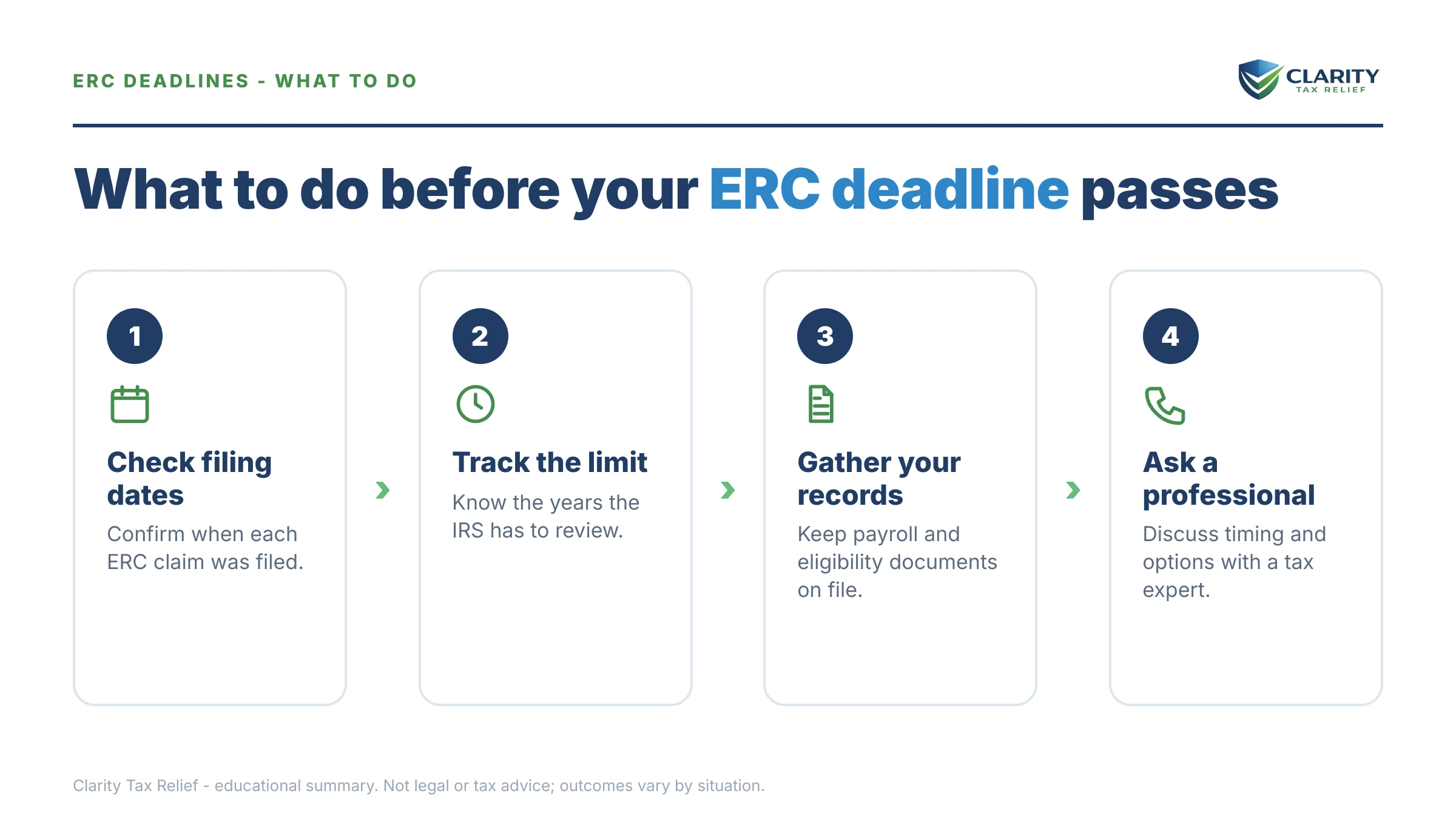
One critical distinction: the statute limits clawbacks, not denials
The assessment statute only protects money the IRS has already paid you — a still-unpaid ERC claim can be denied at any time, statute or no statute. There is no deadline forcing the IRS to approve or pay a pending refund claim. With hundreds of thousands of claims still sitting in the backlog in 2026, plenty of employers with "expired" 2020 quarters are discovering this the hard way when a Letter 105-C full disallowance arrives years after filing.
Two more back doors survive an expired statute. Where the IRS can establish fraud, there is no assessment statute at all. And even without an assessment, the government can file an erroneous-refund lawsuit in court — generally within two years of paying the refund, or five where it can show fraud or misrepresentation of a material fact. Statute expiration is real protection, but it's narrower than most owners assume.
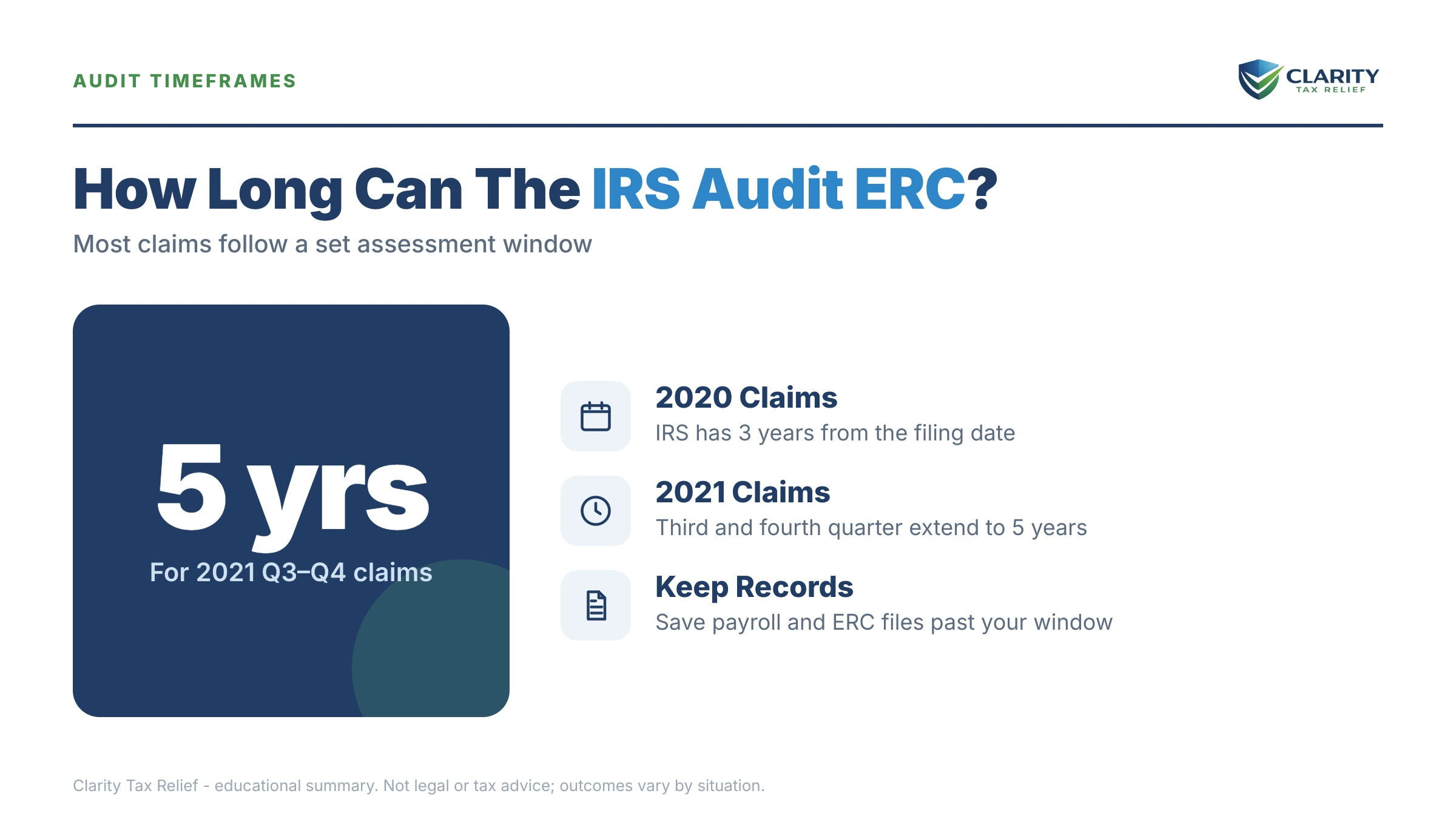
What happens if the IRS challenges your ERC and you do nothing
An ERC challenge runs through a fixed sequence, and each stage extinguishes a right the previous stage still offered. Ignore the letters and the sequence completes itself:
- Exam contact. An audit letter or document request asks for your eligibility proof — gross-receipts math, government orders, the credit computation. This is the cheapest stage to win; our ERC audit guide covers what examiners actually ask for.
- Proposed findings. The examiner issues a report proposing to disallow or recapture the credit, typically with 30 days to protest to IRS Appeals. Somewhere in here you may be asked to sign Form 872 extending the statute — a real decision, not a formality.
- Disallowance or assessment. Unpaid claims get a Letter 105-C or Letter 106-C, which starts a 2-year clock to sue for your refund. Paid claims get recapture assessed on your 941 account — often with a 20% accuracy-related penalty and interest stacked on top.
- Collection notices. The assessed balance enters the automated collection stream on the business account: balance-due notices escalating to a final notice of intent to levy with 30-day Collection Due Process rights.
- Levy. Business bank accounts and accounts receivable become fair game, and the debt becomes collectible for the standard 10-year window — see how long can the IRS collect back taxes for how that separate clock works. You can also estimate when the collection window on an assessed balance ends with our CSED Calculator.
Notice the asymmetry: the IRS's clocks in this sequence are years long, but yours are measured in days. The table below puts every one of them side by side.
Every ERC clock in one place
| Event | Your window | The right at stake |
|---|---|---|
| Audit letter / document request | The date printed on the letter | Shaping the record before the examiner writes findings |
| Exam report proposing disallowance or recapture | Typically 30 days | An ERC disallowance appeal to IRS Appeals before assessment |
| Letter 105-C / 106-C disallowance | 2 years from the letter date | Suing for your refund in federal court — extendable only by Form 907 |
| Final notice of intent to levy on recaptured balance | 30 days | A Collection Due Process hearing before levy |
| Assessed recapture balance | 10 years (the IRS's clock, not yours) | N/A — this is how long collection can pursue you |
ERC claim under audit — or worried it will be?
Q3 and Q4 2021 assessment windows run through April 15, 2027 and beyond, and disallowance letters carry a hard 2-year suit clock. Send us your 941-X file and any IRS letter — an experienced tax professional will map exactly which of your quarters is still open and what to do about it. Free, confidential, no pressure.
Your options when the IRS recaptures or disallows your ERC
Which move is right depends on one question: can you actually document eligibility for the open quarters? If yes, you defend. If no, you get ahead of the repayment on the best available terms. The ERC Voluntary Disclosure Program's two rounds — repay 80%, then 85% — both closed in 2024, and as of mid-2026 no third round has been announced, so today the options look like this:
| Option | What it costs | Timeline |
|---|---|---|
| Defend the credit in exam | Documentation effort; professional fees if represented | Runs with the audit — often many months given 2026 IRS staffing |
| Appeal proposed findings / protest a disallowance | No IRS filing fee; representation fees if used | Frequently a year or more before Appeals resolves it |
| Refund suit after a 105-C | Court filing fees plus litigation costs | Often years; must be filed within the 2-year window or a Form 907 extension |
| Pay the recapture in full | Balance + penalties + accrued interest; stops further interest | Immediate |
| Installment agreement on the recaptured balance | Setup fee; interest and late-payment penalty continue accruing | Months to years — business plans run on tighter thresholds than personal ones (see below) |
| Amend income tax to restore the wage deduction | Preparation cost; recovers income tax you overpaid | Only while your income-tax refund statute is open — check this early |
Three of these deserve a closer look. If your claim was disallowed before payment, start with ERC claim disallowed — the appeal-versus-suit decision has its own traps. If recapture has already been assessed and the number is unpayable, can't repay ERC walks through every payment path, and note that a business IRS installment agreement generally requires financial disclosure sooner than a personal plan — many in-business agreements need the balance at or below $25,000 for streamlined setup.
And don't skip the income-tax side. When you claimed the ERC, you were required to shrink your wage deduction by the credit amount, which raised your income tax. If the credit is later repaid or clawed back, unwinding that adjustment is real money — the ERC recapture guide covers whether your amendment window is still open.
What a $48,300 ERC recapture actually costs: a worked example
A $48,300 clawback rarely stays $48,300 — penalties, interest, and the income-tax interplay move the real number in both directions. Say you and your spouse co-own an S-corp café that claimed $48,300 for Q3 2021 on a 941-X filed in July 2023, with the refund arriving in early 2024. This is hypothetical, but the mechanics are exactly what the math looks like:
- Your exposure window. ARPA's 5-year rule keeps the quarter open to April 15, 2027. But because the claim itself was filed in July 2023, the OBBBA's 6-year "latest of" rule runs from the claim date — open into mid-2029.
- If the IRS recaptures. $48,300 in credit comes back, plus a 20% accuracy-related penalty of $9,660 if the examiner sustains it, for $57,960 before interest. Interest generally reaches back toward when the refund was paid — not when the IRS caught it — so a 2028 recapture carries years of accrual.
- The income-tax offset. When you claimed the credit, you cut your 2021 wage deduction by $48,300. At a 24% marginal rate on your joint return, that meant roughly $48,300 × 0.24 = $11,592 of extra income tax paid. If the credit is repaid, recovering that depends on whether your income-tax refund statute is still open — one of the most commonly missed dollars in ERC cases.
- If you can't pay at once. $57,960 spread over 60 months is about $966/month before interest. Because the total exceeds the streamlined-setup range for most business agreements, expect to provide financials — another reason to engage before assessment rather than after.
Net honest picture: a $48,300 claim that can't be defended is realistically a $50,000–$60,000-plus problem, partially offset by an $11,000-range income-tax recovery if you move while that window is open. Sequencing — defense first, penalty relief second, payment terms third, amendment in parallel — is where outcomes diverge.
How to respond, step by step
- Pin down every filing date — Pull the filed date for each original 941 and each 941-X so you know exactly which quarters are still inside an open assessment window.
- Assemble your eligibility file — Gather quarterly gross-receipts figures, the government orders you relied on, and the worksheets behind the credit computation for every open quarter.
- Pull your business account transcripts — Check the IRS record for each quarter for exam activity, assessments, or freezes before you assume everything is quiet.
- Answer every IRS letter by its printed date — Audit letters, 30-day exam reports, and disallowance letters each start their own clock, and missing one forfeits a specific right.
- Choose your path: defend, appeal, or repay — Match your facts to a defense of the credit, an appeal or refund suit, or a repayment arrangement before the IRS chooses for you.
- Get a professional review for large or mill-filed claims — A five-figure claim, a promoter-prepared file, or an assessed recapture is where experienced representation changes outcomes.
When you can handle this yourself — and when not to
Plenty of ERC situations don't need professional help, and it's worth being honest about which ones. You can likely handle it yourself if your eligibility rests on a clean, documented gross-receipts decline your own bookkeeper computed; if your only claim is a modest 2020 quarter whose assessment window has closed and whose refund was paid long ago; or if you agree with a small recapture and can pay it within a few months.
Experienced help genuinely changes outcomes in the harder fact patterns: a promoter prepared your claim and you can't reproduce the eligibility math — if an ERC mill filed your claim, start there; your eligibility depends on a government-order or supply-chain theory rather than a receipts decline; you've received a 105-C and the 2-year suit clock is running; the claim is six figures; or recapture is already assessed and collection notices are arriving. In those cases, what you say to the examiner — and when — shapes the penalty, the appeal, and sometimes whether the case stays civil.
If any of those describes your file, a free review of your 941-X package by an experienced tax professional takes minutes and costs nothing — call (888) 825-7779 or use the 2-minute form.
Terms on your ERC paperwork, decoded
- Assessment — the formal act of putting a tax debt on the IRS's books; the statutes in this article limit when it can happen.
- Statute of limitations on assessment — the legal window (3, 5, or 6 years here) after which the IRS can no longer assess more tax or recapture a paid credit.
- Recapture — the IRS reclaiming an ERC refund it already paid, assessed as a balance on your employment tax account.
- Form 941-X — the amended quarterly employment tax return almost all ERC claims were filed on; its filing date now drives the 6-year window for Q3/Q4 2021.
- Letter 105-C / 106-C — full or partial disallowance of an unpaid claim; each starts the 2-year clock to sue for your refund.
- Form 872 — a consent extending the assessment statute; examiners request it when a quarter is about to close mid-audit.
- CSED — the Collection Statute Expiration Date, the separate 10-year limit on collecting a balance once it's assessed.
For the IRS's own guidance on the credit, eligibility rules, and withdrawing improper claims, see the official IRS Employee Retention Credit page.
ERC statute of limitations questions, answered
How long does the IRS have to audit an ERC claim?
It depends on the quarter. Claims for 2020 and the first two quarters of 2021 carried the standard 3-year assessment window, which has generally expired. Claims for Q3 and Q4 2021 carry a 5-year window under ARPA — extended to 6 years by the 2025 OBBBA — so those quarters stay open through at least April 15, 2027, and later if the claim was filed after the return's deemed filing date.
Can the IRS still audit my 2020 ERC claim in 2026?
Generally the IRS can no longer assess recapture on a timely-filed, already-paid 2020 claim — that window closed April 15, 2024. Three exceptions matter: fraud leaves the window open forever, a still-unpaid claim can be denied at any time regardless of the statute, and the government can pursue an erroneous-refund lawsuit, generally within two years of paying the refund.
What is the ERC statute of limitations for Q3 2021?
At least five years from April 15, 2022 — the date 2021 employment tax returns are treated as filed — which lands on April 15, 2027. The 2025 OBBBA stretched it to six years, measured from the latest of the filing date, the deemed filing date, or the date the refund claim was made. A 941-X filed in mid-2023 can therefore stay open into 2029.
Does filing Form 941-X restart the ERC statute of limitations?
For 2020 and early-2021 quarters, generally no — an amended return doesn't restart the 3-year assessment clock, though a 941-X received within 60 days of the deadline gives the IRS a short extra window to assess. For Q3 and Q4 2021, the OBBBA's 6-year period runs from the latest relevant date, including the date the claim was filed, so a late-filed 941-X effectively does extend those quarters.
What happens when the ERC statute of limitations expires?
The IRS loses the power to assess recapture on a claim it has already paid — the refund is generally yours to keep. Expiration does not protect an unpaid pending claim, which can still be disallowed, and it does not apply where the IRS can establish fraud. It also doesn't stop an erroneous-refund suit filed within that separate two-year window.
Should I sign Form 872 to extend the ERC audit statute?
Sometimes — refusing to sign often pushes the examiner to assess immediately based on the current record, which may be worse than buying time to document eligibility. Signing keeps the quarter open longer, so it's a genuine trade-off. Weigh the strength of your eligibility file with an experienced tax professional before deciding, and consider a fixed-date extension rather than an open-ended one.
Is there a statute of limitations on fraudulent ERC claims?
No civil assessment statute at all — where the IRS can prove fraud, it can assess recapture at any time, no matter how old the quarter. Fraudulent claims also carry a 75% civil fraud penalty and potential criminal exposure, which runs on its own separate clock. If a promoter fabricated eligibility on your behalf, get representation before responding to any IRS contact.
Can I still file a new ERC claim in 2026?
No. The refund-claim deadlines have passed — April 15, 2024 for 2020 quarters and April 15, 2025 for 2021 quarters. On top of that, the OBBBA barred refunds on Q3 and Q4 2021 claims filed after January 31, 2024. In 2026, the ERC conversation is entirely about defending or unwinding claims already filed, not filing new ones.
How long do I have to sue after an ERC disallowance letter?
Two years from the date on your Letter 105-C or 106-C to file a refund suit in federal court. That clock keeps running even while you pursue an IRS Appeals protest, which is why the IRS created a Form 907 process to extend it by agreement. Miss both the suit deadline and an extension, and the disallowance becomes permanent.
How long can the IRS collect recaptured ERC once it's assessed?
Ten years from the assessment date — the standard collection statute — and that clock can be paused by an offer in compromise, bankruptcy, or certain appeals. So a Q3 2021 recapture assessed in 2027 could remain collectible into 2037. Assessment and collection are separate windows: the statutes in this article govern when the IRS can put the debt on the books, not how long it can chase it.
Your next 24 hours
- Find your filing dates. Locate the filed date on each 941-X (or request the filing confirmation from whoever prepared it) and mark each quarter against the table above — this tells you exactly which claims are still inside an open window.
- Gather the file. Pull quarterly gross-receipts numbers, any government orders you relied on, the preparer's worksheets, and every IRS letter you've received. If you owe recaptured ERC and simply want to pay, you can do that any time at IRS.gov/payments.
- Get your free case review. Q3 and Q4 2021 windows stay open through April 15, 2027 and beyond, and interest on any recaptured balance accrues every month it sits. Call (888) 825-7779 or use the 2-minute form and an experienced tax professional will map your open quarters and your best path — before the IRS maps it for you.
This guide is general information, not tax or legal advice for your specific situation. Eligibility for IRS programs depends on individual facts and circumstances; no outcome is guaranteed.