
Tax Law Changes
One Big Beautiful Bill Tax Changes: What They Mean in 2026 If You Owe the IRS
The short answer: the One Big Beautiful Bill tax changes make the 2017 TCJA rates permanent and add temporary deductions for tips, overtime, seniors, and car-loan interest for tax years 2025–2028. The law lowers what many filers owe next April — but it forgives nothing: every existing IRS balance still stands, still growing.
Your first tax season filing on your own is coming, every headline says tips and overtime are suddenly tax-free, and the balance from the returns you and your ex signed together hasn't moved an inch. You need two separate answers: what the new law gives you going forward, and what it does to the debt behind you.
This guide covers both — the real numbers in the law, the parts of the IRS it left completely untouched, and what a divorced filer carrying an $83,100 balance can actually do about it.
⏱ Two clocks are running: the new deductions for tips, overtime, seniors, and car-loan interest apply only to tax years 2025 through 2028. Meanwhile, any balance you already owe grows every month — a 0.5% failure-to-pay penalty plus daily-compounding interest, whether or not you claim a single new deduction.
What the One Big Beautiful Bill tax changes actually mean for 2026
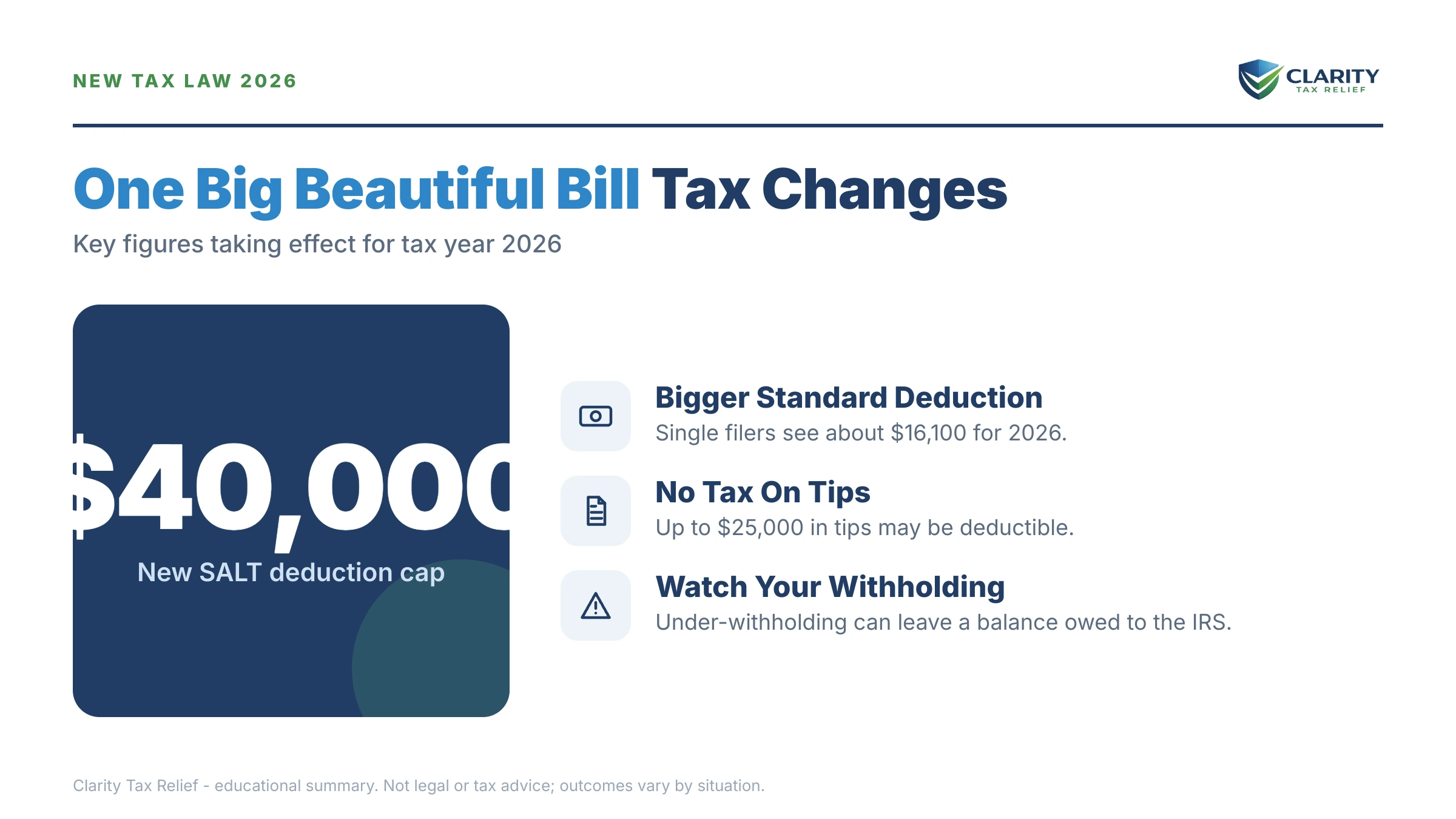
The One Big Beautiful Bill Act (OBBBA), signed July 4, 2025, made the 2017 TCJA individual rates permanent and added four temporary deductions that run only through the 2028 tax year. The permanent pieces matter most: the lower brackets, the larger standard deduction ($15,750 single and $31,500 joint for 2025, inflation-adjusted after), the 20% QBI deduction for business owners, and a child tax credit raised to $2,200 per child, now indexed for inflation.
The temporary pieces got the headlines. Tips, overtime premium pay, a senior deduction, and interest on new U.S.-assembled car loans are all deductible within limits — and every one of them phases out as income rises and expires after 2028.
Two quieter provisions hit specific readers hard. Starting in 2026, gambling losses are capped at 90% of losses — and still never more than your gambling winnings — meaning a bettor who breaks even can still owe tax, a real problem if you already carry casino winnings tax debt. And OBBBA restored the 1099-K $20,000 threshold (with 200 transactions), killing the $600 rule — while raising the 1099-NEC reporting floor from $600 to $2,000 for payments made starting in 2026. Fewer forms arrive; the income stays taxable either way.
| Provision | Maximum benefit | Income phaseout begins | Years in effect |
|---|---|---|---|
| Tips deduction | $25,000 of reported tips | $150,000 ($300,000 joint) | 2025–2028 |
| Overtime deduction | $12,500 ($25,000 joint) | $150,000 ($300,000 joint) | 2025–2028 |
| Senior deduction (65+) | $6,000 per person | $75,000 ($150,000 joint) | 2025–2028 |
| Car-loan interest (new U.S.-assembled vehicles) | $10,000 of interest | $100,000 ($200,000 joint) | 2025–2028 |
| Child Tax Credit | $2,200 per child, indexed | Existing CTC phaseouts | Permanent |
| SALT deduction cap | $40,000 (2025, rising slightly each year) | Phases down above $500,000 | Reverts to $10,000 in 2030 |
| Gambling-loss deduction | Capped at 90% of losses — and still never more than your gambling winnings | N/A | Starts 2026 |
| 1099-K reporting threshold | $20,000 and 200 transactions | N/A | Restored permanently |
Also gone: the EV credit ended September 30, 2025, and residential clean-energy credits ended with 2025. If you were counting on either to offset a balance due, that math changed.
The new deductions lower next April's bill — not the balance you already owe
Every OBBBA deduction applies only to the tax year you claim it in; none of them reduces a balance the IRS has already assessed. A deduction shrinks the liability on a return you haven't filed yet. A debt is a liability the IRS already put on the books — with penalties and interest compounding on top.
Worse, the two interact against you in one specific way: any refund the new deductions create gets seized automatically and applied to your oldest balance. That happens even if you're current on a payment plan — see our guide on will the IRS take my refund on a payment plan. A bigger refund just means a bigger involuntary payment.
The other trap is withholding. "No tax on tips" convinced some workers to cut their withholding to near zero. But the tips and overtime breaks are deductions claimed at filing — capped, phased out, and layered on top of Social Security and Medicare taxes that never went away. Zero out your withholding and you'll manufacture a brand-new balance to sit beside the old one.
One thing OBBBA does not let you do: reopen old years to claim the new deductions. They start with 2025. Amending remains a legitimate tool only when the original return was actually wrong — missed deductions that existed then, overstated income, a corrected 1099. If that's your situation, see how to amend a return to reduce tax debt.
If you owe back taxes, the collection machine didn't change
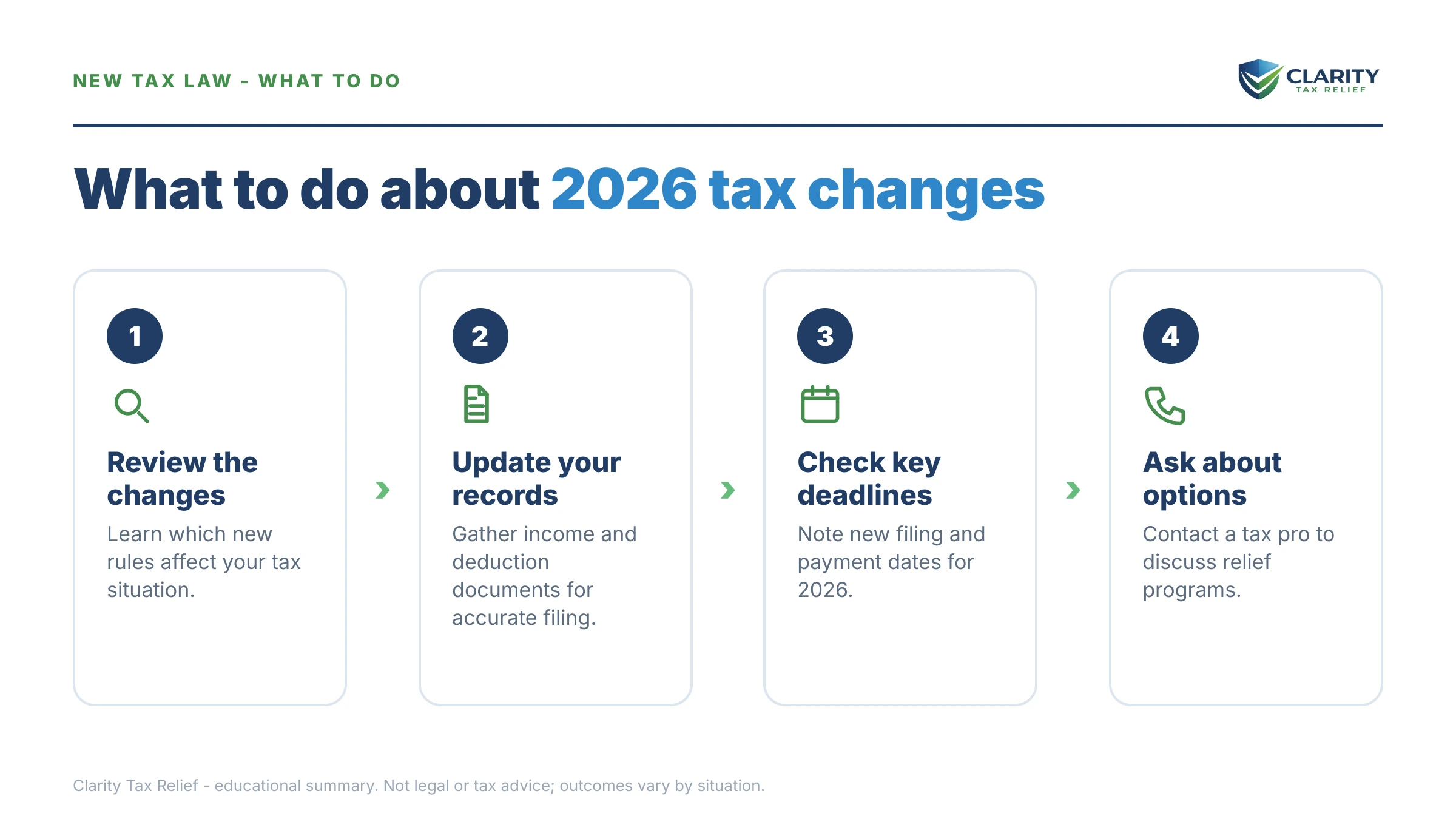
OBBBA left the entire IRS collection process untouched — the same notice sequence, the same levy powers, the same 10-year collection statute. If you're behind, ignoring the balance still triggers the same automated escalation it always has:
- CP14 — the first bill, with roughly 21 days to respond before the cycle continues.
- CP501 / CP503 — reminder notices while the balance compounds monthly.
- CP504 — Notice of Intent to Levy: the IRS can now take your state tax refund, and a federal tax lien is on the table.
- LT11 / Letter 1058 — the final notice, starting a 30-day clock on your Collection Due Process rights.
- Levy — bank accounts (a 21-day hold before funds leave), wages (continuous until released), and up to 15% of Social Security payments.
The law arrived in the same year the IRS lost roughly 27% of its workforce — a story we cover in IRS budget cuts 2026. Fewer humans answer the phone, but the notices, liens, and levies are generated by automated systems that never stopped. Waiting for the shrunken IRS to forget you is not a strategy.
One threshold deserves special attention at larger balances: once your total debt crosses $66,000 in 2026, the IRS can certify it to the State Department and block your passport. If you're carrying a balance anywhere near that line, read what happens when a passport is revoked for tax debt — and note that a formal payment arrangement prevents or reverses certification.
Owe back taxes while the new law reshapes your return?
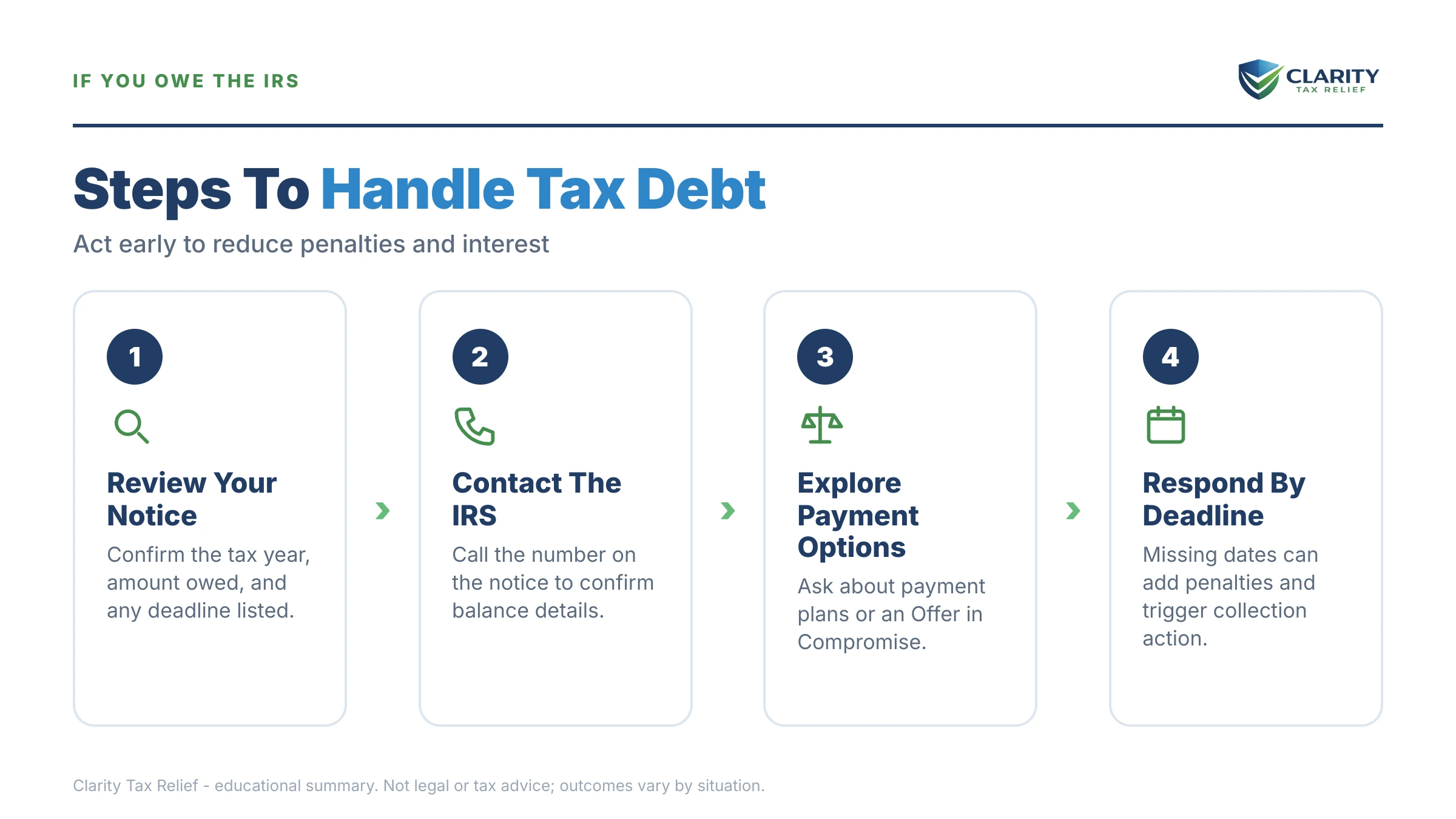
The deductions you claim and the resolution you pick interact — get both reviewed together. An experienced tax professional will map your balance, your thresholds, and your cheapest path forward. Free and confidential, while interest and penalties keep accruing either way.
Your options with an $83,100 balance — the thresholds OBBBA left alone
Every IRS resolution program and its eligibility thresholds survived OBBBA unchanged. That matters because the thresholds — not the new deductions — decide what you can actually do with an existing debt. At $83,100, you're above two of the big ones:
| Option | Threshold or test (unchanged) | How it applies at $83,100 |
|---|---|---|
| Short-term payment plan | Full payment within 180 days; $0 setup fee | Only realistic if divorce-settlement or home-sale proceeds are coming soon |
| Streamlined installment agreement | Total balance ≤ $50,000, up to 72 months, set up online | Not available unless you pay the balance down below $50,000 first |
| Non-streamlined installment agreement | Over $50,000 — Form 433-F financial disclosure required | The default path; the payment is negotiated from your actual budget |
| Offer in Compromise | Means-tested; $205 fee, 20% down on lump-sum offers (both waived with low-income certification) | Possible if post-divorce income and equity genuinely can't cover the debt |
| Currently Not Collectible | Allowable-expense hardship test | Pauses collection if the divorce gutted your income; debt and interest remain |
| Penalty abatement / AEP | Clean prior 3 years (FTA); AEP applies automatically starting summer 2026 | Shrinks the balance itself — pursue alongside any option above |
Above $50,000, the online 72-month plan is off the table, and the IRS sets your payment from a full financial disclosure — the rules are different enough that we wrote a separate guide to an IRS payment plan over $50,000. The general playbook for negotiating any of these on your own lives in our pillar on how to settle tax debt yourself; this page sticks to what's specific to the post-OBBBA landscape.
Be wary of anyone claiming the new law created a settlement window. The Offer in Compromise is real, but it's the same strict math it was before July 2025 — the IRS accepted roughly 1 in 5 offers in FY2024 — and no salesperson can change your Reasonable Collection Potential.
A worked example: divorced, tipped income, and $83,100 of joint-year debt
Say you're recently divorced, tending bar, and carrying $83,100 in back taxes from three years of joint returns. Here's the honest math, all hypothetical:
What the debt does on its own. The failure-to-pay penalty adds 0.5% a month — about $415 on this balance — until it caps at 25% of the tax. Interest compounds daily at the federal rate, recently in the 7–8% range, roughly another $500 a month. Doing nothing costs on the order of $900 a month. You can run your own numbers with our Penalty & Interest Calculator, which estimates how a balance grows over time.
What OBBBA gives you. Suppose you report $9,000 in tips on $68,000 of income in 2026. The tips deduction covers all $9,000 (well under the $25,000 cap, and your income is under the $150,000 phaseout). In the 22% bracket, that's about $1,980 less tax on your 2026 return.
Where the two collide. If that deduction turns into a $2,100 refund, you never see it — it's offset against the $83,100 automatically, covering barely two months of accruals. And because $83,100 is over both the $50,000 streamlined line and the $66,000 passport line, the realistic move is a financially verified installment agreement: full-paying over six years would run roughly $1,154 a month before interest, so if your post-divorce budget can't support that, the numbers themselves argue for a lower negotiated payment, CNC, or an offer — whichever your Form 433-F actually supports.
Filing after divorce under the new law
A divorce resets your filing status, standard deduction, and child tax credit — but it never splits a jointly assessed IRS balance. For your first solo return, you'll file single (2025 standard deduction: $15,750) or, if a child lived with you more than half the year, head of household ($23,625 for 2025) — a meaningfully better bracket structure.
The $2,200 child tax credit follows whoever properly claims the child, so nail down the dependency terms in your decree before filing season. And because OBBBA made the TCJA rules permanent, alimony under a post-2018 decree stays non-deductible for the payer and tax-free for the recipient — permanently.
What the decree cannot do is bind the IRS. If your ex was ordered to pay the joint-year balance and doesn't, the IRS can still collect every dollar from you — refund offsets, liens, levies, all of it. The full picture, including innocent spouse and separation-of-liability relief, is in divorce and IRS debt: who pays.
Finally, update your W-4 the year the divorce is final. Withholding calculated at married rates on a now-single filer is the single most common way divorced taxpayers add a fresh balance to an old one.
How to respond to the One Big Beautiful Bill changes when you owe back taxes
- Pull your full balance. Log into your IRS online account and write down the total across every year — the thresholds that decide your options ($50,000, $66,000) run on the aggregate, not one year.
- Fix your withholding. Do not cut withholding because of the tips and overtime headlines — both are deductions you claim at filing, and under-withholding now creates next year's CP14.
- Claim every 2026 deduction you qualify for. Tips, overtime, the senior deduction, car-loan interest, and the higher standard deduction all shrink the new liability you would otherwise stack on top of the old debt.
- Put the old balance into a formal resolution. A payment plan, Currently Not Collectible status, or an Offer in Compromise stops the notice cycle; at $83,100 that means a financially verified agreement, not the online form.
- Request penalty relief. First-time abatement can remove penalties if your prior three years are clean, and the new Automatic Exemption from Penalty begins applying some relief automatically in summer 2026.
On step five: if your compliance history is clean, start with first-time penalty abatement, and read how the automatic exemption from penalty (AEP) in 2026 changes the request process — it's automatic for qualifying penalties, so don't let anyone charge you for relief the IRS grants on its own.
When you can handle this yourself
Most people don't need professional help to benefit from OBBBA itself. If you're current on your taxes, the new deductions flow through ordinary tax software — claim them and move on. Same if you owe under $50,000 and agree with the balance: you can set up a streamlined plan yourself in about 20 minutes on the IRS payment plans page, or pay a small balance outright at IRS.gov/payments.
Experienced help changes outcomes in narrower situations: a balance over $50,000 (where the payment is negotiated from your financial disclosure, and the disclosure's framing matters), a debt over $66,000 with travel plans (passport certification), Offer in Compromise math, joint-year liability you believe belongs to your ex, or a levy already in motion. If the IRS itself is stonewalling a legitimate hardship, the Taxpayer Advocate Service is a free, independent channel worth knowing about.
Terms in the new law, decoded
- OBBBA — the One Big Beautiful Bill Act, the July 2025 law behind all the changes on this page.
- MAGI — modified adjusted gross income, the income figure the new deductions' phaseouts are measured against.
- Phaseout — the income range where a deduction shrinks toward zero; above it, you get nothing even if you otherwise qualify.
- Refund offset — the IRS applying your refund to a back-tax balance automatically, before any money reaches you.
- Assessment — the moment the IRS formally records a tax as owed; deductions work before assessment, resolution programs work after.
- CSED — the collection statute expiration date: the IRS generally has 10 years from assessment to collect, though appeals, offers, and bankruptcy pause the clock.
One Big Beautiful Bill questions, answered
Does the One Big Beautiful Bill forgive IRS tax debt?
No. OBBBA contains no forgiveness, amnesty, or debt-relief provision for existing balances. Every dollar assessed before the law passed is still owed, still accruing the 0.5% monthly failure-to-pay penalty plus daily interest, and still subject to liens and levies. The real paths to reducing an existing balance are unchanged: penalty abatement, an Offer in Compromise if your finances qualify, or resolution through a payment plan.
Is “no tax on tips” really tax-free income?
Not entirely. It is a deduction of up to $25,000 in reported tips, available for tax years 2025 through 2028 and phasing out above $150,000 of income ($300,000 joint). Social Security and Medicare taxes still come out of every tipped dollar, most states still tax tips, and your employer keeps withholding all year — you claim the deduction when you file your return.
Will the IRS take my bigger refund if I owe back taxes?
Yes, automatically. Any federal refund is applied to your oldest outstanding balance before a dollar reaches you — even while you are current on an installment agreement. Because the new deductions make refunds larger for many filers, they simply become larger involuntary payments toward the debt. If you would rather control the money, adjust your withholding so less is refundable in the first place.
Did the One Big Beautiful Bill change the 1099-K threshold?
Yes. OBBBA restored the original rule: payment apps and online marketplaces issue a 1099-K only if you exceed $20,000 in payments and 200 transactions in a year, ending the $600 threshold. The income was always taxable whether or not a form arrives, though — and balances the IRS already assessed for earlier years do not go away because the reporting rule changed.
Did OBBBA change IRS payment plans or the Offer in Compromise?
No. Every collection-program threshold is untouched: short-term plans still run up to 180 days, streamlined installment agreements still cap at $50,000, and the Offer in Compromise still carries a $205 application fee and a strict means test — the IRS accepted roughly 1 in 5 offers in FY2024. The $66,000 passport certification threshold for 2026 is a routine inflation adjustment, not an OBBBA change.
How does the One Big Beautiful Bill affect me if I just got divorced?
Your filing status, standard deduction, and child tax credit all reset for your first single-year return, and the now-permanent TCJA rules mean alimony under a post-2018 decree stays non-deductible for the payer and tax-free to the recipient. What does not reset is any balance from a jointly filed year: the IRS can collect all of it from either ex-spouse, regardless of what the divorce decree says.
When do the tips and overtime deductions expire?
After the 2028 tax year. The tips deduction (up to $25,000), the overtime deduction (up to $12,500, or $25,000 on a joint return), the $6,000 senior deduction, and the car-loan-interest deduction all apply only to tax years 2025 through 2028 unless Congress extends them. The permanent pieces — the TCJA rates, larger standard deduction, $2,200 child tax credit, and QBI deduction — have no expiration date.
Your next 24 hours
- Find your real number. Log into your IRS online account and total the balance across every year — then note which side of $50,000 and $66,000 you're on, because those two lines decide your options.
- Gather three documents: your last filed return, your divorce decree (the dependency and debt-allocation pages), and a current pay stub showing your reported tips or overtime.
- Get the free case review. Use the 2-minute form or call (888) 825-7779 — an experienced tax professional will map the new deductions against your balance and pick the resolution your numbers actually support, while penalties and interest keep compounding on anything left unresolved.
This guide is general information, not tax or legal advice for your specific situation. Eligibility for IRS programs depends on individual facts and circumstances; no outcome is guaranteed.