
IRS Letters
IRS Letter 106-C: Your ERC Claim Was Partially Disallowed — What to Do (2026)
The short answer: IRS Letter 106-C means the IRS partially disallowed your refund claim — in 2026, almost always part of an Employee Retention Credit claim. The letter lists which quarters or amounts were allowed and which were denied, and its date starts a 2-year deadline to sue for the disallowed portion.
You waited months — maybe years — for the ERC refund a preparer told you was locked in. Now a Letter 106-C says the IRS agrees with some of your quarters and rejects the rest, and you're not sure whether you just lost tens of thousands of dollars or whether you can still fight.
You can still fight — but a Letter 106-C is one of the few IRS letters where doing nothing quietly and permanently kills a legal right. The image below shows you exactly what this letter looks like and where to find the two numbers that matter most: the disallowed amount and the letter date that starts your clocks.
⏱ Your deadlines: You have 2 years from the date on your Letter 106-C to file suit for the disallowed portion — a statutory deadline under IRC §6532 that an IRS appeal does not pause. Your window to request an IRS appeal is much shorter: check the date printed on your letter, typically about 30 days.
Why you got a Letter 106-C
A Letter 106-C means the IRS reviewed a refund claim you filed — usually an Employee Retention Credit claim on Form 941-X — and allowed part of it while formally denying the rest. Unlike its sibling Letter 105-C, which rejects the entire claim, the 106-C is a split decision: some quarters passed the IRS's screening, and some didn't.
The letter states the reason for each denial. In the ERC batches the IRS has been mailing since 2024, the most common ones are:
- Gross receipts didn't decline enough. Your revenue drop in the denied quarter didn't meet the threshold for that year, even if another quarter did.
- The government-order suspension wasn't substantiated. The IRS didn't accept that a specific federal, state, or local order fully or partially suspended your operations in that quarter. Vague "supply-chain disruption" theories pushed by promoters fail here constantly.
- Wage overlap. The same wages were counted for PPP loan forgiveness or another credit, or the calculation included owner and family wages that don't qualify.
- The business wasn't eligible for that period at all — for example, quarters outside the ERC's covered 2020–2021 window.
The critical mindset shift: a 106-C is not a bill and not an audit. It's a legal determination on a refund claim, which is why the rights and deadlines it triggers look nothing like an ordinary balance-due notice. (If you're staring at a different IRS envelope and just want orientation, start with our guide to why did I get a letter from the IRS — this page covers the 106-C specifically.)
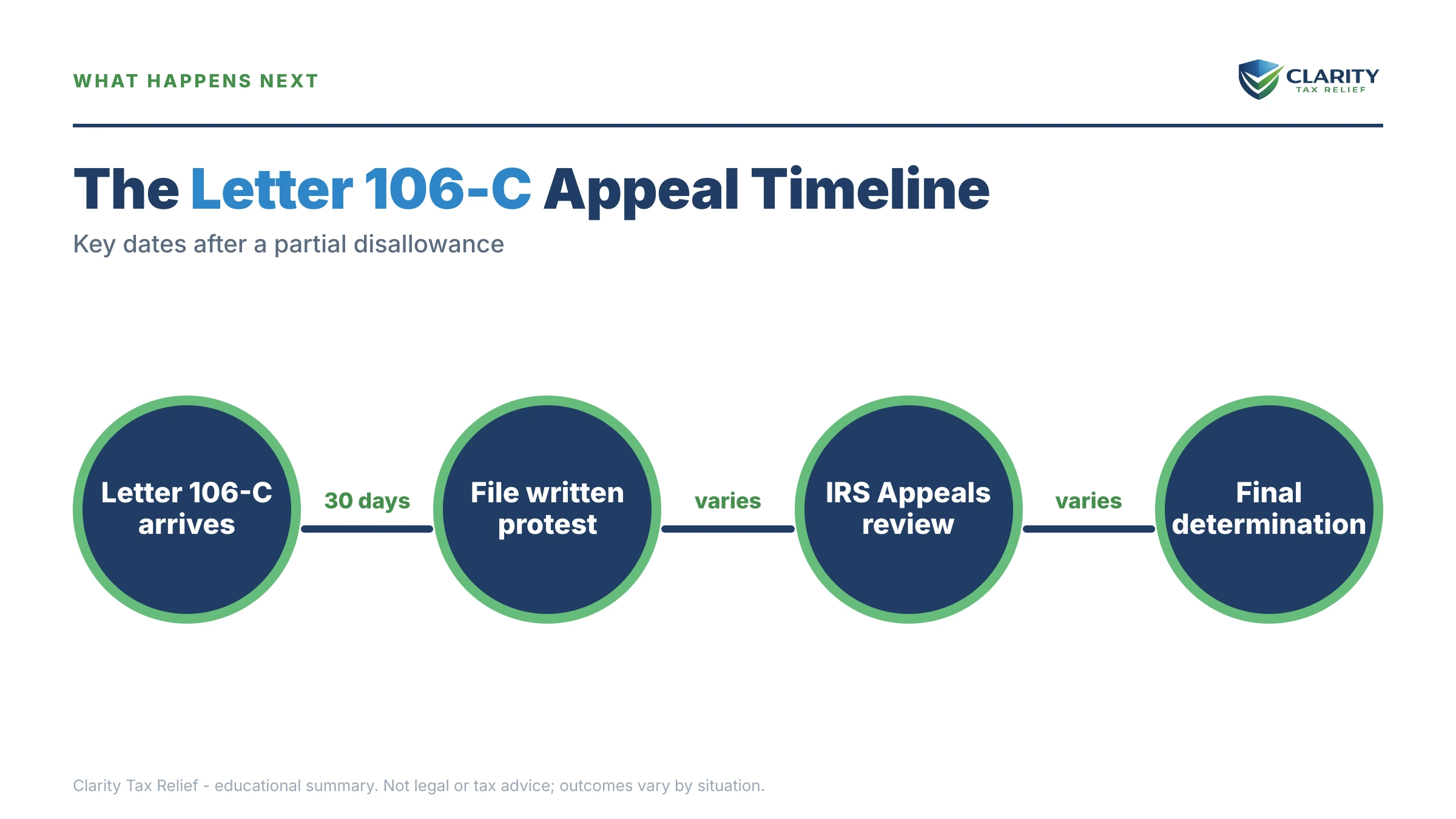
The two clocks a Letter 106-C starts
A Letter 106-C starts a 2-year period to file suit on the disallowed portion, and a much shorter window to request an IRS appeal. The trap most people fall into is assuming the appeal pauses the court deadline. It doesn't — the 2-year suit clock keeps running while Appeals reviews your case. If Appeals is slow (and with the IRS workforce down roughly 27% since 2025, it often is), you can run out of court rights while waiting politely for an answer.
There's a fix for that: Form 907, a written agreement between you and the IRS to extend the 2-year suit period. Our Form 907 ERC guide walks through when and how to use it.
| Clock | How long you have | What you lose if it passes |
|---|---|---|
| Appeals request | The date printed on your letter — typically about 30 days from the letter date | The cheapest review path: an independent Appeals officer looking at your file without a lawsuit |
| Suit deadline (IRC §6532) | 2 years from the date on the Letter 106-C | The right to recover the disallowed amount in federal court — permanently, even if your claim was valid |
| Form 907 extension | Must be signed by both sides before the 2-year deadline expires | The ability to extend the suit clock at all — an expired deadline can't be revived |
| Repayment (only if the denied portion was already refunded to you) | No fixed date — but interest accrues from the start | The cheapest payoff; the balance grows monthly and collection notices escalate |
What a partial disallowance looks like in dollars
Say you ran a small two-employee cleaning company before retiring, and in 2023 a promoter filed Form 941-X claims for three quarters of 2021 — $18,200 per quarter, $54,600 total. Now, living on Social Security, you open a Letter 106-C. Here's how the math splits:
- Allowed: Q1 2021, $18,200 — your gross receipts that quarter fell far enough to qualify. That portion of the claim survives.
- Disallowed: Q2 and Q3 2021, $18,200 each — $36,400 denied because receipts recovered and the "government order" the promoter cited didn't actually suspend your operations in those quarters.
What happens to the $36,400 depends entirely on whether it was ever paid out. If it wasn't, your worst case is losing money you never received — painful, but nothing to repay. If the IRS refunded it before deciding to disallow it, the IRS will move to get it back, with interest accruing on top — and on a fixed Social Security income, that changes which response path makes sense. Either way, the promoter's contingency fee (often 15–25% of the claim) is a separate fight between you and the promoter; the IRS doesn't care who kept what.
What happens if you ignore a Letter 106-C
Ignoring a Letter 106-C ends one of two ways, depending on whether the disallowed money already reached your bank account. Neither path involves the IRS forgetting.
If the denied portion was never paid out, the sequence is quiet but final:
- The appeal window on your letter closes. The easy, no-court review path is gone.
- The 2-year suit period runs. During this time you can still sue or sign Form 907 — the claim is dormant, not dead.
- The 2-year deadline expires. The disallowed portion is gone permanently. No appeal, no lawsuit, no reconsideration can bring it back — even if every dollar was legitimately owed to you.
If the denied portion was already refunded to you, the sequence gets louder instead of quieter:
- The IRS assesses the amount to be recovered and bills you for it, with interest accruing from the start.
- Balance-due and reminder notices arrive, each with a larger total than the last.
- Collection escalates to a final notice of intent to levy — Letter 1058 or its LT11 equivalent — which starts a 30-day clock before the IRS can levy bank accounts and garnish income.
One 2026 reality worth naming: the IRS answers fewer calls than ever, but the notice and levy systems are automated. Silence from the IRS never means the file is closed.
Holding a Letter 106-C right now?
Get it reviewed free before the appeal window printed on your letter closes. An experienced tax professional will check the IRS's disallowance reasons against your actual eligibility, tell you whether the denied quarters are worth fighting, and map out your deadlines — no pressure, no obligation.
Your options after a partial ERC disallowance
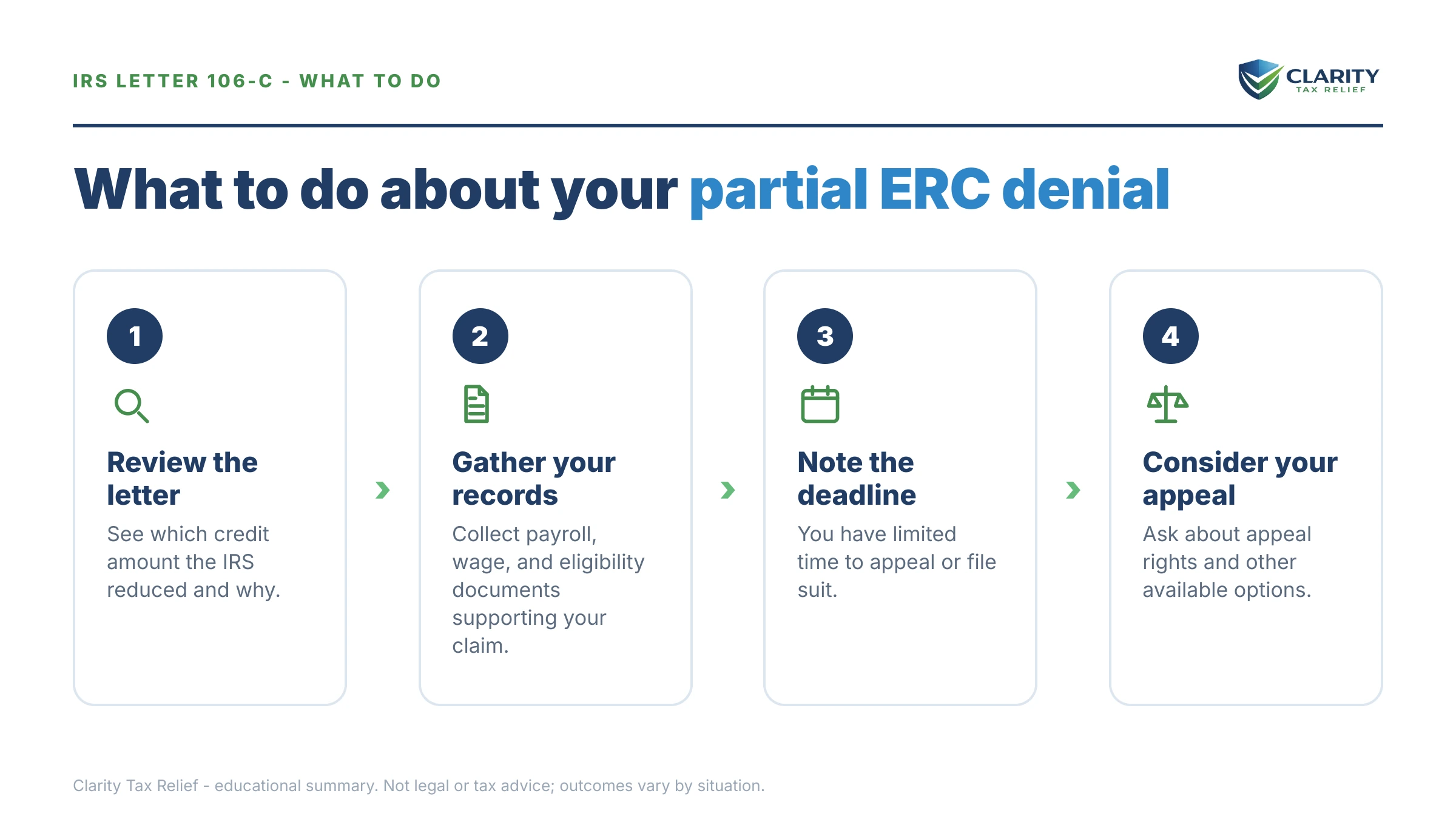
You have four realistic paths after a Letter 106-C, and they aren't mutually exclusive — appealing now and preserving your court rights with Form 907 later is a common combination. Our pillar guide to an ERC claim disallowed covers the whole landscape; here's how the paths compare for a partial denial:
| Path | What it does | Deadline | Best when |
|---|---|---|---|
| Accept the partial disallowance | Keep the allowed quarters; let the denied ones go | None — you simply don't respond | The denied quarters genuinely didn't qualify (common with promoter-filed claims) |
| Written protest to IRS Appeals | An independent Appeals officer reviews the denial without a lawsuit | Printed on your letter — typically ~30 days; does not pause the suit clock | You have real substantiation the reviewer never saw — receipts data, the actual government orders, corrected wage math |
| File suit (district court or Court of Federal Claims) | A federal judge decides whether the denied portion was owed | 2 years from the letter date (IRC §6532) | The disallowed amount is large and your eligibility evidence is strong |
| Sign Form 907 | Extends the 2-year suit period by written agreement | Must be executed before the 2-year deadline runs out | Appeals is still reviewing your case as the clock runs low |
If you go the protest route, precision matters more than passion. Appeals officers respond to quarter-by-quarter substantiation — receipts comparisons with source documents, the exact text of the government order and how it restricted your operations, payroll records tying qualified wages to eligible periods. Our ERC disallowance appeal guide covers what a protest letter needs to contain.
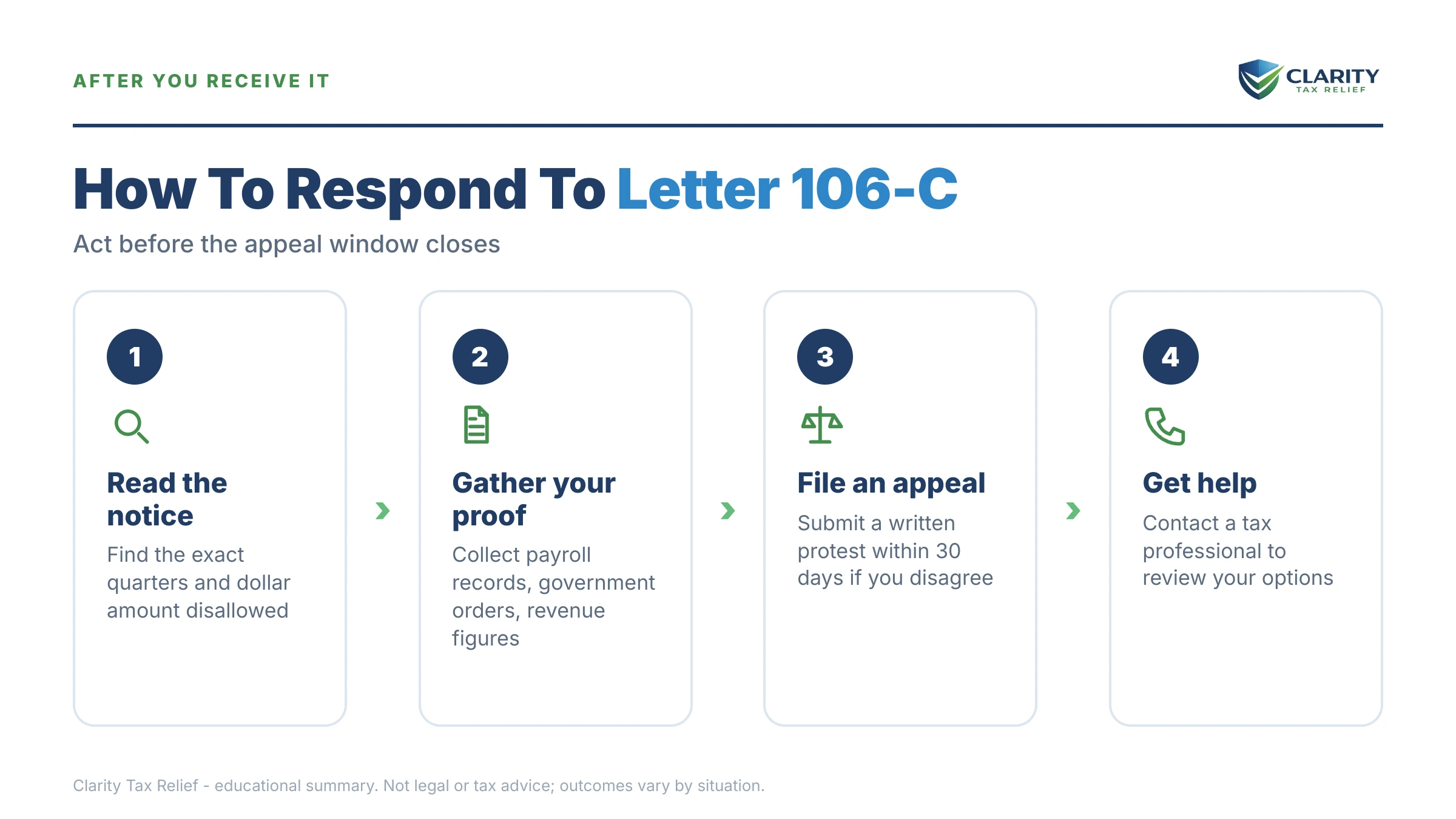
How to respond to Letter 106-C, step by step
- Read the disallowance breakdown — identify exactly which quarters and dollar amounts were allowed, which were denied, and the reason the IRS gives for each denial.
- Circle the letter date — that date starts your 2-year deadline to file suit and anchors the shorter appeal window printed on the letter — keep the letter and the envelope.
- Pull your eligibility proof — gather gross-receipts records, the specific government orders you relied on, payroll records, PPP forgiveness paperwork, and everything your preparer or promoter gave you for the denied quarters.
- Choose your path in writing — accept the partial disallowance, send a written protest to Appeals before the letter's deadline, or preserve your court rights with Form 907 or a timely suit.
- Get a professional review before you protest — a weak or incomplete protest builds a bad record while the 2-year clock keeps running — have an experienced tax professional check your eligibility math first.
Do you have to repay ERC money you already received?
You only owe money back on a Letter 106-C if the disallowed portion was already refunded to you. That's the single most important fact to establish on day one, because it decides whether your problem is a lost refund or a growing debt.
If repayment is on the table, interest accrues on the recovered amount until it's paid — you can estimate what that adds with our IRS penalty & interest calculator. You don't have to write one check: installment options exist, and our guide for people who can't repay ERC walks through them, including what changes when your income is fixed, like Social Security.
Two related wrinkles worth knowing. First, if you amended your income-tax return to reduce your wage deduction when you claimed the ERC, a disallowed quarter may entitle you to reverse that amendment — money moving back in your direction. Second, the IRS has an extended ERC assessment window for Q3 and Q4 2021 claims — under the 2025 One Big Beautiful Bill Act, up to six years (the later of April 15, 2028, or six years from when the claim was filed) — so "they haven't billed me yet" is not the same as "they can't."
And if a promoter filed the claim and has since gone quiet, the deadlines still belong to you, not them. Our guide to ERC mill claim problems covers how to disavow promoter positions, respond in your own name, and — where the paid-out claim was clearly wrong — whether the IRS's voluntary disclosure terms can reduce what you repay.
When you can handle this yourself
You don't need professional help to accept a partial disallowance you agree with. If the denied quarters were a promoter's stretch — a supply-chain theory you never believed, receipts that plainly didn't drop — and nothing was paid out, keeping the allowed quarters and letting the rest go is a perfectly rational, zero-cost ending. Verifying the allowed portion arrives is the only follow-up.
Experienced help changes outcomes in four situations: the disallowed amount is large and your eligibility evidence is genuinely strong; the denied portion was already paid out and repayment would strain you; Appeals is dragging while your 2-year clock runs (the Form 907 / suit decision has real legal consequences); or the 106-C arrived alongside an exam of other quarters, where our ERC audit guide applies. In those cases, the cost of getting the protest or the timing wrong dwarfs the cost of getting it reviewed.
Terms on your Letter 106-C, decoded
- Claim disallowance — the IRS's formal legal denial of a refund claim; "partial" means only part of what you claimed was denied.
- IRC §6532 two-year period — the federal statute giving you 2 years from the disallowance notice to file suit; after that, courts can't hear the claim.
- Written protest — the formal letter requesting review by the IRS Independent Office of Appeals, laying out the facts and law supporting the denied quarters.
- Form 907 — a signed agreement between you and the IRS extending the 2-year suit period, used when review is still pending as the deadline nears.
- Gross receipts test / government-order suspension — the two ways a quarter qualified for the ERC: a sufficient revenue decline, or operations fully or partially suspended by a specific government order.
- Form 941-X — the amended payroll return used to claim the ERC; each quarter is its own claim, which is why a 106-C can split them.
Letter 106-C questions, answered
What is IRS Letter 106-C?
Letter 106-C is the IRS's formal notice that it partially disallowed a refund claim — in 2026, that almost always means part of an Employee Retention Credit claim filed on Form 941-X. The letter lists which quarters or amounts were allowed, which were denied, and why. Its date starts a 2-year deadline to sue for the disallowed portion under IRC §6532, so keep the letter and its envelope.
What is the difference between Letter 105-C and Letter 106-C?
Letter 105-C is a full disallowance — the IRS denied your entire claim. Letter 106-C is a partial disallowance — the IRS allowed some of what you claimed and denied the rest. Both letters start the same 2-year period to file suit on the denied amount, and both give you the right to ask the IRS Independent Office of Appeals to review the decision. The strategy differs because with a 106-C you're only fighting over the denied quarters.
Can I appeal a Letter 106-C?
Yes — you can send a written protest asking the IRS Independent Office of Appeals to review the disallowed portion, and the letter itself explains how and by when (typically about 30 days from the letter date). One critical catch: an appeal does not pause the 2-year deadline to file suit. If Appeals is still reviewing your case as that deadline approaches, you protect yourself by signing Form 907 to extend the suit period or by filing suit before it expires.
Do I have to pay back the disallowed ERC money?
Only if the IRS already paid you the portion it is now disallowing. If the denied quarters were never refunded, you owe nothing — you simply don't receive that money unless you win an appeal or suit. If the money was paid out, the IRS will move to recover it, and interest accrues on the balance until it's resolved. Payment plans exist for people who can't repay in a lump sum, so a repayment demand is a cash-flow problem, not a dead end.
How long do I have to fight a Letter 106-C?
You have 2 years from the date on the letter to file suit in federal district court or the Court of Federal Claims — that deadline comes from IRC §6532 and is unforgiving. The window to request an IRS appeal is much shorter and is printed on the letter itself, typically around 30 days. If you need more time because Appeals is still working your case, Form 907 lets you and the IRS agree in writing to extend the 2-year suit period.
Does Letter 106-C mean I'm being audited?
No — a 106-C is a claim determination, not an audit of your business. The IRS reviewed the refund claim you filed and decided part of it didn't qualify. That said, ERC claims can draw separate examination of other quarters or of the income-tax side, since claiming the credit required reducing your wage deduction. If you receive a separate exam letter, treat it as its own matter with its own deadlines.
What if a promoter or ERC mill filed the claim for me?
You are still the taxpayer on the claim, so the 106-C deadlines apply to you — not the promoter. Many promoters have disappeared, stopped answering, or charged contingency fees on money the IRS is now denying. Gather every document the promoter gave you, respond to the letter yourself or through your own representative, and don't rely on the promoter's assurance that they'll handle it. If part of the paid-out claim was clearly wrong, the IRS's voluntary disclosure terms may reduce what you repay.
Your next 24 hours
- Find the letter date and the disallowed amount. Both are on page one of the Letter 106-C — the date starts your 2-year suit clock, and the amount tells you the size of the fight. Note whether the denied portion was ever actually paid to you.
- Gather your ERC file. Form 941-X copies for every quarter, quarterly gross-receipts records, the government orders you relied on, payroll records, PPP paperwork, and everything the preparer or promoter gave you.
- Get a free case review before the appeal window on your letter closes. Call (888) 825-7779 or use the 2-minute form — we'll tell you honestly whether the denied quarters are worth appealing, worth suing over, or worth letting go.
For the IRS's own materials, see the official Employee Retention Credit page at IRS.gov, the IRS Independent Office of Appeals, and — if IRS delays are causing you hardship — the Taxpayer Advocate Service.
This guide is general information, not tax or legal advice for your specific situation. Eligibility for IRS programs depends on individual facts and circumstances; no outcome is guaranteed.