
IRS Programs
ERC Voluntary Disclosure Program in 2026: It's Closed — Here's What to Do Now
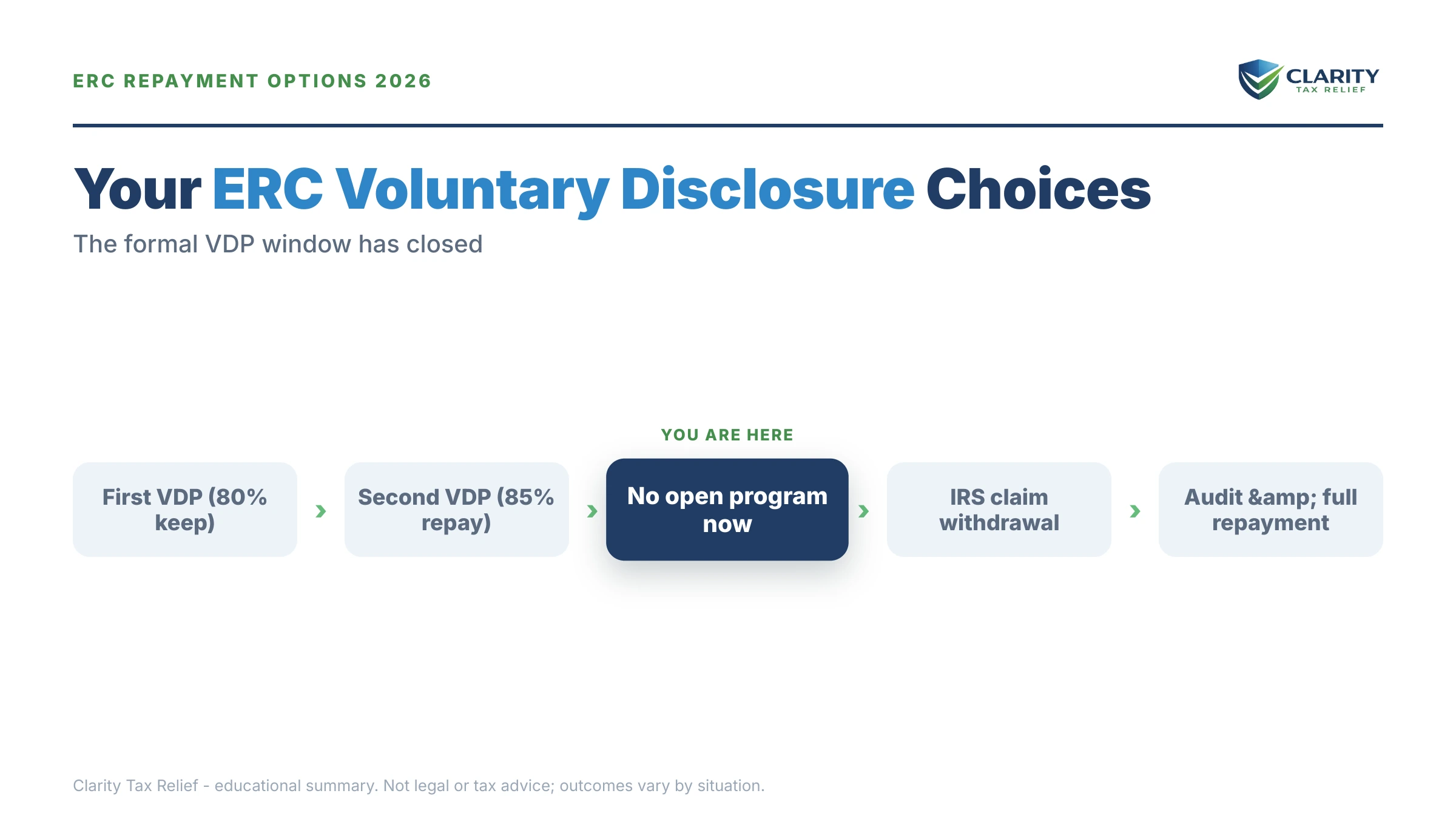
The short answer: the ERC voluntary disclosure program let employers repay improper Employee Retention Credit claims at a discount — 80% in the first round, 85% in the second. Both windows are now closed; the second ended November 22, 2024. In 2026, your remaining paths are claim withdrawal, voluntary repayment, or responding to IRS letters.
You took the ERC money — or a promoter took it for you — and every new headline about ERC audits makes that deposit feel less like a windfall and more like a loan you never agreed to. That knot in your stomach is reasonable, but the situation has a map: even with the ERC voluntary disclosure program closed, there are still three legitimate ways to correct a bad claim, and the earlier you pick one, the cheaper it is.
Which path is open to you depends on one question the IRS paperwork answers in a single line: has your claim been paid, and did you cash the check? The image below shows what the ERC correction paperwork actually looks like and where those status-deciding details appear — worth a look before you touch anything.
⏱ The clock that actually matters: there is no ERC-VDP deadline left to beat — the second and final window closed November 22, 2024. Two clocks still run: interest accrues on any improper credit until it's repaid, and if you're holding a disallowance or recapture letter, the response date printed on that letter controls.
What the ERC voluntary disclosure program offered: the 80% and 85% terms
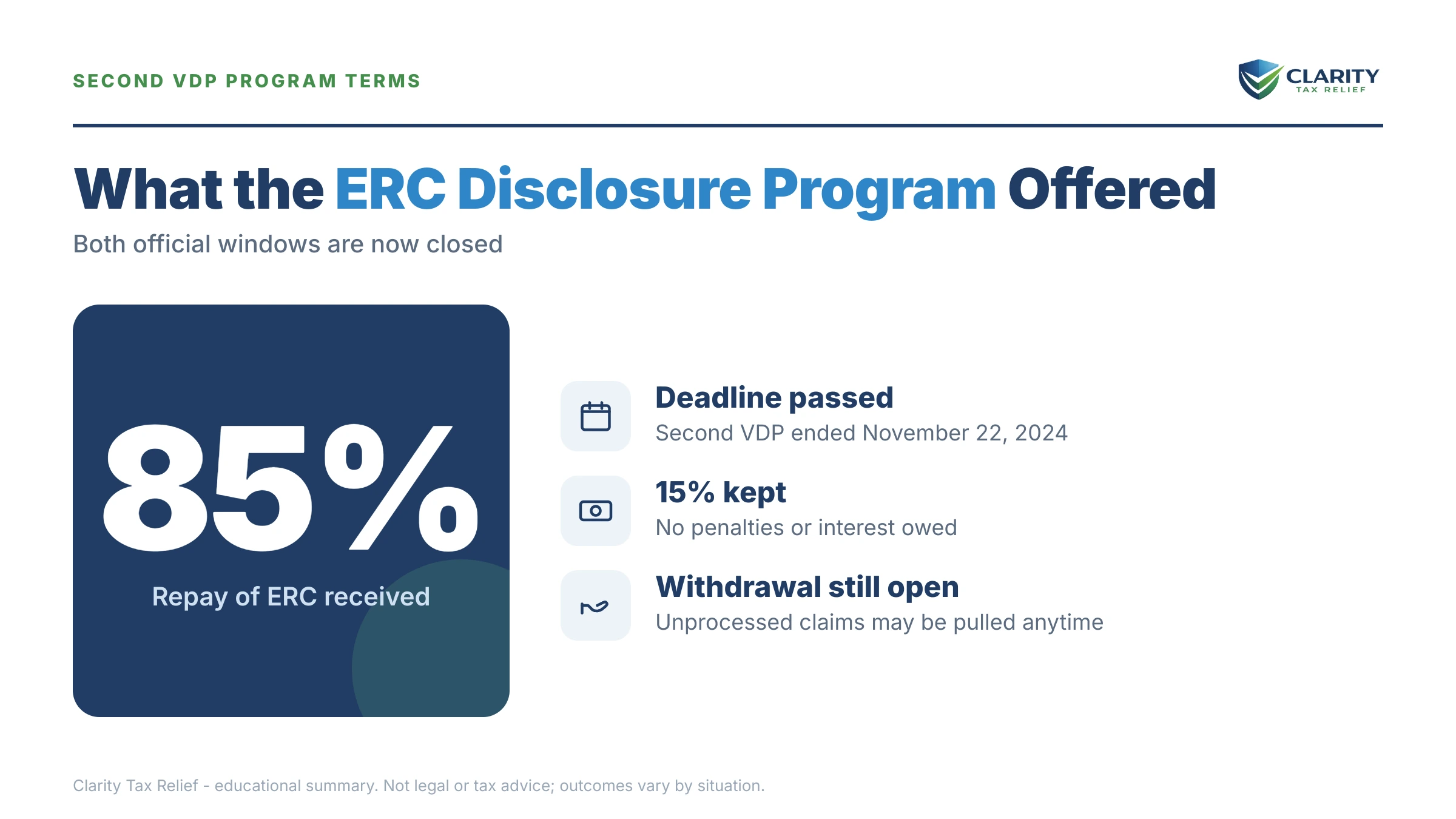
The ERC-VDP let employers return an improper Employee Retention Credit while keeping 15–20% of it and paying no penalties. It ran twice. The first round, announced in December 2023, required repaying 80% of the credit received and closed March 22, 2024. The second round, opened in August 2024, required repaying 85%, covered only 2021 tax periods, and closed November 22, 2024.
The discount wasn't generosity — it was arithmetic. ERC mills typically kept a contingency fee of 15–25% of each refund, so many employers never actually held the full credit. Letting them keep roughly the promoter's cut meant repaying didn't leave them worse off than never claiming at all.
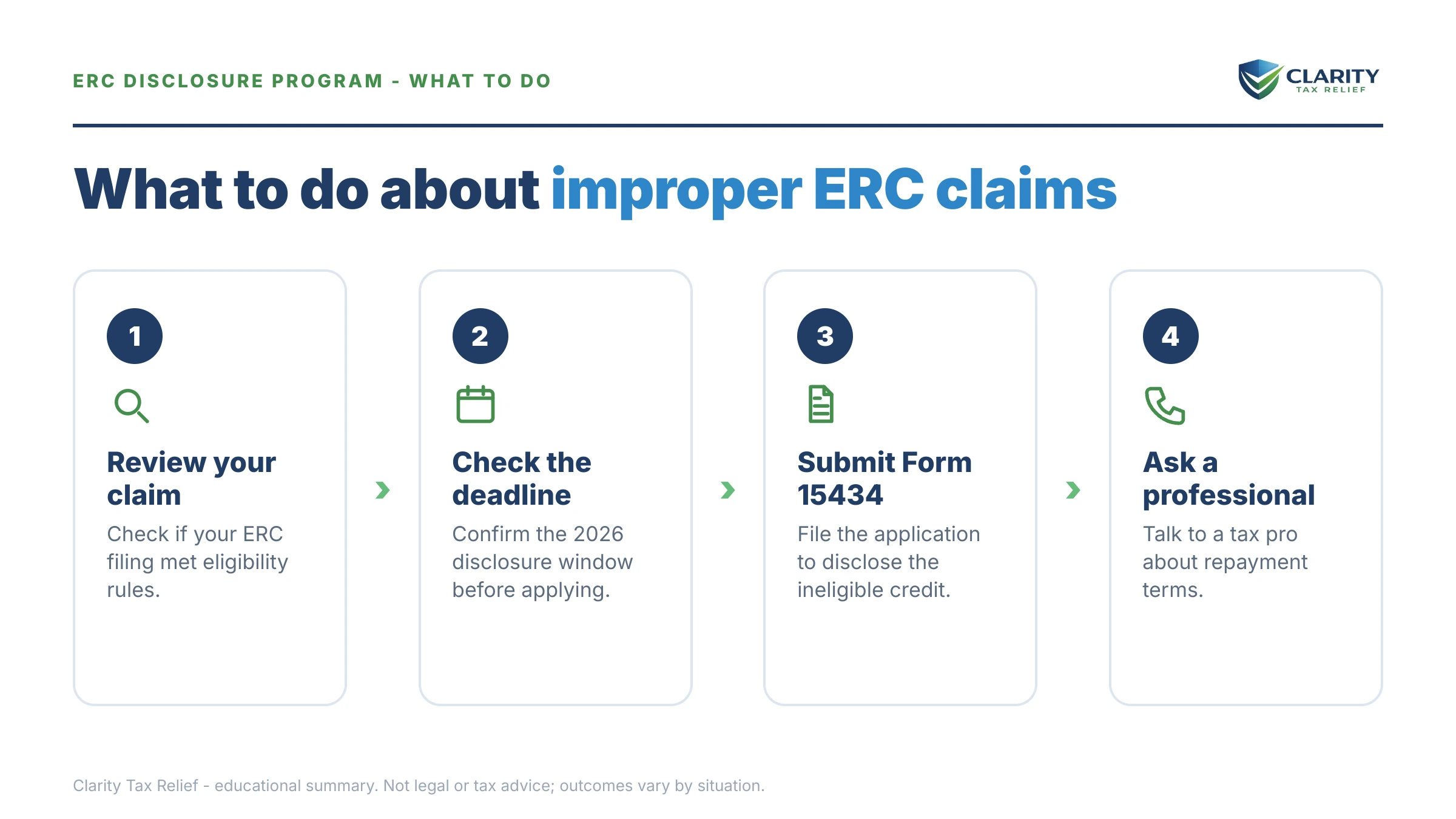
The terms were unusually clean for an IRS settlement program. Participants who paid in full owed no penalties and no interest on the repaid amount, the portion they kept was not treated as taxable income, and they didn't have to amend their income tax returns to unwind the wage-deduction adjustment. Applications went in on Form 15434, which also required naming the preparer or promoter behind the claim — one reason the IRS wanted the program to exist in the first place.
Not everyone could use it. Employers under criminal investigation, already under employment-tax examination for the claimed quarters, or already holding a recapture demand for the credit were excluded. Voluntary disclosure only counts when the IRS hasn't found you first — a principle that still governs every option below.
Is the ERC voluntary disclosure program still open in 2026?
No — as of July 2026, both ERC-VDP windows are closed and the IRS has not announced a third round. Some practitioners expected one to accompany the wave of ERC enforcement letters that began going out in 2024 and 2025, but nothing has materialized, and with the IRS workforce down roughly 27% after the 2025 cuts, standing up a new taxpayer-facing program isn't where the agency's remaining resources are going.
What that staffing cut did not slow down is the automated side: disallowance letters, recapture assessments, and balance-due notices on ERC claims are generated by systems, not people. Enforcement continued; the discount didn't. If a new window ever opens, it will be announced on the IRS's Employee Retention Credit page — treat any company telling you it can "get you into the ERC amnesty" today as a red flag, because there is no such program to get into.
What happens if you sit on a bad ERC claim
An improper ERC claim doesn't age out quietly — for late-2021 quarters, Congress gave the IRS a five-year assessment window that runs into 2027 for most employers. Do nothing, and the sequence typically unfolds like this:
- Screening. The IRS continues risk-scoring the ERC claim inventory. High-risk claims — no W-2 payroll, promoter fingerprints, eligibility that doesn't match the quarters claimed — get routed to disallowance or exam.
- Disallowance or exam. An unpaid claim draws a Letter 105-C (full denial) or Letter 106-C (partial). A paid claim can be pulled into an employment-tax examination instead.
- Recapture and assessment. If the credit was paid out and shouldn't have been, the IRS assesses it back — the full credit, plus interest, plus penalties that can include the 20% accuracy-related penalty, or far worse where fraud is shown.
- Collection. The assessed balance enters the normal collection machine: balance-due notices, then lien and levy authority. At that point you're managing an employment-tax debt, not correcting a credit.
Every stage is more expensive than the one before it, and none of them require a human at the IRS to remember your file. You can estimate what penalties and interest would add at each stage with our IRS penalty & interest calculator.
Worried an ERC claim was filed wrong — or filed for you?
Send us the claim paperwork. An experienced tax professional will check your actual eligibility, tell you which correction path is still open, and show you the cost of each — free, confidential, before interest adds another month.
Your options in 2026 now that the ERC-VDP is closed
Three correction paths survived the program's closure, and which one fits depends entirely on your claim's status. General back-tax strategy — payment plans, hardship status, the order to fix things in — is covered in our guide to how to settle tax debt yourself; here's what's specific to ERC:
| Option | Who it fits | What it costs | Status in 2026 |
|---|---|---|---|
| ERC-VDP (80% / 85% repayment) | Employers who repaid during the two windows | 80–85% of the credit; no penalties or interest | Closed — no third round announced |
| Claim withdrawal | Claim unpaid, or refund check never cashed | $0 — treated as if never filed | Available; confirm current procedure at IRS.gov |
| Voluntary repayment via Form 941-X | Credit received and cashed; you correct before the IRS does | 100% of the credit, plus interest; penalty exposure often reduced | Available any time before assessment |
| Installment agreement on the balance | Ineligible claim you can't repay at once | Full balance over time; interest keeps accruing | Available — see can't repay ERC options |
| Appeal a disallowance | Employers whose claims were legitimately eligible | Time and documentation, not repayment | Available — see the ERC disallowance appeal route |
| IRS Criminal Voluntary Disclosure Practice | Willfully false claims only | Full repayment plus negotiated penalties; attorney required | Available — see the IRS voluntary disclosure practice |
Two warnings before you pick. First, don't repay a claim that was actually valid — a real government-order suspension or gross-receipts decline is a defensible claim, and the right answer may be documentation, not a check. Second, if you repay outside a formal program, do it completely and with a clear explanation; a partial, unexplained correction is the classic quiet disclosure pattern that invites more scrutiny rather than less.
One side effect people miss: repaying the credit can entitle you to restore the wage deduction you were required to give up when you claimed it. That income-tax amendment — and its deadline — is covered in our ERC recapture income-tax guide.
ERC letters decoded: what each one means before you respond
The letter in your hand tells you which stage you're at — and each stage has a different correct move.
| Letter / notice | What it means | Your move |
|---|---|---|
| Letter 105-C | Your claim was fully disallowed before payment | Agree (nothing to repay) or appeal with eligibility proof — start with our ERC claim disallowed guide |
| Letter 106-C | Part of your claim was disallowed | Check which quarters survived and why; appeal only the portion you can document |
| Recapture / repayment demand | The IRS is assessing back a credit already paid to you | Verify the math, then pay or arrange payment by the printed date — this letter also ends any withdrawal option |
| Examination letter | Your ERC claim is under employment-tax audit | Don't self-correct mid-exam without advice; get representation before responding |
| Balance-due notice after assessment | The recaptured credit is now a collectible debt | Set up payment before the notice sequence escalates to levy authority |
A worked example: the $4,800 claim a promoter filed
Say you're a gig worker — no W-2 employees, three years of your own returns unfiled — and in 2023 a promoter convinced you to claim $4,800 of ERC, taking a 20% fee ($960) and leaving you $3,840. That claim was never valid: the ERC is an employer credit against W-2 payroll, and self-employment income alone doesn't qualify. Here's what each path costs, purely as a hypothetical:
- If the check was never cashed: withdraw the claim. Cost: $0. The claim is treated as never filed.
- Under the closed second VDP window: repayment would have been 85% of $4,800 = $4,080, keeping $720 — roughly covering the promoter's fee, which is exactly how the discount was designed.
- Voluntary repayment today: the full $4,800 plus interest at the IRS's current rate — even though you only pocketed $3,840. The promoter's $960 is your loss, though naming the promoter supports penalty relief.
- Waiting for recapture: $4,800, plus a 20% accuracy-related penalty of $960 ($5,760), plus interest compounding until paid — and the balance then sits inside the collection machine.
The unfiled years change the order of operations, not the destination. The IRS treats a taxpayer who corrects the ERC claim and gets current on filing very differently from one who fixes only the piece under a spotlight — so the three missing returns come first or alongside, following the sequence in our guide to haven't filed in 3 years. And this scenario is the norm, not the exception: if a promoter engineered your claim, our ERC mill claim problems guide covers how to disavow and document it.
How to respond, step by step
- Pull your ERC paperwork together. Find the 941-X claims that were filed, the refund checks or deposits for each quarter, and everything the preparer or promoter gave you.
- Confirm each quarter's status. For every claim, determine whether it's still pending, paid but uncashed, or paid and spent — the status decides which correction path is open.
- Test your eligibility honestly. Check each quarter against the real rules — a qualifying government shutdown order or the gross-receipts decline test — not the promoter's summary.
- Pick your correction path. Withdraw unprocessed claims, repay cashed claims through amended Form 941-X returns, or respond to any disallowance or recapture letter by the date printed on it.
- Get a second opinion before you send anything. Have an experienced tax professional review your eligibility and the correction package — an unnecessary repayment is as expensive as an uncorrected claim.
If repayment is the answer and you can't write one check, the IRS's standard payment plan options apply to recaptured ERC the same as any other balance.
When you can handle this yourself
Some ERC corrections genuinely don't need professional help. If your claim is small, hasn't been paid, and you now know it was wrong, the withdrawal process is a form and a fax — you can do it yourself. Likewise, if you received a Letter 105-C on a claim you agree was ineligible and nothing was ever paid out, agreeing costs you nothing and closes the file.
Experienced help changes outcomes in four situations: when the eligibility question is actually close (a partial-suspension argument you might win rather than repay), when the credit was paid and spent and you need penalties managed and payment structured, when an exam or recapture letter has already arrived, and when the claim was knowingly false — that last one belongs with an attorney under the criminal voluntary disclosure practice, not a DIY 941-X. The dividing line is whether money already moved: unpaid claims are cheap to fix alone; paid claims are where sequencing and penalty defense earn their fee. If you're stuck between paths, the Taxpayer Advocate Service is also a free resource when IRS processing itself is the obstacle.
Terms on your ERC paperwork, decoded
- ERC-VDP — the two-round IRS program (closed 2024) that let employers repay improper ERC at 80–85% with no penalties.
- Form 15434 — the application form used to enter the ERC-VDP, which also required identifying the claim's preparer or promoter.
- Form 941-X — the amended payroll return used both to claim the ERC and, now, to correct or reverse it.
- Claim withdrawal — the process for pulling back an unpaid (or uncashed) ERC claim so it's treated as never filed.
- Recapture — the IRS assessing back a credit it already paid you, converting it into a collectible tax debt with interest.
- Assessment statute — the IRS's legal window to assess; for late-2021 ERC quarters it's five years, detailed in our ERC statute of limitations guide.
ERC voluntary disclosure questions, answered
Is the ERC voluntary disclosure program still open in 2026?
No. The first window (80% repayment) closed March 22, 2024, and the second window (85% repayment, 2021 quarters only) closed November 22, 2024. As of July 2026, the IRS has not announced a third round. Your remaining paths are withdrawing an unprocessed claim, repaying through amended Form 941-X returns, or responding to whatever IRS letter you receive.
What were the terms of the ERC voluntary disclosure program?
Participants repaid 80% of the credit in the first round and 85% in the second, kept the rest, and paid no penalties or interest on the repaid amount if they paid in full. The portion kept was not treated as taxable income, and applicants applied on Form 15434, which also asked who prepared or promoted the claim. Employers already under criminal investigation or employment-tax exam for those periods were excluded.
Can I still withdraw my ERC claim in 2026?
If your claim hasn't been paid — or the refund check arrived but you never cashed or deposited it — the withdrawal process has remained available, and a withdrawn claim is treated as if it was never filed, with no penalties or interest. Confirm the current procedure on the IRS's Employee Retention Credit page before you send anything. Withdrawal does not erase criminal exposure for a claim that was fraudulent when filed, but honest mistakes withdrawn early rarely go anywhere near that territory.
What if I already spent the ERC money and can't repay it?
You can usually put the recaptured balance on an IRS installment agreement, the same way any employment-tax balance is paid over time — interest continues to accrue until it's paid. If paying anything would create genuine hardship, currently-not-collectible status may pause collection. Correcting the claim first and then arranging payment is far better than waiting for the IRS to assess it with penalties attached.
Will I go to jail over a bad ERC claim?
Criminal cases are reserved for willful fraud — and the IRS has aimed most of that firepower at promoters, not at business owners who relied on bad advice. Most improper claims are resolved civilly through repayment, penalties, and interest. If you knowingly filed a false claim, the IRS Criminal Voluntary Disclosure Practice exists for exactly that situation, and coming forward before the IRS contacts you weighs heavily in your favor.
Do I owe income tax adjustments if I repay the ERC?
Possibly, in your favor. Claiming the ERC required reducing your wage deduction for that year, so repaying the credit can let you amend and restore that deduction — a partial offset to the repayment. VDP participants were spared this step entirely; outside the program you'll need to run the amendment math, and the refund-claim window for the affected income-tax year may be closing.
How long can the IRS come after an ERC claim?
For third and fourth quarter 2021 claims, Congress gave the IRS a five-year assessment window — for most employers that runs into 2027. The ordinary three-year window on 2020 and early-2021 quarters has largely closed by mid-2026, though there is no time limit at all where the IRS can show fraud. That five-year window is why ERC exam and disallowance letters are still going out in 2026.
A promoter filed my ERC claim — am I still responsible?
Yes — the claim was filed under your name or EIN, so the repayment obligation is yours even if a promoter engineered it and kept a fee. Promoter involvement still matters: it supports penalty relief, shows the error wasn't willful, and the IRS has actively pursued the mills themselves. Save the promoter's marketing, contract, and fee invoice — that paper trail is your best evidence.
Your next 24 hours
- Find your claim's status. Locate each 941-X that was filed and the refund check or deposit for each quarter — paid-and-cashed versus pending is the fact that decides everything.
- Gather the promoter trail. Pull the contract, the fee invoice, the eligibility "analysis" you were given, and any IRS letter you've received about the claim.
- Get the claim reviewed free. Interest on an improper credit accrues until it's corrected, and the IRS's five-year window on 2021 quarters is still open — call (888) 825-7779 or use the 2-minute form and an experienced tax professional will map your cheapest way out.
This guide is general information, not tax or legal advice for your specific situation. Eligibility for IRS programs depends on individual facts and circumstances; no outcome is guaranteed.