
IRS Notices
IRS CP320B Notice: Your ERC Refund-Suit Window Is Closing — What It Means and What to Do (2026)
The short answer: a CP320B notice — first mailed in late April 2026 — means you responded to an ERC disallowance (Letter 105-C or 106-C) and now have less than six months left in the two-year window to file a refund suit. Sign Form 907 — through the QR code on the notice and the IRS Document Upload Tool — before that window expires to extend it. A CP320B is not a bill: a clawback of ERC the IRS already paid arrives via Letter 6577-C or a balance-due notice instead.
You claimed the ERC when making payroll was a monthly cliffhanger. Then the IRS disallowed the claim, you pushed back, and the dispute has been sitting. What you may not have been watching is the clock: the disallowance letter started a two-year countdown on your right to take that refund claim to court, and the CP320B is the IRS telling you that fewer than six months of it remain.
Two items on this letter control everything: the disallowed claim it refers to, and the closing two-year suit window behind it. The image below shows you exactly what a CP320B looks like and where to find both before you read another word.
⏱ Your deadline: the two-year window to file a refund suit runs from the date of your Letter 105-C or 106-C — a CP320B means less than six months of it remain. There is no single calendar date for everyone; the date on your disallowance letter controls. Sign Form 907 through the notice's QR code and the Document Upload Tool before the window expires, or the right to sue for that refund can be lost for good.
Why you got a CP320B notice
A CP320B notice means you responded to an ERC disallowance — a Letter 105-C or 106-C — and the two-year window to file a refund suit over that claim is nearly closed. Unlike most IRS mail, this one has a single trigger: an unresolved ERC dispute with less than six months left on the litigation clock. (For every other kind of IRS letter, start with why did I get a letter from the IRS.)
The IRS began mailing CP320B notices in late April 2026, as its multi-year ERC compliance push generated a wave of disallowances — and a wave of disputes still pending as those two-year windows run down. The most common reasons a claim gets disallowed in the first place:
- The eligibility tests weren't met. The ERC required either a specific decline in gross receipts or a full or partial suspension of operations under a government order. Many claims — especially promoter-prepared ones — relied on "supply chain disruption" theories the IRS has rejected.
- The wage math was wrong. Wages counted twice (for ERC and PPP forgiveness), owner and family wages included improperly, or qualified-wage caps exceeded.
- A promoter filed an aggressive claim in your name. If a marketing firm prepared your Form 941-X for a percentage of the refund, you're squarely in the population the IRS is reviewing — see erc mill claim problems for the disavow-and-fix path.
One timing note that surprises employers: the IRS isn't limited to the usual three years here. Under the July 2025 One Big Beautiful Bill Act, the IRS now has six years — measured from the latest of the return's filing date, its deemed-filed date, or the date the refund claim was filed — to assess ERC adjustments for Q3–Q4 2021; earlier quarters keep the normal three-year window. The erc statute of limitations explains which quarters are still open.
CP320B vs. Letter 105-C and 106-C
These three ERC letters get confused, and the difference changes your rights. A letter 105-c fully denies an ERC claim and starts a two-year window to sue for the refund. A letter 106-c partially denies a claim. A CP320B is different in kind: it arrives only after you've responded to one of those disallowances, and it warns that the two-year suit window they started has less than six months to run — offering Form 907 as the way to extend it. And note what a CP320B is not: it is not a recapture bill. If the IRS claws back ERC money it already paid, that arrives via Letter 6577-C or a balance-due notice, not a CP320B.
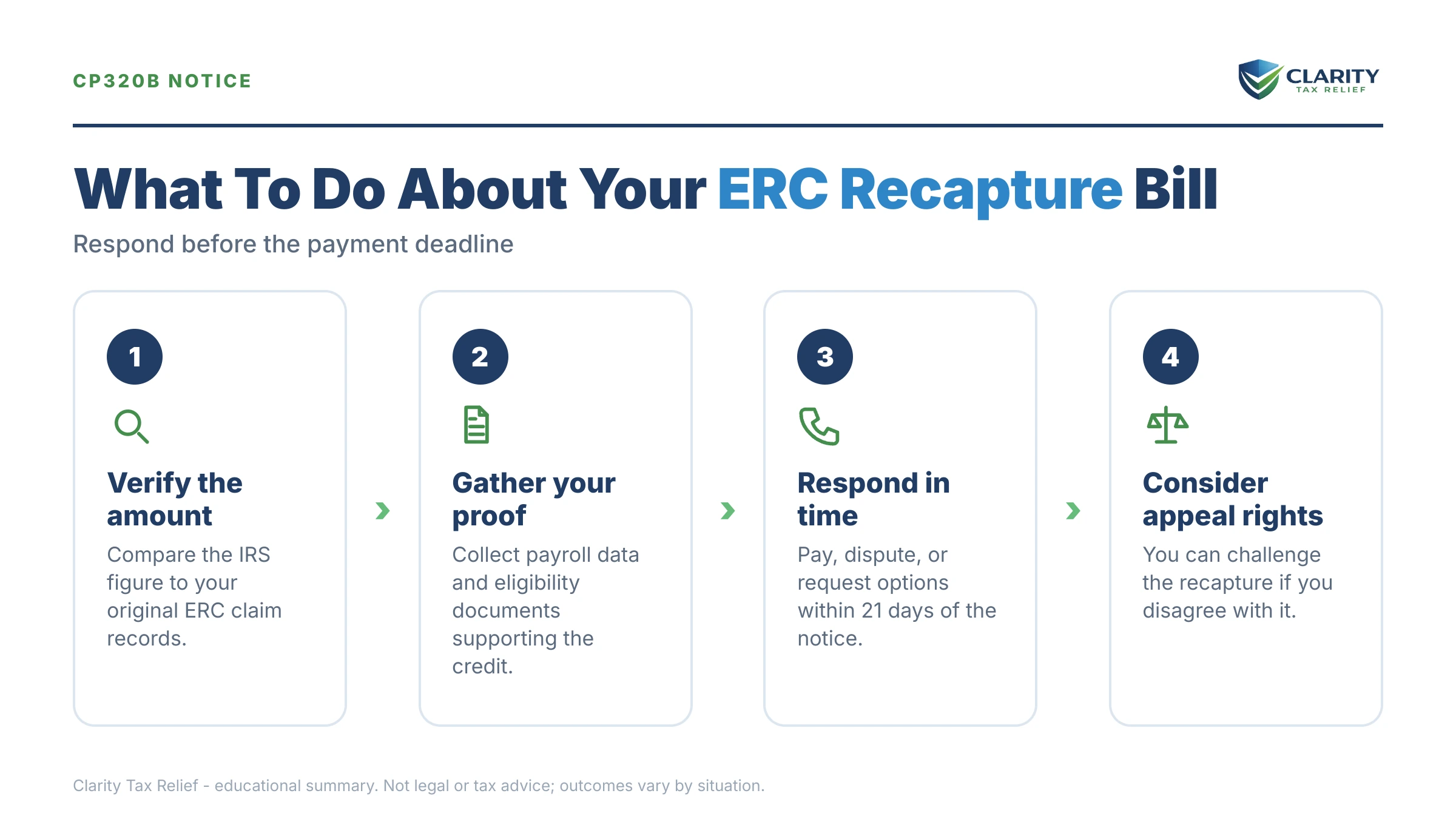
What happens if you ignore a CP320B
Ignoring a CP320B doesn't trigger a levy — it triggers something quieter and, for your refund claim, more final. When the two-year window closes without a signed Form 907 or a filed refund suit, the courthouse door shuts on that claim. Your administrative dispute may still be sitting in the IRS's queue, but you lose the leverage of litigation and, with it, most of your practical ability to force a resolution.
A separate track matters here too. If the IRS also claws back ERC it already paid your business — which arrives via Letter 6577-C or a balance-due notice, not a CP320B — that assessed balance follows the standard business collection sequence, each stage with more power than the last:
- Letter 6577-C or balance-due notice — the assessment and first bill. No enforcement yet, but penalties and interest are running.
- Reminder notices — automated follow-up bills on the business balance, each showing a larger total.
- cp504b notice — the business intent-to-levy notice. The IRS can now take your state tax refund, and a federal tax lien filing becomes a live possibility.
- cp297a notice or Letter 1058 — the final notice of intent to levy. This starts a 30-day clock and your Collection Due Process rights, requested on Form 12153. It is the last structured off-ramp.
- Levy — after the 30 days, the IRS can levy your business bank account (funds are held 21 days before they leave), levy accounts receivable, and file a lien against everything the business owns.
The CP320B track, by contrast, has no enforcement stage at all — its danger is a deadline, not a levy. That's what makes it easy to ignore and expensive to have ignored.
Don't count on IRS staffing problems to buy you time on either track. The workforce shrank roughly 27% in 2025, which makes it harder to reach a human to fix your case — but deadline warnings, collection notices, liens, and levies are generated by automated systems that never stopped running.
| Stage | What it says | What's at stake |
|---|---|---|
| Letter 105-C / 106-C | ERC claim fully or partially disallowed | Starts the two-year window to file a refund suit |
| CP320B | You responded to the disallowance; less than 6 months remain in the suit window | Sign Form 907 (QR code / Document Upload Tool) or file suit before the window expires |
| Window expires | No Form 907 signed, no suit filed | Right to sue for the refund can be lost for good |
| Letter 6577-C / balance-due notice | Separate track: clawback of ERC already paid | Assessed balance; penalties and interest accrue |
| CP504B → CP297A / Letter 1058 → levy | Collection escalation on that separate clawback balance | State refund seizure, lien, then bank and receivables levies after the 30-day CDP window |
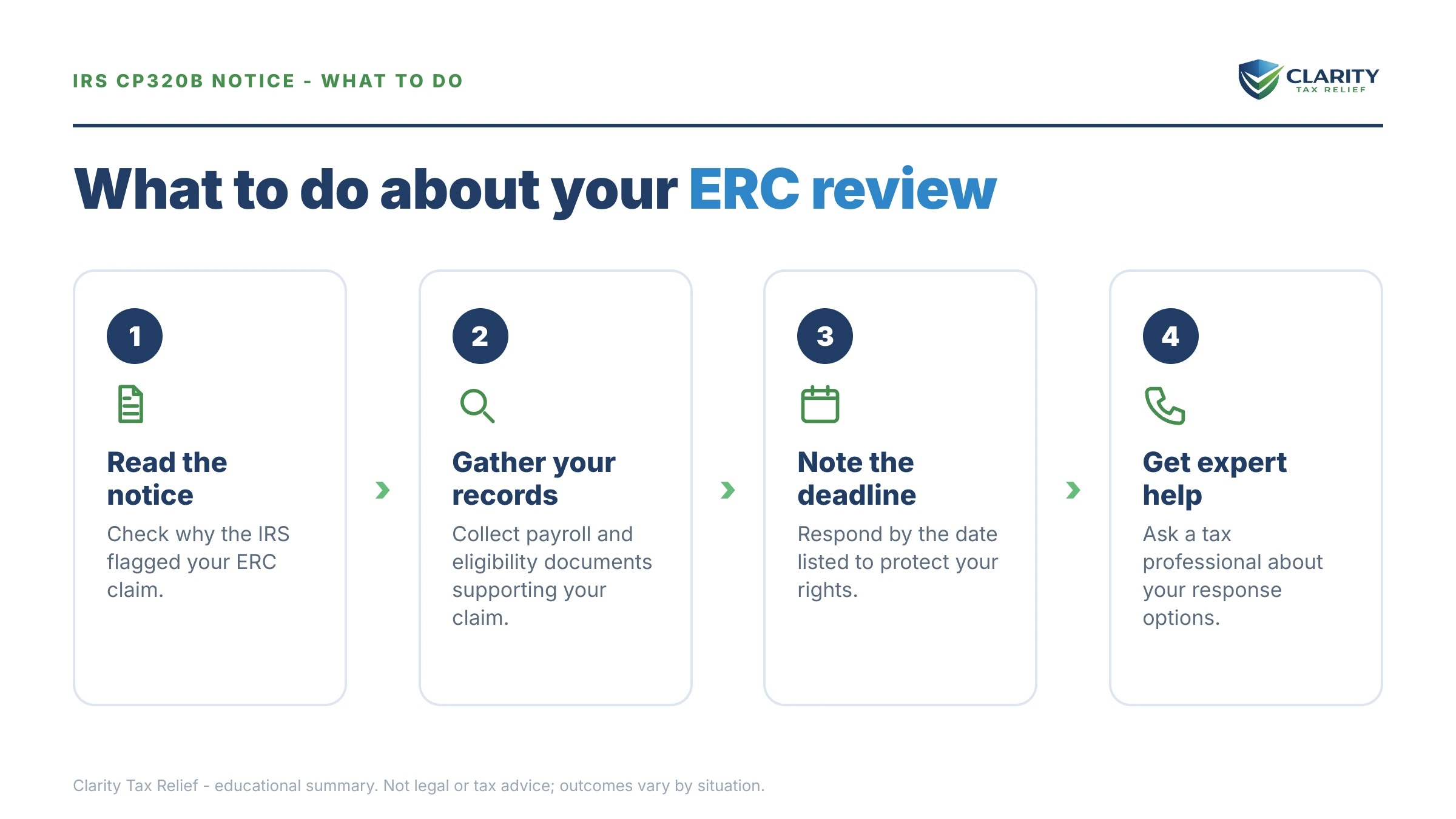
Holding a CP320B right now?
Get it reviewed free before your two-year window runs out. An experienced tax professional will tell you whether signing Form 907 makes sense for your facts, which quarters have a real defense, and whether your dispute is on track.
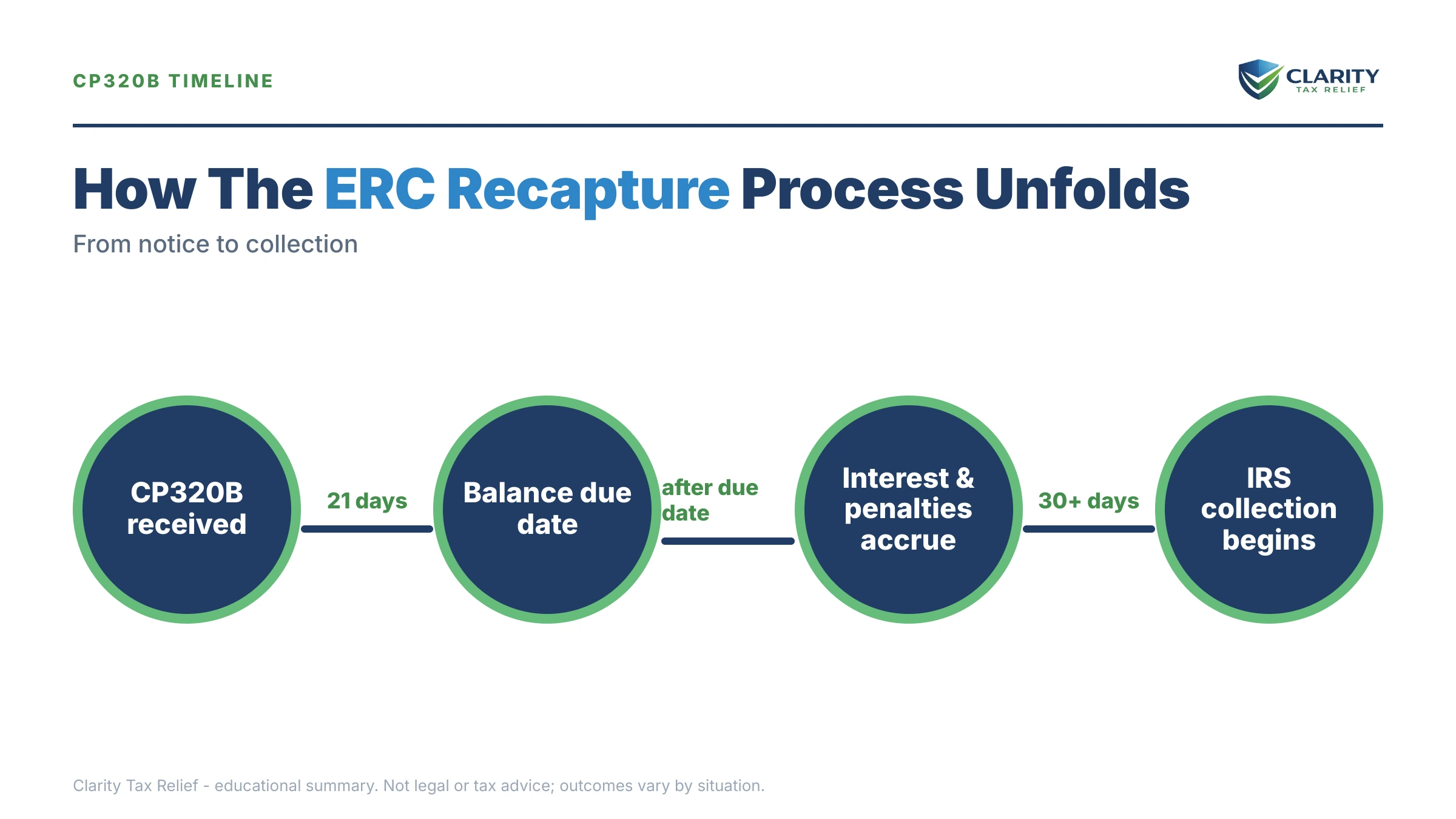
Your options after a CP320B: extend, sue, or let go
A CP320B gives you three lanes — extend the window with Form 907, file a refund suit before it closes, or accept the disallowance — and the first one preserves the other two. Extending costs nothing and closes no doors.
- Sign Form 907. The Agreement to Extend the Time to Bring Suit keeps your refund-suit rights alive while your dispute works through the system. Scan the QR code on your CP320B and submit the signed form through the IRS Document Upload Tool before the window expires.
- Keep working the dispute. With the window extended, your protest or appeal can continue on its merits. If the IRS holds its position, the erc disallowance appeal route is your next move. The broader playbook for a denied claim lives in our erc claim disallowed guide.
- File a refund suit. If Appeals is going nowhere and the deadline is real, a suit in federal district court or the Court of Federal Claims — filed before the two-year window closes — is the option the CP320B exists to protect.
- Accept the disallowance. If you know the claim was aggressive or promoter-inflated, letting the window lapse may be the honest answer — but do it as a decision, not by default, and fix the income-tax side (below) once it's final.
- If you also got a clawback bill. A Letter 6577-C or balance-due notice for ERC already paid is a separate, assessed debt. Payment goes through IRS.gov/payments — never to anyone asking for gift cards or payment apps. A short-term plan gives up to 180 days with a $0 setup fee; longer installment agreements exist for balances you can't clear that fast — see business irs installment agreement for the in-business thresholds and the IRS's own payment plans page for current setup fees. Reasonable-cause penalty abatement — good-faith reliance on a promoter is the classic ERC argument — is requested in writing with Form 843. If repaying would genuinely break the business, Currently Not Collectible status can pause enforcement, and an Offer in Compromise exists for cases where the IRS could never collect the full amount — though offers on business employment-tax debt are rare and strictly reviewed. Our guide to can't repay erc walks through this decision in depth.
One door that has likely closed: the IRS has periodically offered ERC voluntary disclosure terms letting employers repay less than the full credit, but those windows are generally unavailable once a quarter is already in dispute or clawed back. A CP320B usually means you're well past that option for the quarters it covers.
| Option | Upfront cost | What it does / how long it takes |
|---|---|---|
| Sign Form 907 | $0 | Extends the two-year refund-suit window; submit via the notice's QR code and Document Upload Tool before it expires |
| Continue the appeal | $0 to respond | Written dispute with eligibility proof works through Appeals; months, with the extended window protecting your rights |
| File a refund suit | Court filing fees plus legal costs | District court or Court of Federal Claims; must be filed before the two-year window closes |
| Accept the disallowance | $0 | Ends the dispute; amend the income-tax side once the denial is final |
| Payment plan on a separate clawback bill | $0 setup (short-term); fee varies for installment agreements | Up to 180 days short-term; monthly payments longer-term, financials may be required |
| Penalty abatement (Form 843) on a clawback bill | $0 | Removes or reduces penalties for reasonable cause; doesn't touch the credit itself |
| Currently Not Collectible / Offer in Compromise on a clawback bill | $0 with financial disclosure / $205 fee + 20% down (lump-sum); low-income certification waives both | Pauses enforcement during genuine hardship / months to years; rare and strictly reviewed for business employment-tax debt |
How to respond to a CP320B, step by step
- Find the window's end date. Check the date on your Letter 105-C or 106-C — the two-year refund-suit window runs from it, and your CP320B means less than six months remain.
- Decide whether to extend. If your appeal is unresolved or a refund suit is a real possibility, Form 907 preserves the option at no cost — letting the window expire is the only irreversible choice.
- Sign and submit Form 907 before the window expires. Scan the QR code on the notice and upload the signed form through the IRS Document Upload Tool.
- Keep your eligibility proof organized. Gather gross-receipts records and any government orders that suspended your operations for the quarters at issue — the dispute still turns on them.
- Fix the income-tax side. If the disallowance becomes final, amend back the wage-deduction reduction you made when you claimed the ERC.
- Get experienced eyes on anything large or contested. Multiple disallowed quarters, a pending appeal, or a companion clawback bill changes the strategy — have an experienced tax professional review it.
What a $36,900 missed window actually costs
The stakes on a CP320B aren't penalties — they're the refund itself. Here's a clearly hypothetical example with the arithmetic shown.
Say your shop — you rent your apartment and your storefront, and the ERC claim was going to cover back rent and payroll — has $36,900 in disallowed credits across two 2021 quarters: $21,400 for one, $15,500 for the other. Your CP320B says the two-year window has under six months to run.
- Doing nothing: when the window closes with no Form 907 and no suit, the ability to recover that $36,900 in court is gone — the full amount, not a percentage of it, is what expires.
- Signing Form 907: costs $0 and keeps every option open — the appeal, the suit, even a negotiated resolution — while your dispute is decided on its merits.
- A successful partial dispute: if your records prove the $21,400 quarter (a genuine government-order suspension) but not the $15,500 one, you recover $21,400 instead of nothing. Preserving the window is what makes that outcome possible at all.
- The companion risk to watch: if the IRS separately claws back ERC it already paid you — via Letter 6577-C or a balance-due notice — that balance accrues a 0.5%-per-month failure-to-pay penalty plus daily-compounding interest, and in some cases a 20% accuracy-related penalty. On $36,900, that 20% alone would be $36,900 × 0.20 = $7,380.
If you're carrying a clawback balance, you can estimate how fast it's growing with our IRS Penalty & Interest Calculator — it's an estimate, but it makes the cost of waiting concrete.
The income-tax side effect most employers miss
A final ERC disallowance usually creates a refund opportunity on your income-tax returns. When you claimed the credit, the rules required reducing your wage-expense deduction by the ERC amount — which raised your taxable income for those years. If the credit is now denied for good, that deduction reduction can be unwound, and the resulting income-tax refund softens the blow of the lost claim. The mechanics — and the deadlines for claiming it — are covered in our erc recapture guide. Don't leave this money on the table; it's often the single biggest lever after the dispute itself.
When you can handle a CP320B yourself
You don't need professional help for every CP320B. Handle it yourself if the disallowance is clearly correct (you know the claim was aggressive or promoter-inflated) and you've decided not to pursue the refund — or if your dispute is simple, your records are solid, and all you need to do is sign Form 907 through the QR code and Document Upload Tool and keep the appeal moving.
Experienced help changes outcomes in specific situations: multiple disallowed quarters with mixed eligibility facts, a promoter-filed claim where the paper trail needs to be assembled for the dispute, a suit deadline close enough that Form 907 timing is tight, a claim large enough that litigation is a real option to evaluate, a companion clawback bill running on the collection track, or a business whose income-tax returns need coordinated amending. Those cases turn on sequencing — extend the window, work the dispute, fix the income-tax side, then resolve any balance — and getting the order wrong is expensive.
Terms on your notice, decoded
- Two-year suit window: the period after a claim disallowance during which you can file a refund suit in court — the clock your CP320B says is nearly out.
- Form 907: the Agreement to Extend the Time to Bring Suit — the signed agreement that extends the two-year window.
- Document Upload Tool: the IRS's secure online portal, reached via the QR code on your notice, for submitting your signed Form 907.
- Letter 105-C / 106-C: the full and partial disallowance letters that started your two-year window.
- Letter 6577-C: the letter (or a balance-due notice) the IRS uses to claw back ERC it already paid — the bill a CP320B is often mistaken for.
- Form 941-X: the amended payroll return your ERC claim was filed on — the document at the heart of the dispute.
- Collection Due Process (CDP): your right to a hearing before levy on a separate clawback balance, triggered by the final notice and requested on Form 12153 within 30 days.
CP320B notice questions, answered
Is a CP320B notice serious?
Yes — a CP320B means less than six months remain in your two-year window to file a refund suit over a disallowed Employee Retention Credit claim. It is not a bill, and nothing is being collected, but if the window expires without a signed Form 907 or a filed suit, you can lose the right to recover that refund in court.
What is the difference between a CP320B and Letter 105-C?
A Letter 105-C disallows an ERC claim and starts the two-year window to file a refund suit; a CP320B arrives later, telling you that you responded to that disallowance and fewer than six months remain in the window. The 105-C creates the dispute; the CP320B warns that the courthouse deadline is closing and offers Form 907 to extend it. Some employers receive both across different quarters.
Can I still dispute my ERC disallowance after a CP320B?
Yes. The CP320B does not end your dispute — it warns that the litigation window behind it is closing. If your business genuinely qualified, sign Form 907 through the notice's QR code and the Document Upload Tool to extend the window while your appeal continues, or file a refund suit before the deadline. Don't let the window expire while you gather records.
What if an ERC promoter filed the claim for me?
The IRS holds the employer responsible even when a promoter prepared the claim, so the CP320B and the suit deadline are yours to manage. Promoter reliance can support reasonable-cause penalty relief if you are later billed on the claim, so gather the promoter's marketing materials, contract, and fee agreement now. If the promoter charged a percentage of the credit, that contingent fee is worth flagging in any penalty-relief request.
Is a CP320B a bill I have to pay?
No. A CP320B does not demand payment — it is a deadline warning about your right to sue over a disallowed claim. A clawback of ERC the IRS already paid arrives separately, via Letter 6577-C or a balance-due notice. If you receive one of those, the IRS offers a short-term plan of up to 180 days with no setup fee and longer installment agreements for balances you can't clear that fast.
Will I owe penalties because of a CP320B?
Not from the CP320B itself — it assesses nothing. Penalties attach to a separate clawback of paid ERC (Letter 6577-C or a balance-due notice): expect the 0.5%-per-month failure-to-pay penalty plus daily-compounding interest, and in some cases a 20% accuracy-related penalty. Penalty relief is realistic if you relied in good faith on a preparer or promoter — request it in writing with Form 843 rather than assuming the penalties are final.
How long does the IRS have to take back an ERC refund?
Longer than the normal three years for some quarters. Under the July 2025 One Big Beautiful Bill Act, the IRS now has six years — measured from the latest of the return's filing date, its deemed-filed date, or the date the refund claim was filed — to assess ERC adjustments for Q3–Q4 2021; earlier quarters keep the normal three-year window. If a notice covers a quarter you believe is outside the assessment window, that is a defense worth raising before you pay anything.
Your next 24 hours
- Find the two things that control everything: the date on your Letter 105-C or 106-C (the two-year window runs from it) and the QR code on your CP320B that leads to Form 907 and the Document Upload Tool.
- Gather the ERC paper trail: your Form 941-X filings, the promoter or preparer contract and worksheets, gross-receipts records for the quarters at issue, and any government orders that affected your operations.
- Get a free case review before your window runs out: call (888) 825-7779 or use the 2-minute form. We'll tell you whether Form 907 fits your facts, which quarters are worth fighting for, and what your dispute is realistically worth — free, confidential, no pressure.
For background on the credit itself and the IRS's current compliance posture, the primary source is the IRS's Employee Retention Credit page. If the IRS's own delay is causing you demonstrable harm — an appeal sitting unanswered while your suit window closes, or a levy threatening payroll on a separate clawback balance — the Taxpayer Advocate Service can intervene.
This guide is general information, not tax or legal advice for your specific situation. Eligibility for IRS programs depends on individual facts and circumstances; no outcome is guaranteed.