
Dealing With the IRS
Can't Reach the IRS on the Phone? Every Way Through (and Around) the Wait in 2026
The short answer: if you can't reach the IRS on the phone, it's because the agency cut roughly 27% of its staff in 2025 and service never recovered. Call the exact line for your issue at 7 a.m. local time — or skip the phone: your IRS online account handles balances, transcripts, and payment plans on debts up to $50,000.
You've dialed 800-829-1040 four times this week. You held for over an hour, got transferred, and the line went dead. Meanwhile the notice on your kitchen table says you owe $23,800, and Social Security is your only income. Here's the part the recording never tells you: most of what you'd ask a phone assistor to do, you can do without the phone at all — and this guide walks through every route, in order of speed.
⏱ The real clock: there is no phone-related deadline — but the dates printed on your notices don't pause while you're on hold. Interest and a monthly failure-to-pay penalty keep posting to your balance, and any response window on a notice (like the 30 days on a final levy notice) runs whether or not you ever reach a human.
Why you can't reach the IRS on the phone in 2026
The IRS cut roughly 27% of its workforce in 2025, and its phone lines have not recovered. Fewer assistors are answering the same flood of calls, so hold times stretch, transfers dead-end, and on the busiest days the system hangs up on callers before they ever enter the queue — the infamous "courtesy disconnect."
Here's what makes that dangerous instead of merely annoying: the humans were cut, but the computers weren't. Notices, liens, and levies are generated by automated systems that never call in sick. As we cover in whether you still owe when the IRS is understaffed, the collection machine runs at full speed while the help desk runs at a fraction of it.
So the question isn't really "how do I get a human on the line?" It's "how do I resolve my issue before the machine takes the next step?" Sometimes that means calling smarter. More often it means not calling at all. (For the raw numbers on how few calls get answered, see our breakdown of IRS answered calls and wait times.)
What happens if you stop trying: a busy signal doesn't pause collections
IRS collection notices escalate on an automated schedule whether or not you ever speak to anyone. If you owe money and give up after a week of redialing, this is the sequence already queued up behind your last letter:
- CP14 — the first bill. No enforcement yet, but interest and the failure-to-pay penalty are already accruing monthly.
- CP501 / CP503 — automated reminders. Each one arrives with a larger balance than the last.
- CP504 — Notice of Intent to Levy. The IRS can now take your state tax refund, and a federal tax lien becomes a live possibility.
- LT11 / Letter 1058 — the final notice. A 30-day clock starts on your Collection Due Process rights (requested on Form 12153). After it runs, levies can begin.
- Levy — a bank levy freezes funds for a 21-day hold before they're sent to the IRS; a wage levy is continuous; and Social Security benefits can be reduced by up to 15% under the Federal Payment Levy Program.
That last stage is the one that matters most if you're retired: the IRS can take up to 15% of a Social Security check through an automated program — no phone call, no human review of your grocery budget. Every notice you can't discuss by phone can still be answered in writing or online, and doing so stops this sequence cold.
Owe the IRS and can't get anyone on the line?
Your balance grows every month while you redial. Send us your latest notice and an experienced tax professional will map exactly where you stand and which fix fits — free, confidential, no hold music.
The IRS phone numbers that matter — and when each is worth dialing
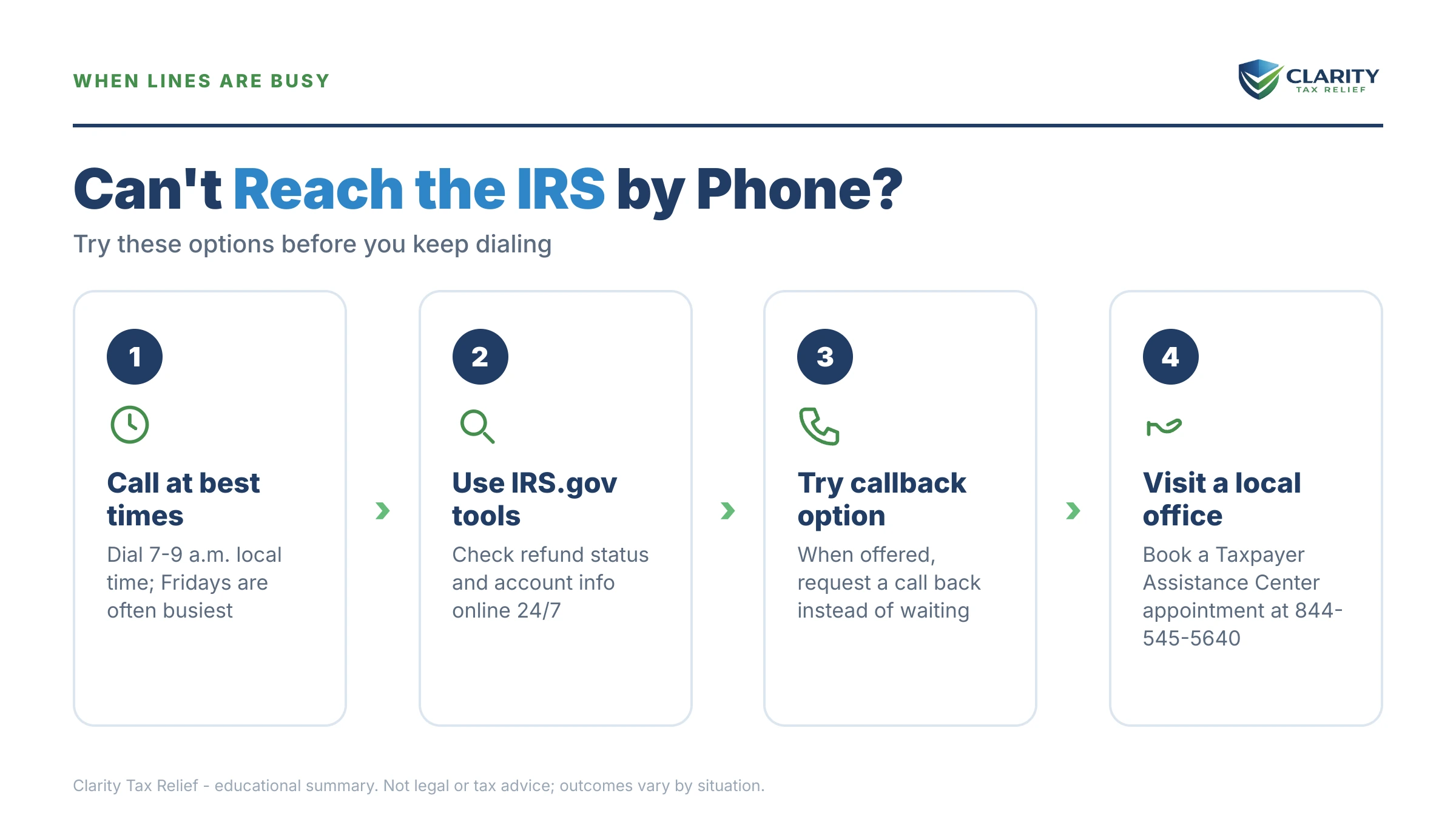
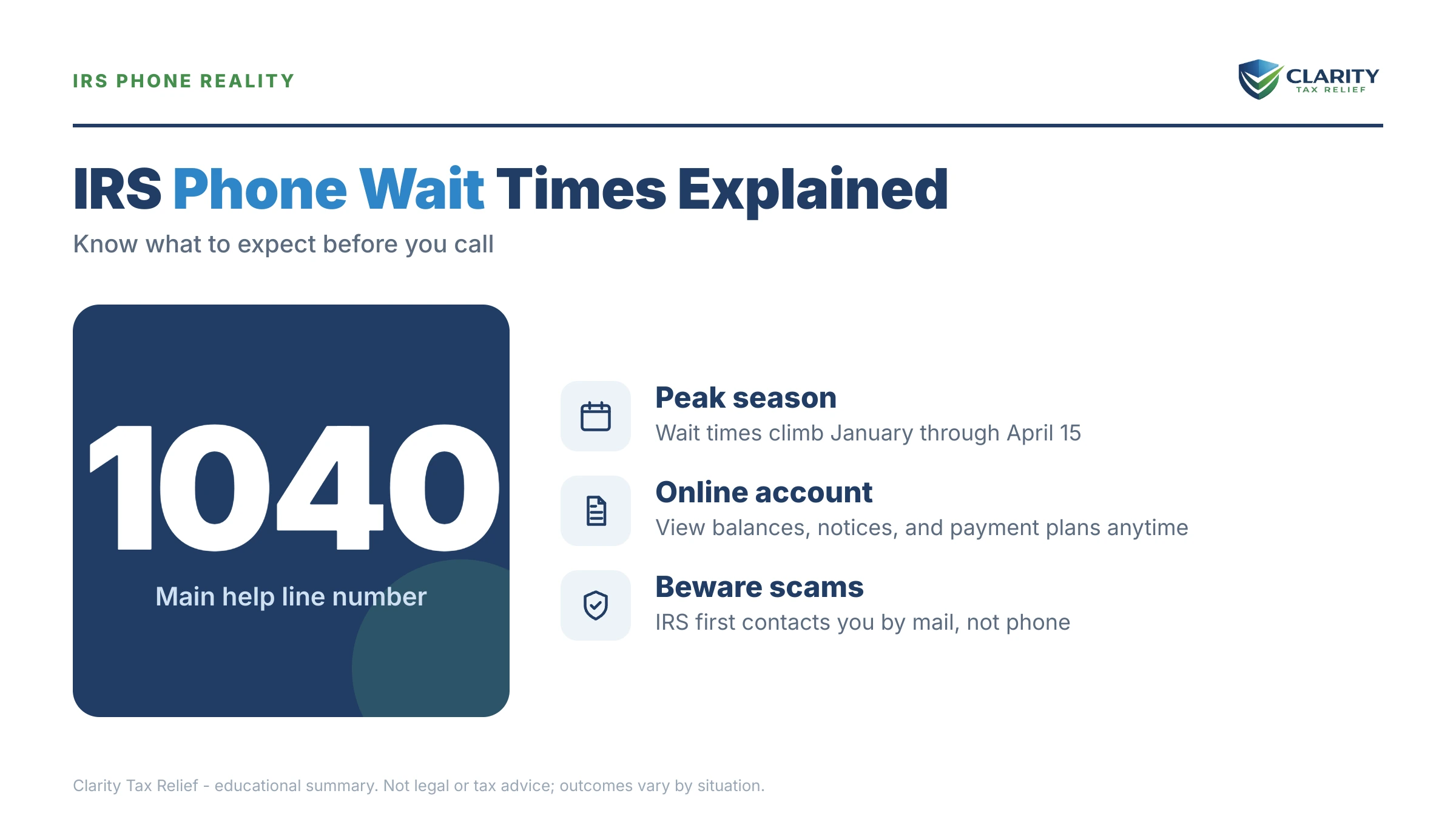
The main IRS line for individuals is 800-829-1040, open 7 a.m. to 7 p.m. local time, Monday through Friday. Most callers dial that one number for everything — which is exactly why it's the most jammed. Several issues have their own direct line, and a few are fully automated (no hold at all):
| Line | Number | What it handles |
|---|---|---|
| Individuals (main line) | 800-829-1040 | Balances, notices, payment plans, account questions — live assistor |
| Businesses | 800-829-4933 | Payroll, EIN, and business account issues — live assistor |
| Refund hotline | 800-829-1954 | Refund status — automated, no hold |
| Amended return status | 866-464-2050 | Form 1040-X status — automated, no hold |
| Treasury Offset Program | 800-304-3107 | Whether your refund will be taken for another debt — automated |
| Taxpayer Advocate Service | 877-777-4778 | Hardship cases and stalled problems the normal channels can't fix |
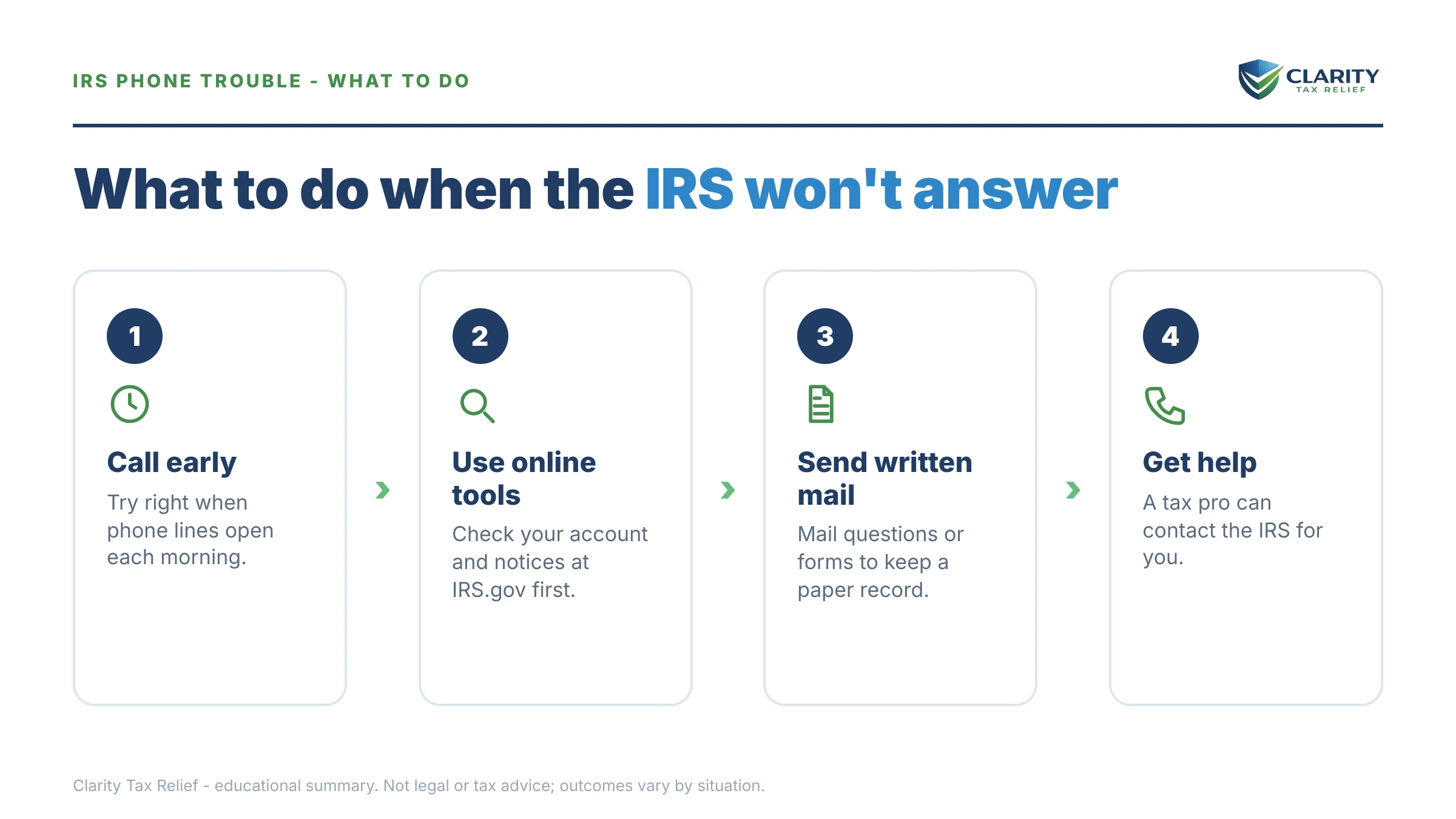
If you must reach a live person, timing is most of the battle. Call the moment the line opens at 7 a.m. your local time — the first hour is typically the least crowded — and avoid Monday mornings and the days around filing deadlines. When call volume is heavy, some lines offer to hold your place and call you back; take it if offered, but don't count on it appearing.
One more rule: never burn a successful connection by being unprepared. Have your Social Security number, the notice you're calling about, and your last filed return in front of you before you dial. Our guide to what to say when calling the IRS about back taxes gives you word-for-word scripts so one call finishes the job.
How to get through to the IRS without the phone at all
You can set up an IRS payment plan of up to 72 months entirely online if you owe $50,000 or less in combined tax, penalties, and interest — no phone call, no hold, and approval is typically immediate. That single fact resolves the most common reason people are dialing in the first place. Here's the full menu of no-phone channels:
| What you need | No-phone channel | Limit / eligibility | Typical timeline |
|---|---|---|---|
| See your balance, notices & transcripts | IRS online account | Anyone who can verify identity via ID.me | Instant once set up |
| Pay in full or make a payment | IRS Direct Pay / online account | Any amount | Same day |
| Short-term payment plan | Online payment plan tool | Up to 180 days to pay; $0 setup fee | Immediate online approval |
| Long-term installment agreement | Online payment plan tool | ≤ $50,000 combined; up to 72 months | Immediate online approval |
| Dispute a notice / protect appeal rights | Written response by certified mail | Must be postmarked by the notice's date (e.g., Form 12153 within 30 days of an LT11) | Rights preserved on mailing; IRS reply can take months |
| Let someone act or speak for you | Form 2848 (act) or Form 8821 (information only) | Any taxpayer; representative must be eligible to practice | Days to process; pro can then use the practitioner line |
| Emergency intervention (hardship, levy) | Taxpayer Advocate Service, Form 911 | Economic hardship or a problem normal channels won't fix | Case assignment typically within days to weeks |
Start with the account itself — our IRS online account setup walkthrough covers the ID.me identity hurdle that trips up most first-timers. Once you're in, you can see the exact balance the IRS sees, download every notice, and set up an IRS payment plan online in about fifteen minutes.
Two things the phone genuinely does better: fixing misapplied payments and negotiating anything nonstandard (a partial-pay agreement, hardship status, a levy release). For everything else — including comparing the best way to pay the IRS for your situation, or the full do-it-yourself playbook in our guide to how to settle tax debt yourself — the website beats the queue.
A worked example: $23,800, Social Security income, and a phone that won't answer
Say you're retired, you owe $23,800 from a year when a pension withdrawal wasn't fully withheld, and you've spent two weeks failing to reach a human. Here's the math on your realistic paths — no phone required for any of them:
- Online installment agreement: $23,800 is well under the $50,000 online ceiling. Spread over the maximum 72 months, that's $23,800 ÷ 72 ≈ $331 a month before interest — and because interest and the 0.5% monthly failure-to-pay penalty keep accruing on the shrinking balance, paying a little more than the minimum shortens the plan meaningfully. You could log in tonight and have it approved before bed.
- The cost of waiting instead: the failure-to-pay penalty alone is 0.5% of $23,800 — about $119 a month — plus interest on top. Six months of redialing without acting costs you roughly $700 in penalties before interest, and moves you two notices deeper into the escalation sequence. You can estimate your own accrual with our IRS Penalty & Interest Calculator.
- The do-nothing endpoint: if the sequence runs to levy and your Social Security benefit is $1,900 a month, the Federal Payment Levy Program can take up to 15% — about $285 a month — automatically, until the debt is resolved.
- If even $331 a month is genuinely impossible: when your income barely covers necessary living expenses, Currently Not Collectible status can pause collection entirely. The debt (and interest) remains, but levies stop. That path usually requires a financial statement and, yes, often a phone call or professional help — see IRS hardship while on Social Security for how the fixed-income version works.
This example is hypothetical, but the arithmetic is the point: the gap between acting online tonight and redialing for six more months is measured in hundreds of dollars and one levy notice.
When to escalate: the Taxpayer Advocate Service and other real levers
The Taxpayer Advocate Service (TAS) is an independent organization inside the IRS that intervenes when normal channels fail or a hardship is imminent. It's not a faster customer-service line for routine questions — it's for cases like a levy about to hit the account your rent comes from, a refund stuck for months with bills unpaid, or an IRS error nobody will fix.
You reach TAS by phone at 877-777-4778 or by filing Form 911 — our Form 911 walkthrough shows exactly how to state a hardship so the case gets picked up. TAS is free, and its official site is taxpayeradvocate.irs.gov.
Two other levers people forget. First, your congressional representative's office has caseworkers who handle constituent IRS problems and can prompt a response when nothing else does. Second, a representative you authorize on Form 2848 can call the Practitioner Priority Service — a dedicated line for credentialed practitioners with typically far shorter waits than the public queue. Our Form 2848 power of attorney walkthrough explains what the form does and doesn't authorize.
How to respond when you can't get through, step by step
- Check your online account first. Balances, notices, transcripts, and payment plans on debts up to $50,000 are all handled at IRS.gov without a call.
- Call the right line at 7 a.m. local time. Use the direct number for your specific issue from the table above; the first hour after the lines open is typically the least crowded.
- Prepare before you dial. Have your Social Security number, the notice, and your last filed return in front of you so one call finishes the job.
- Put anything deadline-critical in writing. Mail your response by certified mail before the date printed on the notice; a timely written response preserves your rights even if you never reach a human.
- Escalate if you're stuck. File Form 911 with the Taxpayer Advocate Service for hardship or long delays, or authorize an experienced tax professional on Form 2848 who can use the Practitioner Priority Service.
When you can handle this yourself — and when the phone problem is worth outsourcing
Be honest with yourself about which situation you're in. You do not need professional help if your question is a balance check, a refund status, or setting up a straightforward payment plan under $50,000 — the online account does all of that faster than any phone call, professional or otherwise. The same goes for paying a bill you agree with; every payment method works without a human.
Experienced help changes the outcome when the phone is the actual bottleneck to something time-sensitive: a levy already in motion, a misapplied payment the automated system keeps re-billing, multiple unfiled years that block every resolution program, or a hardship case (like living on Social Security alone) where the difference between a payment plan and Currently Not Collectible status comes down to how your financial statement is presented. In those cases, a representative with Practitioner Priority Service access and Form 2848 authority isn't buying convenience — they're buying weeks of time your deadlines don't have. What that costs and what to ask first is covered honestly in our free consultation.
Terms you'll keep hearing, decoded
- ACS (Automated Collection System): the computer-driven IRS collection operation that sends notices and issues levies without a human assigned to your case.
- Courtesy disconnect: the IRS system hanging up on you before you enter the hold queue because call volume is too high — it's them, not your phone.
- Practitioner Priority Service (PPS): a dedicated IRS phone line for credentialed representatives, with typically much shorter waits than the public lines.
- Taxpayer Advocate Service (TAS): the independent organization inside the IRS that intervenes in hardship cases and stalled problems, reached via Form 911.
- Collection Due Process (CDP): your formal right to a hearing before levy after a final notice, requested on Form 12153 within 30 days — by mail, no phone needed.
Can't-reach-the-IRS questions, answered
Why is it so hard to reach the IRS on the phone in 2026?
The IRS lost roughly 27% of its workforce in 2025, and phone staffing took some of the deepest cuts. Fewer assistors answer the same call volume, so hold times stretch and high-volume lines disconnect callers before they ever reach a human. The automated systems that send notices and issue levies were not cut, which is why collection keeps moving even when nobody picks up.
What is the best time to call the IRS?
The main lines open at 7 a.m. your local time, Monday through Friday, and the first hour is typically the least crowded. Midday Mondays and the days around a filing deadline are typically the worst. Calling the moment the line opens, midweek, gives you the best realistic odds — and have your SSN, the notice, and your last return in hand so you aren't sent back into the queue.
Does the IRS offer a callback instead of holding?
On some lines, when projected hold times run long, the system offers to hold your place and call you back — accept it if it's offered. It isn't available on every line or every call, so don't build your plan around it. If no callback is offered, your IRS online account handles most balance, transcript, and payment-plan tasks without any phone call at all.
Can I set up a payment plan without calling the IRS?
Yes. If you owe $50,000 or less in combined tax, penalties, and interest, you can set up a long-term installment agreement of up to 72 months entirely online through your IRS account. A short-term plan of up to 180 days carries a $0 setup fee. Online approval is typically immediate — no hold music involved.
Does being unable to reach the IRS extend my deadline?
No. The response date printed on a notice stands whether or not you ever reach a human. If a deadline is approaching, respond in writing by certified mail before the date — a timely written response preserves the same rights a phone call would, including the right to request a Collection Due Process hearing on a final levy notice.
Can someone call the IRS on my behalf?
Yes, if you authorize them. Form 2848 (power of attorney) lets an experienced tax professional speak and act for you; Form 8821 lets someone receive your account information only. Credentialed practitioners also use the Practitioner Priority Service, a dedicated line that typically carries materially shorter waits than the general public queue.
What if I'm facing a levy and can't get through to anyone?
Don't wait on hold while the clock runs. If a levy is creating or about to create economic hardship, the Taxpayer Advocate Service can intervene — file Form 911 or call 877-777-4778. And if you received an LT11 or Letter 1058, mailing Form 12153 within the 30-day window protects your Collection Due Process rights while your hearing request is pending.
How do I know a call or message claiming to be the IRS is real?
The IRS almost never initiates contact by phone, and never by text, email, or social media — real tax problems arrive by postal mail first. Anyone demanding immediate payment by gift card, wire transfer, or payment app is a scammer, not the IRS. Verify any claimed balance yourself by logging into your account at IRS.gov before paying anyone anything.
Your next 24 hours
- Find the response date and amount on your most recent IRS notice. That date — not your call log — is the deadline that matters. Write both down.
- Gather three things: the notice, your last filed tax return, and your income information (for a retiree, the SSA-1099 and any pension statements). Then create or log into your IRS online account to confirm the balance — and, if it fits, resolve it right there at IRS.gov/payments.
- If the online tools don't fit your situation — a levy is moving, a payment was misapplied, or the numbers just don't work on your income — get a free case review at the 2-minute form or (888) 825-7779. Your balance accrues penalties and interest every month it sits; the review costs nothing.
This guide is general information, not tax or legal advice for your specific situation. Eligibility for IRS programs depends on individual facts and circumstances; no outcome is guaranteed.