
California Tax Audits
EDD Audit in 2026: What Triggers It, the ABC Test, and How to Respond
The short answer: an EDD audit is a California payroll tax examination — usually testing whether workers you paid on 1099s should have been W-2 employees under the ABC test. It typically covers the last 12 calendar quarters and ends in a Notice of Assessment you can generally appeal within 30 days.
One of your former installers, drivers, or stylists filed for unemployment, and now a letter from the Employment Development Department wants three years of payroll records and an "entrance interview." That's how most EDD audits start — and it lands hard when you have a real payroll to run. The outcome, though, is mostly decided by preparation, and the preparation is still entirely in your hands.
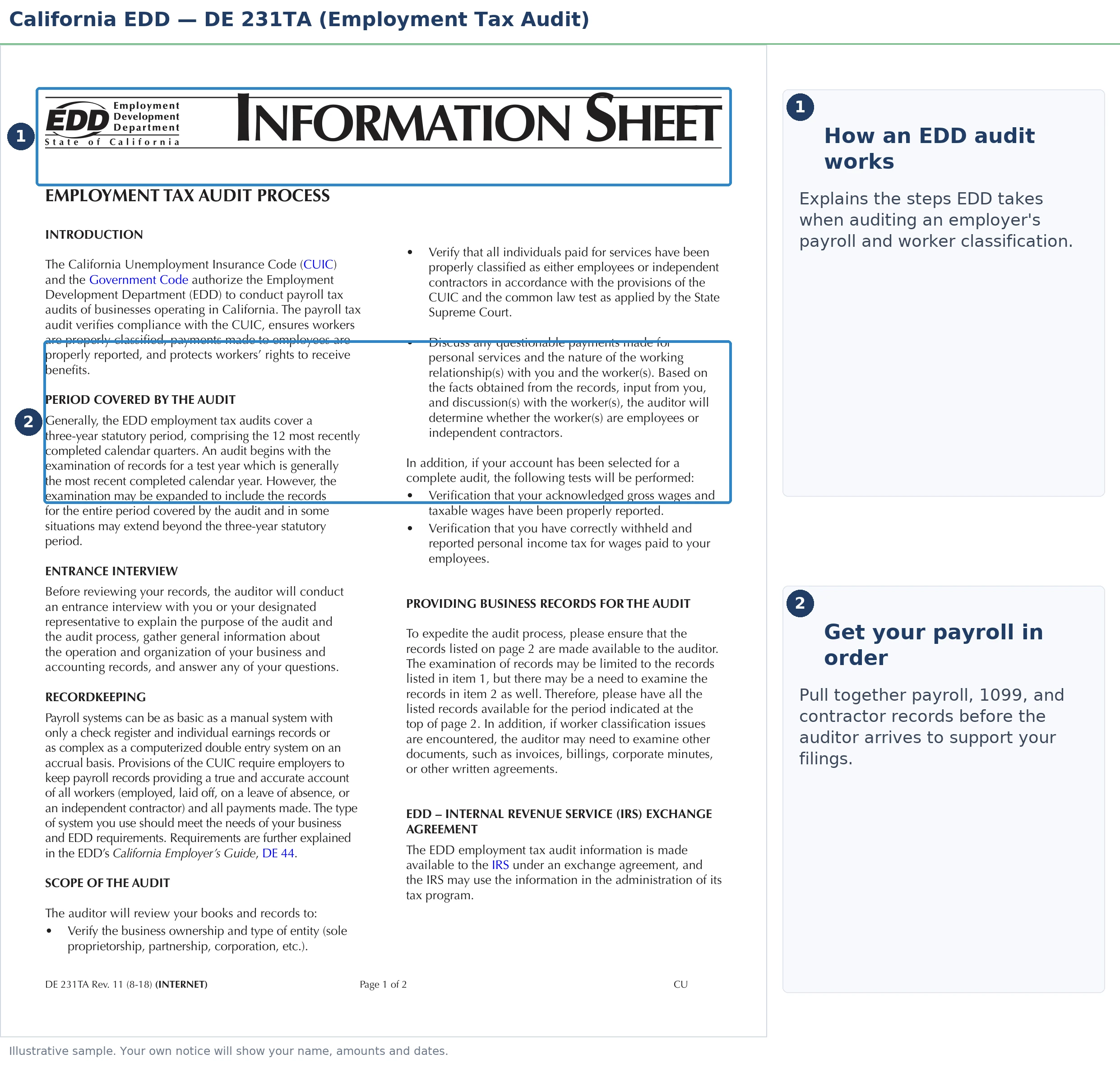
Two things on that letter control everything else: the quarters under examination and your response or appointment date. The image below shows exactly what EDD audit paperwork looks like and where to find both before you touch a single record.
⏱ Your deadlines: respond by the appointment or response date printed on your audit letter — silence invites an estimated assessment. If the audit ends in a Notice of Assessment, you generally have 30 days from the notice date to file a petition with the California Unemployment Insurance Appeals Board (CUIAB). Miss that window and the assessment becomes final and collectible.
Why you got an EDD audit letter
Most EDD audits begin when a worker you paid on a 1099 files an unemployment claim and the EDD finds no reported wages under your employer account. A single unemployment claim from one 1099 worker is the number-one trigger of EDD audits — the claim can't be processed against zero wages, so it routes straight to the audit unit, and the exam that follows covers all your workers, not just the one who filed.
Other common triggers for a California EDD audit:
- Reporting mismatches — heavy 1099 volume with a thin or nonexistent payroll account, or independent-contractor reports that don't line up with your quarterly filings.
- Worker complaints — a contractor who believes they were really an employee can file with the EDD or the Labor Commissioner, and either can spark the audit. (If that's your worker's angle federally, see our guide to being paid on 1099 but treated like an employee (SS-8).)
- Agency data sharing — the EDD exchanges information with the IRS, the FTB, and the CDTFA, so an exam by one agency can seed an exam by another.
- Industry sweeps — construction, salons, restaurants, trucking, janitorial, and delivery businesses see targeted classification enforcement.
- Random verification audits — a small share of EDD audits have no trigger at all. If your classifications hold up, these close quickly.
An EDD audit is not the IRS, and the rules differ in ways that matter — federal audit reach is covered separately in how far back can the IRS audit. This page is about California's version, which in 2026 is often the more aggressive of the two.
What an EDD payroll tax audit actually examines
An EDD audit tests four California payroll taxes — unemployment insurance (UI), employment training tax (ETT), state disability insurance (SDI), and personal income tax (PIT) withholding — across the 12 most recent completed calendar quarters. If you never registered as an employer or never filed the required quarterly returns, the reach typically extends to as many as eight years, and there is no practical limit where the EDD finds fraud.
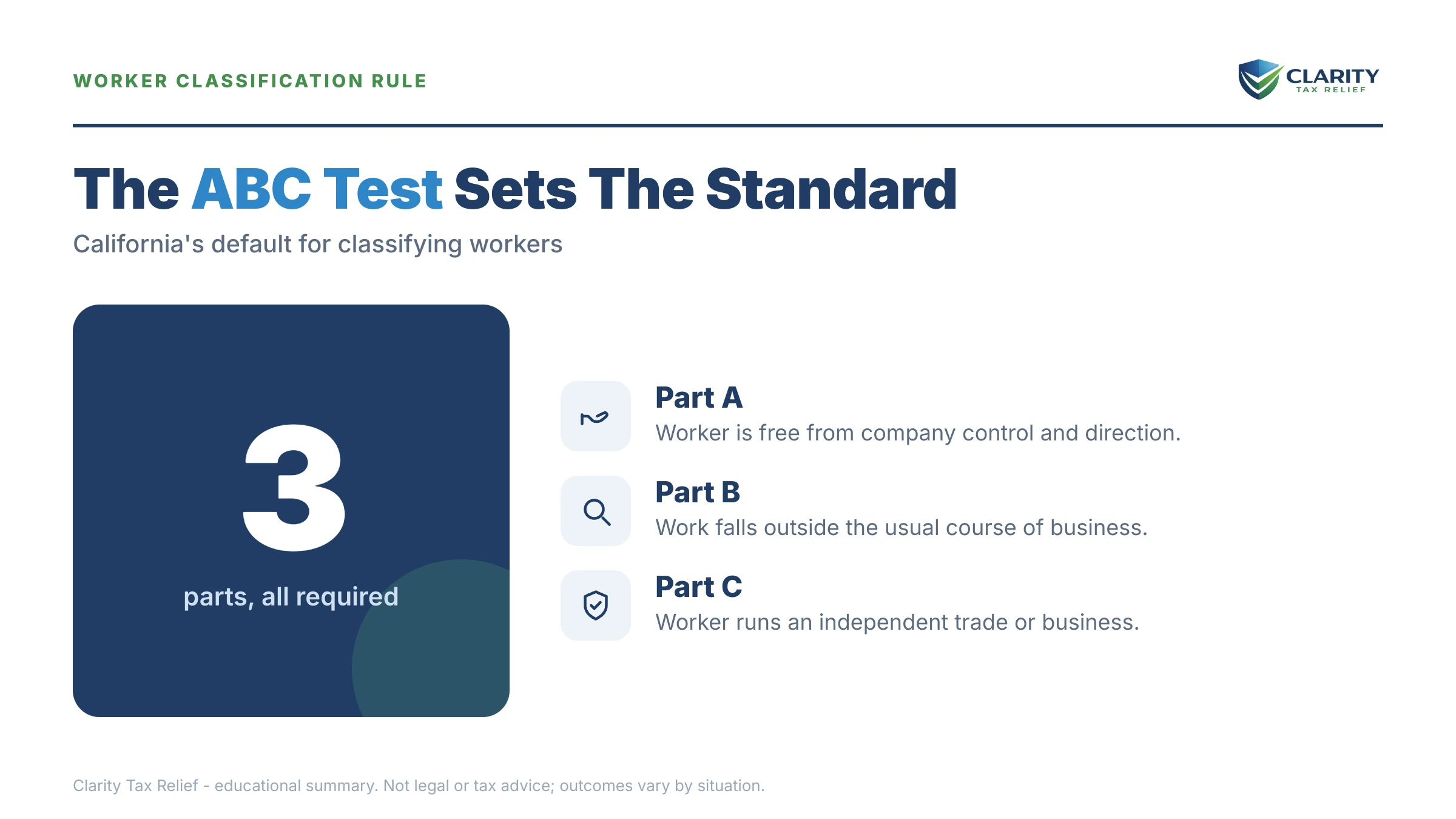
The core question is almost always classification: were the people you paid on 1099s actually employees under California law? Since 2020, Assembly Bill 5 makes the ABC test the default — a worker is an independent contractor only if all three prongs are satisfied. Certain occupations and bona fide business-to-business relationships are carved out and judged under the older, multi-factor Borello test instead, but for most small businesses, ABC is the battlefield.
| Prong | What the EDD is asking | Evidence that helps you |
|---|---|---|
| A — Control | Is the worker free from your control and direction — in the contract and in day-to-day reality? | Worker sets their own hours and methods; no training, scripts, or supervision; the written contract matches actual practice |
| B — Usual course of business | Is the work outside the usual course of your business? | Your invoices and marketing show a different core business; the worker's service is genuinely peripheral (a plumber fixing a bakery's sink, not a baker) |
| C — Independent business | Is the worker customarily engaged in an independently established trade of the same nature? | The worker's own business license, insurance, tools, advertising, invoices, and other clients |
In practice, prong B decides most cases. A drywall crew working for a drywall contractor, a stylist renting no chair in a salon, a driver delivering for a delivery company — each performs the hiring business's core work, and no contract language fixes that. Auditors read your website and your invoices to define your "usual course of business" before they ever read your agreements.
Expect the auditor to request bank statements, check registers, general ledgers, 1099s and W-2s, your DE 9 and DE 9C quarterly filings, contracts, and workers' compensation records. They will also mail questionnaires directly to your current and former workers — and worker answers about who set the schedule and who supplied the tools often outweigh everything in your file. If a meaningful share of your revenue or payments moved in cash, the exam gets more forensic; the dynamics resemble a cash business audit, where bank-deposit analysis fills the gaps your records leave.
How an EDD audit unfolds, stage by stage
An EDD employment tax audit moves through five stages: opening letter, entrance interview, records examination, proposed assessment, and Notice of Assessment.
- Opening letter. Usually an audit appointment letter or records inquiry, often with a pre-audit questionnaire attached. The quarters listed here define your exposure.
- Entrance interview. The auditor asks how the business operates, who does what, and how workers are paid. Casual answers here — "oh, they're basically part of the team" — do more damage than any document.
- Records examination. The auditor traces payments through your bank records and ledgers, matches them to 1099s, and sends worker questionnaires. Payments you can't explain tend to be treated as wages.
- Proposed assessment and exit conference. Before anything is final, you see the proposed numbers and can challenge classifications, math, and penalty treatment. This is also where you raise the PIT offset (more below).
- Notice of Assessment. The formal bill for tax, penalties, and interest — and the start of your appeal clock. We break down that document line by line in our EDD Notice of Assessment guide.
One wrinkle worth knowing before it comes up: if the audit runs long, the auditor may ask you to sign a waiver extending the assessment deadline. The calculus mirrors the IRS's Form 872 decision — refusing usually triggers an immediate protective assessment, estimated high, which is generally worse than more time.
What happens if you ignore an EDD audit
Ignoring an EDD audit leads to an estimated assessment, a final bill, a state tax lien, and — for many owners — personal liability under CUIC section 1735. The sequence is procedural, and each stage removes options the previous stage still offered:
- You skip the records request or interview. The auditor doesn't close the file — they estimate. Using your 1099 filings, bank data, and worker statements, the EDD assumes every payment it can see (and some it infers) was wages. Estimated assessments almost always exceed what a documented audit would have produced.
- A Notice of Assessment issues. Tax, penalties, and interest are now on paper. You generally have 30 days to petition the CUIAB; do nothing and the number — however inflated — becomes final.
- The assessment goes final and collections begin. The EDD can record a state tax lien against your business, levy bank accounts, and intercept receivables. Interest keeps compounding through all of it.
- The business can't pay or shuts down. The EDD pivots to CUIC §1735 and personally assesses the owners, officers, or other responsible people who willfully let the taxes go unpaid. Dissolving the entity does not dissolve this — the full picture is in our guide to California EDD payroll tax debt.
- The results travel. The EDD shares its findings with the IRS, FTB, and CDTFA. A reclassification here can seed a federal worker classification exam and, for retail or food businesses, a CDTFA sales tax audit — the same three years, examined twice more.
Facing an EDD audit or holding a Notice of Assessment?
Send us the letter. An experienced tax professional will map your ABC-test exposure and your options — free and confidential — before your appointment date or the 30-day petition window closes.
Your options after an EDD audit assessment
After an EDD audit, you have six realistic paths: pay in full, petition the CUIAB, an installment agreement, the Settlement Program, an Offer in Compromise, or a PIT offset that shrinks the bill itself. Which ones are open depends on where you are in the process and whether the business is still operating.
| Option | Who it fits | The tradeoff |
|---|---|---|
| Pay in full | The assessment is correct and affordable | Stops interest immediately; you can still pursue a refund claim if you later prove the assessment was wrong |
| CUIAB petition | Filed within roughly 30 days of the Notice of Assessment; genuine ABC-test or math disputes | Collection generally pauses on timely-petitioned amounts, but interest keeps accruing while you fight |
| EDD installment agreement | Operating business that can't pay at once but can pay monthly | Interest continues; a missed payment can revive enforcement — see our EDD payment plan guide |
| EDD Settlement Program | Cases in active appeal where the EDD's position carries real litigation risk | Requires a credible legal argument, not just inability to pay |
| EDD Offer in Compromise | Generally closed or inactive businesses whose owners have no realistic ability to pay in full | Strict, means-tested eligibility; assets and income are scrutinized |
| PIT offset | Workers who reported the 1099 income and paid their California income tax on it | Reduces only the PIT portion of the assessment, and you need documentation from the workers |
Two of these deserve emphasis. First, the PIT offset: a big slice of most classification assessments is income tax the EDD says you should have withheld. If your workers already reported that income and paid California tax on it, that slice can often be reduced or removed with proof — and auditors don't always volunteer this. Ask, in writing, at the exit conference. Second, the Settlement Program only exists inside an appeal — which means a timely CUIAB petition isn't just a dispute mechanism, it's the key that unlocks negotiation. Filing on time preserves leverage even if you ultimately expect to pay.
Say you owe the EDD $16,400: the math, worked
Say you run a flooring company with four W-2 employees, and an EDD audit reclassifies three 1099 installers across 12 quarters. The Notice of Assessment reads $16,400 — hypothetically: about $4,100 in UI and ETT, $3,300 in SDI, $6,000 in PIT the EDD says you should have withheld, $2,000 in penalties, and $1,000 in interest.
Your realistic moves, priced out:
- Installment agreement: $16,400 over 24 months is roughly $683 a month before continuing interest — survivable for an operating shop, but that's $683 of margin gone for two years.
- PIT offset: if all three installers filed California returns reporting the 1099 income, much of the $6,000 PIT portion may come off with documentation. That alone could pull the bill toward $10,000–$11,000 before you've argued a single classification.
- Targeted petition: suppose one installer has his own contractor's license, insurance, truck, and three other builder clients — a genuine prong-C independent business who also arguably clears prong B. Knocking out one of three workers removes roughly a third of the underlying tax, plus its share of penalties and interest.
Stack the offset and a partially successful appeal and this hypothetical $16,400 case can land in the mid four figures — not because anyone "settled for a fraction," but because the original assessment charged tax that was already paid and classified a real independent business as an employee. That's what a well-run defense does: it corrects the number, then arranges payment of what's genuinely owed.
| Assessment size | Realistic path | Watch out for |
|---|---|---|
| Under $5,000 | Pay in full or a short installment plan; petition only if the classification is clearly wrong | Penalties and interest can outgrow the tax if you stall |
| $5,000 – $25,000 | Installment agreement plus a targeted appeal on the weakest reclassifications; document the PIT offset | Missing the 30-day petition window locks the number in permanently |
| $25,000 – $100,000 | Professional representation, a full CUIAB petition, and Settlement Program leverage | CUIC §1735 personal-assessment exposure if the business falters mid-fight |
| Over $100,000 | Coordinated appeal-plus-settlement strategy, lien and levy defense, and early personal-liability planning | Liens against business assets, and follow-on IRS and FTB exams on the same quarters |
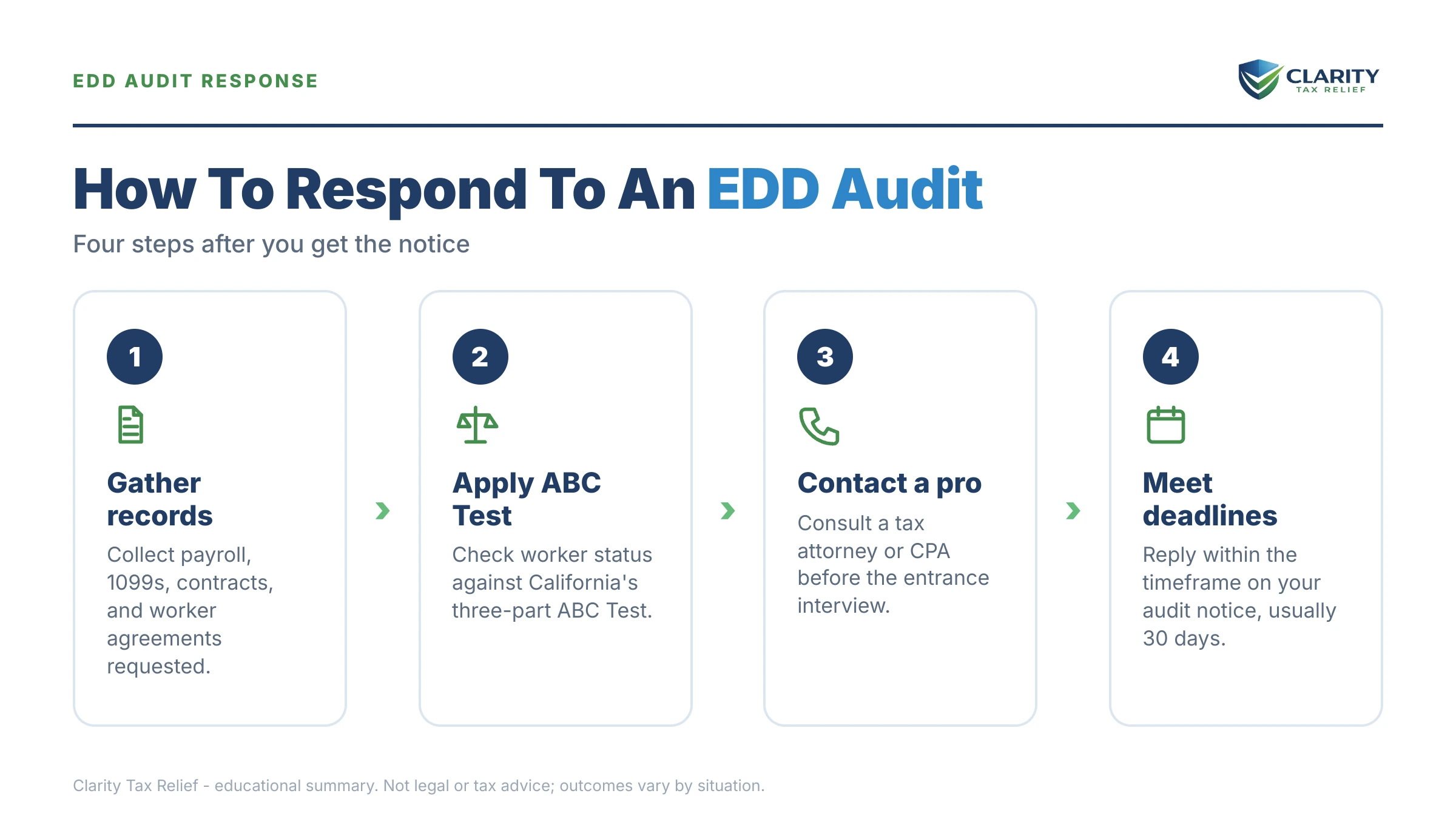
How to respond to an EDD audit, step by step
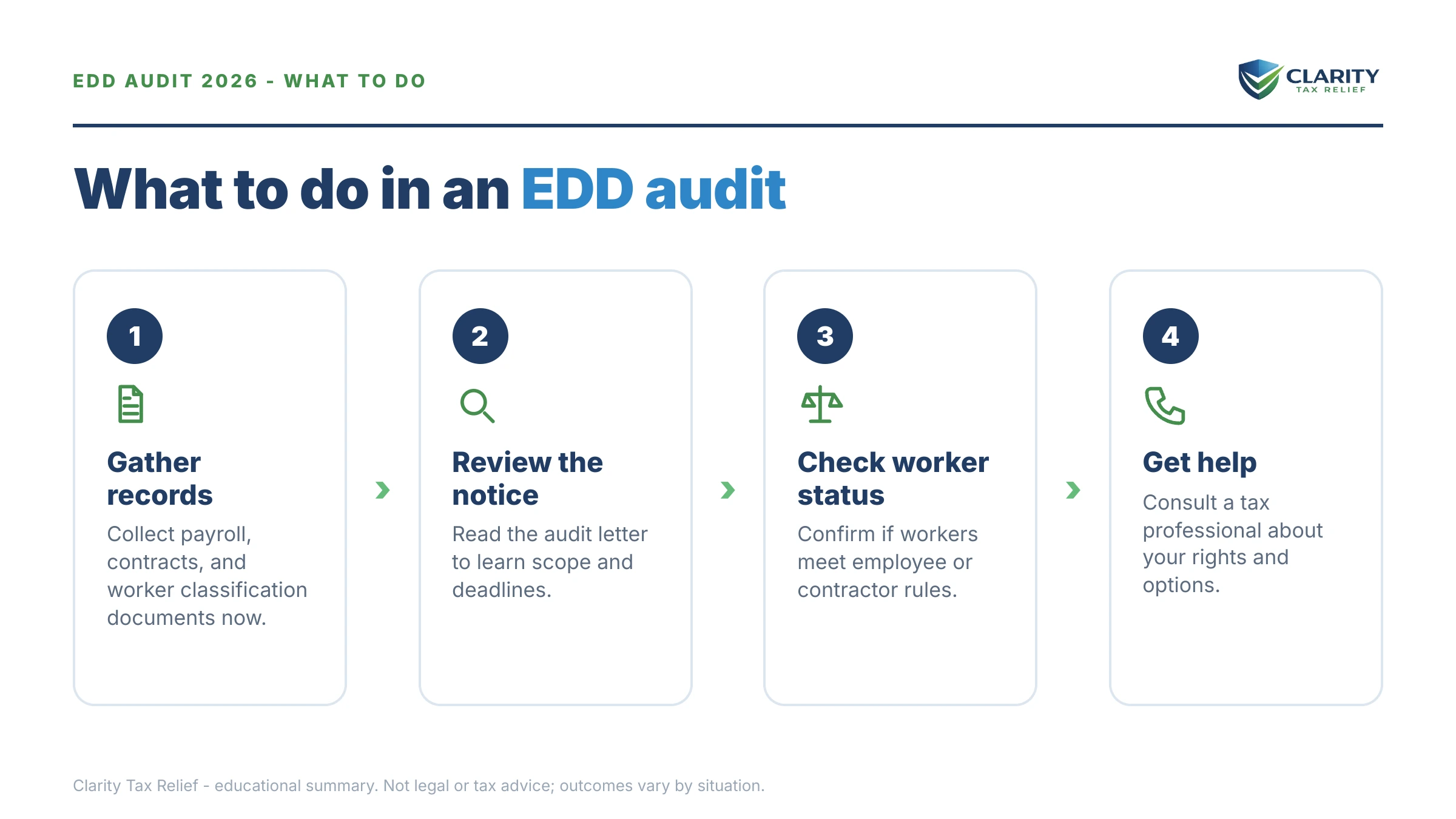
- Verify the letter and calendar every date. Confirm the letter is genuinely from the EDD, then write down the audit period, the appointment date, and every response deadline it lists.
- Gather the quarters under exam. Pull bank statements, check registers, 1099s, contracts, and your DE 9 and DE 9C filings for every quarter listed on the letter — nothing more, nothing less.
- Map each 1099 worker against the ABC test. Before any interview, decide honestly which workers pass all three prongs and which are vulnerable, so you know where the fight is before the auditor does.
- Control the entrance interview. Answer what is asked, accurately and briefly; volunteer nothing, and consider having a representative attend in your place under a power of attorney.
- Review the proposed assessment before it becomes final. Ask for the exit conference, challenge the math and the classifications, and request the PIT offset if your workers already paid California income tax on the earnings.
- Petition the CUIAB within 30 days if you disagree. A timely petition keeps the Notice of Assessment from becoming final and is the only door into the EDD Settlement Program.
When you can handle an EDD audit yourself
You can reasonably handle an EDD audit yourself when your 1099 workers clearly pass the ABC test and your quarterly filings are current. A bookkeeping firm that hired a licensed electrician to rewire the office, a retailer whose only contractor is an outside web designer with her own agency and client list — those are prong-B and prong-C winners on paper, and an organized owner with clean bank records can usually walk an auditor through them. The same is true if the audit is a random verification exam and your DE 9s reconcile to your books.
Experienced help changes the outcome in specific situations:
- Multiple workers doing your core work on 1099s — prong B is nearly unwinnable alone, and the strategy shifts from "win the audit" to "shape the assessment, offset the PIT, and negotiate."
- Unfiled quarterly returns — your exposure jumps from three years toward eight, and the filing-and-defense sequence matters.
- Cash payments or off-books wages — where an auditor might see intentional conduct, you're in eggshell audit territory: a civil exam with something worse underneath, where what you volunteer matters as much as what you produce.
- A struggling or closing business — every move must be made with CUIC §1735 personal liability in view; the wind-down order can determine whether the debt follows you home. Our guide to being personally liable for payroll taxes covers the parallel federal doctrine.
- Concurrent IRS or CDTFA activity — positions taken in one exam become evidence in the others, so the defenses must be coordinated.
If any of those describes your audit, a free review costs nothing and can reshape the assessment before it's final — start the 2-minute form or call (888) 825-7779.
Terms on your EDD audit paperwork, decoded
- ABC test — California's default worker-classification test: a worker is an independent contractor only if they're free from your control (A), work outside your usual business (B), and run an independent trade of the same kind (C). All three, or they're an employee.
- Borello test — the older multi-factor "control" test, still used for occupations and business relationships exempted from the ABC test.
- DE 9 / DE 9C — your quarterly wage report to the EDD and its employee-by-employee wage detail; auditors reconcile these against your bank records and 1099s.
- Notice of Assessment — the formal bill for tax, penalties, and interest that ends the audit and starts your appeal clock.
- CUIAB — the California Unemployment Insurance Appeals Board, the independent body that hears your petition against an assessment.
- CUIC §1735 — the statute letting the EDD personally assess owners, officers, and other responsible people when a business willfully fails to pay and can't cover the bill.
You can verify any letter and manage your employer account directly with the Employment Development Department, and appeal procedures are published by the California Unemployment Insurance Appeals Board.
EDD audit questions, answered
What triggers an EDD audit?
The most common trigger is a worker you paid on a 1099 filing an unemployment claim — the EDD finds no reported wages under your account, and the claim routes to its audit unit. Other triggers include independent-contractor reporting mismatches, worker complaints, referrals from the IRS, FTB, or CDTFA through data-sharing agreements, and industry sweeps of construction, salons, restaurants, and trucking. A small share are random verification audits with no trigger at all.
How far back can an EDD audit go?
A standard EDD audit covers the 12 most recent completed calendar quarters — three years. If you never registered as an employer or never filed the required quarterly returns, the EDD can typically reach back as far as eight years, and there is no practical limit where it finds fraud. The audit letter lists the exact quarters under exam, so read it before you gather records.
What happens if you fail an EDD audit?
Failing an EDD audit means the auditor reclassifies workers and issues a Notice of Assessment for unpaid UI, ETT, SDI, and PIT withholding, plus penalties and interest. You then generally have 30 days to petition the CUIAB before the assessment becomes final and collectible. A final assessment can lead to a state tax lien, bank levies, and — if the business cannot pay — personal assessments against owners and officers under CUIC section 1735.
How long does an EDD audit take?
Most EDD audits run several months from the opening letter to the exit conference, though cases with many workers or missing records can stretch past a year. The timeline depends heavily on how organized your records are and how quickly you respond to document requests. Delay generally works against you: when the auditor cannot verify figures, they estimate — and estimated assessments almost always run high.
Will the EDD contact my workers directly?
Yes — the EDD routinely mails questionnaires to your current and former 1099 workers and may interview some by phone, and you cannot block it. Their answers about control, schedules, tools, and other clients often carry more weight than the contract you signed. You can prepare by making sure your own records tell a consistent story, but never coach workers on what to say — that can turn a civil audit into something far worse.
Does an EDD audit trigger an IRS audit?
It can. The EDD shares audit results with the IRS and the FTB under information-exchange agreements, so a California reclassification can invite a federal worker-classification exam covering the same workers and years. The federal side has its own relief paths — including the Section 530 safe harbor — that California does not mirror, so the two cases need coordinated, not identical, defenses.
Can I settle an EDD audit assessment for less?
Sometimes. The EDD Settlement Program can resolve an assessment for less than the full amount, but only while your case is in the appeal process and only where the EDD sees real litigation risk in its own position. Separately, the EDD offers an Offer in Compromise, generally limited to businesses that are no longer operating and owners with no realistic ability to pay in full. Neither is automatic, and neither resembles the pennies-on-the-dollar pitch you see advertised — that pitch is a scam signal.
Am I personally liable if my corporation or LLC can't pay an EDD assessment?
You can be. Under CUIC section 1735, the EDD can personally assess any officer, owner, or other responsible person who willfully failed to pay payroll taxes when the corporation or LLC cannot pay. The personal assessment includes the tax, penalties, and interest, and the EDD pursues it against personal assets. Closing or dissolving the business does not erase it — the personal assessment is exactly how the EDD reaches you after the entity is gone.
Should I sign an EDD waiver extending the audit deadline?
It depends on what refusing would cause. Signing buys goodwill and time to build your defense; refusing usually pushes the auditor to issue a protective assessment immediately — often estimated high. The tradeoffs mirror the IRS's Form 872 decision: a waiver keeps quarters open longer, but a rushed, inflated assessment is usually worse than an extended timeline. Have an experienced tax professional review your exposure before you sign or refuse.
Your next 24 hours
- Find the two dates on your letter. Locate the audit period (the quarters under exam) and your appointment or response date — or, if you're holding a Notice of Assessment, the issue date that starts your roughly 30-day petition window.
- Pull the paper. Gather bank statements, 1099s, contracts, and your DE 9 and DE 9C filings for the quarters listed, plus anything showing your 1099 workers' own licenses, insurance, and other clients.
- Get the letter reviewed free. Use the 2-minute form or call (888) 825-7779 — an experienced tax professional will map your ABC-test exposure and your appeal and payment options before your deadline passes, while interest is still small and every option is still open.
This guide is general information, not tax or legal advice for your specific situation. Eligibility for IRS programs depends on individual facts and circumstances; no outcome is guaranteed.