
California Tax Notices
EDD Notice of Assessment: What It Means, Your 30-Day Deadline, and How to Respond (2026)
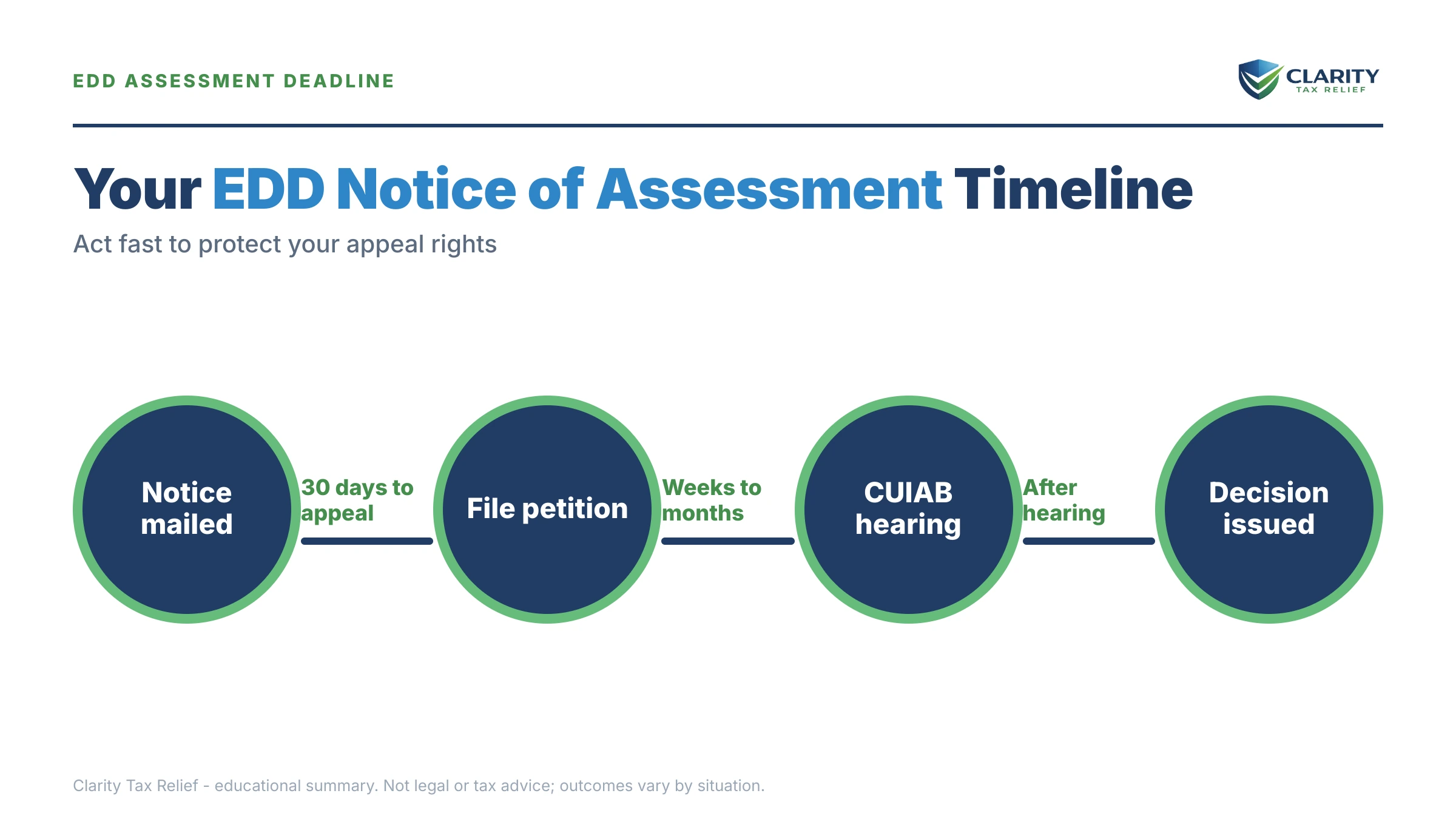
The short answer: an EDD Notice of Assessment is California's formal bill for unpaid payroll taxes — usually issued after an EDD audit reclassifies workers or finds unreported wages. You have 30 days from the issue date to file a petition for reassessment with the CUIAB. Miss that window and the assessment becomes final and collectible.
The envelope says Employment Development Department, not IRS — and the number inside covers three years of payroll you thought was handled. Maybe the audit reclassified the contractors you and your spouse have used since you started the business. This is one of the few tax letters with a genuine drop-dead date, but it is also one of the most fixable if you move inside the window.
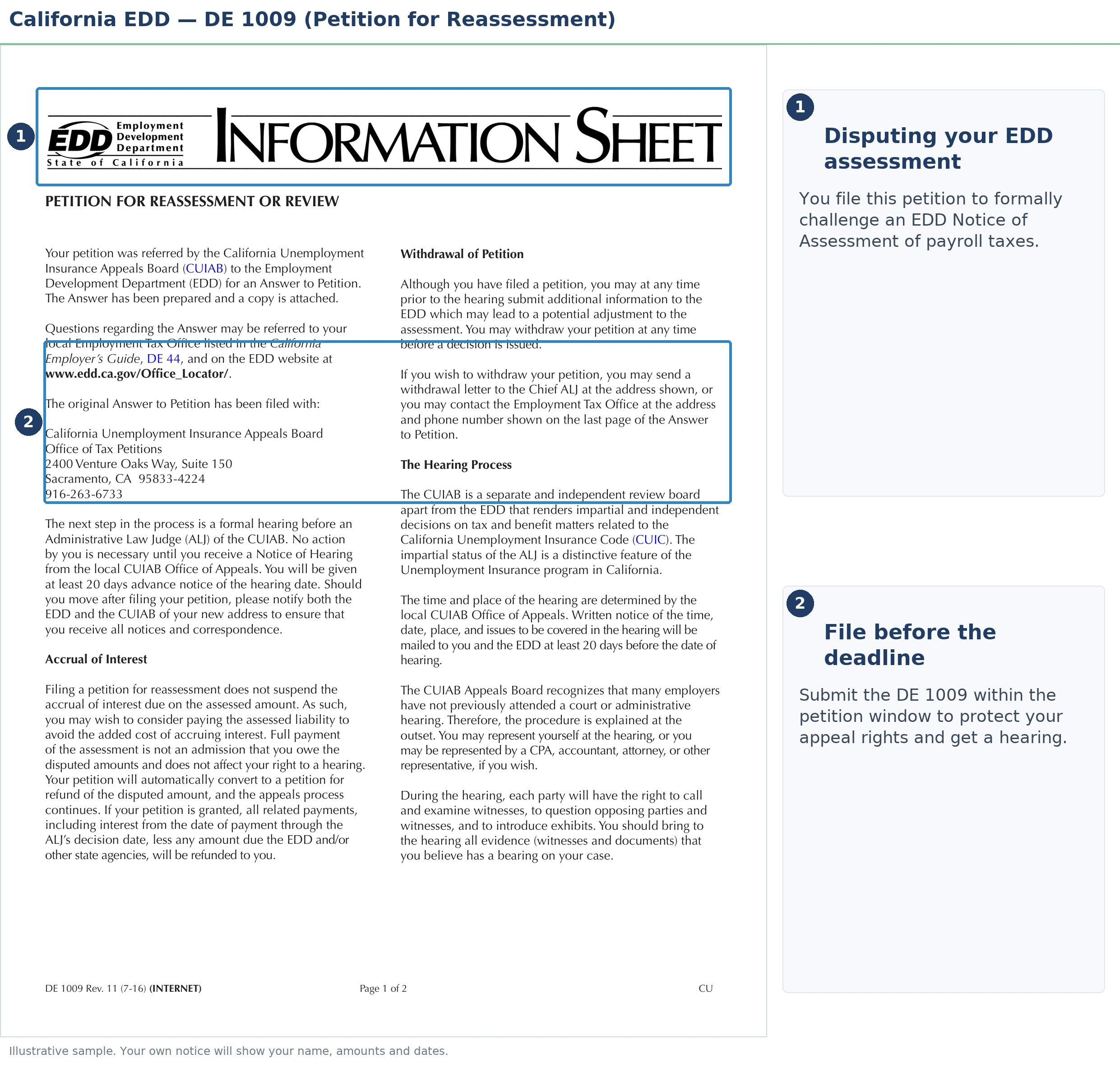
The single most important thing on the page is the issue date, because your appeal deadline runs from it — the image below shows exactly what an EDD Notice of Assessment looks like and where that date sits.
⏱ Your deadline: you have 30 days from the issue date on an EDD Notice of Assessment to file a petition for reassessment with the California Unemployment Insurance Appeals Board (CUIAB). One additional 30-day extension is possible for good cause. After that, the assessment is final — you lose the right to dispute it and collection can begin.
One clarification before anything else: this article covers the employer payroll tax assessment. If your EDD letter is about unemployment or disability benefits you received and must pay back, that's a different process — see EDD overpayment collection. And if your letter came from the IRS rather than a state agency, start with why did I get a letter from the IRS.
Why you got an EDD Notice of Assessment
An EDD Notice of Assessment means the EDD has formally decided your business owes California payroll taxes it didn't pay. The four taxes at stake are unemployment insurance (UI), employment training tax (ETT), state disability insurance (SDI), and California personal income tax (PIT) withholding — the notice itemizes each, plus penalties and interest, by quarter.
In practice, most assessments come out of one of these situations:
- A worker-classification audit. This is the big one. California's ABC test presumes every worker is an employee unless you prove all three prongs — freedom from your control, work outside your usual course of business, and an independently established trade. When an EDD audit reclassifies your 1099 contractors under that test, the assessment charges you the payroll taxes you would have owed on their pay, going back through the audit period.
- A UI claim by a 1099 worker. A contractor you let go files for unemployment. The EDD sees no wages reported for them, opens a status audit, and the reclassification cascades to every similar worker you've paid.
- Unfiled or incomplete payroll returns. If quarterly returns weren't filed, the EDD can estimate wages from the records it has and assess on those estimates — which are almost always higher than reality, because it's your job to prove them down.
- Unreported cash wages or off-payroll pay, including owner draws that functioned as wages, tips, or workers paid partly on payroll and partly outside it.
Most EDD assessments are built on estimates and presumptions, not confirmed facts — which is exactly why the petition right matters. The auditor had to fill gaps with assumptions; your records can often shrink the number substantially even when some liability is real.
One quirk worth knowing: the PIT withholding portion — often the largest line — can sometimes be reduced if you can show the reclassified workers already reported that income and paid tax on it themselves. California isn't trying to collect the same income tax twice, but it won't volunteer the reduction. You have to raise it and document it.
What happens if you ignore an EDD assessment
An EDD Notice of Assessment becomes final 30 days after its issue date if you do nothing — and a final assessment is immediately collectible. From there, the sequence runs in stages, and unlike the appeal window, most of the later stages have no fixed schedule; they simply arrive when the EDD's collection system gets to your account:
- Notice of Assessment issued. You are here. The 30-day petition clock is running, but no collection can happen yet on a non-final assessment (jeopardy assessments are the rare exception).
- Assessment becomes final. Day 31 with no petition filed. Your dispute rights are gone; only payment and collection questions remain.
- Statement of account and demand for payment. The balance — now growing with interest — moves to EDD collections.
- Notice of State Tax Lien. The EDD can record a lien against the business's property, and against your personal property once personal liability attaches. It's a public record that complicates financing, refinancing, and selling.
- Levy and garnishment. The EDD can levy bank accounts and issue earnings withholding orders against wages. Like the IRS, the EDD must assess and demand payment before it takes money — if you're wondering how the federal version works, see can the IRS freeze my bank account without notice.
- Personal assessment against you. If the corporation or LLC can't pay, the EDD can issue a new assessment against the individuals who controlled the money — under CUIC section 1735 — and that one comes with its own 30-day petition window. More on this below, because for married co-owners it can hit both spouses.
Two clocks run through this whole sequence regardless of what the EDD does: interest accrues continuously on the unpaid balance, and each quarter that passes makes payroll records, worker contact information, and bank statements harder to reconstruct for a defense.
| Stage | What the EDD can do | Your window |
|---|---|---|
| Notice of Assessment issued | Nothing yet — assessment is not final | 30 days from the issue date to petition (one 30-day good-cause extension possible) |
| No petition filed | Assessment becomes final and collectible | Dispute rights are gone; payment options remain |
| Demand for payment | Account moves to EDD collections; interest keeps accruing | Set up payment before enforcement starts |
| Notice of State Tax Lien | Public lien recorded against business or personal property | No fixed schedule — can follow any final unpaid balance |
| Levy / earnings withholding order | Bank accounts levied, wages garnished | No fixed schedule once the assessment is final |
| CUIC §1735 personal assessment | Responsible individuals billed personally for the entity's debt | A new 30-day petition window opens for that assessment |
Holding an EDD Notice of Assessment right now?
Get it reviewed free before your 30-day petition window closes. An experienced tax professional will check the auditor's math, your ABC-test exposure, and whether a petition, a payment plan, or both is the right move — no pressure, no obligation.
Your options after an EDD Notice of Assessment
Every EDD assessment resolves through one of five doors, and the right one depends on two questions: is the assessment correct, and can you pay it? Note what's not on the list — waiting. There is no version of this notice that improves with time.
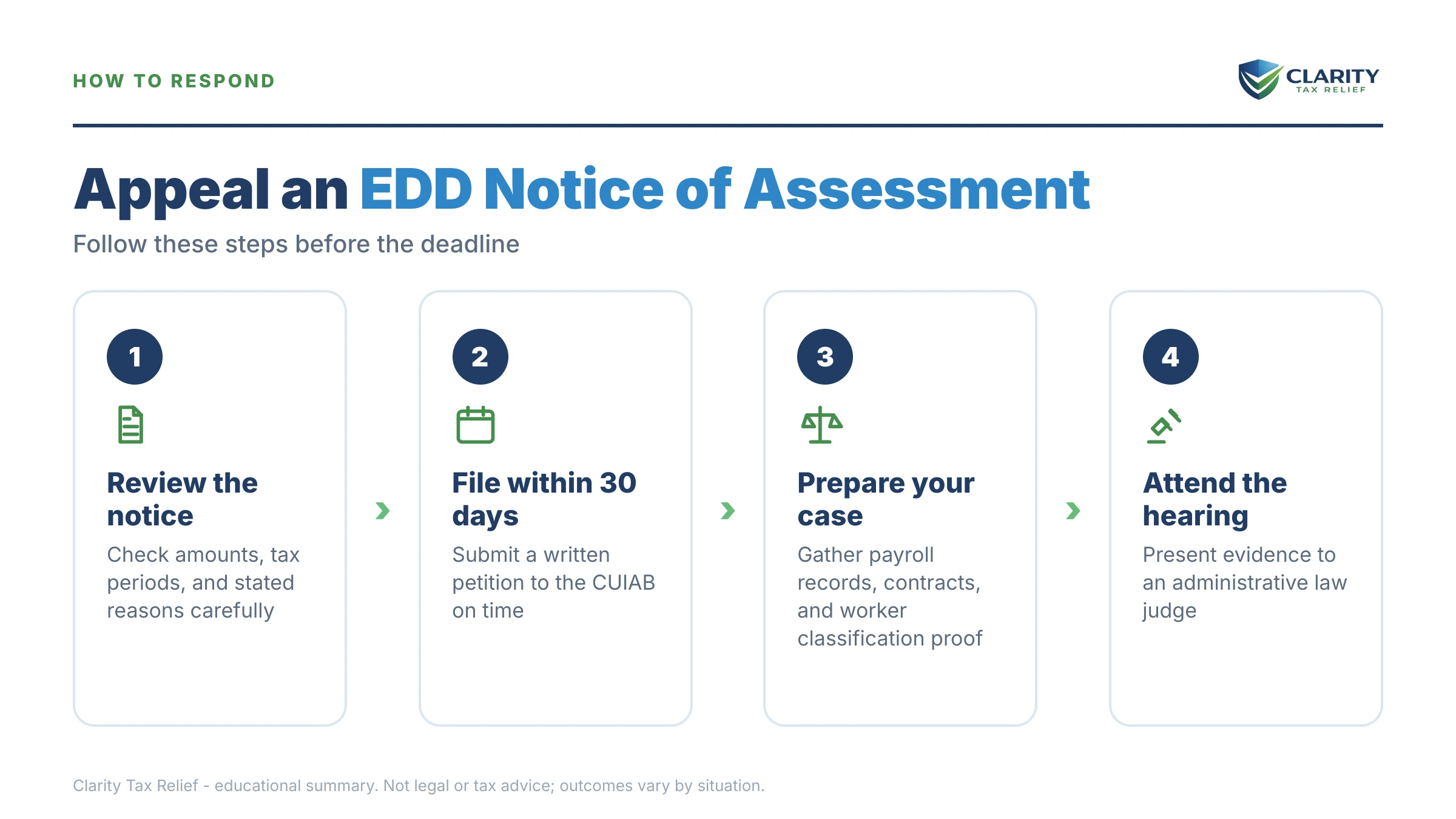
- Petition for reassessment. A written appeal to the CUIAB, filed within 30 days. It costs nothing to file, it keeps the assessment from becoming final, and it puts your case in front of an administrative law judge — not the auditor who wrote the assessment. This is the right move whenever the classification call, the wage estimates, or the penalties are genuinely disputable.
- Pay in full. Stops interest and ends the matter. If the assessment is correct and the money exists, this is the cheapest outcome — you can still petition first and pay only what survives the appeal.
- EDD installment agreement. A monthly payment arrangement on a balance you accept. Interest continues, but liens and levies generally stay off the table while you're current. The full mechanics — what the EDD asks for and how long plans typically run — are in our EDD payment plan guide.
- EDD Offer in Compromise. Real but narrow: it's generally limited to accounts where the business is closed or inactive and the EDD is convinced the full balance can never be collected. An operating business that wants a discount is not a candidate.
- Settlement through the EDD's Settlements Office. Available while a petition is pending, based on the hazards of litigation — essentially, both sides pricing the risk of losing at hearing. It only exists if you filed the petition, which is one more reason the 30-day deadline is the hinge of the whole case.
| Option | Upfront cost | Typical timeline | Best for |
|---|---|---|---|
| Petition for reassessment (CUIAB) | Free to file; professional representation optional | Several months to a year-plus through hearing | Disputed classification, inflated wage estimates, penalty challenges |
| Pay in full | Full balance plus accrued interest | Immediate; stops interest and enforcement | Correct assessment you can afford |
| EDD installment agreement | First monthly payment; interest continues | Months to a few years depending on balance | Correct assessment you can't pay at once |
| EDD Offer in Compromise | Offer funds; documentation of inability to pay | Months of review | Closed or inactive businesses that can never pay in full |
| Settlement (EDD Settlements Office) | Negotiated amount | While your petition is pending | Genuinely disputed cases where both sides face hearing risk |
A worked example: a $27,500 EDD assessment
Say you and your spouse own a small design-build firm and file a joint return. After a UI claim by a former contractor triggers an audit, the EDD reclassifies four 1099 workers as employees across a three-year audit period and issues a Notice of Assessment for $27,500, broken down roughly like this (hypothetical figures for illustration):
- UI contributions: $9,800
- ETT: $350
- SDI (the worker share you never withheld): $4,200
- PIT withholding assessed on the reclassified pay: $8,900
- Penalties: $3,100
- Interest to date: $1,150
Now the math on each path. Do nothing: the $27,500 is final in 30 days, interest keeps compounding, and a lien against the business — and eventually against you personally under §1735 — is on the table. Installment agreement: $27,500 over 24 months is roughly $1,146/month before continuing interest. Petition: if all four workers filed their own California returns and paid tax on that income, the $8,900 PIT line may be largely abatable with proof — and if two of the four workers genuinely pass the ABC test, the wage base itself shrinks. In this scenario, a successful petition could realistically cut the assessment by a third or more before any payment plan starts. That's why filing the petition first, then negotiating payment on what survives, is usually the right order.
How to respond to an EDD Notice of Assessment, step by step
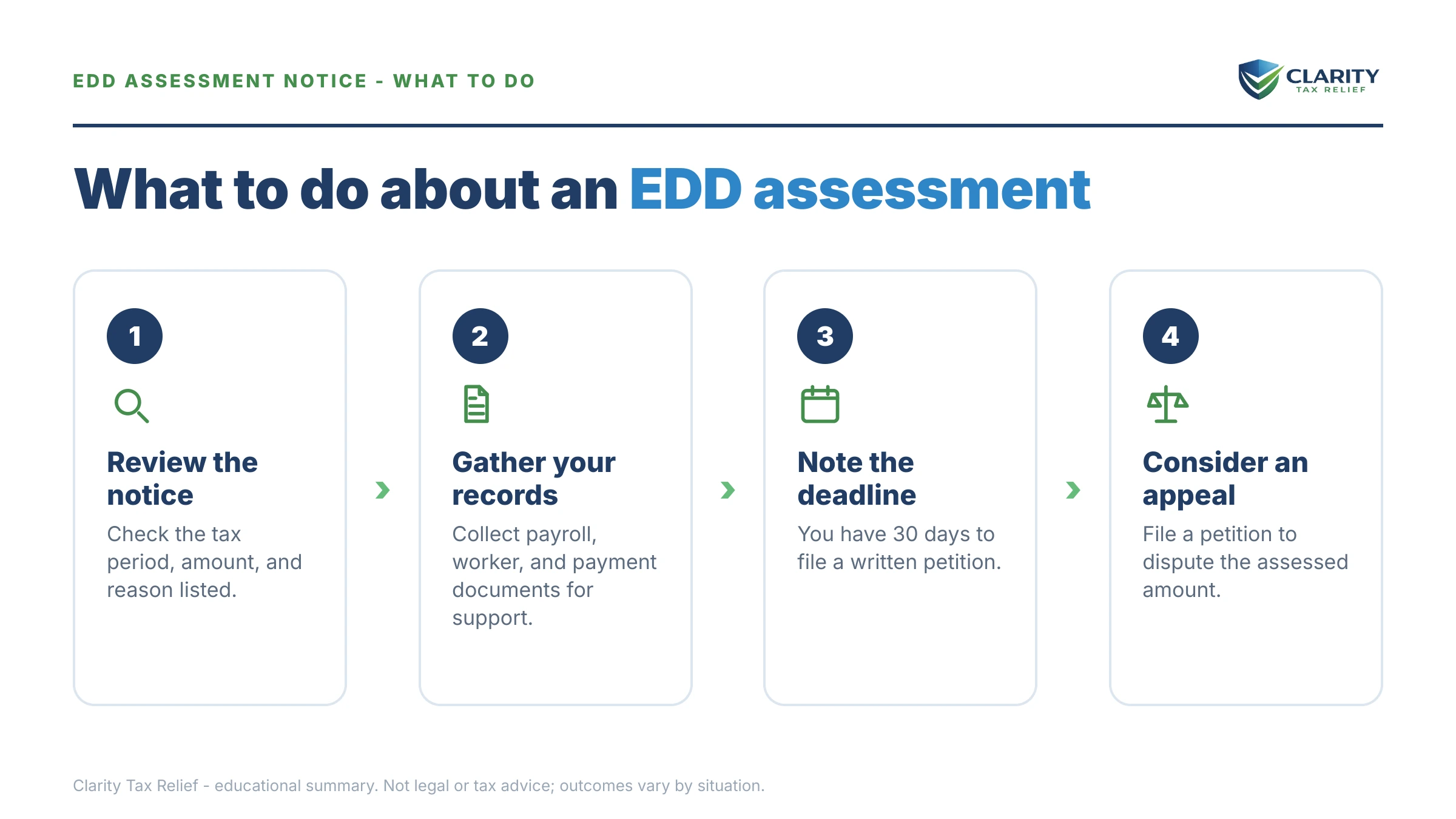
- Find the issue date. Locate the issue date on the notice and mark your petition deadline 30 days out — that date controls everything else.
- Verify the numbers. Compare each quarter's assessed wages against your payroll records, 1099s, and bank statements to confirm what the EDD counted.
- File a petition if you disagree. Send a written petition for reassessment to the CUIAB before the 30-day deadline, stating the specific grounds you dispute.
- Arrange payment if you agree. Pay in full or contact the EDD to set up an installment agreement before the account moves to collections.
- Get a professional review. Have an experienced tax professional assess misclassification and personal-liability exposure before your window closes.
The petition itself doesn't need to be elaborate — it needs to be timely, in writing, and specific about what you dispute and why. You can supplement evidence later; you cannot resurrect a missed deadline. Procedural details and hearing information are published by the California Unemployment Insurance Appeals Board.
Personal liability: when the assessment follows you home
A corporation or LLC does not fully shield you from an EDD payroll tax assessment. Under CUIC section 1735, once the entity fails to pay, the EDD can assess the unpaid taxes, penalties, and interest personally against the individuals who had control over the business's finances — officers, owners, and anyone who directed which bills got paid. For a married couple who run the business together, that can mean two separate personal assessments for the same debt, each with its own 30-day petition right.
This is the state cousin of the federal Trust Fund Recovery Penalty, and the defense questions are similar: did you actually control the money, and during which quarters? The broader landscape — who's exposed by role, from officers to check-signers — is covered in personally liable payroll taxes. The practical point for right now: resolving the assessment at the business level, or contesting it while it's still disputable, is far cheaper than fighting a personal assessment after the entity has folded.
Worth knowing too: state agencies share audit results with each other and with the IRS. An EDD reclassification can surface as a federal worker classification issue, and if you also owe other California agencies, the parallel state process for sales tax runs through a CDTFA notice of determination — same concept, different agency, its own appeal window. If you're juggling more than one balance, state tax debt vs IRS walks through which to resolve first. If you owe both the EDD and other debts, a free review can map the sequence before any deadline lapses.
When you can handle this yourself
You likely don't need professional help if the assessment is small, the EDD's numbers match your own records, and you simply need a payment arrangement — calling the EDD and setting up an installment agreement on an undisputed balance is genuinely a do-it-yourself task. The same goes for a pure paperwork error, like wages assessed to the wrong quarter, that a copy of your filed returns can fix.
Experienced help changes outcomes in four situations: a misclassification finding covering multiple workers or years, where ABC-test arguments and PIT abatement can move five figures; a personal assessment under §1735 against you or your spouse; a petition heading toward a CUIAB hearing, where the EDD will be represented and you'll face evidence rules; and a closed or closing business, where the order of wind-down steps determines how much of the debt follows you personally. In those cases, the fee for representation is usually being measured against a much larger swing in the final number.
Terms on your EDD notice, decoded
- Petition for reassessment — your written appeal of the assessment, filed with the CUIAB within 30 days; it keeps the assessment from becoming final.
- CUIAB — the California Unemployment Insurance Appeals Board, the independent body (not the EDD) that hears your petition before an administrative law judge.
- ABC test — California's worker-classification standard: a worker is an employee unless you prove all three prongs, including that their work is outside your usual course of business.
- PIT withholding — California personal income tax you were supposed to withhold from employee wages; often reducible if the workers already paid tax on that income.
- CUIC §1735 — the statute letting the EDD personally assess owners, officers, and others who controlled the money when the business entity doesn't pay.
- Earnings withholding order — the EDD's wage garnishment, sent to an employer once a final assessment goes unpaid.
EDD Notice of Assessment questions, answered
How long do I have to appeal an EDD Notice of Assessment?
You have 30 days from the issue date printed on the notice to file a petition for reassessment with the California Unemployment Insurance Appeals Board (CUIAB). The board can grant one additional 30-day extension, but only for good cause — don't count on it. Once the window closes without a petition, the assessment becomes final and the EDD can begin collection.
What happens if I ignore an EDD Notice of Assessment?
The assessment becomes final after the 30-day petition window and moves to collections. From there the EDD can record a Notice of State Tax Lien against your property, levy bank accounts, and garnish wages through an earnings withholding order — and interest keeps accruing the whole time. If the business can't pay, the EDD can also assess responsible individuals personally under CUIC section 1735.
Can I be held personally liable for my company's EDD assessment?
Yes. Under CUIC section 1735, the EDD can personally assess officers, owners, and other individuals who had control over the business's finances when the corporation or LLC fails to pay. That personal assessment covers the unpaid taxes, penalties, and interest, and it survives the closure of the business. If you and your spouse both ran the company, the EDD can assess each of you separately.
Does filing a petition stop EDD collection?
Generally yes — a timely petition for reassessment keeps the assessment from becoming final, and the EDD generally cannot collect on a non-final assessment. The exception is a jeopardy assessment, where the EDD believes collection is at risk and can demand immediate payment. Interest continues to accrue while your petition is pending, so weigh the cost of a long appeal against the strength of your case.
Can I settle an EDD assessment for less than I owe?
Sometimes, through two narrow doors. The EDD's Offer in Compromise program is generally limited to accounts where the business is closed or inactive and you can show the full balance can never realistically be collected. Separately, the EDD's Settlements Office can resolve a disputed assessment while a petition is pending, based on the hazards of litigation. Neither is automatic, and neither is a discount for simply asking.
Is an EDD Notice of Assessment the same as an IRS notice?
No. The EDD is a California state agency that collects payroll taxes — unemployment insurance, employment training tax, state disability insurance, and state income tax withholding. An IRS notice covers federal tax. The same worker-classification issue can trigger both, though, because state and federal agencies share audit information, so resolving the EDD side without checking your federal exposure is a common mistake.
Why did the EDD say my independent contractors are employees?
California applies the ABC test, which presumes a worker is an employee unless the business proves all three prongs: the worker is free from your control, performs work outside your usual course of business, and runs an independently established trade. Most EDD assessments come from audits that reclassify 1099 contractors under this test — and prong B, work outside your usual business, is where most companies fail.
Your next 24 hours
- Find the issue date on the notice and count 30 days forward. Write that petition deadline somewhere you'll see it — it is the one date in this process you cannot get back.
- Gather your paper: the full notice with its quarter-by-quarter schedule, your filed payroll returns, 1099s and contracts for any reclassified workers, and bank statements for the audit period.
- Get a free case review before the window closes — use the 2-minute form or call (888) 825-7779. We'll tell you honestly whether your assessment is worth petitioning, what the PIT portion might abate to, and what a payment plan on the remainder would look like.
For payroll tax rates, forms, and account access, the agency's official site is edd.ca.gov — verify anything you're told against it, and never pay a state tax bill through gift cards, payment apps, or anyone who contacts you by text.
This guide is general information, not tax or legal advice for your specific situation. Eligibility for IRS programs depends on individual facts and circumstances; no outcome is guaranteed.