
California Tax Notices
CDTFA Notice of Determination: Your 30-Day Deadline and What to Do (2026)
The short answer: a CDTFA Notice of Determination is the California Department of Tax and Fee Administration's formal bill for sales or use tax it says you owe — usually after an audit or unfiled returns. You have 30 days from the notice date to file a Petition for Redetermination before it becomes final and collectible.
You're self-employed, the envelope came from Sacramento instead of the IRS, and the letter says California has "determined" you owe sales tax you never collected from anyone. This is fixable — but a CDTFA Notice of Determination runs on a shorter, harder clock than almost any IRS letter you've heard of, and the number on it is a proposal, not a verdict.
Three facts should frame everything you do next. First, this notice comes from the CDTFA — California's sales and use tax agency — not the FTB (income tax) or the IRS. Second, the determination is not yet final: it becomes final only if you let 30 days pass without a written petition. Third, the amounts on it are frequently negotiable downward, because audit and non-filer determinations are built on assumptions you're allowed to rebut with records.
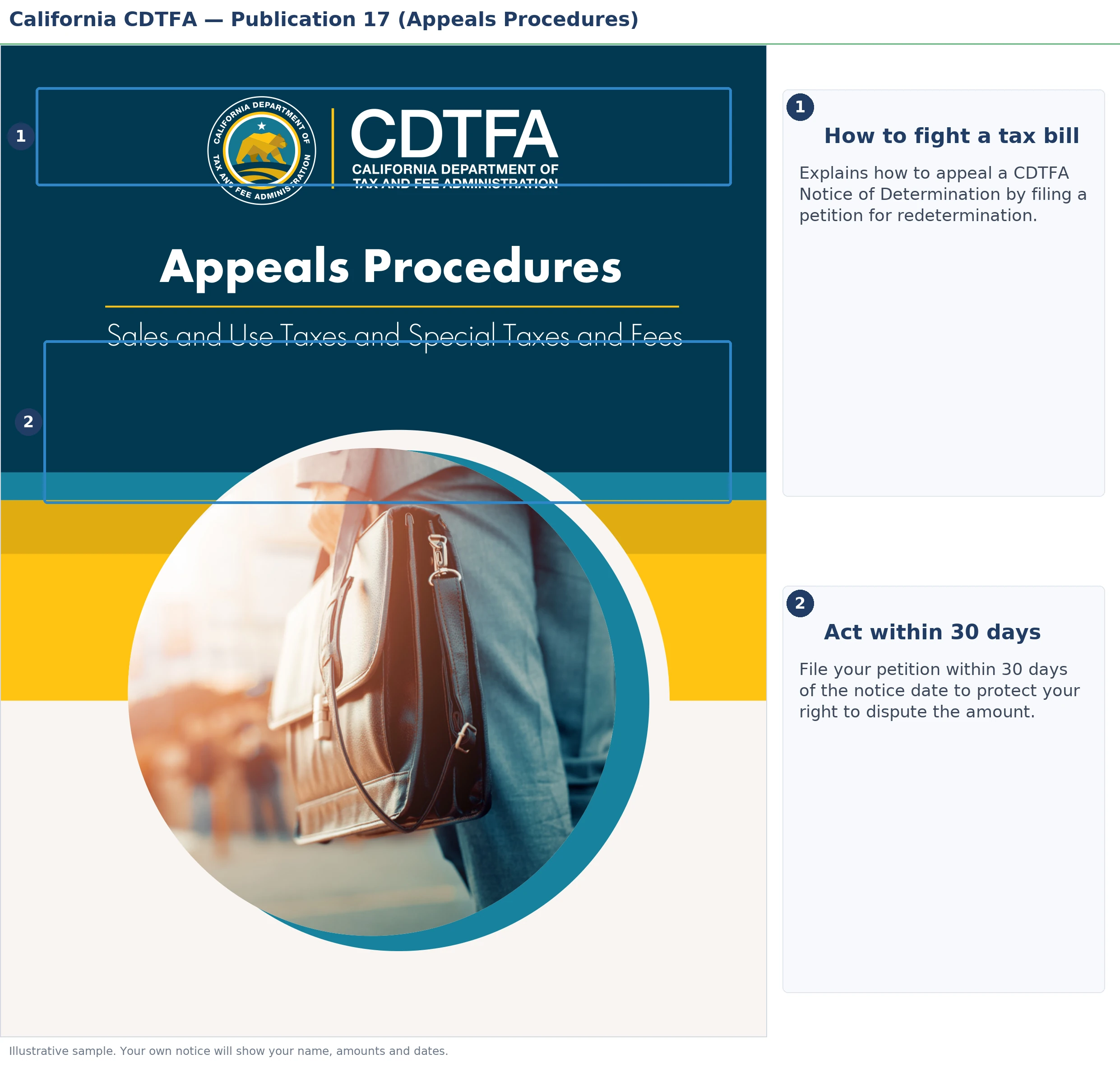
The image below shows exactly what a CDTFA Notice of Determination looks like and where to find the two things that control your case: the date of the notice and the breakdown of tax, penalty, and interest.
⏱ Your deadline: you have 30 days from the date printed on a CDTFA Notice of Determination to file a Petition for Redetermination. On day 31 with no petition, the determination becomes final, a 10% finality penalty is added to any unpaid tax, and the balance moves toward collection. Interest accrues monthly the entire time.
Why you got a CDTFA Notice of Determination
A Notice of Determination is issued when CDTFA concludes you owe sales or use tax you didn't report or pay. For a self-employed person or small operator, it almost always traces to one of four triggers:
- A sales tax audit closed against you. The auditor tested your records — often with markup analysis or a sample of transactions — and concluded you under-reported taxable sales. The determination bills the difference plus penalty and interest. If you're still in the exam stage, start with our CDTFA sales tax audit guide instead; the determination is what arrives when that process ends without agreement.
- You never filed returns, so CDTFA estimated. The agency receives 1099-K payment card data, marketplace reports, and bank information. If you sold taxable goods — or performed taxable fabrication work — without a seller's permit or without filing, CDTFA can build an estimated liability and bill it. Estimates routinely assume every deposit was a taxable California sale, which is exactly why they're often beatable.
- Your exemption paperwork failed. Sales you treated as exempt — resales, interstate shipments, certain labor — get taxed in the determination if you can't produce resale certificates or shipping documentation. Missing paperwork, not fraud, drives a huge share of these bills.
- A closed business's debt followed you personally. If a corporation or LLC shut down owing sales tax, CDTFA can issue a "dual determination" against the individuals who ran it. If that's your letter, the personal-liability rules in our closed business owe sales tax guide matter as much as anything on this page.
Whatever the trigger, the notice itself shows the periods covered, the tax CDTFA determined, the penalty applied, and interest through the notice date. If your letter is actually from the IRS rather than a California agency, start with why did I get a letter from the IRS — the playbooks are completely different.
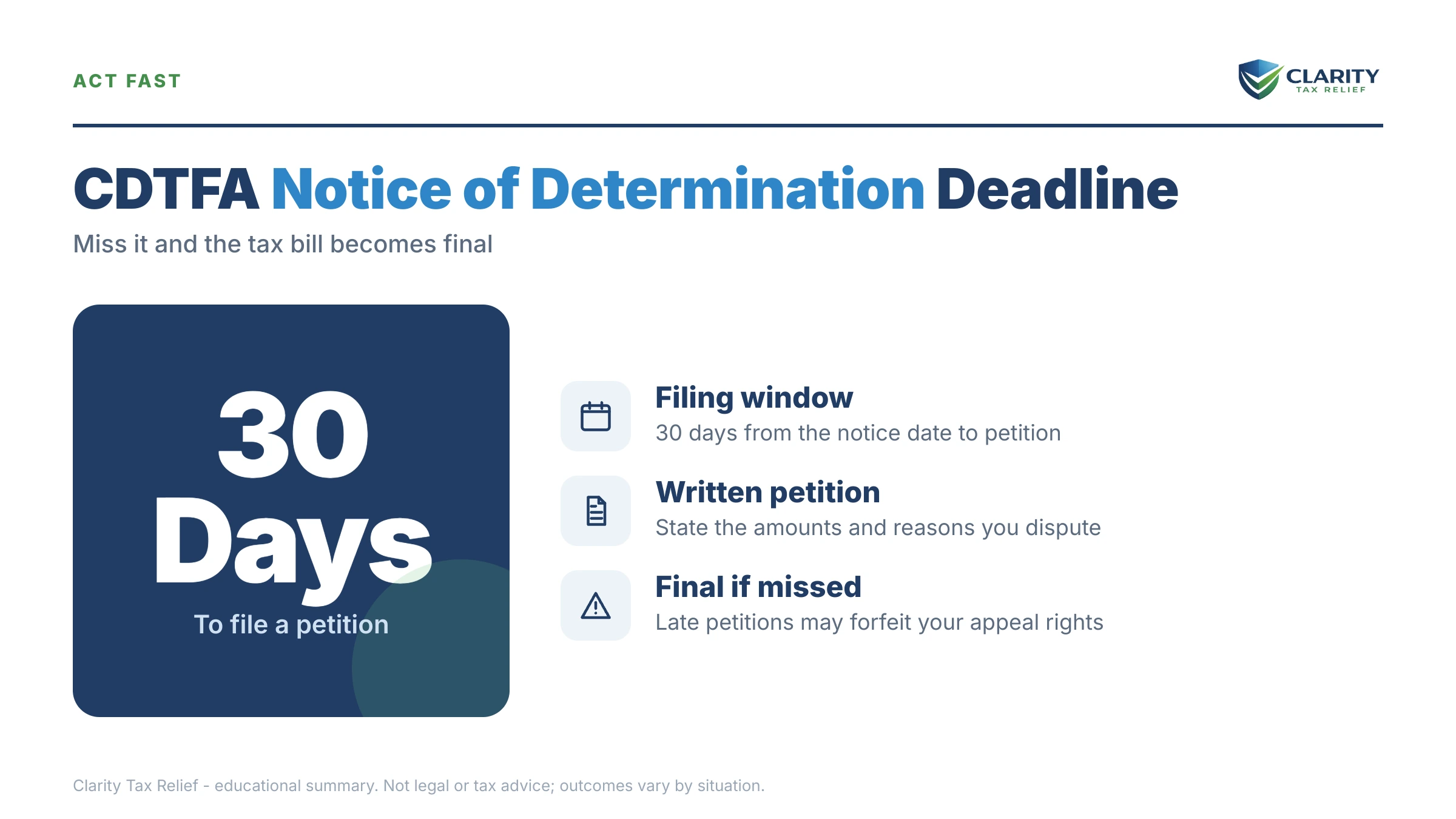
The 30-day clock: your Petition for Redetermination rights
Filing a Petition for Redetermination within 30 days is the only way to dispute a CDTFA determination before paying it. The petition must be in writing, filed by the 30th day after the notice date, and it should identify which items you dispute and why. CDTFA publishes a petition form, but a signed letter that clearly protests the determination and states your grounds also works — what matters is that it's specific and provably on time.
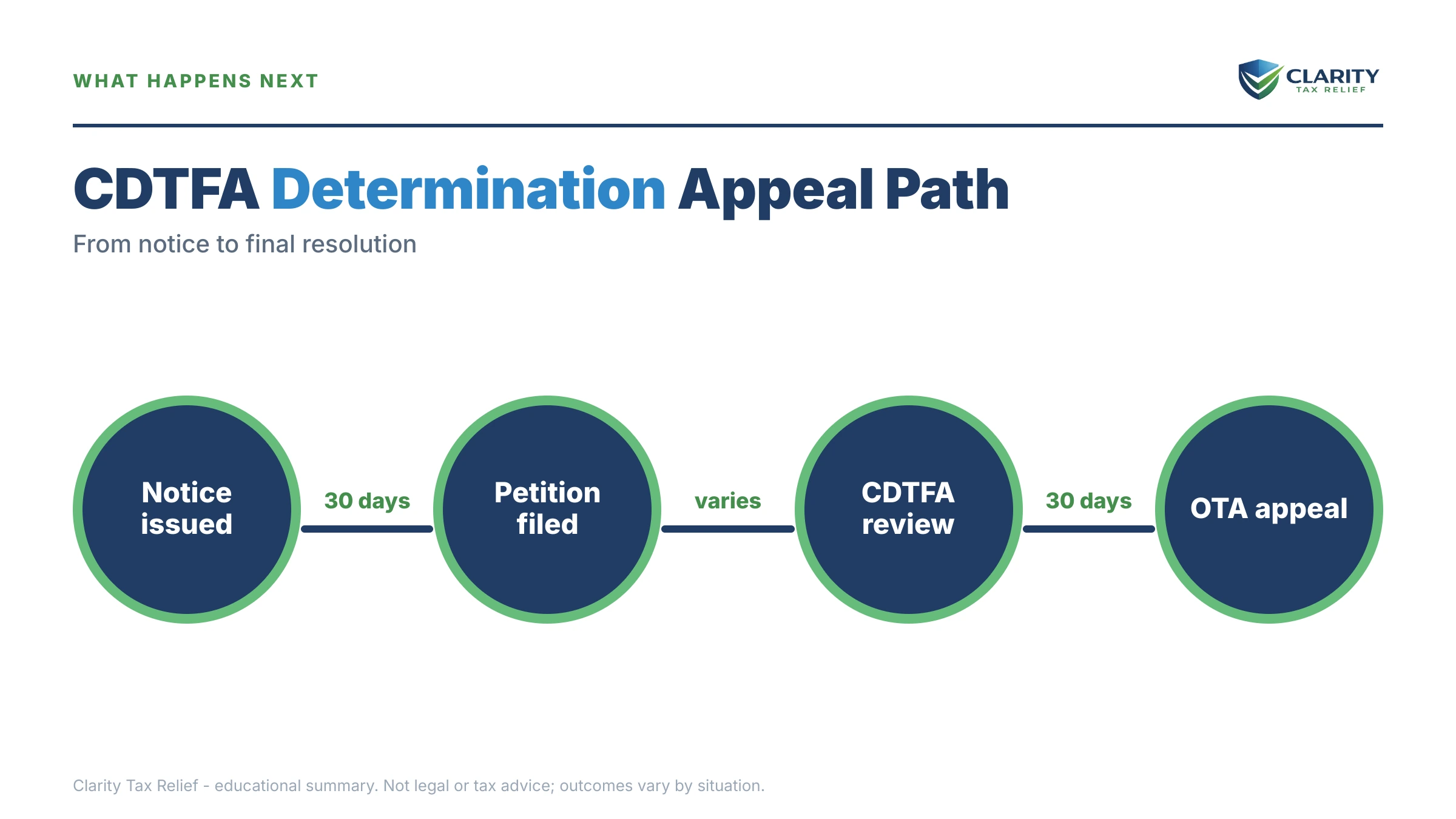
A timely petition does three things at once. It keeps the determination from becoming final. It generally holds collection on the disputed amount while your case is reviewed. And it opens the appeals track: an appeals conference where you present records and argument, followed by a written decision. If CDTFA's decision still goes against you, it issues a Notice of Redetermination — and you then have 30 days to appeal to the California Office of Tax Appeals (OTA), an independent body that is not part of CDTFA.
Two strategic points most people miss. Interest keeps accruing on the unpaid balance throughout the petition process, so if part of the bill is clearly correct, paying that part early stops interest on it without giving up your dispute — payment simply converts that portion into a claim for refund. And once a petition or refund claim is pending, CDTFA's settlement program becomes available for genuinely disputed cases, which can resolve a liability based on the hazards of litigation rather than a full fight.
| Document | Your window | The right you lose if it passes |
|---|---|---|
| Notice of Determination | 30 days from the notice date | The Petition for Redetermination — your only chance to dispute the bill before paying it. After day 30, the determination is final and a 10% finality penalty attaches to unpaid tax. |
| Notice of Redetermination (after the appeals decision) | 30 days from that notice's date | Your appeal to the independent Office of Tax Appeals. Miss it and the redetermined amount becomes final and collectible. |
| After you pay a final determination | Generally three years from the due date of the return for the period, or six months after a CDTFA determination becomes final, or six months from the date of the overpayment — whichever expires latest | The claim for refund — the pay-first dispute route. Once the refund window closes, the money is gone even if the assessment was wrong. |
Notice what that table implies: missing the first 30-day window doesn't just cost you a penalty. It flips you from "dispute now, pay later" to "pay everything first, then argue for it back" — a brutal switch when the determined amount is more than you have.
What happens if you ignore a CDTFA Notice of Determination
An unanswered Notice of Determination becomes final 30 days after its date, and California collects final sales tax debts aggressively. The sequence is a chain of stages, each one narrowing your options:
- Days 1–30: the petition window. Nothing is being collected yet. This is the cheapest, strongest position you will ever hold in this case.
- Day 31 with no petition: the determination is final. A 10% finality penalty is added to the unpaid tax, on top of the penalty and interest already on the notice, and the balance becomes legally collectible.
- Demand for payment. CDTFA bills the now-final amount. Interest continues compounding monthly. Payment arrangements are still available at this stage — but the amount itself is no longer up for debate through the petition route.
- Enforced collection. CDTFA can record a state tax lien against everything you own, levy your bank accounts, issue an earnings withholding order against wages, and intercept payments owed to you. For anyone still selling, it can also revoke the seller's permit — which makes continuing to make taxable sales illegal, effectively closing the business.
- Personal pursuit after a business closes. If the debt belongs to a shuttered corporation or LLC, CDTFA can issue a dual determination against responsible individuals, restarting the whole cycle against you personally.
| Stage | What happens | Window / consequence |
|---|---|---|
| Audit or non-filer review closes | Notice of Determination issued: tax + penalty + interest | 30 days to file a Petition for Redetermination |
| Petition filed on time | Appeals conference, then written decision and Notice of Redetermination | 30 days from the Notice of Redetermination to appeal to the OTA |
| No petition by day 30 | Determination is final; 10% finality penalty added to unpaid tax | Dispute now requires full payment plus a refund claim |
| Final balance unpaid | Collection: state tax lien, bank levy, earnings withholding, seller's permit revocation | No fixed schedule — stages proceed until the debt is paid or resolved |
| Business closed with debt unpaid | Dual determination against responsible individuals | A fresh 30-day petition window on the personal assessment |
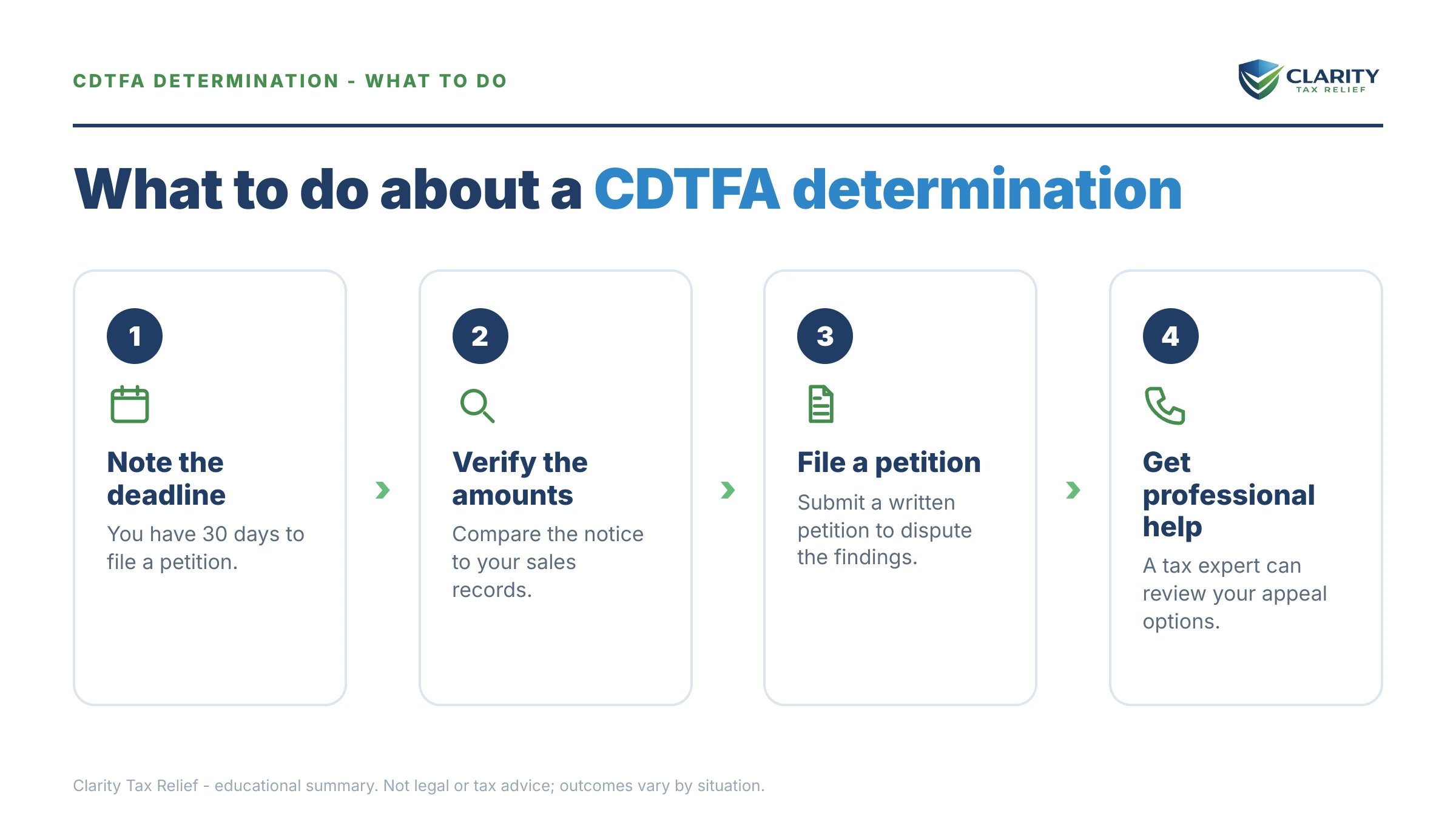
Holding a CDTFA Notice of Determination right now?
The 30-day petition window is the whole ballgame — and it's counting down from the date on your notice, not the day you found it. Send us a photo of the notice and an experienced tax professional will map your deadline, your dispute grounds, and your payment options — free and confidential.
Your options: dispute, pay, arrange, or settle
Every CDTFA Notice of Determination resolves through one of five paths, and they can be combined. Which fits depends on whether the number is right and whether you can pay it:
- Petition for Redetermination — the dispute route, free to file, available only in the first 30 days. Best when the audit assumed too much (all deposits taxable, all labor taxable, no exempt sales) or when an estimated non-filer bill ignores your real numbers. You can petition part of a determination and pay the rest.
- Pay in full — stops interest immediately and ends the case. Even if you believe part is wrong, paying and filing a claim for refund preserves the dispute while the interest meter stops. This is often smart on smaller determinations where interest would outrun the fight.
- CDTFA payment plan — monthly installments on a balance you agree with. CDTFA sets its own terms and documentation requirements, separate from anything the IRS offers; the mechanics, and what CDTFA expects before granting one, are covered in our CDTFA payment plan guide. Interest continues during the plan.
- CDTFA offer in compromise — settlement for less than the full liability, with CDTFA's own criteria. It's generally aimed at people who no longer operate the business that generated the tax and genuinely cannot pay in full from income or assets. It is means-tested and documentation-heavy — a real program, not a loophole.
- Settlement program — for liabilities that are actually in dispute (a pending petition or refund claim), CDTFA can settle based on litigation risk. This is a negotiation about the strength of the evidence, which is why the quality of your petition matters even if you expect to settle.
One thing that is not on the list: waiting for the debt to age off. Do not import IRS assumptions — like the federal 10-year collection statute — into a California sales tax case. State collection rules are their own world; if you owe multiple California agencies or both the state and the IRS, our guide to state tax debt vs IRS walks through sequencing, and the broader landscape is in sales tax debt help and California back sales tax.
A worked example: petitioning vs. ignoring a $61,200 determination
Say you're a 1099 contractor who built custom cabinets for three years — collecting nothing, because you thought of yourself as labor, not a retailer. In California, fabrication labor is generally taxable, and CDTFA's audit treats your cabinet receipts accordingly. The Notice of Determination reads: $48,500 tax + $4,850 penalty (10%) + $7,850 interest = $61,200.
Here's what each path costs, hypothetically:
- Do nothing. On day 31 the determination is final and a 10% finality penalty attaches to the unpaid tax — roughly $4,850 more, pushing the balance past $66,000 before collection even starts. Interest keeps compounding monthly, and the next contact may be a lien or a bank levy rather than a letter.
- Petition. Your records show the audit taxed everything — but a large share of your invoices were for on-site installation labor, which is generally not taxable, and several jobs were sold for resale to a general contractor who gave you resale certificates. Suppose documentation supports removing 40% of the audited measure: tax drops to about $29,100, the 10% penalty recomputes to about $2,910, and interest recalculates to roughly $4,700 — a total near $36,700 instead of $61,200. That difference exists only if a petition is filed by day 30.
- Petition and pay the undisputed part. If you agree roughly $29,000 is owed no matter what, paying it while the petition runs stops interest on that portion immediately — and if the appeal goes better than expected, the excess comes back as a refund claim.
- Then arrange the remainder. A CDTFA payment plan on the reduced balance turns a business-ending number into a monthly obligation you can actually carry alongside quarterly income taxes.
Every figure above is illustrative — your audit's measure, your exemption documentation, and your periods drive the real math. The lesson isn't the numbers; it's that the 30-day petition is where the numbers get decided.
How to respond to a CDTFA Notice of Determination, step by step
- Circle the notice date and count 30 days. Find the date printed on the Notice of Determination and calendar the 30th day after it. That is your Petition for Redetermination deadline — everything else waits until this is on your calendar.
- Pull the workpapers behind the number. Request the audit workpapers or the schedule showing how CDTFA computed the determination, and match each line against your own sales records, resale certificates, and exemption documentation.
- Decide: petition, pay, or both. If any part of the determination is wrong, plan to petition. If part is correct, consider paying that portion now to stop interest — payment does not give up your right to dispute the rest.
- File your Petition for Redetermination in writing before day 30. State which items you dispute and why, request an appeals conference, sign it, and send it in a way you can prove the date — certified mail or CDTFA's online submission.
- Resolve whatever you agree you owe. Set up a CDTFA payment plan or pay in full on the undisputed balance so penalties and collection pressure don't build while the disputed portion works through appeals.
When you can handle this yourself — and when help changes the outcome
You can reasonably handle a Notice of Determination alone when the amount is small, the determination is simply correct, and you can pay it or set up a plan within the notice period — filing a clear, on-time petition for one or two disputed line items is also well within a careful person's reach.
Experienced help tends to change the outcome in four situations. When the determination is estimated — non-filer bills built from 1099-K data are often dramatically overstated, but rebutting them means reconstructing years of records persuasively. When taxability itself is the fight — fabrication versus installation labor, resale documentation, interstate sales — because these are technical arguments the appeals conference expects you to frame correctly. When a dual determination threatens you personally for a closed entity's debt, since responsibility and willfulness are contestable elements with real defenses. And when the balance is large enough that settlement or an offer in compromise is on the table, because those negotiations turn on financial presentation. Honest rule of thumb: the more the final number depends on argument rather than arithmetic, the more representation earns its cost.
Terms on your notice, decoded
- Determination — CDTFA's formal assessment of tax it believes you owe; a proposed liability that becomes final if not petitioned within 30 days.
- Petition for Redetermination — your written, 30-day-deadline request that CDTFA re-examine the determination before you have to pay it.
- Notice of Redetermination — CDTFA's answer after the appeals process; it starts a second 30-day clock, this time to appeal to the Office of Tax Appeals.
- Finality penalty — the extra 10% added to unpaid tax when a determination becomes final without payment.
- Dual determination — a personal assessment under Revenue and Taxation Code section 6829 against individuals responsible for a closed business's unpaid sales tax.
- Seller's permit — the CDTFA registration that legally allows you to make taxable sales in California; revocable for unpaid final liabilities.
CDTFA Notice of Determination questions, answered
What is a CDTFA Notice of Determination?
It is the California Department of Tax and Fee Administration's formal assessment of sales or use tax, penalties, and interest it believes you owe. It usually follows an audit or, for non-filers, an estimate CDTFA built from third-party data. It is not yet final — you have 30 days from the notice date to file a Petition for Redetermination and dispute it.
How long do I have to appeal a CDTFA Notice of Determination?
You have 30 days from the date printed on the notice to file a written Petition for Redetermination. Miss that window and the determination becomes final, a 10% finality penalty is added to any unpaid tax, and your main remaining dispute route is to pay the bill and file a claim for refund. The 30 days runs from the notice date, not the day you opened the envelope.
Do I have to pay while my petition is pending?
No — filing a timely petition generally holds collection on the disputed amount while your case moves through the appeals process. Interest keeps accruing the whole time, though, so many taxpayers pay some or all of the balance to stop the interest clock. Paying does not forfeit your dispute; it converts that portion into a claim for refund.
What happens if I ignore a Notice of Determination?
It becomes final 30 days after the notice date, CDTFA adds a 10% finality penalty to the unpaid tax, and the balance moves to collections. From there CDTFA can record a state tax lien, levy bank accounts, garnish earnings, and revoke your seller's permit — which makes it illegal to keep making taxable sales. If the business has closed, CDTFA can pursue responsible individuals personally.
Can I settle a CDTFA determination for less than I owe?
Sometimes. CDTFA runs its own offer in compromise program — separate from the IRS program — generally aimed at taxpayers who cannot pay in full and no longer operate the business that created the debt. For disputed liabilities still in the petition stage, CDTFA also has a settlement program that can resolve a case based on the risks of litigation. Both are means- and facts-tested; neither is automatic.
Am I personally liable if my LLC or corporation got the notice?
You can be. When a corporation or LLC closes or stops operating with unpaid sales tax, CDTFA can issue a dual determination under Revenue and Taxation Code section 6829 against the people who controlled the money and willfully failed to pay it over — owners, officers, sometimes managers. That personal assessment carries its own 30-day petition window, and it is worth contesting: the responsibility and willfulness elements are genuinely arguable in many cases.
Can CDTFA send a Notice of Determination if I never filed sales tax returns?
Yes. CDTFA can estimate your liability using third-party data — 1099-K payment card reports, marketplace records, bank deposits, even industry averages — and bill you on that estimate. Estimated determinations are frequently overstated because they assume every dollar was a taxable California sale. Filing accurate returns or petitioning with real records usually brings the number down.
Is a CDTFA Notice of Determination the same as an FTB or EDD notice?
No — three different California agencies. CDTFA handles sales and use tax and special taxes and fees; the Franchise Tax Board handles income tax; the EDD handles payroll tax and issues its own Notice of Assessment. Each agency has its own deadlines and appeal paths, so match the letterhead to the right playbook before you respond.
If California payroll tax is in the mix too — common when a contractor has been treating helpers as 1099 subs — the parallel state letter is the EDD Notice of Assessment, and it runs on its own separate appeal clock.
Your next 24 hours
- Find the notice date in the header of your Notice of Determination and count 30 days forward. Write that date somewhere you'll see it daily — it is the deadline that decides whether you dispute before paying or after.
- Gather your case file: the notice itself, the audit workpapers or any CDTFA correspondence, your sales records and invoices for the periods listed, and every resale certificate or exemption document you have.
- Get the notice reviewed free before the petition window closes — call (888) 825-7779 or use the 2-minute form. An experienced tax professional can tell you within one conversation whether the determined amount is worth fighting, what it should be, and how to protect the deadline.
Primary sources: the California Department of Tax and Fee Administration publishes appeal and payment guidance at cdtfa.ca.gov, and the independent appeal body for redetermined liabilities is the California Office of Tax Appeals.
This guide is general information, not tax or legal advice for your specific situation. Eligibility for IRS programs depends on individual facts and circumstances; no outcome is guaranteed. California tax programs are administered under state law with their own eligibility rules.