
California Tax Audits
CDTFA Sales Tax Audit: What to Expect, How Far Back It Goes, and How to Respond (2026)
The short answer: a CDTFA sales tax audit is California's examination of whether your business reported and paid the right sales and use tax — normally covering the last 3 years (8 if you never filed returns). It ends in a Notice of Determination you generally have 30 days to dispute before the bill becomes final.
The letter isn't from the IRS, and it isn't even from the Franchise Tax Board — it's from the CDTFA, an agency you may never have dealt with directly, announcing it wants to examine the books of the business you're now running alone after the divorce. The years it wants to look at may be years when someone else kept those books.
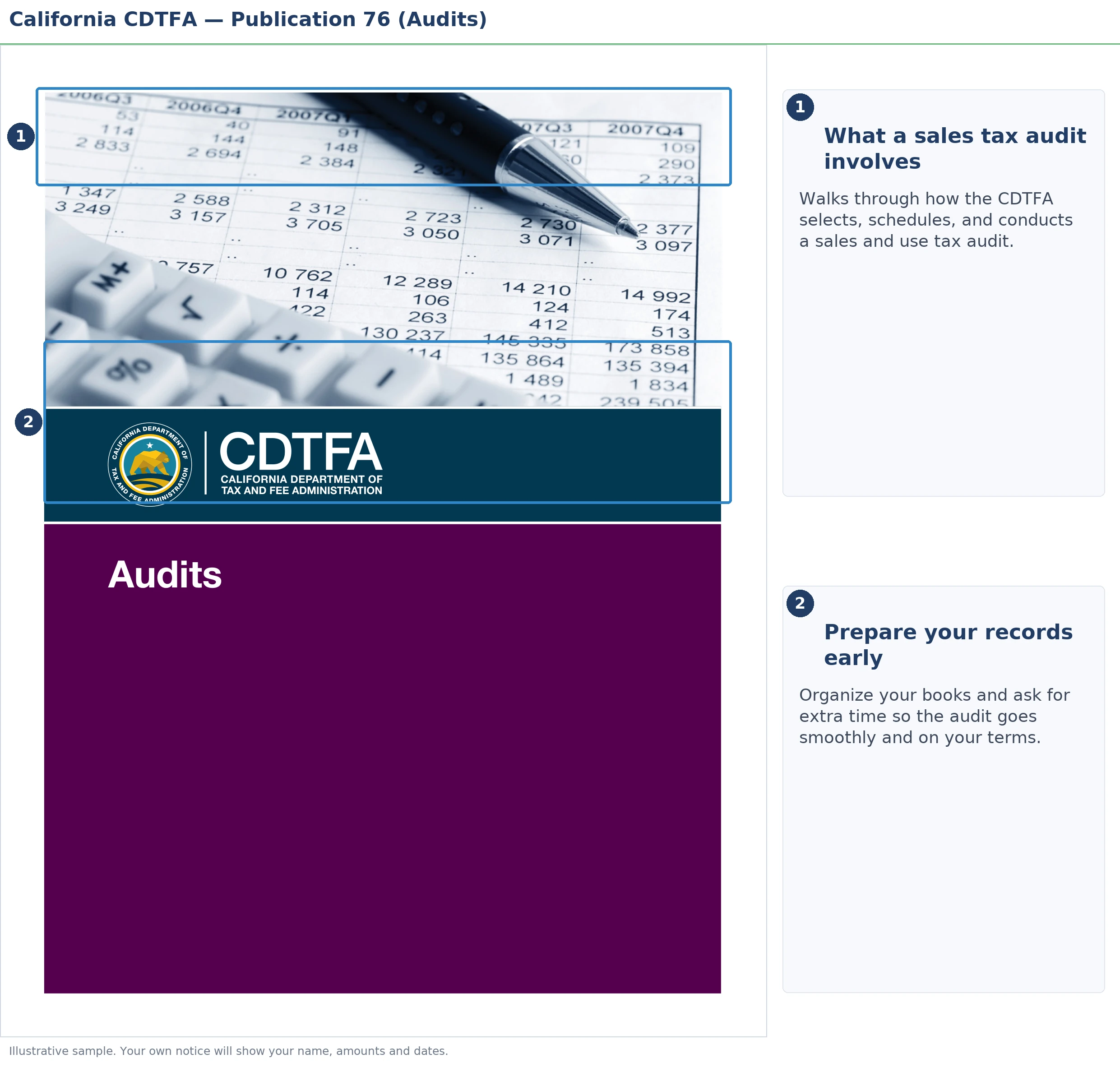
That's a solvable problem, not a verdict. A CDTFA audit is a reconstruction of your sales using tests you can run yourself first — and everything the auditor proposes can still be challenged before it hardens into a final bill. The image below shows exactly what CDTFA audit paperwork looks like and where to find the audit period and the date that controls your response.
⏱ The clock that matters: if you've already received a CDTFA Notice of Determination, you generally have 30 days from the date printed on it to file a petition for redetermination — miss it and the assessment becomes final. Still in the audit itself? The appointment date on your engagement letter is the deadline to act on, and interest accrues on any unpaid liability the whole time.
Why CDTFA selected your business for a sales tax audit
The most common trigger for a CDTFA sales tax audit is a mismatch between your sales tax returns and another data source the state can see. CDTFA routinely compares your reported sales against your federal income tax returns, your 1099-K card-processing totals, and the markup it expects for your industry — and a gap in any of those comparisons can generate an audit without a human ever suspecting you of anything.
Certain industries get audited far more often because their numbers are hardest to verify: restaurants and bars, convenience and liquor stores, auto repair shops, salons, contractors, and gas stations. Heavy cash volume, high claimed exempt or resale sales, and low reported markup relative to industry norms all raise selection odds.
Life and business events pull audits too. Closing a business, selling it (which requires a tax clearance), canceling a seller's permit, or transferring ownership — including transferring it in a divorce settlement — puts the account in front of CDTFA at exactly the moment it decides whether to examine the final periods. Referrals from other agencies matter as well: an EDD audit or an FTB exam that surfaces unreported receipts frequently ripples into a CDTFA exam, because California's tax agencies share data.
Online sellers are a newer target. If you ship into or out of California, marketplace and economic-nexus rules can create sales tax exposure you never registered for, in California and in the other states you ship into.
And yes, some audits are simply random or cyclical. But if you're holding an engagement letter, assume the computer found a gap — and start figuring out what it saw.
How a CDTFA sales tax audit actually works
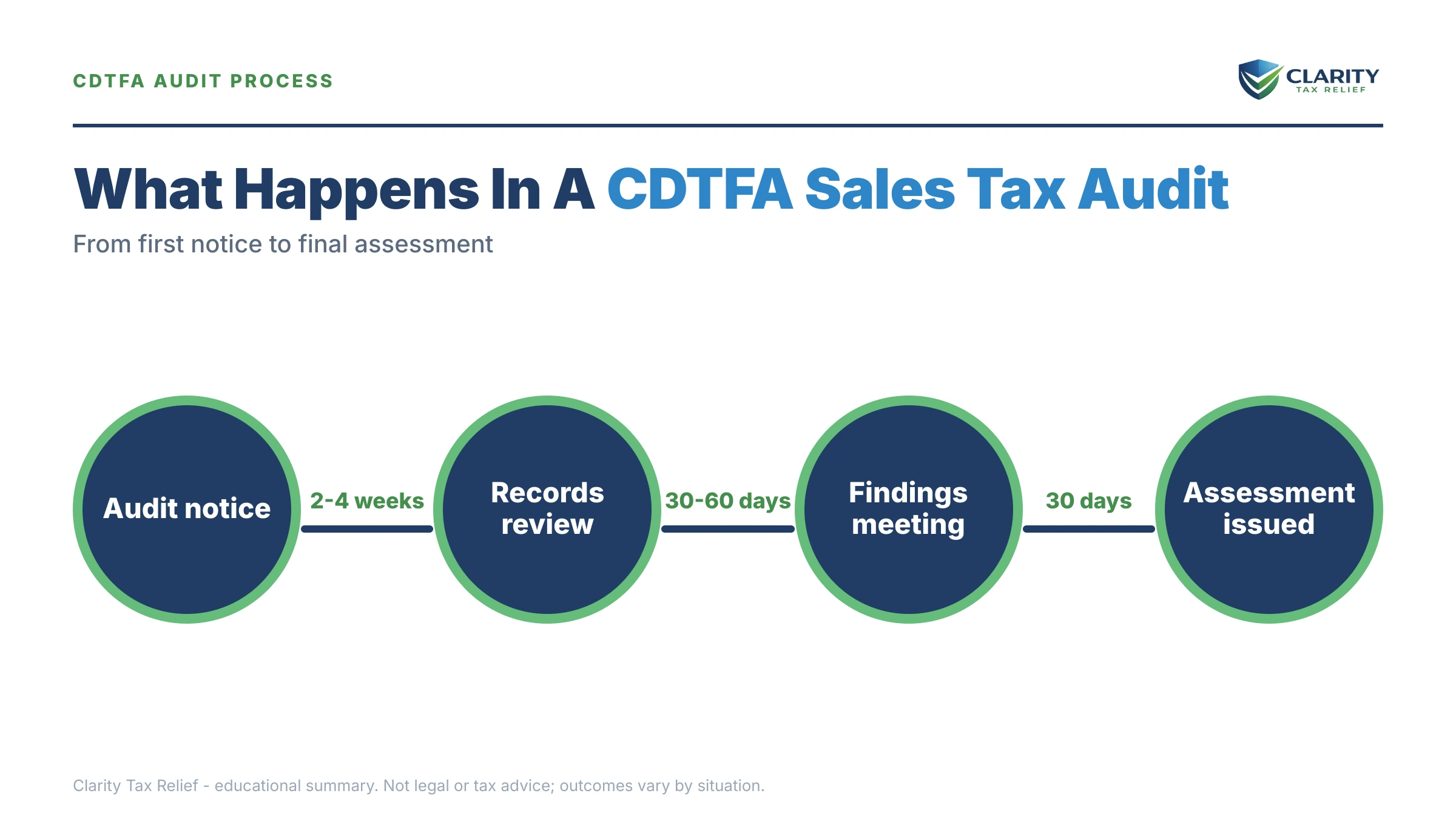
A CDTFA sales tax audit is a reconstruction exercise: the auditor rebuilds what your taxable sales should have been and compares that figure to what you reported. It opens with an engagement letter naming the audit period and listing the records requested, followed by an opening conference — by phone, at a CDTFA office, or at your business — where the auditor maps how money flows through your operation.
Then come the tests. Which ones the auditor runs depends on your industry and your records, but the core toolkit looks like this:
| Audit test | What CDTFA compares | What to have ready |
|---|---|---|
| Markup analysis | Your cost of goods sold, marked up to expected retail, vs. reported sales | Purchase invoices, inventory records, price lists showing your actual margins |
| Credit card / 1099-K ratio | Card-processing totals vs. total reported sales, extrapolating expected cash sales | 1099-Ks, processor statements, POS reports splitting cash vs. card |
| Bank deposit analysis | Total deposits vs. reported sales, netting out loans, transfers, and non-sale items | Business and personal bank statements, documentation for non-sale deposits |
| Observation test | Sales the auditor observes over sample days, projected across the audit period | Context for seasonality — a slow-week sample projected over 3 years distorts everything |
| Resale & exemption review (XYZ letters) | Claimed nontaxable sales vs. valid certificates and customer confirmations | Complete, timely resale certificates; customer contact info for verification letters |
| Federal return cross-check | Gross receipts on your 1040 Schedule C / 1120 / 1065 vs. sales tax returns | Federal returns for the audit years and a reconciliation explaining any difference |
Two features of this process surprise almost everyone. First, missing records don't protect you — they hand the auditor permission to estimate, using industry-average markups and projections that nearly always land higher than reality. Second, claimed exempt sales are guilty until documented: if you sold at wholesale without a valid resale certificate on file, CDTFA can tax that sale as retail, and it may send "XYZ letters" directly to your customers to verify the ones you did document.
Somewhere mid-audit, you may also be asked to sign a waiver extending the statute of limitations so the auditor has more time. Signing isn't automatically wrong — refusing can push the auditor to assess high immediately to protect the deadline — but it's a strategic decision, not a formality. For how this exam compares to other states' versions, see our broader guide to defending a sales tax audit.
How far back can a CDTFA audit go?
A CDTFA audit generally reaches back 3 years — but 8 years if you never filed sales tax returns for the period. Under Revenue and Taxation Code section 6487, the standard lookback is 3 years for filed returns and 8 years for unfiled periods, and there is no time limit at all where fraud is established.
That 8-year rule is the trap for anyone who operated informally — a market stall, an online store, a side business that never registered for a seller's permit. No returns means no statute running, and the audit can reconstruct nearly a decade.
The window can also stretch by consent: the waiver the auditor asks you to sign extends the 3-year statute for specific periods. Before signing, understand what you're preserving (time to negotiate) versus what you're giving up (the deadline that would otherwise close old periods forever).
Note that these are California rules, not federal ones. The IRS runs on its own, different lookback framework — covered in our guide to how far back the IRS can audit — and nothing about your CDTFA exam changes those federal windows, or vice versa.
What happens if you ignore a CDTFA audit
Ignoring a CDTFA audit doesn't make it stall — it makes the state finish it without you, using the least favorable assumptions available. The sequence runs in stages:
- Missed appointment. The auditor proceeds on "best available information" — 1099-K data, FTB and IRS filings, bank records obtainable by subpoena, and industry-average markups. Every judgment call goes against you because no one is there to explain your numbers.
- Preliminary findings issue without your input. The report proposes tax on estimated unreported sales, plus interest — and a 10% negligence penalty can be added, with a fraud penalty of 25% possible in aggravated cases.
- Notice of Determination. The proposed audit becomes an assessment: tax, penalties, and interest, with a petition deadline printed on the face of the notice — generally 30 days from its date.
- The petition window lapses. The assessment becomes final. Your appeal rights through CDTFA and the Office of Tax Appeals are gone; from here, disputing the numbers is dramatically harder.
- Collections begin. CDTFA can record liens, levy bank accounts, garnish income, and move to revoke your seller's permit for nonpayment. If the business has closed, CDTFA can pursue you personally for the trust-fund portion through a dual determination.
Every stage of that sequence is cheaper to interrupt than the one after it. The audit stage is where documents change the number; the petition stage is where arguments change it; the collection stage is mostly about payment terms.
Holding a CDTFA audit letter — or a Notice of Determination?
Send us a photo of it. An experienced tax professional will map where you are in the CDTFA process, what the auditor is likely testing, and what to do before your appointment date — or before the 30-day petition window on a Notice of Determination closes. Free and confidential.
Your options after a CDTFA sales tax audit
An audit assessment is not a single fork between "pay" and "fight" — California gives you several distinct paths, each with its own eligibility gate. Which door is open depends mostly on one thing: whether your liability is still in dispute or has gone final.
| Option | Best when | Key eligibility / limit |
|---|---|---|
| Pay in full | You agree with the findings and can cover the bill | Always available; stops further interest from accruing |
| Petition for redetermination | You dispute some or all of the assessment | Must be filed within the window on the Notice of Determination — generally 30 days |
| Appeal to the Office of Tax Appeals | CDTFA denies your petition and you still disagree | Requires a timely petition first; independent judges decide the case |
| CDTFA settlement program | Both sides face real litigation risk on a disputed assessment | Only while the liability is still in dispute — not after it goes final |
| CDTFA payment plan | The liability is correct but you can't pay at once | Available on final liabilities; interest continues while you pay |
| CDTFA offer in compromise | You genuinely cannot ever pay the final liability | Means-tested; most readily available when the business has closed |
The petition is the pivot point. Filing one on time keeps every door open — CDTFA review, an appeals conference, the settlement program, and ultimately the independent Office of Tax Appeals. Our guide to the CDTFA Notice of Determination walks through exactly what a petition must say and where to send it.
If the numbers are right and the problem is cash flow, a CDTFA payment plan converts the assessment into monthly payments and keeps collections — and your seller's permit — off the table while you pay. For the wider picture of resolving California sales tax balances beyond the audit itself, see California back sales tax.
| Option | Upfront cost | Typical timeline | What keeps accruing |
|---|---|---|---|
| Pay in full | The full assessment | Immediate | Nothing further once paid |
| Petition for redetermination | No filing fee | Months to a year-plus through review and conference | Interest on whatever is ultimately upheld |
| Office of Tax Appeals | No filing fee; representation costs if you use a pro | Often a year or more after the petition stage | Interest on the disputed balance |
| Settlement program | No fee; the negotiated amount varies by case strength | Runs alongside the dispute process | Interest until the settlement is finalized |
| Payment plan | First monthly payment | Starts within weeks of approval | Interest on the declining balance |
| Offer in compromise | Full financial disclosure; offer funds if accepted | Several months of CDTFA review | Interest until a decision is reached |
What a $13,600 CDTFA audit bill actually looks like
Say you owe $13,600 after a CDTFA audit — a realistic small-retail outcome. Here's hypothetical math showing how a bill like that gets built, using a boutique owner who took over the shop solo in a divorce and got audited for the three prior years:
- The auditor's markup analysis and 1099-K comparison conclude roughly $130,000 in taxable sales went unreported across the three-year audit period.
- At a combined state and local rate of about 8%, that's $10,400 in tax.
- A 10% negligence penalty adds $1,040.
- Accrued interest across the period adds roughly $2,160.
- Total on the Notice of Determination: $13,600.
Now watch what documentation does to that number. Suppose $40,000 of the "unreported" sales were actually wholesale orders to two boutiques that resold the goods — but the resale certificates were in your ex's email, never printed. Recover and submit them during the audit or petition stage, and the tax drops by about $3,200, the penalty tied to it by about $320, and the interest proportionally — cutting the total bill by roughly a third before you've negotiated anything.
And if the remaining balance is simply unpayable at once? Spread about $9,000 over a 12-month CDTFA payment plan and you're near $750 a month, with interest continuing on the declining balance. The order of operations matters: shrink the assessment first with documents and a timely petition, then arrange payment on what genuinely remains.
How to respond to a CDTFA sales tax audit, step by step
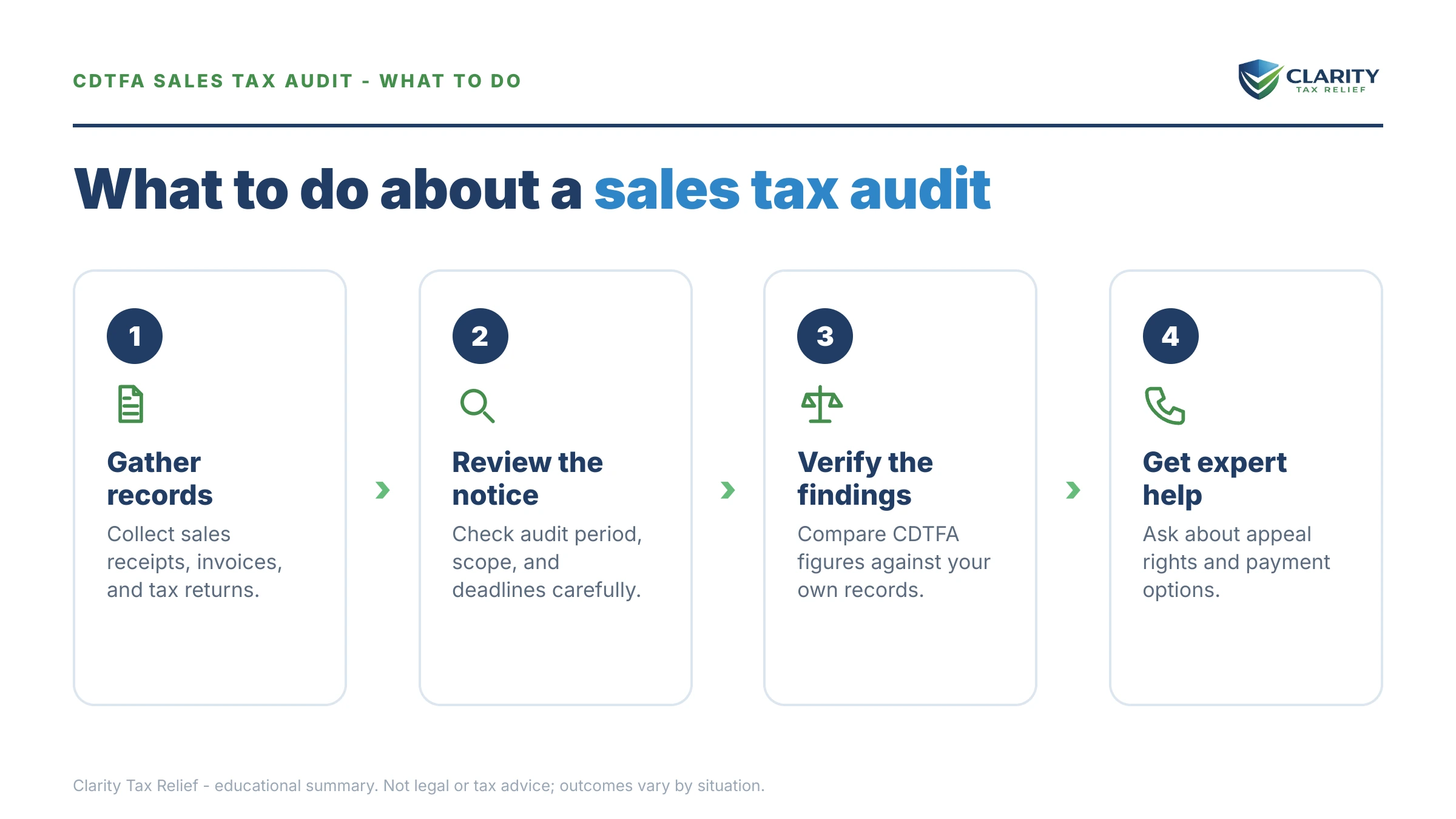
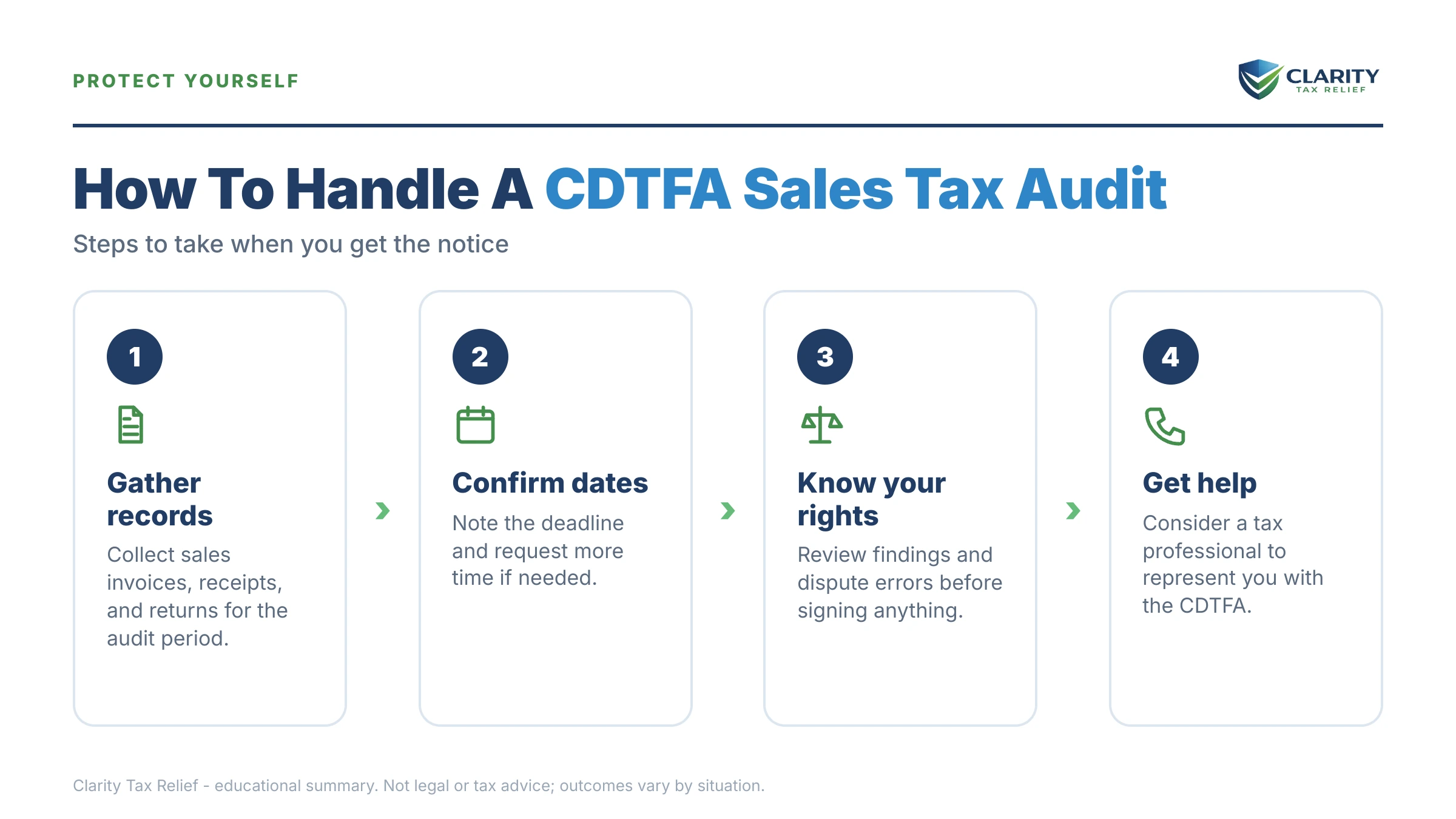
- Read the engagement letter carefully. Confirm the audit period, the records requested, and the appointment date before you do anything else.
- Contact the auditor promptly. Confirm or reschedule the appointment — silence is what turns audits into estimated assessments.
- Gather your records. Pull sales journals, POS reports, bank statements, federal returns, and resale and exemption certificates for the full audit period.
- Run the auditor's tests yourself first. Compare your 1099-K totals and bank deposits to reported sales so you find the gaps before CDTFA does.
- Respond to preliminary findings in writing. Errors corrected at the audit stage are far cheaper than errors appealed later.
- Petition within 30 days if you disagree. A Notice of Determination gives you a 30-day window to file a petition for redetermination — calendar it the day the notice arrives.
Divorced, closed, or sold the business? Who CDTFA can pursue
CDTFA follows responsibility, not paperwork — and that has sharp edges for anyone whose business changed hands recently. A divorce decree assigning the tax debt to your ex does not bind CDTFA. If your name was on the seller's permit during the audit years, or you signed returns and controlled the accounts, the state can assess and collect from you and leave you to enforce the decree against your ex separately. The same principle applies federally, as we explain in our guide to the divorce decree and IRS debt — family court divides obligations between spouses; it doesn't erase either spouse's liability to a tax agency.
If the business has closed, the liability doesn't close with it. Sales tax reimbursement collected from customers is trust money, and Revenue and Taxation Code section 6829 lets CDTFA issue a dual determination — a personal assessment against the individuals who controlled the finances of a terminated business that failed to remit. An LLC or corporation is not a shield here; what matters is who had the duty and authority to pay. Our guide to a closed business that still owes sales tax covers how to contest responsible-person status.
Buying or selling a business carries its own trap: successor liability. A buyer who takes over a California business without obtaining a tax clearance certificate can be held liable for the seller's unpaid sales tax, up to the purchase price. If you acquired your business — in a sale or a divorce settlement — and CDTFA is now auditing periods before you took over, establishing exactly when your responsibility began is one of the most valuable arguments in the case.
When you can handle a CDTFA audit yourself — and when to get help
You can reasonably handle a CDTFA audit on your own when your records are complete, the audit period is short, and the auditor's preliminary numbers roughly match your own reconciliation. If the exam ends with a small adjustment you agree with and can pay — or can spread over a straightforward payment plan — professional fees may cost more than they save. Be organized, be prompt, and keep everything in writing.
Experienced help changes outcomes in specific situations: when records are missing and the auditor is estimating from industry averages you can rebut; when the business is cash-intensive and the projection methods themselves are attackable (the same dynamics we cover in cash business audit defense); when large exempt or resale sales are being disallowed for certificate defects that can be cured; when the business has closed and CDTFA is building a personal dual determination; and when the case is headed to petition, settlement, or the Office of Tax Appeals, where framing decides money.
One situation demands help before you say another word to the auditor: if the audit years contain deliberately unreported cash, second sets of books, or anything you'd be afraid to explain under oath, you're in what practitioners call an eggshell audit — a civil exam sitting on top of potential criminal exposure. In that scenario, how facts get disclosed matters as much as what the facts are, and representation isn't a luxury.
Not sure which side of that line you're on? A free case review with an experienced tax professional will tell you honestly whether this is a records problem you can fix yourself or a defense problem worth paying for — call (888) 825-7779 or use the 2-minute form.
Terms on your CDTFA audit paperwork, decoded
- Notice of Determination: CDTFA's formal assessment of tax, penalties, and interest after an audit — the document that starts your petition clock.
- Petition for redetermination: your written challenge to a Notice of Determination, generally due within 30 days of the notice date, which keeps the assessment from going final.
- Markup analysis: the audit method that takes your cost of goods, applies an expected retail markup, and compares the result to your reported sales.
- XYZ letter: a verification letter CDTFA sends to your customers to confirm that sales you claimed as nontaxable resales really were purchases for resale.
- Dual determination: a personal assessment under Revenue and Taxation Code section 6829 against individuals who controlled a closed business's finances when it failed to remit collected sales tax.
- Waiver: your written consent extending the statute of limitations so the auditor has more time to finish — a strategic decision, never an automatic yes.
- Resale certificate: the document a wholesale customer gives you certifying goods are bought for resale; without a valid one on file, CDTFA can tax the sale as retail.
CDTFA sales tax audit FAQs
What triggers a CDTFA sales tax audit?
Most CDTFA audits start with a data mismatch: the sales you reported on your sales tax returns don't line up with your federal income tax returns, your 1099-K card-processing totals, or the markup CDTFA expects for your industry. Cash-heavy businesses, high claimed exempt sales, and closing or selling a business also raise selection odds. Random selection happens, but it's the minority.
How far back can the CDTFA audit my business?
Generally three years from when returns were due or filed. If you never filed sales tax returns for a period, the lookback extends to eight years, and there is no time limit where fraud is established. CDTFA may also ask you to sign a waiver extending the three-year window — that decision deserves professional input before you sign.
How long does a CDTFA sales tax audit take?
There's no fixed statutory length — routine audits of small businesses often wrap up in a few months, while audits involving reconstructed records, multiple locations, or disputed exempt sales can run a year or longer. The single biggest factor you control is how organized your records are; missing records force the auditor into slower, less favorable estimation methods.
Can I refuse or ignore a CDTFA audit?
No — refusing doesn't stop the audit, it just removes your voice from it. CDTFA has legal authority to examine your records and can subpoena them, and if you don't participate the auditor estimates your liability from third-party data and industry averages. Those estimates almost always run higher than what complete records would show.
What happens after the audit is finished?
You'll receive the auditor's findings, a chance to respond, and then — if a balance remains — a Notice of Determination assessing the tax, penalties, and interest. You generally have 30 days from the date on that notice to file a petition for redetermination. Miss that window and the assessment becomes final, moving your case from audit to collections.
Am I personally liable for sales tax my business owes?
You can be. Sales tax reimbursement collected from customers is treated like trust money, and when a business closes owing it, CDTFA can issue a dual determination under Revenue and Taxation Code section 6829 against the people who controlled the finances. Corporate and LLC structures do not reliably block this — responsibility, not entity type, is what CDTFA tests.
Does my divorce decree protect me from a CDTFA audit bill?
Not by itself. A divorce decree divides obligations between you and your ex — it binds the two of you, not the state. If your name was on the seller's permit or you were a responsible person during the audit period, CDTFA can pursue you and leave you to seek reimbursement from your ex under the decree.
Can I settle a CDTFA audit for less than the full amount?
Sometimes, through two narrow doors. While the assessment is still in dispute, CDTFA's settlement program can resolve cases based on the litigation risk each side faces. Once a liability is final, CDTFA's offer in compromise program may accept less than full payment — but it is means-tested and most readily available when the business has closed. Neither is automatic or guaranteed.
Will a CDTFA audit affect my seller's permit?
The audit itself doesn't, but an unpaid final liability can. CDTFA has authority to revoke a seller's permit for failure to pay amounts due, and operating a retail business in California without a valid permit is illegal. Getting on a payment plan before the liability goes delinquent is the practical way to keep the permit safe.
Your Next 24 Hours
- Find the controlling date. On an engagement letter, that's the audit period and appointment date; on a Notice of Determination, it's the notice date that starts your 30-day petition window. Write it somewhere you'll see it daily.
- Pull the audit-year paper trail. Sales tax returns, federal returns, POS and 1099-K reports, bank statements, and every resale or exemption certificate — including anything still in your ex's files or email from before the divorce.
- Get the letter reviewed free. Call (888) 825-7779 or use the 2-minute form before your appointment date — or before the petition window closes — so an experienced tax professional can tell you what the auditor is likely testing and how to answer it.
For primary-source details on California sales and use tax, seller's permits, and audit procedures, see the California Department of Tax and Fee Administration. Appeals beyond CDTFA are heard by the independent California Office of Tax Appeals.
This guide is general information, not tax or legal advice for your specific situation. Eligibility for IRS programs depends on individual facts and circumstances; no outcome is guaranteed. The same is true of California tax programs, which have their own rules and eligibility tests.