
IRS Audits
Cash Business Audit: How the IRS Reconstructs Your Income — and How to Fight Back (2026)
The short answer: a cash business audit is an IRS exam that assumes your books are incomplete. The auditor rebuilds your income indirectly — from bank deposits, spending, and industry ratios — and every unexplained dollar counts as income until you prove otherwise. Your documentation, not the auditor's estimate, decides the final bill.
The envelope says a return — or a year you never filed — has been selected for examination. Your money arrives as cash tips, app payouts, and peer-to-peer transfers, and you already know your deposits won't line up neatly with anything on paper. Here's what matters: the auditor's reconstruction is a first draft, not a verdict, and the next few weeks decide which version of your income becomes the bill.
This guide covers how the IRS builds that draft, the two deadlines that control the exam, and every point where you can push back. The image below shows exactly what the paperwork in a cash business audit looks like and where the numbers that become your bill actually come from.
⏱ Two clocks control a cash business audit. You typically have 30 days to protest the exam report (Letter 525) to the IRS Independent Office of Appeals, and exactly 90 days to petition Tax Court after the statutory notice of deficiency (CP3219A). The earlier clocks — your opening letter and document requests — use the dates printed on those letters. Miss the 90-day window and the reconstruction becomes an assessed debt.
Why cash business audits happen — and why you were selected
Cash-intensive businesses draw disproportionate IRS exam attention because cash leaves no third-party paper trail — so the IRS treats the surrounding evidence as the trail instead. Restaurants, salons, landscaping, construction, rideshare and delivery work with cash tips, vending, laundromats: the IRS maintains published Audit Techniques Guides for many of these industries, which means examiners walk in already knowing what your margins "should" look like.
Selection usually starts with a mismatch a computer can see. The classic patterns:
- Lifestyle vs. reported income. Your return shows $19,000 of profit, but your mortgage, car payments, and card spending require twice that. The IRS's scoring models — increasingly machine-driven, as we cover in IRS AI audits — are built to spot exactly that gap.
- A 1099-K that dwarfs your reported gross. The 1099-K threshold sits at $20,000 and 200 transactions in 2026, so platform income above that line is reported to the IRS whether or not you report it yourself.
- Ratios that don't fit your industry. A markup or cost-of-goods percentage far outside the norm for your business type raises the return's audit score. We break down owner-specific triggers in small business audit red flags.
- Unfiled years. A gig worker or cash operator with several unfiled years is a natural exam target, because the IRS's own income data (1099-NEC, 1099-K, W-2G) shows money moving with no return behind it. If that's you, start with haven't filed in 3 years — filing accurate returns before the exam hardens is the single highest-leverage move available.
- Referrals. Tips from ex-employees or ex-spouses, and data shared from state sales-tax and payroll audits, all feed the exam pipeline.
Most self-employed cash exams are technically Schedule C audits — but the cash-intensive version differs in one crucial way: the examiner isn't just testing your deductions. They're testing whether your reported income is real, and they don't need your cooperation to build their own number.
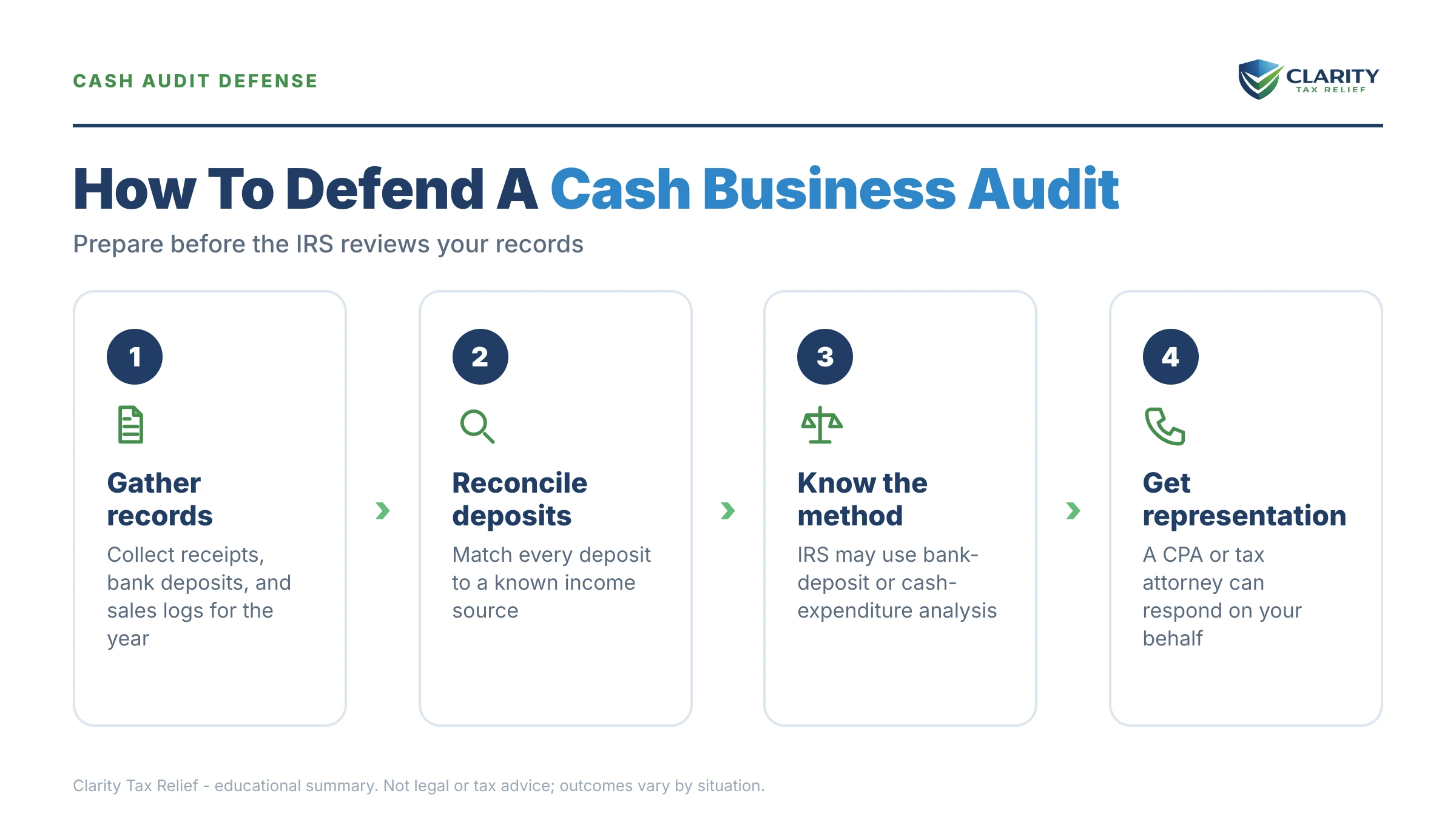
How the IRS reconstructs cash income without your books
When a cash business can't produce complete records, the IRS is legally permitted to reconstruct income using indirect methods — and courts routinely uphold the results when the method is reasonable. Once the auditor produces a plausible reconstruction, the practical burden shifts to you: every deposit, every asset, and every dollar of spending is income until you document a nontaxable source.
| Indirect method | What the auditor examines | How you rebut it |
|---|---|---|
| Bank deposit analysis | Every deposit into every account you touch — checking, savings, and payment apps | Trace and label nontaxable deposits: transfers between accounts, loan proceeds, gifts, refunds, reimbursements |
| Cash-T (source & application of funds) | Total money you spent versus total income you reported | Document nontaxable cash sources — savings drawn down, gifts, insurance proceeds, borrowed money |
| Net worth method | Year-over-year growth in what you own against reported income | Show assets were bought with prior savings, inheritance, or financing — with dates and paper |
| Markup / percentage method | Industry gross-profit ratios applied to your purchases and cost of goods | Prove why your margins differ: spoilage, discounting, theft, comps, local pricing |
| Unit & volume method | Supplies consumed (cups, boxes, appointment slots) multiplied by your prices | Correct the per-unit assumptions with your actual menu, pricing history, and waste rates |
The bank deposit method dominates because it's mechanical, and it has a brutal default: every unexplained deposit is treated as taxable income. A transfer from savings to checking, a Venmo repayment from a roommate, a car-loan disbursement — all income, on paper, until you connect the dots. Our companion guide to the bank deposit method audit walks through the tracing process line by line.
Missing receipts on the expense side are a related but separate battle. Courts sometimes allow reasonable estimated expenses under the Cohan rule — but not for vehicle and travel costs, which require contemporaneous-style records. If your deduction documentation is thin, read IRS audit no receipts before your first response, because reconstructed records prepared honestly and labeled as such are routinely accepted.
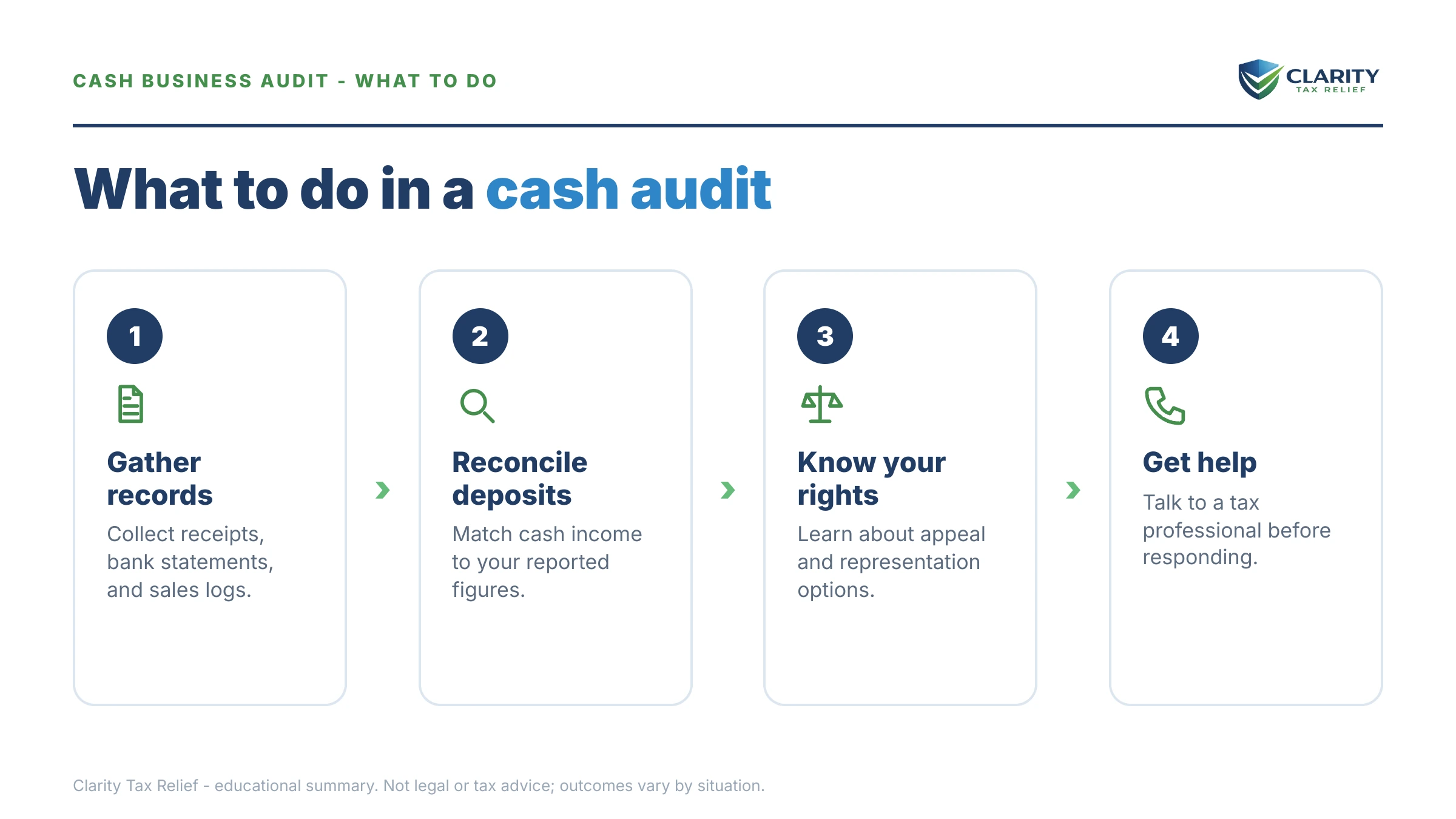
A worked example: $13,600 on the table
Say you're a gig worker — rideshare, delivery, some cash landscaping on the side — with three years unfiled. The IRS opens an exam and runs a bank deposit analysis. It totals $68,400 in deposits across the three years, treats every dollar as self-employment income, allows zero expenses (you documented none), and proposes $13,600 in additional tax — most of it self-employment tax, which runs 15.3% on net earnings before income tax even starts.
Because the years were unfiled, penalties stack on top:
- Failure-to-file penalty: 5% per month, capped at 25% — up to $3,400 on this balance.
- Failure-to-pay penalty: 0.5% per month, still running.
- Interest: compounding daily on tax and penalties alike.
Before you've disputed a single number, the $13,600 is closer to $18,000 and climbing. You can estimate your own penalty exposure with our Penalty & Interest Calculator.
Now run the defense. You go through the statements and prove $9,200 of deposits were transfers between your own checking and savings, and $3,000 was a documented family loan — both nontaxable, both removed. Your app trip histories support roughly 41,000 business miles across the three years, worth roughly $27,000 in mileage deductions at the standard rates, plus platform fees and phone costs. Reconstructed net profit drops from $68,400 to about $28,000; the tax falls to roughly $4,900, and the capped failure-to-file penalty falls with it, from $3,400 to about $1,225.
In this hypothetical, documentation is worth roughly $10,000 — the difference between the IRS's zero-expense draft and a defended return. That's the entire game in a cash business audit: whoever does the reconstruction work controls the number.
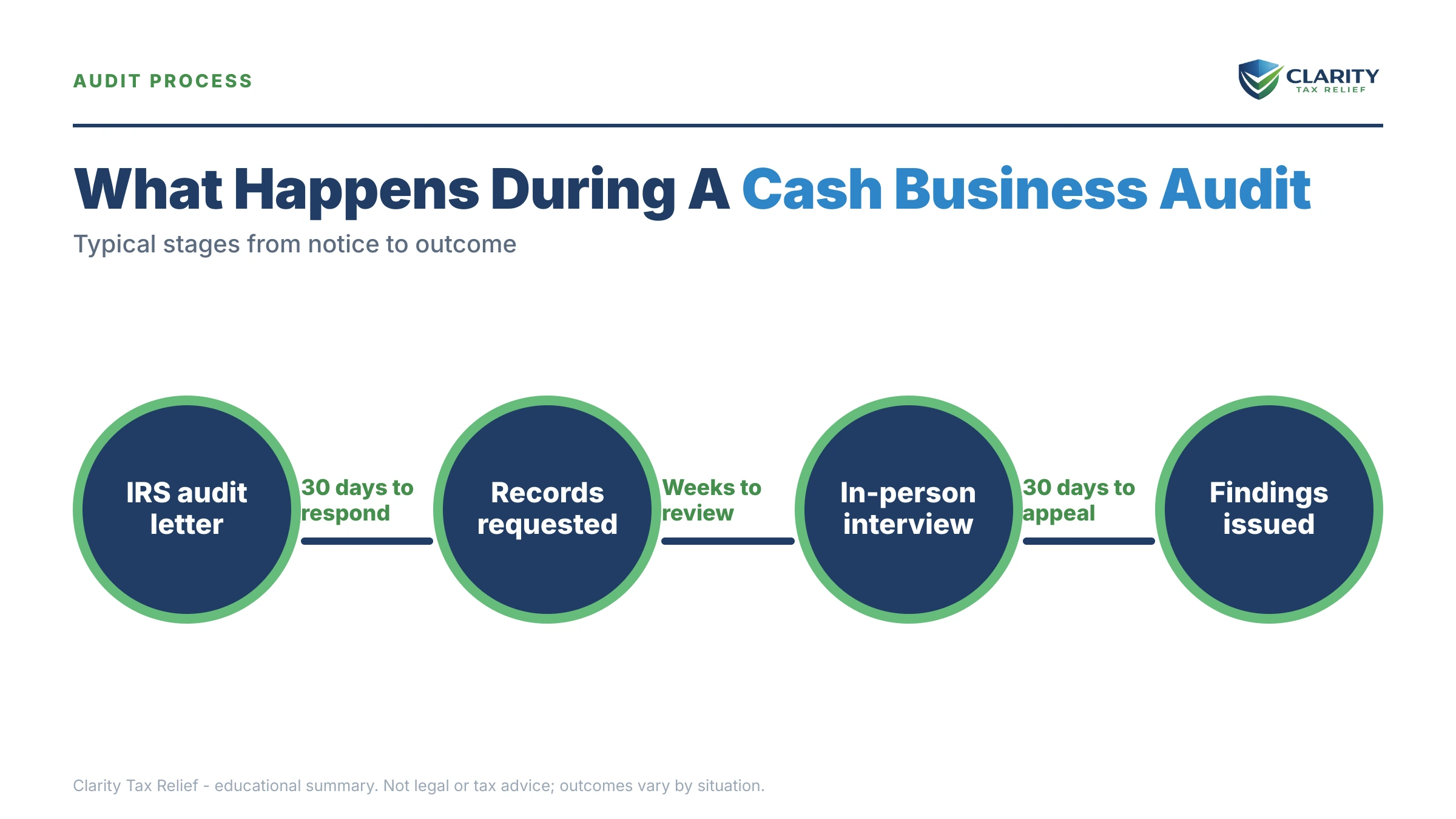
What happens if you ignore a cash business audit
An ignored cash business audit ends with the IRS's reconstruction becoming a legally assessed debt — almost always the largest number the process could have produced. The sequence is procedural and it does not require your participation:
- The opening letter goes unanswered (Letter 566 or Letter 2205-A). The exam proceeds without you. The auditor can summons your bank records directly — silence doesn't hide the deposits; it only removes your explanations.
- The document request (Form 4564) goes unanswered. Every deposit becomes income. Every expense is disallowed. The reconstruction is finished using only the IRS's assumptions.
- Letter 525 arrives — the exam report. This is the "30-day letter": your window to protest to the Independent Office of Appeals, where most disputed exams settle. The report may now include the 20% accuracy-related penalty — or a 75% civil fraud penalty if the examiner found deliberate concealment.
- CP3219A — Notice of Deficiency. The 90-day letter. Petitioning Tax Court is your last chance to dispute the numbers before they're assessed — and you don't have to pay first to do it.
- Assessment, then collection. A CP14 bill (about 21 days to respond — 10 business days if the balance is $100,000 or more), then escalating notices toward lien filing and levy of bank accounts and wages. The dispute phase is over; only payment and post-assessment remedies remain.
One more branch matters in cash exams specifically: if the auditor finds badges of fraud — hidden accounts, structured deposits, two sets of books — the civil exam can pause and route toward a fraud referral. That's the eggshell audit scenario, and it's the one situation where what you say to the auditor matters more than any document you produce.
Facing a cash business audit right now?
Before you answer the auditor's first question, have an experienced tax professional review your letters and transcripts — free and confidential. The reconstruction the IRS builds in the first weeks is the number you'll be fighting for months.
Your options during and after a cash business audit
You can challenge a cash business audit at four separate points — during the exam, at Appeals, in Tax Court, and even after assessment — and each stage has different rules and costs. Most taxpayers get their best result at the first two stages, where the examiner and Appeals officer both have authority to accept documentation and settle based on litigation risk. If you disagree with the outcome, your full playbook is in IRS audit appeal.
| Option | When it's available | What it requires / costs |
|---|---|---|
| Document and rebut during the exam | From the opening letter until the exam report | Free; labeled deposit tracing, reconstructed expense records, filed returns for unfiled years |
| Appeals protest (30-day letter) | Typically 30 days from Letter 525 | Free; a written protest — Appeals weighs hazards of litigation, not just the auditor's file |
| Tax Court petition | 90 days from the CP3219A notice of deficiency | Modest filing fee; no payment required first; many cases settle before trial |
| Audit reconsideration | After assessment, with documentation the exam never considered | Free, but discretionary — strongest when you never received or responded to the audit |
| Offer in Compromise — doubt as to liability | After assessment, when the reconstructed amount is genuinely wrong | Form 656-L; no application fee; requires evidence the assessment overstates what you owe |
| Payment plan on the final balance | After assessment, if the number is right but unpayable at once | Balances of $50,000 or less can be set up online for up to 72 months; interest and the 0.5%/month penalty continue |
| Penalty relief | After penalties are assessed | First-Time Abate with a clean prior 3 years, or reasonable cause; starting summer 2026, the Automatic Exemption from Penalty (AEP) applies some relief with no request needed |
Two cautions on this menu. First, an Offer in Compromise based on inability to pay (doubt as to collectibility) is means-tested — the IRS accepted roughly 1 in 5 offers in FY2024, and it runs the math on your assets and income, not your preference. Second, auditors in multi-year cash exams often ask you to sign Form 872, extending the time the IRS has to assess. Signing is sometimes the right call and sometimes a serious mistake; get advice on that specific decision before you sign anything.
How to respond to a cash business audit, step by step
- Calendar every deadline. Find the response date on your opening letter (Letter 566 or Letter 2205-A) and calendar it, along with every deadline in the letters that follow.
- Pull your transcripts. Order your wage and income transcript and account transcripts so you see the same third-party data the auditor is working from.
- Reconstruct your deposits. Go through every bank and payment-app statement for the audit years and label each deposit: sales, transfer, loan, gift, or refund.
- File any unfiled years. Prepare accurate returns for the missing years before the IRS builds its own version with zero expenses.
- Answer the document request in writing. Respond to the Form 4564 completely and in one organized package — and never hand over more years or accounts than the request names.
- Appeal if you disagree. If the exam report is wrong, file a written protest within the 30-day window instead of letting the reconstruction become final.
How the audit shows up on your IRS transcript
Your account transcript usually signals an examination before, during, and after the letters arrive — which makes it the fastest free way to confirm where a cash business audit actually stands.
| Code | What it means | What to do |
|---|---|---|
| 424 | Exam request — your return is flagged for possible examination | Watch the mail; pull all transcripts; don't file amendments blindly |
| 420 | Return assigned to examination | Match it to an opening letter and start reconstructing your deposit records now |
| 971 | Notice issued | Match the transcript date to the letter in hand so you know which clock is running |
| 300 | Additional tax assessed by examination | The audit closed against you — if you never got to respond, look at audit reconsideration |
| 421 | Examination closed | Confirm the closing letter and check whether a balance was assessed or the exam ended no-change |
When you can handle a cash business audit yourself
You can reasonably handle the exam alone when the stakes and the story are both simple: one tax year, returns actually filed, books that reconcile to your bank statements, and a correspondence-only exam asking for a specific document or two. In that situation, organized records and short, factual written responses usually close the exam without drama — and paying a professional may not change the outcome.
Experienced representation changes outcomes in the situations cash exams are famous for:
- Unfiled years inside the exam. The sequence you file them in, and what they show, shapes the entire reconstruction.
- Deposits you can't immediately explain. Tracing has to be done carefully — a wrong guess in writing is worse than no answer.
- Any hint of fraud exposure. Structured deposits, unreported accounts, or income deliberately left off returns mean your representative should be talking to the auditor, not you. A Form 2848 power of attorney lets a representative attend the interviews in your place.
- Multi-year or business-site exams. When the auditor wants to tour your business or expand to more years, scope control becomes the fight.
If your cash business audit involves unfiled years or deposits you can't yet explain, have an experienced tax professional review your transcripts before your first conversation with the examiner — the free case review at (888) 825-7779 covers exactly that.
Terms on your audit letters, decoded
- Indirect method — any technique that estimates income from evidence other than your books: deposits, spending, assets, or industry ratios.
- Information Document Request (Form 4564) — the auditor's written list of records to produce; it defines the exam's scope, which is why you never volunteer beyond it.
- 30-day letter (Letter 525) — the exam report with proposed changes; your window to protest to the Independent Office of Appeals before the numbers advance.
- Statutory notice of deficiency (CP3219A) — the "90-day letter"; your only pre-payment ticket to Tax Court, and a hard deadline that cannot be extended.
- Badges of fraud — patterns examiners are trained to flag: hidden accounts, structured deposits, destroyed records, false statements. They separate a civil bill from criminal exposure.
- Cohan rule — court doctrine allowing reasonable estimated deductions when records are lost, except for categories like vehicle and travel that require actual records.
Cash business audit questions, answered
What triggers a cash business audit?
Most cash business audits start with a mismatch a computer can see: reported income too low to support your rent, mortgage, or spending; margins that don't fit your industry; a 1099-K that dwarfs your reported gross; or years you never filed. The IRS's scoring models — increasingly AI-driven — flag returns where the lifestyle and the numbers don't line up, and cash-intensive industries carry extra scrutiny because underreporting is common there.
Can the IRS audit my cash business if I kept no records?
Yes — missing records don't stop an audit; they change how it's done. The auditor switches to an indirect method like bank deposit analysis and builds your income from third-party data: bank statements, payment-app records, and industry markup ratios. You're then in the position of disproving the IRS's number, which is why reconstructing your own records first matters so much.
How far back can a cash business audit go?
The standard window is three years from filing, but it stretches to six years if the IRS can show you omitted more than 25% of gross income — a common allegation in cash exams. For unfiled years or fraud, there is no time limit at all, because the assessment clock never started running.
How does the IRS know about cash income that was never deposited?
Through indirect evidence: what you spent, what you own, and what businesses like yours typically earn. A Cash-T analysis compares your total outflows against reported income; if you spent more than you made on paper, the gap is presumed to be unreported income. The 1099-K threshold reverted to $20,000 and 200 transactions for platforms, but the IRS never needed a form to reconstruct cash.
What is the bank deposit method in a cash business audit?
It's the IRS's most common income-reconstruction tool: the auditor totals every deposit into every account you touch, subtracts items you prove are nontaxable, and treats the remainder as income. Transfers between accounts, loan proceeds, gifts, and refunds all count as income until you document otherwise — which is why labeling every deposit before your first meeting is the core of the defense.
Can a cash business audit turn into a criminal case?
It can, but rarely — the line is willfulness. Civil exams handle sloppy records and honest underreporting; criminal referrals happen when the auditor finds badges of fraud: two sets of books, structured deposits kept under $10,000, destroyed records, or false statements during the exam. If any of those describe your situation, stop talking to the auditor and get representation before answering anything else.
Should I talk to the IRS auditor myself?
If your returns are accurate and your records are solid, you can — politely, briefly, and only about what's asked. If income was understated, if years are unfiled, or if you're not sure, don't: everything you say is evidence, and casual answers about how much cash the business handles routinely become the auditor's reconstruction assumptions. A representative with a power of attorney can attend in your place.
What happens if I ignore the audit letter?
The audit happens without you. The auditor reconstructs your income from bank records and industry data, allows zero expenses you didn't document, and issues an exam report you have roughly 30 days to protest. Ignore that, and a statutory notice of deficiency starts a 90-day Tax Court clock; after that, the balance is assessed and collection begins — with far fewer ways to challenge the numbers.
Does keeping deposits under $10,000 protect me in an audit?
No — it does the opposite. Deliberately breaking cash deposits into smaller amounts to avoid bank reporting is called structuring, and it's a federal crime even when the underlying money is legal. In an audit, a pattern of just-under-$10,000 deposits is one of the strongest badges of fraud an examiner can find. Deposit business cash as it comes; the paper trail helps you far more than it hurts.
Your next 24 hours
- Find the response deadline and the tax years listed on your opening letter — the letter number (566 or 2205-A) is in the corner, and the years named define the exam's starting scope.
- Gather the raw material: bank and payment-app statements for every account you touched during those years, your last filed return, and any loan, gift, or transfer records that explain non-income deposits.
- Get a free case review — the 2-minute form at /#consult or (888) 825-7779 — before your first conversation with the examiner. The 30-day and 90-day windows come later, but the reconstruction assumptions get set now, and penalties and interest accrue the entire time.
For deeper primary-source reading, the IRS explains the exam process at IRS audits for small businesses and the self-employed and publishes its industry playbooks in the Audit Techniques Guides — reading the guide for your industry shows you the exact questions coming. If the exam stalls or the IRS won't respond, the independent Taxpayer Advocate Service can intervene at no cost. The general lookback rules that decide how many years can be pulled in are covered in our hub on how far back can the IRS audit.
This guide is general information, not tax or legal advice for your specific situation. Eligibility for IRS programs depends on individual facts and circumstances; no outcome is guaranteed.