
IRS Audits
Bank Deposit Method Audit: How the IRS Reconstructs Your Income — and How to Respond (2026)
The short answer: in a bank deposit method audit, the IRS totals every deposit into every account you hold, subtracts the deposits you can prove were nontaxable, and treats the rest as unreported income. The burden falls on you — any deposit you can't document gets taxed, often with a 20% penalty on top.
The examiner asked for your bank statements, ran the numbers, and now claims your deposits show income you never reported. Maybe you know exactly which deposits they're wrong about — the settlement transfer from your ex, the child support, the money you moved between your own accounts. Every one of those can come off the number. But none of them come off automatically.
This guide walks you through how the analysis is built, which deposits are legally nontaxable, how to prove it with documents the examiner must accept, and what to do at each deadline if the report is wrong. The image below shows you exactly what an examiner's deposit analysis looks like and where the number that becomes your tax bill comes from — knowing that layout is half the battle.
⏱ Your deadlines: you have 30 days from the date on the examiner's report letter to file a written protest with IRS Appeals, and 90 days from a Notice of Deficiency to petition Tax Court. Before that, the only clock is the response date printed on your Information Document Request — miss it, and the IRS can summons your bank records and build the analysis without you.
Why the IRS chose the bank deposit method for your audit
The IRS uses the bank deposit method when your reported income doesn't match the money moving through your accounts. It's an "indirect method" — instead of checking your return line by line against receipts, the examiner rebuilds your income from the outside, using your own bank records as the raw material. IRC §446(b) gives the IRS authority to compute income by any method that clearly reflects it, and courts have upheld deposit analyses for decades.
There's a legal limit worth knowing: under IRC §7602(e), the IRS may not use financial-status techniques to hunt for unreported income unless it already has a reasonable indication that unreported income likely exists. In practice, that indication usually comes from one of these:
- Deposits visibly exceed reported income. Information returns — 1099-Ks from payment apps, 1099-NECs, W-2Gs — arrive at the IRS whether or not they made it onto your return. Mismatch scoring is increasingly automated; see how IRS AI audits select returns in 2026.
- Cash-intensive work. Restaurants, salons, contractors, and anyone paid heavily in cash draw this method by default, because there's no third-party paper trail to test. If that's your situation, the cash business audit playbook applies alongside this one.
- A divorce-year anomaly. Divorce years are a classic false-positive trigger. Your reported income drops — one W-2 instead of two, a mid-year job change — while your deposits spike, because settlement money, account splits, and support payments are all landing in your account. To a computer, that pattern looks exactly like unreported income. To a documented file, it looks like a divorce.
- Sloppy or missing records. When you can't substantiate a Schedule C, the examiner falls back on deposits. Being audited with no receipts almost guarantees an indirect method gets used.
One reassurance up front: a deposit analysis is a civil examination tool, not an accusation of fraud. The examiner isn't claiming you hid money — yet. The analysis is a presumption machine, and presumptions can be rebutted with paper.
How a bank deposit method audit works, step by step
A bank deposit method audit treats every deposit as taxable income until you prove otherwise. Here is the actual sequence the examiner follows, so you know what's happening on the other side of the table:
- The document request. The audit opens with Letter 566 or an appointment letter, followed by Form 4564 — an Information Document Request (IDR) — asking for 12 months of statements for every account: checking, savings, money market, and increasingly PayPal, Venmo, and Cash App. In an IRS field audit, a revenue agent may ask for these at the first meeting.
- The tally. The examiner enters every single deposit into a workpaper — date, amount, source if identifiable.
- The examiner's own subtractions. Good examiners remove obvious non-income items on their own: visible transfers between accounts on the same statements, direct-deposited tax refunds, redeposited checks. Don't count on it — anything ambiguous stays in.
- The comparison. Total remaining deposits get compared to the gross income on your return. The excess is proposed as unreported income on Form 4549, the examination report.
- Your rebuttal window. Everything before the report is signed is negotiable. Every deposit you document as nontaxable comes off the proposed adjustment — dollar for dollar.
The single most important fact in this entire process: the burden of proving a deposit was nontaxable is on you, not the IRS. Once the government establishes the deposits exist, courts treat them as strong evidence of income. The examiner doesn't have to prove the $4,000 deposit in March was wages; you have to prove it was your ex-spouse's equalization payment.
Which deposits are nontaxable — and what proves it
Most inflated deposit analyses collapse once these categories are documented. Match each deposit to its source by exact date and amount:
| Deposit type | Taxable? | Proof the examiner will accept |
|---|---|---|
| Transfers between your own accounts | No | Both statements — the withdrawal and the matching deposit |
| Property settlement from an ex-spouse (IRC §1041) | No | Divorce decree or marital settlement agreement + the payment record |
| Child support | No — never | Support order + payment history (state disbursement records help) |
| Alimony under post-2018 agreements | No | Divorce/separation agreement executed after Dec. 31, 2018 |
| Loan proceeds | No | Signed note or loan agreement; lender's disbursement record |
| Gifts and inheritances | No (to recipient) | Signed donor statement; donor's bank record; estate documents |
| Federal and state tax refunds | No* | IRS/state account records (*state refunds can be partly taxable if deducted earlier) |
| Sale of personal items at a loss | No gain to report | Original purchase evidence + sale record |
| Redeposit of cash you previously withdrew | No | The earlier withdrawal, tied by amount and timing |
| Cash wages, side-gig receipts, client payments | Yes | These stay in — and should have been reported |
Two divorce-specific rules do the heaviest lifting for recently divorced filers. First, IRC §1041 makes property transfers between spouses "incident to divorce" completely nontaxable — the house buyout, the retirement equalization, the split of the joint savings account. Second, alimony under agreements executed after December 31, 2018 is not income to the recipient, and child support never is. An examiner who doesn't have your decree in the file will count all of it as income. Get the decree in the file.
A worked example: turning a $27,500 deposit gap into $2,500
Say you divorced last year and the examiner's analysis shows $96,300 in total deposits against $68,800 of reported income — a proposed $27,500 in unreported income. This is hypothetical, but the math is exactly how these cases resolve. You go deposit by deposit:
- $9,000 — equalization payment from your ex under the settlement agreement (§1041, nontaxable): off.
- $7,200 — twelve monthly $600 child support deposits (never taxable): off.
- $4,800 — four transfers from your own savings into checking (double-counted money): off.
- $2,300 — federal and state tax refunds: off.
- $1,700 — furniture and exercise equipment sold below what you paid: off.
That documents $25,000 of the gap, leaving $2,500 genuinely unexplained — maybe cash birthday gifts and a repaid personal loan you can't paper. At a 22% marginal rate, the tax difference is stark: $27,500 × 22% = $6,050 in tax, plus a 20% accuracy-related penalty of about $1,210, plus interest — versus roughly $550 on the $2,500 that survives, where the penalty may not even apply. Same audit, same bank statements. The only variable was documentation.
Curious what a proposed adjustment would actually cost once penalties and interest stack on? You can estimate it with our Penalty & Interest Calculator before you decide whether to agree or fight.
What happens if you ignore a bank deposit analysis
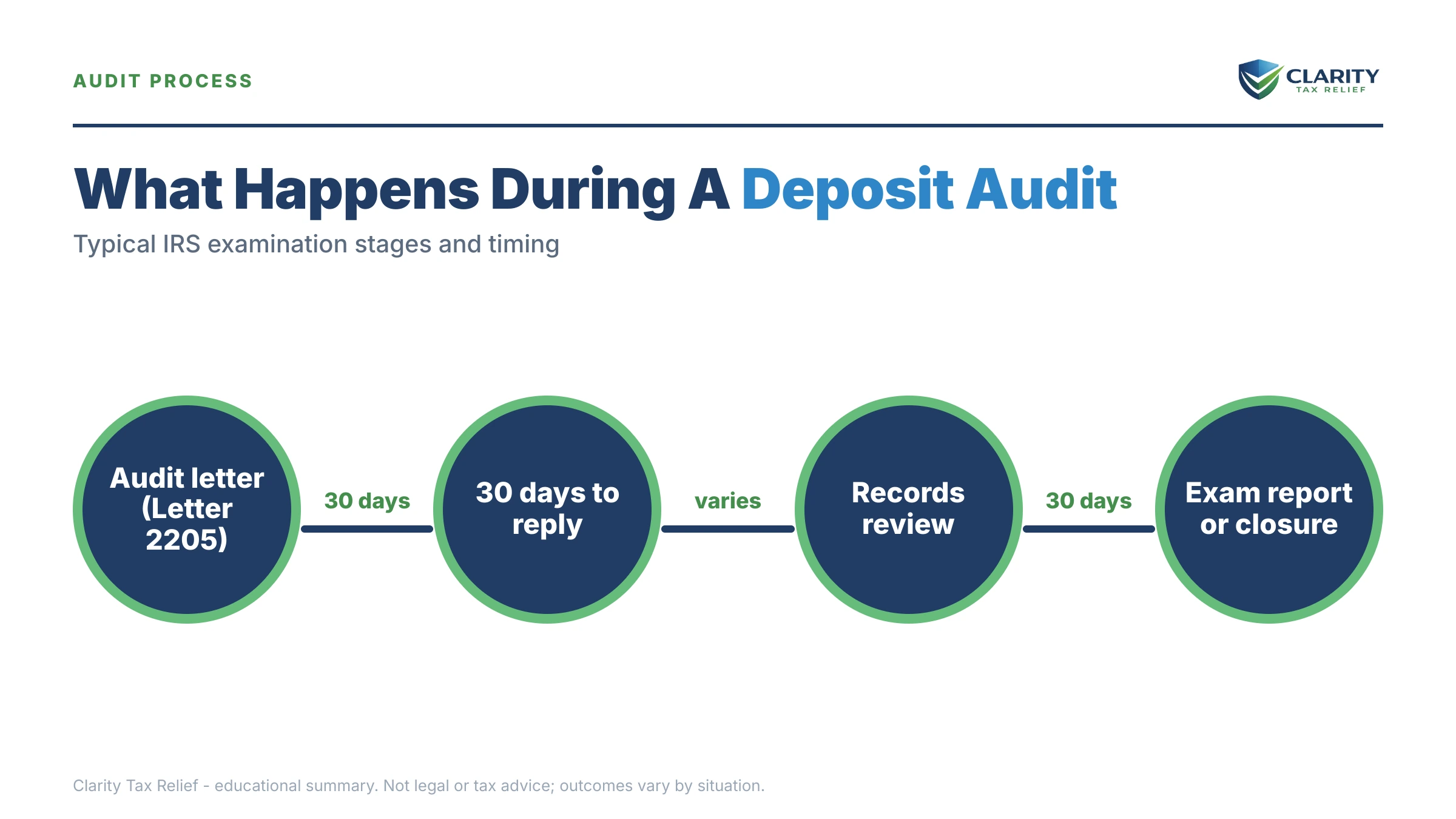
Ignoring a bank deposit audit doesn't stall it — it hands the examiner a one-sided file where every deposit counts as income. The sequence runs on autopilot from there:
- Ignored IDR → bank summons. If you don't produce statements, the examiner issues a third-party summons to your bank under IRC §7602. The bank complies. Now the analysis is built entirely without your explanations — worst-case numbers by default.
- Examination report (Form 4549) + 30-day letter. The examiner closes the file "unagreed" and sends the report with a letter giving you 30 days to protest to Appeals. Silence here forfeits your only free, informal review.
- Notice of Deficiency. Next comes the CP3219A Notice of Deficiency — the 90-day letter. You have 90 days to petition Tax Court, the last chance to dispute the number before you owe it.
- Assessment. No petition means the full proposed amount — tax, the 20% accuracy-related penalty, and accrued interest — is assessed against you.
- Collection. The balance enters the automated collection stream: bills, escalating notices, and eventually lien and levy authority. What was a documentation dispute is now a debt.
One more consequence hides in the math: if the sustained unreported income exceeds 25% of the gross income on your return, the assessment statute doubles from three years to six — meaning the IRS can open your older years too. Our guide to how far back the IRS can audit covers those windows in full.
| Document / stage | Your window | What passes with it |
|---|---|---|
| Form 4564 (IDR) requesting bank statements | Date printed on the request | Control over how your deposits are presented; summons follows |
| Form 4549 report + 30-day letter | 30 days | Independent Appeals review before any tax is assessed |
| CP3219A Notice of Deficiency | 90 days | Tax Court review without paying the tax first |
| After assessment | Ongoing — interest accrues | Pre-payment review; you're left with reconsideration, refund suits, or paying |
Staring at an IDR for your bank statements — or a report that counts everything as income?
Send it to us before the printed response date passes. An experienced tax professional will reconstruct the deposit analysis with your documents — settlement, support, transfers — and tell you exactly what should come off the number. Free, confidential, no pressure.
Your options at every stage of a bank deposit audit
You have a distinct set of options before the report, after the report, and even after assessment — and each stage costs more than the one before it.
| Option | When it's available | What it takes / cost |
|---|---|---|
| Document deposits with the examiner | During the exam, before Form 4549 is final | Statements + source documents; free, and where most cases should end |
| Manager conference / Fast Track | During the exam, when you and the examiner deadlock | Written request; free; keeps the case out of formal Appeals |
| Written protest to Appeals | Within 30 days of the report letter | Protest letter with legal grounds; free; Appeals weighs litigation risk examiners ignore |
| Tax Court petition | Within 90 days of the Notice of Deficiency | $60 filing fee; simplified "S case" rules available for disputes of $50,000 or less per year |
| Audit reconsideration | After assessment, with documents the exam never saw | Written request + new evidence; free; discretionary but effective for no-show audits |
| Offer in Compromise — doubt as to liability (Form 656-L) | After assessment, when the tax itself is wrong | No application fee; you must show the assessed amount is incorrect |
| Agree and resolve the balance | Any time | Sign the report; then payment plan, penalty relief, or hardship options on the debt |
Three of these deserve a closer look:
Appeals is where documentation disputes actually settle. Examiners apply checklists; the Independent Office of Appeals weighs the hazards of litigation. If your evidence for a deposit is imperfect but credible — a donor's letter without a bank record, a decree that describes the payment schedule loosely — Appeals can compromise where an examiner can't. Your full IRS audit appeal rights are covered in our dedicated guide.
Audit reconsideration rescues the people who never responded. If the analysis was built by summons because you ignored the audit — divorce years are chaotic; mail goes to old addresses — you can submit your documentation after assessment through audit reconsideration and ask the IRS to rework the number. It's discretionary, but with a decree and statements in hand it regularly works.
Form 872 is a decision, not a formality. Deposit analyses take time, and if the assessment statute is about to expire the examiner will ask you to sign Form 872 extending it. Refusing can force a rushed, inflated Notice of Deficiency; signing gives the IRS more runway. Get advice on this one — the right answer depends on how strong your documentation is.
And one honest warning: if your unexplained deposits are large, in cash, span multiple years, and you know they were income, the danger isn't the 20% penalty — it's the 75% civil fraud penalty or worse. Answering an examiner's questions about intent in that posture is the classic eggshell audit. Stop talking and get representation before the next interview.
How to respond to a bank deposit method audit, step by step
- Calendar the response date on your IDR. Form 4564 prints a due date; if you need more time, ask the examiner for an extension in writing before it passes — never after.
- Pull 12 months of statements for every account. Checking, savings, joint accounts you were on during the year, and payment apps like PayPal and Venmo — the examiner will find them anyway.
- Build your own deposit schedule before the examiner finishes theirs. List every deposit with date, amount, source, and whether it is taxable — the first complete schedule on the table usually frames the whole exam.
- Attach a source document to every nontaxable deposit. Divorce decree pages, loan notes, gift letters, the matching withdrawal for each transfer — tie each document to the exact date and dollar amount.
- Review Form 4549 line by line before signing. Signing the examination report agrees to the tax and closes your easiest appeal paths — verify every deposit the examiner kept in the income column.
- File an appeal within 30 days if nontaxable deposits remain in the report. A written protest sends the case to the IRS Independent Office of Appeals before any tax is assessed — and Appeals settles documentation disputes examiners won't.
When you can handle a deposit analysis yourself — and when help changes the outcome
You can reasonably handle this alone when the exam covers one year, the deposit gap is small, and every disputed deposit has a clean paper trail. If the analysis flagged $6,000 that's obviously your own savings-to-checking transfers, a tidy schedule with both statements attached will usually close the issue at the examiner level. Free help exists too: the Taxpayer Advocate Service can intervene when the process breaks down, and the Taxpayer Bill of Rights guarantees your right to challenge the IRS's position and be heard.
Experienced help changes outcomes in specific situations: when the proposed adjustment is five figures, when multiple years or a Schedule C audit are involved, when the examiner is pressing you to sign a statute extension, when your documentation is partial and the case needs to be positioned for IRS Appeals, or when any of the unexplained money genuinely was income and the conversation is drifting toward intent. A representative under power of attorney also takes you out of the room entirely — the examiner's questions go to your representative, not to you, which matters most in cash-heavy and eggshell cases.
If an examiner's report is already counting your settlement, support, or transfer deposits as income, have an experienced tax professional recheck the workpaper against your decree before the 30-day protest window closes — call (888) 825-7779 or use the 2-minute form.
Terms on your audit paperwork, decoded
- Indirect method — any technique that reconstructs income from outside evidence (deposits, net worth, spending) instead of your return's line items.
- IDR (Form 4564) — the Information Document Request listing exactly which records the examiner wants and the date they're due.
- Form 4549 — the examination report proposing changes to your tax; signing it means you agree to the adjustment.
- Third-party summons — the IRS's power under IRC §7602 to compel your bank to hand over records, with notice to you.
- Unexplained deposits — the workpaper line for deposits with no documented nontaxable source; this line becomes your proposed unreported income.
- Cash hoard — the defense that deposits came from previously accumulated cash; courts view it skeptically without evidence the hoard existed.
Bank deposit method audit questions, answered
What is the bank deposit method of proving income?
It is an indirect method the IRS uses to reconstruct your income from bank records instead of your tax return. The examiner totals every deposit into every account for the year, subtracts deposits shown to be nontaxable, and compares the remainder to what you reported. Courts have accepted this method for decades under IRC §446(b), which lets the IRS compute income by any method that clearly reflects it.
Does the IRS count every bank deposit as income?
The starting presumption is yes — every deposit is treated as taxable income until you show otherwise. Transfers between your own accounts, loan proceeds, gifts, child support, post-2018 alimony, tax refunds, and sales of personal items at a loss are all nontaxable, but the examiner won't remove them without documentation. That's why building your own deposit-by-deposit schedule matters.
How do I prove a bank deposit wasn't income?
Match the deposit to a source document: the withdrawal on the other account for a transfer, the loan note for borrowed money, the divorce decree for a settlement or support payment, a signed statement from the donor for a gift. The date and amount should tie exactly. If your evidence is thin, a contemporaneous paper trail from the payer's side — their bank record — usually carries the most weight.
Can the IRS get my bank statements without my permission?
Yes. If you don't provide them, the examiner can issue a third-party summons to your bank under IRC §7602, and the bank will comply. You get notice of the summons and a limited right to challenge it, but banks almost always produce the records. It's usually better to provide statements yourself so you control the presentation and pair every deposit with its explanation.
Is child support or alimony counted as income in a bank deposit audit?
Child support is never taxable income, and alimony under divorce or separation agreements executed after December 31, 2018 is not taxable to the recipient either. Both should be removed from the deposit analysis — but only if you document them with the decree or agreement and payment records. Alimony under pre-2019 agreements is still taxable unless the agreement was modified to adopt the new rule.
What happens if I can't explain a deposit?
It stays in the analysis as unreported income, and you're taxed on it — often with a 20% accuracy-related penalty added. One or two small unexplained deposits rarely sink a case; a pattern of large round-number cash deposits is a bigger problem. If the total is genuinely wrong, you can still contest the result through Appeals, Tax Court, or audit reconsideration.
Can a bank deposit method audit turn criminal?
It can, but it's rare and it takes more than sloppy records. Criminal referrals generally involve large, deliberate, multi-year understatements plus indicators of intent — hidden accounts, false statements to the examiner, cash structuring. If your audit involves years of significant unreported cash income, talk to a professional before answering intent-related questions; this is the classic eggshell audit scenario.
How many years of bank statements can the IRS analyze?
Normally the three most recent filed years, because the standard assessment statute is three years. If the exam shows you omitted more than 25% of gross income, the window extends to six years, and there is no time limit for fraud or unfiled returns. Examiners typically start with one year and expand if the deposit gap is large.
Should I give the examiner every bank account I have?
You must be truthful about what accounts exist — concealing an account is one of the worst moves you can make, because examiners cross-check with information returns and can summons records anyway. That said, respond to what the IDR actually asks for, in an organized package, rather than volunteering loose piles of records. A representative can handle document production so you never speak to the examiner directly.
Your next 24 hours
- Find the response date printed on your IDR, 30-day letter, or Notice of Deficiency — that single date determines which options are still open to you.
- Gather the rebuttal file: 12 months of statements for every account, your divorce decree or settlement agreement, loan documents, and the tax return for the audit year.
- Get the analysis reviewed free before your window closes — call (888) 825-7779 or use the 2-minute form, and we'll walk the deposit workpaper with you line by line.
This guide is general information, not tax or legal advice for your specific situation. Eligibility for IRS programs depends on individual facts and circumstances; no outcome is guaranteed.