
IRS Audits
IRS Field Audit in 2026: What to Expect When a Revenue Agent Examines Your Business
The short answer: an IRS field audit is the agency's most comprehensive examination — a trained revenue agent reviews your books and records in person, usually at your business. It targets business and complex returns, can span multiple years, and ends with a report you can accept, negotiate, or formally appeal. What you do before the first meeting matters most.
The letter names a revenue agent, lists the tax years under examination, and asks you to call to schedule an in-person meeting at your business. That drop in your stomach is real — but a field audit is a defined process with rules, deadlines, and appeal rights, and the owners who come out best are the ones who prepare before that first call, not after the report lands.
Everything starts with that opening appointment letter. The image below shows exactly what a field audit's opening letter looks like and where to find the three things that matter: the agent's name and contact information, the tax years under exam, and the response date that starts your clock.
⏱ Your deadlines: the first one is the response date printed on your appointment letter — call (or have your representative call) by that date to keep control over scheduling and location. Later, the 30-day letter (Letter 950) opens your window to appeal the findings, and a Notice of Deficiency gives you 90 days (150 if the notice is addressed to you outside the U.S.) to petition the U.S. Tax Court — the notice itself prints your exact last day to file. Interest accrues on any proposed balance the entire time.
Why the IRS chose a field audit for your return
Field audits are the smallest slice of IRS examinations and the most expensive for the agency to run — a revenue agent is assigned only when the IRS expects the return to justify the effort. If you're reading this, something about your filing profile signaled complexity, dollars, or both.
The most common routes into a field exam for a small-business owner:
- Statistical scoring. Every return receives a DIF score comparing it to statistical norms. Business returns with high deductions relative to receipts score high — and in 2026, machine-learning models increasingly do this triage, as we explain in our guide to IRS AI audits.
- Information mismatches. Gross receipts on your return that don't line up with 1099-K and 1099-NEC filings, or wages on your business return that don't reconcile with the 941s and W-2s you filed.
- Cash-intensive operations. Restaurants, salons, contractors, and other cash-heavy businesses get examined with special indirect methods — see our guide to a cash business audit.
- Related exams. A partner, shareholder, vendor, or a prior-year audit that produced adjustments can pull your return in behind it.
One thing a field audit is not: an accusation of fraud. It is a civil examination, and the overwhelming majority end in a proposed adjustment you can pay, negotiate, or appeal — not a criminal referral.
IRS field audit vs. office audit vs. mail audit
A field audit is the only exam type where the IRS comes to you — and the only one run by a revenue agent, the agency's most highly trained examiner. That single fact tells you how the IRS views your case.
| Exam type | Who runs it | Where it happens | Typical target |
|---|---|---|---|
| Mail (correspondence) audit | Tax examiner, by letter | Entirely by mail | One or two line items — a credit, a single deduction |
| Office audit | Tax compliance officer | An IRS office, by appointment | Moderate-complexity individual and Schedule C issues |
| Field audit | Revenue agent | Your business, home, or your representative's office | Businesses with payroll, multi-year and high-dollar returns |
If your letter says the exam is by mail, you're in different territory — start with our guide to mail audits: what to expect. An in-office appointment exam sits in between; the field audit playbook below is for the full in-person examination.
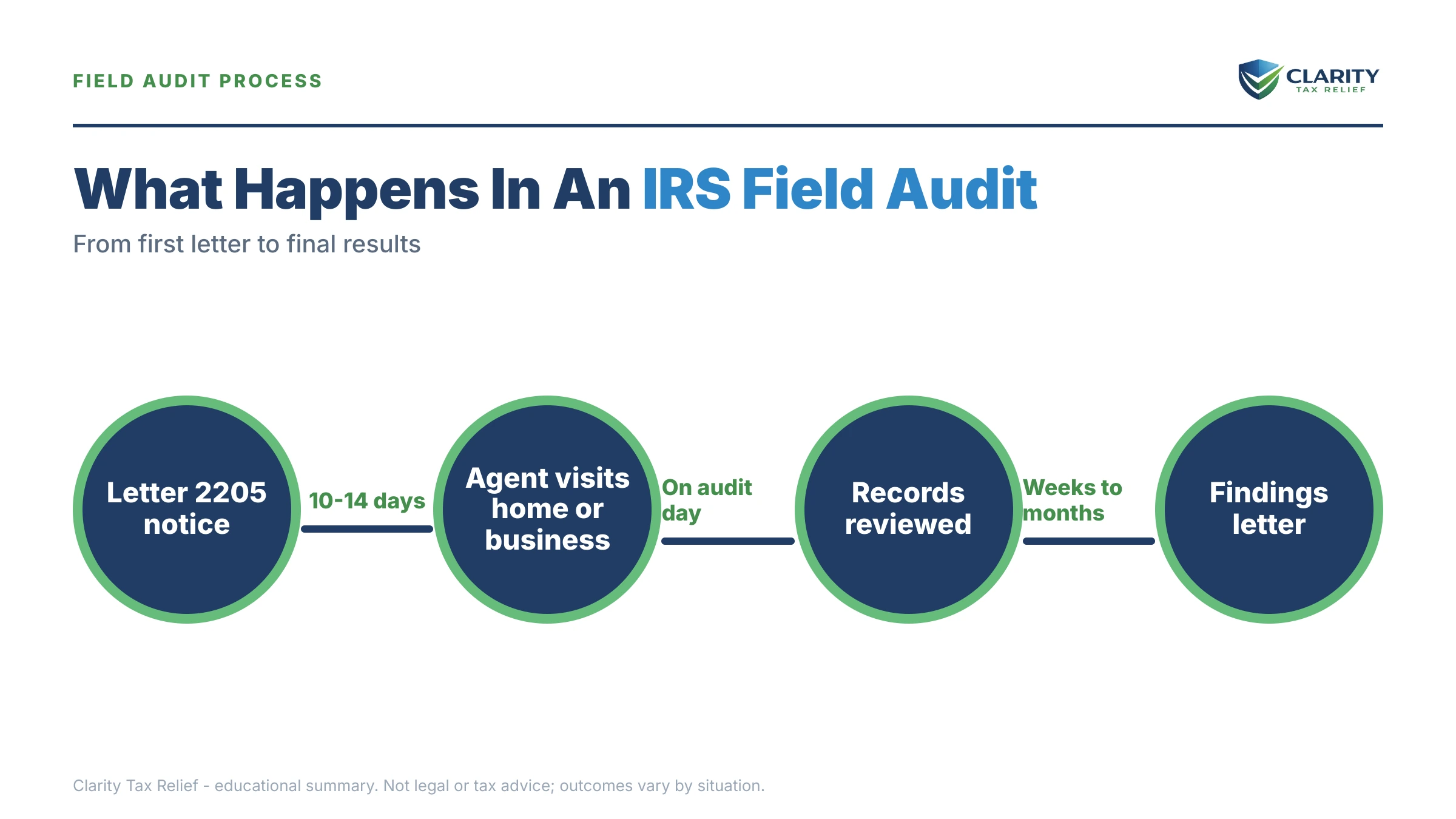
What happens during an IRS field audit, stage by stage
Every field audit follows the same arc: appointment letter → opening interview → document requests → findings → report. Knowing the sequence turns a frightening unknown into a series of manageable decisions.
1. The opening letter. First contact comes by mail — the IRS does not open an audit by phone call, text, or email. Individual exams often start with a Letter 2205-A; business exams use a similar appointment letter naming the agent and the years under review.
2. Scheduling and location. You (or your representative) call by the printed date to set the meeting. You can propose timing, and you can request the exam be conducted at your representative's office. The agent may still ask to tour your business briefly to verify operations — that's normal and can be scheduled and limited.
3. The opening interview. This is the agent's most powerful tool. Expect questions about how the business receives money, who handles the books, cash practices, personal use of business assets, and your lifestyle. Answers here shape the entire exam. With Form 2848 on file, a representative can attend in your place.
4. Information Document Requests. The agent issues Form 4564 IDRs listing exactly what to produce: bank statements, ledgers, invoices, payroll reports, loan documents. Each IDR carries its own due date. Answer what's asked — completely, and nothing extra.
5. Income probes. On business exams the agent almost always tests income independently, typically by totaling deposits across every account you touch. Our guide to the bank deposit method audit explains how to keep loans, transfers, and gifts from being counted as taxable receipts.
6. Scope and statute decisions. Long exams bump against the assessment deadline, and the agent may ask you to sign Form 872 extending it. That's a strategic decision, not paperwork. How many years the exam can reach is governed by the rules in our hub on how far back the IRS can audit — 3 years by default, 6 for large income omissions, unlimited for fraud or unfiled returns.
7. The closing conference and report. The agent presents proposed adjustments on Form 4549 (the Revenue Agent Report). You can agree, negotiate specific items, or decline to sign and take the case to Appeals.
What the revenue agent will dig into at a small business with payroll
For an employer, a field audit is never just an income tax exam — payroll compliance is on the table too. The agent will test both sides of your return and your employment tax filings against each other.
- Gross receipts: deposits vs. reported income, POS reports vs. the return, 1099-K totals vs. books.
- Payroll reconciliation: wages deducted on the business return vs. wages reported on 941s and W-2s. Gaps here can open an employment tax exam alongside the income exam.
- Worker classification: contractors who look like employees are a classic expansion issue, with retroactive payroll tax exposure.
- Owner transactions: personal expenses run through the business, below-market officer compensation, shareholder loans without documentation, vehicles used personally but deducted fully.
- Substantiation: mileage logs, meal records, and receipts behind the largest deduction categories.
One quiet stakes-raiser for employers: if the exam surfaces unpaid withholding, the trust-fund portion can become a personal liability of the owner even inside a corporation or LLC. That's a reason to treat payroll findings with extra care from day one.
Field audit deadlines and the rights each one protects
Each stage of a field audit comes with a date, and each date protects a right you lose if it passes. This is the single most useful table to keep next to your paperwork.
| Document or stage | Your window | What you lose if it passes |
|---|---|---|
| Appointment letter (e.g., Letter 2205-A) | The response date printed on the letter | Control over scheduling and where the audit happens |
| Information Document Request (Form 4564) | The due date printed on each IDR | The chance to shape the record before the agent uses summons power or estimates against you |
| Form 872 statute-extension request | Before the assessment statute expires | Leverage — extending, restricting, or refusing is a strategic call, not a formality |
| Letter 950 (30-day letter) with Form 4549 | 30 days from the letter date | Your right to independent IRS Appeals review before assessment |
| Notice of Deficiency (CP3219A / Letter 531) | 90 days from the notice date (150 if the notice is addressed to you outside the U.S.) | Your right to contest the tax in U.S. Tax Court before paying it |
| After assessment | Collection notice sequence begins | Options narrow as liens and levies enter the picture |
What happens if you ignore a field audit
Ignoring a field audit doesn't stall it — it hands the pen to the revenue agent, who will finish the exam on the worst possible record. Here's the sequence, stage by stage:
- Missed appointment date. The agent proceeds anyway — calling, writing, and possibly visiting your business unannounced to make contact.
- Unanswered IDRs. The agent can issue a summons — a legally enforceable demand for your records, and for your banks' records about you.
- Findings without you. With no cooperation, the agent reconstructs income from bank deposits and third-party data and disallows deductions you never substantiated. Silence is treated as no proof.
- Letter 950. The 30-day letter arrives with Form 4549 attached. Miss this window and you lose your shot at protesting through Letter 950 to the independent Office of Appeals.
- Notice of Deficiency. The CP3219A Notice of Deficiency starts a strict 90-day clock (150 days if the notice is addressed to you outside the U.S.) to petition Tax Court. Let it lapse and the proposed tax is assessed exactly as written.
- Collection. The assessed balance enters the automated collection stream — bills, then intent-to-levy notices, then liens and levies. Every option left at that point is harder and more expensive than answering the audit would have been.
In 2026 there's a tempting myth that a short-staffed IRS lets audits drift away. It doesn't. An open exam either closes with your input or closes without it — and the version without it almost always costs more.
Facing a revenue agent right now?
Send us your appointment letter before your first meeting or interview. An experienced tax professional will map the years and issues at stake, explain exactly what to say and what not to volunteer, and tell you whether representation makes sense for your case — free and confidential.
Your options when the field audit ends
A field audit ends with a proposal, not a verdict — Form 4549 is an offer you can accept, contest, or pay on terms. Here is the full menu and who each option actually fits:
| Option | Who it fits | Key threshold or requirement |
|---|---|---|
| Agree and pay in full | You accept the findings and can pay | Sign Form 4549; paying stops further interest |
| Streamlined payment plan | Assessed balance of $50,000 or less | Up to 72 months, set up online, no financial statement |
| Payment plan over $50,000 | Larger post-audit balances | Financial disclosure (Form 433 series) required |
| IRS Appeals protest | You disagree with any finding | File within the 30-day window on Letter 950 |
| Tax Court petition | Appeals failed, or you skipped it | File within 90 days of the Notice of Deficiency (150 if addressed to you outside the U.S.) |
| Audit reconsideration | Already assessed, but you have new evidence | Balance not fully paid; documentation the agent never saw |
| Offer in Compromise — doubt as to liability | You dispute that the assessed amount is correct | Show genuine doubt about the liability itself |
| Penalty relief | Reasonable cause for the penalty portion | The accuracy penalty requires reasonable cause — first-time abatement doesn't cover it |
The appeal route deserves emphasis: Appeals officers settle cases based on litigation risk, which examiners cannot do. Our full guide to your IRS audit appeal rights walks through the protest letter and what Appeals can and can't concede. And if the assessment already happened without your input, audit reconsideration can reopen it with new documentation.
Say the agent proposes $76,400: the math and your realistic moves
Here's a clearly hypothetical example built on a common small-business fact pattern. Say you run an S corporation with six employees on payroll, and the revenue agent examines two years. He disallows $145,000 of deductions — vehicle expenses with no mileage log, owner personal spending run through the business, and contractor payments with no invoices — and proposes:
- Additional tax: $58,300
- Accuracy-related penalty (20% × $58,300): $11,660
- Interest through the report date: roughly $6,440
- Total proposed: $76,400
Your realistic moves, in order of impact:
Attack the adjustments first. Every $10,000 of deductions you substantiate on appeal removes the tax on it, the 20% penalty on that tax, and the interest on both. Reconstructed mileage logs and vendor confirmations routinely claw back a meaningful share of a report like this.
Then attack the penalty. The accuracy-related penalty falls away if you show reasonable cause — such as documented reliance on a competent bookkeeper or preparer. Winning just that issue cuts $11,660, about 15% of the bill. You can estimate how penalties and interest change your own numbers with our Penalty & Interest Calculator.
Then structure the payment. At $76,400 you're above the $50,000 streamlined ceiling, so a plan requires financial disclosure — the rules are covered in our guide to an IRS payment plan over $50,000. One practical alternative: pay the balance down by $26,400 or more, drop under $50,000, and set up a 72-month plan online — roughly $695 a month on the remaining $50,000 before accruing interest, with no financial statement required.
How to respond to an IRS field audit, step by step
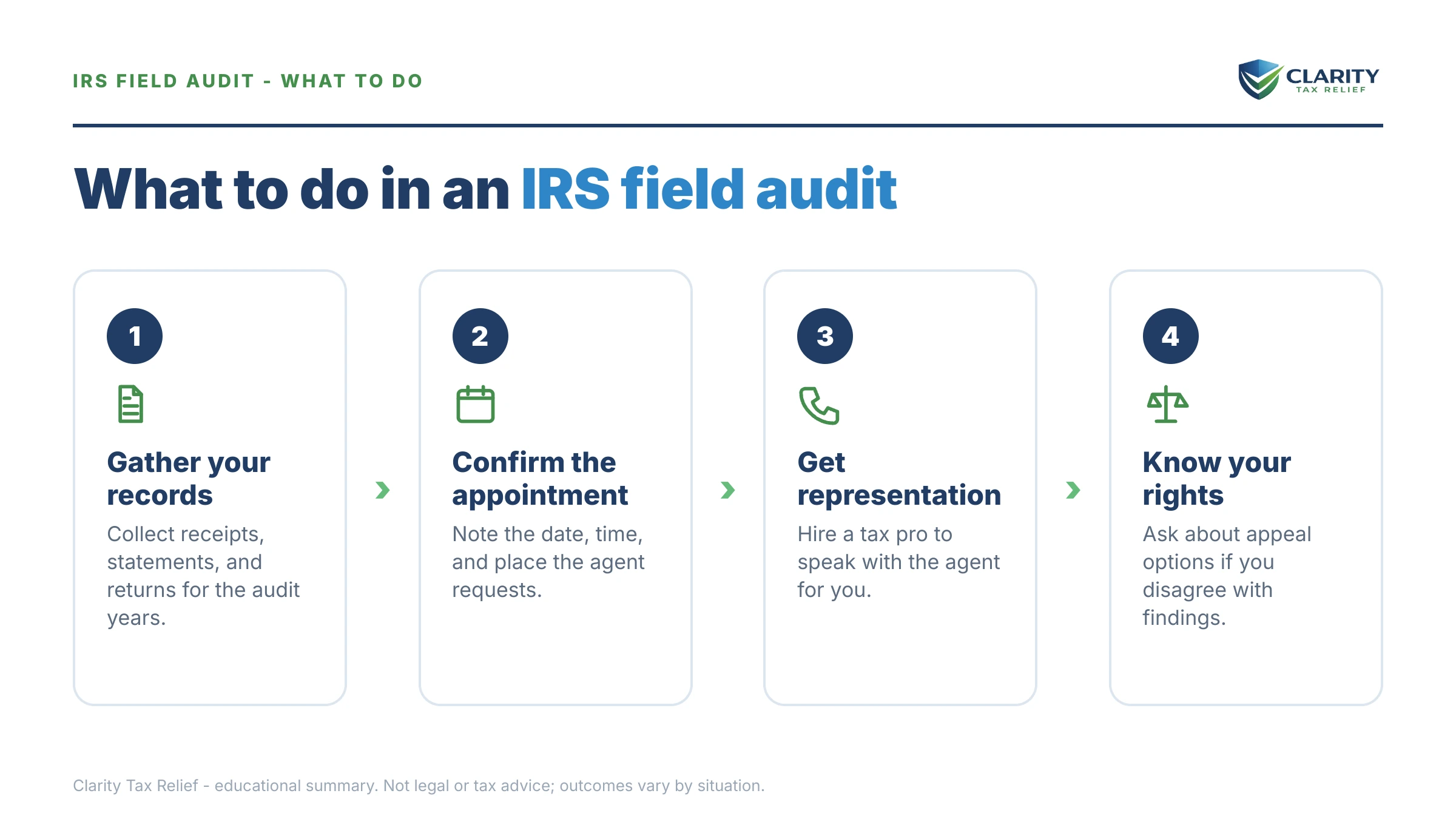
- Verify the audit is real. Real field audits open with a mailed letter on IRS letterhead naming a revenue agent and the tax years under exam. Confirm by calling the IRS directly — not a number left on a voicemail — before sharing anything.
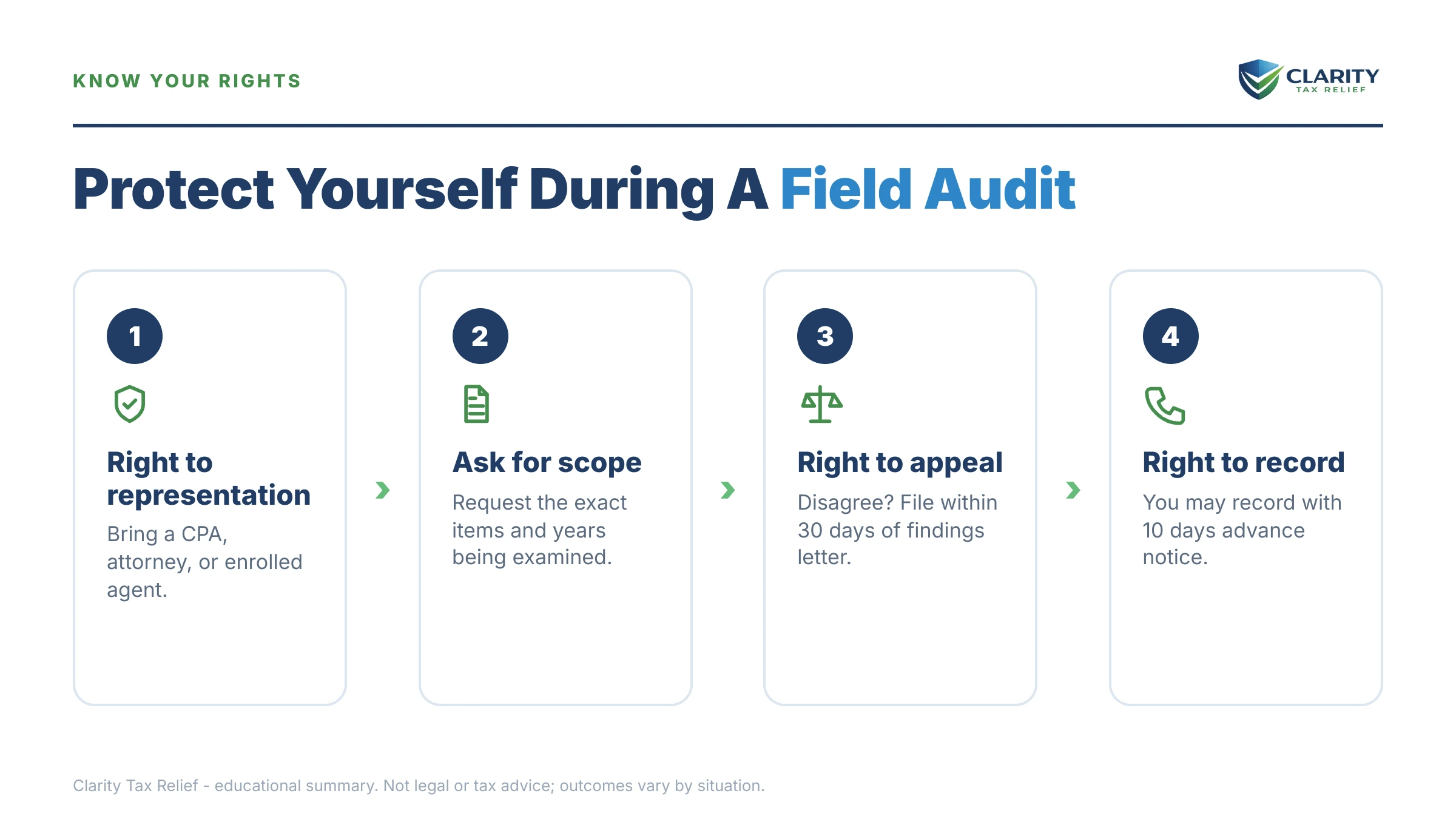
- Get representation in place before the first interview. File Form 2848 so an experienced tax professional can appear for you. Once it is on file, you generally do not have to meet the agent yourself.
- Respond by the date on your appointment letter. Call — or have your representative call — to schedule. You can propose the time and request the meeting be held at your representative's office instead of your business.
- Gather exactly what each IDR asks for — no more. Organize records by year and by issue, and answer each document request completely. Volunteering extra records invites the agent to open extra issues.
- Review Form 4549 line by line before signing. The examination report is a proposal, not a bill. Signing it waives your right to contest the findings in Tax Court.
- Appeal or arrange payment within the deadline. If you disagree, file a protest within the 30-day window on Letter 950. If you agree, set up payment before assessment triggers the collection notice sequence.
When you can handle a field audit yourself — and when you shouldn't
Honest answer: a field audit is the one exam type where going in alone is rarely the right call — but not never.
You can reasonably self-represent when the exam is genuinely narrow — one year, one or two issues, and you have complete, organized documentation for everything questioned. If your books are clean and the likely adjustment is small, cooperative and prompt often ends it quickly.
Experienced help changes the outcome when any of these are true:
- The opening interview hasn't happened yet. The single highest-leverage move in any field audit is keeping the owner out of that room. Casual answers become findings.
- You run a cash-heavy business or the agent is running a deposit analysis — indirect income methods have specific, technical defenses.
- Payroll is involved: classification questions, 941 gaps, or anything that could reach you personally through the trust-fund rules.
- Multiple years or a statute-extension request (Form 872) is on the table.
- There's a problem underneath the return you already know about. When potential fraud exposure sits beneath a civil exam, the case must be handled with extreme care from the first conversation.
If a revenue agent has already scheduled your opening interview and any of those bullets describe you, get a free case review before that meeting — the order in which issues are conceded, contested, and documented in a field exam is exactly where experience pays for itself.
Terms on your audit paperwork, decoded
- Revenue agent: the IRS's most highly trained civil examiner — assigned to field audits, distinct from a revenue officer (who collects) and a special agent (who investigates crimes).
- IDR (Form 4564): an Information Document Request — the agent's written list of records to produce, each with its own due date.
- RAR / Form 4549: the Revenue Agent Report listing every proposed change; signing it agrees to the adjustments and waives Tax Court review.
- 30-day letter (Letter 950): the letter transmitting the report and opening a 30-day window to protest to IRS Appeals.
- Notice of Deficiency: the "90-day letter" — your final, strict window to petition the U.S. Tax Court before the tax is assessed.
- Summons: a legally enforceable demand for records or testimony, from you or from third parties like your bank.
IRS field audit questions, answered
How serious is an IRS field audit?
A field audit is the most comprehensive examination the IRS conducts — it is assigned to a trained revenue agent rather than handled by mail, and it usually involves business returns, multiple issues, or larger dollar amounts. That said, it is a civil process with defined rights at every stage. Most field audits end in a negotiated adjustment, not fraud findings, and you can appeal any result you disagree with.
Why did I get a field audit instead of a mail audit?
Field audits are reserved for returns too complex to examine by correspondence — typically businesses with payroll, cash-heavy operations, rental portfolios, or returns with several questionable items across multiple years. A mail audit checks one or two line items; a field audit examines your books as a whole. If your business files 941s and a business return, complexity alone can route you to a revenue agent.
Do I have to let the IRS agent into my home?
Generally no. If you claim a home office, the agent may ask to see it, but you can decline entry to your home; without your consent the IRS needs a court order to come inside. You can request that the audit take place at your representative's office instead, and for business audits the agent's site visit can usually be limited to a brief tour.
Do I have to talk to the revenue agent myself?
No. Once you file Form 2848 appointing a representative, the agent must generally work through that person, and you do not have to sit for the interview yourself. The opening interview is where most damaging admissions happen — casual answers about cash habits, personal use of business assets, or record-keeping gaps become findings. Most experienced representatives keep the owner out of the room.
How long does an IRS field audit take?
There is no fixed length — field audits commonly run several months, and complex multi-year business exams can run a year or more. The pace depends on how many issues the agent opens, how quickly you answer document requests, and whether the statute of limitations is extended. Slow, disorganized responses stretch the exam; complete, well-organized ones shorten it.
How many years can a field audit cover?
The default assessment window is 3 years from when you filed, so most field audits open with one year and may expand to the two on either side. If the agent finds you omitted more than 25% of gross income, the window stretches to 6 years — and there is no time limit for fraud or unfiled returns. Our guide on how far back the IRS can audit covers each rule.
What if I don't have receipts for my deductions?
Missing records are common and not fatal. You can reconstruct expenses with bank and card statements, vendor invoices, mileage and appointment logs, and third-party records, and courts have allowed reasonable estimates for some categories under the Cohan rule. What you cannot do is guess out loud in the interview — reconstruct first, then present. Deductions the agent disallows can often still be substantiated later on appeal.
Can a field audit turn into a criminal investigation?
Rarely, but it is the field audit's most serious risk. If the revenue agent finds firm indications of fraud — two sets of books, faked invoices, large unreported cash — the civil exam is suspended and the case can be referred to IRS Criminal Investigation. A sudden, unexplained halt in agent activity is a classic warning sign. If you know there are problems underneath your return, get representation before the first interview, not after.
What happens if I disagree with the field audit results?
You do not have to accept the revenue agent's report. A 30-day letter (Letter 950) lets you protest to the independent IRS Office of Appeals, which settles a large share of disputes based on the hazards of litigation. If Appeals fails or you miss that window, the Notice of Deficiency gives you 90 days (150 if the notice is addressed to you outside the U.S.) to petition the U.S. Tax Court — the notice itself prints your exact last day to file. Never sign Form 4549 if you dispute the findings.
Should I sign Form 872 to extend the statute of limitations?
Not automatically — Form 872 gives the IRS more time to assess tax against you, and the decision deserves professional analysis. Refusing can force the agent to issue a Notice of Deficiency on the existing record, which sometimes helps you and sometimes hurts. A restricted-scope or fixed-date extension is often the better middle ground. Weigh it against where the exam stands before signing.
Your next 24 hours
- Find three things on your appointment letter: the revenue agent's name and phone number, the tax years under examination, and the response date. That date is your first deadline — nothing else on the letter matters more.
- Pull the file for those years: the filed returns, business bank statements for every account, your bookkeeping records, and payroll reports (941s, W-2s/W-3). Don't send anything yet — just get it in one place.
- Get a free case review before you call the agent. Use the 2-minute form or call (888) 825-7779. Ten minutes with an experienced tax professional before first contact — while you still control the interview, the location, and the record — is worth more than anything you can do after the report is written.
The IRS's own overview of the examination process is at IRS.gov: IRS Audits, and your rights during any exam are set out in the Taxpayer Bill of Rights. If you end up owing, official payment options live at IRS.gov/payments.
This guide is general information, not tax or legal advice for your specific situation. Eligibility for IRS programs depends on individual facts and circumstances; no outcome is guaranteed.