
IRS Audits
IRS Mail Audit: What to Expect in 2026 — Timeline, Letters, and Deadlines
The short answer: an IRS mail audit is an examination conducted entirely by letter, usually focused on one or two items — credits, dependents, or Schedule C deductions. Expect an opening letter (Letter 566 or CP75) with a printed response deadline, a months-long wait between letters, and a written decision you can appeal.
The letter says your return has been "selected for examination," lists documents the IRS wants, and gives you a date. No agent is coming to your door, no meeting is scheduled — the entire audit will happen through this exchange of paper, which means the packet you mail back is your defense.
That's actually good news if you use it. Mail audits are the narrowest, most winnable kind of exam, and the whole game is documentation plus deadlines. The image below shows exactly what a mail audit opening letter looks like and where to find the two details that control everything: the tax year under exam and your response date.
⏱ Your deadline: the response date printed on your opening letter — typically 30 days from the letter date. Miss it and the IRS disallows the questioned items by default and moves toward a final assessment. If you need more time, call the number on the letter before the date passes; extensions are often granted, but only if you ask.
Why the IRS selected your return for a correspondence audit
Mail audits are the cheapest exams the IRS runs — a computer selects the return and a letter does the work — which is why they make up the large majority of all audits. No human decided you looked suspicious. Software scored your return, or a document didn't match, and the system generated a letter.
The most common selection reasons are:
- Refundable credits — the Earned Income Tax Credit and Child Tax Credit are the single biggest mail audit category, usually via a CP75 asking for proof of a child's residency and relationship.
- Schedule C deductions — mileage, home office, supplies, and meals on self-employment returns, especially when expenses look large next to income.
- Document mismatches — a 1099 or W-2 in the IRS's file that doesn't line up with what you reported.
- Filing status and dependents — head of household claims and dependents claimed on more than one return.
- Itemized deductions — outsized charitable or unreimbursed-expense claims relative to income.
In 2026, selection is increasingly model-driven — our guide to IRS AI audits covers how returns get scored now. And the lookback window matters: the IRS generally has three years to audit a filed return, longer in specific cases — see how far back can the IRS audit for the full rules.
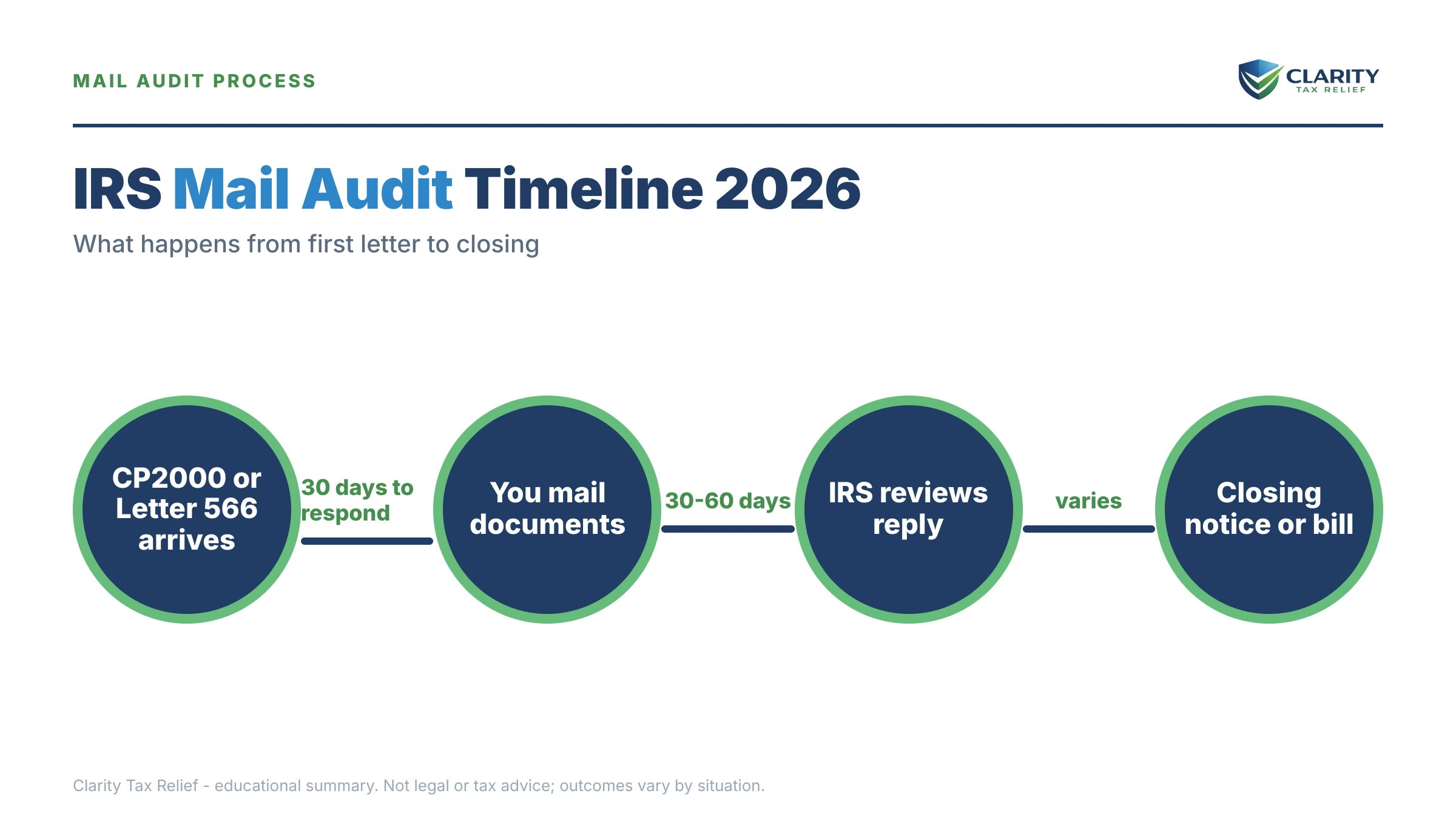
IRS mail audit: what to expect, letter by letter
A mail audit runs through four letters — the opening request, the examination report, the Notice of Deficiency, and the assessment — and each one shrinks your options. Whichever variant you received, the structure is the same: a Letter 566 for general issues or a CP75 for credit audits, with Form 886-A pages listing exactly what's questioned. The image below shows where those details appear on the letter itself.
| Letter | What it means | Your window | Right you lose if it passes |
|---|---|---|---|
| Letter 566 / CP75 | Audit opened; documents requested | Printed on the letter — typically 30 days | Resolving the exam with paperwork alone |
| Letter 525 + Form 4549 | Examination report with proposed changes | 30 days | Your free IRS Appeals review |
| CP3219A (Notice of Deficiency) | The IRS's final proposal before assessment | 90 days (set by statute) | Tax Court — the only way to dispute before paying |
| CP22E and balance-due notices | Tax assessed; collection sequence begins | Pay-by date on each notice | Each notice adds enforcement power, ending in levy |
Between each letter, expect silence — often long silence. Correspondence exam units are heavily backlogged after the 2025 workforce cuts, so responses can sit for weeks before anyone logs them. That silence is not agreement and not a win; the automated deadlines keep running regardless.
If your letter instead schedules a meeting at an IRS office or a visit to your home or business, you're not in a mail audit — see our guide to the IRS field audit, which is a different animal with different stakes.
Three unfiled years change the math
Unfiled returns sitting behind an audited year raise the stakes of a mail audit considerably. The examiner can see your filing history, and missing years invite three specific problems:
- The exam can expand. A narrow question about one year's deductions can grow into a review of the unfiled years — including income reconstruction through a bank deposit method audit, where every deposit is presumed income until you prove otherwise.
- Refunds stay locked. The IRS can hold current refunds while returns are missing, on top of any audit freeze.
- Every resolution door needs filing compliance. Payment plans, hardship status, and offers all require your required returns to be filed first.
There's also a penalty reason to file the missing years now, not after the audit: the failure-to-file penalty runs at 5% per month — ten times the 0.5% failure-to-pay rate. If you're behind, start with our guide for people who haven't filed taxes in 3 years, and get those returns moving in parallel with your audit response. Filing your own accurate returns almost always beats letting the IRS compute them for you.
What happens if you ignore a mail audit
If you don't respond to a mail audit, the IRS disallows every questioned item by default and assesses the full proposed tax — no hearing, no phone call, no second look at your side. The sequence from there is automated:
- No response to Letter 566 / CP75. The examiner treats the questioned deductions or credits as unproven and recomputes your tax without them. Some units send one follow-up request; many don't.
- Letter 525 arrives with Form 4549. This is the examination report — the proposed new tax, penalties, and interest in black and white. You have 30 days to protest to IRS Appeals.
- CP3219A Notice of Deficiency. The statutory "90-day letter." Petition Tax Court within 90 days or the proposal becomes a legally final assessment. This is the last exit before the debt is real.
- Assessment posts — code 300 on your transcript — and a CP22E or balance-due notice states what you now owe, with the 20% accuracy-related penalty and interest folded in.
- Collection begins. The balance enters the standard notice sequence that ends, if ignored long enough, in liens and levies. Meanwhile any refund tied to the audited year was disallowed, and future refunds offset against the debt.
Here's the part that surprises people: most defaulted mail audits weren't lost on the merits. The taxpayer had the records, or could have rebuilt them — the case closed because nothing came back in the mail. In a mail audit, silence is a full concession.
Holding a mail audit letter right now?
Get it reviewed free before your response window closes. Send a photo of your Letter 566 or CP75 and an experienced tax professional will map exactly what the IRS is questioning, what to send, and what not to send — no pressure, no obligation.
Your options at every stage of a mail audit
You keep formal rights at every stage of a mail audit, but the strongest ones — Appeals and Tax Court — expire on fixed clocks of 30 and 90 days. Here's the full menu, from cheapest to last-resort:
| Option | When it's available | Key eligibility / cost |
|---|---|---|
| Respond with documentation | Before the exam closes | Records matching each Form 886-A item; free |
| Extension of time | Before your printed deadline | Call the number on the letter; typically granted once; free |
| IRS Appeals | Within 30 days of Letter 525 | Written protest — Form 12203 works for disputes of $25,000 or less per year; free |
| Tax Court petition | Within 90 days of CP3219A | No payment required first; $60 filing fee |
| Audit reconsideration | After assessment | New information the examiner never saw; free, but collection isn't paused automatically |
| Offer in Compromise — doubt as to liability | After assessment | Form 656-L with a genuine dispute that the tax is wrong; no application fee |
| Payment plan or hardship status | After assessment, if the tax is correct | All required returns filed; balances of $50,000 or less can be set up online over up to 72 months |
Two of these deserve emphasis. First, Appeals settles a large share of disputed exams without court — if the examiner disagrees with your documentation, that's the escalation path, and our guide to an IRS audit appeal walks through it. Second, if the audit already closed against you by default, audit reconsideration lets you submit the evidence late — it's slower and weaker than responding on time, but it's real.
How to respond to an IRS mail audit, step by step
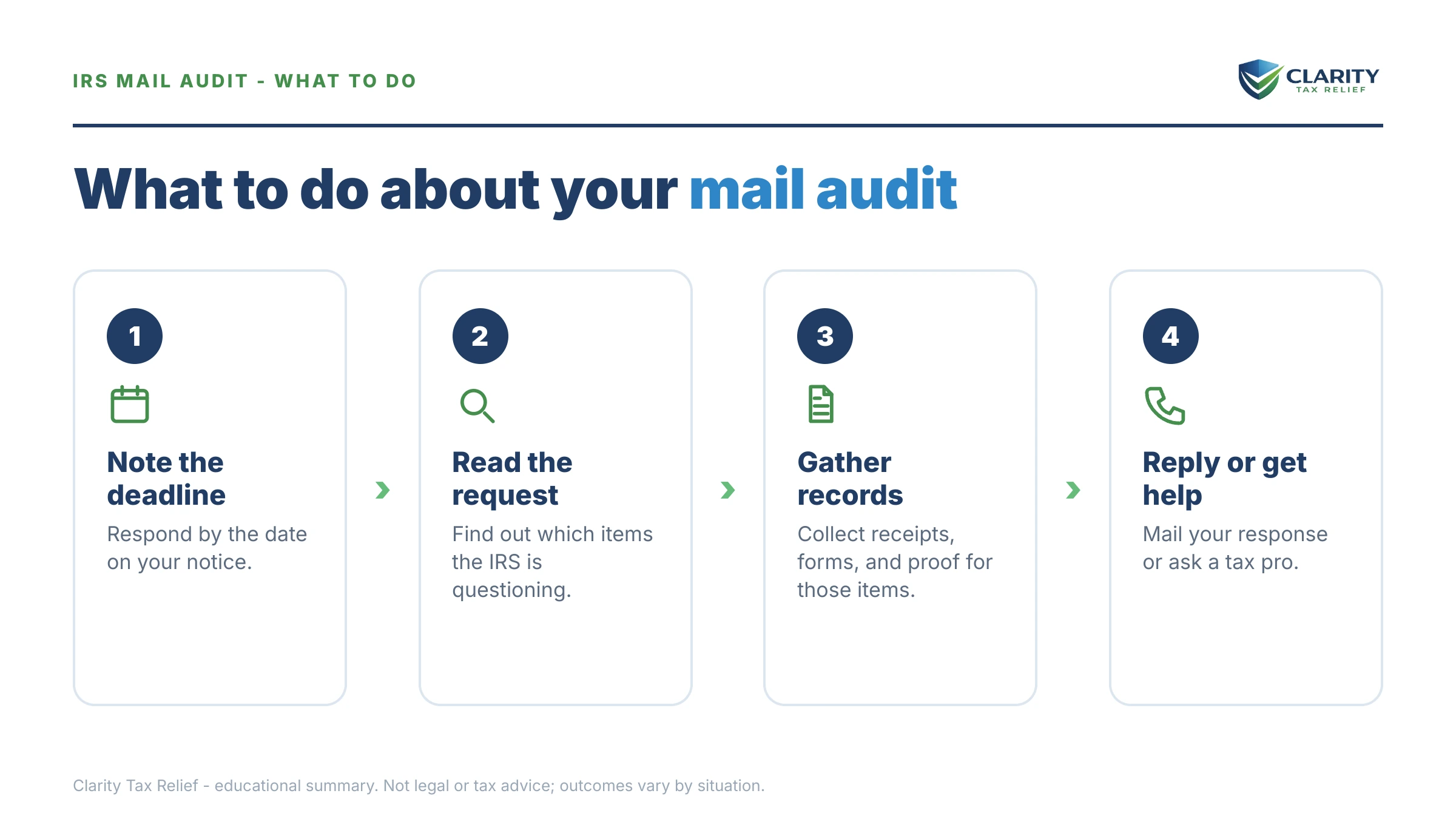
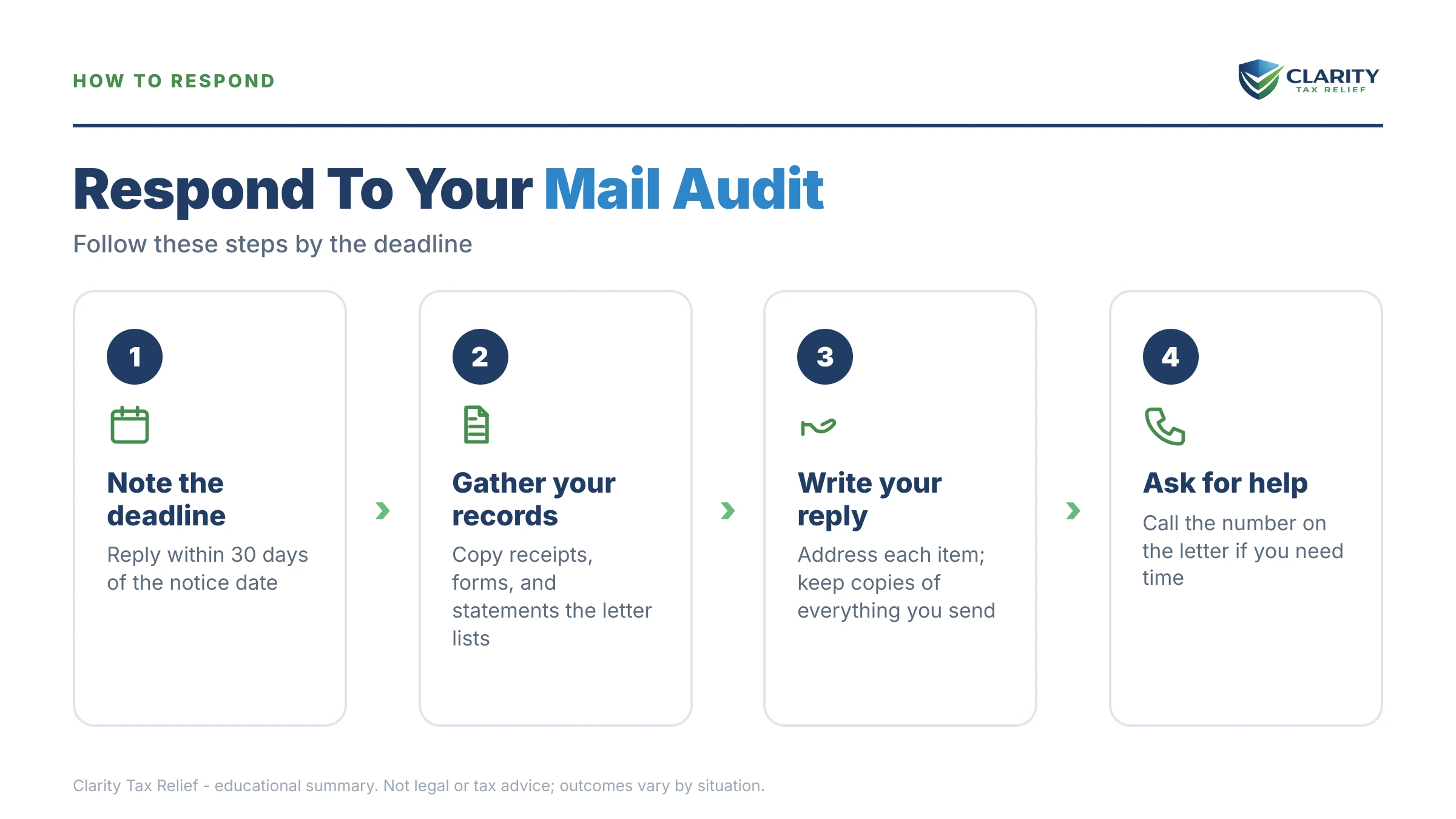
A strong mail audit response answers only the items listed on Form 886-A, in one organized package, sent with proof of delivery. Nothing more, nothing less:
- Calendar the deadline. Find the response date printed on your letter and set a reminder a week earlier — a late response is treated the same as no response.
- Confirm the scope. Read the Form 886-A pages to see exactly which items and which tax year are under exam — you only need to answer those.
- Gather matching proof. Pull the records that answer each questioned item: 1099s, app earnings summaries, bank statements, mileage data, receipts, or school and medical records for dependent claims.
- Write a one-page cover letter. List each questioned item and the document that answers it, and put the tax year and notice number on every page you send.
- Send copies with proof of delivery. Use the fax number or address printed on the letter, never originals, and keep the fax confirmation or certified mail receipt.
- Track the case. If you hear nothing about 60 days after sending, call the number on the letter to confirm receipt — and answer every follow-up letter by its own deadline.
Missing receipts don't end the fight — reconstructed records from bank statements, platform data, and calendars are accepted more often than people expect. Our guide to surviving an IRS audit no receipts situation covers exactly how to rebuild each expense category.
What a mail audit can cost: the $6,200 example
Say you drive for two delivery apps. You filed your 2023 return showing $41,000 of gross 1099 income and $17,500 of Schedule C expenses — but 2022, 2024, and 2025 are still unfiled. In early 2026, a Letter 566 arrives questioning your car-and-truck expenses and supplies deduction. This is a hypothetical, but the math is how these cases actually price out.
The do-nothing path. You never kept a mileage log, so you send nothing. The examiner disallows the questioned deductions and proposes $6,200 in additional tax. The 20% accuracy-related penalty adds $1,240, and interest runs from April 2024 — the return's original due date, not the audit date. The bill lands above $7,800 before interest and keeps compounding daily. You can estimate how penalties and interest stack on your own numbers with our IRS penalty and interest calculator.
The respond path. Both apps keep trip-level data — dates, miles, deliveries. You download the year-end summaries, match them to bank deposits, and rebuild a mileage record. If the examiner accepts documentation for 75% of the claimed expenses, the adjustment drops from $6,200 to roughly $1,550 ($6,200 × 25%), and the accuracy penalty on that remainder falls to about $310. Same audit, same taxpayer — a five-figure difference over the life of the debt, built from records that already existed.
One more wrinkle from the unfiled years: even that smaller $1,860 balance can't go on a payment plan until the 2022, 2024, and 2025 returns are filed. In a case like this, the sequence is returns first, audit response in parallel, then the payment arrangement — order matters.
Reading your transcript during a mail audit
Transcript code 420 is the clearest sign a correspondence audit is open on your account. Pull your account transcript through your IRS online account and you can track the exam's real status even when the mail is silent:
| Code | What it means | What to do |
|---|---|---|
| 424 | Exam request — your return was referred for possible audit | Nothing yet; wait for a letter before assuming an audit is open |
| 420 | Examination open — a correspondence audit is underway | Watch the mail closely and make sure the IRS has your current address |
| 810 | Refund freeze | Respond to the audit letter — the refund stays held until the exam closes |
| 971 | Notice issued | A letter is on its way; match its date against your transcript |
| 300 | Additional tax assessed by examination | The audit closed with a balance — check which appeal window is still open and act fast |
| 421 | Examination closed | Read the closing letter: no-change, agreed changes, or a default assessment |
The most useful habit: check the transcript about two weeks after mailing your response. If nothing has posted after 60 days, call the number on your letter with your proof of delivery in hand.
When you can handle a mail audit yourself
A single-issue mail audit with clean records is genuinely a do-it-yourself project. You don't need professional help when:
- The letter questions one item and you have the documents that directly answer it — a receipt file, a mileage log, school records for a dependent.
- You review the numbers and the IRS is right about a small amount — agreeing, signing, and paying (or setting a short plan at IRS.gov/payments) closes it cleanly.
- Your only need is more time — one call to the number on the letter usually handles that.
Experienced help tends to change the outcome when the case has layers: multiple questioned issues or multiple years; unfiled returns behind the audited year; income that won't match the 1099s in the IRS's file; deductions that must be reconstructed rather than produced; a 20% accuracy penalty worth contesting; or a case that already defaulted and needs reconsideration or an Appeals fight. In those cases, what you include — and what you leave out — determines whether a narrow exam stays narrow.
Two free resources worth knowing either way: the IRS's own overview of the exam process at its IRS audits page, and the Taxpayer Advocate Service, which can intervene when a stalled audit or frozen refund is causing genuine hardship.
If your letter questions more than one issue — or you're staring at it with unfiled years behind you — get the whole picture reviewed free or call (888) 825-7779 before your response window closes.
Terms on your audit letter, decoded
- Correspondence examination — the IRS's formal name for a mail audit: an exam conducted entirely by letter, with no in-person meeting.
- Form 886-A (Explanation of Items) — the pages listing exactly which items are questioned and what proof the IRS wants. It's the outline your response should follow.
- Form 4549 (Income Tax Examination Changes) — the examination report showing proposed changes, penalties, and the new balance. Signing it means you agree.
- 30-day letter (Letter 525) — the letter transmitting the exam report; it starts your 30-day window to request an IRS Appeals review.
- Notice of Deficiency (CP3219A) — the "90-day letter," your last chance to dispute the tax in Tax Court before it's assessed.
- No-change letter — the closing letter you want: the IRS accepted your documentation and made no changes to your return.
IRS mail audit FAQs
How long does an IRS mail audit take?
Most mail audits take several months from the opening letter to a closing letter, and backlogged cases can stretch past a year. The slow part is usually the IRS: your response can sit unlogged for weeks after it arrives. If you've heard nothing about 60 days after sending your documents, call the number on your letter to confirm they were received — and keep your proof of delivery until you get a closing letter.
Can an IRS mail audit turn into a full audit?
Yes. If your response raises new questions — unexplained bank deposits, income that doesn't match your 1099s, or several unfiled years — the exam can expand to more issues, more years, or be transferred to an office or field examination. That's why you answer only the items listed on the letter: volunteering extra documents is the most common way taxpayers widen their own audit.
What happens if I ignore an IRS mail audit?
The IRS disallows every questioned item by default and moves toward assessing the full proposed tax, plus penalties and interest. You'll get an examination report, then a Notice of Deficiency giving you 90 days to petition Tax Court. Once that window passes, the balance becomes final and collection notices begin — after that, audit reconsideration is usually your only way to reopen the numbers.
Should I call the IRS or respond in writing to a mail audit?
Respond in writing — a phone call is not a response and doesn't stop any deadline. Calls are useful for two things: asking for more time before your date passes and confirming the IRS received your package. Everything substantive goes in one organized written packet, sent to the fax number or address printed on the letter, with proof of delivery you keep.
Will the IRS hold my refund during a mail audit?
Usually, yes — if the audit involves a refund year, the refund stays frozen until the exam closes. On your transcript this often shows as code 810 (refund freeze) alongside code 420. The fastest way to release it is a complete, on-time response; partial or piecemeal responses tend to add months. If the frozen refund is creating a genuine financial hardship, the Taxpayer Advocate Service can sometimes intervene.
What if I don't have receipts for the items being audited?
You can often reconstruct records instead. Bank and credit card statements, app earnings summaries, calendars, photos, and third-party letters can substantiate expenses when original receipts are gone. Mileage is the classic example — delivery and rideshare platforms keep trip data you can download and turn into a usable log. Send the reconstruction with a short explanation of how you built it; examiners can accept reasonable reconstructions, though usually not for the full amount claimed.
I missed my mail audit deadline — is it too late?
No, but your path changes. Before the tax is assessed, call the number on the letter immediately — examiners can often reopen or extend a case that just closed. After assessment, you can request audit reconsideration by sending the documents the examiner never saw, or dispute the liability through an Offer in Compromise based on doubt as to liability. None of those pause collection automatically, so act before the balance-due notices escalate.
Does a mail audit mean the IRS suspects fraud?
No. Mail audits are computer-selected document checks, not fraud investigations — most involve routine items like credits, dependents, or self-employment deductions. Fraud cases are handled by different units with different contact methods. That said, honesty matters: sending fabricated documents can convert a routine exam into something far more serious, so if there's a problem underneath your return, talk to an experienced tax professional before you respond.
How far back can a mail audit go?
Generally three years from the date you filed the return, which is why most mail audit letters cover a recent year. The window doubles to six years if you omitted more than 25% of your income, and there is no time limit at all for a year you never filed. If your letter covers an old year, check which rule applies before assuming the IRS is out of time.
Your next 24 hours
- Find two things on your letter: the tax year under exam and the response deadline printed near the top. Write that deadline somewhere you'll see it every day.
- Gather the raw material: the audited year's return, every 1099 and app earnings summary for that year, and whatever records touch the questioned items — even partial records are the starting point for a reconstruction.
- Get the letter reviewed free before your response window closes: call (888) 825-7779 or use the 2-minute form, and an experienced tax professional will map exactly what to send — and what to leave out.
This guide is general information, not tax or legal advice for your specific situation. Eligibility for IRS programs depends on individual facts and circumstances; no outcome is guaranteed.