
IRS Letters & Audits
IRS Letter 566 in 2026: The Audit Letter, Your Deadline, and How to Respond
The short answer: IRS Letter 566 means your tax return has been selected for examination — an audit, usually handled entirely by mail. The enclosed Form 886-A lists the items being questioned, and the letter sets a response deadline, typically 30 days. Send proof by that date, or the IRS disallows those items and bills you.
You filed your joint return months ago — maybe you've already spent the refund — and now a letter 566 says the IRS has "selected your return for examination" and wants proof of the deductions and credits you claimed. That word, examination, means audit. Here's the part the letter doesn't say plainly: most 566 audits happen entirely by mail, they cover only the items listed inside, and a complete response closes many of them with no change at all.
Two pieces of the package decide how this goes: the response deadline and the Form 886-A item list. The image below shows exactly what a Letter 566 looks like and where to find both on the page. (If you're still not sure why the IRS wrote to you at all, start with our decoder on why did I get a letter from the IRS.)
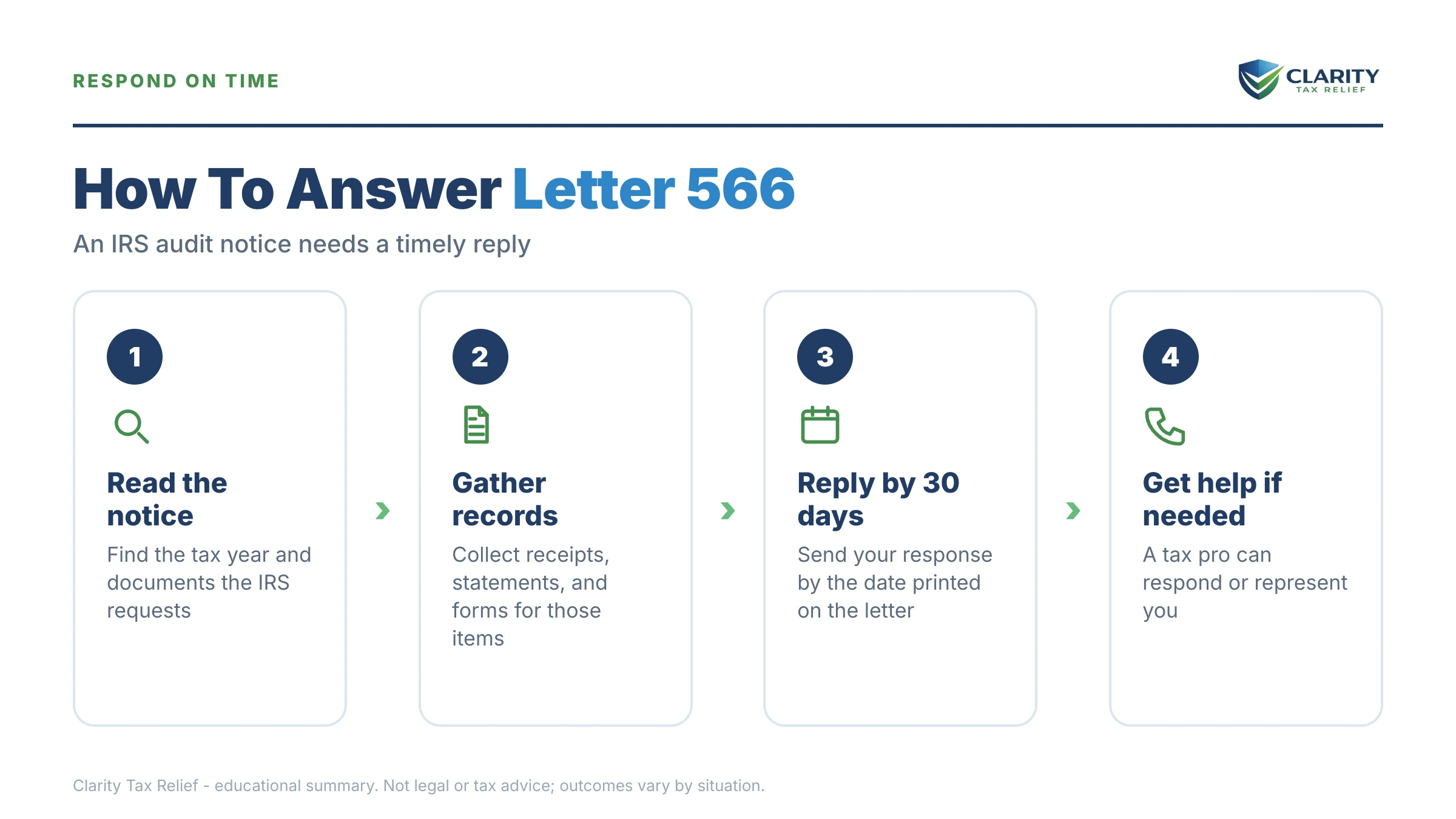
⏱ Your deadline: the response date printed on your Letter 566 — typically 30 days from the letter date. Miss it and the IRS treats silence as agreement: the questioned items are disallowed and the case moves toward a Notice of Deficiency. Extensions are available — but only if you call the number on the letter before the date passes.
Why you got Letter 566
Letter 566 is the IRS's opening letter for a correspondence audit — an examination of specific items on your return, conducted by mail from a service center rather than by an agent across a desk. Getting one is not an accusation of fraud. It means the IRS's screening flagged something on your return it wants documented before it accepts the numbers.
The most common triggers, in rough order of frequency:
- Refundable credits — the Earned Income Tax Credit, the Additional Child Tax Credit, and education credits are the single largest category of correspondence exams. If your 566 targets the EITC specifically, you may instead have received a CP75 notice, its EITC-specific cousin.
- Deductions large relative to income — charitable gifts, unreimbursed medical expenses, or a Schedule C loss that looks out of proportion to what similar returns show. The IRS's computer scoring (the DIF system) compares your return against statistical norms; outliers get pulled.
- Document mismatches — a 1098-T that doesn't support the education credit claimed, a dependent's SSN that appears on someone else's return.
- Related exams — a business partner, an ex-spouse claiming the same child, or an employer under audit can pull your return in with theirs.
- Random selection — a small share of exams are compliance-research picks. Rare, but real.
One 2026 note worth knowing: the IRS workforce shrank roughly 27% in 2025, and correspondence exam units were hit hard. That means slower replies to your letters — but the automated deadlines on the IRS's letters still run on schedule. The asymmetry is the trap: the machine holds you to 30 days while taking months to answer you.
What's inside the Letter 566 envelope
A Letter 566 package contains three things that matter: the letter itself, Form 886-A listing every questioned item, and instructions for where and how to send your response.
The letter names the tax year under exam, the response deadline, and a contact number or examiner unit. Letter 566 comes in several versions — 566-S, 566-B, and 566-E among them — and the version letter changes the format, not the meaning: your return is under examination and the date printed on page one controls.
Form 886-A, Explanation of Items, is your actual to-do list. It states each questioned item and, usually, the kind of proof the IRS wants for it. Some packages also include Form 4564, an Information Document Request, and Publication 3498-A, the IRS's own guide to audits by mail — worth skimming, though it won't tell you how to win.
If your letter instead schedules an appointment with a named agent, you're looking at an office or field exam, not a mail audit — see our guide to Letter 2205-A, because the strategy changes when a human examiner is assigned.
Letter 566 vs. CP2000: not the same thing
Letter 566 opens a true examination; a CP2000 is an automated income-matching proposal — different processes with different rights. A CP2000 says "your reported income doesn't match the W-2s and 1099s we received," and the IRS already has the third-party documents. A 566 flips the burden: the IRS is questioning items you claimed, and you must prove them. That's why a 566 response is built from your records — receipts, statements, logs — rather than from arguing about a payer's form. It also means an exam ends with formal appeal rights and, if needed, a Tax Court path, which matters later on this page.
What happens if you ignore Letter 566
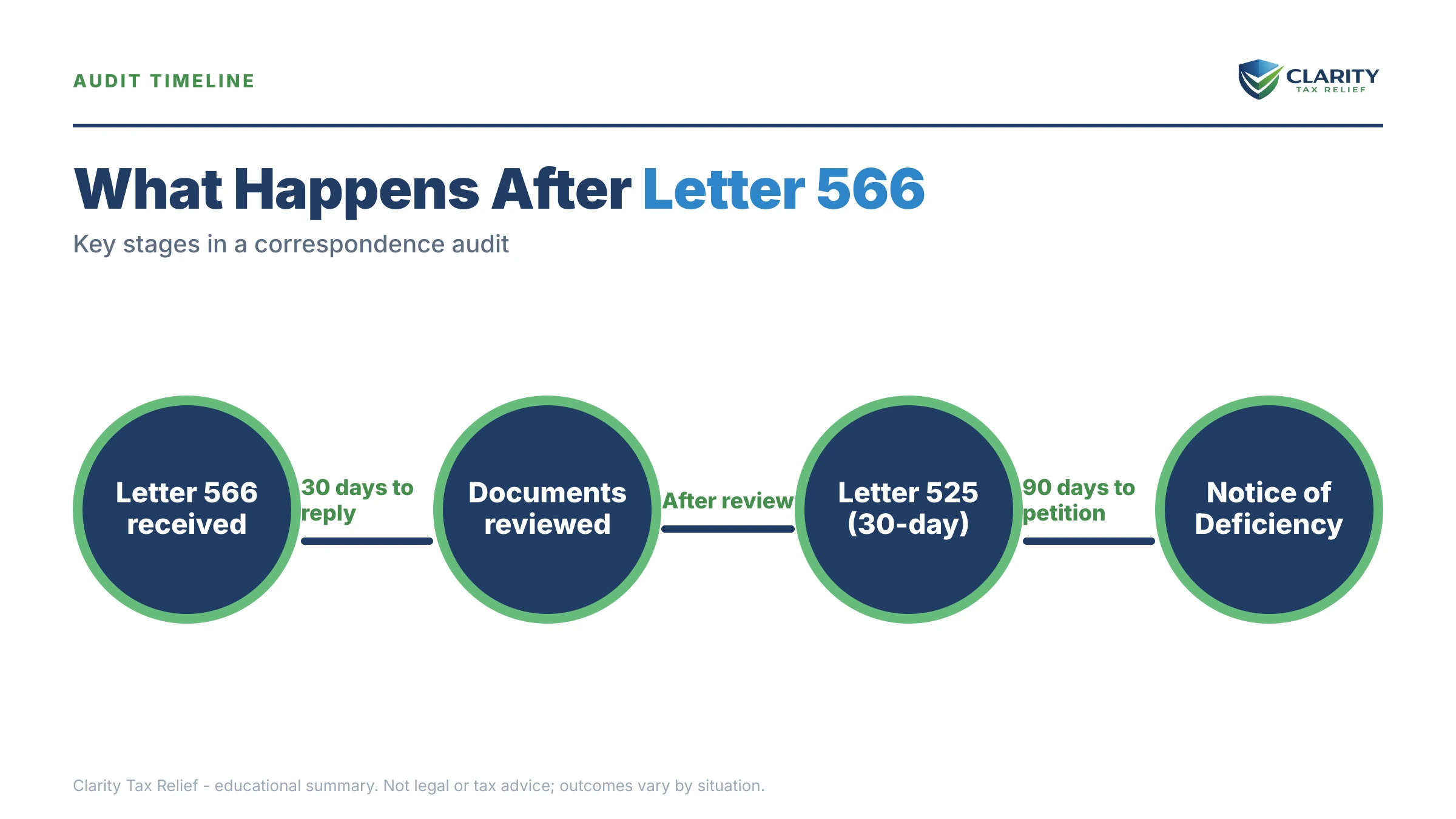
If you don't respond to Letter 566, the IRS disallows every questioned item and rebuilds your tax bill as if you never claimed them. There's no hearing first and no benefit of the doubt — a correspondence exam decided on no evidence goes one way. The sequence from there is orderly and automated:
- Letter 566 — the exam opens and your documents are requested. You are here. Respond by the printed date and you control the outcome.
- Examination report — with no response, the IRS issues its findings (typically a Letter 525 with Form 4549 attached) showing the proposed additional tax, penalties, and interest. You typically get 30 days to agree or appeal.
- CP3219A Notice of Deficiency — the formal, statutory proposal. The CP3219A notice of deficiency starts a hard 90-day window to petition Tax Court — the last stop before the tax becomes final.
- Assessment and billing — after the 90 days, the tax is assessed and the first bill arrives, with the full collection notice stream behind it.
- Enforced collection — the stream ends at a final notice of intent to levy such as Letter 1058, after which the IRS can garnish wages and levy bank accounts.
| Stage | What it means | Your window |
|---|---|---|
| Letter 566 | Exam opens; documents requested for the listed items | Typically 30 days — the date printed on your letter |
| Exam report (Letter 525 / Form 4549) | IRS proposes changes based on what you did — or didn't — send | Typically 30 days to agree or appeal |
| CP3219A Notice of Deficiency | Formal proposed assessment; Tax Court rights begin | 90 days to petition Tax Court |
| Assessment + first bill | Balance becomes legally owed, with penalties and interest attached | About 21 days before reminder notices begin |
| Final notice (LT11 / Letter 1058) | Levy and garnishment power activates | 30 days to request a Collection Due Process hearing |
What silence costs: a worked $41,800 example
Say you and your spouse filed jointly, and Letter 566 questions $130,000 of Schedule C expenses from one spouse's consulting business. This is hypothetical, but the math is how it actually works. You never respond, so the IRS disallows all $130,000:
- Additional income tax: $130,000 of disallowed deductions in the 24% bracket ≈ $31,200 — before any extra self-employment tax on the higher net profit.
- Accuracy-related penalty: the 20% accuracy-related penalty on the understatement ≈ 20% × $31,200 = $6,240.
- Interest: roughly $4,360 accrued by the time the balance is assessed and billed — interest compounds daily at the federal underpayment rate, so the exact figure depends on timing.
Total: roughly $41,800 — assessed by default, without anyone ever weighing your evidence. Now run the alternative: you respond and substantiate $95,000 of the expenses with bank statements and a reconstructed mileage log. The disallowance shrinks to $35,000, the additional tax to about $8,400, the penalty to about $1,680 — a swing of roughly $30,000 created entirely by answering the letter. You can estimate how penalties and interest stack on any proposed audit balance with our IRS Penalty & Interest Calculator.
Holding a Letter 566 right now?
Your response window is measured in days, and what you send — and don't send — decides the outcome. Get your Letter 566 reviewed free before the deadline printed on it: an experienced tax professional will tell you exactly what the IRS is asking for and how to answer it.
Your options after Letter 566
Every Letter 566 ends one of five ways: no change, an agreed change, an appealed change, Tax Court, or a default assessment you then have to unwind. Which path you take — and what it costs — depends on your records and whether the IRS's concern is legitimate:
| Option | What it costs | Typical timeline | Best when |
|---|---|---|---|
| Respond with full documentation | Free beyond copying and certified postage | Weeks to months for an IRS reply — exam units are slow in 2026 | You have (or can reconstruct) records for the questioned items |
| Request an extension | Free — call the number on the letter | Short extensions are commonly granted when requested before the deadline | You need time to pull bank records or third-party letters |
| Agree and pay, or set up a plan | The corrected tax plus penalties and interest; payment plans run up to 72 months for balances under $50,000 | A plan can be set up online the same day at IRS.gov/payments | The IRS is right and fighting would cost more than paying |
| Appeal the exam report | Free to request (Form 12203 for smaller cases, via IRS Appeals) | Months — Appeals is backlogged | You disagree with the findings and have at least partial proof |
| Tax Court petition after CP3219A | $60 filing fee | Many months; most cases settle before trial | The 90 day letter window is closing and you still dispute the changes |
| Audit reconsideration | Free | Months | You missed every deadline but later found documentation — see audit reconsideration |
| Professional representation | Varies by case; reputable firms quote a flat fee up front | Handles the exam start to finish under a power of attorney | Schedule C exams, multiple years, or five-figure exposure |
Two things the table can't capture. First, a complete response beats a fast one — a rushed, partial packet often triggers a second document request and restarts the wait. Second, "agree and pay" isn't defeat when the IRS is right: an accepted balance can be resolved with a payment plan, and penalties may still be reducible afterward. What you should never do is agree to numbers you haven't verified just to make the letter stop.
How to respond to Letter 566, step by step
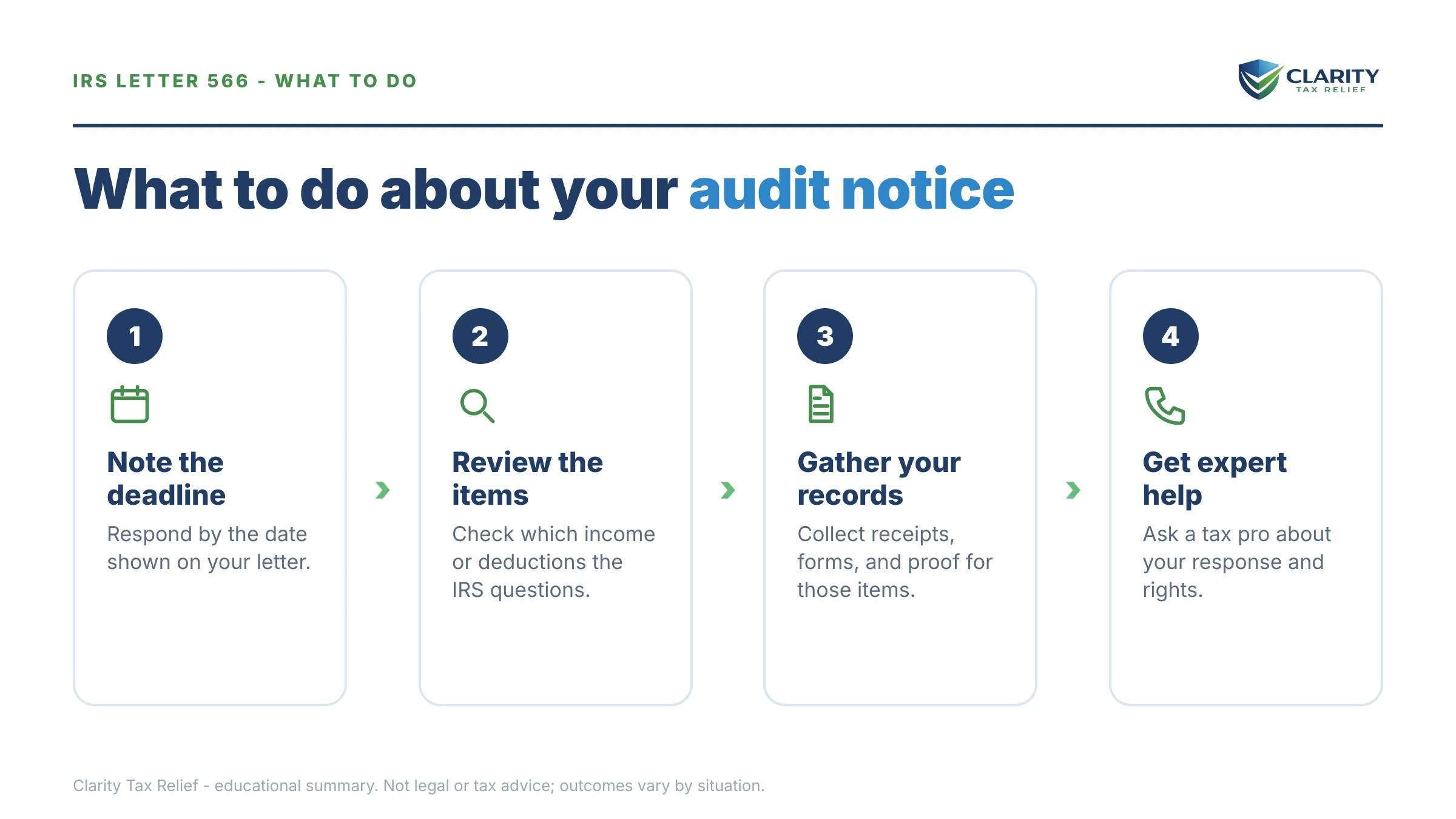
- Read Form 886-A first — it lists exactly which items and which tax year are under exam. Everything you send should answer that list — nothing more, nothing less.
- Verify the letter is real — log in to your IRS online account or call the IRS directly using a number from IRS.gov. A genuine Letter 566 arrives by postal mail, never by email or text.
- Gather proof for every questioned item — receipts, bank statements, logs, acknowledgment letters, and official records. Send clear copies — never originals — and label each document with the item it supports.
- Write a one-page cover letter — respond to each Form 886-A item in order, state what documents prove it, and include the contact or response page from your letter so your reply reaches the right file.
- Send it before the deadline with proof of delivery — use certified mail with return receipt, or the fax number printed on the letter, and keep the delivery confirmation with your copies.
- Calendar the follow-up — exam units are slow in 2026, so a quiet stretch is normal — but respond immediately to whatever arrives next, whether it's a no-change letter or an exam report.
What documents to send for each audited item
Correspondence audits are won on paper: the examiner can only allow what you can document, and a tax examiner working a stack of files will accept clean, labeled proof far faster than a shoebox of loose receipts. Match your packet to what's on your Form 886-A:
| Item under exam | What proves it |
|---|---|
| EITC / dependents | Birth certificates, school and medical records showing the child lived at your address, custody orders |
| Schedule C income and expenses | Bank statements, invoices, receipts, a mileage log, Forms 1099 you received |
| Charitable contributions | Written acknowledgment letters for any gift of $250 or more, canceled checks, card statements |
| Education credits | Form 1098-T, tuition account statements, proof of payment |
| Medical and other itemized deductions | Provider bills, insurance explanations of benefits, proof of payment |
| Filing status | Records showing who lived in the household and who paid its costs |
Missing records aren't automatically fatal. The IRS accepts reconstructed evidence more often than people assume — bank and card statements can rebuild expenses, calendars can rebuild mileage, and third parties can write statements. Our guide to surviving an IRS audit no receipts covers reconstruction in detail. What is fatal is sending nothing because your records are imperfect.
Married filing jointly, self-employed, or multiple years: what changes
The same Letter 566 plays out very differently depending on whether it targets a credit, a business schedule, or more than one year.
Married filing jointly. Both spouses signed the return, so both are jointly and severally liable for anything the exam adds — the IRS can collect the entire assessment from either of you, regardless of whose deduction it was. Respond as a team now, with one coordinated packet. If one spouse hid the questioned income or fabricated the deductions, innocent spouse relief exists, but only after a liability is on the books — it's a cleanup tool, not a response to the audit itself.
Self-employed / Schedule C. Business exams are the highest-stakes version of a 566 because disallowed expenses raise both income tax and self-employment tax, and because a weak response invites the examiner to look at gross receipts too. Organize by expense category, tie every category to bank records, and read our schedule c audit defense guide before mailing anything.
Multiple years. If the letter covers more than one tax year — or a second letter follows for an adjacent year — treat consistency as the whole game: the story your documents tell for one year must match the next. This is also where statute questions arise; the general audit window is covered in how far back can the IRS audit, and if the examiner asks you to sign Form 872 extending the assessment statute, get advice before signing — it's a real decision, not a formality.
Refund frozen. When the exam covers refundable credits, the IRS typically holds the related refund until the case closes. If that freeze is causing genuine hardship — eviction risk, utility shutoff — the Taxpayer Advocate Service can intervene while the exam is pending.
When you can handle a Letter 566 yourself — and when help changes the outcome
You can handle many Letter 566 audits yourself; the honest dividing line is what's being examined and how much is at stake. Handle it on your own when the exam covers one clean, documentable item: an education credit backed by a 1098-T, a charitable deduction with acknowledgment letters in hand, a dependent question you can answer with school records. Follow the steps above, send a complete packet by certified mail, and you'll do as well as anyone.
Experienced help genuinely changes outcomes in four situations: a Schedule C exam with imperfect records, where reconstruction and presentation determine how much survives; multiple years or five-figure exposure, where one bad answer compounds across returns; anything you know is wrong on the return — unreported income underneath the questioned deductions is how a routine mail exam becomes a serious problem, and what you volunteer matters; and a blown deadline, where the path back runs through appeals, Tax Court, or audit reconsideration with their own rules. A representative under power of attorney also becomes the IRS's point of contact, which alone prevents the most common self-inflicted wound: answering questions that were never asked.
If your Letter 566 questions a business schedule or more than one year, have an experienced tax professional look at it free before you mail anything — start with the 2-minute form or call (888) 825-7779.
Terms on your Letter 566, decoded
- Examination — the IRS's formal word for an audit; on a 566 it means specific items, not your whole life.
- Form 886-A (Explanation of Items) — the attachment listing each questioned item and the proof the IRS wants; your response checklist.
- Information Document Request (Form 4564) — a formal list of records the examiner wants; answer every line or note why you can't.
- Tax examiner — the service-center employee working your file by mail; correspondence exams usually have no single assigned agent.
- No-change letter — the best possible ending: the IRS accepts your documentation and closes the exam with zero adjustment.
- Statutory notice of deficiency — the formal 90-day letter (CP3219A) that follows an unresolved exam; your ticket to Tax Court, and the last exit before assessment.
Letter 566 questions, answered
Is Letter 566 an audit?
Yes. Letter 566 is the IRS's official notification that your tax return has been selected for examination — the formal term for an audit. Most Letter 566 audits are correspondence audits handled entirely by mail, focused only on the items listed on the enclosed Form 886-A. You won't meet an agent in person unless the case is later converted to an office or field exam, which is uncommon when you respond with solid documentation.
How long do I have to respond to Letter 566?
The controlling deadline is the response date printed on your letter — typically 30 days from the letter date. If you need more time to gather records, call the number on the letter before the deadline; examiners routinely grant short extensions when you ask early. Never let the date pass silently, because the IRS treats no response as agreement to disallow every questioned item.
What happens if I ignore Letter 566?
The IRS disallows the questioned items and recalculates your tax as if you never claimed them. You'll receive an examination report proposing the new balance, then a CP3219A Notice of Deficiency giving you 90 days to petition Tax Court. If that window passes, the tax is assessed with penalties and interest, and the account moves into the collection notice stream.
Is Letter 566 the same as a CP2000?
No. A CP2000 is an automated underreporter proposal generated when income on W-2s or 1099s doesn't match your return — it isn't technically an audit. Letter 566 opens a true examination: the IRS is questioning items you claimed, such as deductions or credits, and the burden is on you to prove them with documents. The response strategies overlap, but exam cases carry appeal rights through the audit process.
Will Letter 566 delay or hold my refund?
Often, yes. When the examined items include refundable credits like the Earned Income Tax Credit or the Additional Child Tax Credit, the IRS typically freezes the related portion of your refund until the exam closes. The fastest way to release it is a complete, well-organized response; a partial or late reply usually restarts the review clock.
Can a Letter 566 audit expand to other years or items?
It can. If your documents raise new questions — unexplained deposits, a pattern of unsupported deductions — the examiner may open additional items or pull your prior- or later-year returns. Most correspondence exams stay limited to the items on the original Form 886-A when the response is clean, organized, and answers exactly what was asked without volunteering extra material.
What is Form 886-A on my Letter 566?
Form 886-A, Explanation of Items, is the attachment that tells you precisely what the IRS is questioning and what proof it wants for each item. Treat it as your checklist: respond to every line on it, in order, with labeled documents. An item you skip on Form 886-A will generally be disallowed even if the rest of your response is perfect.
Do both spouses need to respond to Letter 566 on a joint return?
One coordinated response covers a jointly filed return, but both spouses are jointly and severally liable for any tax the exam adds — the IRS can collect the full amount from either of you. If the questioned items belong entirely to one spouse, respond together now; relief options such as innocent spouse relief only come into play later, after a liability exists.
How far back can the IRS audit me with Letter 566?
Generally three years from the date you filed the return. The window extends to six years if you omitted more than 25% of your gross income, and there is no time limit for a fraudulent return or a year you never filed. If the examiner asks you to sign Form 872 to extend the assessment statute, get advice from an experienced tax professional before signing.
Your next 24 hours
- Find two things on your letter: the response deadline printed near the top, and the Form 886-A list of items under exam — those two facts define your entire task.
- Gather your file: a complete copy of the audited year's return, the full Letter 566 package, and every receipt, statement, or record touching the questioned items — even imperfect ones.
- Get the letter reviewed free before you mail anything: use the 2-minute form or call (888) 825-7779. The window printed on your Letter 566 is typically 30 days, and what goes in your first response shapes everything after it.
This guide is general information, not tax or legal advice for your specific situation. Eligibility for IRS programs depends on individual facts and circumstances; no outcome is guaranteed.