
IRS Audits
Schedule C Audit in 2026: The Self-Employed Filer's Defense Guide
The short answer: a Schedule C audit is an IRS examination of your self-employment income and deductions — most often triggered by 1099 totals that don't match your reported receipts, or deductions that look large for your income. You typically have 30 days from the date on your audit letter to respond with documentation.
The letter names your tax years, lists the Schedule C lines under examination, and gives you a date to respond by. Maybe some of those years were never filed at all, and the number the IRS is hinting at feels impossible. Take a breath: most Schedule C audits are won or lost on paperwork — and paperwork can be rebuilt.
Two things on that letter control your whole case: the response date and the list of examined items. The image below shows you exactly what a Schedule C audit letter looks like and where to find both.
⏱ Your deadline: the response date printed on your audit letter — typically 30 days from the letter date. Miss it and the IRS issues an examination report disallowing every questioned deduction, followed by a 90-day Notice of Deficiency that is your last stop before the balance becomes final.
Why the IRS is auditing your Schedule C
A Schedule C audit almost always starts with something a computer can see: income forms that don't match your return, or expense ratios that sit outside the norm for your industry code. Every line on a Schedule C is self-reported with no employer verifying it, which is exactly why the IRS's scoring system watches this form so closely.
The most common trigger is a 1099 mismatch. Platforms and clients file 1099-NEC and 1099-K forms with the IRS; if those totals exceed the gross receipts on your return — or no return exists at all — the system flags you automatically. The 1099-K reporting threshold reverted to $20,000 and 200 transactions, but the IRS still holds the forms filed for earlier years, and those years remain fully auditable.
After income, the flags are deduction-side: vehicle expenses claimed at or near 100% business use, home office claims on top of low profit, meals that scale faster than revenue, round numbers on every line, and losses year after year that suggest a hobby rather than a business. The full list lives in our guide to IRS audit triggers. If your work runs heavily on cash — tips, side jobs, cash clients — the exam plays by different rules, covered in our cash business audit guide, because the examiner assumes income went unreported until deposits prove otherwise.
One important limit works in your favor: the exam letter names specific years and specific line items. The examiner works from that list. You are never required to volunteer documents, years, or issues that weren't asked for.
The three kinds of Schedule C audits — and which one you have
Most Schedule C audits are correspondence audits: everything happens by mail, usually opening with a Letter 566 that lists the examined items and asks for documentation. Nobody visits, nobody calls first. Your entire defense is the paper package you send back.
An office audit — often opened with Letter 2205-A — asks you to bring records to an IRS office and answer questions in person. A field audit sends a revenue agent to your business or home, and is reserved for larger or more complex cases. The higher the format, the more an experienced tax professional changes the outcome, because live questions create risks a mailed response never does.
One 2026 reality to plan around: the IRS workforce shrank roughly 27% in 2025, so correspondence exams move slowly and phone follow-up is hard. That cuts both ways. Send everything in writing, keep proof of mailing, and never assume silence means the case closed — the automated deadlines keep running even when no human answers.
What a Schedule C audit examines, line by line
Schedule C exams concentrate on a handful of predictable lines, and each one has a specific document the examiner expects to see. Match your evidence to this list before you respond:
| Schedule C line | What the examiner asks for | Where filers get hurt |
|---|---|---|
| Gross receipts | Bank statements, 1099-NEC/1099-K totals, platform annual summaries | Deposits exceed reported receipts → unreported-income adjustment |
| Car & truck expenses | Mileage log with dates, miles, and business purpose | No log at all; commuting miles counted as business |
| Meals | Receipts plus the business purpose and who attended | Amounts documented, purpose not — disallowed anyway |
| Home office | Square footage, photos, proof of exclusive business use | Space doubles as a guest room or family area |
| Supplies & cost of goods | Invoices, inventory counts, supplier statements | Personal purchases mixed into business totals |
| Contract labor | 1099-NECs you issued, invoices, proof of payment | Cash payments with no 1099 trail — and misclassification questions |
Gross receipts deserve special attention because of how the IRS tests them. In a bank deposit method audit, the examiner totals deposits across every account you touch — personal included — and presumes anything above reported receipts is income. Transfers, loans, and gifts are not income, but you carry the burden of proving each deposit's source. If you paid helpers in cash, expect follow-up questions about whether they should have been employees; that issue can spill into payroll tax exposure, so answer it carefully.
If you filed jointly, remember that any balance the audit produces attaches to both spouses, because a joint return means joint liability for the whole assessment.
What happens if you ignore a Schedule C audit
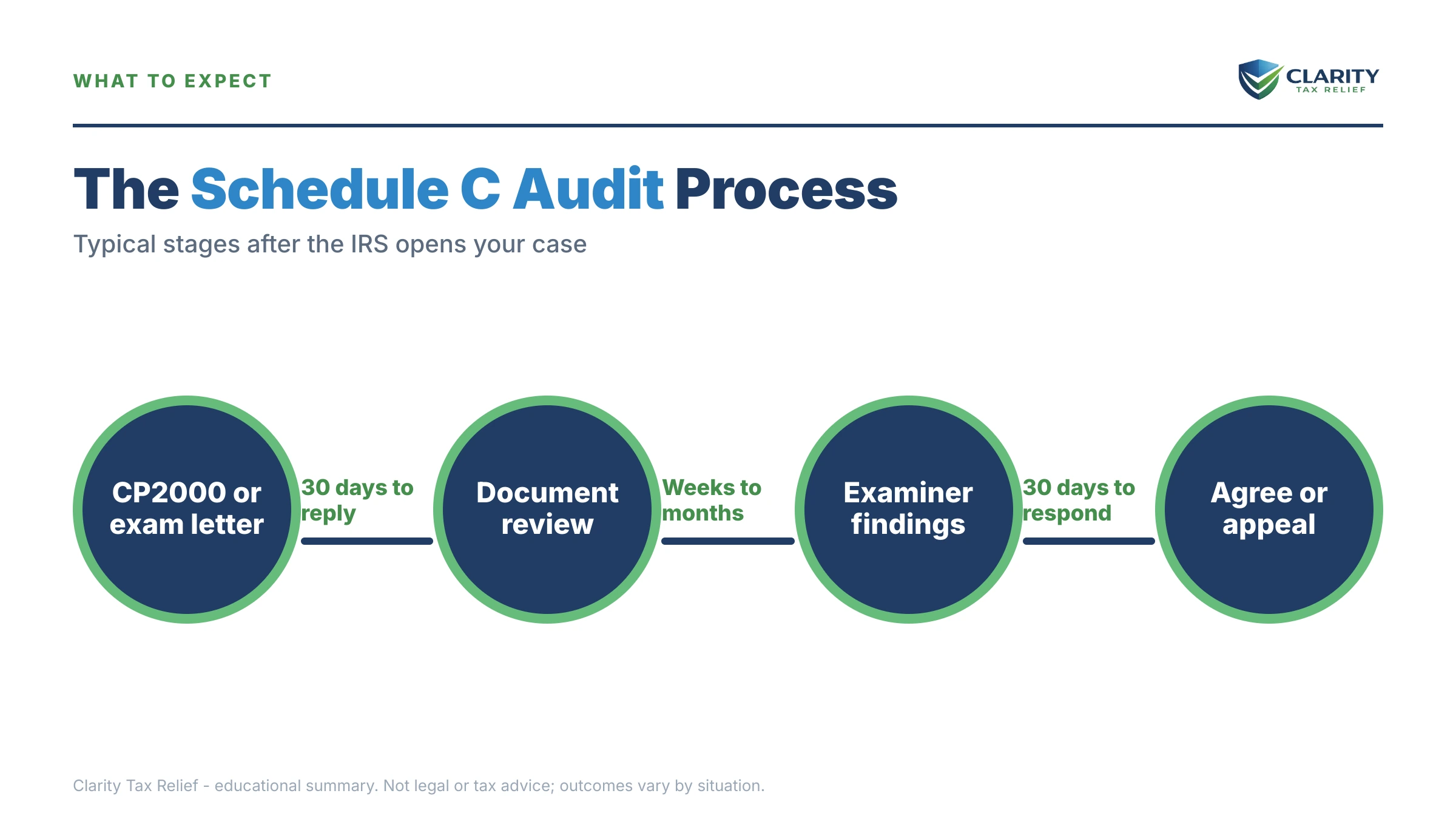
An ignored Schedule C audit doesn't close — it concludes against you, deduction by deduction, on a fixed sequence of letters. Here is the order of escalation:
- Opening letter (Letter 566 or an appointment letter) goes unanswered — the examiner decides each questioned item using only IRS records, which means every deduction without documentation is disallowed and every 1099 dollar is counted.
- Examination report (Letter 525 with Form 4549) — the "30-day letter." It shows the proposed tax, the 20% accuracy-related penalty where it applies, and interest. Its printed window is your chance to request an Appeals conference.
- CP3219A Notice of Deficiency — the "90-day letter." You have 90 days to petition the U.S. Tax Court without paying first. This deadline is statutory; no one at the IRS can extend it.
- Assessment posts — the proposed balance becomes a legal debt with penalties and interest attached, and the 10-year collection clock starts. If the assessed total passes $66,000, passport certification becomes a real possibility.
- Collection begins — the balance-due notice sequence runs toward liens and levies, and your remaining exam remedies shrink to audit reconsideration or an Offer in Compromise based on doubt as to liability.
- State follow-on — most states receive federal audit adjustments and bill their own tax on the same changes, so an ignored federal exam typically produces a second, separate state balance.
Every stage in that sequence is cheaper to fix than the one after it. The response window on your opening letter is the only stage where you can still shape the numbers instead of fighting them.
Holding a Schedule C audit letter right now?
Send us a photo of it before your response date passes. An experienced tax professional will decode which years and line items are on the table, what the exposure really is, and the fastest path to close it — free, confidential, no pressure.
Your options at every stage of a Schedule C audit
You have different rights at different points in the exam, and each right expires on its own clock. This table maps every path — whether you can document your return, disagree with the findings, or agree but can't pay:
| Option | When it's available | Threshold / cost |
|---|---|---|
| Full documentation response | During the exam, before the letter's response date | Free — and the strongest position you will ever hold |
| IRS audit appeal (Appeals conference) | Within the 30-day window on the examination report | Free to request; independent officer weighs hazards of litigation |
| Tax Court petition | Within 90 days of the CP3219A Notice of Deficiency | Small filing fee; no payment required before the case is heard |
| Audit reconsideration | After assessment, with documents the examiner never saw | No fee; discretionary and slow, but it works with real evidence |
| Short-term payment plan | You agree with the balance and can clear it within 180 days | $0 setup; interest and penalties continue until paid |
| Streamlined installment agreement | Assessed balance ≤ $50,000 | Up to 72 months online; setup fee applies, interest continues |
| Currently Not Collectible | Paying anything would create genuine hardship | No fee; collection pauses, the debt and interest remain |
| Offer in Compromise | You dispute the audit math (doubt as to liability) or genuinely can't ever pay it | $205 fee (waived with low-income certification); roughly 1 in 5 offers accepted in FY2024 |
Two penalty notes change the math on whichever path you take. First, the 20% accuracy-related penalty is computed on the underpayment — so every deduction you substantiate cuts the penalty along with the tax. Second, for unfiled years, first-time abatement can remove failure-to-file and failure-to-pay penalties if your prior three years were clean; starting summer 2026, the new Automatic Exemption from Penalty (AEP) begins applying that relief automatically, no request needed. Neither program touches the accuracy penalty, which has to be fought on the merits.
A worked example: $83,100 in gig income, three years unfiled
Say you drove for delivery apps, grossed $83,100 in a typical year, and never filed for three years. The platforms filed 1099s, so the IRS knows the income — and its substitute figures treat the entire $83,100 as pure profit. Here's the hypothetical math, single filer, rounded:
With no return and no records: self-employment tax runs about 15.3% on 92.35% of that profit — roughly $11,700 — and income tax after only the standard deduction adds roughly $9,300. That's about $21,000 in tax for one year. The failure-to-file penalty (5% per month, capped at 25%) adds roughly $5,200, with failure-to-pay penalties and interest still compounding on top. One year clears $27,000. Three similar years push past $80,000 — over the $66,000 passport-certification threshold.
With reconstructed records: say you can document 24,000 business miles (about $15,700 at the mileage rate for that year) plus $2,900 in phone, tolls, and supplies. Net profit drops to roughly $64,500. Self-employment tax falls to about $9,100 and income tax to about $5,500 — roughly $14,600 total, about $6,400 less per year. Across three years that's nearly $20,000 in tax alone, before you count the penalties and interest that shrink with it, because every addition is computed on the smaller base.
That gap is the entire argument for doing the reconstruction work instead of accepting the IRS's numbers. You can estimate your own penalty and interest exposure with our Penalty & Interest Calculator.
When the audit meets years you never filed
An unfiled year has no audit statute of limitations — the IRS can examine it forever, and it often starts by filing a substitute for return on your behalf. An SFR uses only the income documents on file, allows zero business deductions, and applies the least favorable filing status. It is, by design, the worst version of your return.
The counter-move is simple and powerful: file your own original returns for the examined years, even mid-audit. Your filed return replaces the SFR math as the starting point, puts your deductions on the table, and starts the clocks that an unfiled year never starts. As a rule of thumb, the IRS generally wants the last six years of returns to consider you compliant — which matters because compliance is a precondition for nearly every payment program in the options table above. If you're several years behind, our guide for people who haven't filed taxes in 3 years walks the catch-up sequence, and the audit lookback rules themselves — three years, six for large understatements, unlimited for unfiled or fraudulent years — are covered in how far back can the IRS audit.
Sequence matters here: returns first, then penalty relief, then the payment or settlement path. Filing before the examiner finalizes figures also blunts the failure-to-file penalty going forward — filing costs nothing even when you can't pay, and the failure-to-file penalty runs ten times the failure-to-pay rate.
How to respond to a Schedule C audit, step by step
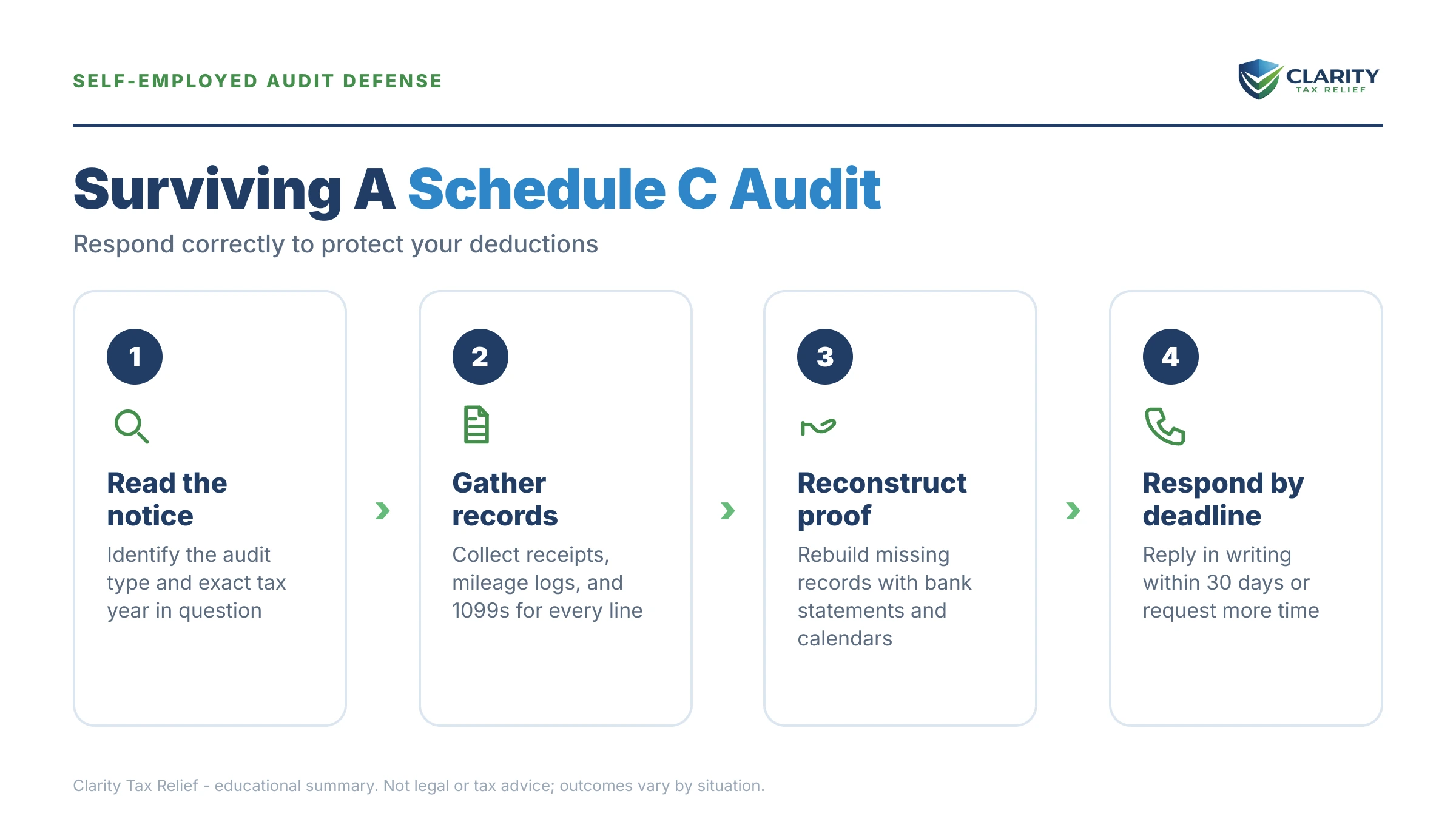
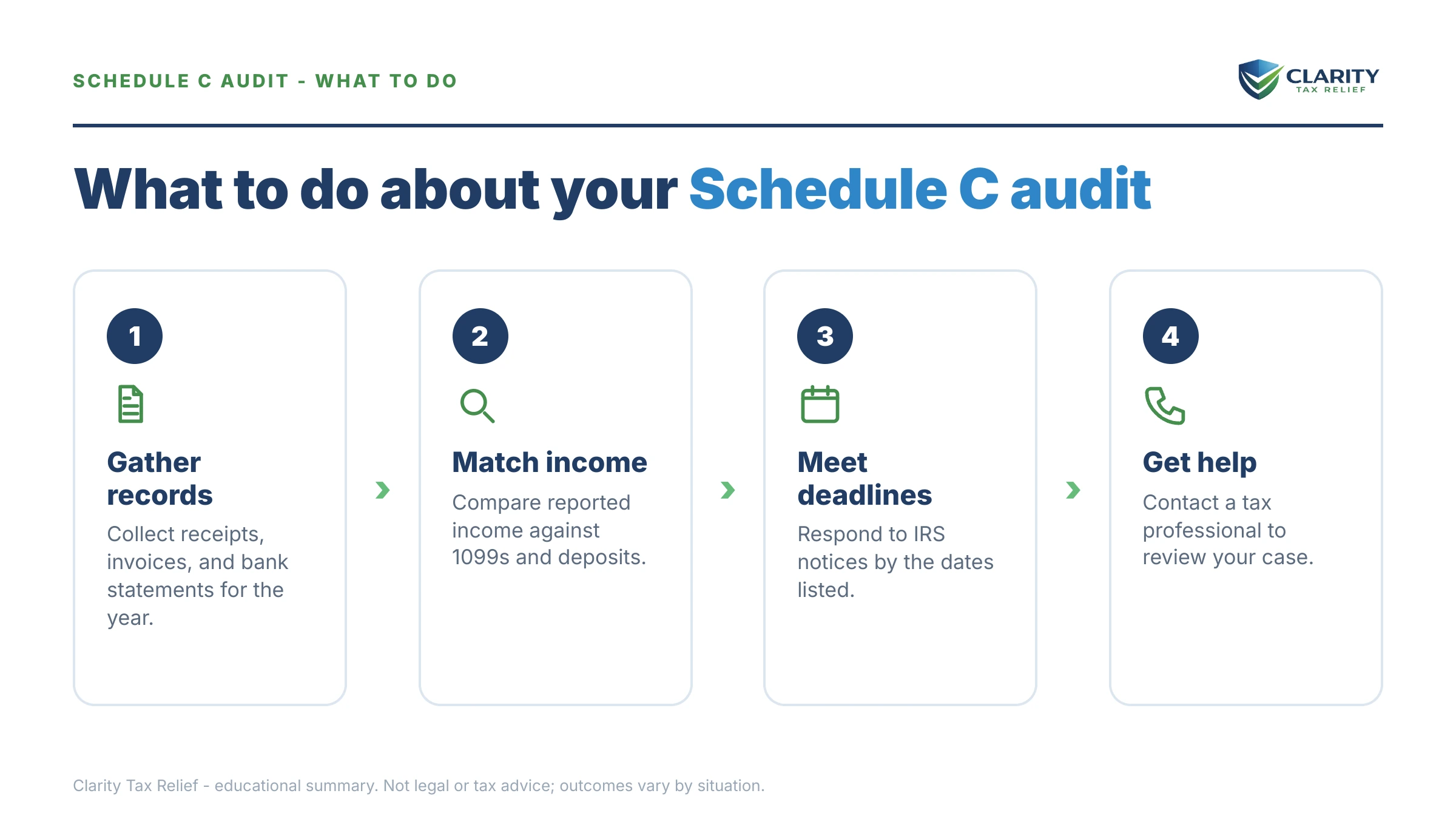
- Calendar the response date. Find the reply-by date on your audit letter and note the tax years and line items listed — the exam covers only what's named, unless you volunteer more.
- Pull your income records. Download 1099-NEC and 1099-K totals, platform annual summaries, and bank statements for every examined year.
- Reconstruct the missing pieces. Rebuild your mileage log from app trip data and calendars, and match every large deposit to its source before the examiner asks.
- File any unfiled years. Submit your own original returns for the years in the letter so the IRS works from your numbers, not its zero-deduction substitute figures.
- Respond in writing before the deadline. Send copies — never originals — organized by line item, with proof of mailing, and keep a complete duplicate set.
- Escalate if you disagree. Request an Appeals conference within the examination report's 30-day window, or petition Tax Court within 90 days of a Notice of Deficiency.
No receipts? How reconstruction actually works
Missing receipts are the normal condition of a Schedule C audit, not a fatal one — the IRS accepts reconstructed records built from credible sources. Bank and card statements establish that money was spent and where. Suppliers and platforms reprint invoices and annual summaries on request. Calendars, job records, and delivery-app trip histories establish business purpose and timing.
For most expense categories, courts have long allowed reasonable estimates where the business purpose is clear — the Cohan rule — though the examiner will discount estimates that have no source data behind them. The full playbook is in our guide to being audited with no receipts.
Vehicle expenses are the strict exception: the law requires an actual mileage record, not an estimate. But "actual record" doesn't mean a paper notebook you kept in real time. A log rebuilt from platform trip data, GPS history, and work calendars is regularly accepted when the sources hold up — the method is detailed in our guide for when the IRS wants a mileage log. For a gig driver, this single reconstruction is usually the largest dollar swing in the whole exam.
When you can handle a Schedule C audit yourself
Plenty of Schedule C audits are genuinely DIY-able. If it's a correspondence exam over one year and one or two line items, you have the records (or can rebuild them from clean sources), and the worst-case adjustment is a balance you could pay within 180 days, an organized written response by the deadline will usually close it. The IRS's own process overview is worth reading before you start.
Experienced help changes the outcome in specific situations: multiple years with some unfiled — where the sequence of filing, penalty relief, and exam response determines the final number; an office or field audit — where live answers can expand the exam's scope; a bank deposit analysis claiming large unreported income; contract-labor questions that could trigger payroll tax liability; or proposed balances big enough to put appeals, Tax Court, or settlement math in play.
And one bright line: if there are facts underneath the return you would not want the examiner to find — unreported cash by design, invented expenses, a second set of numbers — do not respond on your own. That's an eggshell audit, where a representative answers only what's asked and nothing more, because volunteered statements are the main way civil exams turn into something worse.
If your situation sits in that second list — multiple unfiled years, reconstructed income, a five-figure proposed balance — a free case review before you send anything can change what the exam ultimately costs.
Terms on your audit letter, decoded
- Form 4549 (examination report): the IRS's proposed changes to your return, with the new tax, penalties, and interest itemized.
- 30-day letter: the letter (usually Letter 525) transmitting that report — its window is your chance to request an Appeals conference before anything becomes final.
- Notice of Deficiency (90-day letter): the CP3219A, explained fully in our CP3219A notice of deficiency guide — your last chance to dispute in Tax Court without paying first.
- Substitute for Return (SFR): a return the IRS files for you on an unfiled year, counting all reported income and allowing no business deductions.
- Cohan rule: the court doctrine allowing reasonable estimates of some business expenses when receipts are gone but the business purpose is clear.
- Form 872: a consent extending the IRS's deadline to assess — signing or refusing it reshapes the endgame, so decide with advice.
Schedule C audit questions, answered
What triggers a Schedule C audit?
Most Schedule C audits start with a computer match: 1099-NEC and 1099-K totals that don't line up with your reported gross receipts, or deductions out of proportion to your income — especially car, meals, and home office. Repeated losses, round-number expenses, and cash-heavy work push your DIF score higher. The IRS compares your ratios against others in your industry code, so a return that looks normal to you can still sit outside the statistical norm.
How many years can a Schedule C audit cover?
Three years from when you filed is the standard window. It stretches to six years if you understated gross income by more than 25%, and there is no time limit for a year you never filed or where fraud is involved. If your letter names one year, expect the examiner to open adjacent years if they find the same pattern repeating.
What happens if I ignore a Schedule C audit letter?
The IRS doesn't drop the case — it decides it without you. Every questioned deduction is disallowed, an examination report proposes the new balance, and a 90-day Notice of Deficiency follows. If the 90 days pass without a Tax Court petition, the tax is assessed with penalties and interest, and collection notices begin. Your options after assessment are narrower and slower than the ones you have during the exam.
Can the IRS audit me if I never filed a Schedule C?
Yes. When 1099s show self-employment income and no return arrives, the IRS can prepare a substitute for return that counts every reported dollar as profit with zero deductions and the least favorable filing status. There is no audit statute of limitations on an unfiled year. Filing your own original returns — even in the middle of the exam — is usually the single fastest way to shrink the proposed balance.
What if I have no receipts for my Schedule C deductions?
You can reconstruct. Bank and card statements, platform trip data, supplier reprints, and calendars are all acceptable source records. Courts have allowed reasonable estimates for some expense categories under the Cohan rule when a business purpose is clear. Vehicle expenses are the exception — the IRS requires an actual mileage record, but a log rebuilt from app data and work calendars is regularly accepted when the sources are credible.
Will a Schedule C audit look at my personal bank account?
Often, yes. In a bank deposit analysis the examiner totals the deposits across every account you use — business and personal — and treats anything above your reported receipts as unreported income unless you prove otherwise. Transfers between your own accounts, loan proceeds, and gifts are not income, but the burden is on you to document each one. Gather that proof before you respond, not after.
Can a Schedule C audit turn criminal?
Rarely, and almost never over sloppy records or honest estimation. Criminal referrals involve deliberate concealment — false invoices, hidden accounts, destroyed records, or a second set of books. If facts like those sit underneath your exam, stop answering questions on your own; that is an eggshell audit, and every response should go through a representative before it reaches the examiner.
How much does the accuracy-related penalty add?
20% of the underpayment attributable to negligence or a substantial understatement, on top of interest. For unfiled years it stacks with failure-to-file and failure-to-pay penalties, so the additions can approach half the tax itself. Every deduction you substantiate cuts both the tax and the penalty computed on it, which is why documentation work pays double.
Should I sign Form 872 to extend the audit statute?
Sometimes. Refusing usually pushes the IRS to issue an immediate Notice of Deficiency based on its current — worst-case — numbers, which forces you into Tax Court to fix anything. Signing a restricted extension can buy time to substantiate and negotiate. It is one of the few audit decisions you cannot undo, so get advice from an experienced tax professional before you answer.
Your next 24 hours
- Find the response date on your audit letter, along with the tax years and Schedule C line items it names — that list defines the entire exam.
- Gather your sources: 1099-NEC and 1099-K forms, platform annual summaries, bank statements for the examined years, and whatever returns and records exist.
- Get the letter reviewed free before the response date passes — use the 2-minute form or call (888) 825-7779. Knowing your real exposure before you respond is the difference between shaping the numbers and fighting them later.
Primary sources: the IRS's own overview of how IRS audits work, its payment options page for any balance the exam produces, and the Taxpayer Advocate Service if the process itself breaks down or causes hardship.
This guide is general information, not tax or legal advice for your specific situation. Eligibility for IRS programs depends on individual facts and circumstances; no outcome is guaranteed.