
IRS Audits
The IRS Wants a Mileage Log: How to Respond Without One (2026)
The short answer: when the IRS wants a mileage log, it's auditing your vehicle deduction under IRC §274(d) — the one deduction it can deny in full without trip-by-trip proof. You can respond even without a log: reconstruct your miles from GPS history, calendars, and odometer records, and submit by the response date on your letter.
You claimed the miles because you drove them — to listings, job sites, client offices. Now an audit letter lists the documents the examiner wants, and one line stops you cold: "mileage log or other written record of vehicle use." The log the IRS wants doesn't exist. That gap is fixable, but the fix has rules, and the clock on your letter is already running.
The request usually arrives inside a Letter 566 exam-opening letter or on a Form 4564 Information Document Request. The image below shows you exactly what this request looks like and where the vehicle-expense items appear, so you can match it to the letter in your hand.
⏱ Your deadline: the response date printed on your audit letter or document request — typically 30 days from the letter date. Miss it and the examiner can disallow every vehicle mile you claimed and write up the exam report without ever hearing your side.
Why the IRS wants a mileage log
Vehicles are "listed property" under IRC §274(d), which means the IRS can disallow 100% of your vehicle deduction unless you prove the date, miles, destination, and business purpose of the trips. For most expenses, imperfect records get you a partial allowance. For mileage, the statute flips the default: no substantiation, no deduction — even if everyone agrees you drove for work.
Vehicle deductions also get flagged before a human ever reads your return. Form 4562 asks two questions under penalty of perjury: "Do you have evidence to support the business use claimed?" and "Is the evidence written?" Checking "Yes" without a log, claiming suspiciously round numbers (exactly 20,000 miles), or reporting mileage that's high relative to your Schedule C revenue all raise the score that routes returns to exam. If your whole return is under review, our Schedule C audit guide covers the other line items.
What the examiner means by "mileage log" is specific: a record showing, for each business trip, the date, miles driven, where you went, and why it was business — plus your total annual miles (business and personal) and your commuting miles. Commuting between home and a regular work location is never deductible, and examiners look for it hiding inside claimed business miles. A qualifying home office changes that analysis, because trips from a home office to work sites generally count as business — which is why your home-office documentation belongs in your response packet too.
One more thing this request is not: an accusation of fraud. It's a substantiation exam. The examiner is asking you to prove a number, and the entire outcome turns on how well you prove it.
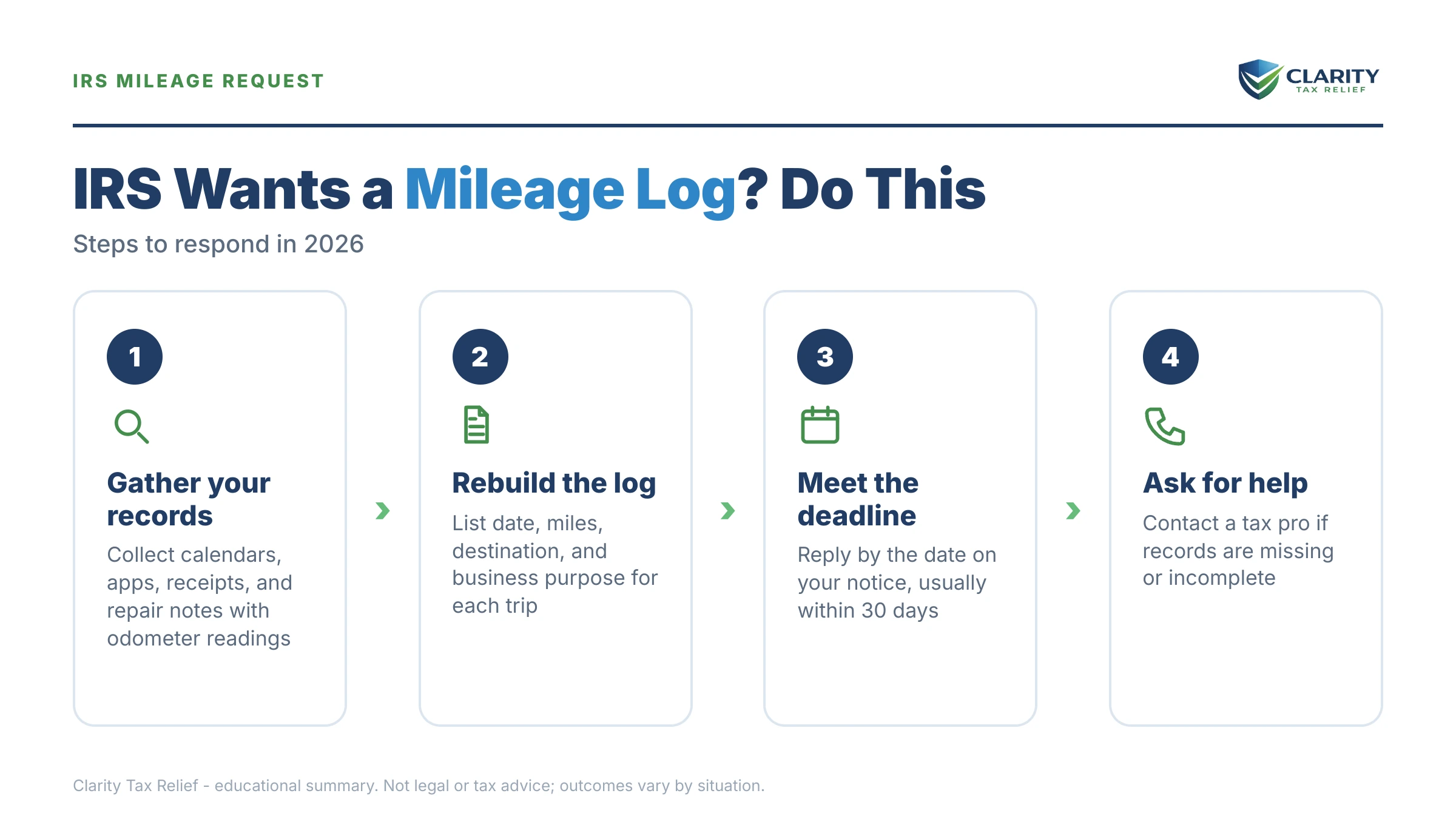
What happens if you ignore the mileage-log request
An unanswered mileage-log request ends one way: the examiner disallows every vehicle mile you claimed and proposes the extra tax, penalty, and interest by default. The sequence after that is procedural, and each stage closes a door:
- Letter 566 or Form 4564 IDR — the document request. You are here. Respond by the printed date and the exam can end at this stage.
- Examination report (Letter 525 or Letter 915) — the examiner's proposed changes, with the vehicle deduction at zero. You have 30 days to protest to IRS Appeals; many IRS correspondence audit cases are resolved here with a good packet.
- CP3219A Notice of Deficiency — the statutory "90-day letter." Your last pre-assessment right: petition the U.S. Tax Court within 90 days or the proposed tax becomes final.
- Assessment and billing — the balance posts to your account, a bill arrives, and the automated collection-notice sequence begins, ending in lien and levy authority if unpaid.
In 2026 the exam side of the IRS is slower — staffing fell roughly 27% in 2025 — but the deadlines on these letters are set by statute and the follow-up notices are generated automatically. A short-staffed IRS makes it harder to fix a default after it happens, not less likely to happen.
| Stage / document | Your window | What you lose if it passes |
|---|---|---|
| Letter 566 / Form 4564 document request | Response date printed on the letter (often 30 days) | The chance to end the audit with records alone |
| Exam report (Letter 525 / Letter 915) | 30 days to protest to IRS Appeals | Free administrative appeal before assessment |
| CP3219A Notice of Deficiency | 90 days to petition the U.S. Tax Court | The right to contest before the tax is assessed |
| Assessment + balance-due bill | Ongoing — interest accrues monthly | Leverage; you now owe first, argue later (via reconsideration) |
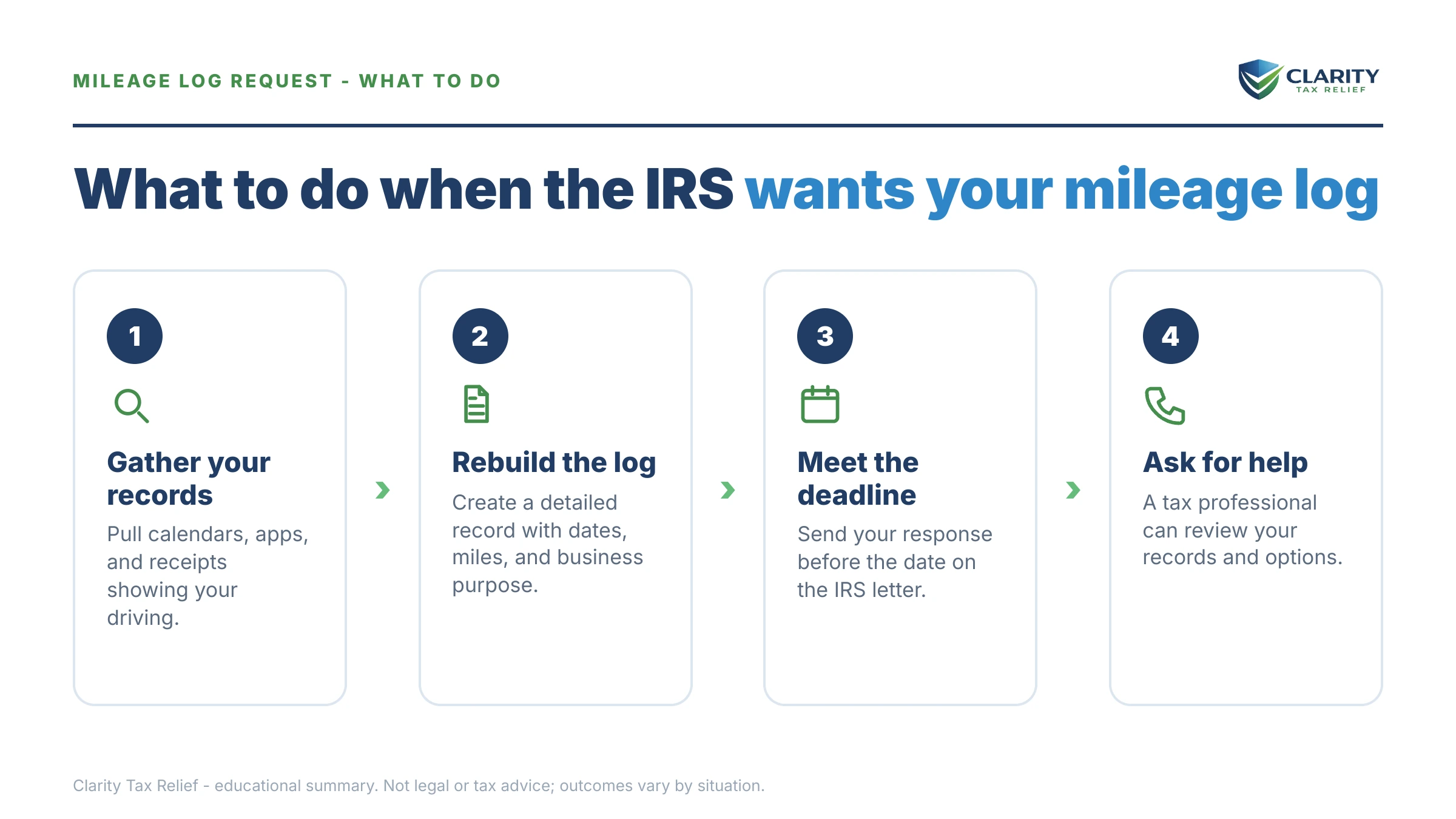
Staring at a document request with no mileage log to send?
Send us a photo of your audit letter before the response date passes. An experienced tax professional will tell you what the examiner will accept, what your reconstruction needs to include, and whether the proposed numbers are even right — free and confidential.
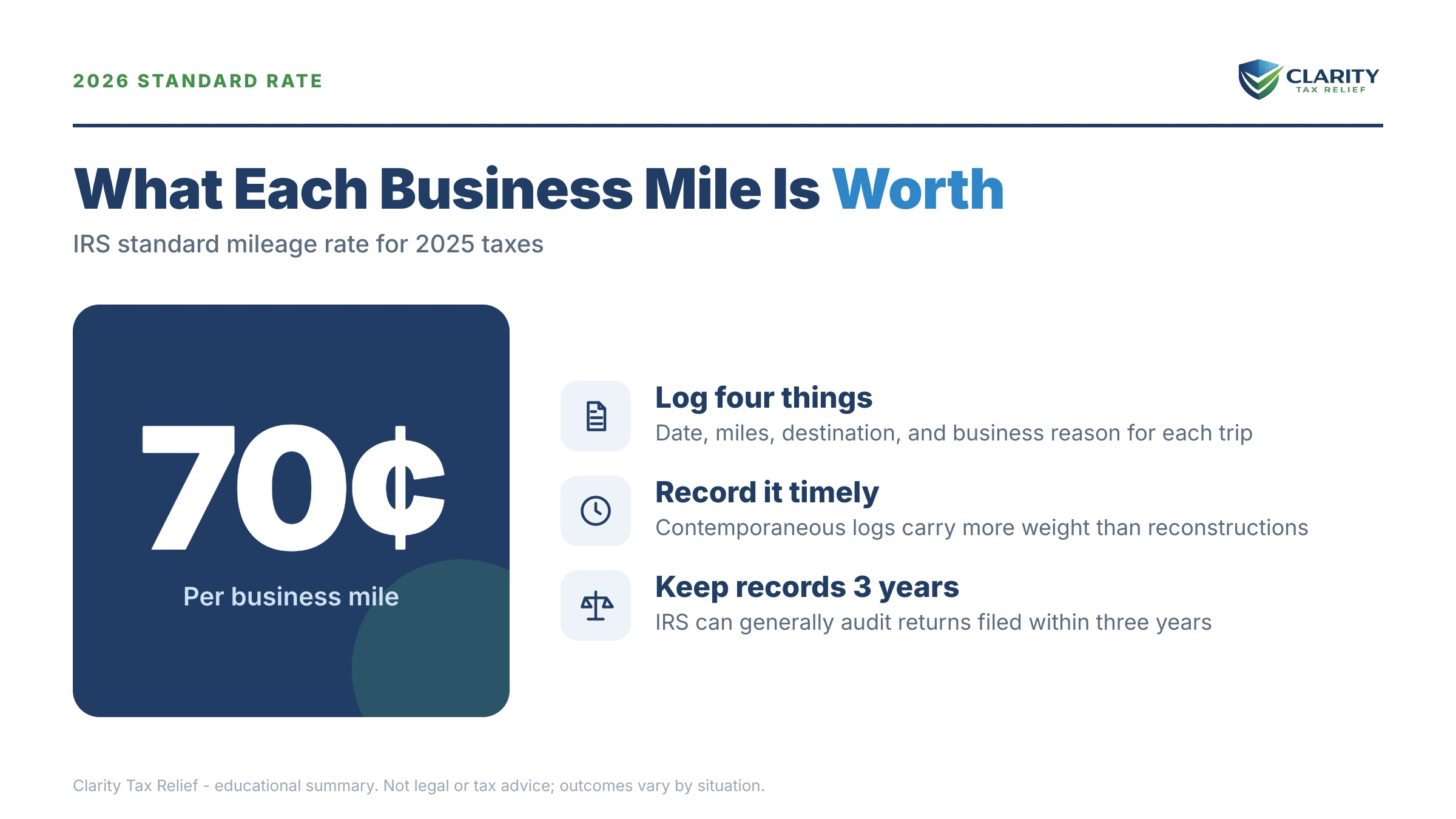
No mileage log? What the IRS actually accepts
IRS regulations accept a reconstructed mileage record when it's supported by corroborating evidence — documents created at the time, ideally by someone other than you. The famous Cohan rule, which lets courts estimate ordinary expenses from thin records, is specifically barred for vehicle expenses by §274(d). So a bare estimate loses, but a rebuilt log tied to independent evidence can win. Three tiers of proof, strongest to weakest:
- A contemporaneous record — a paper log, mileage app, or diary kept at or near the time of each trip. Gold standard; if you have even a partial one, lead with it.
- An adequate sample — the regulations allow records for a representative portion of the year (for example, a fully documented week each month) extrapolated to the whole year, if your driving pattern was consistent and you can show it.
- An honest reconstruction — a trip-by-trip rebuild from calendars, GPS data, and work records, clearly labeled as a reconstruction, with the annual total anchored by odometer evidence.
Here's where reconstructions come from in practice:
| Evidence source | What it proves | How to use it |
|---|---|---|
| Repair, oil-change, and inspection invoices | Odometer readings → your true total annual miles | Anchor the ceiling; your business miles must fit inside this number |
| Google Maps Timeline / phone GPS history | Where the vehicle actually went, trip by trip | Export the audited year; match each trip to a client or job |
| Work calendar, CRM, MLS showing records, dispatch logs | The business purpose of each trip | Pair with GPS or map-measured distances to build daily entries |
| Gig-platform annual summaries (rideshare, delivery) | Platform-recorded on-trip miles | Strong third-party proof — but usually understates total business miles |
| Toll, parking, and fuel receipts | Independent placement of the car on specific dates | Spot-corroborate the log; fuel volume also sanity-checks totals |
| Home-office documentation | That trips from home to work sites are business, not commuting | Include if you claimed (or could have claimed) a qualifying home office |
Two hard rules while you rebuild. First, never backdate — a reconstruction presented as a contemporaneous log converts a records problem into a fraud problem, which is a different universe of risk (our guide to can you go to jail for owing irs draws that civil-versus-criminal line). Second, make the math internally consistent: if your odometer evidence shows 28,000 total miles, a log claiming 26,500 business miles for a couple with one car and two commutes will sink the whole packet. Gig drivers rebuilding delivery miles have extra platform-specific options — see didn't track miles doordash taxes.
What a disallowed mileage deduction really costs: a $48,300 example
Say you're a married couple filing jointly, one spouse self-employed, and the exam covers three years in which you claimed $48,300 in standard-mileage deductions — roughly 23,000 business miles a year at the standard rates in effect (around 70¢ per mile). This is a hypothetical, but the arithmetic is how it actually plays out:
- Full disallowance, no response: that $48,300 flows back into Schedule C profit, so it's hit by both income tax and self-employment tax — roughly 36 cents on the dollar for a couple in the 22% bracket. That's about $17,400 in added tax. Add the accuracy related penalty irs examiners routinely assert — 20% of the understatement, about $3,480 — and you're near $20,900 before interest, with interest compounding from each year's original due date.
- Substantiate 70% of the miles: a reconstruction that proves $33,810 of the deduction leaves only $14,490 disallowed. Added tax drops to roughly $5,200, and a good-faith reconstruction gives you a real argument against the 20% penalty entirely.
Same audit, same couple — a difference of roughly $15,000, decided almost entirely by the quality of the response packet. To rough out penalty and interest on your own proposed numbers, our IRS Penalty & Interest Calculator can estimate what's stacking on top of the tax.
One joint-filing note: both spouses are fully liable for whatever the audit assesses, even if only one of you drove or ran the business. Review the response together and both of you should sign whatever goes back.
How to respond to an IRS mileage log request, step by step
- Find the response deadline — circle the reply-by date printed on your letter or document request and set your own target one week earlier — reconstruction always takes longer than you expect.
- Anchor your total miles — pull odometer readings from repair invoices, oil-change stickers, inspection reports, and purchase or sale paperwork so your yearly total-miles figure comes from third-party documents.
- Rebuild the trips — export your work calendar, Google Maps Timeline or GPS app history, and dispatch or client records, then rebuild a day-by-day mileage record clearly labeled as a reconstruction.
- Assemble the corroboration packet — match trips to appointments, invoices, tolls, parking, and fuel receipts that independently place your vehicle where the log says it was.
- Respond in writing before the deadline — send copies (never originals) with a one-page cover letter summarizing your method, by certified mail or the exam's document-upload link, and keep proof of delivery.
- Escalate if the examiner still disallows — file a protest with IRS Appeals within the 30-day window on the examination report, or request irs audit reconsideration if the assessment already went final.
If the exam ends with a balance you can't pay at once, that becomes a separate, very solvable problem — start with the best way to pay the irs and our full guide on how to settle tax debt yourself.
When you can handle this yourself — and when help changes the outcome
You can likely respond on your own if the audit covers one year, you have GPS or calendar data that rebuilds cleanly, the deduction is modest, and your odometer math holds together. Examiners resolve well-organized substantiation packets by mail all the time — this doesn't have to become adversarial.
Experienced help tends to change the outcome when the disallowance would exceed roughly $10,000 in tax, the exam covers multiple years or multiple Schedule C issues, the examiner has already issued a report proposing the 20% penalty, your records contain something you're nervous about, or the vehicle claim sits inside a broader exam with irs audit no receipts problems on other lines. A representative also handles Appeals framing — which arguments to concede and which to fight — where most of the dollar swings happen.
Terms on your audit letter, decoded
- Section 274(d): the statute requiring strict, trip-level substantiation for vehicle expenses — the reason estimates aren't allowed.
- Listed property: asset categories (including vehicles) Congress flagged for personal-use abuse, triggering the stricter proof rules.
- Contemporaneous record: a log made at or near the time of each trip — the highest-weight evidence an examiner can see.
- IDR (Form 4564): the Information Document Request — the examiner's itemized list of what to send and by when.
- Cohan rule: a court doctrine allowing estimated deductions from imperfect records — expressly unavailable for mileage.
- Accuracy-related penalty: a 20% penalty on the understatement, commonly proposed when deductions are disallowed for lack of substantiation.
Mileage log audit questions, answered
What if I never kept a mileage log at all?
You can still defend the deduction — IRS regulations allow reconstructed records when they're backed by corroborating evidence like calendars, GPS history, and odometer readings. Reconstruction takes real work: you rebuild trips day by day and anchor the totals to documents a third party created. What you cannot do is submit estimates alone; under Section 274(d), an unsupported round number gets disallowed in full.
Will the IRS accept a reconstructed mileage log?
Yes, examiners regularly accept reconstructed logs when they are honestly labeled as reconstructions and every entry ties to independent evidence — an appointment, a dispatch record, a toll charge. A contemporaneous log carries more weight, so expect the examiner to scrutinize a rebuilt one harder. Never backdate a log to make it look contemporaneous; that turns a records problem into a fraud problem.
Can I use Google Maps Timeline or a GPS app to prove business miles?
Yes — location history is some of the strongest corroboration available because a third party recorded it automatically. Export the timeline for the audited year, match each trip to a client, job site, or delivery, and total the miles. GPS data proves where you went; you still need to document why each trip was business, so pair it with calendar entries or work records.
Why can't the IRS just estimate my mileage like other expenses?
Because Congress specifically barred it. The Cohan rule lets courts estimate many business expenses from imperfect records, but Section 274(d) makes vehicle expenses an exception: no adequate records or corroborating evidence, no deduction. That's why a mileage-log request is more dangerous than a typical receipts request — the examiner can lawfully allow zero.
Can I switch to actual car expenses if I can't prove my miles?
It rarely helps. Actual-expense deductions (gas, insurance, repairs, depreciation) are multiplied by your business-use percentage — which is itself calculated from business miles versus total miles. So you still need mileage substantiation, plus receipts for every cost. If you can prove the miles, the standard mileage rate is usually the cleaner path in an audit.
Can I get in criminal trouble over a bad mileage log?
Sloppy or missing records are a civil matter — the worst-case outcome is a disallowed deduction, added tax, a 20% accuracy-related penalty, and interest. Fabricating a log after the fact and passing it off as contemporaneous is different: that can support civil fraud penalties and, in extreme cases, criminal referral. Reconstruct honestly and label it as reconstructed, and you stay firmly on the civil side.
Is my spouse on the hook if our joint return's mileage deduction is disallowed?
Yes. On a married-filing-jointly return, both spouses are fully liable for any tax, penalty, and interest from the audit, even if only one of you ran the business or drove the miles. Innocent-spouse relief exists but is aimed at understatements one spouse knew nothing about — it's rarely a fit while an exam is still open. The practical move is to respond to the audit together and limit the assessment before it's final.
Going forward, keep the log the easy way: a mileage app or a Sunday-night calendar habit. The rate and rules for the current year are in our guide to the 2026 mileage rate self employed drivers should be using. The IRS's own rules for vehicle substantiation are in Publication 463, Travel, Gift, and Car Expenses and Tax Topic 510, Business Use of Car.
Your next 24 hours
- Find two things on your letter: the response date and the exact wording of the vehicle-records request — it tells you whether the examiner wants the log alone or the odometer and purpose evidence too.
- Gather your anchors: the audited returns, any repair or inspection invoices with odometer readings, and exports of your work calendar and phone location history for the years under exam.
- Get the letter reviewed free before the response date: use the 2-minute form or call (888) 825-7779 — an experienced tax professional will map exactly what your reconstruction needs to hold up.
This guide is general information, not tax or legal advice for your specific situation. Eligibility for IRS programs depends on individual facts and circumstances; no outcome is guaranteed.