
Gig Economy Taxes
Didn't Track Miles for DoorDash Taxes? How to Rebuild Your Mileage Deduction (2026)
The short answer: if you didn't track miles for DoorDash, taxes can still include the mileage deduction. The IRS accepts a reconstructed mileage log built from real evidence — DoorDash's year-end mileage estimate, app delivery history, Google location data, and odometer records. Rebuild your miles before you file or amend, because every 1,000 documented miles cuts hundreds off your bill.
You typed the number from your 1099-NEC into tax software and watched the bill climb past anything you can actually pay — because the software thinks you kept every dollar DoorDash sent you. You didn't. You bought the gas, the oil changes, the brake pads. The problem isn't that you truly owe that much; it's that your single biggest deduction is sitting untracked in your odometer, and nobody told you that you'd need it.
This guide walks through exactly how to rebuild those miles the way the IRS accepts, how much the fix is worth in real dollars, and what to do about any balance left over after the deduction is claimed.
⏱ The real clock: you generally have 3 years from the date you filed a return to amend it and claim a mileage deduction you missed. After that window closes, the overpayment is gone for good — and in the meantime, any unpaid balance keeps growing with monthly penalties and daily-compounding interest.
Why you owe so much when you didn't track miles for DoorDash taxes
Without a mileage record, you're taxed as if delivering food cost you nothing — on 100% of your gross DoorDash pay. DoorDash reports your gross earnings to the IRS on Form 1099-NEC (delivered through Stripe Express), and that gross number becomes your starting point on Schedule C. Every legitimate expense you can't document stays on your side of the table as taxable "profit."
The damage is doubled because gig income carries two taxes. On top of ordinary income tax, net self-employment profit is hit with 15.3% self-employment tax — Social Security and Medicare with no employer paying half. That's the shock explained in depth in our guide to the self employment tax owe irs problem. For a delivery driver, the mileage deduction is usually the only thing standing between a manageable bill and a crushing one — a Dasher's car costs often eat a quarter to a third of gross pay.
Here's the good news most tax software never mentions: a mileage log does not have to be written in real time to count. It has to be supported.
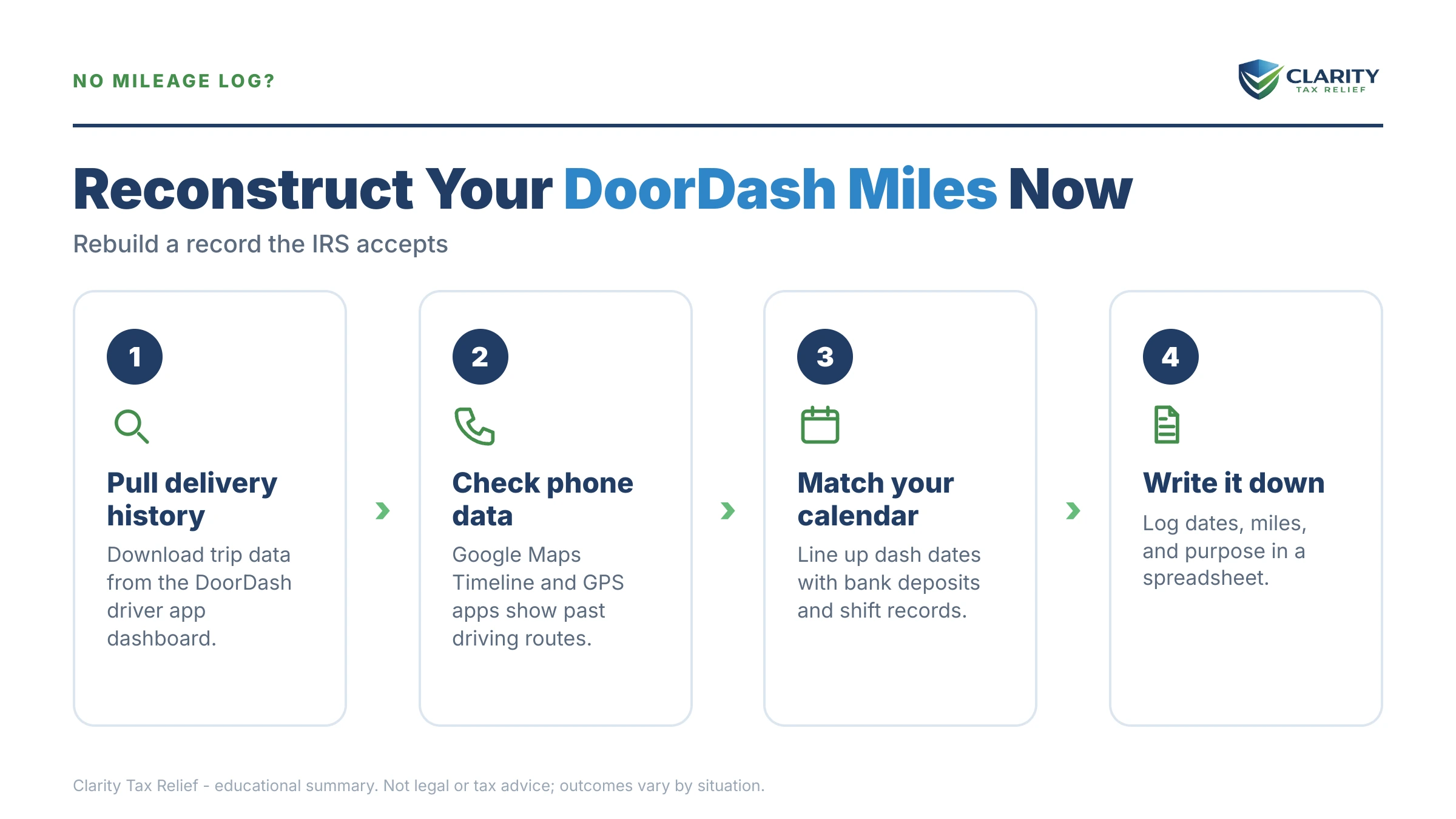
Yes, you can reconstruct DoorDash miles — here's what the IRS accepts
The IRS accepts a reconstructed mileage log when it's built from corroborating evidence, not pulled from thin air. Vehicle expenses fall under the strict substantiation rules of IRC §274(d), which means the usual "reasonable estimate" escape hatch (the Cohan rule) doesn't apply to miles. But the Treasury regulations explicitly allow you to substantiate with a record created later, as long as it's backed by evidence with a high degree of reliability. Translation: a worksheet that ties your miles to documents beats a guess every time.
The raw material already exists — you just have to gather it. Most Dashers can pull from five or six independent sources and cross-check them against each other:
| Source | What it proves | Where to find it |
|---|---|---|
| DoorDash year-end mileage estimate | A floor for active-delivery miles (undercounts driving between offers) | Email from DoorDash / Dasher account, typically sent around tax season |
| Dasher app & Stripe delivery history | Dates worked, number of deliveries, pickup and drop-off locations | Dasher app earnings history; Stripe Express account |
| Google Maps Timeline / phone location history | Where your car actually went on dash days — day by day | Google account Timeline (now stored on-device — export it before it's purged) |
| Odometer readings on paper | Total miles the car traveled between two dates | Oil-change stickers and invoices, state inspection reports, repair receipts |
| Gas and maintenance purchases | Fuel volume consistent with your claimed miles | Bank and card statements, fuel-app history |
| Vehicle purchase/sale paperwork | Odometer anchor points at the start or end of the year | Bill of sale, title transfer, trade-in appraisal |
The method that holds up: pick two odometer anchor points (say, a January oil change and a December inspection) to establish total miles for the year. Subtract documented personal use. Then sanity-check the business share against DoorDash's own estimate, your delivery counts, and location history. Write down each step. That worksheet — not a leather-bound logbook — is what an examiner wants to see, and it's exactly what the IRS asks about when it sends a records request; see what that looks like in irs wants mileage log.
Two honest boundaries. First, only working miles count: driving to the restaurant, to the customer, and between deliveries is business; the trip from home to your starting zone is usually commuting unless your home qualifies as your principal place of business. Second, resist the urge to round up. A reconstruction that's slightly conservative and fully documented survives an audit; an aggressive one invites the 20% accuracy-related penalty on top of the tax.
If mileage isn't the only record you're missing — no expense receipts, no bank statements, maybe no filed return at all — the broader playbook is in file back taxes without records.
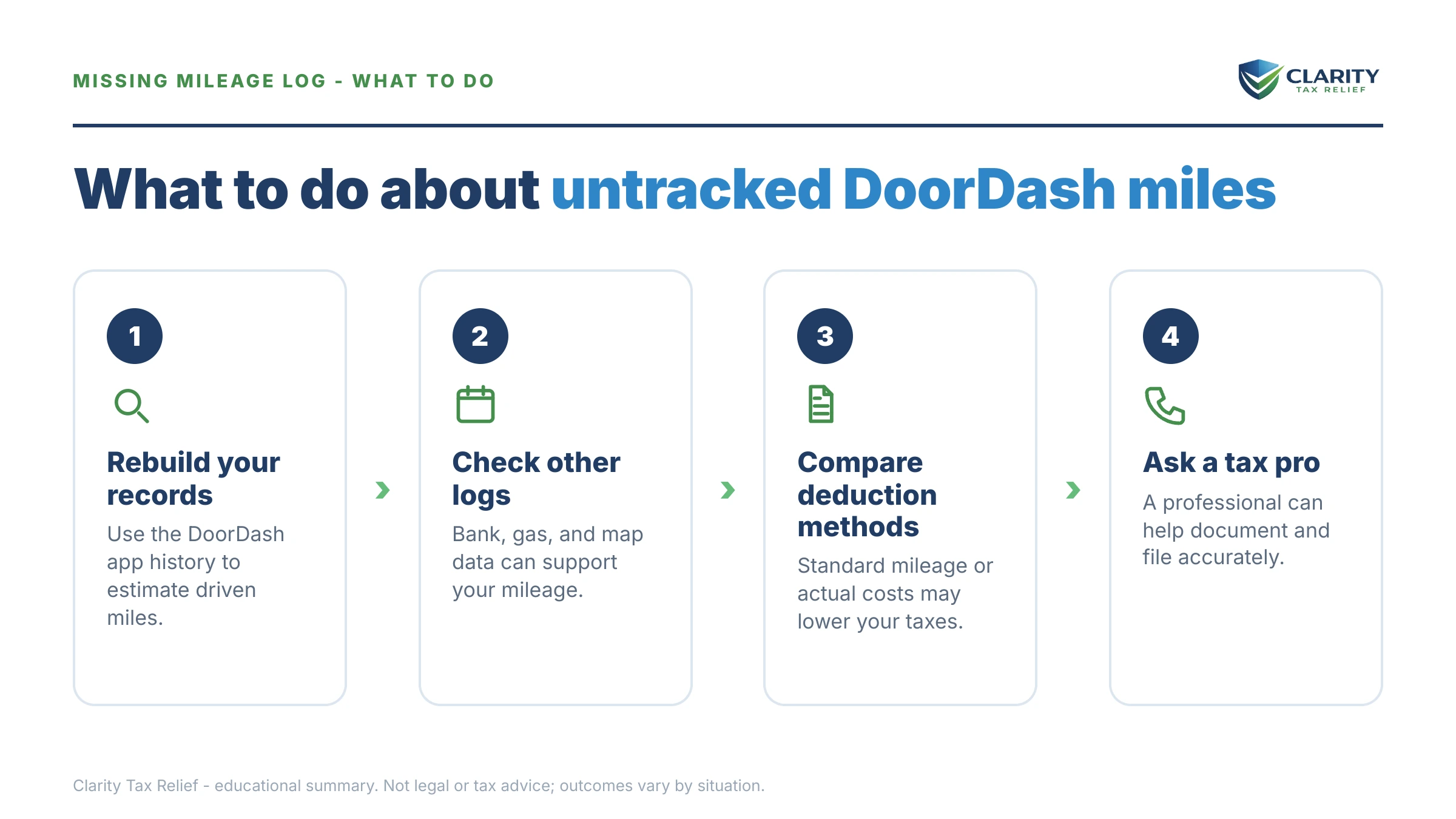
What the fix is worth: a worked example
A reconstructed mileage log routinely cuts a Dasher's tax bill by thousands of dollars. Say you earned $36,900 dashing last year — a full-time-ish year — and filed (or were about to file) with zero miles claimed. This is a hypothetical, but the math is the real math:
- With no mileage: net profit = $36,900. Self-employment tax = $36,900 × 92.35% × 15.3% ≈ $5,214, before a dollar of income tax.
- With a reconstructed 18,000 business miles at the 2025 standard rate of 70¢/mile: deduction = 18,000 × $0.70 = $12,600. Net profit drops to $24,300. Self-employment tax = $24,300 × 92.35% × 15.3% ≈ $3,434.
- The difference: about $1,780 less self-employment tax, plus roughly $1,512 less income tax in the 12% bracket ($12,600 × 12%) — call it $3,300 saved from an afternoon of paperwork. Most Dashers also qualify for the qualified business income deduction on top, which trims the income-tax side further.
The per-mile rate changes each year, so use the current figure for the year you're filing — our guide to the 2026 mileage rate self employed question keeps the number current.
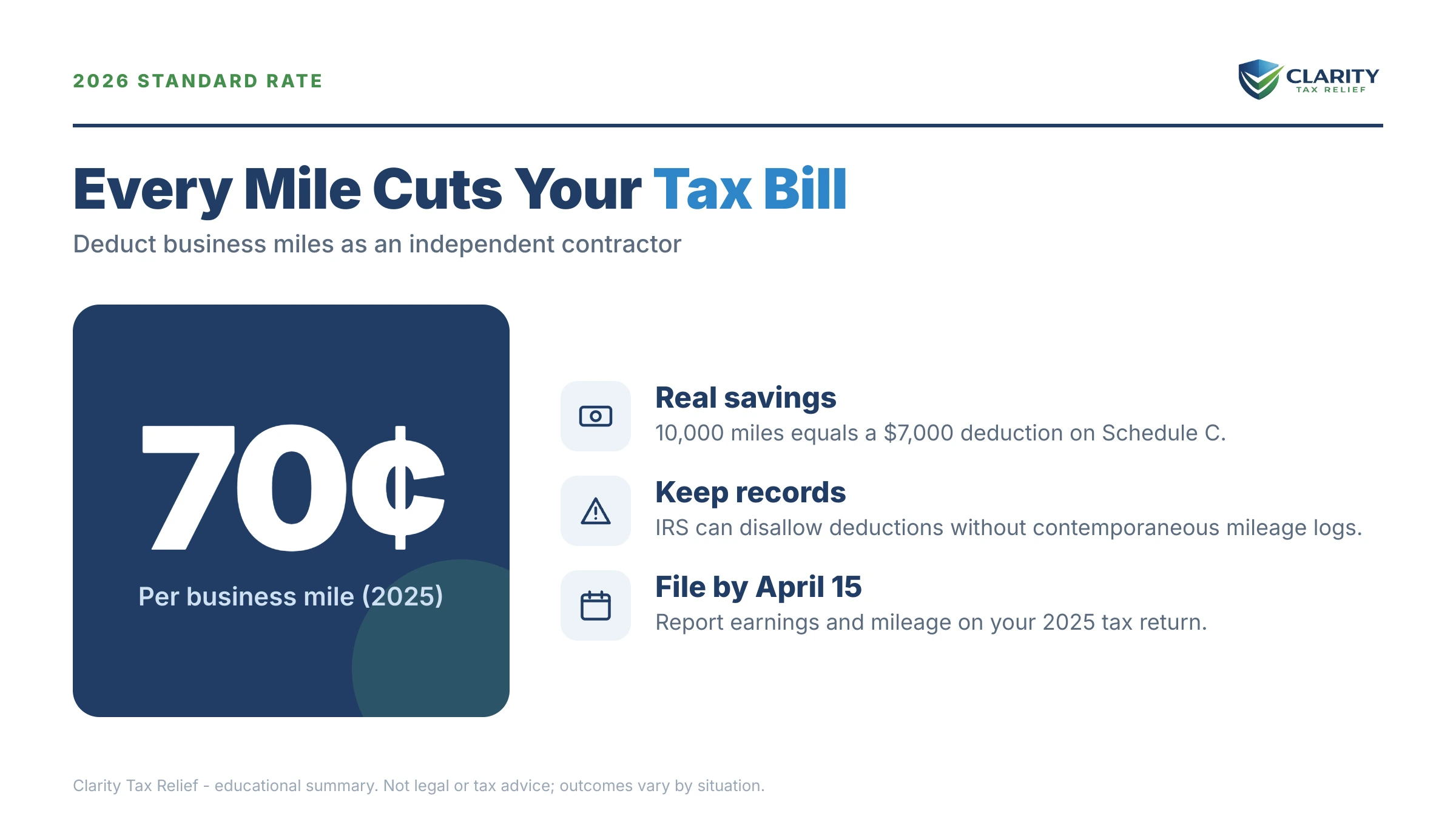
Standard mileage rate vs. actual expenses when your records are thin
For a driver with no records, the standard mileage rate is almost always the right rescue, because it demands only one number: business miles. Actual expenses can win for an expensive or gas-hungry car — but it requires receipts for fuel, insurance, repairs, and depreciation, plus a business-use percentage that still depends on knowing your miles.
| Question | Standard mileage rate | Actual expenses |
|---|---|---|
| What you deduct | A flat per-mile rate covering gas, depreciation, insurance, repairs | The business share of every real car cost, itemized |
| Records needed | A supportable business-mile total | Receipts for everything and a business-use percentage |
| Best for | High-mileage drivers, older/efficient cars, thin records | Newer, costly, or fuel-thirsty vehicles with complete receipts |
| Timing catch | For a car you own, generally must be chosen the first year it's used for work | Can be used any year, but locks in depreciation rules |
What happens if you ignore the bill instead of fixing it
A DoorDash tax debt doesn't sit still — it compounds first, then escalates through an automated notice sequence. The order of events depends on whether you've filed:
- If you haven't filed: the failure-to-file penalty runs at 5% per month — ten times the 0.5% failure-to-pay penalty, though in months where both penalties apply, the failure-to-file portion drops to 4.5% (5% combined) — so filing now, even with nothing to send, is the single cheapest move. Wait long enough and the IRS can file a substitute return for you using your gross 1099-NEC and zero miles deducted, billing you on the worst possible version of your year.
- If you filed but didn't pay: the first bill is a CP14 notice, which typically gives about 21 days before the sequence moves on.
- Reminders follow — CP501, then CP503 — each arriving with a bigger balance as interest compounds daily and the 0.5% monthly penalty stacks.
- CP504 — intent to levy your state tax refund, and the point where a federal tax lien becomes realistic.
- LT11 / Letter 1058 — the final notice. After its 30-day window, the IRS can levy your bank account and even issue levies against gig-platform payouts. You gain formal appeal rights here, but far fewer good options than you have today.
In 2026, don't count on slipping through: the IRS workforce shrank roughly 27% in 2025, but this sequence is generated by computers that never took a buyout. To see what the penalties and interest are doing to your specific balance while you decide, run the numbers through our Penalty & Interest Calculator — it estimates what waiting actually costs per month.
Facing a DoorDash tax bill with no mileage log?
Your 1099-NEC is already in the IRS's system, and penalties and interest compound every month the year stays unresolved. An experienced tax professional will review your situation free — how many miles you can realistically support, what the corrected bill looks like, and the best path for whatever remains.
Your options for whatever balance remains after the mileage fix
Even after reconstructing miles, many Dashers still owe more than they can pay at once — and the IRS has a program for nearly every situation. Which one fits comes down to how much is left and what your finances honestly look like:
| Option | Typically fits when | Key numbers |
|---|---|---|
| Pay in full | Corrected balance is small enough to clear now | Stops penalties and the notice sequence immediately |
| Short-term payment plan | You can pay everything within 180 days | $0 setup fee; interest and penalties continue until paid |
| Guaranteed installment agreement | You owe $10,000 or less and are current on filings | Approval by statute if conditions are met; up to 3 years |
| Streamlined installment agreement | You owe $50,000 or less | Up to 72 months, set up online without full financial disclosure |
| Currently Not Collectible | Paying anything would leave you unable to cover basic living costs | Collection pauses; debt and interest remain; IRS re-reviews periodically |
| Offer in Compromise | Assets plus future income genuinely can't cover the debt | $205 fee; 20% down on lump-sum offers (both waived with low-income certification); roughly 1 in 5 offers accepted in FY2024 |
| Penalty relief | Clean compliance the prior 3 years, or circumstances beyond your control | Can remove failure-to-file and failure-to-pay penalties entirely |
On the penalty line: if this is your first slip, first time penalty abatement can wipe the penalties for one year — and starting in summer 2026, the IRS's new Automatic Exemption from Penalty (AEP) begins applying similar relief automatically, no request needed. The full self-serve walkthrough of these programs lives in our guide on how to settle tax debt yourself; the version aimed at your exact balance situation is doordash driver owes taxes.
One more Dasher-specific note: if part of your bill is the underpayment penalty for skipping quarterlies, that's a separate, fixable problem — the math and the waiver paths are covered in didn't pay estimated taxes penalty, and the same trap catches shoppers on other platforms too (see instacart didn't pay quarterly taxes).
How to respond, step by step
- Pull your gross income records. Download your 1099-NEC from Stripe Express and your full earnings history from the Dasher app so you know exactly what the IRS was told you made.
- Rebuild your business miles from evidence. Gather DoorDash's year-end mileage estimate, location history, odometer readings from repair and inspection records, and your dash dates — then build a written log and keep the worksheet showing your method.
- File or amend Schedule C with the reconstructed deduction. Report your gross earnings, claim the standard mileage rate on the miles you can support, and attach Schedule SE; use Form 1040-X if the year was already filed without the deduction.
- Resolve any balance that remains. Pay in full if you can; otherwise set up a short-term plan or installment agreement before notices escalate, and request penalty relief if your history qualifies.
- Start tracking today. Turn on a mileage-tracking app or log your odometer weekly so next year's return never depends on reconstruction again.
When you can handle this yourself — and when help changes the outcome
Plenty of Dashers can fix this without paying anyone. If you have one problem year, your odometer evidence is recoverable, and the corrected balance is something you can pay within 180 days, do it yourself: rebuild the log, file or amend, and set up the payment plan online in an evening.
Experienced help earns its cost in specific situations: multiple unfiled years stacking penalties; the IRS has already filed a substitute return on your gross income; an audit letter is asking for the mileage log you never kept; a levy or garnishment is already in motion; or you're weighing an Offer in Compromise, where the eligibility math (not the marketing) decides everything. In those cases, the order you fix things in — returns first, then penalties, then the balance — changes what you ultimately pay, and getting the sequence wrong is expensive.
Terms on your tax forms, decoded
- Form 1099-NEC — the form DoorDash uses to tell both you and the IRS your gross contractor pay for the year.
- Schedule C — the form where your gig income and expenses (including mileage) meet to produce your actual taxable profit.
- Self-employment tax — the 15.3% Social Security and Medicare tax on net profit, calculated on Schedule SE, owed on top of income tax.
- Standard mileage rate — the IRS's flat per-mile deduction that substitutes for tracking every individual car expense.
- Strict substantiation (§274(d)) — the rule requiring vehicle deductions to be backed by records or corroborating evidence, not estimates.
- Cohan rule — a court doctrine letting taxpayers estimate some undocumented expenses; it does not apply to vehicle mileage, which is why reconstruction from evidence matters.
DoorDash mileage questions, answered
Can I claim mileage on my DoorDash taxes without a log?
Yes — the IRS accepts a reconstructed mileage log built from corroborating evidence, not only a log kept in real time. What you cannot do is write down a round guess with nothing behind it, because vehicle deductions fall under strict substantiation rules. Rebuild your miles from DoorDash's records, your app history, location data, and odometer evidence, and keep the worksheet showing how you got each number.
Does DoorDash track my miles for me?
Partially. DoorDash has provided Dashers a year-end estimate of miles driven on active deliveries, but it typically understates your real business miles because it ignores driving between offers and repositioning to busier zones. Treat the DoorDash figure as a floor, not your total, and cross-check it against odometer records or location history before you file.
Can I use Google Maps Timeline to prove my DoorDash miles?
Yes — location history is one of the strongest reconstruction tools because it is a contemporaneous record of where your car actually went, created before you had any reason to inflate it. Pull the days you dashed and pair them with your delivery history. Note that Timeline data has moved to on-device storage in recent years, so export or screenshot it before it is deleted or you change phones.
What happens if the IRS audits my reconstructed mileage log?
The examiner will ask how you arrived at your numbers. A reconstruction that ties to real evidence — DoorDash delivery records, odometer readings, location history — is regularly accepted; a bare estimate with no support is regularly denied, and a denied deduction can add a 20% accuracy-related penalty on top of the tax. Keep your reconstruction worksheet with your tax records so you can show your method years later.
Can I amend a past return to add mileage I never claimed?
Yes, using Form 1040-X — generally within three years of when you filed the return, or two years of when you paid the tax, whichever is later. Adding a mileage deduction lowers both income tax and self-employment tax, so the correction is often worth thousands. If you still owe a balance for that year, the amendment shrinks the debt instead of producing a refund check.
Which miles count as business miles for DoorDash?
Miles driven while working — to the restaurant, to the customer, and between deliveries while waiting for the next offer — are business miles. The drive from home to your starting zone is usually nondeductible commuting, unless your home qualifies as your principal place of business. Personal errands run mid-shift never count, which is one reason the IRS wants a mile-level record rather than a yearly guess.
Should I use the standard mileage rate or actual car expenses?
For most Dashers the standard mileage rate wins: one flat rate per mile bundles gas, depreciation, insurance, and repairs, and it only requires a mileage record. Actual expenses can come out ahead for expensive or gas-hungry vehicles, but you need receipts for everything plus a business-use percentage — which still requires knowing your miles. One catch: for a car you own, you generally must choose the standard rate in the first year you use that car for work to keep the option later.
Do I owe taxes on DoorDash income if I never got a 1099?
Yes. Self-employment income is taxable whether or not a form arrives in your mailbox, and DoorDash may still have reported your earnings to the IRS even if your copy went astray. Check your Stripe Express account and your IRS wage and income transcript to see what was reported. Filing accurately — with your mileage deducted — is far cheaper than waiting for the IRS to bill you on the gross amount.
Your next 24 hours
- Find your odometer anchors. Dig out two dated odometer readings that bracket your dashing year — an oil-change invoice, an inspection report, a repair receipt. Those two numbers are the skeleton of your reconstruction.
- Gather the income side. Download your 1099-NEC from Stripe Express, your Dasher earnings history, and DoorDash's mileage-estimate email if you received one — plus last year's return if it was already filed without miles.
- Get the free case review. Send what you've gathered through the 2-minute form at claritytaxrelief.com/#consult or call (888) 825-7779. An experienced tax professional will estimate what your corrected bill should be and map the path for the rest — before another month of penalties and interest posts to the balance.
For the official rules, see the IRS's standard mileage rates page, the instructions hub for Schedule C (Form 1040), and payment options at IRS.gov/payments.
This guide is general information, not tax or legal advice for your specific situation. Eligibility for IRS programs depends on individual facts and circumstances; no outcome is guaranteed.